
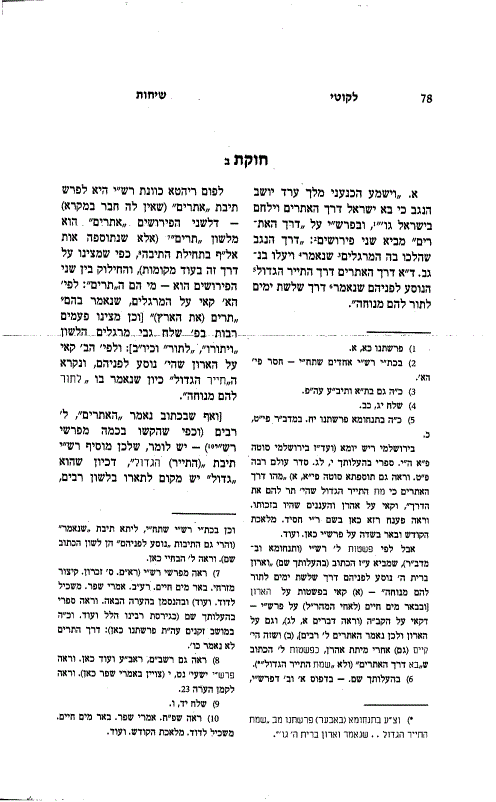
The Canaanite king of Arad, who dwelled in the Negev, heard that Israel was coming by way of the Atarim, and he fought against Israel. Rashi, in his commentary on "by way of the Atarim," offers two explanations: "The way of the Negev, which the spies traveled, as it is said, 'and they went up into the Negev.' Alternatively, 'by way of the Atarim' refers to the path of the great scout who traveled before them, as it is said, 'a three-day journey to seek out a resting place for them.'
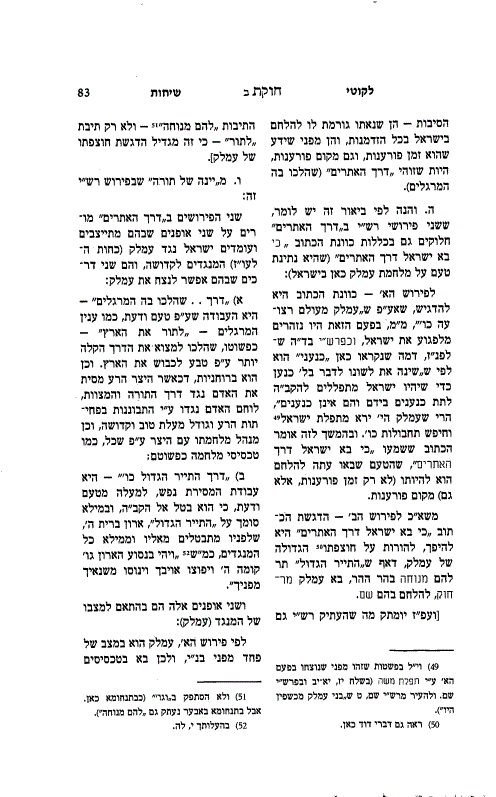
At first glance, Rashi's intention is to explain the word "Atarim" (which has no parallel in Scripture) — in both interpretations, "Atarim" is derived from the word "tayarim" (scouts), with an aleph added at the beginning of the word, as we find similarly in other places. The difference between the two interpretations is who the "tayarim" are: according to the first interpretation, it refers to the spies, as it is said about them "tayarim (the land)" [and similarly, we find many times in Parshas Shelach regarding the spies the expressions "vayaturu," "latur," and the like]; according to the second interpretation, it refers to the Ark that traveled before them, called the "great scout" because it is said about it "to seek out a resting place for them."
[And even though the verse says "the Atarim," in the plural (as several of Rashi's commentators have questioned) — it can be said that Rashi adds the word "(the scout) great," since it is "great," it can be described in the plural, similar to Rashi's explanation (in Parshas Vayeira) "in many places, the language of divinity and the language of authority is called in the plural."]
However, it is difficult to say that Rashi's main intention is to explain the word "Atarim" — because, simply, it is a place name, which does not require explanation, like the overwhelming majority of names in the Torah that Rashi does not explain. Similarly, in this very verse, Rashi does not explain the name "Arad," especially since the Talmud (in Tractate Rosh Hashanah, which Rashi references here in his commentary on "and the Canaanite heard") explains it.
Furthermore, if we say that Rashi's intention is solely to explain the word "Atarim," there are questions regarding Rashi's wording:
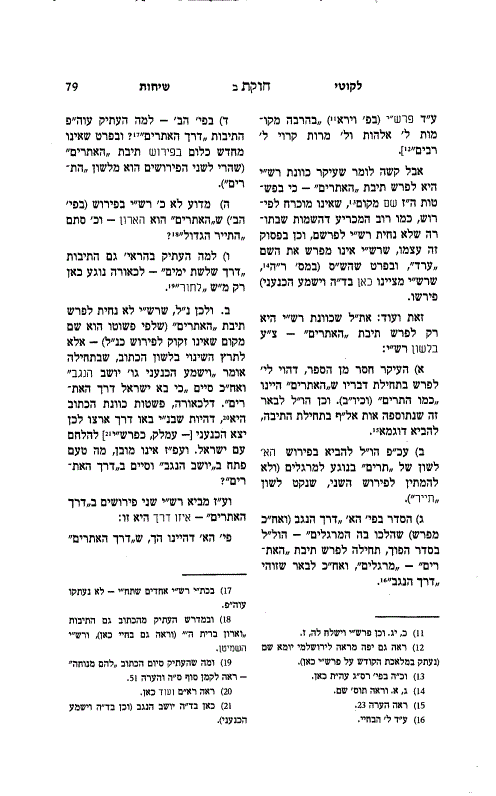
a) The main point is missing from the text; he should have explained at the beginning of his words that "Atarim" means "like tayarim" (and the like). He should also have explained the addition of the aleph at the beginning of the word and provided an example.
b) At the very least, he should have brought in the first interpretation the language of "tayarim" concerning the spies (and not wait for the second interpretation, where he uses the term "scout").
c) The order in the first interpretation, "the way of the Negev (and then explains) that the spies traveled there" — should have been in reverse order, first explaining the word "Atarim" — "spies," and then clarifying that this is "the way of the Negev."
d) In the second interpretation — why does he repeat the words "by way of the Atarim"? Especially since he does not introduce anything new in the interpretation of the word "Atarim" (since in both interpretations it is derived from "tayarim").
e) Why does Rashi not explicitly state (in the second interpretation) that "Atarim" is the Ark — and instead writes simply "the great scout"?
f) Why does he include in the proof the words "a three-day journey" — seemingly, only "to seek out" is relevant here.
Therefore, it seems to me that Rashi's intention is not to explain the word "Atarim" (which, according to its simple meaning, is a place name that does not require explanation, as mentioned above) — but rather to resolve the change in the language of the verse, which initially says "and the Canaanite heard... who dwelled in the Negev" and then concludes "because Israel came by way of the Atarim." Seemingly, the simple meaning of the verse is that since the Children of Israel came through his land, the Canaanite [— Amalek, as Rashi explains] went out to fight with Israel. Based on this, it is not understood why it begins with "who dwelled in the Negev" and concludes with "by way of the Atarim."
Therefore, Rashi brings two interpretations of "by way of the Atarim" — what path this is:
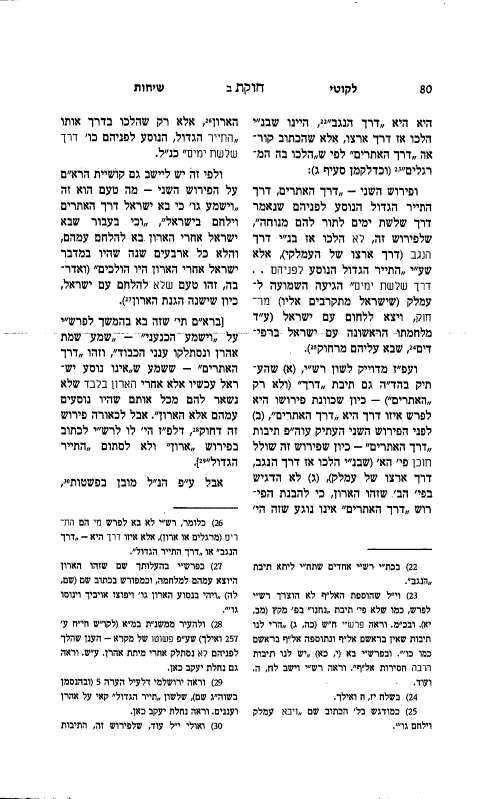
The first interpretation is that it is the same, that "by way of the Atarim" is indeed "the way of the Negev," meaning that the Children of Israel traveled through his land, but the verse calls it "by way of the Atarim" because "the spies traveled there" (as will be explained in section 3).
The second interpretation is: "the way of the Atarim, the way of the great scout that traveled before them, as it is said, 'a three-day journey to seek out rest for them.'" According to this interpretation, the Children of Israel did not travel through the Negev (the land of the Amalekite) at that time. Rather, it was through "the great scout that traveled before them... a three-day journey" that the news reached Amalek (that Israel was approaching him) from afar, and he went out to fight with Israel (similar to his first battle with Israel in Rephidim, where he came upon them from afar).
Based on this, Rashi's wording is precise: (a) He includes the word "way" in the heading, not just "Atarim," because his intention is to explain what path "the way of the Atarim" is. (b) Before the second interpretation, he repeats the words "the way of the Atarim," because this interpretation negates the content of the first interpretation (that the Children of Israel traveled through the Negev, the land of Amalek). (c) He does not emphasize in the second interpretation that this is the Ark, because for understanding the interpretation of "the way of the Atarim," it is not relevant that it was the Ark, but only that they traveled by the way of that "great scout, traveling before them... a three-day journey," as mentioned above.
According to this, we can also resolve the question of the Re'em on the second interpretation: What is the reason for "and he heard... that Israel came by way of the Atarim and fought with Israel"? "Is it because Israel came after the Ark that he came to fight with them? After all, for the entire forty years they were in the desert, Israel traveled after the Ark" (and on the contrary, this is a reason not to fight with Israel, since there is the protection of the Ark).
[The Re'em answers that this comes in continuation to Rashi on "and the Canaanite heard" — "he heard that Aaron died and the clouds of glory departed," and this is "the way of the Atarim" — he heard that "Israel is now traveling only after the Ark, as nothing remains of those who traveled with them except the Ark." But seemingly, this interpretation is forced, for according to this, Rashi should have written explicitly "Ark" and not left it vague as "the great scout."]
But according to the above, it is understood simply,
since the Children of Israel were not then near the land of Amalek, the verse needed to inform how he came to fight with Israel. It explains that he heard from afar about the journey of Israel by "the great scout traveling before them... a three-day journey," as mentioned above.
However, there is still a need to clarify: According to the first interpretation, the question remains: Why does it begin with "the Negev" and conclude with "the Atarim"? Furthermore (as the commentators have asked) — is it because the spies traveled through the Negev that the path is named after them ("the way of the Atarim")? What relevance does the journey of the spies have here?
Some commentators explain that as long as Israel was in the desert, Amalek was not concerned, but now that they traveled the way of the spies, it is the beginning of entering the land, and they are coming to inherit his land, and therefore he went out to war. But it is difficult to interpret this according to Rashi, who wrote "and Amalek has always been a whip of discipline for Israel, ready at any time for punishment," as we find that he went out to fight with Israel in Rephidim when they were far from his land, and all the more so when they came through his land. Moreover, the kings of Edom, the Amorite, and Bashan also went out to fight with Israel even though it was explicitly stated to them that they were not coming to inherit their land.
It can be said that this comes in continuation to Rashi on "and the Canaanite heard" — "he heard that Aaron died and the clouds of glory departed," which seemingly does not fit with what is explicitly stated later in the verse "(and the Canaanite heard...) that Israel came by way of the Atarim."
Simply, it can be said (and so it is written in the commentators) that what is stated "that Israel came by way of the Atarim" is not the news he heard, but as if it said "when Israel came by way of the Atarim," meaning, the verse comes to explain why only the Canaanite was aroused by this news (that Aaron died and the clouds of glory departed) to fight with Israel, "because Israel came by way of the Atarim" (through his land).
But it can be said that in this, the verse...
The description "by way of the Atarim" instead of "by way of the Negev" (the path "that the spies traveled") also hints at the news "that the clouds of glory departed." Until then, the journey of the Children of Israel in the desert was guided by the clouds that went before them "to lead them on the way." Now that the clouds had departed, how would Israel know where to go? The verse states that they went "by way of the Atarim" — they traveled on a paved path, the path paved by the spies. This is what the Canaanite heard, that the Children of Israel no longer had the clouds of glory to guide them (and therefore they were following the path of the spies). Since the clouds of glory, which protected Israel, had departed — "he fought against Israel."
Furthermore, it can be said, based on the Targum Yonatan's explanation here of "by way of the Atarim" — "the path of rebellion against the L‑rd of the world" [the path of the spies, the place where they rebelled against G‑d]. Since the Amalekite heard that this was the place where they rebelled against G‑d, he went out to fight with Israel, thinking it was "a place prepared for punishment."
We can say that this emphasis (that it is the path the spies traveled, a place prepared for punishment) is a continuation of Rashi's commentary on "and the Canaanite heard," where he writes, "and Amalek has always been a whip of discipline for Israel, ready at any time for punishment." At first glance, what is the repetition in Rashi's words? However, they are two separate matters: A) "always a whip of discipline, etc." refers to a general hatred of Israel, which is "from always." B) "ready at any time for punishment" means that he is always ready to exploit any "time for punishment" for Israel to harm them.
We find these two aspects in their first battle, where (A) "he came... to confront Israel before all the nations," indicating his greater hatred for Israel than all other nations, and (B) it was then a time for punishment, as Rashi explains that the war with Amalek came after "the quarrel of the Children of Israel... testing the L‑rd, saying, 'Is the L‑rd among us or not?'"
Similarly, in our case, Amalek came to fight with Israel (upon Aaron's death) for two reasons: A) a general hatred for Israel, but as long as Israel was protected by the clouds, there was no opportunity to fight them, unlike now that the clouds of glory had departed. B) Aaron's death was a time of punishment for Israel, as Rashi explains, "because they gathered here to approach Esau the wicked, their deeds were breached, and they lost this righteous one."
This is the continuation in Rashi's commentary, that Amalek came to fight Israel now for two reasons — both his hatred drove him to fight Israel at every opportunity, and because he knew it was a time of punishment, and also a place of punishment, as this is "by way of the Atarim" (the path the spies traveled).
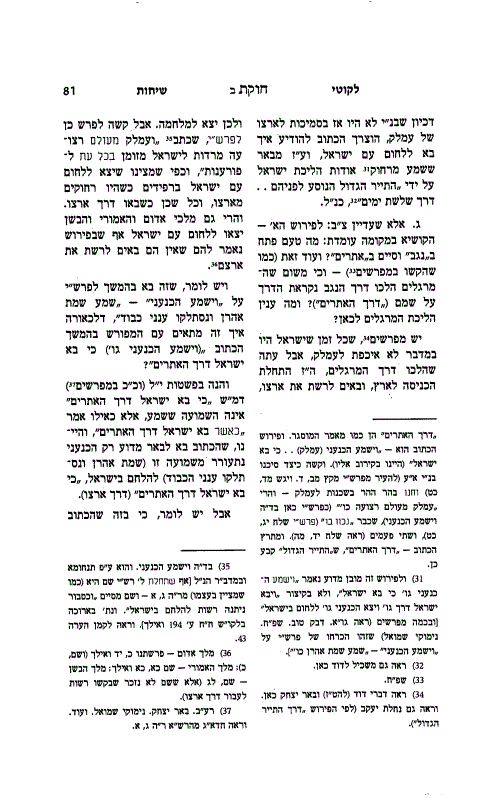
According to this explanation, we can say that Rashi's two interpretations of "by way of the Atarim" also differ in the overall intent of the verse "because Israel came by way of the Atarim" (which is the reason for Amalek's war here with Israel):
According to the first interpretation — the intent of the verse is to emphasize that although "Amalek has always been a whip, etc.," nevertheless, this time they were cautious about harming Israel, as Rashi explains in the preceding commentary, that they were called "Canaanite" here because "he changed his language to speak in the language of Canaan so that Israel would pray to G‑d to deliver the Canaanites into their hands, and they were not Canaanites," indicating that Amalek feared the prayer of Israel and sought strategies, etc. In continuation, the verse states that they heard "because Israel came by way of the Atarim," that the reason they came to fight now was because it was (not only a time of punishment, but also) a place of punishment.
However, according to the second interpretation — the emphasis of the verse "because Israel came by way of the Atarim" is the opposite, to indicate the great audacity of Amalek, that even though "the great fear" provided them rest at Mount Hor, Amalek came from afar to fight them there.
[According to this, it clarifies why Rashi also quotes the words "for them rest" — and not just the word "to spy" — because this increases the emphasis on Amalek's audacity.]
From the "wine of Torah" in this Rashi interpretation:
The two interpretations of "by way of the Atarim" indicate two approaches by which Israel stands against Amalek (the forces of opposition to holiness), and these are two ways to defeat Amalek:
a) "The way... that the spies went" — this refers to the service based on reason and understanding, similar to the matter of the spies — "to scout the land" — in its literal sense, where they went to find the easiest natural way to conquer the land. Similarly, in a spiritual sense, when the evil inclination incites a person against the path of Torah and mitzvos, the person fights against it by contemplating the baseness of evil and the greatness of good and holiness, and thus conducts his battle with the evil inclination according to intellect, like literal military strategies.
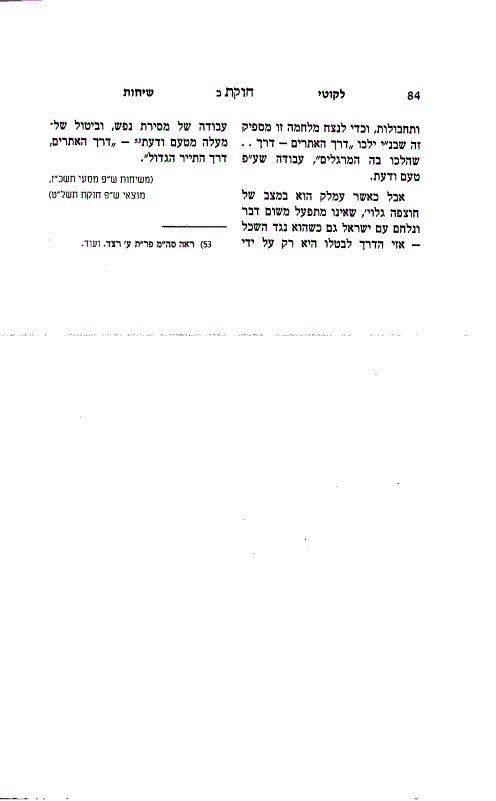
b) "The way of the great scout, etc." — this refers to the service of mesiras nefesh (self-sacrifice), beyond reason and understanding, because he is nullified to the Holy One, blessed be He, and consequently relies on "the great scout," the Ark of the Covenant of the L‑rd, before which all opposers are automatically nullified, as it is written, "And it came to pass, when the Ark set forward, that Moses said, Rise up, O L‑rd, and let Your enemies be scattered, and let those who hate You flee before You."
These two approaches correspond to the state of the opposer (Amalek):
According to the first interpretation, Amalek is in a state of fear of the Children of Israel, and therefore comes with strategies and schemes. To win this battle, it suffices for the Children of Israel to go "by way of the Atarim — the way... that the spies went," a service based on reason and understanding.
However, when Amalek is in a state of blatant audacity, unaffected by anything, and fights against Israel even when it is against reason — then the way to nullify it is only through the service of mesiras nefesh, and nullification beyond reason and understanding — "by way of the Atarim, the way of the great scout."
(From the talks of Shabbos Parshas Masei 5727, Motzei Shabbos Parshas Chukas 5739)