The Torah portion begins with Balak sending messengers to Balaam, saying: "Behold, a people has come out of Egypt, and behold, they cover the face of the earth, and they are dwelling opposite me. Now, please come and curse this people for me, for they are too mighty for me; perhaps I will be able to strike them and drive them out of the land, for I know that whomever you bless is blessed, and whomever you curse is cursed." Later, when Balaam speaks to G‑d, he says: "Balaam said to G‑d, 'Balak sent to me, saying, Behold, the people that has come out of Egypt covers the face of the earth. Now, come and curse them for me; perhaps I will be able to wage war against them and drive them out.'
The Ohr HaChaim HaKadosh has already noted the differences between the language used by Balak and that used by Balaam in the name of Balak. Balak said, 'Behold, a people has come out,' while Balaam said, 'Behold, the people that has come out.' Balak said, 'Behold, they cover,' while Balaam said, 'They cover.' Balak said, 'Now,' while Balaam said, 'Now.' Balak said, 'Curse,' while Balaam said, 'Curse.' Balak said, 'Strike them,' while Balaam said, 'Wage war against them.' Balaam also changed and said, 'Drive them out,' while Balak said, 'Drive them out of the land.' Additionally, Balak said, 'And they are dwelling opposite me,' which Balaam omitted, even though it seems to be the main point (as Rashi explains on the verse, 'They are close to destroying me').
At first glance, one might say that according to the simple interpretation, there is no difficulty here, as it is the way of the scriptures to be concise, etc. However, we find in Rashi's commentary on the Torah that he addresses two of these differences: 'Curse them for me' is harsher than 'Curse them for me,' as it is more explicit and detailed. 'Drive them out' means from the world, while Balak only said, 'Drive them out of the land,' indicating that he only wished to remove them from his vicinity, whereas Balaam hated them more than Balak did. Thus, Rashi holds that the differences in the text are not due to conciseness or the like. Based on this, we must examine why Rashi did not address the other differences between them, such as: (a) 'has come out... covers' or 'that has come out... covers,' (b) 'strike them' or 'wage war against them,' (c) the omission of 'and they are dwelling opposite me.'
The Ohr HaChaim and the Kli Yakar explain these differences based on the idea that Balaam, in his words to G‑d, intended to minimize the hatred expressed in Balak's words. This was to make his request more acceptable to G‑d, knowing that the Israelites are beloved to Him. They explained that 'Curse' is harsher than 'Curse,' and 'Strike them' is harsher than 'Wage war against them,' because 'Wage war' could be just to drive them away, whereas 'Strike them' implies actual striking. Similarly, 'Drive them out' simply means from this place, whereas 'Drive them out of the land' means from the entire world (or all of the Land of Israel). In this way, they explained all the other differences in Balaam's words, which aimed to reduce the hatred, etc., in Balak's words. See there.
However, Rashi interprets it the opposite way, that Balaam changed Balak's words because 'he hated them more than Balak did.' Therefore, according to Rashi, the reason for the differences is that 'Balaam hated them more than Balak.'
As for why Rashi explicitly explained only these two differences — (a) 'Curse' or 'Curse,' (b) 'Drive them out of the land' or 'Drive them out' — it is because in these cases, the matter is not as clear. It is not clear that 'Curse' is harsher than 'Curse,' and there is room to interpret that 'Drive them out of the land' is harsher than 'Drive them out' simply (as the aforementioned commentators explained). Therefore, Rashi needed to explain the meaning of these two differences. In contrast, the other differences are self-explanatory based on the above principle.
Regarding the difference between 'Wage war' or 'Strike them,' it can be simply understood that after Rashi explained that the intention of 'Drive them out' (simply) means 'from the world,' it is understood that 'Wage war' means with the intention to destroy them from the world, whereas 'Strike them' is merely a matter of 'striking,' which does not necessarily imply killing and destruction. On the contrary, the simple meaning of striking is that the one struck remains alive. Especially according to Rashi's second interpretation of 'Strike them,' which is like 'deduct from them a little,' meaning only a slight deficiency.
There remains a need to examine the other differences.
It is also necessary to examine what compelled Rashi (in his peshat approach) to explain the reason for the changes as "Balaam hated them more than Balak," rather than following the aforementioned commentators. Especially since Rashi's explanation seems difficult, as the Kli Yakar questions: (a) How could it enter Balaam's mind that the Holy One, blessed be He, would permit him to curse, G‑d forbid, the Children of Israel even more than Balak intended? (b) How can it be said that 'curse' is harsher than 'curse,' when after Balaam responded to Balak's messengers, "The L‑rd has refused to let me go with you" (and G‑d commanded him "You shall not curse the people"), Balak sent messengers again to Balaam and requested, "Please come and curse this people for me"? How is it possible that after the smaller request was denied ("Please come and curse for me"), he would ask for something greater, "Please come and curse for me"? (As we find that the commentators on Rashi discuss these questions.)
We can say that Rashi's compulsion for his explanation does not stem from the words "curse" and "drive them out" themselves (since the words themselves can also be interpreted as the aforementioned commentators do), but rather his intention is to resolve the wonder that arises from the overall content of the parsha:
What was Balak's fear of the Children of Israel, for Israel was commanded "Do not distress Moab," and as Balak himself saw, the Children of Israel "circled the land of Moab until they came to the other side," "and they did not come to the border of Moab," and when they were not given permission to pass through their land, they did not wage war with them. So what was his fear?
And although later in Parshas Matos, Rashi explains that the Moabites' fear was "that they would plunder them, as it was only said 'Do not engage them in war,'" this question arises immediately in our parsha. If Rashi held that this was the only fear of the Moabites (and not that they feared they would wage war with them, as the simple meaning of the verses suggests, and as Rashi explains on "and he sat opposite me" — "they are close to destroying me"), Rashi should have explained it here and not relied on his explanation later in Parshas Matos.
[And in the Midrash here it states, "they were afraid because they saw the entire land in the hands of Israel, as Sihon came and took the land of Moab, etc., Israel came and took it, etc., and they saw their land in the hands of Israel and said, 'Did not the Holy One, blessed be He, say that He would not give you their land as an inheritance, and behold, our land is before them,' therefore they were afraid" ("and they did not know that Israel acquired it because it was purified by Sihon").
But it is difficult to explain this according to the peshat, for they saw that the Children of Israel circled their land and did not go against them in war to conquer their land, as mentioned above.]
Regarding Moab (and Balak), it can be simply said that they did not know about the command "Do not distress Moab," and they thought that the reason the Children of Israel did not fight with them was because they relied on Sihon and Og to protect them, as Rashi explained earlier that the nations would pay them tribute to protect them, and therefore Israel did not fight against Moab because it would provoke a war against Sihon and Og. Therefore, after seeing that Israel defeated Sihon and Og, "Moab was very afraid of the people."
But there is a difficulty regarding Balaam: since Balaam was a prophet, he certainly knew that the reason the Children of Israel did not fight with Moab was because Israel was commanded so, and if so, why did he not tell Balak that he had nothing to fear?
This is why Rashi explains that "Balaam hated them more than Balak," meaning that his hatred was of a different kind: Balak's hatred for the Children of Israel was a result of his fear that the Children of Israel would wage war with him and conquer his land, whereas Balaam's hatred for the Children of Israel was an intrinsic hatred, without reason.
For this reason, it is not difficult to understand why Balaam did not reveal to Balak that he had nothing to fear, because Balaam sought an opportunity to harm Israel, and in this case — to fulfill Balak's request to curse them, etc.
And according to this introduction, the reason for the changes in Balaam's words is simply understood:
Balak's main emphasis was on the actions of the Children of Israel that instilled fear in him, whereas Balaam was not concerned with what the Children of Israel were doing, and only expressed his own hatred for the people of Israel.
Therefore, Balak said, "And he is sitting opposite me," which was the main source of his fear, as Rashi explains (as mentioned above), meaning that "they are close to destroying me." In contrast, Balaam omitted this entire matter because he knew that the Children of Israel had no intention of fighting with Moab, as they were commanded by the Holy One, blessed be He. Thus, there was no reason to present Balak's claim of "and he is sitting opposite me" to G‑d.
This also explains the difference between Balak's words, "Behold, a people has come out of Egypt, behold, it has covered the face of the earth," and Balaam's words, "Behold, the people that has come out of Egypt and covers, etc.":
Balak's main intention was to emphasize the actions of the Children of Israel, and therefore he divided his words into two parts — "Behold, a people has come out of Egypt... behold, it has covered the face of the earth" — which are two different matters: "A people has come out of Egypt" clarifies which people he is speaking about, and "behold, it has covered, etc." describes their evil actions that caused him to fear them (and this is why he said everything in the past tense — "has come out... has covered" — as these are actions that have already occurred).
In contrast, Balaam's wording — "the people that has come out, etc. and covers, etc." — is meant to describe the essence of the people, that the characteristic of "the people that has come out, etc." is to cover the face of the earth (that they go and cause harm, etc.). Therefore, he did not say "behold, it has covered, etc." (which would imply that this is an additional matter) but rather "and covers, etc.," which is a continuation of what was said before.
[It can be said that for this reason he used "has come out," in the present tense, because this emphasizes more that this is the characteristic of the people, to the extent that the entire purpose of their exodus from Egypt was (what they are doing now, in the present) to cover the face of the earth.]
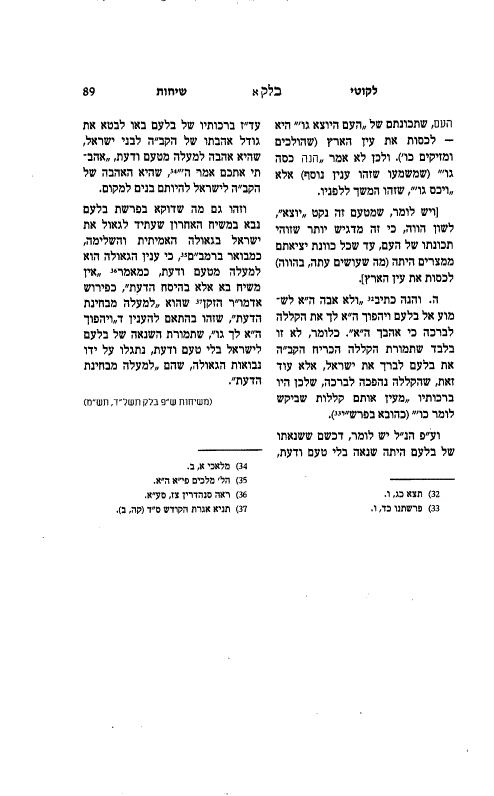
Furthermore, it is written, "But the L‑rd your G‑d did not want to listen to Balaam, and the L‑rd your G‑d transformed the curse into a blessing for you, because the L‑rd your G‑d loves you." This means that not only did the Holy One, blessed be He, force Balaam to bless Israel instead of cursing them, but moreover, the curse was transformed into a blessing. Therefore, his blessings were "similar to those curses he wished to say, etc." (as brought in Rashi).
According to the above, it can be said that just as Balaam's hatred was a hatred without reason or understanding, so too Balaam's blessings came to express the great love of the Holy One, blessed be He, for the Children of Israel, which is a love beyond reason and understanding, "I have loved you, says the L‑rd," which is the love of the Holy One, blessed be He, for Israel because they are children to the Omnipresent.
This is also why specifically in the portion of Balaam, there is a prophecy about the final redeemer who will redeem Israel with the true and complete redemption, as explained by the Rambam, because the concept of redemption is beyond reason and understanding, as the saying goes, "Mashiach will not come except in a moment of distraction," as explained by the Alter Rebbe that it is "beyond the aspect of understanding," which corresponds to the concept of "and the L‑rd your G‑d transformed, etc.," that in place of Balaam's hatred for Israel without reason and understanding, prophecies of redemption were revealed through him, which are "beyond the aspect of understanding."
(From the talks of Shabbat Parshat Balak 5734, 5740)