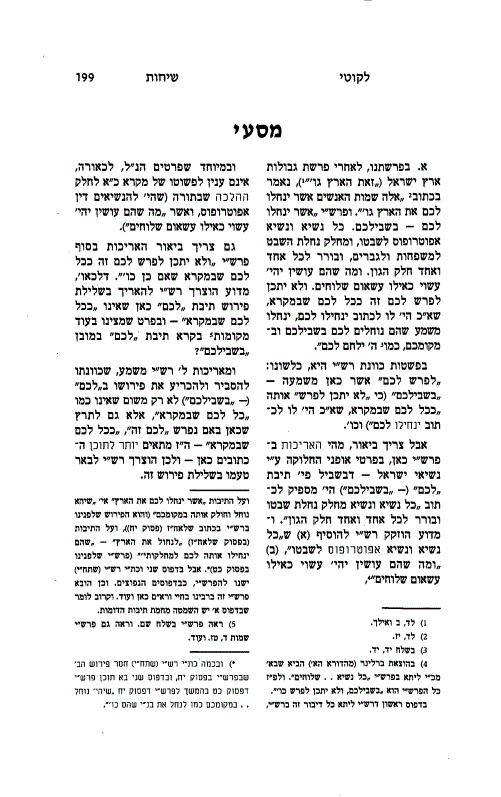
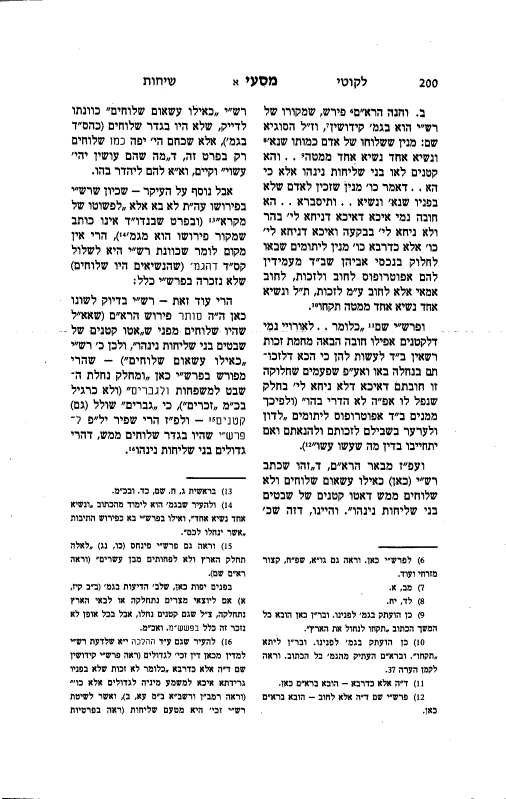
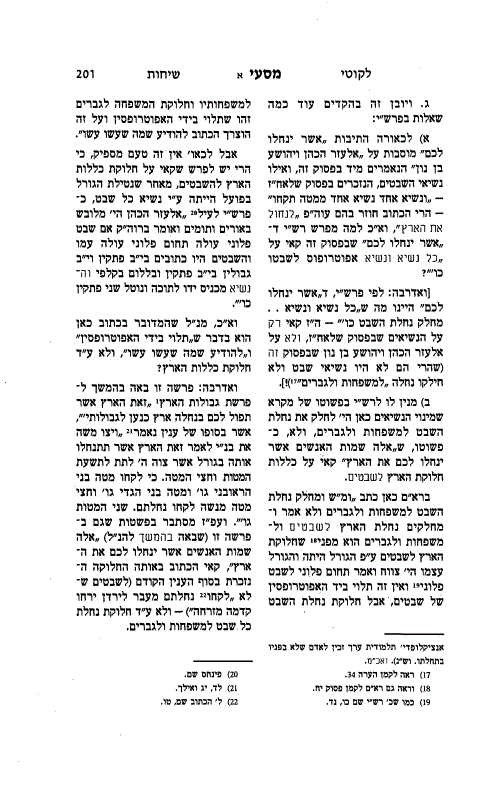
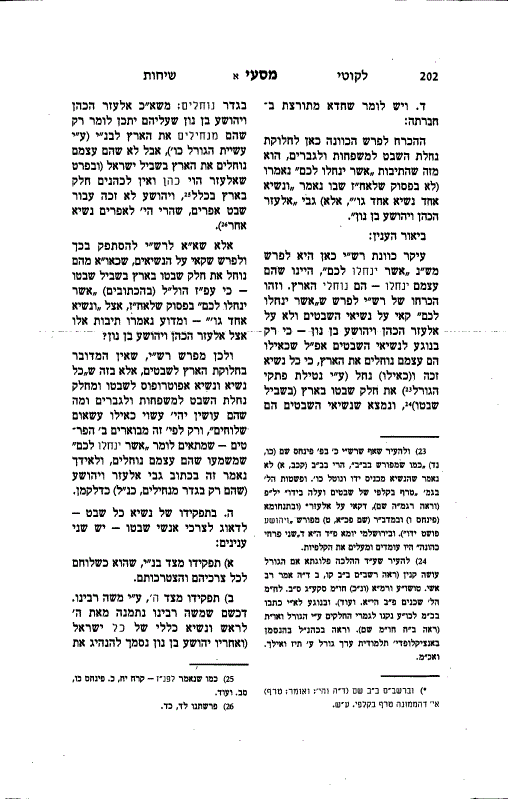
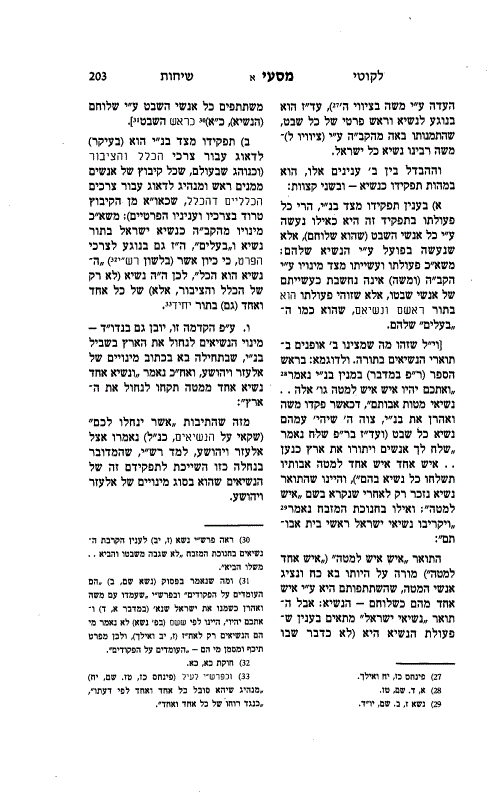
In our parsha, after the section detailing the borders of the Land of Israel ("This is the land..."), the verse states, "These are the names of the men who shall inherit the land for you." Rashi comments, "who shall inherit for you — on your behalf. Each prince is a guardian for his tribe, distributing the inheritance of the tribe to families and individuals, selecting for each one a fitting portion. What they do shall be done as if they were appointed as agents. It is not possible to interpret 'for you' here as it is elsewhere in Scripture, for if so, it should have been written 'they shall inherit for you'; 'shall inherit' implies they inherit for you, on your behalf and in your place, as in 'The L‑rd shall fight for you.'"
Rashi's straightforward intention is, as he states: to interpret 'for you' here as meaning 'on your behalf'. However, it requires explanation why Rashi elaborates here on the details of the distribution by the princes of Israel. For the explanation of the word 'for you' ('on your behalf'), it would have sufficed to write, "Each prince distributes the inheritance of his tribe and selects for each one a fitting portion." Why did Rashi need to add (a) that "each prince is a guardian for his tribe," and (b) "what they do shall be done as if they were appointed as agents"?
Especially since these details, seemingly, do not pertain to the simple meaning of the verse but rather to the legal aspect of the Torah (that the princes had the status of guardians and that "what they do shall be done as if they were appointed as agents").
There is also a need to explain the length at the end of Rashi's commentary, "It is not possible to interpret 'for you' here as it is elsewhere in Scripture, for if so..." Why did Rashi need to elaborate on rejecting the interpretation of 'for you' here as it is elsewhere in Scripture, especially since we find in other places in Scripture the word 'for you' meaning 'on your behalf'?
From Rashi's lengthy wording, it seems that his intention is to explain and justify his interpretation of 'for you' ('on your behalf') not only because it is not like "all 'for you' in Scripture," but also to resolve that here, if we interpret 'for you' as it is elsewhere in Scripture, it would fit better with the content of the verses here. Therefore, Rashi needed to explain his reason for rejecting this interpretation.
The Ra'ah explains that Rashi's source is from the Gemara in Kiddushin, where the Gemara discusses the principle that a person's agent is like himself, citing the verse "and one prince, one prince from a tribe." The Gemara questions, "But minors are not capable of agency, rather it is like this... as it says... how do we know that we can benefit a person in his absence, as it says 'and one prince...' and you might think... but there is also a disadvantage, as some prefer the mountain and not the valley, and some prefer... rather as Rava said... how do we know that for orphans who come to divide their father's estate, the court appoints a guardian for them for their benefit and detriment, for detriment why, rather for detriment in order to benefit, as it says 'and one prince, one prince from a tribe you shall take.'"
Rashi there explains, "That is to say... to teach also that for minors, even a detriment that comes from a benefit, the court is authorized to act for them, as here they come to benefit them in inheritance, and even though sometimes this division is to their detriment, as some do not prefer the portion that fell to them, nevertheless they cannot retract." Therefore, the court appoints a guardian for the orphans "to argue and contest on their behalf for their benefit and advantage, and if they are liable in judgment, what they did is done."
Based on this, the Ra'ah explains that "this is what Rashi wrote (here) as if they were appointed as agents, not actual agents, for are the minors of the tribes capable of agency?" This means that when Rashi writes "as if they were appointed as agents," he intends to clarify that they were not actual agents, but their power was as effective as agents only in this aspect, that "what they do shall be done" and valid, and they cannot retract.
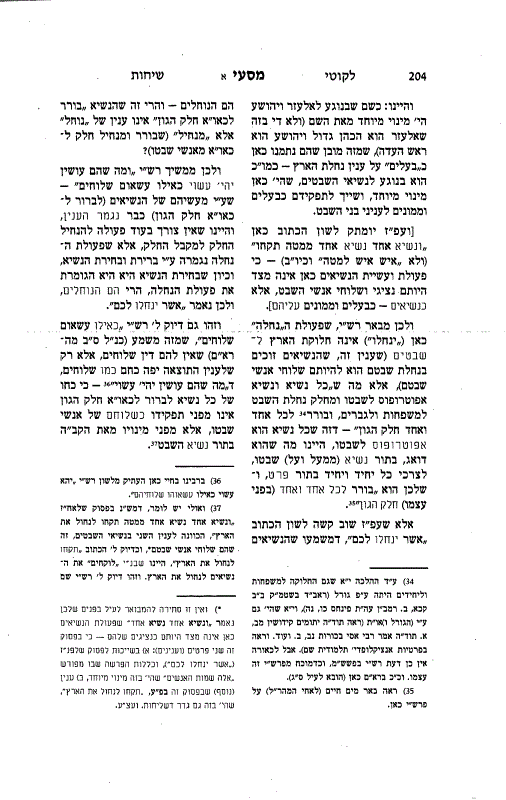
However, in addition to the main point — since Rashi in his commentary on the Torah comes only to explain the simple meaning of the verse...
Especially since in our case, Rashi does not write that the source of his explanation is from the Gemara, there is no reason to say that Rashi's intention is to negate the initial understanding of the Gemara (that the leaders were agents), which is not mentioned in Rashi at all. Furthermore, Rashi's precise wording here contradicts the explanation of the Ra'ah — for it is explicitly stated in Rashi here "and he divides the inheritance of the tribe to families and males" (and not as is usual in other places "males"), because "males" excludes (also) minors. Therefore, according to this, it is indeed possible to explain according to Rashi that they were actually agents, for adults are capable of agency.
This will be understood by first addressing several questions in Rashi's commentary:
a) At first glance, the words "who shall inherit for you" refer to "Elazar the priest and Joshua the son of Nun" mentioned immediately in this verse, whereas the leaders of the tribes, mentioned in the following verse — "one leader from each tribe you shall take" — the scripture repeats "to inherit the land." So why does Rashi explain that "who shall inherit for you" in this verse refers to "each leader as a guardian for his tribe, etc."? On the contrary: according to Rashi, that "who shall inherit for you" means that "each leader... divides the inheritance of the tribe, etc." — this applies only to the leaders in the following verse, and not to Elazar the priest and Joshua the son of Nun in this verse (since they were not tribal leaders and did not divide inheritance "to families and males").
b) From where does Rashi derive in the simple meaning of the text that the appointment of the leaders here was to divide the inheritance of the tribe to families and males, and not, as simply understood, that "these are the names of the men who shall inherit for you the land" refers to the general division of the land to the tribes? The Ra'ah here wrote, "And what he wrote, 'and he divides the inheritance of the tribe to families and males' and did not say 'and they divide the inheritance of the land to tribes and to families and males' is because the division of the land to tribes was by lot, and the lot itself would call out and say 'such and such territory to such and such tribe,' and this was not dependent on the guardians of the tribes, but the division of the tribe's inheritance to its families and the division of the family to males was dependent on the guardians, and for this the scripture needed to inform that what they did was done." However, this does not seem to be a sufficient reason, because it can be explained that it refers to the general division of the land to the tribes, since the actual drawing of the lot was done by the leader of each tribe, as Rashi explained earlier, "Elazar the priest was clothed in the Urim and Thummim and would say with the Holy Spirit, 'if such and such tribe ascends, such and such territory ascends with it,' and the tribes were written on twelve slips and twelve boundaries on twelve slips, and they were mixed in a box, and the leader would insert his hand into it and take two slips, etc." Therefore, from where does it derive that the matter discussed in the scripture here is something "dependent on the guardians" and "to inform that what they did was done," and not about the general division of the land? On the contrary: this section follows the section of the boundaries of the land, "This is the land that shall fall to you as an inheritance, the land of Canaan according to its borders," which concludes with "And Moses commanded the children of Israel, saying, 'This is the land which you shall inherit by lot, which the L‑rd commanded to give to the nine tribes and the half-tribe. For the tribe of the children of Reuben, etc., and the tribe of the children of Gad, etc., and half the tribe of Manasseh have taken their inheritance. The two tribes, etc.'" Based on this, it is simple to understand that also in this section (which follows the aforementioned) "these are the names of the men who shall inherit for you the land," the scripture refers to the same division mentioned at the end of the previous matter (to the tribes that did not "take their inheritance beyond the Jordan eastward") — and not about the division of each tribe's inheritance to families and males.
And one can say that one question is answered by the other.
The necessity to interpret the intention here as referring to the division of the tribe's inheritance to families and males comes from the fact that the words "who shall inherit for you" are stated (not in the subsequent verse where it says "one prince, one prince, etc.," but) in relation to "Eleazar the priest and Joshua the son of Nun."
The explanation of the matter is as follows: The main intention of Rashi here is to explain what is meant by "who shall inherit for you," meaning that they themselves shall inherit — they are the inheritors of the land. This is Rashi's necessity to explain that "who shall inherit for you" refers to the princes of the tribes and not to Eleazar the priest and Joshua the son of Nun — because only regarding the princes of the tribes can it be said that it is as if they themselves inherit the land, since each prince merited and (as if) inherited (through the drawing of lots) the portion of his tribe in the land (for his tribe), and thus the princes of the tribes are considered inheritors. However, concerning Eleazar the priest and Joshua the son of Nun, it can only be said that they are the ones who cause the land to be inherited by the children of Israel (through the act of drawing lots, etc.), but not that they themselves inherit the land for Israel.
However, Rashi cannot suffice with this and explain that it refers to the princes, each of whom inherits the portion of his tribe in the land for his tribe — because according to this, it should have said "who shall inherit for you" in the subsequent verse, next to "one prince, etc." — so why are these words stated in relation to Eleazar the priest and Joshua the son of Nun?
Therefore, Rashi explains that the discussion is not about the division of the land to the tribes, but rather that "each prince is a guardian for his tribe and divides the tribe's inheritance to families and males, and what they do shall be done as if they were agents," and only according to this explanation are the two details clarified — it is fitting to say "who shall inherit for you," implying that they themselves inherit, and on the other hand, it is stated in the scripture regarding Eleazar and Joshua (who are only in the category of causing inheritance, as mentioned above) as will be explained later.
In the role of the prince of each tribe — to care for the needs of his tribe members — there are two aspects:
a) His role from the perspective of the children of Israel, as their agent for all their needs and requirements.
b) His role from the perspective of G‑d, through Moses our teacher. Just as Moses our teacher was appointed by G‑d as the head and general prince of all Israel, so too regarding the prince and specific head of each tribe, his appointment comes from the Holy One, blessed be He, through (His command to) Moses our teacher, the prince of all Israel.
The difference between these two aspects lies in the nature of his role as a prince — and in two extremes:
a) In terms of his role from the perspective of the children of Israel, all his actions in this role are as if done by all the members of the tribe (as he is their agent), but are actually carried out by their prince; whereas his actions and deeds from his appointment by the Holy One, blessed be He (and Moses) are not considered as the actions of his tribe members, but rather as his own actions as their head and prince, as if he is their "owner." [And it can be said that this is what we find in the two manners of the titles of the princes in the Torah. For example, at the beginning of the book in the census of the children of Israel, it is stated "And with you shall be one man from each tribe, etc. These are... the princes of the tribes of their fathers," that when Moses and Aaron counted the children of Israel, G‑d commanded that there should be with them a prince of each tribe (and similarly at the beginning of Parshas Shelach it is stated "Send for yourself men, and they shall scout the land of Canaan... one man from each tribe of their fathers you shall send, every prince among them"), meaning that the title prince is mentioned only after being called "a man from the tribe"; whereas in the dedication of the altar it is stated...]
The title "each man from the tribe" ("one man from the tribe") indicates that he is the representative and agent of the people of the tribe, with their participation being through one of them as their emissary — the prince. However, the title "princes of Israel" aligns with the notion that the prince's action is not as something in which all the members of the tribe participate through their emissary (the prince), but rather...
As the head of the tribe.
His role from the perspective of the children of Israel is primarily to care for the needs of the community and the public (as is customary in the world, where every group of people appoints a leader and guide to take care of the general needs of the community, since each member of the group is preoccupied with their own personal needs and matters). However, his appointment by the Holy One, blessed be He, as the prince of Israel, as a prince and "owner," also pertains to individual needs. Since, in the words of Rashi, "the prince is everything," he is therefore a prince (not only of the community and the public, but) of each and every individual as well.
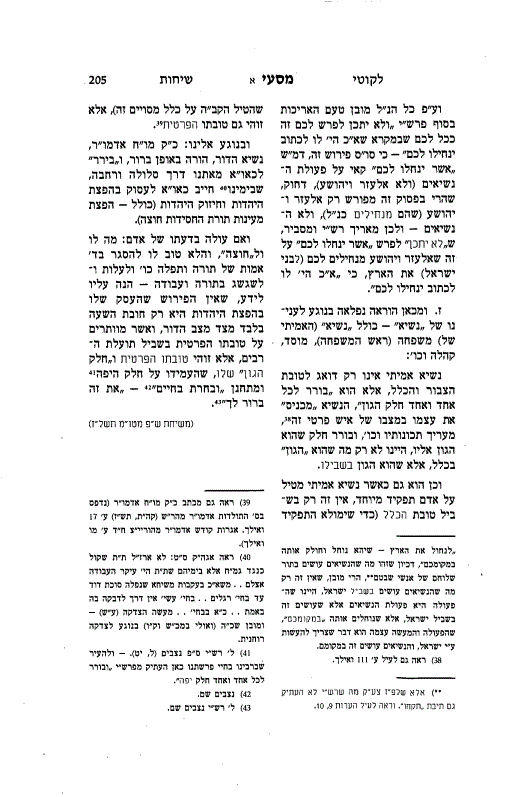
Based on this introduction, it is also understood in our case — the appointment of the princes to inherit the land for the children of Israel. Initially, the verse mentions the appointments of Elazar and Joshua, and afterwards it states, "And you shall take one prince from each tribe to inherit the land." From the fact that the words "who shall inherit for you" (which refers to the princes, as mentioned above) are stated regarding Elazar and Joshua, Rashi learns that the inheritance in question pertains to this type of appointment of the princes, which is similar to the appointments of Elazar and Joshua.
That is: Just as regarding Elazar and Joshua there was a special appointment from G‑d, from which it is understood that they were appointed here as "owners" over the matter of the inheritance of the land — so too regarding the princes of the tribes, there was a special appointment, and it pertains to their role as owners and appointees over the matters of the tribe members. [Accordingly, the wording of the verse here "and you shall take one prince from each tribe" (and not "each man from the tribe" or similar) is precise — because the actions and deeds of the princes here are not due to their being representatives and emissaries of the tribe members, but as princes — as owners and appointees over them.] Therefore, Rashi explains that the action of "inheritance" here ("shall inherit") is not the division of the land to the tribes (which is a matter where the princes acquire the inheritance of their tribe as the emissaries of the tribe members), but rather that "each prince is a guardian for his tribe and divides the inheritance of the tribe to families and men, and selects for each one an appropriate portion" — this means that each prince is a guardian for his tribe, meaning that he cares, as a prince (above and over) his tribe, for the needs of each individual as an individual, and therefore he "selects for each one (individually) an appropriate portion."
However, based on this, the wording of the verse "who shall inherit for you" is difficult, as it implies that the princes are the ones inheriting — and indeed, the fact that the prince "selects an appropriate portion for each one" is not a matter of "inheriting" but of "bequeathing" (selecting and bequeathing a portion to each of his tribe members)? Therefore, Rashi continues, "and what they do will be done as if they were emissaries" — that through the actions of the princes (selecting an appropriate portion for each one), the matter is already completed, meaning there is no need for another action to bequeath the portion to the recipient of the portion, but the action of inheritance is completed through the selection and choice of the prince. Since the prince's choice is what completes the action of inheritance, they are the inheritors, and therefore it is stated "who shall inherit for you."
And this is also the precision in Rashi's wording "as if they were emissaries," which implies (as mentioned above in section 2 from the Re'em) that they do not have the status of emissaries, but only that regarding the outcome, their power is as effective as that of emissaries, that "what they do will be done."
The power of each prince to select an appropriate portion for each individual is not due to his role as an emissary of his tribe members, but because of his appointment by the Holy One, blessed be He, as the prince of the tribe.
Based on all the above, we understand the reason for the lengthy explanation at the end of Rashi's commentary: "It is not possible to interpret 'for you' as in all other instances of 'for you' in Scripture, for if so, it should have written 'they shall inherit for you.'" This is because, ultimately, this interpretation, that "who shall inherit for you" refers to the actions of the princes (and not Elazar and Yehoshua), is difficult, as in this verse only Elazar and Yehoshua are explicitly mentioned (who are the ones bequeathing, as mentioned above), and not the princes. Therefore, Rashi elaborates and explains that it is not possible to interpret "who shall inherit for you" as referring to Elazar and Yehoshua bequeathing the land to you (the children of Israel), because "if so, it should have written 'they shall inherit for you.'"
From this, we derive a wonderful lesson regarding the concept of a "prince" — including the "prince" (the true one) of a family (the head of the family), an institution, a community, etc.: A true prince not only cares for the welfare of the public and the community, but he "selects an appropriate portion for each individual." The prince "immerses" himself in the situation of this particular person, evaluates his qualities, etc., and selects a portion that is suitable for him, meaning not only what is generally "appropriate," but what is appropriate specifically for him.
This is also the case when a true prince assigns a person a special task; it is not only for the benefit of the community (so that the task assigned by the Holy One, blessed be He, to this particular community is fulfilled), but it is also for his personal benefit.
Regarding us: Our master, teacher, and Rebbe, the leader of the generation, has clearly instructed and "selected" for each of us a clear and broad path, that in our times, each individual must engage in spreading Judaism and strengthening Judaism (including the spreading of the wellsprings of Chassidic teachings outward).
If a person thinks: What is his connection to "outward," and is it not better for him to remain secluded within the four cubits of Torah and prayer, etc., and to ascend and thrive in Torah and service — he must know that his involvement in spreading Judaism is not merely a temporary obligation due to the state of the generation, and that his personal benefit is being sacrificed for the benefit of the many, but rather, it is his personal benefit and his "appropriate portion," that he has been placed in a beautiful portion and is implored "and you shall choose life" — "this is what has been chosen for you."