
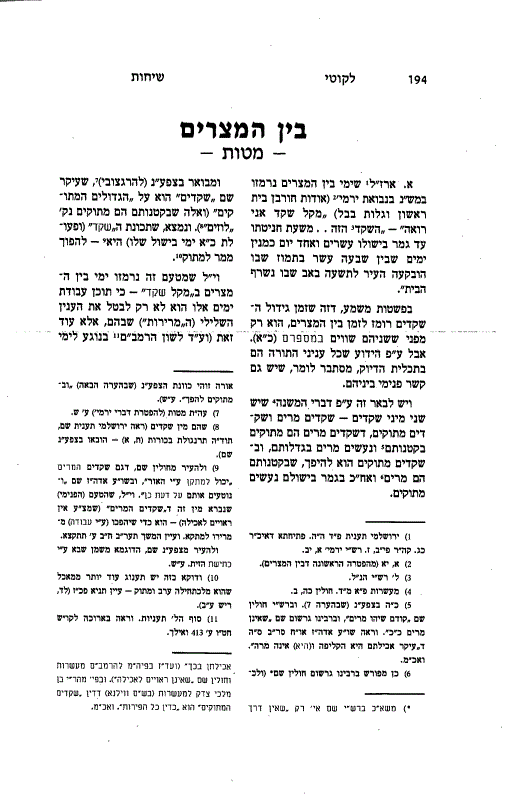
The sages said that the period of Bein HaMetzarim is alluded to in the prophecy of Jeremiah concerning the destruction of the First Temple and the Babylonian exile: "I see a rod of an almond tree" — "This almond... from the time it begins to bud until it is fully ripe takes twenty-one days, corresponding to the number of days between the seventeenth of Tammuz, when the city was breached, and the ninth of Av, when the Temple was burned."
At first glance, it seems that the reason the growth period of almonds alludes to the time of Bein HaMetzarim is simply because they both share the same number (twenty-one). However, it is known that all matters of Torah are precise, so it is reasonable to say that there is also an internal connection between them.
This can be explained based on the Mishnah, which states that there are two types of almonds — bitter almonds and sweet almonds. Bitter almonds are sweet when they are small and become bitter when they grow, whereas sweet almonds are bitter when they are small and become sweet when they are fully ripe.
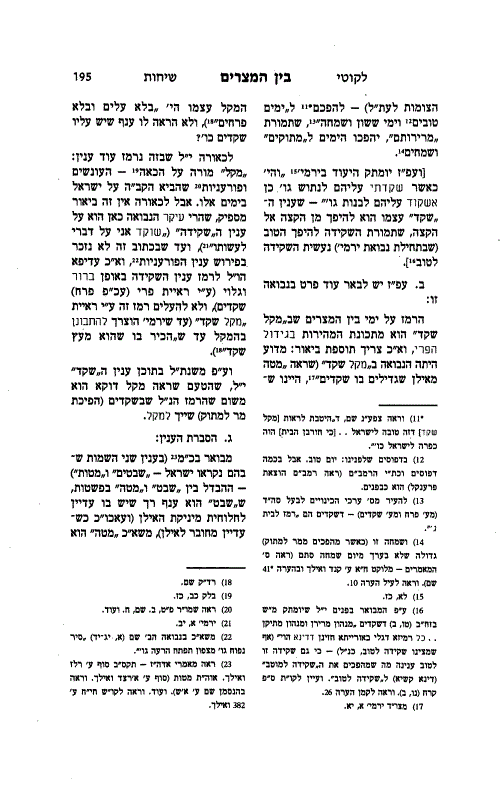
It is explained in the Tzafnas Paneach (by the Rogatchover) that the primary name "almonds" refers to the "large sweet ones" (and those that are sweet when small are called "luzim"). Thus, the characteristic of the "almond" (and the effect of its twenty-one days of ripening) is to transform from bitter to sweet.
It can be said that for this reason, the days of Bein HaMetzarim are alluded to by the "almond rod" — because the purpose of the service during these days is not only to nullify the negative aspect (the "bitterness") within them, but also, as the Rambam writes regarding the fast days in the future, to transform them into "days of joy and gladness," so that instead of their "bitterness," the days will become "sweet" and joyful.
Based on this, the prophecy in Jeremiah is sweetened: "And it shall be that as I have watched over them to uproot... so will I watch over them to build..." — the very concept of "almond" is to transform from one extreme to the other, so that instead of the diligence for the opposite of good (at the beginning of Jeremiah's prophecy), the diligence becomes for good.
Based on this, another detail in this prophecy can be explained: the allusion to the days of Bein HaMetzarim in the "almond rod" is from the characteristic of the rapid growth of the fruit. Therefore, further explanation is needed: why was the prophecy in the form of an "almond rod" (where he saw "a staff from a tree that grows almonds," meaning the rod itself was "without leaves and without flowers"), and not shown a branch with almonds on it?
It could be said that this alludes to another matter: "rod" indicates striking — the punishments and calamities that G‑d brought upon Israel during these days. However, this explanation is not sufficient, for the main prophecy here is about the matter of "diligence" ("I am diligent concerning My word to perform it"), and in this verse, the matter of calamities is not explicitly mentioned. Therefore, it would have been preferable to allude to the matter of diligence in a clear and revealed manner (by seeing the fruit, or at least the flower, of almonds), rather than concealing this allusion by seeing an "almond rod" (to the extent that Jeremiah had to contemplate the rod until he "recognized that it was from an almond tree").
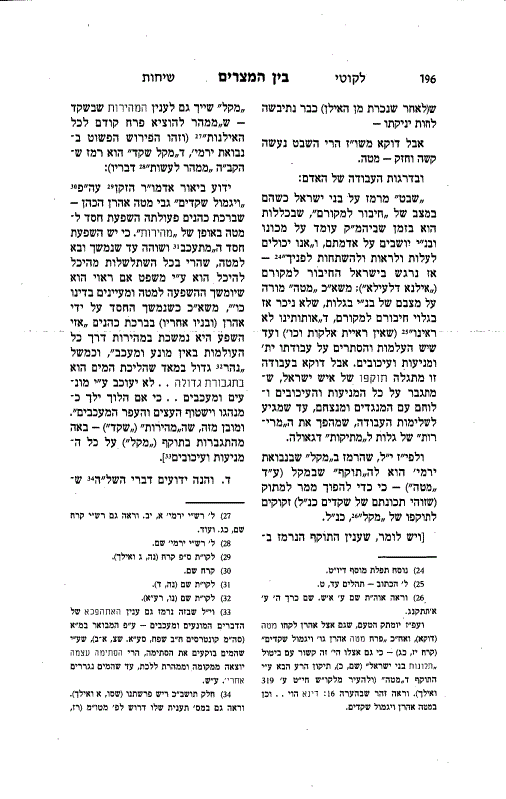
Based on what was explained earlier regarding the concept of the "almond," it can be said that the reason he saw specifically a rod is because the aforementioned allusion in almonds (transforming bitter to sweet) is related to the rod.
The explanation of the matter: It is explained in various places (regarding the two names by which Israel is called — "tribes" and "staffs") — the difference between "tribe" and "staff" in simple terms is that a "tribe" is a soft branch that still has moisture from the nourishment of the tree (especially when it is still attached to the tree), whereas a "staff" is one that (after being cut from the tree) has already dried up from its moisture of nourishment.
However, precisely because of this, the "tribe" becomes hard and strong — a "staff."
In the levels of a person's service: "Tribe" alludes to the Jewish people when they are in a state of "connection to their source," which generally is when the Temple stands in its place and the Jewish people dwell in their land, and "we can ascend and see and bow before You." At that time, the connection to their source ("the supernal tree") is felt among the Jewish people. In contrast, "staff" indicates the state of the Jewish people in exile, when their connection to their source is not openly recognized, as "we do not see our signs" (there is no visible G‑dliness, etc.), and there are concealments and obstructions to their service of the Almighty, with hindrances and delays. Yet, it is precisely in this service that the strength of a Jewish person is revealed, as they overcome all hindrances and delays, fight against the opposers and defeat them, until they reach the completion of the service, transforming the "bitterness" of exile into the "sweetness" of redemption.
According to this, it can be said that the allusion in the "rod" in Jeremiah's prophecy is to the "strength" of the rod (similar to "staff") — because to transform from bitter to sweet (which is the characteristic of almonds, as mentioned above), one needs the strength of a "rod," as mentioned above. It can be said that the strength alluded to in the "rod" is also related to the speed of the almond — that it "hastens to blossom before all the trees." This is the simple explanation in Jeremiah's prophecy, that the "almond rod" is a hint that the Holy One, blessed be He, "hastens to perform His word." It is known the explanation of the Alter Rebbe on the verse "and it blossomed almonds" regarding the staff of Aaron the priest — that the effect of the Priestly Blessing is the influence of kindness below in a manner of "speed." For there is an influence of kindness that "delays and lingers until it is drawn down below, for in every descent from chamber to chamber, it is through judgment if it is worthy for the influence to be drawn down below, and they examine its judgment, etc." However, when the kindness is drawn through Aaron (and his sons after him) in the Priestly Blessing, "then the flow is drawn quickly through all the worlds without any hindrance or delay," like the analogy of "a very large river whose flow of water is with great force... it is not hindered by obstacles and delays... but rather it flows as usual and sweeps away the trees and earth that obstruct." From this, it is understood that the "speed" ("almond") comes from an increase in strength ("rod") over all hindrances and delays.
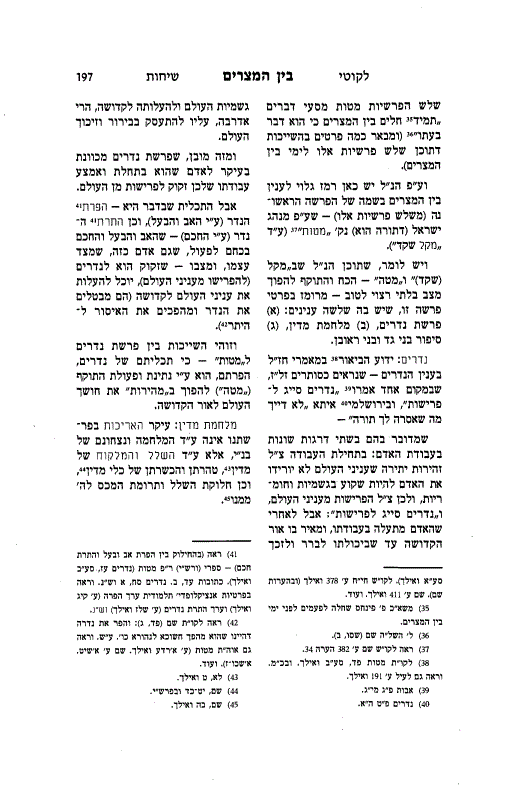
It is known the words of the Shelah that the three portions of Matos, Masei, and Devarim "always occur during the Three Weeks because it is a matter in its time" (and he explains several details in the connection of the content of these three portions to the days of the Three Weeks). According to the above, there is a clear allusion to the matter of the Three Weeks in the name of the first portion (of these three portions) — which according to the custom of Israel (which is Torah) is called "Matot" (similar to "almond rod"). It can be said that the aforementioned content in "almond rod" and "staff" — the power and strength to transform an undesirable state to good — is hinted at in the details of this portion, which contains three matters: (a) the portion of vows, (b) the war with Midian, (c) the story of the children of Gad and the children of Reuben.
Vows: It is known the explanation in the sayings of our Sages regarding vows — which seem to contradict each other, as in one place they said "vows are a fence for abstinence," and in the Jerusalem Talmud...
It is stated, "Is it not enough what the Torah has forbidden you?" — indicating that there are two different levels in a person's service: at the beginning of one's service, there must be extra caution that worldly matters do not cause a person to become immersed in materialism and physicality. Therefore, there must be separation from worldly matters, and "vows are a fence for abstinence." However, after a person has advanced in their service, and the light of holiness shines within them to the extent that they can refine and elevate the physicality of the world to holiness, then on the contrary, they must engage in the refinement and purification of the world.
From this, it is understood that the portion of vows is primarily directed at a person who is at the beginning or middle of their service and therefore needs separation from the world. But the ultimate purpose of this is the annulment of the vow (by the father and husband), and similarly, the release of the vow (by the sage) — that the father, husband, and sage have the power to enable even such a person, who by themselves and their situation needs vows (to separate them from worldly matters), to elevate worldly matters to holiness (they annul the vow and transform the prohibition into a permission).
This is the connection between the portion of vows and "Matot" — because the purpose of vows, their annulment, is through the giving and effect of strength ("staff") to quickly transform the darkness of the world into the light of holiness.
The war with Midian: The main elaboration in our portion is not about the war and the victory of the Children of Israel, but about the spoils and booty of Midian, the purification and preparation of the vessels of Midian, and also the division of the spoils and the tribute offering to G‑d from it.
This means that the ultimate perfection of the (service in the) war with Midian is not only the nullification of the (klipah of) Midian but the transformation of the bitter to sweet, to purify and elevate the spoils of Midian to holiness, to the extent that a portion of it was raised to be "a tribute to G‑d."
The children of Gad and the children of Reuben: Moses' concern was — "Shall your brothers go to war while you stay here?" — meaning that they did not want to fight with Canaan. Similarly, in spirituality, the reason the children of Gad and the children of Reuben wanted to remain on the other side of the Jordan, "a land for livestock," was because they chose to be shepherds, an occupation that allows them to be in a state of seclusion (in the field, away from the distractions and noise of the city) so that they could maintain a constant attachment to G‑d, etc. And this is Moses' argument in his response to them, "Shall your brothers go to war, etc." — meaning that the main service is for a person to come and fight with the materiality of the world, to refine and purify it, etc. Therefore, he conditioned with them, "If you do this thing, if you arm yourselves before the L‑rd for war... (until) the land is subdued before the L‑rd."
And this is also the conclusion of the portion — the story about the building of the cities of Sihon and Og by the children of Gad and the children of Reuben, and in a manner of "changing their names" — these cities were associated with idolatry, "and the children of Reuben changed their names to other names" — transforming darkness to light and bitterness to sweetness.
Therefore, this portion is read during the Three Weeks — to indicate that the ultimate purpose of these days is to transform them from bitterness to sweetness, that they will turn into "days of goodness and days of joy and gladness," with the future redemption, speedily in our days, truly.