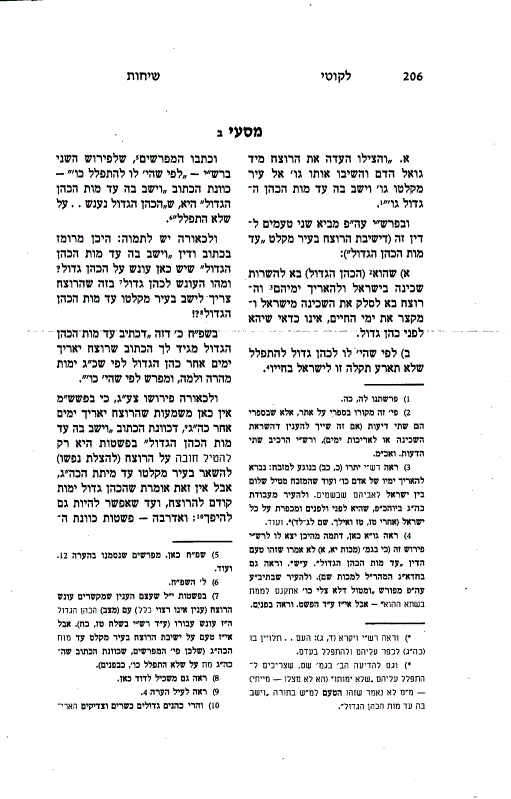
The verse states, "And the congregation shall save the murderer from the hand of the avenger of blood, and the congregation shall restore him to his city of refuge... and he shall dwell there until the death of the high priest."
Rashi, in his commentary on this verse, provides two reasons for this law (that the murderer must remain in the city of refuge "until the death of the high priest"): 1) The high priest comes to bring the Divine Presence upon Israel and to extend their days, whereas the murderer comes to remove the Divine Presence from Israel and to shorten life; it is not fitting that he should be before the high priest. 2) Because the high priest should have prayed that such a mishap not occur in Israel during his lifetime.
The commentators explain that according to Rashi's second explanation — "because he should have prayed, etc." — the intention of the verse "and he shall dwell there until the death of the high priest" is that "the high priest is punished... for not having prayed."
However, it seems puzzling: where is it hinted in the verse and the law "and he shall dwell there until the death of the high priest" that there is a punishment for the high priest? And what is the punishment for the high priest in that the murderer must remain in his city of refuge until the death of the high priest?
The Shev Shmaatsa writes that this "teaches you that the murderer will outlive the high priest because the high priest will die soon, and why? Because he did not pray, etc." However, this explanation seems difficult, as there is no indication in the simple meaning of the text that the murderer will outlive the high priest. The intention of the verse "and he shall dwell there until the death of the high priest" is simply to impose an obligation on the murderer (to save his life) to remain in his city of refuge until the death of the high priest, but this does not mean that the high priest will die before the murderer, and it could even be the opposite. On the contrary, the simple intention of the verse is to emphasize the length of the murderer's stay in the city of refuge.
Some explain that "because the high priest did not pray, etc., therefore the Torah obligated him to remain in his city of refuge until the death of the high priest, and he will suffer from not being able to return to his home as long as the high priest is alive, and thus he will pray for the death of the high priest, and his prayer will be accepted, and the high priest will receive his punishment... and another will be appointed... and there will be no more mishaps in Israel." However, it is a great stretch to interpret Rashi's words in this way, as he did not mention at all (not even by hint) that the murderer should pray for the death of the high priest. If this were Rashi's intention (and it begins with a five-year-old learning the text) — he should have explained it.
Furthermore, the content of the explanation — that the reason the Torah states "until the death of the high priest" is so that the murderers will pray for the death of the high priest — is very puzzling, and in the words of the Geonim, "these are not the ways of the true Torah."
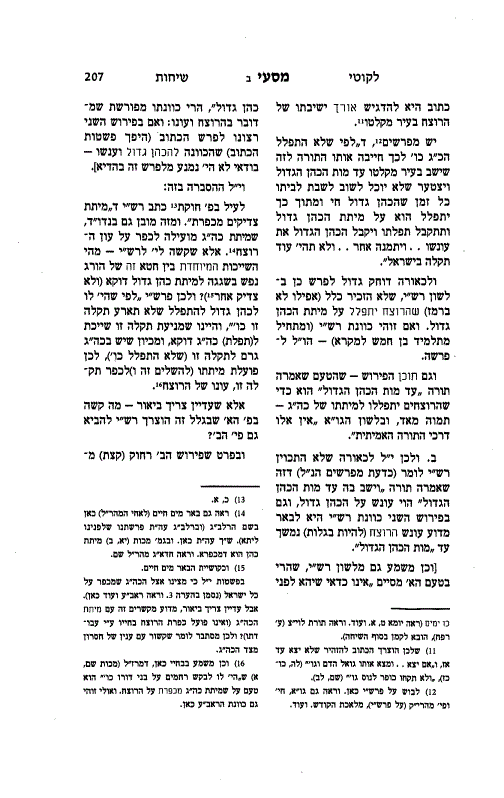
Therefore, it seems that Rashi did not intend to say (as the aforementioned commentators) that the Torah's statement "and he shall dwell there until the death of the high priest" is a punishment for the high priest. Even in Rashi's second explanation, his intention is to explain why the punishment of the murderer (to be in exile) lasts until "the death of the high priest." This is also implied by Rashi's language, as in the first reason he concludes, "it is not fitting that he should be before the high priest," clearly indicating that he is speaking about the murderer and his punishment; if in the second explanation he intended to interpret the verse (contrary to the simple meaning) as referring to the high priest and his punishment, he certainly would not have refrained from explaining this explicitly.
We can explain this as follows: Earlier, in Parshas Chukas, Rashi wrote that "the death of the righteous atones." From this, it is understood in our case as well that the death of the high priest serves to atone for the sin of the murderer. However, Rashi is troubled by what the specific connection is between this particular sin of killing a person unintentionally and the death of the high priest specifically (and not another righteous person).
Therefore, Rashi explains, "because the high priest should have prayed that such a mishap not occur, etc." This indicates that preventing such a mishap is specifically related to the high priest's prayer. Since the high priest bears some responsibility for this mishap (by not praying, etc.), his death acts to rectify and atone for this mishap, the sin of the murderer.
However, further clarification is needed: What difficulty in the first explanation prompted Rashi to also present a second explanation? Especially since the second explanation is somewhat distant from the straightforward interpretation, as it is difficult to say that the determination of the murderer's punishment, which extends his stay in the city of refuge until the death of the high priest, is due to the high priest's lack of caution ("that he should have prayed"). Rashi could have sufficed with the first explanation, which is from the perspective of the murderer ("it is not fitting that he should be before the high priest").
Some commentators explain that if it were only for the first reason, he would never be allowed to stand before any high priest, even another one, since this one brings the Divine Presence and this one removes it, as Rashi writes in the verse "for your sword... it is not proper that the shortener should be wielded over the lengthener." However, this explanation seems forced, because it is understood that the sin of the murderer and the effect of the sin are at the time of the sin — during the life of this high priest, as his act of murder "weakened" the high priest's ability to bring the Divine Presence and prolong the days of his generation, and therefore "it is not fitting for him to be before this high priest" specifically.
This can be understood by prefacing with what we find in Rashi's commentary on the Torah, that it is not his usual practice to explain the reasons for the laws and commandments of the Torah (since it is not necessary for the study of the simple meaning of the text), except when the reason is relevant to understanding the simple meaning. From this, it is also understood in our case that Rashi's bringing the reasons for the murderer dwelling in his city of refuge "until the death of the high priest" is not merely to expound on the reason for the verse but to resolve a difficulty in the scriptures here.
The law that "he shall dwell there until the death of the high priest" follows the statement "and the congregation shall save the murderer from the hand of the avenger of blood and return him, etc., to his city of refuge." It is puzzling: What is the connection between the rescue from the avenger of blood and "the death of the high priest"? If the city of refuge is because the murderer needs protection from the avenger of blood, what changes in this and even nullifies the necessity through the death of the high priest?
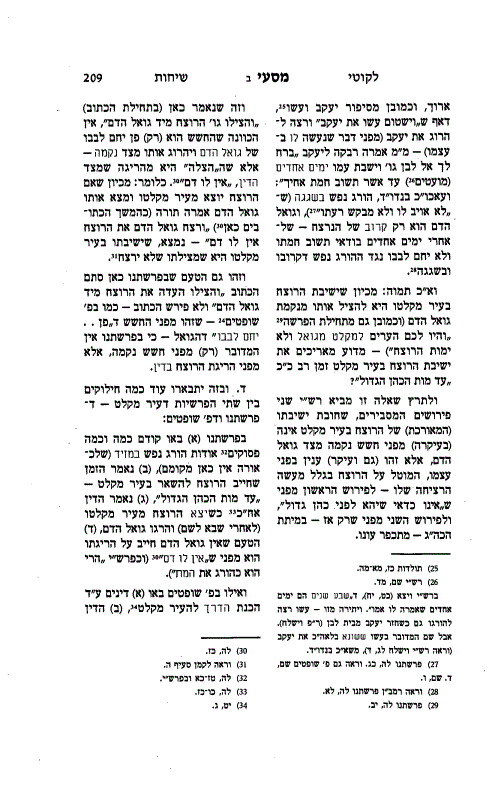
Furthermore, according to the simple meaning, the concern of revenge — "lest he pursue... his heart be heated" — does not last long, as is evident from the story of Jacob and Esau. Even though "Esau hated Jacob" and wanted to kill Jacob (for something done to him personally), nevertheless, Rebecca told Jacob, "Flee to Laban... and stay with him for a few days (a short time) until your brother's anger subsides." All the more so in our case, where the killing was unintentional ("he was not his enemy nor sought his harm"), and the avenger of blood is only a relative of the murdered — after a few days, his anger would surely subside, and his heart would not be heated against the murderer of his relative and unintentionally.
Therefore, it is puzzling: Since the murderer's stay in his city of refuge is to save him from the avenger of blood's revenge (as is evident from the beginning of the portion), why is it necessary for him to remain there until the death of the high priest?
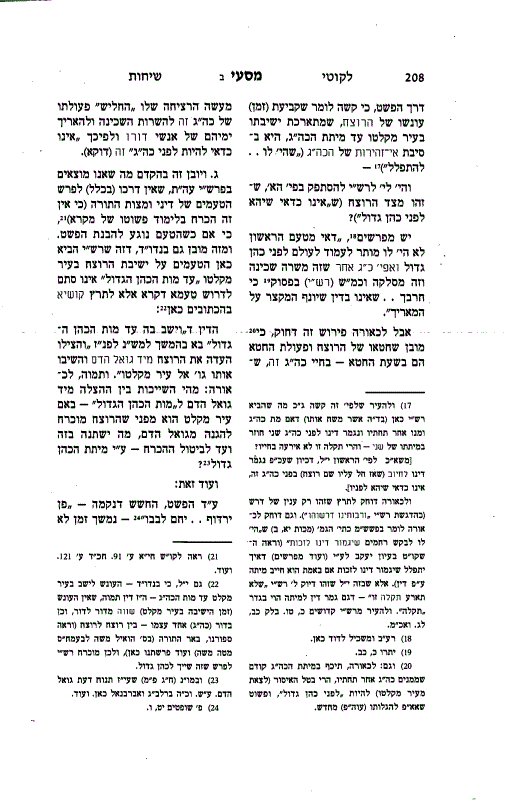
Why is the murderer required to remain in the city of refuge for such an extended period "until the death of the high priest"? To answer this question, Rashi provides two explanations. These explanations clarify that the extended stay of the murderer in the city of refuge is not primarily due to the fear of revenge from the avenger of blood. Rather, it is mainly a matter concerning the murderer himself because of his act of killing. According to the first explanation, it is because "he is not worthy to be before the high priest," and according to the second explanation, it is because only then — with the death of the high priest — is his sin atoned for.
When it says here (at the beginning of the verse) "and they shall save the murderer from the hand of the avenger of blood," it does not mean that the concern is (only) that the heart of the avenger of blood will be heated and he will kill him out of revenge. Rather, the "saving" is from a killing that is justified by law, "he has no blood."
In other words, since if the murderer leaves his city of refuge and the avenger of blood finds him, the Torah states (as the continuation of the verses here) "and the avenger of blood shall kill the murderer; he has no blood" — it turns out that his stay in his city of refuge is what saves him from being killed.
This is also why in our portion here, the verse simply states "and the congregation shall save the murderer from the hand of the avenger of blood" without specifying — as it does in the portion of Shoftim — that this is due to the concern "lest his heart be heated" of the avenger. Because in our portion, it is not (only) about the fear of revenge, but about the lawful killing of the murderer.
This explains several differences between the two portions regarding the city of refuge — our portion and the portion of Shoftim: In our portion (a) several verses precede concerning intentional murder (which seemingly do not belong here), (b) the time the murderer must remain in the city of refuge is stated — "until the death of the high priest," (c) the law is stated afterward when the murderer leaves his city of refuge (after he has arrived there) and the avenger of blood kills him, (d) the reason the avenger of blood is not liable for killing him is because "he has no blood".
Whereas in the portion of Shoftim, (a) the laws concerning the preparation of the road to the city of refuge are mentioned, (b) the law if the avenger of blood pursues the murderer on his way to the city of refuge, (c) and it is stated there that "he (the murderer) has no death sentence because he did not hate him from yesterday or the day before." According to the above, the reason for the differences is understood: In the portion of Shoftim, it discusses the saving of the murderer from the revenge of the avenger of blood, which is primarily an immediate concern, at the time of fleeing to the city of refuge. Therefore, the laws of preparing the road to the city of refuge (and also preparing "many cities of refuge") are stated there so that the murderer can flee there — "lest the avenger of blood pursue the murderer because his heart is heated and he overtakes him because the road is long," where there is the concern "lest he pursue... because his heart is heated" (and in this, the verse emphasizes that "he has no death sentence" to be killed by the avenger of blood while he is still on his way to the city of refuge).
In contrast, in our portion, it primarily discusses the (continued) stay of the murderer in his city of refuge after the concern of the avenger of blood's revenge has already been nullified, and the saving of the city of refuge is so that the avenger of blood does not kill him lawfully. Therefore, the verse precedes with the laws of intentional murder and emphasizes (twice) "the avenger of blood shall kill the murderer when he meets him," meaning that the avenger of blood has a Torah obligation to kill the murderer. Following this, it is stated that in the case of unintentional killing, "and they shall judge...
The congregation shall judge between the striker and the avenger of blood according to these judgments. They shall save the murderer from the hand of the avenger of blood, and he shall dwell there until the death of the high priest. But if the murderer goes out and the avenger of blood finds him and kills him, he has no blood guilt." From this, it is understood that these matters are laws of the Torah — the judge forbids the avenger of blood from killing the murderer while he is in his city of refuge. However, "if the murderer goes out beyond the boundary of his city of refuge and the avenger of blood finds him and kills him," the reason for this is because outside his city of refuge, "he has no blood," meaning "it is as if he kills a dead person" (as mentioned earlier), because in this state, his judgment is considered as if he is liable to death.
Based on the above, the difference between Rashi's two interpretations and the reason Rashi needed to bring a second reason is understood:
According to the first interpretation, that "he comes to cause the Divine Presence to dwell, etc., and the murderer comes to remove, etc., it is not fitting that he should be before the high priest," it follows that the murderer’s stay in his city of refuge is not a punishment or atonement for his sin, but rather a secondary matter related to the high priest, as the murderer has placed himself in a situation that compels him to be away from the high priest ("it is not fitting that he should be before the high priest").
However, this interpretation is somewhat difficult, for why should the departure of the murderer from his city of refuge be so severe that "he has no blood" ("it is as if he is dead") — is it because he places himself in a situation where "it is not fitting (that he should be before the high priest)" that he should be subject to a death penalty?
Moreover, according to this, it follows that the fact that the city of refuge is a protection and salvation ("refuge") from the avenger of blood is a result and consequence of (the obligation to dwell in this city and) the prohibition to leave it, for when he transgresses this prohibition, his blood is permitted for death by the avenger of blood (as mentioned earlier) — contrary to the simple understanding of the matter, that the reason (and beginning) of the obligation to place the murderer in this city is (because it is a "refuge," meaning) to save him "from the hand of the avenger of blood."
Therefore, Rashi brings a second reason, that until the death of the high priest, his sin has not yet been atoned for. According to this, the reason is understood that if he leaves his city of refuge, "he has no blood," because until the death of the high priest, he still has a death penalty due to his act of murder, but as long as he is in his city of refuge, it protects and saves him from this punishment.
From all this, we can learn a wonderful lesson regarding the love and unity of Israel:
The high priest represents the highest level among the Jewish people, while one who kills unintentionally represents the lowest level [for one who kills intentionally is liable to death and is considered a dead person, but among those who remain alive, there is nothing lower than one who kills unintentionally, which is why only he is given the punishment of exile].
The verse teaches us that even these two extremes among the Jewish people are dependent on each other, to the extent that the Torah links the atonement of this murderer with the high priest, for this is the role of the high priest — to love Israel, as we find with Aaron the high priest, who was "a lover of even the creatures."
This is also the connection between Rashi's two interpretations — in both, the great love of Israel by the high priest is emphasized: in the first interpretation — in the positive aspect, that he "comes... to prolong the days" of Israel [as my father explains that this is the reason the chamber of the high priest is called "the chamber of wood," because "wood signifies longevity... as the days of a tree are the days of my people," and "the high priest is associated with longevity as it is written, 'Length of days is in her right hand,' indicating that longevity is drawn from the attribute of the right, which is kindness... and this is the attribute of the high priest."
Rashi further adds that the high priest involves himself even in the welfare of such individuals who require prayer so that no mishap should occur through them to Israel. He prays for them as well, and his prayer is accepted, ensuring that only goodness and kindness will befall Israel, always, all the days.