Sicha 2.
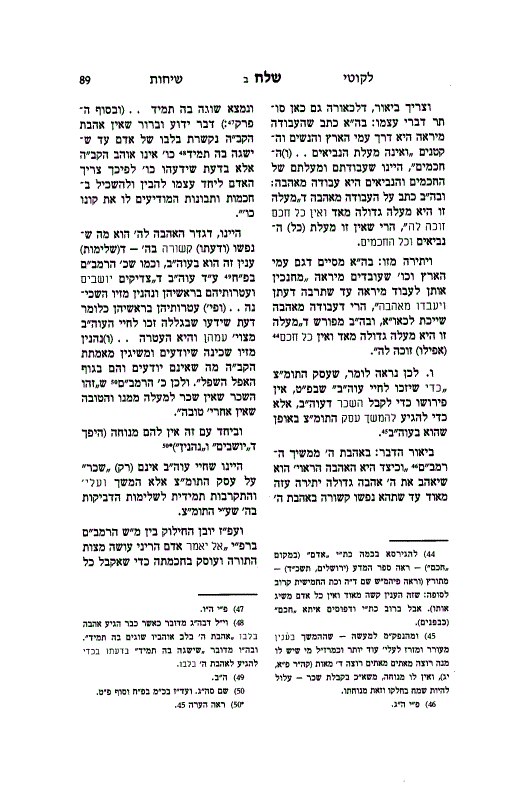
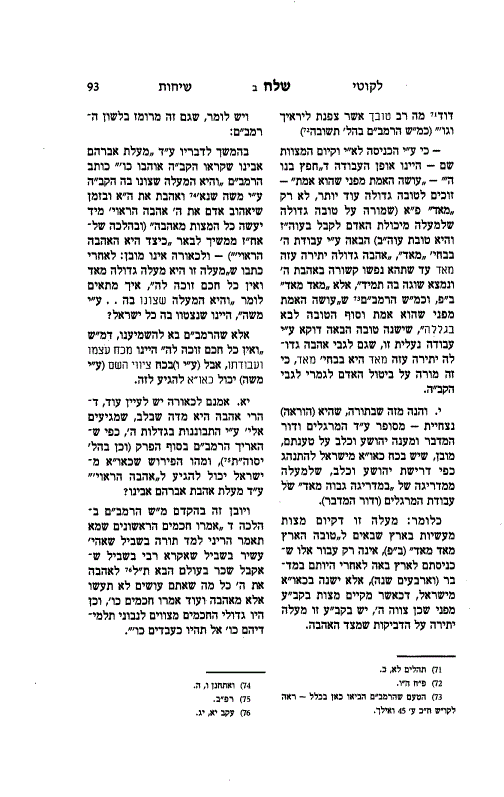
1. From the fact that the spies are referred to (in our parsha) as a "congregation" and there were ten of them (since Yehoshua and Kalev were not included among them), our Sages learned that every ten Jews, when they join together, are considered a complete "congregation".
It requires clarification why the source for this law, regarding the special status of a "congregation" in matters of holiness (that "any matter of holiness should not be with less than ten"), is specifically learned from the spies (about whom it is written, "How long shall I bear with this evil congregation")?
And even though the law regarding a holy congregation ("there is no matter of holiness with less than ten") is that even a wicked person "joins the count of ten for any matter of holiness... (because) a Jew, even if he sins, remains a Jew and stands in his holiness and does not leave the category of Israel," this seemingly is not a sufficient reason. For [in addition to the fact that if we say (as implied from the simple meaning of the text) that the spies were considered rebels against G‑d (as Caleb said, "Do not rebel against the L‑rd"), it is not straightforward according to halacha if "rebels" can be included in the count of ten for a matter of holiness, especially when all ten are "rebels" — thus] the teaching from the spies that "congregation" is ten also pertains to the law of "congregation" in the Sanhedrin ("and the congregation shall judge... and the congregation shall save") which is ten, where it is clear that a wicked person is not included.
It can be said that this is one of the hints in the revealed aspect of the Torah to what is explained in the inner dimension of the Torah, that the spies were on a lofty level. Meaning, not
only was their intention not, G‑d forbid, rebellion in the simple sense, but on the contrary, "they were on a very high level," as will be explained at length below.
As explained in various places, the revealed aspect of the Torah and the inner dimension of the Torah are one Torah. Therefore, even though each part has its own definitions and rules, and just as we do not derive halacha from Aggadah, nevertheless, since in essence it is one Torah, it is understood that there is a connection, a relationship, and even a unification between them (to the extent that they are like body and soul to each other, as stated in the Zohar). Even those matters in the inner dimension of the Torah that at first glance do not seem to align with the simple meaning and halacha have their foundation and source in the revealed Torah, whether hinted at or explicitly.
Similarly, in our case, even though according to the simple meaning of the text (and the revealed Torah in general), the spies sinned a grave sin, and because of it, they themselves were punished, and through them, the entire generation of the desert, etc., nevertheless, it must be said that even in the revealed Torah, there is at least a hint of the virtue of the spies as explained in the inner dimension of the Torah.
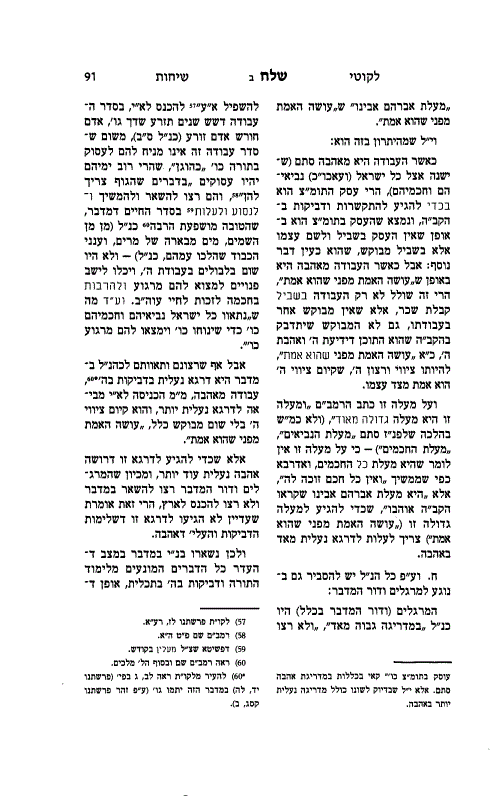
2. In the teachings of Chassidus (the inner dimension of the Torah), it is explained that the reason the spies did not want to enter the Land of Israel was due to their great virtue in the service of G‑d. They did not want to enter the Land of Israel because they refused to lower themselves to the order of life of "six years you shall sow your field, etc.," to engage in physical and material matters, similar to the saying of Rabbi Shimon bar Yochai, "Is it possible for a person to plow, etc., and sow, etc., what will become of the Torah?" Their entire desire and wish (as a continuation of the giving of the Torah) was to remain in seclusion in the desert, detached from settled life, without the burdens of livelihood, etc. (for G‑d provided their needs in the desert through the manna, bread from heaven, and the water from Miriam's well, and through the clouds of glory that accompanied them, killed the snakes and scorpions, and ironed their clothes, etc.). This is indeed the true way to study Torah and to be attached to G‑d, as our Sages say, the Torah was given (to be expounded) only to those who eat manna.
However, they erred in this, for there is a greater virtue in the service within the order of life in the Land of Israel, in the fulfillment of the mitzvos that depend on the land, and practical mitzvos in general, even compared to the virtue of attachment, etc., that was in the desert.
Based on this, it can be said that regarding the aforementioned matter — that specifically from the "congregation" of the spies we learn that ten from Israel are considered a "holy congregation" — it is hinted that the sin of the spies was not in its simple meaning, but rather they erred in thinking that the path (mentioned above) they chose was the primary path in the service of G‑d,
but because of the greatness of their virtue and their level in the service of G‑d.
And furthermore (and it can be said that this is the main point) their effort to influence the Jewish people in this matter.
— this is a great and severe sin.
3. It can be further said that the root of the behavior of the spies, which is something rooted in holiness, is also hinted at and learned from the fact that the people of the generation of the desert remained in the desert for forty years. They did not live lives of suffering and troubles, but on the contrary, lives of tranquility. For all forty years they had the manna for sustenance, water from Miriam's well, and so on, and the clouds of glory protected them, etc. (as mentioned above).
Seemingly: This was the argument and desire of (the spies and) the generation of the desert to remain in the desert and not enter the Land of Israel. How is it fitting that their request was fulfilled and they remained in the desert in tranquility, with the cloud of the L‑rd upon them day and night, etc.?
[Furthermore: According to what is known, that the punishments of the Torah are meant to rectify the blemish of the sin, and until the situation becomes the opposite of the sin, it is most puzzling that in this case, their desire was not denied, nor was their sin (entering the land) rectified and denied. Rather, the conduct with them was as they wished, that the entire generation remained all their years in the desert! And even if we say that due to their sin they were not worthy to enter the Land of Israel (since they despised the land, they did not merit to enter it), nevertheless, what is the explanation that the punishment would be to remain in the desert in a life of tranquility, etc., within the Clouds of Glory, with Moshe and Aharon at their head, etc.?]
And according to the above explanation (in the inner dimension of the Torah), it can be said that the reason for this is that the spiritual advantage of the desert (which was their intention, and for the sake of Heaven) is not a mistake (rather, from this came and branched out an actual mistake).
In other words, the dwelling in the desert within the Clouds of Glory, etc., in itself possesses holiness. However, they thought that this was the ultimate purpose, even though this level is (it should be said) a preparation for entering the Land of Israel. For in order to reach the elevated stage of entering the Land of Israel, the preparation and training through their forty-year stay in the desert was necessary.
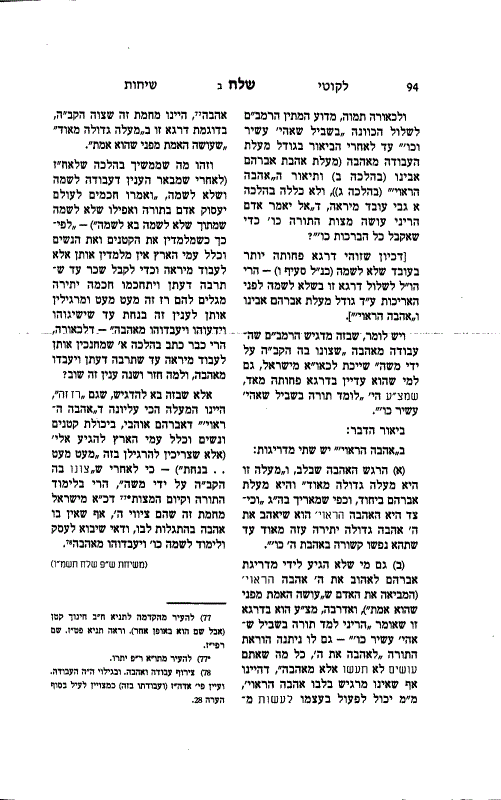
4. it is necessary to clarify the words of the Rambam in the Laws of Repentance, through which it is possible to explain this interpretation (in the inner dimension of the Torah) — in the style of halacha:
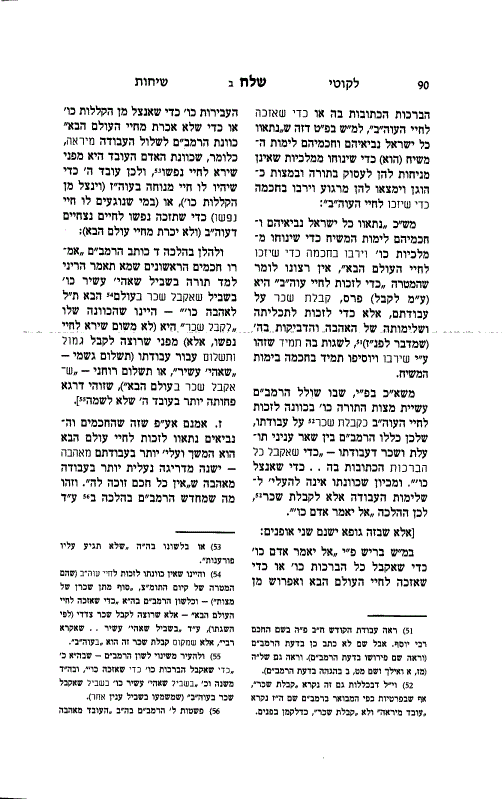
In the tenth chapter of the Laws of Repentance, the Rambam writes: A person should not say, "I will perform the commandments of the Torah and engage in its wisdom so that I will receive all the blessings written in it, or so that I will merit the life of the World to Come. And I will refrain from the transgressions that the Torah warned against so that I will be saved from the curses written in the Torah, or so that I will not be cut off from the life of the World to Come." It is not proper to serve G‑d in this manner, for one who serves in this way is serving out of fear. This is not the level of the prophets, nor the level of the wise. One should not serve G‑d in this manner, except for the unlearned, women, and children, whom we educate to serve out of fear until their knowledge increases and they serve out of love.
In the previous chapter, it is written "And because of this, it was given—
All of Israel, their prophets and sages, longed for the days of Mashiach so that they could be free from kingdoms that do not allow them to properly engage in Torah and mitzvos, and they would find rest and increase in wisdom in order to merit the life of the World to Come."
And seemingly, this requires explanation: How can it be said in the chapter that "it is not fitting to serve G‑d in this manner... and it is not the level of the prophets nor the level of the sages," when previously it is explicitly written that this is the way of the prophets and the sages (therefore "all of Israel, their prophets and sages, longed for the days of Mashiach"), which indicates that this is indeed the level of the prophets and the sages?
Simply put, it can be said that there are two matters: In Chapter 9, it does not refer to the manner of fulfilling the mitzvos, but rather to explaining the content and essence of the reward for the mitzvos in the life of the World to Come, which is "the ultimate reward and the final good that has no interruption or deficiency." Therefore, "all the prophets desired it," and "David greatly desired the life of the World to Come," and for this reason, all of Israel, their prophets, and sages also desired (this state in the world) the days of Moshiach, because only through this (can they properly engage in Torah and mitzvos and) merit the life of the World to Come.
In contrast, in Chapter 10, the Rambam explains the desirable manner of fulfilling the mitzvos, that the intention in engaging in Torah and mitzvos should not be to merit the life of the World to Come, but out of love. Thus, even though there should be a desire for the life of the World to Come, it is not the purpose of fulfilling the mitzvos, but a separate matter.
However, this distinction seems strained, because from the language "(and they will find rest) and increase in wisdom in order to merit the life of the World to Come," it implies that ultimately their thought and intention (even if not at the time of fulfilling the mitzvos) is that engaging in Torah and mitzvos is in order to merit the life of the World to Come.
5. In the following chapter, the Rambam continues (in a separate halacha): One who serves out of love engages in Torah and mitzvos and walks in the paths of wisdom not because of anything in the world, not out of fear of evil, nor to inherit the good, but does the truth because it is the truth, and ultimately good will come because of it. This level is a very great level, and not every wise person merits it. It is the level of our forefather Abraham, whom the Holy One, blessed be He, called His beloved because he served only out of love.
And this requires explanation, for it seems that here too he contradicts his own words: In the first halacha, he wrote that service out of fear is the way of the common people, women, and children "and it is not the level of the prophets... (and) the wise," meaning that the service and level of the wise and prophets is service out of love. Yet in the second halacha, he wrote about service out of love that "this level is a very great level, and not every wise person merits it," indicating that it is not the level of (all) the prophets and all the wise.
Moreover: In the first halacha, he concludes that even the common people, etc., who serve out of fear "are educated to serve out of fear until their knowledge increases and they serve out of love," indicating that service out of love is relevant to everyone. Yet in the second halacha, it is explicitly stated that "this level is a very great level, and not every wise person (even) merits it."
6. Therefore, it seems appropriate to say that the engagement in Torah and mitzvos "in order to merit the life of the World to Come" mentioned in Chapter 9 does not mean for the sake of receiving the reward of the World to Come, but rather to reach a continued engagement in Torah and mitzvos in a manner that is in the World to Come.
The explanation of the matter: In the love of G‑d, the Rambam continues, "And how is the love that is fitting? It is that one should love G‑d with a great, excessive, and very intense love until his soul is bound up in the love of G‑d, and he finds himself constantly enraptured by it... (And at the end of the chapter:) It is well-known and clear that the love of the Holy One, blessed be He, does not become bound in a person's heart until he is constantly enraptured by it, etc. One does not love the Holy One, blessed be He, except through the knowledge by which he knows Him, etc. Therefore, a person needs to dedicate himself to understanding and comprehending the wisdoms and insights that inform him about his Creator, etc."
This means that the definition of love for G‑d is when one's soul (and mind) is bound up with G‑d — the completion of this matter is in the World to Come, as the Rambam writes in Chapter 8 about the World to Come: "The righteous sit with their crowns on their heads and enjoy the radiance of the Divine Presence... (And the explanation is) their crowns on their heads, meaning the knowledge by which they merited the life of the World to Come is present with them, and it is the crown... (And they) enjoy the radiance of the Divine Presence, for they know and comprehend the truth of the Holy One, blessed be He, which they do not know while they are in the dark and lowly body." Therefore, the Rambam writes that "this is the reward that has no greater reward above it and the goodness that has no goodness after it."
And together with this, they have no rest (the opposite of "sitting" and "enjoying").
This means that the life of the World to Come is not (only) a "reward" for engaging in Torah and mitzvos, but rather a continuation, elevation, and constant closeness to the perfection of attachment to G‑d that is achieved through Torah and mitzvos.
Based on this, we can understand the difference between what the Rambam writes at the beginning of his work: "A person should not say, 'I will perform the mitzvos of the Torah and engage in its wisdom so that I will receive all...
The blessings written in it, or in order that I may merit the life of the World to Come," as it is stated in chapter nine that the reason "all of Israel, their prophets, and their sages desired the days of Mashiach is so that they could rest from the kingdoms that do not allow them to engage in Torah and mitzvos properly, and they will find rest and increase in wisdom in order to merit the life of the World to Come."
When it is stated that "all of Israel, their prophets, and their sages desired the days of Mashiach so that they could rest from the kingdoms, etc., and increase in wisdom in order to merit the life of the World to Come," it does not mean that the goal "to merit the life of the World to Come" is for the sake of receiving a reward for their work. Rather, it is to merit the ultimate purpose and perfection of love and attachment to G‑d (as discussed earlier), to always delight in it, which will be achieved by constantly increasing and adding in wisdom in the days of Mashiach.
In contrast, in chapter ten, where the Rambam negates performing the mitzvos of the Torah, etc., with the intention of meriting the life of the World to Come as a reward for one's work, he therefore includes it among other matters of benefit and reward for his work — "in order that I may receive all the blessings written in it... in order that I may be saved, etc." And since his intention is not to elevate to the perfection of the work but to receive a reward, therefore the law is "a person should not say, etc."
However, within this itself, there are two ways:
In what is stated at the beginning of Chapter 10, "A person should not say... in order that I may receive all the blessings... or in order that I may merit the life of the World to Come and refrain from transgressions... in order that I may be saved from the curses... or in order that I may not be cut off from the life of the World to Come," the intention of the Rambam is to negate service out of fear. This means that the intention of the person serving is because he fears for the life of his soul, and therefore serves G‑d so that he may have a life of tranquility in this world (and be saved from the curses, etc.), or (for one whose soul's life is of concern to him) so that his soul may merit eternal life in the World to Come (and not be cut off from the life of the World to Come).
And further on, in Halacha 4, the Rambam writes, "The early sages said, 'Lest you say, I will learn Torah so that I will become wealthy... so that I will receive reward in the World to Come,' therefore it says, 'to love...'" — this means that his intention "to receive reward" is (not because he fears for the life of his soul, but) because he wants to receive compensation and payment for his service (material payment — "so that I will become wealthy," or spiritual payment — "so that I will receive reward in the World to Come"), which is a lower level in serving G‑d not for its own sake.
7. However, even though the fact that the sages and prophets desired to merit the World to Come is a continuation and an elevation in their service beyond love — there is a higher level in service beyond love that "not every wise person merits." This is what Rambam innovates in Halacha 2 regarding
"the virtue of our forefather Abraham" who "does the truth because it is the truth."
And it can be said that the advantage in this is:
When the service is from simple love (which exists among all Jews, and certainly among their prophets and sages), the engagement in Torah and mitzvos is in order to achieve connection and attachment to the Holy One, blessed be He. Thus, the engagement in Torah and mitzvos is in a manner where the engagement is not for its own sake but for a desired goal, which is like an additional matter. However, when the service from love is in a manner of "doing the truth because it is the truth," this negates not only the service for the sake of receiving a reward, but there is no other desire in his service, not even the desire to cleave to the Holy One, blessed be He, which is the content of the knowledge of G‑d and the love of G‑d. Rather, "doing the truth because it is the truth," because it is the command and will of G‑d, and the fulfillment of G‑d's command is truth in and of itself.
And regarding this level, the Rambam wrote, "And this level is a very great level," (and not as he wrote in the previous halacha simply "the level of the prophets," "the level of the sages") — because regarding this level, it cannot be said that it is the level of all the sages. On the contrary, as he continues, "and not every sage merits it," but "it is the level of our father Abraham, whom the Holy One, blessed be He, called His beloved," for to reach this very great level ("doing the truth because it is the truth"), one must ascend to a very high degree in love.
8. Based on all the above, it is also possible to explain concerning the spies and the generation of the desert:
The spies (and the generation of the desert in general) were, as mentioned above, "on a very high level," and "did not want to lower themselves" to enter the Land of Israel, in the order of service of "six years you shall sow your field," where a person plows and sows (as mentioned above, section 2), because this order of service does not allow them to engage in Torah study, etc., "properly," since most of their days would be occupied "with matters that the body needs." They wanted to remain and continue traveling and ascending in the lifestyle of the desert, where goodness was abundantly provided (manna from heaven, water from Miriam's well, and the clouds of glory that accompanied them, as mentioned above) — and there were no disturbances in the service of G‑d, allowing them to sit undisturbed, find rest, and increase in wisdom to merit the life of the World to Come. This is similar to what "all of Israel, their prophets and sages, desired, etc., so that they could rest, etc., and find tranquility, etc."
However, even though their desire and longing to remain in the desert was a lofty level of attachment to G‑d, a service out of love, nevertheless, entering the Land of Israel brings one to an even higher level, which is fulfilling the command of G‑d without any personal desire at all, "doing the truth because it is the truth."
Yet, to reach this level requires an even higher love, and since the spies and the generation of the desert wanted to remain in the desert and did not want to enter the land, this indicates that they had not yet reached this level of complete attachment and the ascent of love.
Therefore, the children of Israel remained in the desert in a state devoid of all things that would prevent the study of Torah and complete attachment to G‑d, in a manner of—
rest and tranquility in order to "increase in wisdom," through which they achieved the ultimate attachment of the soul, etc. After this, in the next generation, in a new generation and level, they entered the Land of Israel to fulfill the command of the L‑rd, both in the very act of entering and in the fulfillment of the practical mitzvos in the land, where specifically in this is felt the matter of "doing the truth because it is the truth."
And it can be said that this is also the content of the words of Yehoshua and Caleb in response to the entire congregation of the children of Israel, "If the L‑rd desires us, He will bring us, etc."—that the entry into the land is connected with "the L‑rd desires us," this is the desire and will of the L‑rd, and consequently, in its fulfillment, "the L‑rd desires us" is revealed, an attachment of the children of Israel to G‑d in a manner higher than the attachment through "increasing in wisdom" in the desert.
9. Now, the Rambam, when speaking about one who "does the truth because it is the truth," concludes with "and ultimately, good will come because of it." At first glance, what is the relevance of this conclusion here — after all, we are discussing a wise person who does not think at all about the good that comes to him from his service.
It can be said that this is understood from the precise wording of the Rambam, "and ultimately, good will come because of it." This means that when one's service is in such a manner that he "does the truth because it is the truth," then the good that comes is also higher than the usual good of the World to Come. Consequently, also in terms of the connection and attachment of his soul to G‑d, he reaches a higher level of perfection in this — than one whose study of Torah and observance of mitzvos is in a manner where he seeks the connection and attachment to Him.
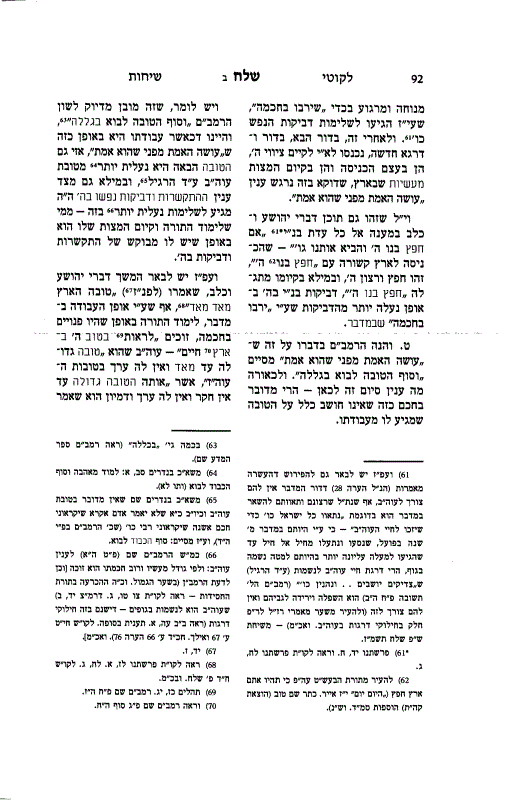
Based on this, we can explain the continuation of the words of Yehoshua and Caleb, who said (previously), "the land is very, very good," even though through the manner of service in the desert, studying Torah in a way that they were free in wisdom, they merit "to see the goodness of the L‑rd in the land of the living" — the World to Come, which is "a very great good and incomparable to the goods of this world," which "that good is so great beyond measure and incomparable and similar to what was said...
"David, how great is Your goodness which You have hidden for those who fear You, etc." (as the Rambam writes in Hilchos Teshuvah).
— For through entering the Land of Israel and fulfilling the mitzvos there — which is the manner of service of "The L‑rd desires us" — "doing the truth because it is the truth" — one merits an even greater goodness, not only "very" once (which indicates a great goodness beyond human capacity to receive in this world, and it is the goodness of the World to Come) that comes through serving G‑d in the aspect of "very," "a great and intense love, exceedingly strong, until his soul is bound in the love of G‑d and he is constantly enraptured by it," but "very very" twice, as the Rambam writes that "one does the truth because it is the truth and ultimately the goodness will come because of it," there is a goodness that comes specifically through this elevated service, which even in relation to a great and intense love, exceedingly strong, is in the aspect of very, for this indicates the complete nullification of the person in relation to the Holy One, blessed be He.
10. And behold, from the fact that in the Torah, which is an eternal instruction — it is recounted about the spies and the generation of the desert and the response of Yehoshua and Caleb to their argument, it is understood that every single Jew has the power to conduct themselves according to the demand of Yehoshua and Caleb, which is above the level of "a very high level" of the service of the spies (and the generation of the desert).
This means: The advantage of fulfilling practical mitzvos in the land, which leads to "the land is very, very good" (twice), is not only for those whose entry into the land came after being in the desert (and forty years), but it exists in every Jew. When one fulfills mitzvos with kabolas ol (acceptance of the yoke) because this is what G‑d commanded, there is in this kabolas ol a superior quality over the attachment that comes from love.
It can be said that this is also hinted at in the language of the Rambam:
Following his words about "the greatness of our forefather Abraham whom the Holy One, blessed be He, called His beloved," the Rambam writes, "And this is the level that the Holy One, blessed be He, commanded us through Moses, as it is said, 'And you shall love the L‑rd your G‑d,' and when a person loves G‑d with the appropriate love, he will immediately perform all the mitzvos out of love" (and in the subsequent halacha, he continues to explain "what is the appropriate love"). — At first glance, it is not understood: After writing that "this level is a very great level and not every wise person merits it," how is it fitting to say "and this is the level that we were commanded in... through Moses," meaning that all of Israel were commanded in it?
However, the Rambam comes to inform us that when he writes "and not every wise person merits it," it means through one's own power and effort. But through the command of G‑d (via Moshe), every individual can reach this.
11. However, at first glance, there is room for further examination, for love is an emotion of the heart that is reached through contemplation of the greatness of G‑d, as the Rambam elaborates at the end of the chapter (and also in Hilchos Yesodei HaTorah). What is the meaning that every Jew can reach the "appropriate love" in the manner of the love of our forefather Avraham?
This can be understood by prefacing with what the Rambam writes in Halacha 4: "The early sages said, perhaps one might say, I will learn Torah so that I will become wealthy, so that I will be called a rabbi, so that I will receive reward in the World to Come. Therefore, it says, 'to love G‑d,' all that you do should be done out of love. And furthermore, the sages said, etc., and so the great sages would command their discerning students, etc., do not be like servants, etc."
And it is seemingly puzzling, why did the Rambam wait to negate the intention "so that I will be rich, etc." until after explaining the great virtue of serving out of love (the virtue of the love of our forefather Avraham (in Halacha 2) and the description of the "appropriate love" (in Halacha 3)), and did not include it in Halacha 1 regarding one who serves out of fear, where it says "a person should not say, I will perform the mitzvos of the Torah, etc., in order to receive all the blessings, etc."?
[Since this is a lower level in serving not for its own sake (as mentioned above in section 6) — it should have negated this level of not for its own sake before elaborating on the great virtue of our forefather Avraham and the "appropriate love"].
It can be said that in this, the Rambam emphasizes that the service out of love "which the Holy One, blessed be He, commanded us through Moshe" is relevant to every Jew, even to someone who is still on a very low level, who by himself would "study Torah so that I will be rich, etc."
Explanation of the matter:
In "the appropriate love" there are two levels:
(1) The feeling of love in the heart, and "this level is a very great level," and it is particularly the level of Avraham. As the Ba'al HaGolah elaborates, "And how is the appropriate love? It is that one should love the L‑rd with a great, excessive, and very intense love until his soul is bound up in the love of the L‑rd, etc."
2. Even someone who has not reached the level of Avraham to love G‑d with the appropriate love (which brings a person to "do the truth because it is the truth"), and on the contrary, is at the level where he says, "I study Torah so that I will become rich, etc." — even he is given the Torah's instruction "to love G‑d, all that you do should be done only out of love." That is to say, even though he does not feel in his heart the appropriate love, nevertheless, he can influence himself to act out of love, meaning because the Holy One, blessed be He, commanded it, similar to this very high level of "doing the truth because it is the truth."
And this is what continues in the subsequent halacha (after explaining the concept of serving for its own sake and not for its own sake, "and the sages said a person should always engage in Torah study even not for its own sake, for from not for its own sake he will come to for its own sake") — "therefore, when teaching children and women and the general populace, they are taught only to serve out of fear and to receive reward until their knowledge increases and they gain greater wisdom, then this secret is revealed to them little by little, and they are accustomed to this matter gently until they grasp it and know it and serve out of love." At first glance, it seems that he already wrote in the first halacha that they are educated to serve out of fear until their knowledge increases and they serve out of love, so why does he repeat this matter again?
However, this comes to emphasize that even "this secret," meaning the highest level of "appropriate love" of Avraham, My beloved, can be reached by children, women, and the general populace (but they need to be accustomed to it "little by little... gently") — because after "the Holy One, blessed be He, commanded it through Moshe," in the study of Torah and the fulfillment of mitzvos by every Jew because they are G‑d's commandments, even if there is no love revealed in his heart, he will certainly come to engage and study for its own sake, etc., and serve out of love.
(From the talk of Shabbat Parshat Shelach, 5746)