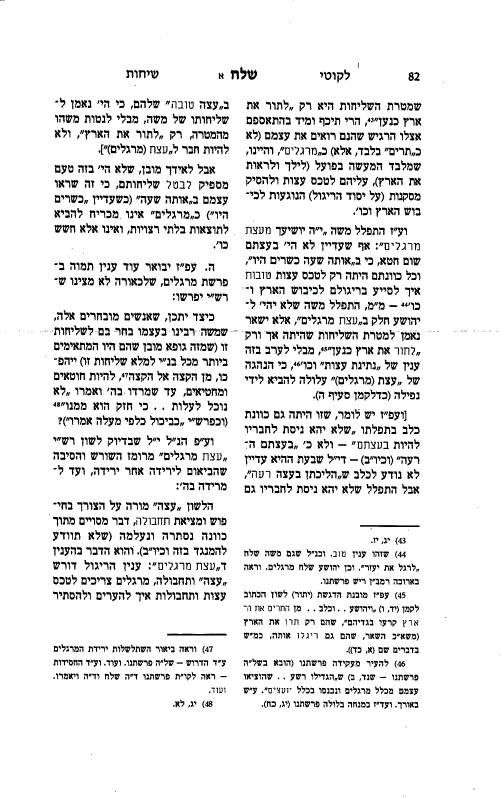
First, in Rashi's commentary on our parsha regarding the spies, we find contradictions concerning their status at the time of their sending: At the beginning of the parsha, on the verse "all of them were men," Rashi explains, "at that time they were righteous." However, later on, regarding the verse "and Moses called Hoshea the son of Nun, Joshua," he explains, "he prayed for him, 'May G‑d save you from the counsel of the spies,'" which implies that even then Moses sensed the wickedness of the spies. This is also explicitly stated in Rashi's commentary later on the verse "and they went and came to Moses" — "just as their coming was with evil intent, so too was their going with evil intent."
And regarding the resolution of the contradiction in Rashi's commentary on the verse "and they went and came," the commentators have already explained that this is the precision in Rashi's earlier comment "at that time they were righteous," meaning only at the time they were chosen and appointed "they were righteous" — "to exclude after that time," once they embarked on the journey ("and they went"), they turned and became wicked.
But this does not resolve what Rashi writes, that Moshe prayed for his student Yehoshua, "May G‑d save you from the counsel of the spies," for this was at "that time" when they were chosen, before they began their journey.
There are those who explain that "immediately after they were selected" they were already not fitting, and they explained that "initially, when they were selected, they were fitting, and Moshe commanded them on the mission by the word of G‑d to see the land, how it could be conquered. But the evil inclination sparked within them, and they returned to Moshe to ask for signs about the land, whether it was good or bad, and whether the people were strong or weak, and whether the cities were fortified. Moshe sensed that their intention was negative, for why should they investigate more than what they were commanded? Therefore, it is written... and Moshe called Yehoshua, when he sensed their evil inclination, he prayed for Yehoshua."
But this explanation requires further examination:
First, it is very difficult to say that Rashi's intention is...
The statement "at that time they were virtuous" refers only to a very short period, from the time of their appointment until they "returned to Moshe to report the signs of the land" [which, simply, there was no delay between their appointment and Moshe's words to them "Go up this way in the south, and see the land, etc."].
Second, according to their interpretation, Rashi should have said "at the time of their appointment they were virtuous" or something similar.
Third, and primarily: If "Moshe felt that their intention was for evil" — why did he persist in his choice to send these spies and not send others in their place whose intentions would not be evil (since certainly this was within Moshe's ability)?
[And what is explained in the commentaries (the reason Moshe prayed for Yehoshua to be saved "from the counsel of the spies" but did not prevent him from going with them) that Moshe thought perhaps Yehoshua and Kalev could turn them away from their evil thoughts — does not resolve this question, for how could he risk the potential harm to all the children of Israel — because perhaps Yehoshua and Kalev might succeed in turning them to good! — Especially since he could have chosen not to send them at all].
Second, it seems one could ask a similar question regarding the entire matter of sending the spies, for according to Rashi, from the very beginning Moshe knew it was not a desirable matter, and yet he did not refrain from sending them.
Regarding the verse "Send for yourself men," Rashi comments: "Send for yourself — according to your own understanding. I am not commanding you; if you wish, send. Because the Israelites came and said, 'Let us send men before us.'... The Holy One, blessed be He, said, 'I told them that it (the Land of Israel) is good... By their lives, I will give them room to err through the words of the spies so that they will not inherit it.'" From this, it emerges that even though Moses heard from the Holy One, blessed be He, that there was no need to send the spies, nevertheless, Moses' own opinion ("according to your own understanding") agreed with it.
This matter is further clarified in Rashi's commentary later in Parshas Devarim (on the verse "And the matter was good in my eyes"), where the reason Moses agreed to send the spies is only because he thought, "Perhaps you will retract when you see that I am not preventing you" (as illustrated by the example he brings there of "a man who says to his friend, 'Sell me your donkey,' and he replies, 'Yes, I will give it to you for a trial,' and he says, 'Yes.'... When he saw that he was not preventing him at all, the buyer said to himself, 'He is confident that I will not find a defect in it,' immediately he said, 'Take your money, and I will not test it'"). Clearly, even though...
Moses sensed that the intention of the Children of Israel was not for the good (as can also be understood from the very manner of the Israelites' request, as Rashi explains there that they all approached "in confusion, children pushing the elders, etc."), nevertheless, he agreed to the request of the Israelites (contrary to his own desire — that of Moses).
And since, in any case, we see that even before this, he did not refrain from sending them (for whatever reason it may be), even though their intention was not good — therefore, there is no longer a question in our case why he did not prevent the sending of the spies after Moshe sensed that their intention was negative.
But it cannot be said so — because there is a significant difference in the matter:
In the above-mentioned Rashi's commentary, it discusses the request of the Children of Israel, "Let us send men before us," because they did not believe in the goodness of the land, and therefore it was not pleasing in the eyes of the L‑rd because "I said to them that it is good." And in this, the reason is understood why Moshe agreed to their words, because he thought that when they see that he is not afraid to send men to see the land, this itself would prove to the Children of Israel that the land is good, and consequently, they would retract from this desire.
And also the fact that Moshe agreed to send the spies even after he saw that the Children of Israel did not retract — this can be explained by the fact that he therefore chose righteous individuals, "the heads of the Children of Israel" (as Rashi states in Parshas Devarim, "from the distinguished among you, from the selected among you"), relying on them to see the goodness of the land and also to bring back with them the fruit of the land. Through this, it would be clarified to the Children of Israel with tangible evidence that indeed the land is very, very good, and on the contrary, their desire to ascend to the land would be strengthened.
But if we say that Moshe sensed in the very people he chose that "their intention was for evil," then there is no reason to send them — and why did he not try to prevent them?
Therefore, it seems to me that the two matters, "at that time they were righteous," and Moshe's prayer "May G‑d save you from the counsel of the spies" — from the outset are not contradictory to each other, as will be explained.
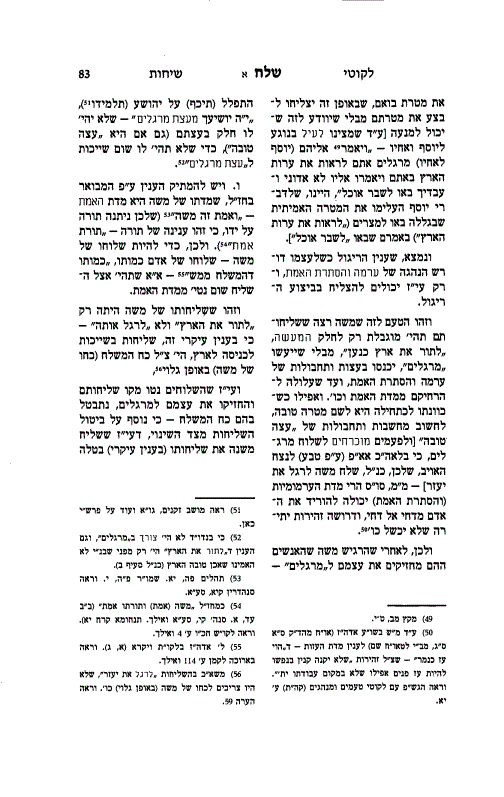
3. This can be understood by first examining Rashi's wording, "May G‑d save you from the counsel of the spies," and similarly, later regarding Caleb, Rashi specifies that "he prostrated himself on the graves of the Patriarchs so that he would not be persuaded by his companions to join their counsel." At first glance, it would seem more appropriate to use language that describes their sin—such as "slander," as it is written, "and they spread slander about the land," [and as Rashi himself states at the beginning of the parsha, "Why is the section of the spies juxtaposed to the section of Miriam? Because she was punished over matters of slander," and similarly later in the matter, "they intended to spread slander"], or "the sin of the spies." Why then does Rashi specifically use the term "counsel"?
It can be said that Rashi deliberately uses this term to emphasize that he does not mean to say that G‑d should save him from the sin of the spies, because at that time "they were still righteous" (and were not yet associated with the sin of "slander," etc.), but only
from the "counsel of the spies," "counsel" in general—not necessarily a bad counsel (as this was only later revealed during their journey, "their journey with bad counsel," as explained by some of the commentators). On the contrary, since "at that time they were righteous," it was certainly considered by them as "good counsel." Nevertheless, Moses prayed for Joshua, "May G‑d save you from the counsel of the spies," because even though their intention was good, their "counsel" could still lead to error, etc. (as indeed happened in practice), and therefore he prayed that he be saved from it.
4. Explanation of the matter:
Throughout the entire parsha, the mission of the spies is described using the term "tour" — "and they shall tour the land of Canaan," "tour the land," "tourists," and similar expressions. Not once in our parsha is the term "spies" mentioned in connection with this mission. This is not because there is something lacking or undesirable in the sending of spies, for we find (later in Parshas Chukas) that even afterwards, Moshe himself sent [spies] "to spy out Ya'zer," and similarly, Yehoshua sent spies.
Regarding the reason for this, it can be said:
The difference between the two expressions — "latur" (to scout) or "leragel" (to spy) — is as follows: "Latur" primarily describes only the act of searching and seeing, and in our context — seeing the land and its inhabitants. In contrast, the term "leragel" implies investigation and searching for a hidden purpose, such as espionage that aids in the conquest of enemy territory [similar to what we find earlier (in Parshas Miketz) regarding Yosef and his brothers — "And he said to them (Yosef to his brothers), 'You are spies; you have come to see the nakedness of the land,'" and Rashi explains, "the vulnerabilities of the land, from where it is easy to conquer"]. Generally, the concept of espionage is associated with the wisdom of the spy, based on whose investigations and searches one can devise a plan to fulfill a specific mission (such as conquering enemy territory, and the like).
This is the reason that in our parsha, only the expression "to scout the land of Canaan" is used, and similar expressions — because the entire mission (as intended by Moshe) was solely about the action, that they should see the land and its inhabitants and report to the children of Israel what they saw (and also to bring from the fruit of the land to show Israel the goodness of the land), and nothing more — but not "to spy the land," to involve themselves in searching for "strategies" and schemes for conquering the land and the like.
With this, we can understand the content of Moshe's prayer, "May G‑d save you from the counsel of the spies":
Even though Moshe emphasized to the men he chose...
That the purpose of the mission was only "to scout the land of Canaan," nevertheless, immediately upon gathering with him, he sensed that they saw themselves (not merely as "scouts," but) as "spies." This means that besides the actual act (of going and seeing the land), they felt it was upon them to devise strategies and draw conclusions (based on the espionage) relevant to the conquest of the land, etc.
And for this, Moshe prayed, "May G‑d save you from the counsel of the spies": Even though at that time there was no sin in their counsel, for "at that moment they were righteous," and their entire intention was only to devise good strategies on how to assist with their espionage for the conquest of the land, etc. — nevertheless, Moshe prayed that Yehoshua would not have a part in the "counsel of the spies," but would remain faithful to the mission's purpose, which was solely "to scout the land of Canaan," without involving the matter of "giving counsel," etc., because the conduct of "the counsel (of spies)" could lead to downfall (as will be explained later in section five).
Based on this, it can be said that this was also the intention of Caleb in his prayer "that he should not be drawn to his companions to be in their counsel" — and not "in their evil counsel" (or similar expressions) — for it can be said that at that time Caleb did not yet know that "their journey was with evil counsel," but he prayed that he should not be drawn to his companions even in their "good counsel," because he was faithful to the mission of Moses, without deviating in the slightest from the goal, which was solely "to scout the land," and not to be a partner in the "counsel of the spies."
On the other hand, it is understood that this was not a sufficient reason to cancel their mission, because the fact that they saw themselves at "that time" (when they were still "righteous") as "spies" does not necessarily lead to undesirable outcomes, and it is merely a concern, etc.
Fifth, based on this, another puzzling matter in the episode of the spies will be explained, which seemingly Rashi does not interpret:
How is it possible that these distinguished individuals, whom Moshe Rabbeinu himself chose for this mission (from which it is understood that they were the most suitable among all the Children of Israel to fulfill this mission), would turn from one extreme to the other, becoming sinners and leading others to sin, to the point that they rebelled against G‑d and said, "We cannot go up... for they are stronger than us" (as Rashi explains, "as if to say, against the Most High")?
According to the above, it can be said that Rashi's precise wording "the counsel of the spies" hints at the root and reason that led them to a decline after decline, until they rebelled against G‑d.
The term "counsel" indicates the need for searching and finding a strategy, a specific matter with a hidden and concealed intention (so that it will not be known to the opponent in this and similar matters). And this is the matter with the "counsel of the spies": the matter of espionage requires "counsel" and strategy; spies need to devise strategies and tactics on how to deceive and conceal.
The purpose of their coming, in this manner, they would succeed in fulfilling their purpose without it being known to the one who could prevent it. [Similar to what we find earlier regarding Yosef and his brothers — "And he said to them (Yosef to his brothers), 'You are spies; you have come to see the nakedness of the land.' And they said to him, 'No, my lord, but your servants have come to buy food,'" meaning that according to Yosef's words, they concealed the true purpose for which they came to Egypt ("to see the nakedness of the land") by saying that they came "to buy food."]
It follows that the matter of spying in itself requires a conduct of cunning and concealment of the truth, and only through this can they succeed in carrying out the spying.
This is the reason why Moshe wanted their mission to be limited only to the practical aspect, "to scout the land of Canaan," without becoming "spies," engaging in schemes and strategies of cunning and concealment of the truth, to the point that it could distance them from the attribute of truth, etc. And even when the intention from the outset is for a good purpose, to think thoughts and strategies of "good counsel" [and sometimes it is necessary to send spies, because otherwise it is impossible (according to nature) to defeat the enemy, which is why, as mentioned above, Moshe sent to spy out Ya'azer] — nevertheless, ultimately, the attribute of cunning (and concealment of the truth) can lead a person from one downfall to another, and it requires extra caution not to stumble, etc.
Therefore, after Moshe felt that those men considered themselves as "spies," he immediately prayed for Yehoshua (his disciple), "May G‑d save you from the counsel of the spies" — so that he would not have any part in their counsel (even if it is a "good counsel"), in order that he would have no connection to the "counsel of the spies."
And we can sweeten the matter according to what is explained in the words of our Sages, that Moshe's attribute is the attribute of truth — "and truth is Moshe" (therefore the Torah was given through him, because this is the essence of the Torah — "the Torah of truth"). Therefore, to be Moshe's emissary — the emissary of a person is like the person himself, "exactly like the sender" — it is impossible for the emissary to have any deviation from the attribute of truth.
And this is why Moshe's mission was only "to tour the land" and not "to spy it" — because in this fundamental matter, a mission related to entering the land, the power of the sender (Moshe's power) had to be openly present,
And through this, that the spies deviated from their mission and considered themselves as spies, the power of the one who sent them was nullified within them—because in addition to the nullification of the mission due to the change, by the fact that a messenger changes his mission (in a fundamental matter), the mission is nullified.
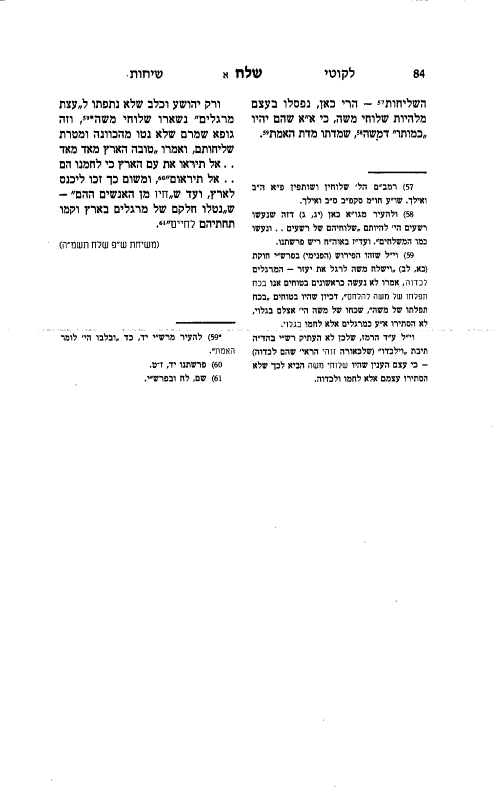
The mission—here, they were essentially disqualified from being the emissaries of Moshe, because it is impossible for them to be "like him," like Moshe, whose attribute is the attribute of truth.
And only Yehoshua and Kalev, who were not enticed by the "counsel of the spies," remained the emissaries of Moshe. This itself preserved them, as they did not deviate from the intention and purpose of their mission, and they said, "The land is very, very good... Do not fear the people of the land, for they are our bread... Do not fear them." Because of this, they merited to enter the land, and even to the extent that "they lived from those men"—that "they took the portion of the spies in the land and stood in their place for life."
(From the talk of Shabbat Parshat Shelach, 5745)