
Beha'alosecha 3
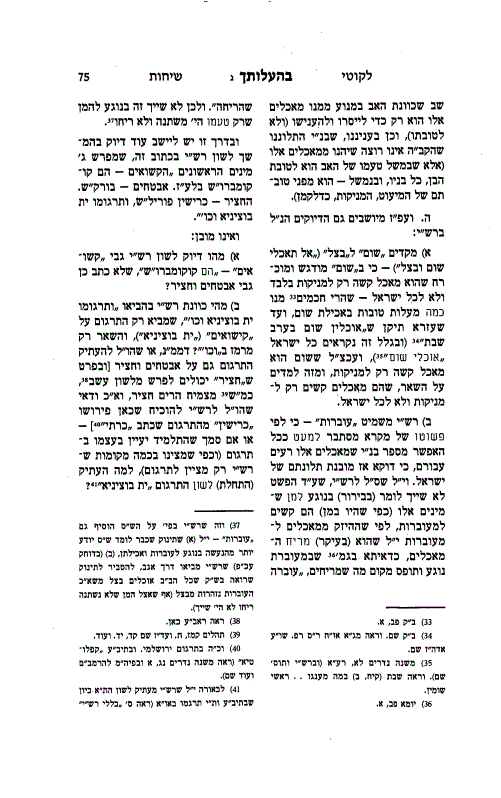
1. "We remember the fish that we ate in Egypt for free, the cucumbers, the melons, the leeks, the onions, and the garlic." In Rashi's commentary on the words "the cucumbers," he brings (from the Sifrei): "Rabbi Shimon said, why did the manna change into everything except these? Because they are difficult for nursing women. It is said to a woman, do not eat garlic and onions because of the child. A parable to a king, etc., as it is stated in the Sifrei."
And behold, in the Ramban, he explains the complaint of the Children of Israel, "We remember... what we ate in Egypt..." that this is "like remembering forgotten things, for they had not eaten fish from the day they left Egypt until now. And the reason... 'for free' in its simple meaning is because the Egyptian fishermen would make them work to draw the fish, etc., and they would give them from the fish, etc. And the cucumbers, melons, leeks, onions, and garlic were very abundant in Egypt because it is like a vegetable garden, and when they would dig in the gardens, they would eat from the vegetables." According to his explanation, there was only one complaint here, that in the desert they lacked those foods that they ate in Egypt "for free" (and similarly, most of the simple commentators of the scripture explained it this way);
However, Rashi divides the verse into two parts. Regarding the words "that we ate in Egypt for free," he explains (based on the Sifrei) "free from mitzvos," and concerning "the cucumbers," he explains (as mentioned above) that the manna did not change its taste to these five species (cucumbers, melons, leeks, onions, garlic). This means there were two complaints against the manna: a) that the manna was dependent on the performance of mitzvos, whereas the fish they ate in Egypt was "free from mitzvos," b) in Egypt, they also had the five species of cucumbers, etc., but in the desert, these species were lacking because "the manna changes to everything except these."
It can be said that Rashi's necessity to divide the verse into two is hinted at in the words he quotes from the verse — "the cucumbers," for according to Ramban's interpretation, the entire verse is a continuation.
If it were one continuous thought, it should have said "and the cucumbers"; from the fact that it says "the," it proves that here begins a new matter (complaint).
2. there is a need to delve into the very explanation itself:
For behold, the words of Rabbi Shimon in the Sifrei are as follows: "Rabbi Shimon says, why did the manna change for them into everything they desired except for these five species? It is comparable to a king of flesh and blood who entrusted his son to a tutor and would sit and command him, saying, 'See to it that he does not eat harmful food, etc.' And yet, the son would complain about his father, saying that it is not because he loves me, but because he does not want me to eat [that which he does not desire]."
Here, there is a significant difference between the language of the Sifrei and the language of Rashi — in the Sifrei, only the parable is brought, whereas Rashi adds explanation and interpretation (in the words of Rabbi Shimon) "because they are difficult for nursing women, they say to a woman, do not eat garlic and onion because of the child."
It is difficult to understand from where Rashi derives that Rabbi Shimon's intention is that these foods are harmful only to nursing women, and not in the straightforward meaning of the parable that they are simply bad foods for everyone.
It is even more perplexing: In the Gemara, it is explicitly stated, "Why are they called cucumbers? Because they are as harmful to the entire body of a person as swords." It is clearly stated that cucumbers are bad food for every person (and for the entire body), to the extent that this is hinted at in their name. If so, it is certain that Rabbi Shimon's words can be interpreted in their simple sense, that these types are "bad foods" in general [and Rambam in Hilchos De'os lists "grass, onions, and garlic" (the last three types here) among "bad foods... (that) a person should eat only a very small amount of these, and in the rainy season"]. So from where does Rashi derive to limit the general words of Rabbi Shimon and say that his intention is that they are harmful only to nursing women?
The source of this matter, "They say to a woman, do not eat garlic and onion because of the child," is in the Sifrei (as also brought in Rashi's commentary on the Talmud), but it is in the Sifrei later on — regarding the verse "and its taste was like the taste of oil," where one of the interpretations in the Sifrei is "just as the breast ["lashad" is an expression of breasts] is one type and changes into many types, so too the manna would change for the Israelites into whatever they desired, a parable says to a woman, do not eat garlic and onion because of the child" (as explained by the commentators, that...
The intention of the Sifrei is that it would change for every taste except for those that are difficult for nursing women "because of the child".
However, this matter is not brought in the statement of Rabbi Shimon. Furthermore, only two types are mentioned there, "garlic and onion" — and from this, there is no proof that the other three types are also difficult for nursing women.
3. it is also necessary to understand several nuances in Rashi's language, among them:
A. Rashi does not quote the main part of Rabbi Shimon's statement, which is the parable of a king of flesh and blood, etc., and he only brings the beginning, "A parable of a king, etc., as it is stated in the Sifrei." And even though Rashi adds an explanation as to why the taste of the manna did not change for these types (as mentioned above), nevertheless, in Rashi's words, there is no explanation for the content of the complaint of the Children of Israel. This is explained only in Rabbi Shimon's parable, where the son thinks that the reason his father commanded not to give him these foods is because he does not want him to enjoy the quality of these foods ("it is impossible for him to eat").
B. why does Rashi also mention the name of the author of the statement — Rabbi Shimon?
As has been explained many times, Rashi's intention in mentioning the name of the author of the statement in a few places in his commentary (even though in most places he does not bring something in the name of its speaker) is to hint at an additional explanation in the content of his commentary, through the knowledge that this statement was said by a particular Tanna (or Amora).
And these two points become more pronounced when comparing this Rashi to his commentary a few verses earlier, on the verse "And the people cried out to Moshe," where he writes, "A parable of a king of flesh and blood who was angry with his son, and the son went to his father's friend and said to him, 'Go and ask for me from my father.'" This parable also originates from the Sifrei on that spot, and the author of the statement is Rabbi Shimon. And there (a) Rashi copied the entire parable (and did not note that its source is the Sifrei), (b) he omitted the author of the statement!
c) Here Rashi wrote, "because they are difficult for nursing women," but in his commentary on the Talmud, he wrote that the manna did not change to these five types because they are "difficult for pregnant and nursing women." It is puzzling why Rashi omitted "for pregnant women" in his commentary on the Torah [since the reason "because of the child" seemingly applies to pregnant women as well as to nursing women. Furthermore, it is reasonable—especially in learning according to the straightforward meaning—to increase as much as possible the number of the Children of Israel for whom the manna did not change to these types, and therefore Rashi certainly should have added in his commentary on the Torah that they are also difficult for pregnant women].
d) Why does Rashi precede "garlic" to "onion" ("Do not eat garlic and onion")—the opposite of their order in the verse—"and the onions and the garlics."
4. it can be said that the explanation of all this is — simply:
In this verse, the argument of the children of Israel is explained regarding
that the intention of the father in withholding these foods from him is only to chastise and punish him (and not for his benefit). Similarly, in our case, the children of Israel complained that the Holy One, blessed be He, does not want them to enjoy these foods (but in the analogy, the father's reason is for the benefit of the son, all his children, and in the application — it is for the benefit of the minority, the nursing mothers, as will be explained).[1]
5. Based on this, the aforementioned nuances in Rashi are also clarified:
a) He precedes "garlic" to "onion" ("Do not eat garlic and onion") — because with "garlic" it is emphasized and necessary that it is a difficult food only for nursing women and not for all of Israel — for the sages have enumerated several good qualities in eating garlic, and even Ezra instituted that "they eat garlic on Friday night" (and because of this all of Israel are called "garlic eaters"), and it must be said that garlic is a difficult food only for nursing women, and from this we learn about the others, that they are difficult foods only for nursing women and not for all of Israel.
b) Rashi omits "pregnant women" — because according to the simple meaning of the text, it is reasonable to minimize as much as possible the number of the children of Israel for whom these foods are harmful, because only then is their complaint understood. And it can be said that Rashi holds that, according to the simple meaning, it is not appropriate to say (clearly) regarding the manna that these species (as they were in the manna) are difficult for pregnant women, because the harm from foods for pregnant women can be said to be (mainly) from the smell of the foods, as it is stated in the Gemara that for a pregnant woman what they smell affects and takes place, "a pregnant woman who smelled." Therefore, this is not relevant regarding the manna, whose taste would change but not its smell.
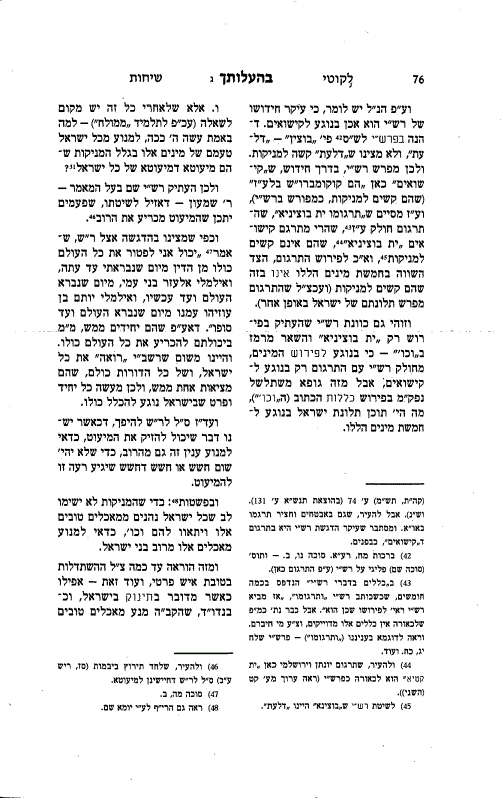
In this manner, we can also resolve another precision in the continuation of Rashi's language on this verse, where he explains the first three species: "The cucumbers — they are 'kukumberos' in the vernacular. Watermelons — 'borkes'. Leeks — 'karishin porilash', and its translation is 'yit butziniya', etc."
And it is not understood:
First, what is the precision in Rashi's language regarding "cucumbers" — "they are 'kukumberos'", which he did not write similarly regarding watermelons and leeks?
Second, what is Rashi's intention in bringing "and its translation is 'yit butziniya', etc.", where he only brings the translation for "kishuim" ("yit butziniya") and the rest he only hints at with "etc."? For either he should have copied the translation also for "avatichim" and "chatzir" [especially since "chatzir" can be interpreted as grass, as it is written "He causes the grass to grow for the mountains," and therefore Rashi should certainly have proven that here it means "leeks" from the translation which writes "karti"], or if he relied on the student to look up the translation themselves (as we find in several places where Rashi only refers to the translation), why did he copy the (beginning of the) translation "yit butziniya"?
Based on the above, it can be said that Rashi's main innovation is indeed regarding "kishuim". For in Rashi's commentary on the Talmud, he explains "butzin" as "pumpkin", and we do not find that "pumpkin" is difficult for nursing women. Therefore, Rashi innovatively explains that "kishuim" here are "cucumbers" in the vernacular (which are difficult for nursing women, as explicitly stated in Rashi), and on this he concludes that "its translation is 'yit butziniya'", indicating that the translation disagrees with this, as it translates "kishuim" as "yit butziniya", which are not difficult for nursing women. Therefore, according to the translation, the commonality among these five species is not that they are difficult for nursing women (and it must be said that the translation interprets the complaint of the Israelites in a different manner).
And this is also Rashi's intention in only copying in his commentary "yit butziniya" and hinting at the rest with "etc." — because regarding the interpretation of the species, Rashi disagrees with the translation only concerning "kishuim", but from this itself derives a practical difference in the interpretation of the overall verse (the "etc."), regarding what was the content of the Israelites' complaint concerning these five species.
6. However, after all this, there is room for a question (at least for a "sharp" student) — why indeed did G‑d do this, to prevent all of Israel from tasting these species because of the nursing women who are a minority of a minority of all Israel?
Therefore, Rashi quotes the author of the statement — Rabbi Shimon — who follows his own reasoning, that sometimes it is possible for the minority to outweigh the majority.
As we find emphasized with Rabbi Shimon, who said, "I can exempt the entire world from judgment from the day I was created until now, and if Elazar my son is with me, from the day the world was created until now, and if Yotam son of Uzziah is with us, from the day the world was created until its end." Although they are truly individuals, nevertheless, they have the power to influence the entire world. This is because Rabbi Shimon bar Yochai "sees" all of Israel, and of all generations, as truly one entity, and therefore the actions of each and every individual in Israel affect the entire collective.
And similarly, Rabbi Shimon holds the opposite view, that when there is something that could potentially harm the minority, it is worthwhile to prevent this matter even from the majority, so that there should be no concern or even a concern of a concern that this harm might reach the minority.
Simply put: in order that the nursing women should not notice that all of Israel is enjoying these good foods and desire them, etc., it is worthwhile to withhold these foods from the majority of the people of Israel.
From this, we learn how much effort must be made for the benefit of an individual, and furthermore — even when it concerns a Jewish infant, as in our case, where the Holy One, blessed be He, withheld good foods.
This applies to all the children of Israel so that there should be no concern of harm to nursing infants — and all the more so, there must be an effort to the point of mesiras nefesh for the spiritual well-being of the young boys and girls of Israel, to care for them, and especially that each one of them receives an education in the purity of holiness, in such a way that "even when he grows old, he will not depart from it."
"(From the talks of Parshas Beha'aloscha and Parshas Shelach, 5728)"