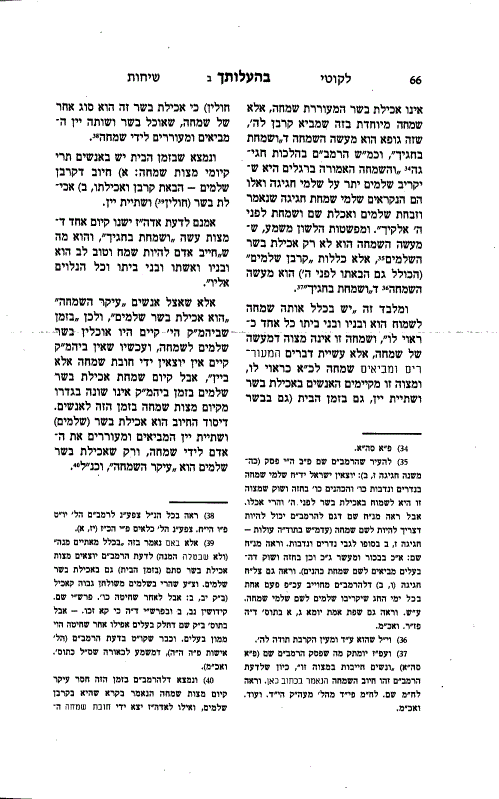
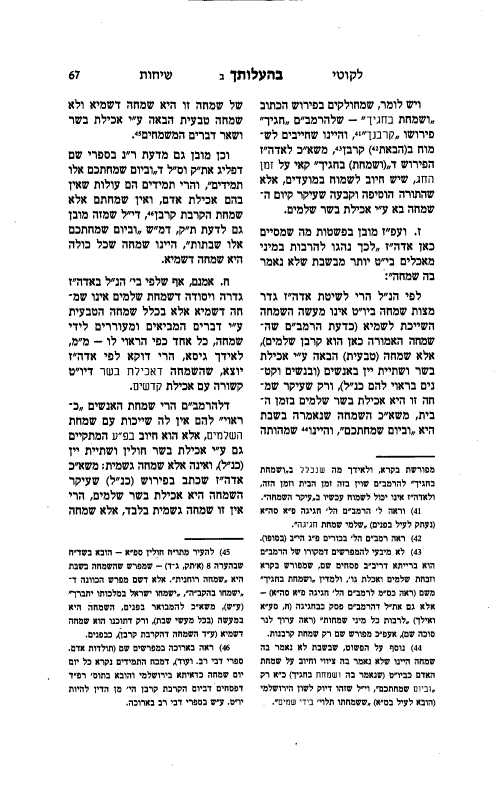
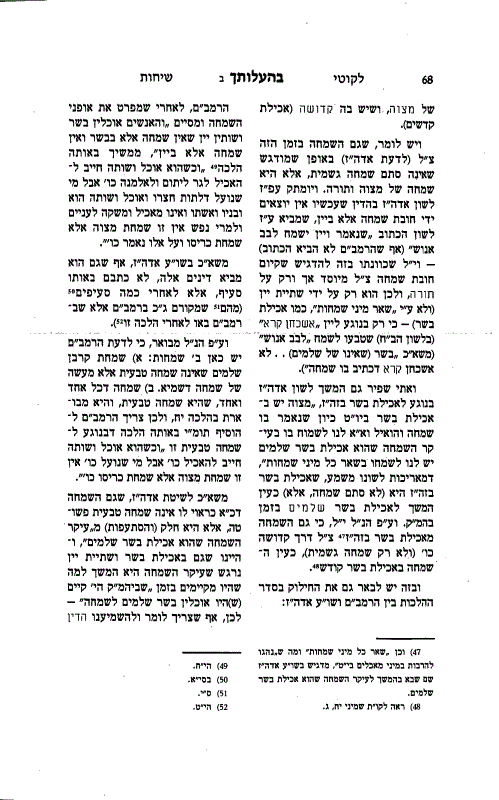
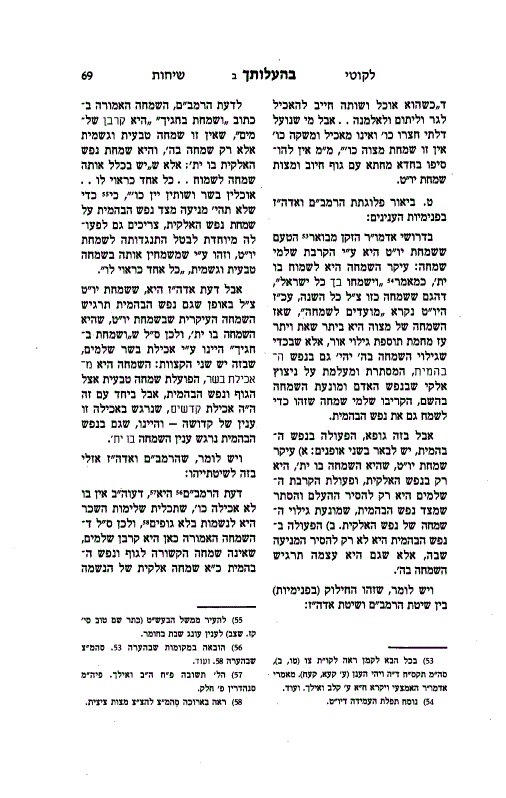
- It is stated in the Sifri on our parshah (on the verse: “And on the day of your rejoicing and on your festivals… you shall sound the trumpets…”): “ ‘And on the day of your rejoicing’—these are the Shabbosos.” From this we understand that Shabbos is a day of joy. So too it appears from the Yerushalmi in Megillah, where we derive the law that when Purim falls on Shabbos, the Purim meal is not held on Shabbos itself (but rather after Shabbos), from the verse: “To make them days of feasting and joy”—only something whose joy depends on Beis Din; this excludes Shabbos, whose joy depends on Heaven.
Now, the Alter Rebbe wrote in his Shulchan Aruch (in the laws of Yom Tov): “The custom is to increase the variety of foods on Yom Tov more than on Shabbos, for regarding Shabbos joy was not stated.” Seemingly, this implies that there is no obligation of joy on Shabbos at all (unlike the Sifri and Yerushalmi above). So too the poskim agreed that there is no obligation of joy on Shabbos, as Tosafos explicitly states in Moed Katan: “Regarding the festival… joy is written concerning them; regarding Shabbos… joy is not written.” (A similar idea appears in the She’iltos and elsewhere.)
However, it can be explained that the Alter Rebbe’s intent in writing “regarding Shabbos joy was not stated” is not to exclude Shabbos from the entire concept of joy, but only to negate a joy comparable to the joy of Yom Tov (which is the subject discussed there in Shulchan Aruch). For the joy of Yom Tov has a unique definition, and this particular definition of joy does not exist regarding Shabbos. In this, the novelty of the Alter Rebbe in this סעיף concerning the definition of the joy of Yom Tov is emphasized, as will be explained further on.
- And this is the wording of the Alter Rebbe there in the laws of Yom Tov:
“All seven days of Pesach, the eight days of the festival [Sukkos], and likewise on the festival of Atzeres, a person is obligated to be joyful and glad-hearted, he, his children, his wife, his household, and all those dependent upon him. This joy is a positive commandment from the Torah, as it is stated: ‘And you shall rejoice on your festival, you, your son, and your daughter, etc.’ How does one gladden them? The children are given roasted grain and nuts; the women are bought clothing and jewelry according to one’s means; and the men, at the time when the Beis HaMikdash existed, would eat the meat of shelamim offerings for joy. And now that the Beis HaMikdash no longer exists, one does not fulfill the obligation of joy except through wine, as it is stated: ‘And wine gladdens the heart of man.’ However, there is no obligation to eat meat nowadays, since we do not have the meat of shelamim offerings. Nevertheless, there is still a mitzvah in eating meat on Yom Tov, since joy is stated concerning it. And since it is impossible for us to rejoice with the primary joy, which is eating the meat of shelamim offerings, we should gladden ourselves with all other kinds of joys. Therefore, the custom developed to increase the variety of foods on Yom Tov more than on Shabbos, regarding which joy was not stated. Likewise, the garments of Yom Tov should be finer than the garments of Shabbos.”
Seemingly, the Alter Rebbe follows the opinion of the Rambam, who wrote:
“On the festivals… a person is obligated to be joyful and glad-hearted, he, his children, his wife, his household, and all those dependent upon him, as it is stated: ‘And you shall rejoice on your festival, etc.’ Even though the joy referred to here is the korban shelamim, as we explain in the laws of Chagigah, included within that joy is that he should gladden himself, his children, and the members of his household, each according to what is fitting for him. How so? The children are given roasted grain, nuts, and sweets; the women are bought beautiful clothing and jewelry according to one’s means; and the men eat meat and drink wine, for there is no joy except with meat and there is no joy except with wine.”
Several details regarding the obligation of joy on Yom Tov are explained in the Rambam’s words, and the Alter Rebbe in his Shulchan Aruch likewise follows his approach:
a) Even nowadays, although we no longer have the Beis HaMikdash and the korban shelamim of joy, nevertheless there is still a Torah obligation of joy (unlike the opinions that nowadays the joy of the festival is only Rabbinic, because “and you shall rejoice” refers specifically to the shelamim offering of joy).
b) Even nowadays there is still a mitzvah to eat meat on Yom Tov.
c) The fact that children are gladdened with roasted grain and nuts, and women through the purchase of clothing and jewelry according to one’s means, is included within the Torah commandment of “And you shall rejoice on your festival.”
- However, there is a fundamental difference between the words of the Alter Rebbe and the words of the Rambam:
The Rambam writes simply: “And the men eat meat and drink wine, for there is no joy except with meat and there is no joy except with wine,” meaning that both meat and wine are always equal in fulfilling the mitzvah of the joy of Yom Tov. But the Alter Rebbe writes and specifies: “And now that the Beis HaMikdash no longer exists, one does not fulfill the obligation of joy except through wine… however, there is no obligation to eat meat nowadays… nevertheless there is a mitzvah in eating meat on Yom Tov, etc.” Thus, although there is a mitzvah to eat meat on Yom Tov, nevertheless nowadays eating meat on Yom Tov differs from drinking wine: through wine one fulfills the obligation of joy, whereas through meat one does not (for “there is no obligation to eat it nowadays”).
Seemingly, one could explain simply that the Alter Rebbe is not חולק on the Rambam, but rather comes (through this addition) to explain his words (and to answer the Beis Yosef’s question on the Rambam, for in the chapter Arvei Pesachim it states: “Our Rabbis taught: A person is obligated to gladden his children and household on the festival. With what does he gladden them? With wine. Rabbi Yehudah says: men with what is fitting for them and women with what is fitting for them… It was taught: Rabbi Yehudah ben Beseira says: when the Beis HaMikdash existed there was no joy except with meat, as it says: ‘And you shall slaughter peace-offerings and eat there and rejoice.’ But now that the Beis HaMikdash no longer exists, there is no joy except with wine, as it says: ‘And wine gladdens the heart of man.’ … And the Beis Yosef wondered regarding the Rambam: why did he require that they eat meat and drink wine, הרי in the Baraisa it states that nowadays there is no joy except with wine, implying that wine alone suffices without meat.”)
The Alter Rebbe explains the Rambam’s words: that now that the Beis HaMikdash no longer exists, there is a distinction between wine and meat. The primary obligation of joy is through wine (as stated in the Gemara), whereas meat carries no obligation to eat it, but only a mitzvah.
Seemingly, this interpretation in the Rambam’s words—that there is also joy in meat—is based (as the Bach writes) on חולין and Shabbos: “And this statement in Arvei Pesachim means as follows: when the Beis HaMikdash existed, the primary joy was through the meat of shelamim, as the verse states: ‘And you shall slaughter peace-offerings, etc.,’ for there are two joys: one, the joy of bringing shelamim to Hashem, and the other, the joy of eating meat. This is unlike wine, where there is only one joy. But now that the Beis HaMikdash no longer exists, the primary joy is only through wine, as the verse states, etc. But meat is not the primary joy, for we do not find a verse stating joy regarding meat that is not from shelamim. And this is the opinion of Tosafos, who wrote… ‘With what does one gladden? With wine’—this refers to nowadays; but בזמן בית המקדש there is no joy except with meat. End quote. Meaning: nowadays the primary joy is through wine, whereas בזמן בית המקדש the primary joy was only through meat.”
However, it is difficult to explain the Rambam this way (and to say that the Alter Rebbe’s words are only an explanation of the Rambam), because from the simple wording of the Rambam it appears that there is no superiority in the joy of drinking wine over ordinary meat, always, even nowadays.
Furthermore: from the simple wording of the Rambam it appears that even בזמן הבית, the mitzvah of “And you shall rejoice on your festival” obligates equally the eating of meat and the drinking of wine. For he does not mention any distinction between בזמן הבית and בזמן הזה, and only distinguishes between the joy of the korban shelamim and the details of joy that “are included within that joy, that he gladden himself and his children, etc.,” which he then specifies afterwards—that regarding men this means eating meat and drinking wine (even through eating ordinary non-sacrificial meat). But from the Alter Rebbe’s words, “And the men, at the time when the Beis HaMikdash existed, would eat the meat of shelamim,” it is understood that the fulfillment of the mitzvah of joy בזמן בית המקדש was only through the meat of shelamim (and there was no obligation to eat meat and drink wine).
- The difference between the Alter Rebbe and the Rambam can be explained by first introducing another distinction between the wording of the Alter Rebbe and that of the Rambam:
a) The Rambam, at the beginning of the discussion, writes: “A person is obligated to be joyful and glad-hearted, he, his children, his wife, his household, and all those dependent upon him, as it is stated: ‘And you shall rejoice on your festival.’ ” He then continues: “Even though the joy referred to here is the korban shelamim… included within that joy is that he should gladden himself, his children, etc.” And only in the following halachah does he specify: “How so? The children…”
Whereas the Alter Rebbe concludes immediately in the first סעיף: “A person is obligated to be joyful and glad-hearted, etc., and this joy is a positive commandment from the Torah, as it is stated: ‘And you shall rejoice on your festival, etc.’ ” Then, in the next סעיף: “How does one gladden them, etc.,” and afterwards: “And the men, at the time when the Beis HaMikdash existed, would eat the meat of shelamim for joy; and now that the Beis HaMikdash no longer exists, one does not fulfill the obligation of joy except through wine.” He does not mention at the beginning of the discussion that the joy stated in the verse refers to the korban shelamim, but only after he details the joy of each category individually.
b) The Rambam writes: “that the joy referred to here is the korban shelamim,” whereas the Alter Rebbe writes: “they would eat the meat of shelamim for joy.”
- It appears from all this that the Alter Rebbe’s approach differs fundamentally from that of the Rambam regarding the basis of the positive commandment of “And you shall rejoice on your festival.” According to the Rambam, the joy of the korban shelamim and the joy of gladdening oneself, one’s children, and one’s household, each according to what is fitting for him (which includes the men eating meat and drinking wine), are two separate laws and two different types of joy. But the Alter Rebbe holds that they are one (law and) type.
This is reflected precisely in the Rambam’s wording: “Even though the joy referred to here is the korban shelamim… included within that joy is that he gladden himself, his children, etc., each according to what is fitting for him.” Meaning, although this is included within the Torah commandment of “And you shall rejoice on your festival,” nevertheless it is only “included within that joy”—that is, it is an additional joy included within that joy, but the joy actually referred to in the verse is the korban shelamim.
However, according to the Alter Rebbe, “this joy” (that “a person is obligated to be joyful and glad-hearted, he, his children… and all those dependent upon him”) “is the positive commandment from the Torah, as it is stated: ‘And you shall rejoice on your festival, you, your son, and your daughter, etc.’ ”
Meaning, the joy of each person according to what is fitting for him—the children with roasted grain and nuts, the women with clothing and jewelry, and the men, etc.—this itself is the joy referred to in the verse: “And you shall rejoice on your festival, you, etc.” אלא that regarding the men, the manner of fulfilling the joy fitting for them changed: at the time when the Beis HaMikdash existed, they would eat the meat of shelamim for joy, whereas now that the Beis HaMikdash no longer exists, the obligation of joy is through wine.
- The explanation of this is as follows:
According to the Rambam, “the joy referred to here is the korban shelamim,” meaning that the obligation of joy is not merely eating meat that arouses happiness, but rather a unique joy in bringing a korban to Hashem. This itself is the act of joy of “And you shall rejoice on your festival.” As the Rambam writes in the laws of Chagigah: “And the joy referred to regarding the festivals is that one should offer shelamim in addition to the festival offerings, and these are called the shelamim of festival joy, as it is stated: ‘And you shall slaughter peace-offerings and eat there and rejoice before Hashem your G‑d.’ ” From the simple wording it appears that the act of joy is not only the eating of the meat of the shelamim, but the entire “korban shelamim” (which also includes bringing it before Hashem) is itself the act of joy of “And you shall rejoice on your festival.”
In addition to this, “included within that joy is that he should gladden himself, his children, and the members of his household, each according to what is fitting for him.” This joy is not a mitzvah consisting of an act of joy itself, but rather doing things that arouse and bring joy to each person according to what is fitting for him. Men fulfill this mitzvah through eating meat and drinking wine, even בזמן הבית (including ordinary non-sacrificial meat), because this eating of meat is a different type of joy: he eats meat and drinks wine that bring and arouse joy.
It emerges that בזמן הבית men had two fulfillments of the mitzvah of joy:
a) the obligation of the korban shelamim — bringing the offering and eating it;
b) eating meat (ordinary meat) and drinking wine.
However, according to the Alter Rebbe, there is only one fulfillment of the positive commandment of “And you shall rejoice on your festival,” namely that “a person is obligated to be joyful and glad-hearted, he, his children, his wife, his household, and all those dependent upon him.”
Rather, regarding men, “the primary joy” “is the eating of the meat of shelamim.” Therefore, “at the time when the Beis HaMikdash existed, they would eat the meat of shelamim for joy; and now that the Beis HaMikdash no longer exists, one does not fulfill the obligation of joy except through wine.” But the fulfillment of the joy through eating the meat of shelamim בזמן הבית is not different in essence from the fulfillment of the mitzvah of joy for men nowadays. For the foundation of the obligation is the eating of meat (of shelamim) and drinking wine that bring and arouse a person to joy; only that eating the meat of shelamim is “the primary joy,” as explained above.
It can be said that they differ in explaining the verse “And you shall rejoice on your festival”: according to the Rambam, “your festival” means “your korban,” meaning that one is obligated to rejoice through the (bringing of the) korban. Whereas according to the Alter Rebbe, the meaning of “(and you shall rejoice) on your festival” refers to the time of the festival—that there is an obligation to rejoice on the festivals. Only that the Torah added and established that the primary fulfillment of joy comes through eating the meat of shelamim.
- Based on all the above, it is understood simply why the Alter Rebbe concludes here: “Therefore, the custom developed to increase the variety of foods on Yom Tov more than on Shabbos, regarding which joy was not stated.”
According to what was explained above, the definition of the mitzvah of joy on Yom Tov according to the Alter Rebbe is not an act of joy related to Heaven (as the Rambam holds, that “the joy referred to here is the korban shelamim”), but rather a (natural) joy that comes through eating meat and drinking wine for men (and for women and children through what is fitting for them, as explained above). Only that the primary form of this joy is the eating of the meat of shelamim בזמן הבית. In contrast, the joy stated regarding Shabbos is “And on the day of your rejoicing,” meaning that the essence of this joy is a heavenly joy, not a natural joy that comes through eating meat and other things that gladden.
This is also understood from the opinion of Rabbi Nosson in the Sifri there, who disagrees with the first opinion and holds that “ ‘And on the day of your rejoicing’—these are the daily offerings.” הרי the daily offerings are olos, from which man does not eat at all, and their joy is only the joy of bringing the korban. It can therefore be said that from this it is also understood according to the first opinion, that when it says “ ‘And on the day of your rejoicing’—these are the Shabbosos,” it means a joy that is entirely a heavenly joy.
- However, although according to the above explanation in the Alter Rebbe, the definition and foundation of the joy of shelamim is not a heavenly joy but rather included within natural joy through things that bring and arouse joy, each person according to what is fitting for him — nevertheless, on the other hand, specifically according to the Alter Rebbe it emerges that the joy of eating meat on Yom Tov is connected with eating sacred offerings.
For according to the Rambam, the joy of men “according to what is fitting” for them has no connection with the joy of the shelamim, but is rather an independent obligation fulfilled even through eating ordinary meat and drinking wine (as explained above), and is merely a physical joy. Whereas the Alter Rebbe explicitly writes (as above) that the primary joy is the eating of the meat of shelamim, thus this is not merely physical joy, but a joy of mitzvah, one that possesses holiness (the eating of sacred offerings).
It can therefore be said that even nowadays the joy must be (according to the Alter Rebbe) in a manner that emphasizes that it is not merely ordinary physical joy, but rather a joy of mitzvah and Torah. Based on this, the wording of the Alter Rebbe regarding the law that nowadays one fulfills the obligation of joy only through wine is especially precise, when he brings for this the verse: “as it is stated: ‘And wine gladdens the heart of man’ ” (although the Rambam does not cite the verse). It can be said that his intention is to emphasize that the fulfillment of the obligation of joy must be founded solely upon Torah, and therefore it is only through drinking wine (and not through “other kinds of joys,” such as eating meat), because only regarding wine “do we find a verse” (in the language of the Bach) that its nature is to gladden “the heart of man.” (Whereas regarding “meat [that is not from shelamim]… we do not find a verse stating joy concerning it.”)
This also explains היטב the continuation of the Alter Rebbe’s wording regarding eating meat nowadays: “there is a mitzvah in eating meat on Yom Tov, since joy is stated concerning it, and since it is impossible for us to rejoice with the primary joy, which is the eating of the meat of shelamim, we should gladden ourselves with all other kinds of joys.” From the lengthiness of his wording it appears that eating meat nowadays is not merely ordinary joy, but rather a continuation, in a sense, of the eating of the meat of shelamim בזמן הבית. According to the above, it can be said that even the joy from eating meat nowadays must be in a manner of holiness, etc. (and not merely physical joy), resembling the joy of eating sacred meat.
With this, one can also explain the difference in the order of the halachos between the Rambam and the Shulchan Aruch of the Alter Rebbe:
The Rambam, after detailing the forms of joy and concluding: “and the men eat meat and drink wine, for there is no joy except with meat and no joy except with wine,” immediately continues in the same halachah: “And when one eats and drinks, he is obligated to feed the convert, the orphan, and the widow, etc. But one who locks the doors of his courtyard and eats and drinks, he, his children, and his wife, and does not feed and give drink to the poor and bitter-hearted — this is not the joy of a mitzvah but the joy of his stomach, and regarding such people it is stated, etc.”
Whereas in the Shulchan Aruch of the Alter Rebbe, although he too brings these laws, he does not write them in the same סעיף, but only several סעיפים later (some of which are also sourced in the Rambam, except that in the Rambam they appear immediately after this halachah).
According to the above, this is understood: according to the Rambam there are two kinds of joy:
a) the joy of the korban shelamim, which is not natural joy but an act of heavenly joy;
b) the joy of each individual, which is natural joy, and this is discussed in halachah 18. Therefore, the Rambam must immediately add in that same halachah that regarding this natural joy, “when one eats and drinks, he is obligated to feed, etc. But one who locks [his doors], etc., this is not the joy of a mitzvah but the joy of his stomach, etc.”
Whereas according to the Alter Rebbe, even the joy of each individual according to what is fitting for him is not simple natural joy, but rather part of (and an extension of) “the primary joy, which is the eating of the meat of shelamim.” Meaning that even in the eating of meat and drinking of wine it is felt that the primary joy is a continuation of what they fulfilled at the time “when the Beis HaMikdash existed, [when] they would eat the meat of shelamim for joy.” Therefore, although it is necessary to state and teach us the law that “when one eats and drinks, he is obligated to feed the convert, the orphan, and the widow… but one who locks the doors of his courtyard, etc., and does not feed and give drink, etc., this is not the joy of a mitzvah, etc.,” nevertheless this should not be inserted together in one section with the גוף obligation and mitzvah of the joy of Yom Tov.
- An explanation of the disagreement between the Rambam and the Alter Rebbe in the inner dimension of the matter:
In the discourses of the Alter Rebbe, the reason is explained why the joy of Yom Tov comes through the offering of the shelamim of joy: the essence of joy is to rejoice in Him, blessed be He, as in the expression, “And all Israel shall rejoice in You.” Although such joy should exist throughout the entire year, nevertheless the festivals are called “appointed times for joy,” because then the joy of mitzvah is with much greater intensity due to the additional revelation of Divine light. However, in order that the revelation of joy in Hashem should also be present within the animal soul — which conceals and hides the Divine spark within a person’s soul and prevents joy in Hashem — they would offer the shelamim of joy, and this was in order to gladden also the animal soul.
But regarding this itself — the effect upon the animal soul — it can be explained in two ways:
a) The primary joy of Yom Tov, which is the joy in Him, blessed be He, exists only within the Divine soul, and the function of offering the shelamim is merely to remove the concealment and obstruction caused by the animal soul, which prevents the revelation of the joy of the Divine soul.
b) The effect upon the animal soul is not merely to remove its obstruction, but that it itself should also feel the joy in Hashem.
It can be said that this is the (inner) difference between the approach of the Rambam and that of the Alter Rebbe:
According to the Rambam, the joy referred to in the verse “And you shall rejoice on your festival” “is the korban shelamim.” This is not a natural or physical joy, but solely joy in Hashem, the joy of the Divine soul in Him, blessed be He. Only that “included within that joy is that he should gladden… each person according to what is fitting for him… they eat meat and drink wine, etc.” For in order that the animal soul should not obstruct the joy of the Divine soul, an additional action is necessary to nullify its opposition to the joy of Yom Tov, and this is accomplished by gladdening it through natural and physical joy, “each person according to what is fitting for him.”
However, the opinion of the Alter Rebbe is that the joy of Yom Tov must be in a manner that even the animal soul itself should feel the essential joy of Yom Tov, which is the joy in Him, blessed be He. Therefore, he holds that “And you shall rejoice on your festival” is fulfilled through eating the meat of shelamim, for in this there are two extremes together: the joy comes through eating meat, which produces natural joy within the body and the animal soul, yet at the same time it is eating sacred offerings, so that within this eating there is sensed an element of holiness — meaning that even within the animal soul there is felt the joy in Hashem.
It can be said that the Rambam and the Alter Rebbe each follow their consistent approach in this matter:
The opinion of the Rambam is that in the World to Come there is no eating, etc.; the ultimate perfection of reward is for souls without bodies. Therefore, he holds that the joy referred to here is the korban shelamim, which is not joy connected to the body and animal soul, but rather a Divine joy of the soul. (And the joy of the body and animal soul through eating meat and drinking wine is only so that they should not disturb the joy of the Divine soul, as explained above.)
However, the ruling in Chassidus follows the opinion of the Ramban, that the ultimate perfection of reward is specifically for souls within bodies. The intent is to make for Him, blessed be He, a dwelling place in the lower realms, and that the ultimate and complete revelation will be specifically at the time of the resurrection of the dead, when the soul will be within the body. This is because the purpose of the avodah throughout the six thousand years of the world’s existence, and especially during the time of exile, is not merely to reveal the soul, but also to refine and purify the body and the animal soul. Similarly regarding the joy of Yom Tov: the essential joy of rejoicing in Hashem is intended not only for the soul, but the purpose is to bring this joy also into the animal soul.
Therefore, according to the Alter Rebbe in Shulchan Aruch, the definition of joy is a joy connected with the body — drinking wine and eating meat. And even the foundation of the joy, and its primary expression, is not the joy of the korban shelamim itself, but rather the eating of the meat of the shelamim, because the joy of Hashem must be felt and penetrate the physical body literally.
“(From the sichah of Simchas Torah 5740)”