
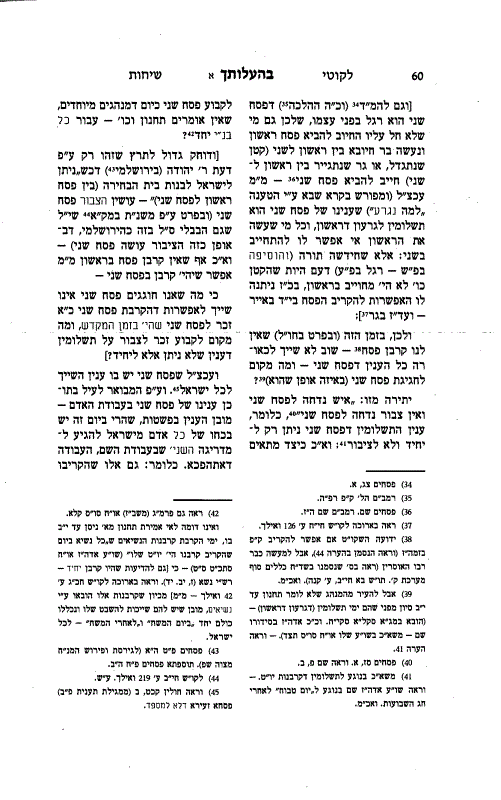

A. Regarding the law of the Second Passover (Pesach Sheni) — that the Torah established the compensation/replacement for the First Passover specifically on the 14th of Iyar, a full month after the First Passover — this requires explanation: What distinguishes the Passover offering (whose compensation time comes only after an interruption of a month) from the other festival offerings, whose compensation days come in continuation of the first day of the festival?
Especially according to the statement of our Sages that the “those impure through a human soul” in the wilderness (who came with the complaint “Why should we be diminished from offering the offering of G‑d in its appointed time,” and merited that this section was stated through them) had the seventh day of their impurity fall on the eve of Passover — for according to this, it would have been possible to establish the time of compensation during the festival itself.
And one may say that (according to the inward dimension of Torah) this is the foundation for the explanation of the Tzemach Tzedek, that the concept of Pesach Sheni in man’s divine service is connected to the content of the service of the month of Iyar, “the second month.”
The content of the explanation of the Tzemach Tzedek:
The concept of Pesach Sheni in man’s service is — the ascent from the first level of the Exodus from Egypt (the First Passover in the month of Nisan, the first month) to the second level (in the month of Iyar, the second month), namely, the service of “and do good” (va’aseh tov) which comes after the prior step of “turn from evil” (sur mera).
That is to say: The Exodus from Egypt is the beginning of the service, “turn from evil” — the departure from Egypt; and as explained in the Tanya, concerning the Exodus from Egypt it is said, “for the people fled,” “because the evil in the souls of Israel was still in its strength, etc.” and their principal service was in the manner of “turn from evil” (fleeing from the impurity of Egypt); and after the preliminary service of “turn from evil,” they rose to the second level — “and do good.”
And in the spiritual service within the soul of man — the Exodus from Egypt (the First Passover) is the service of itkafya (“subjugation”), the forcing/subduing of the evil in his soul; and from this service he reaches and ascends to the second level — the service of ithapcha (“transformation”), transforming evil into good, “with all your heart — with both your inclinations.”
And this superiority of Pesach Sheni corresponds with the general innovation in the service of the month of Iyar, the second month (relative to the month of Nisan, the first month) — the counting of the Omer (for “the main period of the counting of the Omer is throughout the whole month of Iyar”) — for the service of the counting of the Omer is the refinement of the attributes and their transformation into holiness.
And according to this he explains the distinction between the First Passover and the Second Passover, that “the first is forbidden with ‘it shall not be seen and it shall not be found,’ while in the second, chametz and matzah are with him in the house”:
Since the service of the First Passover is “turn from evil,” fleeing from evil, therefore at that time there applies the obligation to eliminate the chametz (which alludes to evil, “the leaven in the dough”), so that no chametz whatsoever should remain in his possession; whereas in Pesach Sheni, whose concept is the transformation of evil into good, there is no need at that time to remove the chametz from his possession, but rather “chametz and matzah are with him in the house,” because through Pesach Sheni there is given (in addition) the power to transform the chametz into holiness.
[And one may say that this is analogous to the superiority of the two loaves on the Festival of Weeks (Shavuot) (relative to the Omer offering of Passover), whose superiority is specifically in this — that “they shall be baked leavened” — because after the completion of the service of the counting of the Omer, the chametz has been completely transformed into holiness, and one is able, and indeed does, make it an offering to G‑d.]
B. However, clarification is required regarding the explanation of the Tzemach Tzedek itself, for seemingly this explanation — that Pesach Sheni is a second and higher level in the divine service (“do good,” ithapcha), which comes after the prior service of the First Passover (“turn from evil,” itkafya) — is the opposite of what is explicit in the plain meaning of Scripture (and halakhah), namely, that the entire concept of Pesach Sheni applies only to a person who did not bring the First Passover; and one who offered his sacrifice on the First Passover — not only is he under no obligation to bring the Second Passover, but he is even forbidden to bring the Second Passover!
And according to the explanation of the Tzemach Tzedek, it is the opposite — for besides the fact that after the service of the First Passover the service of the Second Passover is both relevant and required, moreover, it is impossible to arrive at the service of the Second Passover except specifically through the prior service of the First Passover?!
C. And one may explain this as follows — by way of introduction:
That which was stated above, that the entire concept of Pesach Sheni exists specifically only when it was not preceded by the First Passover, applies only with regard to the Passover sacrifice: if one did not offer it in the first [Passover], he offers it in the second; and if he offered it in the first, he is forbidden to offer it in the second. However, it is understood that this does not apply regarding the other matters and commandments of the Festival of Passover, such as the prohibitions of chametz and the eating of matzah — for even one who does not offer the Passover sacrifice on the 14th of Nisan (according to Torah law, because he is “impure” or “on a distant journey”) is nevertheless obligated in the prohibitions of chametz and to eat matzah, etc.
[And one may add that in the case discussed in the verse, the “men who were impure through a human soul” were (in the words of our Sages) “Mishael and Elzaphan… who were occupied with Nadav and Avihu,” meaning that their impurity was according to the command of Moses: “Approach, carry your brothers, etc.”
(And one may say that this explains their claim, “Why should we be diminished?” — for seemingly it is not understood: what room was there for the claim “Why should we be diminished from offering the offering of G‑d in its appointed time,” when they themselves already gave the answer to this claim by saying “we are impure through a human soul,” and therefore cannot offer the offering of G‑d in its appointed time?
Rather, their claim was founded on the fact that their impurity came through the command of Moses, and therefore they argued: How can it be that through the command of Moses — “we should be diminished,” especially from “offering the offering of G‑d in its appointed time.”)
And according to this, it is clear and obvious that all the matters of Passover in these “men” (aside from the offering of the Passover sacrifice) were in complete perfection.]
And according to this, the words of the Tzemach Tzedek are understood — that Pesach Sheni is connected to the second level in the divine service, which comes after the first level of the First Passover — meaning that in order to arrive at Pesach Sheni, there must necessarily first be the First Passover (even though Pesach Sheni is only for one who did not offer the First Passover):
The spiritual service of the Festival of Passover — “turn from evil,” the subjugation of evil — is connected with the observance of the (other) matters and commandments of the festival (the prohibitions of chametz, and the obligation to eat matzah — “bread of affliction”); and since even one who did not offer the First Passover at its proper time nevertheless performs his service through the (other) matters of Passover, it follows that for him Pesach Sheni is the second level, which comes after the service of the Festival of Passover (the first one), and in accordance with the explanation of the Tzemach Tzedek that through Pesach Sheni one reaches and ascends to the second level in the divine service: “do good,” ithapcha (transformation).
D. However, the matter has still not been fully explained:
It is indeed true that even one who did not offer the First Passover sacrifice did not lack in his service (including the spiritual aspect of it) at the first level of the Festival of the First Passover (since he possessed all the matters of the First Passover besides the Passover sacrifice), and from that level he ascends to the second level, that of Pesach Sheni — but on the other hand:
(a) Why is one who offered the First Passover forbidden to offer the Second Passover (for according to the explanation of the Tzemach Tzedek, the service of Pesach Sheni is also required from him)?
(b) How and in what way does he ascend to the second level in the service of G‑d when it comes (only) through offering the First Passover sacrifice at its appointed time?
And one may explain this as follows:
After the offering of the First Passover sacrifice, there is no longer any need to bring a sacrifice on Pesach Sheni in order to reach the second level (“do good,” ithapcha) — because this has already been accomplished in completeness through the sacrifice of the First Passover.
That is to say: the fact that a person is able to reach (in the month of Iyar, the second month) the second level in the service of G‑d (“do good,” ithapcha) comes through the Passover sacrifice of the First Passover.
The explanation of the matter:
A “sacrifice” (korban) — is from the expression of “drawing near” (kiruv), for through sacrifices a person draws near to G‑d. And as explained in many places, the concept of a sacrifice in man’s service is that a person must offer to G‑d the “animal, etc.” within himself, until it becomes fit to be offered upon the altar of G‑d and burned in the heavenly fire, so that it may be included within holiness, etc.
And the offering of the First Passover itself gives the power and effects that the continuation of a person’s service (the counting of the Omer, whose time begins immediately “on the morrow” after Passover) should be in such a manner that through it he will arrive at “do good,” ithapcha.
And there is no contradiction between the explanation of the Tzemach Tzedek (that the concept of Pesach Sheni is the second level in the service of G‑d) and the concept of Pesach Sheni itself (that it comes to correct and complete the deficiency of the First Passover) — because the service of Pesach Sheni (the second level, ithapcha) is dependent upon the offering of the Passover sacrifice.
Therefore: one who offered the First Passover will certainly reach the second level (in the second month, including the day of Pesach Sheni), and there is no need (and consequently no place) for an additional sacrifice; whereas one who did not offer the Passover sacrifice in the first [Passover] cannot reach the level of ithapcha unless he corrects and completes the deficiency of the First Passover by bringing a sacrifice on Pesach Sheni (“and he shall not be diminished from offering” — just as in the First Passover).