Introduction
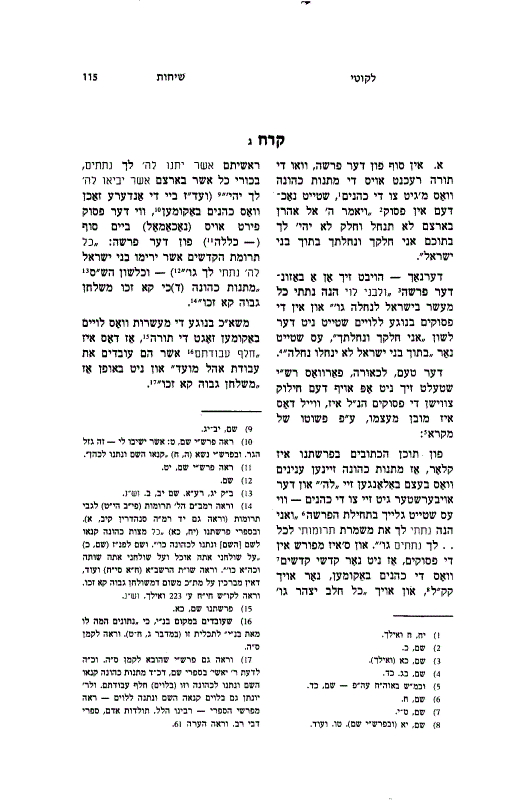
This sicha is a review of Likkutei Sichos, volume 28, the third sicha for Parshas Korach. In this sicha, the Rebbe explores the differences between the Kohanim and the Leviyim regarding how they receive their special gifts and portions from the Jewish people. The focus is on how the gifts given to the Kohen differ from those given to the Levi.
The Rebbe analyzes various expressions found in the verses and in many pesukim, as well as distinctions between the views of Rambam and Rashi. The discussion is detailed and explanatory, clarifying the relationship between the Kohen receiving his gifts directly from Hashem—meaning that these gifts are first designated for Hashem, who then gives them to the Kohen—while the Levi receives his portion as a reward for his service.
The sicha proceeds step by step, examining many different verses. The context is Parshas Korach, following Korach’s rebellion against Moshe Rabbeinu and his challenge to the priesthood. In response to this challenge, Hashem reaffirms and establishes that the Kohen will receive all these special gifts—the 24 matnos kehunah—the priestly gifts—which are enumerated in detail after Korach’s dispute.
The Torah lists these matnos kehunah that are given to the Kohen. After detailing these various gifts, the verse continues with Hashem telling Aaron that he will not inherit land in Eretz Yisroel as do all other tribes. Aaron, representing all Kohanim, does not receive a portion of land together with the rest of Bnei Yisroel.
The verse states further that Aaron has no portion among Bnei Yisroel in Eretz Yisroel. Instead:
אני חלקך ונחלתך בתוך בני ישראל
"I am your portion and your inheritance among the children of Israel."
Saif Aleph
The discussion begins with the verse, “Ani chelkekha v’nachalatkha,” which refers to the Kohanim of the tribe of Levi—specifically Aaron and his descendants. The Rebbe will analyze these words, first focusing on “Ani chelkekha v’nachalatkha,” and then turning to the phrase “besoch Bnei Yisroel.”
When it comes to the Kohanim, Hashem says, “I am your portion and your inheritance.” However, when the Torah discusses the rest of the tribe of Levi—the Leviim—it uses a different language. There, it states, “Hinei nosati kol ma’aser b’Yisroel l’nachalah”—that all tithes from the Bnei Yisroel are given as an inheritance to the Leviim. But in these verses about Leviim, we do not find the expression used by Kohanim: “Ani chelkekha v’nachalatkha.” It does not say that Hashem Himself is their portion or inheritance.
For the gifts that go to the Kohen, Hashem declares, “I am your portion and your inheritance.” In contrast, regarding what is given to the Levi—the ma’aser (tithes from grain)—the Torah does not say that Hashem is their portion. Instead, it simply notes that they do not receive a share in Eretz Yisroel among the rest of Bnei Yisroel. The Leviim are excluded from receiving land in Israel, but there is no statement that Hashem becomes their portion in place of land.
The Rebbe explains this distinction: for a Kohen, Hashem is truly his portion and inheritance. The gifts received by a Kohen are essentially Hashem’s own share; Hashem gives His own portion directly to the Kohen. That is why it says explicitly: “I am your portion and your inheritance.” The Kohen does not receive land in Eretz Yisroel; instead, his share is Hashem Himself.
By contrast, when it comes to a Levi, he does not get a portion in Eretz Yisroel either—but Hashem does not become his portion in place of land. Rather, what he receives—the ma’aser—is payment for his service. The Levi’s share is not Hashem’s own portion being transferred; it is simply compensation for his work.
This distinction seems straightforward and obvious from reading the verses themselves. Therefore, Rashi does not need to comment or explain this difference according to peshat—the plain meaning—because it emerges clearly from the context of our parsha.
Looking closely at these verses reveals that there is a fundamental difference between gifts given to Kohanim and those given to Leviim. The gifts for Kohanim are described as belonging inherently to Hashem—He gives them away but they remain His property until He bestows them upon the Kohen. This applies not only to portions from sacrifices (korbanos), but also to all twenty-four gifts designated for Kohanim.
For example, at the beginning of our section about Matnos Kehuna (the priestly gifts), it says: “I have given you…to guard my terumah.” This means that what was separated by all Jews as terumah belongs first to Hashem; then He gives it over to the Kohen as his share—“I am your portion.”
This idea extends beyond just kodshei kodoshim—the most sacred offerings received by Kohanim—to include kodshim kalim, lighter sanctities within korbanos themselves. It also includes other gifts such as fat from wine and oil (trumah), and reishis shemen, which are all separated for Hashem before being given over.
The verse states: “The first [of your produce] which they give to Hashem—I have given to you.” In other words, what was originally designated for Hashem is then handed over by Him directly to the Kohen. Similarly with bikurim—the first fruits brought as an offering—it says: “That which they bring to Hashem shall be yours.” All these gifts are first brought or separated for Hashem and only afterward transferred by Him specifically to the Kohen.
This pattern applies across all aspects of priestly gifts—not just bikurim but every category where something is first set aside for Hashem and then granted by Him as a special privilege or share for His priests.
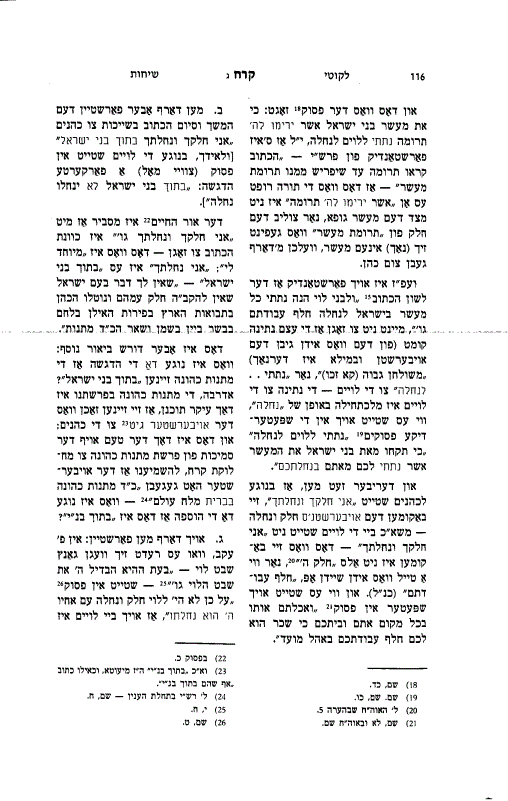
Saif Beis
The Torah emphasizes that the gifts given to the Kohanim are described as “ani chelkukha v’nachaloscha”—“I am your portion and your inheritance.” The verses repeatedly stress that these gifts are not simply material benefits, but rather a unique portion that comes directly from Hashem. At the end of the parsha, the Torah summarizes all the gifts of holiness—trumei sakadoshim—that Bnei Yisroel separate for Hashem, stating that whatever is raised up and separated for Hashem is given to the Kohen. This highlights that these gifts are first designated for Hashem, and only then does Hashem give them to the Kohen.
As expressed in the language of the Gemara: “matnas kehuna ki kozocho mishulchano shel gavoya zocho”—the gifts of Kehuna, when received by the Kohanim, are considered as if they are taken from Hashem’s own table. In other words, these are Hashem’s gifts, and it is from His table that the Kohanim merit to eat. That is why it says “ani chelkukha v’nachaloscha”—the Kohanim receive a portion that truly belongs to Hashem.
This unique status applies only to the Kohanim. In contrast, regarding maasros—the tithes received by the Leviim—the Torah states: “ados ischele v’avidosom”—these are given in exchange for their service in the Tent of Meeting. The Leviim receive their portion as payment for their work guarding and serving in the Mishkan; it is not a gift from Hashem’s table in the same sense as with the Kohanim.
The verse says: כעס מעשר בני ישראל אשר ירימו לה' תרומה נתתי ללויים לנחלה. Here too, it seems at first glance that just as with the Kohanim, what was separated for Hashem is then given to the Leviim. However, Rashi clarifies that this verse does not refer to what remains after terumas maaser (the tithe from within a tithe) has been separated by the Leviim for the Kohen. Rather, only after this separation does what remains become theirs.
The Torah calls this tithe “teruma,” even though it refers to what is given to Leviim. Why? Because until they separate terumas maaser, it still contains a part meant for Hashem (to be given to a Kohen). Only after this separation does what remains become fully theirs—their own portion. Thus, when it says “asher yerimu laHashem teruma,” it refers specifically to what is set aside for Hashem; what remains is not called “Hashem’s” anymore but becomes property of the Leviim.
This distinction means that unlike with Kohanim—who receive their portion directly from what was designated for Hashem—the Leviim do not receive their share as a direct gift from Hashem’s table. Instead, they receive payment for their service; it is compensation rather than a divine gift.
The Torah further emphasizes this difference by stating that Leviim may eat their portion anywhere (“b’chol makom”), unlike certain priestly gifts which must be eaten in purity or within specific locations. The Levi’s share is described as “sachar”—wages—for their service in guarding and working in the Mishkan.
The Rebbe raises an important question: Why does Scripture use different language regarding these two groups? For Kohanim, it says “ani chelkukha v’nachaloscha,” but not so for Leviim. The answer lies in how each group receives its share: The Kohen eats from what was first given to Hashem; his portion comes directly from sanctity. The Levi receives his due as payment for labor performed on behalf of Bnei Yisroel—it is not inherently holy nor directly from Hashem’s table.
This explains why all verses about priestly gifts emphasize their sanctity and connection to Hashem (“kol trumei l’Hashem”), while those about tithes for Leviim do not carry this same emphasis. Even though both groups receive portions set aside by Israel, only those of the Kohanim retain their status as holy gifts belonging first to Hashem.
The Rebbe continues by analyzing why Scripture sometimes appears to equate these two types of gifts—suggesting both are inheritances or portions—but ultimately clarifies that only one (the priestly gift) has true sanctity derived from being first offered to Hashem.
This distinction also explains why certain laws apply differently: For example, priestly portions must be eaten in purity and sometimes within Jerusalem; tithes for Leviim can be consumed anywhere because they are wages rather than sacred offerings.
The Rebbe concludes by noting that this entire discussion underscores why Scripture stresses that priestly gifts are received among Bnei Yisroel—they represent something uniquely holy within Israelite society, distinct from other forms of compensation or inheritance such as those given to Leviim.
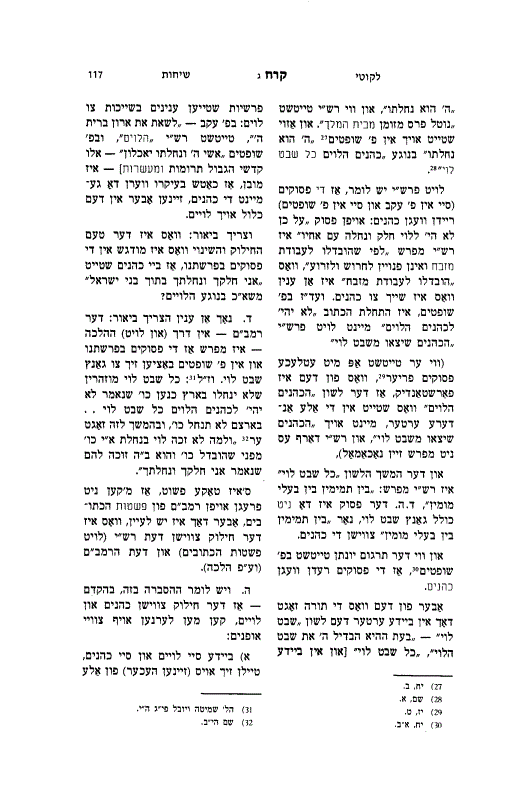
Saif Gimmel
The discussion here centers on the distinction between the inheritance of the Kohanim and the rest of the tribe of Levi. The Torah describes the covenant of priesthood as an eternal covenant, an everlasting bond. When it comes to Levi’s history, it is described as being “among the children of Israel.” The question arises: why is this phrase—“among the children of Israel”—emphasized specifically here in connection with Levi?
The commentators explain that this phrase means that Levi receives everything together with the rest of Israel. However, in our context, it is not about what they lose out on compared to other tribes; rather, it is about something unique that they received from Hashem. So why does the verse say “among the children of Israel” regarding Levi?
Furthermore, in Parshas Eikev—which is in Devarim, Mishneh Torah—the Torah speaks about all of shevet Levi, not just the Kohanim. The verse states:
בָּעֵת הַהִוא הִבְדִּיל ה' אֶת שֵׁבֶט הַלֵּוִי גוֹמֵר
“At that time, Hashem separated the tribe of Levi…”
This passage seems to indicate that all of shevet Levi was chosen by Hashem. The following verse says:
עַל כֵּן לֹא הָיָה לְלֵוִי חֵלֶק וְנַחֲלָה עִם אֶחָיו
“Therefore, Levi did not have a portion or inheritance with his brothers.”
The Torah then says: “Hashem is his inheritance.” This appears to be written not only about Kohanim but also about all Levites. In Parshas Shoftim as well—in Mishneh Torah—it says “Hashem is his inheritance” regarding both Kohanim and all shevet Levi.
Rashi comments that this means they receive a special portion from “the king’s house”—meaning from Hashem Himself—just as a king gives a special share to someone close to him. Both Kohanim and Leviim receive their portion directly from Hashem.
In these passages in Devarim, it seems clear that “Hashem is his inheritance” refers to all of shevet Levi—not only to Kohanim. This raises a question: why does our parsha seem to focus on Kohanim alone when discussing this concept?
The Rebbe now analyzes Rashi’s commentary more closely. Rashi explains that when the Torah says “they were separated for service at the altar and are not free for other work among Israel,” it refers specifically to Kohanim—those who serve at the altar. Only Kohanim perform this service; Levites do not serve at the altar itself.
Therefore, when Rashi discusses those who are separated for service at the altar and thus receive their portion from Hashem, he is referring specifically to Kohanim. Even though Levites are also separated from Israel for holy service, their role is different—they do not serve at the altar but have other responsibilities.
This distinction is further supported by Targum Yonasan, who interprets certain verses as referring specifically to Kohanim rather than all Levites. Even when verses mention “the tribe of Levi,” sometimes they mean only those within Levi who are eligible for priestly service—that is, Kohanim.
However, there are places where Targum Yonasan and others interpret these verses as referring to all Levites—such as when discussing certain mitzvos or tithes given to them by Israel. In those contexts, “Hashem is his inheritance” applies broadly to all members of shevet Levi.
Rashi also notes that some verses refer specifically to boundaries or territories in Eretz Yisrael—such as terumos and maasros (tithes) given from produce grown in specific regions—which are given to all Levites.
Thus, while some passages focus on Kohanim alone (especially regarding service at the altar), others include all Levites when discussing their unique relationship with Hashem and their lack of territorial inheritance among Israel.
This leads us back to our main question: what accounts for these differences? Why do some verses and commentaries focus on Kohanim alone while others include all Levites? What is behind this shift in language and emphasis?
The Rambam addresses this issue directly. He writes: “All of shevet Levi are warned not to inherit land in Canaan… neither Kohanim nor Levites shall inherit land among Israel.” The Rambam makes no distinction between Kohanim and other Levites; he includes them together regarding their lack of territorial inheritance because Hashem Himself is their portion.
The Rambam further explains that this unique status was granted because they were separated for holy service—and therefore merit a special relationship with Hashem: “I am your portion and your inheritance.” This applies equally to both groups within shevet Levi.
So according to Rambam’s halachic view, there is no difference between Kohen and Levi regarding this aspect—they both share equally in having Hashem as their inheritance instead of land in Eretz Yisrael.
The Rebbe concludes that we must still clarify why Rashi (and sometimes scripture itself) distinguishes between them—sometimes focusing only on Kohanim and sometimes including all Levites. To understand this fully requires analyzing whether their separation from Israel constitutes one general distinction (with degrees within it), or whether there are two fundamentally different types of separation—one for Kohanim and another for Levites.
This difference can be traced back to how each group was originally designated for its role: Aaron and his sons were singled out first for priestly service at the beginning of Tzav (in Vayikra), while the rest of shevet Levi was brought close later—after the Mishkan was erected—in Bamidbar. There, they were placed under Aaron’s authority and assigned distinct roles serving him rather than serving directly at the altar themselves.
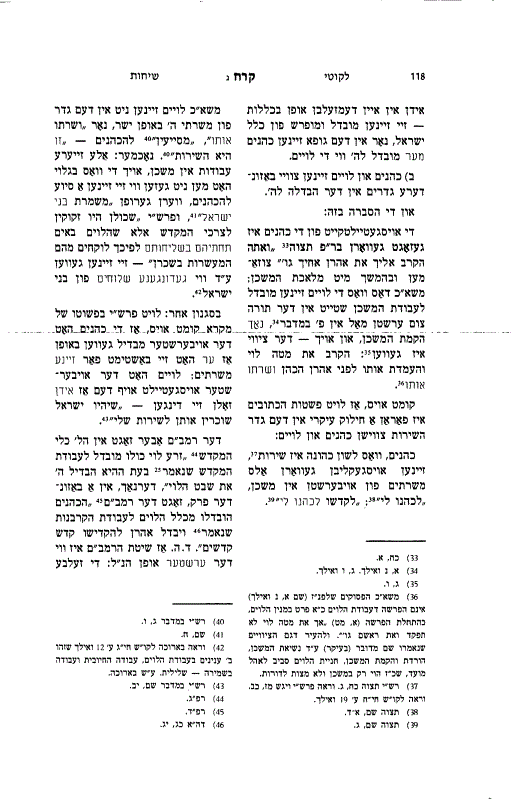
Saif Daled
According to the simple meaning of the verse, there is a fundamental distinction in how we define the service of a Kohen versus that of a Levi. The term kohuna—priesthood—itself means service: the Kohanim were chosen as direct servants of Hashem in the Mishkan, to serve and sanctify Him. In contrast, the Leviim are not defined as direct servants of Hashem; rather, they serve the Kohanim. Their role is to support and assist Aaron and his sons in their priestly duties.
Even when the Leviim performed their own tasks in the Mishkan—such as guarding its gates and areas, which is referred to as “guarding for Bnei Yisroel”—their function was still fundamentally as agents or representatives of the Jewish people. The Leviim were required to fulfill the needs of the Mishkan, but they did so as substitutes for Bnei Yisroel, acting on behalf of all Jews. This is why they received maaser—tithes—as their reward: they took the place of Bnei Yisroel in this service, similar to hired workers who are paid for performing someone else’s job.
The Kohanim, by contrast, are defined as servants of Hashem Himself. The Leviim serve in the Mishkan as if “hired” by the Jewish people to take their place. According to Rashi’s approach to peshat—the plain meaning—the Torah separated and designated Kohanim specifically as Hashem’s servants. The Leviim were separated so that Jews could “hire” them for their own service needs in the Mishkan.
The Rambam presents a different style: he writes that the entire tribe of Levi was separated at once to serve in the Mishkan. Within this separation, Kohanim were then distinguished from among the Leviim for special service—namely, offering sacrifices (korbanos). Thus, both groups share a fundamental distinction from Israel at large: both are servants of Hashem, but with different roles—Kohanim for sacrifices and Leviim for general Mishkan service.
This leads to two key differences between Rashi and Rambam. First: according to Rashi, there are two entirely separate designations—Kohanim are separated from Israel independently of their being part of Shevet Levi; it is not connected with being a member of that tribe. Rambam holds that first there is a general separation of all Leviim from Israel, and only then are Kohanim distinguished within Shevet Levi.
Second: according to Rashi, these are two distinct categories with different definitions of service. A Kohen’s very identity is that he is a servant—his essence is service to Hashem. A Levi, however, is not inherently a servant in this sense; rather, he is more like someone hired for a job on behalf of others (the Jewish people), not directly serving Hashem in his own right.
In Rambam’s view, both Kohanim and Leviim fall under one broad category—servants separated from Israel—but within this group there are further distinctions regarding what each serves (sacrifices versus other Mishkan work). Their essential status as servants does not differ; only their specific tasks do.
This distinction helps us understand our parsha following Korach’s rebellion. After Korach challenged Moshe and Aaron regarding priesthood and Levite roles, there was confusion about how these positions should be structured going forward. It became necessary to reestablish proper order between Kohanim and Leviim.
According to Rashi’s approach (the plain meaning), this order was restored exactly as it had originally been: two separate categories. First came warnings directed specifically at Kohanim—“You and your sons shall bear responsibility for your priesthood”—a charge not given to Leviim. There was also an explicit warning that mistaken Leviim should not encroach upon priestly duties.
Then came instructions regarding reappointing the Leviim: “Bring also your brethren, the tribe of Levi… they shall join you and serve you.” Here again we see two steps—first distinguishing Kohanim with their unique responsibilities, then bringing along (but keeping separate) the Leviim as assistants or “hired hands.” This pattern continues throughout our parsha: detailed verses distinguish between services exclusive to Kohanim versus those assigned to Leviim.
The Torah repeatedly emphasizes that neither group should encroach on each other’s domain—the Kohen’s work remains theirs alone; likewise for the Levite’s tasks. According to Rashi, this maintains clear boundaries: Kohanim retain their original chosen status while Leviim fulfill their supporting role without overstepping into priestly territory.
The Rambam learns differently from these verses: just as Leviim are warned not to perform priestly duties (avodas hakohanim), so too are Kohanim warned not to perform Levite tasks (avodas haleviim). Both groups have distinct roles because both underwent separations—even though initially all were part of Shevet Levi.
The reason why even Kohanim cannot perform Levite duties is because they were specifically set apart from among all Levites—a unique separation according to Rambam’s framework. Thus, although all members of Shevet Levi share a general status as servants set apart from Israel at large, within that group each has his own clearly defined area which must not be breached by another—even by those on a higher level such as Kohanim.
Saif Hei
The distinction between kohanim and leviim is central to understanding their respective roles. According to the Rambam, both kohanim and leviim are defined as servants—shedus—chosen by Hashem for service. The Levi is just as much a servant as the kohen, both selected for their roles. However, we do not find that kohanim are warned not to perform the service of the leviim, as the Rambam notes. This is because their services are not of the same kind; the shedus of the leviim is fundamentally different from that of the kohanim.
If something is not of its kind, it cannot invalidate it. For example, if one has an improper thought regarding a korban of its own type, it can disqualify that korban. But if one thinks about something entirely unrelated—not even a korban—it cannot disqualify it. Similarly, since the service of the leviim is in a completely different category than that of the kohanim, a kohen performing leviim duties does not invalidate them; they are simply not in the same classification.
According to the Rambam, since both groups share a similar status but with distinct roles, a kohen cannot perform the service of a levi. But according to peshuto shel mikra—the plain meaning—perhaps they could, since their services are so different there is no reason for restriction.
The Rebbe explains that originally there were two steps: first came the kohanim and then the leviim—two separate categories according to Rashi. But according to the Rambam, there was one category: Hashem distinguished all of Shevet Levi for His service and then separated out the kohanim from within them.
This difference in approach continues into how each view interprets the gifts given to kohanim—the matanos kehuna. The Torah concludes regarding kehuna: “הדֹס יִסְבְּרִית מֶלַח עוֹלָם”—it is an eternal covenant. According to Rashi’s view in peshuto shel mikra, when it says “אני חלקך ונחלתך”—“I am your portion and inheritance”—this applies only to kohanim because their role is direct service to Hashem.
The gifts given to them reflect this: they receive from Hashem’s table—meshulchan gavoha kozachu. In contrast, leviim do not serve Hashem directly but rather serve and assist the kohanim; they act as agents on behalf of Bnei Yisrael. Therefore, their gifts are not described as “I am your portion,” but rather as compensation for their service—meyser chelev avodaso.
According to the Rambam, however, both kohanim and leviim were separated together for Hashem’s service—the entire tribe was distinguished first, and only then were kohanim separated from among them. Thus, both groups are considered servants of Hashem and receive their portion accordingly.
This distinction also clarifies verses in Mishneh Torah—in Parshas Ekev and Shoftim—which seem inclusive according to Rambam’s approach but exclusive according to Rashi’s interpretation. In Bamidbar (and specifically Parshas Korach), Rashi maintains there is a clear distinction between those who serve as kohanim and those who serve as leviim; each has its own unique form of service.
Mishneh Torah appears more inclusive about Shevet Levi’s role before Hashem (“לעמוד לפני ה׳ לשרתו ולברך בשמו עד היום הזה”), but Rashi explains this does not refer specifically to priestly service or its essence—it refers only generally or partially to their function.
This explains why Rashi does not interpret these verses in Ekev or Shoftim as redefining or merging these categories; he maintains throughout that only kohanim have “Hashem as their inheritance,” while leviim receive compensation for their assistance role.
The difference between inheritance (nakhla) for kohanim versus leviim becomes clear: Kohanim receive an actual portion among Israel—a true inheritance like any other Jew receives in Eretz Yisrael—but also something unique from Hashem Himself. Leviim do not receive such an inheritance directly; instead, they are compensated by Bnei Yisrael for their work.
This distinction is emphasized by Rashi: Leviim do not have an inheritance together with Bnei Yisrael; theirs is not on par with what Jews received in Eretz Yisrael nor with what was given uniquely to kohanim by Hashem.
The Rambam adds another dimension: Not only Shevet Levi but any person whose spirit moves him can become like Shevet Levi—standing before Hashem and becoming sanctified so that “Hashem becomes his portion and inheritance.” This spiritual idea exists even today: every Jew can attain aspects of both levels—the spiritual “Levi” now and even higher in times to come when Levi will surpass Kohen in certain respects.
The core idea behind Levi’s name—le’vi, meaning “to connect” or “to attach”—reflects this duality: on one hand, they cleave to Hashem through assisting Kohanim; on another level, they act as agents serving Bnei Yisrael. Ideally, since their essence is connection (dveikus) with Hashem, they should be like Kohanim themselves—servants sanctified directly for divine service.
The explanation is that true divine service comes when one nullifies oneself completely—not existing as an independent entity at all before Hashem. This self-effacement allows one’s entire being to be dedicated solely to serving God without personal identity or agenda intervening.
Key Points
1. The Torah distinguishes between the gifts given to Kohanim and those given to Leviim: Kohanim receive their portion directly from Hashem, as expressed in the phrase “I am your portion and your inheritance,” while Leviim receive tithes as compensation for their service, not as a direct divine gift.
2. All priestly gifts are first designated for Hashem and only afterward transferred to the Kohen, emphasizing their unique sanctity and the special relationship between Kohanim and Hashem. In contrast, the Levi’s share is not inherently holy but is considered wages for their work in the Mishkan.
3. Scriptural language sometimes appears to include all of Shevet Levi in having Hashem as their inheritance, but close analysis (especially according to Rashi) shows that this status applies primarily to Kohanim, who serve directly at the altar, while Leviim have a different role and relationship with Hashem’s gifts.
4. According to Rashi’s approach, Kohanim are separated from Israel as direct servants of Hashem, while Leviim are separated to serve the Kohanim and act as agents on behalf of Bnei Yisroel. The Rambam, however, sees both groups as servants of Hashem with distinct roles within one general category of service.
5. The distinction between Kohanim and Leviim is reflected in their respective inheritances: Kohanim receive a unique portion from Hashem Himself, while Leviim receive compensation for substituting for Bnei Yisroel in Mishkan service. This difference shapes both halachic status and practical laws regarding their gifts and roles.
6. The Rambam teaches that any Jew who dedicates himself fully to serving Hashem can attain a spiritual status similar to Shevet Levi—having “Hashem as his portion and inheritance”—highlighting a timeless lesson about self-nullification and devotion in divine service that transcends tribal distinctions.