Introduction
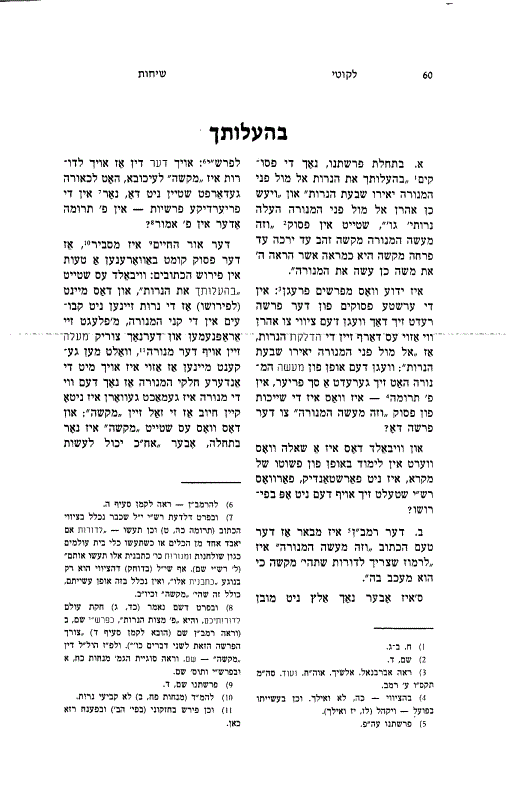
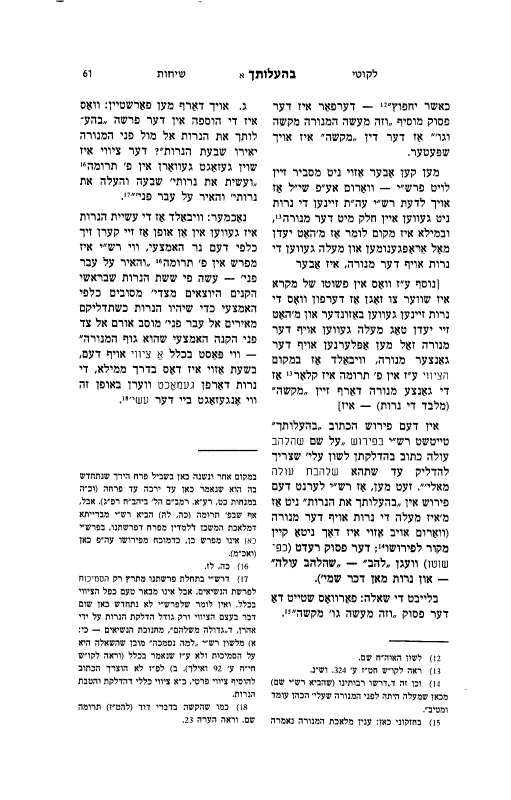
In this session, we will be reviewing a sicha from Likkutei Sichos, volume 28—the first sicha on Parshas Beha’aloscha. This learning is dedicated in loving memory of Harav Lev Yitzchok ben Reb Chaim Tzvi, a devoted and successful shliach who passed away suddenly. May the learning be a merit for his neshamah—tehei nishmaso tzerurah b’tzror hachaim.
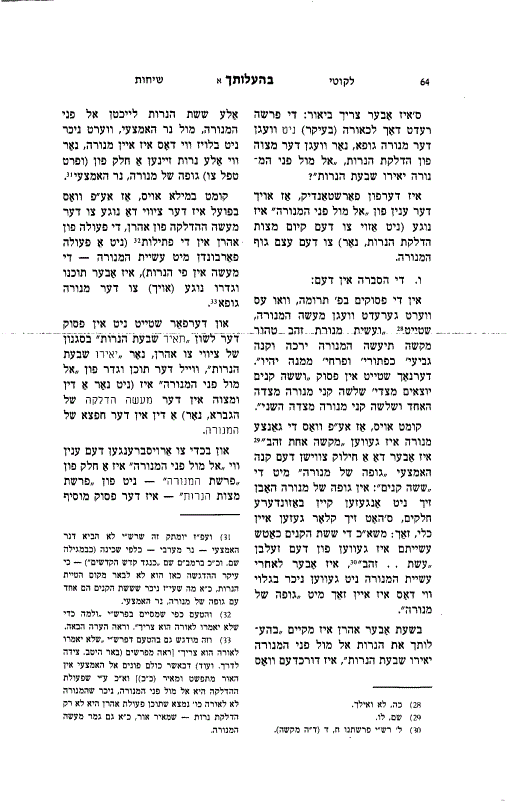
This sicha is primarily a Parsha-Rashi analysis, but it also addresses questions raised by various commentators. The Rebbe focuses on an apparent difficulty: the Torah describes how Aharon lights the lamps of the Menorah—beha’aloscha es haneiros—and then immediately introduces a halachah about the Menorah’s construction: v’zeh ma’aseh hamenorah mikshah, that the Menorah must be made from one solid piece, hammered out rather than assembled from separate parts.
This detail about the Menorah’s construction seems out of place here. The laws regarding how to make the Menorah were already discussed earlier in Parshas Tetzaveh and Parshas Terumah. Why does the Torah repeat this point now, when discussing how to light the Menorah? It appears as if this halachic detail is inserted into the wrong context.
The Rebbe notes that Rashi does not address this question directly, which is surprising given its prominence in other commentaries. The Rebbe then presents a novel insight—a chiddush—that according to Rashi, this passage is actually central to understanding the entire section about the Menorah.
The explanation is that although the Menorah must be fashioned from one piece of gold—mikshah zahav—the branches themselves appear distinct and separate. You might not realize at first glance that they are all part of a single unit. However, since all seven lamps shine toward the central branch, this demonstrates their essential unity: they are all expressions of one Menorah.
This idea—that despite outward differences, everything is fundamentally one—is precisely the message of this parsha and why it belongs here in connection with lighting the Menorah. As we proceed through the sicha step by step, we will see how this theme unfolds and why it is so significant in understanding both Rashi’s approach and the deeper meaning behind these verses.
The parsha begins with Moshe conveying Hashem’s instructions to Aharon regarding lighting the Menorah…
Saif Aleph
The Torah gives a specific instruction regarding the lighting of the Menorah: when you light the lamps, ensure that all the lamps face the front of the Menorah, towards its central shaft. The verse states that Aaron did exactly as he was told—he lit the lamps so that they all faced toward the middle lamp, following Hashem’s command precisely.
Immediately after this, another verse appears: “V’zeh ma’aseh haMenorah”—this is how the Menorah was made. It describes that the Menorah was hammered out of one piece of gold, not assembled from separate parts. From its base to its flower, it was all one solid piece, crafted according to the vision Hashem showed Moshe. The Torah emphasizes that Moshe made it exactly as he was shown.
This raises a question: why does the Torah insert a description of how the Menorah was constructed right after discussing how it should be lit? The details about its construction seem more relevant to Parshas Terumah, where the vessels of the Mishkan are described in detail. Here, we are in a section focused on Aaron’s lighting of the Menorah—not its construction.
This issue is well known among commentators. In this portion’s opening verse, we are given instructions to Aaron about how to light the lamps so they face inward toward the main shaft. This is clearly a directive about lighting, not building. The construction details were already discussed earlier in Parshas Terumah.
So what is the connection between “V’zeh ma’aseh haMenorah”—the description of how it was made—and this section about lighting? Why does this structural information appear here? It seems out of place and unrelated to Aaron’s mitzvah of lighting.
Whenever there is an apparent difficulty in understanding a verse according to its simple meaning—peshat—Rashi usually addresses it in his commentary. This question arises naturally when reading peshat: why does this construction detail appear here? Yet Rashi says nothing about it at this point.
This leads us to ask: why doesn’t Rashi comment on this issue? We are not discussing building or making a Menorah—that was covered earlier—we are talking about Aaron’s act of lighting it. Why does Rashi remain silent?
The Ramban offers an explanation: even though earlier verses said that the Menorah must be made from one piece (mikshah), one might have thought that only for that first Menorah did this apply, and later generations could make it differently—even from assembled parts. Therefore, our verse repeats “V’zeh ma’aseh haMenorah” here to teach that for all generations, every Menorah must be hammered from one piece; this requirement is absolute and indispensable (li’ikuvah). That is why it is repeated here.
However, even with this answer, there remains a difficulty: if this halacha applies for all generations, why not state it clearly back in Parshas Terumah or elsewhere where construction laws are discussed? Why bring it up now in a section focused on lighting?
The Rebbe points out that according to Rashi’s approach—who always focuses on peshat—this answer may not suffice. Even if there is a halacha for future generations requiring mikshah, why introduce it specifically here? The question remains: why does Rashi not address what seems like an obvious textual difficulty?
The discussion will continue by examining how Rashi understands these verses and whether he sees any problem at all with their placement or content.
Saif Beis
The Rebbe raises a question regarding the placement of the halacha that the menorah must be made from one solid piece—mikshah. This law is stated here, in the context of lighting the menorah, rather than earlier in Parshas Terumah or Parshas Emor. Those earlier portions discuss either the construction of the menorah or its use, and according to Rashi, Parshas Emor is actually the main source for the mitzvah of lighting the menorah. So why does the Torah choose to teach us about mikshah—that it must be hammered from one piece—here, when discussing Aaron’s command to light it?
The Rebbe notes that this seems out of place. If this is a law for all generations—that a menorah must be made from one piece—it would make more sense for it to be taught where the construction is first described, not here in connection with lighting.
The Rebbe then brings another interpretation from the Ohr HaChaim. The Ohr HaChaim explains that “beha’aloscha es haneros” refers not to lighting but to physically raising up and placing the lamps—the containers with oil and wick—on top of the menorah’s branches. According to this view, these lamps were separate pieces, not part of the actual structure.
The Ohr HaChaim argues that since the verse says “bring them up,” it implies that these lamps are detachable and independent from the menorah itself. This could lead someone to think that perhaps other parts of the menorah could also be separate pieces, not necessarily made as one unit.
Therefore, according to this explanation, after mentioning “beha’aloscha es haneros,” which might imply separateness, the Torah needs to reiterate that despite this, the body of the menorah must still be mikshah—a single hammered piece. The law applies even after initial construction: if a new menorah is ever needed, it too must be made from one piece.
The Rebbe points out some difficulties with this approach. First, Rashi does not interpret “beha’aloscha es haneros” as referring to placing physical lamps on top; rather, he explains it as lighting—the act of kindling so that each flame rises on its own. Thus, according to Rashi’s peshat, there is no implication that parts are detachable simply because you light them daily.
Even if we accept that Rashi agrees with Ohr HaChaim about some technical details—that perhaps wicks or lamps were not physically fused with the branches—the main point remains: Rashi’s reading does not suggest any separateness in a way that would require clarification about mikshah. The Torah’s focus here is on how to light (the wicks), not on assembling or disassembling components.
The Rebbe further argues that even if you say there was some separateness (like removable lamps), it is difficult to claim this would lead someone to think that other parts could also be separate. The simple meaning of previous verses about construction already makes clear that all main parts must be one piece.
Therefore, according to Rashi’s approach and based on straightforward logic, there is no compelling reason for the Torah to insert this law about mikshah here just because of any supposed confusion arising from “beha’aloscha es haneros.” The question remains: why does this halacha appear specifically in this context?
Saif Gimmel
The Torah describes the menorah as being made from one piece, so it would seem unnecessary to specify anything further. Yet, Rashi interprets the words carefully. He explains that because the flame rises upward, when you light the menorah, you must ensure that the flame ascends on its own. The Torah uses the phrase "when you elevate" because the flame naturally goes up, and that's what Rashi focuses on—not bringing up the lamps to the menorah, but rather ensuring that the flame itself rises independently.
Rashi's interpretation of beha'aloscha es haneros is not about physically raising the menorah or placing lamps onto it. Instead, it's about lighting in such a way that the flame stands upright by itself. If Rashi were to interpret this as raising up the menorah or its branches, there would be no clear source for such an idea in the verse. The verse is speaking about a flame—shalheves oleh me'eileha, a flame that rises on its own—not about constructing or positioning parts of the menorah.
This leads to a question: if Rashi is not discussing assembling or raising up the menorah itself, but rather how to light it, why does the Torah mention here how the menorah was constructed? The Ramban offers an explanation that perhaps this is to teach us for future generations that it must always be made from one piece—miksha. However, this answer does not fully satisfy Rashi’s approach, since such details would more appropriately belong in Parshas Terumah or elsewhere where construction is discussed.
The Rebbe points out that according to Rashi, beha'aloscha refers specifically to lighting—the act of causing the flame to rise—and not to assembling or elevating any physical part of the menorah. So why does this section of Torah discuss details of construction here? The Rebbe now turns to another question based on the wording of the verse.
The verse says: when you light the menorah so that its lamps face toward its center branch. But this command has already appeared earlier in Parshas Terumah: "Make seven lamps... and they shall give light toward its face." What is new here?
The construction of the menorah was such that all six side branches were tilted toward the central shaft—the body of the menorah—so their light would shine inward. The Torah describes making "the mouth" (the opening) of each lamp lean toward the middle. This design ensured that when lit, all flames would shine toward the center.
If that's how they were built by default, what is being commanded now? It seems redundant for Hashem to instruct Aaron again to light them facing inward if their very construction already ensures this outcome.
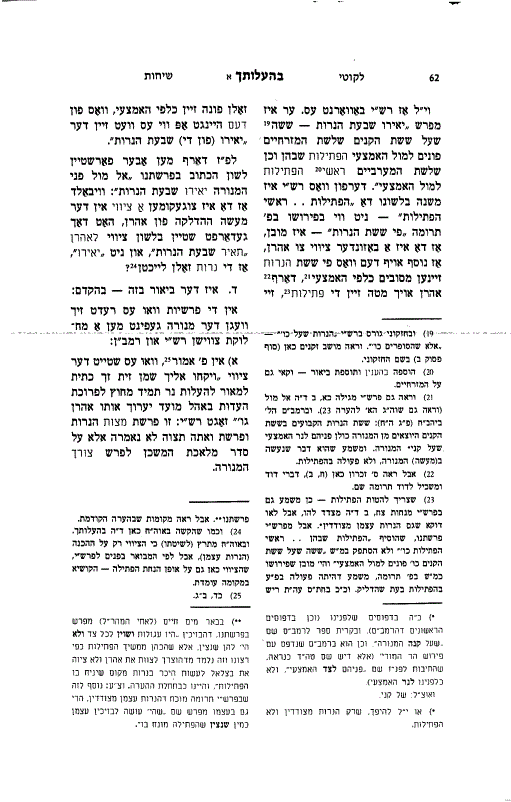
The Rebbe explains that Rashi addresses this by noting an additional detail: besides tilting each lamp's cup toward the center during construction, Aaron also had to tilt each wick within those cups toward the middle branch when lighting them. In other words, even though structurally everything was angled inward, Aaron needed to position each wick so its flame would point toward and illuminate the central lamp.
Rashi clarifies: three lamps on each side (east and west) had their wicks turned toward the center lamp. This was not just about how they were made; it was an active step Aaron performed during lighting.
This distinction highlights a new instruction in our parsha compared with Parshas Terumah. There, Hashem described how to construct and arrange each lamp; here He commands Aaron regarding how he should actually light them—by directing each wick's head toward the center branch.
If so, why does our verse use passive language—"toward its face shall shine"—rather than directly commanding Aaron ("you shall light them so they shine")? If this is a new mitzvah for Aaron—to actively tilt each wick—it should have been stated as an explicit directive rather than as a description of what will happen.
The Rebbe notes that this subtlety in language requires explanation. If there is indeed a new instruction here—that Aaron must tilt each wick during lighting—why present it passively instead of as a clear command?
Saif Daled
The Torah uses the phrase “your light will shine,” not “you should shine.” Here, the Rebbe begins to clarify Rashi’s view and how it differs from that of the Ramban. According to Rashi, there are three places in the Torah that discuss the menorah: Parshas Terumah, which describes its construction; Parshas Emor, where the Torah discusses the oil used for lighting the eternal flame; and our parsha, which details the actual kindling of the menorah in the Mishkan.
The Rebbe explains that, according to Rashi, while Parshas Terumah and Tetzaveh discuss constructing and preparing the menorah as part of building the Mishkan, the main section that addresses the mitzvah of lighting it is Parshas Emor. The commandment to light the menorah is primarily found in Emor, while Tetzaveh only mentions it briefly as part of describing what was done with what was built.
Let’s look inside: In these portions that discuss the menorah, we find a disagreement between Rashi and Ramban. In Parshas Emor, where it says to take pure olive oil crushed for illumination so as to kindle a constant light outside of the curtain covering the testimony—Aharon is to arrange it outside—the Torah here gives us the mitzvah of lighting the menorah. This is not about constructing it but about performing its service: lighting its lamps.
In this verse, we see that when discussing how all vessels of the Mishkan were used, it also mentions lighting the menorah. However, this is not its main place; rather, it’s mentioned because after building it, you need to know what you do with it. The primary discussion about lighting is in Parshas Emor. That’s Rashi’s view.
The Ramban disagrees with Rashi regarding Parshas Emor. He learns differently: In Tetzaveh, where it says to arrange and light lamps, it doesn’t specify that this must be done on a menorah. One might think you could light them even if there was no menorah—if it broke or was lost. The Torah in Tetzaveh doesn’t clarify this detail.
But then in Emor, according to Ramban, when it says Aharon and his sons must prepare them on the menorah, this adds a crucial detail: Lighting must always be done specifically on a menorah. However, for Ramban, this is just an additional detail; he maintains that Tetzaveh is still the main section for commanding lighting of the lamps. Emor merely clarifies that it must be on a menorah.
For Rashi, however, things are reversed: The main commandment for lighting is found in Emor; Tetzaveh only mentions what you do with what you’ve built as part of describing construction. Thus, according to Rashi, Emor is central for understanding how and when to light.
The Ramban continues his approach regarding our parsha as well. At the start of our parsha (Baaloscha), Rashi explains why the section about kindling follows immediately after describing offerings brought by tribal leaders (the Nesiim). Rashi uses “the portion of the menorah,” not “the portion of lamps.” He explains: When Aharon saw all these offerings brought by each Nasi during their inauguration—each bringing wagons and special sacrifices—he felt left out since neither he nor his tribe (Levi) participated.
Hashem reassured him: “What you do is greater than theirs—you prepare and kindle the lamps.” This act surpasses even what was done by all other leaders through their offerings.
The Ramban interprets differently: Just as he learned regarding Emor—that each new mention adds a detail—so too here in Baaloscha. After finishing discussion about raising up (dedicating) the Mishkan during inauguration week (the eighth day), another law about lighting lamps is introduced. This teaches us that for future generations as well (“for your generations”), lamps must always face toward (be arranged before) the menorah—a new detail added here.
Thus we learn two extra details from these sections: First (from Emor), one cannot light without a proper menorah—it’s essential for fulfilling this mitzvah. Second (from Baaloscha), throughout all generations lamps must always be arranged facing toward or upon a proper menorah. That’s why here in Baaloscha there’s no mention of “this is how they did at inauguration,” but rather “this is how it must always be.”
In summary: According to Ramban, all three sections—Tetzaveh, Emor, and Baaloscha—discuss aspects of lighting; each adds its own necessary detail for fulfilling this mitzvah properly across generations. For Rashi though, each section has its own focus: Tetzaveh relates to construction instructions; Emor contains most of what we need for understanding how to perform kindling; Baaloscha presents “the portion of the menorah” itself—a unique focus distinct from simply discussing lamp-lighting or construction.
Rashi thus identifies three special portions regarding menorah: Tetzaveh as part of building instructions from Truma (“constructing”); Emor as giving us mitzvas hadlakas hamenorah—the commandment itself; and Baaloscha as parshas hamenorah—the unique portion dedicated specifically to discussing aspects unique to kindling itself.
Saif Hei
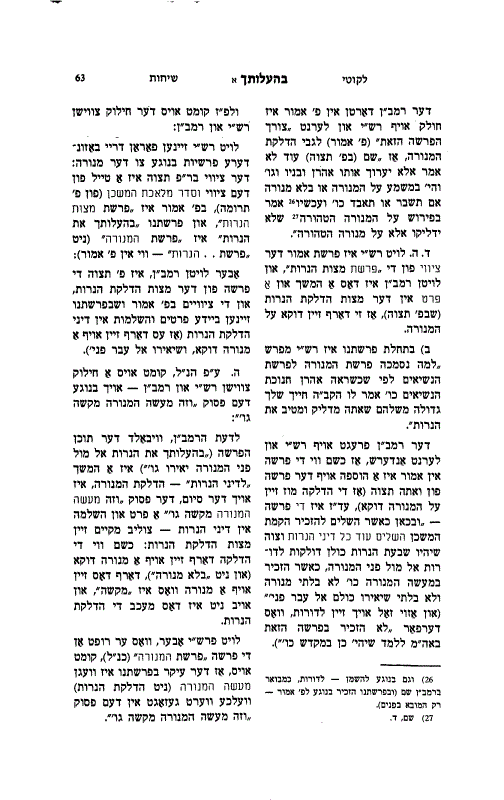
In Parshas Emor, the Torah discusses the lighting of the lamps, but Rashi explains that this is actually the portion of the menorah. There is a distinction between the menorah itself, the lamps (neres), and what is referred to as “the portion of the menorah.” According to Ramban, it is Parshas Tetzaveh that contains the mitzvah of lighting the lamps—this is where we find the commandment itself. The additional instructions in Parshas Emor and now in our parsha are details that complete and clarify the laws of lighting the menorah.
Ramban sees all these passages as one mitzvah with various details: the main commandment is in Tetzaveh, while Emor and Behaaloscha provide further specifications. For example, it must be done on the menorah itself (al hamenorah), and the flames must face its center (el mul pnei hamenorah). These requirements apply for all generations. Thus, according to Ramban, these are all aspects of a single mitzvah whose core is found in Tetzaveh.
Rashi, on the other hand, holds that Parshas Emor contains the actual mitzvah of lighting, while Tetzaveh describes part of the order and structure of the Mishkan. In our parsha, it’s called “the portion of the menorah,” not “the portion of the lamps.” This difference leads to a practical distinction in how we understand verses like “V’zeh ma’aseh hamenorah mikshah zahav”—“This was how the menorah was made: hammered out of gold.” Is this verse about how to light or about how to construct?
Based on this, there’s a fundamental difference between Rashi and Ramban regarding whether these verses are part of the mitzvah of lighting or part of constructing the menorah itself. For Ramban, these details are necessary for fulfilling hadlakas hamenorah—the act of lighting. You cannot fulfill this mitzvah without a proper menorah made as described: hammered from one piece (mikshah). The act of lighting must be done on such a menorah; otherwise, you have not fulfilled your obligation.
According to Rashi, however, when he refers to this section as “the portion of the menorah,” he means that its primary focus is on describing how to build or define what constitutes a valid menorah—not on how to light it. Even though there are verses about causing it to shine (yairu), this shining is what makes it a menorah; it’s an aspect that defines its identity as a menorah rather than detailing how to perform its lighting.
This raises an important question: if we’re discussing lighting here, why does Rashi call it “the portion of the menorah” if it doesn’t discuss construction directly? The answer is that by commanding us to light so that all flames face inward toward the center branch (mul pnei hamenorah), we reveal something essential about what makes it a true menorah. The act of shining together demonstrates its unity—it’s not just seven separate lamps but one unified candelabrum.
The Torah describes in Parshas Terumah how to make a golden menorah: pure gold, hammered out as one piece—the base, shaft, branches, cups, knobs, and flowers all from one chunk. There are three branches extending from each side. Even though everything comes from one piece, there’s still a distinction between the central shaft (the body) and its six branches.
The body—the central branch—appears as one solid unit. The six side branches are also made from that same gold but are visually distinct from the body after construction. You can’t immediately tell they’re all part of one entity just by looking at them.
However, when Aharon fulfills his commandment in Behaaloscha—raising up and directing all six outer flames toward the center—this action reveals their unity with neir ha’emtza’i, the central lamp. By having all six face inward toward that middle flame (mul neir ha’emtza’i), it becomes apparent not only that this is one menorah but also that each lamp is merely a detail or extension subordinate to that central shaft.
The act of arranging and lighting them in this way highlights their relationship: they’re not independent entities but parts contributing toward one unified purpose—the illumination centered around neir ha’emtza’i. This arrangement expresses their status as secondary or subsidiary elements relative to the main body.
This leads us back to our earlier point: even though practically speaking Aharon’s command here relates to his act of lighting (how he positioned wicks and flames), his actions didn’t alter or construct any physical aspect of the menorah itself—they were about how he lit it. Yet conceptually and legally (b’geder u’b’tochen) this arrangement impacts not just his action but also defines something about what makes it a true menorah—a single entity composed harmoniously from its parts.
This explains why Scripture says simply “yo’ir shivas haneros”—“the seven lamps shall shine”—rather than commanding Aharon directly (“you shall cause them to shine”). The emphasis isn’t just on Aharon’s role but on achieving an outcome where all seven lamps function together as one unit through their orientation toward neir ha’emtza’i. It’s not merely about fulfilling an individual’s obligation; it’s about manifesting what makes this candelabrum truly whole—a single mikshah achas, hammered out as one piece.
Saif Vov
The Rebbe explains that the halacha here is not just about the act of lighting performed by Aaron, nor is it merely a law about the object—the cheftza—of the menorah. Rather, it is a halacha that pertains to the essence of the menorah itself. In order to express this idea, that “facing the menorah” (mul p’nei ha-menorah) is an integral part of the parsha of the menorah—not just a detail in the mitzvah of lighting its lamps—the Torah adds another verse:
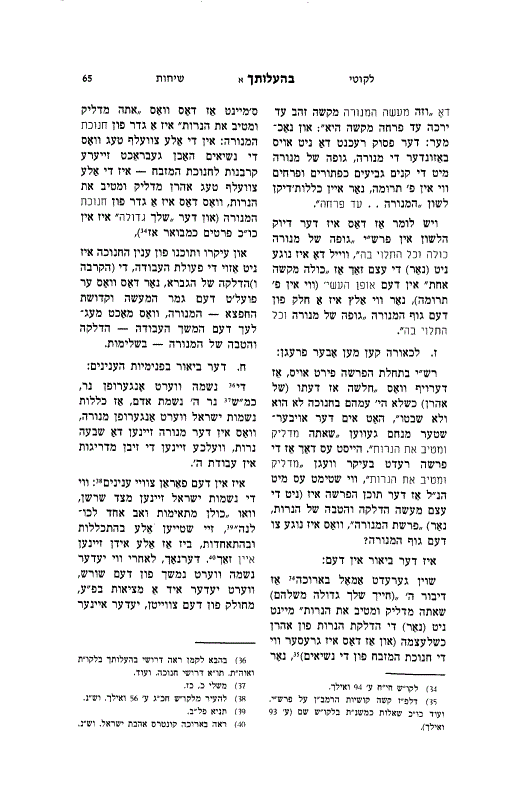
וזה מעשה המנורה מקשה זהב עד ירכה עד פרחה מקשה היא.
"And this was the work of the menorah: hammered gold, from its base to its flower, it was all one piece."
This verse teaches that the lighting of all seven lamps is what completes the act of making the menorah. The Torah describes how it was made—hammered out from one piece, from its base to its flower—emphasizing its unity and wholeness.
Furthermore, the Torah does not separately enumerate each part of the menorah—the body, branches, goblets, knobs, and flowers. Instead, it uses a general phrase: “the menorah… to its flower.” This all-inclusive language shows that everything is part of one unified menorah. The Torah wants us to see that all these components together make up a single entity—the ma’aseh ha-menorah, or “the work of the menorah.”
The Rebbe points out that Rashi’s commentary highlights this idea. Rashi writes: “the body of the menorah—all of it and all that depends on it.” This means not only was it all hammered out as one piece in terms of construction, but everything is considered part and parcel of the menorah itself. All elements—its body and everything attached—are included in this unity.
Rashi does not list each branch or detail individually because his point is not about their construction per se but about demonstrating their essential unity as parts of one complete menorah. This unity is what makes it possible for all seven lamps to be lit as one act upon one object.
According to Rashi, then, when the Torah says “v’zeh ma’aseh ha-menorah,” it’s explaining why Aaron must light all seven lamps facing toward the center: this creates a sense of wholeness and oneness in the menorah’s service.
However, there remains a question. From Rashi’s wording at the beginning of our parsha, it seems as if Aaron’s privilege was simply that he got to perform this mitzvah because he felt left out when he did not participate in bringing offerings during the inauguration. Hashem comforted him by saying he would light and prepare (fix) the lamps—a special action for Aaron himself.
This appears to focus on Aaron’s personal role in lighting rather than on establishing some essential quality or unity within the menorah itself. How does this fit with what we have just explained—that this section is really about defining what makes up a complete menorah?
The Rebbe addresses this by referencing previous discussions: When Hashem tells Aaron “yours is greater than theirs—you will light and prepare the lamps,” He does not mean simply that Aaron gets an extra mitzvah or honor independent from what happened with the offerings on the altar. Rather, Aaron’s lighting and preparing of the lamps constitutes an inauguration (chanukas ha-menorah)—it defines what it means for there to be a functioning, sanctified menorah.
During all twelve days when each tribal leader brought their offering for inaugurating the altar (mizbeach), Aaron was lighting and preparing (fixing) the lamps every day. But his service was not just another daily task; it was itself an act of inaugurating—and thus completing—the essence (cheftza) of the menorah.
This means that Hashem’s promise to Aaron (“yours is greater”) refers specifically to his role in making sure that through his actions—lighting and preparing—the menorah becomes fully inaugurated and ready for ongoing service. The main content here isn’t just performing a ritual but effecting a transformation in status: through Aaron’s actions, the object becomes sanctified and whole.
This also explains why our parsha concludes with “v’zeh ma’aseh ha-menorah”—to clarify that Aaron’s service completes and unifies all aspects into one true menorah.
The Rebbe now transitions to explain these ideas on a deeper level (Pnimius Inyanim): What does a lamp represent? What does a menorah symbolize? And how do Rashi and Ramban differ regarding whether “hammered work” (mikshah) or lighting/fixing are most central?
The soul (neshamah) is called a lamp—as it says: "נר ה' נשמת אדם"—“The lamp of Hashem is man’s soul.” Thus, every Jew is like a lamp; every soul has this inner light.
Saif Zayin
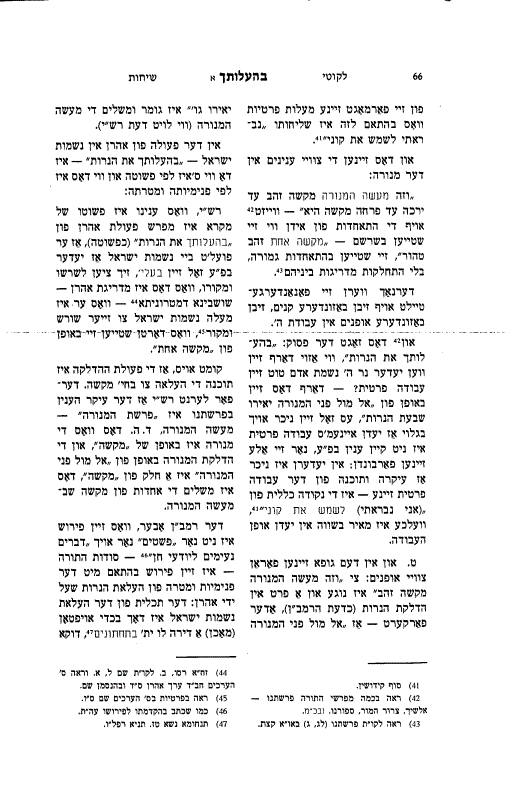
The collective soul of the Jewish people is represented by the menorah. While each individual soul is likened to a single lamp, the menorah as a whole symbolizes the general Jewish soul—klolus nishamas Yisrael. The menorah contains seven lamps, and these correspond to seven different categories of Jews. These categories encompass all Jews, reflecting the seven levels in serving Hashem: love of Hashem, awe of Hashem, and other distinct modes of divine service. Each branch represents a unique approach, but together they form the complete menorah.
There are two aspects to this idea. First, when considering the souls of Israel from their root—shorsham—they are all united. As Tanya teaches, “all have one Father,” meaning that at their source, all souls are truly one entity, a single unified whole—miksha achas. In this state, all Jews stand in total inclusion and unity; they are not separate entities but rather one indivisible being.
However, after each soul is drawn forth from that root and descends into this world, every Jew becomes an individual entity—etzem bifnei atzmo. Each person is distinct from the next and possesses unique qualities and strengths. These individual traits are suited to each person’s particular mission in life—shlichus. Every Jew was created to serve Hashem in their own way, contributing their special talents and advantages to divine service.
This duality is reflected in the structure of the menorah itself. On one hand, it is fashioned from a single piece of pure gold—miksha achas zahav tahor—symbolizing the essential unity of Israel at their root. There are no divisions or gradations between them at this level; it is total oneness.
On the other hand, the menorah branches into seven distinct arms. These represent seven separate paths in serving Hashem—seven unique expressions within divine service. Thus, while there is unity at the core, there is also diversity in actual practice.
This is what the verse means when it says:
בהעלותך את הנרות אל מול פני המנורה יאירו שבעת הנרות
"When you raise up the lamps, toward the face of the menorah shall the seven lamps shine."
The Torah instructs that when you elevate each lamp—that is, when each Jew performs their individual service according to their category—it must be done so that all lamps face toward the center of the menorah. This means that even as each person serves Hashem in their unique way, it should be evident that their service is not isolated or self-contained. Rather, all individual efforts are bound together by a common purpose.
In every Jew’s personal divine service (avodah protis), what should shine through most clearly is not merely how they serve Hashem but that they were created for this very purpose—to serve their Creator. This central point unites every type of service; it radiates equally through all approaches.
The lesson here is that as we “raise up” our own lamp—as we strive for spiritual growth—we must ensure that our individuality remains connected to this shared mission. The main thing isn’t how we serve but that we serve together as part of one greater whole.
Within this concept itself there are two approaches: that of Ramban and Rashi. When discussing whether “the act of making the menorah out of one piece” (miksha zahav) relates specifically to lighting the lamps (according to Ramban), or whether (according to Rashi) “toward the face of the menorah shall its lamps shine” completes and perfects the menorah’s form—their views diverge on how unity and individuality interact in practice.
The Rebbe explains: according to Rashi (who focuses on peshat—the simple meaning), Aaron’s act in lighting the menorah means he inspires each Jewish soul so that every individual rises up on their own—to reach back toward their source and root. This reflects Aaron’s role as shushvina dematronisa, supporting and uplifting Israel so they return to their spiritual origin where all souls stand as one unified entity.
The result is a dynamic where both unity and individuality are preserved: each Jew shines with their own light while remaining fundamentally connected with every other Jew through a shared purpose—to serve Hashem together as one people.
Saif Ches
The act of lighting the menorah is, in its essence, about elevating to the level of miksho—that is, the menorah being made from one solid piece. This is why Rashi explains that the main idea in our parsha is the parsha of the menorah, specifically the act of the menorah. The fact that the menorah is fashioned as a single, unified piece, and that the lighting must be done in a way that faces the menorah itself, are all aspects of this concept of miksho.
This means that lighting the menorah in this manner completes and perfects the unity inherent in its construction. The act of lighting is not just a technical task; it brings out and fulfills the oneness of the menorah as a single entity. This is why this avodah—this service—is described as Aharon's mission when he lights the lamps.
The Ramban, however, whose commentary goes beyond just simple explanations and includes deep and pleasant insights for those who know the inner secrets of Torah, interprets this differently. He explains it according to pnimiyus haTorah—the inner dimension—regarding Aharon's raising up of the lamps.
The Ramban teaches that the ultimate purpose in elevating Jewish souls (neshamos Yisroel) is to make a dwelling place for Hashem in this lowly world (dirah lo yisborach b'tachtonim). Specifically, it must happen here in this physical world, even in places likened to reshus harabim—a domain characterized by separation and multiplicity.
From this we understand that the goal of miksho, unity, is not only about Jews being united at their source but also about drawing down that unity into this world—even into places where there appears to be division. The unity should be revealed even among seven separate lamps (sheva neros), each with its own unique style and approach to divine service.
This idea expresses itself in how all seven lamps are made to shine toward the face of the menorah. Even though there are different lamps and different ways of serving Hashem, they all turn toward one center point—toward unity.
According to the Ramban, then, it is specifically through lighting all seven lamps that this unity is achieved. The main thing is to light them properly so that their essential oneness becomes apparent—a unity rooted in their very souls.
In summary: while Rashi emphasizes how lighting completes and expresses the unity built into the menorah's construction, for Ramban, it is through lighting all seven distinct lamps together that true unity shines forth. This reflects our mission: to bring Hashem's presence into every part of our divided world by revealing our essential oneness.
This concludes a segment from a sicha delivered on Shabbos Parshas Behaaloscha 5730 (1970).
Key Points
1. The Torah’s placement of the law that the Menorah must be made from one solid piece (mikshah) immediately after the command to light its lamps raises a textual difficulty, as this construction detail seems more relevant to earlier sections about building the Menorah.
2. Rashi does not address this apparent difficulty, unlike other commentators such as Ramban and Ohr HaChaim, who offer explanations for why the law of mikshah is repeated here; however, these explanations do not fully resolve the issue according to Rashi’s approach to peshat.
3. According to Rashi, “beha’aloscha es haneros” refers specifically to lighting the lamps so that each flame rises on its own, not to assembling or raising physical parts of the Menorah; thus, there is no implication in peshat that would require clarification about mikshah at this point.
4. The Torah’s command that all lamps face toward the center branch is not redundant; while the Menorah was constructed with branches tilted inward, Aaron was also instructed to actively direct each wick toward the center during lighting, highlighting a new aspect of service distinct from construction.
5. There is a fundamental difference between Rashi and Ramban regarding where the mitzvah of lighting the Menorah is primarily commanded: Rashi sees Parshas Emor as central for this mitzvah, while Ramban views Parshas Tetzaveh as primary and considers Emor and Behaaloscha as adding necessary details for all generations.
6. For Ramban, all details—including mikshah and lamp orientation—are integral aspects of fulfilling the mitzvah of lighting; for Rashi, these elements define what constitutes a true Menorah rather than being mere technical requirements for lighting it.
7. The unity of the Menorah—its being hammered from one piece—becomes manifest through Aaron’s act of lighting all seven lamps toward the center branch. This arrangement reveals that all branches are subordinate parts of a single entity rather than independent elements.
8. Aaron’s privilege in lighting and preparing the lamps is not just a personal honor but an act that inaugurates and completes the essence (cheftza) of the Menorah itself, making it fully sanctified and ready for ongoing service in the Mishkan.
9. On a deeper level (pnimius), each Jewish soul is likened to a lamp, while the collective soul of Israel is represented by the Menorah. The seven branches symbolize seven categories or approaches within divine service, unified by their shared purpose despite individual differences.
10. According to Rashi, Aaron’s role is to inspire each Jewish soul so that every individual rises up on their own yet remains fundamentally connected with others through a common mission—to serve Hashem together as one people; this dynamic preserves both unity and individuality within klal Yisrael.
11. The act of lighting in accordance with mikshah completes and expresses the inherent unity built into the Menorah’s construction. For Ramban, true unity shines forth when all seven distinct lamps are lit together toward one center point—demonstrating how Hashem’s presence can be revealed even within diversity and division in our world.