מבוא
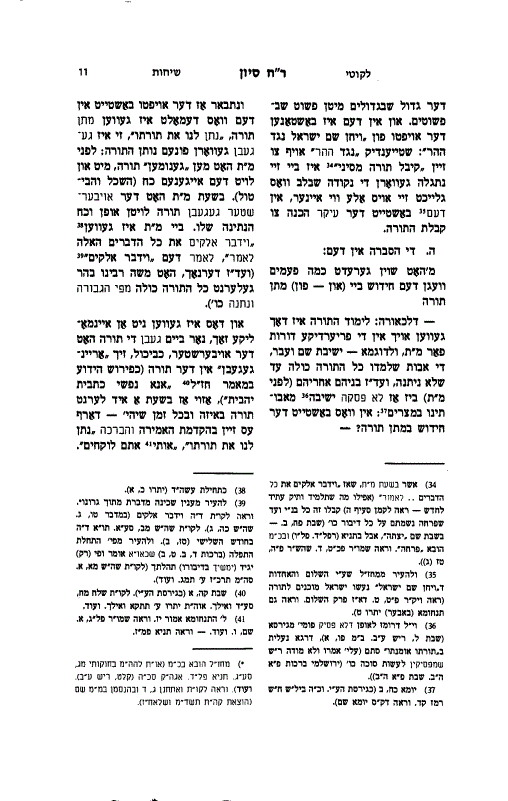
We are going to study a sicha from Likkutei Sichos, volume 28, for Rosh Chodesh Sivan. In this sicha, the Rebbe introduces a novel perspective. He addresses what the Gemara means when it says that on Rosh Chodesh Sivan, when the Jews arrived at Mount Sinai, nothing was said to them because they were just beginning their journey. This implies that even as they began to travel physically, they were also embarking on a spiritual journey.
When the Jewish people arrived at Mount Sinai, the Torah describes them as being “like one person with one heart”—כאיש אחד בלב אחד. This phrase is not just poetic; it expresses a profound idea and an emotional reality. The Rebbe emphasizes that this unity is not something negative or merely an absence of conflict, but rather something deeply positive and powerful.
Their unity meant that all Jews—from Moshe Rabbeinu to the simplest individuals—were together in complete harmony. There was nothing more to say; their togetherness was so complete and natural that it required no further comment or instruction. This marks the beginning of a new stage in their development as a people.
As we will see, the Rebbe explores this theme in depth. Let us now proceed into the details of Rosh Chodesh Sivan.
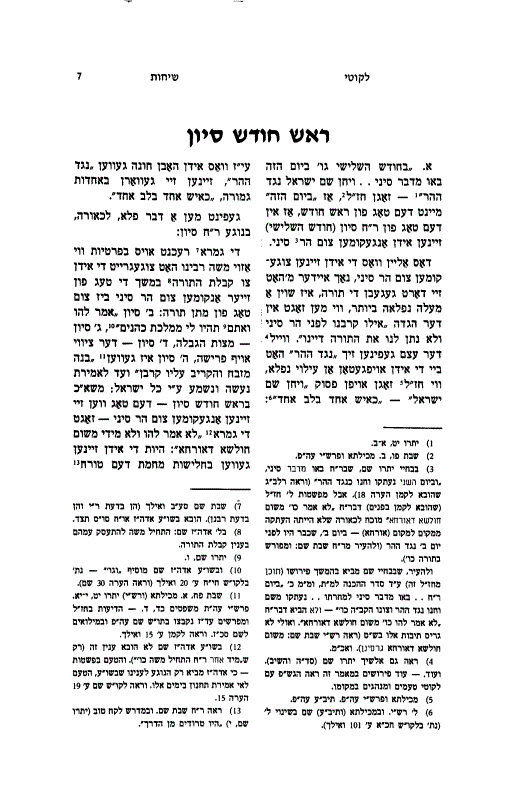
בחודש השלישי לצאת בני ישראל מארץ מצרים ביום הזה באו מדבר סיני.
The verse states that in the third month after leaving Egypt, “on this day,” which is Rosh Chodesh Sivan, they arrived at the wilderness of Sinai. The Torah continues:
ויחן שם ישראל נגד ההר.
“And Israel camped there opposite the mountain.” The Torah uses the singular form “ויחן”—“he camped”—rather than “they camped,” highlighting their unity as they stood before Mount Sinai.
Chazal point out that when the verse says “ביום הזה”—“on this day”—it refers specifically to Rosh Chodesh Sivan, the first day of Sivan. On that day, when they came to Mount Sinai—the third month since leaving Egypt—the Jewish people reached their destination.
This arrival was not just about reaching a physical location; it represented attaining an extraordinary spiritual level—standing before Har Sinai itself. As we say in the Haggadah: אילו קרבנו לפני הר סיני ולא נתן לנו את התורה דיינו, “If He had brought us before Mount Sinai and not given us the Torah—it would have been enough.” Just being at Har Sinai was itself a tremendous achievement.
The very fact that the Jews came to Mount Sinai—dos alein, as expressed in Yiddish—was already significant, even before anything else happened there.
סעיף א׳
Before the Torah was given, the Jewish people were already on a very wondrous level. As we say in the Haggadah, “Ilu kervanu lifnei Har Sinai v’lo nasan lanu es haTorah dayeinu”—had He brought us close to Mount Sinai and not given us the Torah, it would have been enough. This raises a question: what was so significant about simply being at Mount Sinai?
The answer is that the very fact of standing next to the mountain accomplished something tremendous for the Jewish people. Our sages comment on the verse “vayichan sham Yisrael”—“and Israel camped there”—noting that it uses a singular form to teach that they were “as one man with one heart.” This unity was achieved specifically on that day, when they camped opposite the mountain.
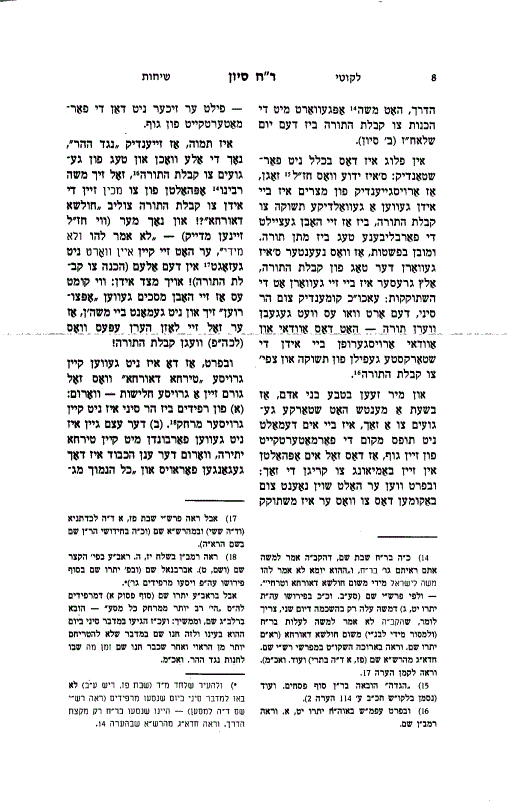
This itself was already a remarkable accomplishment on Rosh Chodesh Sivan. The Rebbe points out that we find something surprising regarding Rosh Chodesh Sivan. The Gemara explains that while all the following days after their arrival were spent preparing for Matan Torah, on the first day—Rosh Chodesh Sivan—Moshe Rabbeinu told them nothing, because they were tired from their journey.
This raises an obvious question: how could mere physical tiredness be enough of a reason not to begin preparations for receiving the Torah? The Jews had been eagerly anticipating this moment, counting down each day since leaving Egypt. Why didn’t they demand to start preparing right away? Was their exhaustion really so overwhelming?
The Gemara details exactly how Moshe Rabbeinu prepared them in the days leading up to Matan Torah. On the second of Sivan, he told them, “You shall be to Me a kingdom of priests.” On the third, he instructed them about setting boundaries around the mountain. On the fourth, he commanded separation between men and their wives. On the fifth, he built an altar and brought sacrifices—all clear steps of preparation.
But on Rosh Chodesh Sivan itself—the day they arrived at Mount Sinai—nothing was said or done in terms of preparation because they were weary from travel. The preparations only began on the following day.
This is difficult to understand. It is well known from our sages that as soon as they left Egypt, there was a tremendous yearning among Bnei Yisrael for receiving the Torah. They counted each day eagerly until its arrival; their anticipation only grew stronger as they drew closer to Matan Torah.
When someone yearns deeply for something, physical tiredness does not hold him back from pursuing it—especially when he is already so close to attaining his goal. If anything, being right at Mount Sinai should have intensified their excitement and anticipation even more.
It is therefore surprising that after all those weeks and days of longing for this moment—now finally standing at the foot of Har Sinai—their preparations would be delayed simply due to weariness from travel. How could this be sufficient reason not to begin preparing immediately for receiving such an extraordinary gift?
סעיף ב׳
The sages emphasize that Moshe Rabbeinu did not say a single word to the Jewish people on that day—not even about the matter of death, nor anything else. He gave them no preparation, no instruction, nothing at all. This is surprising: how could Moshe Rabbeinu remain silent at such a crucial moment?
It is not only Moshe’s silence that is puzzling. The Jewish people themselves did not demand anything from him. Why did they accept this? Even if they were tired from the journey, it was not such an exhausting trip. Hashem sent clouds to smooth the way before them, making the road easy and flat. The distance from Rephidim to Har Sinai was not great, and the journey itself was not difficult.
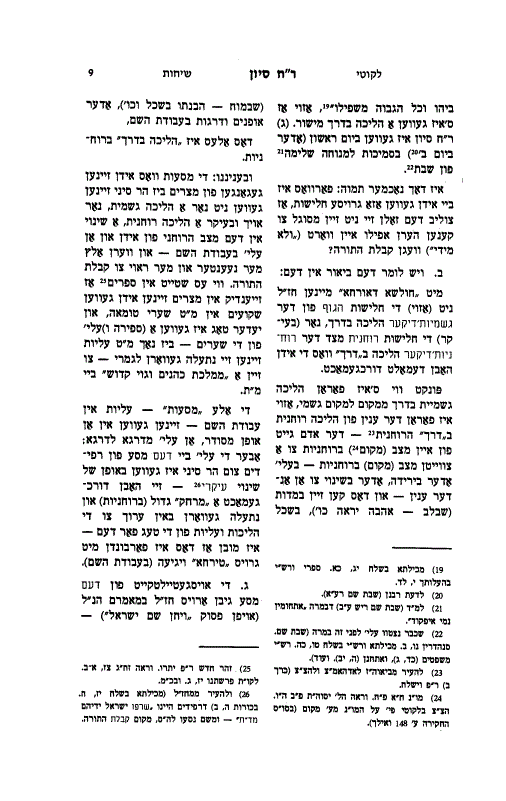
סעיף ג׳
Here, there was a sudden and tremendous leap in the spiritual standing of the Jewish people—from Rephidim to Har Sinai. This was not just a gradual progression, but a major transformation, an essential change. Spiritually, they traveled an immense distance and reached a level of elevation incomparable to any of their previous journeys or ascents.
This dramatic shift is connected with great effort and toil in serving Hashem. Such a sudden and significant change requires tremendous exertion. What was this lofty level they attained? It was the unity of all the people, camping “with one heart”—a revelation of such depth that it united every Jew together as one, representing an extraordinary spiritual achievement.
The distinction of this journey is highlighted by our sages in their commentary on the verse:
ויחן שם ישראל נגד ההר
They explain: “As one man with one heart.” In contrast, all other encampments were characterized by arguments and complaints—there were always disagreements and disputes among them. But specifically here, as they camped opposite the mountain, the Jews stood in complete unity, “as one man with one heart.”
Normally, we might interpret the previous encampments negatively—as if they were always fighting. However, the Rebbe clarifies that these disagreements were natural; it is normal for people to understand things differently and not always be of one mind. The exception is when everyone suddenly agrees—this is truly remarkable.
The meaning of “all other encampments were with discord” does not imply simple fighting or quarreling over physical matters. Rather, even within Torah itself there are different opinions—forty-nine ways to declare something pure and forty-nine ways to declare it impure. The Torah allows for multiple interpretations; this diversity is by design.
Hashem created people with different minds and perspectives. He also gave us a Torah that accommodates various viewpoints. Both sides of a debate can be “the words of the living God.” Thus, the disagreements among the Jews during their travels were not negative; they reflected the natural diversity within holiness itself.
It follows that during all other encampments, discord existed for the sake of heaven—machlokes l’shem shamayim. Their disputes were about spiritual matters, not personal grievances or material concerns.
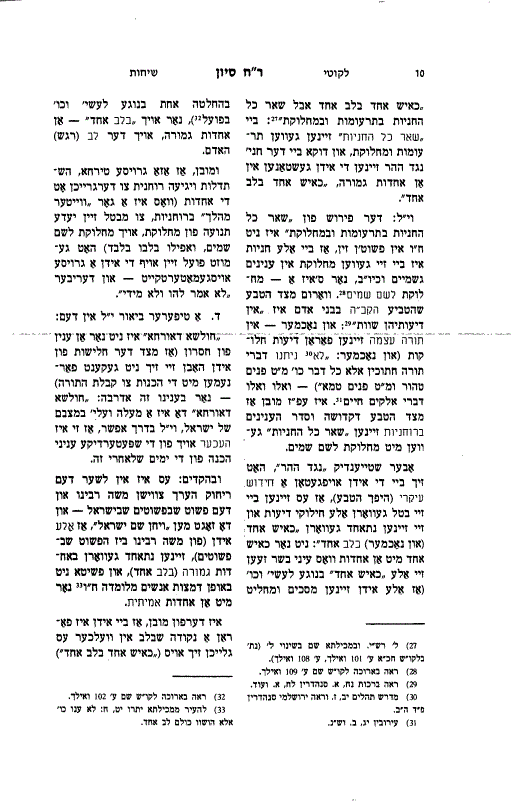
But when they camped opposite Har Sinai, something entirely new occurred—a true novelty that went against their nature. All differences of opinion vanished; they became united as one person with one heart. This was not only unity in action (“as one man”), where everyone agreed on what to do and acted together—but also unity in feeling (“with one heart”), where their emotions and inner desires aligned completely.
This level of unity was extraordinary—a total oneness encompassing both deed and emotion. Achieving such harmony required immense effort: negating every trace of discord—even those arguments that had been for the sake of heaven—and reaching a state where even internally, in their hearts, all Jews were bound together as one.
Such a profound transformation demanded great exertion—spiritual toil far beyond anything experienced before. To reach this unity meant journeying an incredible spiritual distance: overcoming every inclination toward disagreement until even internal feelings were unified.
This explains why their exhaustion at this point was so great—it was not merely physical fatigue from traveling, but primarily spiritual weariness from achieving such unprecedented unity. This emotional toll left them drained relative to where they had been previously.
Therefore, Rashi says that Moshe did not rebuke them at this time—their tiredness (“weakness from the road”) refers mainly to this intense spiritual transition into complete unity. The main exhaustion was emotional and spiritual; thus Moshe refrained from saying anything further to them at that moment.
The Rebbe deepens this idea: The weakness from the journey is not simply a deficiency or lack—meaning that because they were weak or tired they could not properly prepare for receiving the Torah. Rather, their very weakness was itself an indication of their greatest achievement…
סעיף ד׳
In this section, the Rebbe emphasizes that what might appear as a weakness—namely, the “plainness” or simplicity of some Jews—is actually a tremendous advantage and elevation in their spiritual condition. This quality, he suggests, may even surpass later stages of preparation for receiving the Torah. The Rebbe introduces the radical idea that at Har Sinai, all Jews—from Moshe Rabbeinu to the simplest Jew—stood together in absolute unity.
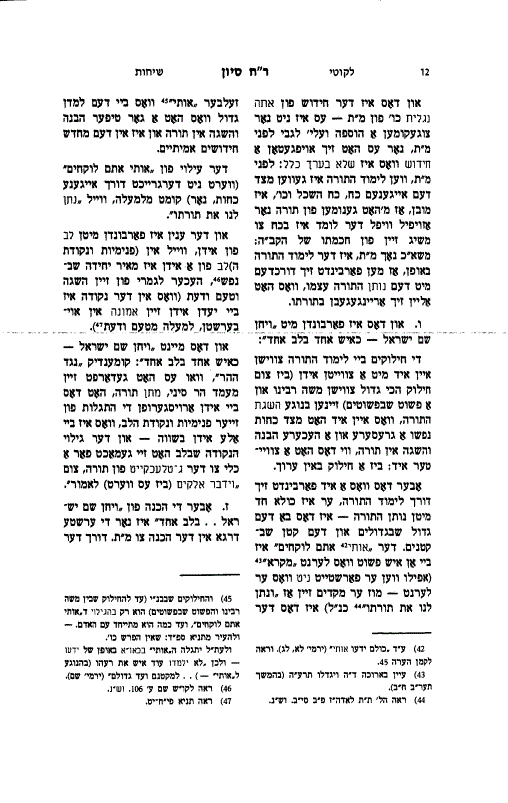
We cannot fathom the vast distance between Moshe Rabbeinu and the simplest Jew in terms of spiritual stature and understanding. Yet, at that moment, they were united “as one man with one heart.” This was not merely an external or superficial unity; rather, it meant that even the simplest Jew shared the same heart as Moshe Rabbeinu. Through true unity, every Jew became genuinely one with Moshe.
How is such unity possible? The Rebbe explains that within every Jew there exists a point in the heart—a level of the soul—where all are truly equal. At this deepest level, distinctions between greatest and simplest disappear; everyone is united as one. This revelation occurred as Bnei Yisrael stood at Sinai to receive the Torah: their inner point of unity was revealed, making them all equal before Hashem.
This profound unity is not just a side benefit but is actually the primary preparation for receiving the Torah. The main readiness for Matan Torah is reaching this state of “Vayichan Yisrael”—the singular encampment and oneness of Israel.
The Rebbe then addresses why this unity is such a crucial preparation—perhaps even greater than other forms of spiritual readiness. Before Matan Torah, Jews studied Torah according to their own intellect and capacity. But at Matan Torah itself, Hashem gave His Torah with His own power—“His Torah,” not just knowledge accessible through human effort.
Before Matan Torah, there were already those who studied Torah: Shem and Ever had yeshivos; the Avos (forefathers) learned all of Torah before it was formally given; even in Egypt there were yeshivos where Jews studied constantly. So what was new about Matan Torah?
The novelty was not merely more knowledge or deeper understanding—it was that Hashem Himself gave us His Torah. Previously, people accessed whatever they could grasp according to their own abilities. But at Matan Torah, Hashem gave us His wisdom directly, according to His infinite capacity—not limited by our own intellect or subjugation.
From then on, whenever we learn Torah—even today—we are connecting with Hashem Himself through His Torah. As Chazal say: “Hashem put Himself into the Torah.” When we study it now, we are not just taking what we can understand; we are taking Hashem Himself as He invested Himself into His Torah at Sinai.
This is reflected in our daily blessing:
נותן התורה
“He who gives the Torah”—in present tense—because every time we study, we receive anew from Hashem’s own giving at Sinai.
This innovation means that after Matan Torah, learning is no longer limited by our intellectual grasp alone. Instead, when we study Torah now—even if our understanding is limited—we connect directly to Hashem who placed Himself in His Torah.
This connection transcends differences between individuals’ intellectual capacities. Whether it’s Moshe Rabbeinu or a simple Jew learning Chumash without full comprehension—they both make the same blessing: “Who has given us His Torah.” Both are equally connected to Hashem through their learning.
The advantage here comes not from personal achievement but from Hashem’s gift: “You take Me”—a level unattainable by human effort alone. This equality is rooted in the innermost point of every Jewish heart—the yechidah, or singular essence of the soul—which shines forth during true unity and transcends intellect or understanding.
Thus, while comprehension and knowledge are important extensions of the soul’s faculties, they do not reach its core essence. The deepest connection to Hashem through Torah comes from this inner point—the yechidah—which unites all Jews equally before Him.
סעיף ה׳
At the moment of standing at Mount Sinai, every Jew possessed a belief in Hashem that transcended reason and understanding. This faith is not based on intellectual grasp, but rather comes from the innermost point of the Jewish heart—a level that is equal in all Jews, regardless of their individual differences.
When they stood opposite the mountain, preparing for the giving of the Torah, a special revelation emerged from within each Jew. This was not merely an external unity, but a deep inner awakening—the revelation of their pnimiyus and nekudas halev, the innermost point and essence of their heart. This point is shared equally by all Jews and made them into proper vessels to receive the godliness of Torah.
This inner awakening—this hisgalus halev, or revelation of the heart—prepared them for Matan Torah. It was this level that enabled them to truly receive and internalize the divine revelation. The Rebbe explains that at Matan Torah, something entirely new occurred: previously, everything depended on one's own revealed faculties—on intellect and personal capacity. The difference between Moshe Rabbeinu and others was in these revealed abilities.
But when it comes to the essence of the heart—the point of faith and acceptance—there is no difference between one Jew and another. This essential point prepared them for the unique revelation at Matan Torah, making them ready to receive godliness in a way that penetrated their very being.
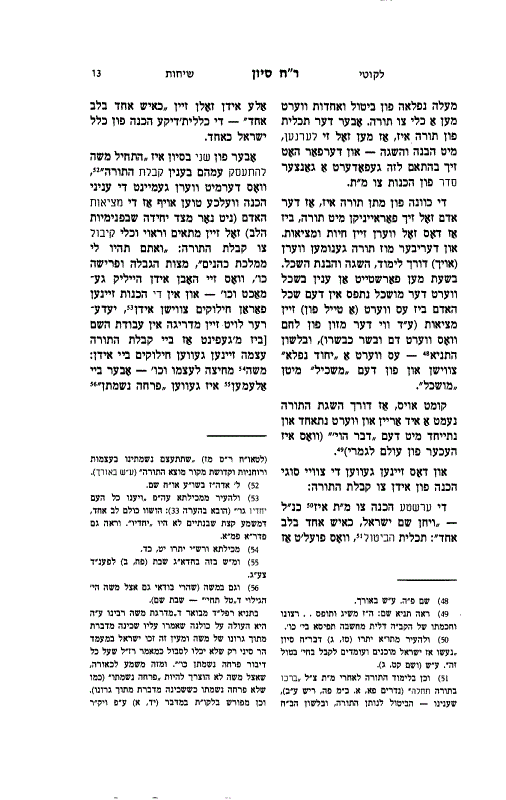
When they arrived at Har Sinai, they reached a state described as “like one man with one heart.” However, this was only the first stage in preparing for Matan Torah. Beyond this initial bitul—self-nullification—they needed further preparation so that Torah would not remain external or above intellect but would also penetrate their minds.
This is why additional days of preparation were required: not just to negate their own existence through faith alone, but to allow this faith to enter into their intellect as well. The first days focused on bitul, but true preparation for Matan Torah required more—it demanded that they become vessels capable of understanding as well as believing.
The wondrous advantage of subjugation and unity makes one a vessel for Torah. Yet, the ultimate goal is not simply self-nullification before Torah, but rather to understand it—to study it with comprehension and grasp (havana v’hasaga). The purpose is not merely to lose oneself in submission but to unite with Torah so deeply that it becomes one's very life-force and existence.
This is why receiving Torah also requires learning it intellectually—grasping its concepts with one's mind. When you understand something logically, what you have learned becomes integrated into your intellect; it becomes part of who you are.
This process is likened to eating bread: just as food turns into blood and flesh within a person’s body, so too does internalized Torah become part of one’s spiritual being when truly understood.
As Tanya describes it: “It becomes a wondrous union” (yichud nifla) between the person who understands and the idea itself—the learner and the Torah become one entity through intellectual comprehension.
The result is that through understanding Torah, a Jew absorbs it internally and becomes united with Hashem’s words. This union surpasses any connection found elsewhere in creation—it is an unparalleled fusion between Jew and Divinity through learning.
Thus, there are two stages: first comes general preparation through bitul, rooted in the essence of the soul beyond intellect; then comes intellectual engagement, where faith penetrates reason so that Torah can be fully absorbed into every aspect of one's being.
סעיף ו׳
The Rebbe explains that there were two general categories of preparation for the Jewish people to receive the Torah. The first, as mentioned earlier, was the state described by the verse:
ויחן שם ישראל נגד ההר — כאיש אחד בלב אחד
They camped at the mountain as one person with one heart. This total unity brought about a profound level of bitul—self-nullification. This was a collective preparation, encompassing all Jews together in a single state of readiness.
However, beginning with the second day of Sivan, Moshe began to engage with them in matters specifically related to receiving the Torah. At this stage, the preparations shifted focus: not only was their innermost essence involved, but also their intellect and entire being needed to become fitting vessels for receiving the Torah.
This is why Moshe told them on the second day:
ואתם תהיו לי ממלכת כהנים וגוי קדוש
And then on subsequent days, he instructed them regarding boundaries around the mountain and separation from certain activities. These steps made them holy and prepared them further.
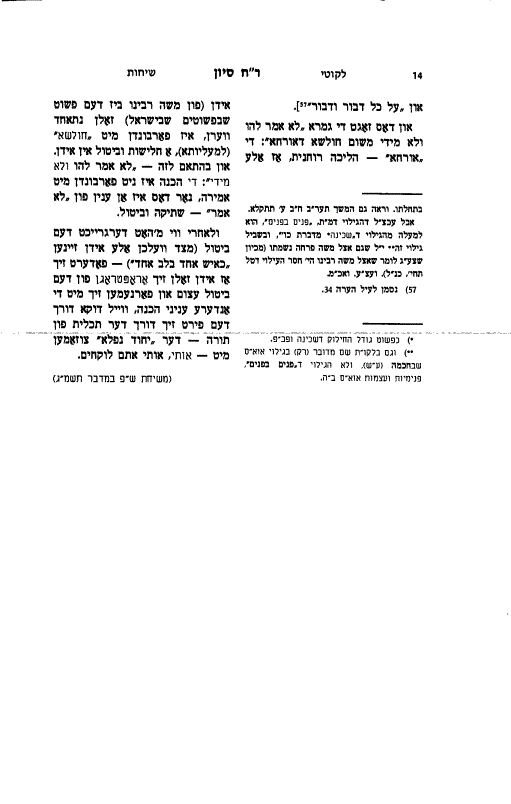
At this point, distinctions emerged among the people. Each Jew prepared according to his own level in serving Hashem. When they actually received the Torah, there were differences among them: Moshe had his own partition and stood apart, while all other Jews experienced their souls leaving their bodies at each Divine utterance.
This means that even though Moshe was separated physically and spiritually, all Jews experienced a profound bitul, a self-nullification that transcended individual differences. The Gemara notes that Moshe did not say anything to them at this stage because of their weakness from the journey—but this “weakness” is understood here as a positive quality: a humility and subjugation that united everyone from Moshe Rabbeinu down to the simplest Jew.
This spiritual journey required every Jew to be united through this humility and bitul. That is why there was no need for words or instructions at this stage—the preparation was not about saying or teaching, but about silence and self-effacement before Hashem’s revelation.
After reaching this intense state of bitul, where all Jews were like one man with one heart, it became necessary for them to descend somewhat from this lofty negation of self. They needed to engage in further preparations that involved their individual personalities and actions. If they remained only in that state of bitul, they would not fulfill Hashem’s ultimate intent for creation.
The goal is to bring that bitul down into one’s concrete existence—to integrate it into daily life and personal service. The preparations that began on the second day of Sivan reflect this process: taking the unity and self-nullification achieved collectively and channeling it into each person’s unique role as a vessel for Torah.
This fulfills the ultimate purpose of Torah, as explained in Tanya: achieving a wondrous union (yechud nifla) between Hashem and every Jew, not only in essence but also within each person’s individual existence. This union brings together both aspects—the collective bitul and its expression within every Jew’s daily life.
Key points
1. In this sicha for Rosh Chodesh Sivan, the Rebbe presents a novel interpretation of the events at Mount Sinai. He explains that when the Jewish people arrived at Har Sinai, their unity—described as “like one person with one heart”—was not merely an absence of conflict but a profound and positive state. This unity marked the beginning of a new spiritual journey, signifying both a physical and spiritual arrival at an extraordinary level, as highlighted by the Torah’s use of singular language and the statement in the Haggadah that simply being brought before Mount Sinai was itself a tremendous achievement.
2. The Rebbe questions why standing at Mount Sinai was considered such a significant accomplishment even before receiving the Torah. He notes that on Rosh Chodesh Sivan, Moshe Rabbeinu gave no instructions to the people because they were weary from travel. This is puzzling, given their intense anticipation for Matan Torah; physical tiredness alone seems insufficient to delay preparations for such a momentous event. The Gemara details how Moshe prepared them on subsequent days, yet on this first day, nothing was said or done in terms of preparation, raising questions about the true nature of their weariness.
3. The sages emphasize that Moshe’s silence was total—he did not speak even about matters of life and death. The Rebbe further questions why neither Moshe nor the people initiated any preparations, especially since their journey was neither long nor arduous due to Divine assistance. He explains that their weakness was not physical but spiritual: it reflected the immense inner transformation required to ascend from one spiritual level to another. Each stage of their journey from Egypt represented an elevation in avodas Hashem, culminating in a climactic transformation as they approached Har Sinai—a process primarily spiritual rather than physical.
4. At this point, there occurred a sudden and radical leap in their spiritual standing—a qualitative transformation that united all Jews “as one man with one heart.” Unlike previous encampments characterized by natural disagreements—even those for the sake of heaven—here all differences vanished. This unity encompassed both action and emotion; every Jew’s inner desires aligned completely. Achieving such harmony demanded immense spiritual effort and left them emotionally exhausted. The Rebbe clarifies that this “weakness” was not a deficiency but itself evidence of their greatest accomplishment: attaining unprecedented unity through profound inner toil.
5. The Rebbe highlights that what might appear as simplicity or plainness among some Jews is actually a tremendous spiritual advantage. At Har Sinai, Jews of every level—from Moshe Rabbeinu to the simplest individual—stood together in absolute unity, sharing an essential point within the heart where all are truly equal. This revelation made them proper vessels for receiving Hashem’s Torah; it is this inner point—the yechidah—that connects every Jew equally to Hashem through Torah study, transcending differences in intellect or understanding. Thus, true preparation for Matan Torah is rooted in this essential unity and self-nullification before Hashem.
6. Standing at Mount Sinai awakened within every Jew a faith in Hashem that transcended intellect—a revelation from the innermost point of the heart shared equally by all. This hisgalus halev (revelation of the heart) prepared them for Matan Torah by making them fitting vessels for divine revelation. However, this was only the first stage; further preparation was needed so that Torah would penetrate not just faith but also intellect. The ultimate goal is not merely self-nullification but internalization—understanding Torah so deeply that it becomes part of one’s very being, achieving a wondrous union between Jew and Divinity through comprehension as well as faith.
7. The Rebbe concludes by distinguishing two stages in preparing to receive the Torah: first, collective unity and bitul (“as one person with one heart”), which encompassed all Jews equally; second, individual preparations involving intellect and personal service as instructed by Moshe on subsequent days. While initial readiness required total self-nullification and silence before Hashem’s revelation, true fulfillment comes when this bitul is integrated into each person’s unique existence and daily life. Thus is achieved Tanya’s ideal: an unparalleled union between Hashem and every Jew—not only in essence but also within each individual’s concrete reality—by channeling collective unity into personal avodah and understanding.