מבוא
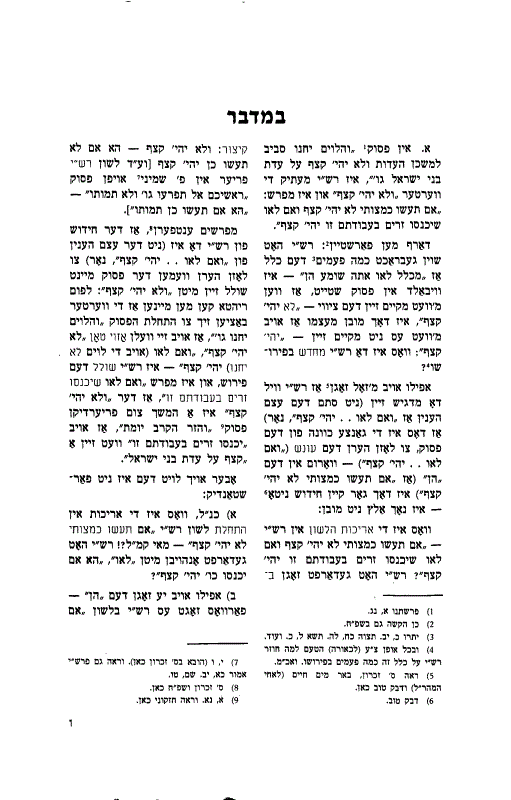
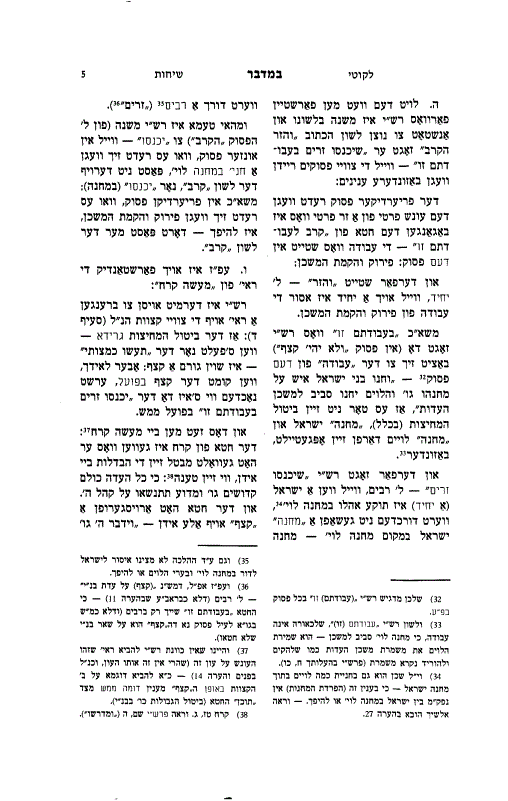
We are about to study a sicha from Likkutei Sichos, volume 28, on Parshas Bamidbar. This is a Rashi sicha, focusing on the commentary of Rashi. We dedicate our learning for the elevation of the soul of Yitzchak ben Rochel and Tzvi—תהי נשמתו צרורה בצרור החיים.
The Rebbe addresses a passage in the Torah that discusses the arrangement of the Mishkan and the responsibilities of the Leviim. The Torah says:
ולא יהיה קצף על עדת בני ישראל גו'.
This means that there should not be anger or a plague upon the community of Israel. When the Leviim are stationed in their designated camp and fulfill their role, this prevents any negative consequence from befalling Bnei Yisrael.
Rashi comments on this verse by quoting its words: ולא יהיה קצף—there will not be anger or a plague. He explains that if you do as I command, there will be no anger; but if not, then what will happen? Then strangers who are not Leviim might enter this sacred area and there will be anger—a punishment will result.
Rashi seems to be clarifying that when non-Leviim perform the service meant for Leviim, or enter where they do not belong, it brings about this negative consequence. He notes that if you follow Hashem’s command, there is no anger; if you do not, there is.
This raises a question: Why does Rashi need to explain this at all? The verse itself says that if you do what is commanded, there will be no anger—if not, there will be. This principle—that we can infer a positive from a negative statement—is something Rashi has pointed out many times before. For example, מכלל לאו אתה שומע הן—from a “no” we learn a “yes.”
Since this method is already established by Rashi elsewhere, we need to understand what exactly he is adding here and why he feels it necessary to comment at all on this verse. As we begin our study, these are some of the questions we will explore regarding Rashi’s approach and his unique explanation here.
סעיף א׳
The Rebbe begins by analyzing the verse which states that when you fulfill HaShem’s command, there will not be anger. He asks: what is Rashi’s novelty in his commentary here? The Torah says explicitly that if you listen, there won’t be anger, and if you don’t, there will be anger. This seems obvious—what is Rashi adding?
Perhaps one might suggest that Rashi wants to clarify the second part of the verse. Why would the Torah need to say that if you follow HaShem’s command, there won’t be anger? Of course, if you do what HaShem wants, there is no anger. So maybe Rashi is emphasizing that the main point of the verse is actually about the consequence of not listening—that then there will be anger.
But even if we say this, it still doesn’t explain why Rashi uses such lengthy language. If his point is simply to tell us that not fulfilling the mitzvah brings about anger, he could have stated it briefly. Instead, Rashi elaborates: “If you do like My mitzvos, there won’t be anger; if not, strangers will enter into this service and there will be anger.” Why does Rashi add all these details?
The Rebbe notes that Rashi’s language here is similar to his wording earlier in Parshas Shemini. There, regarding the sons of Aharon after Nadav and Avihu died, Hashem commands them not to act as mourners. The verse says not to let their hair grow so they won’t die, and Rashi explains: “If you do so, you’ll die.” In that context it makes sense—the main point of the verse is the consequence. But here in our case, Rashi adds extra words about fulfilling mitzvos and strangers entering the service. What is going on?
This suggests that something deeper is happening in our verse than just a simple warning about punishment for non-fulfillment. The Rebbe points out that Rashi’s novelty isn’t just about stating a general principle—that failing to fulfill brings anger—but rather explaining who exactly this anger is directed toward.
Reading the verse quickly might lead one to think it refers only to the Leviyim: “The Leviyim should camp around the Mishkan so there won’t be anger.” If they do what Hashem wants—if they camp properly—there won’t be anger; if not, there will be anger against them.
Rashi comes to negate this interpretation. He clarifies that the intent of the verse isn’t simply about whether or not the Leviyim fulfill their duty. Instead, he explains that if strangers (non-Leviyim) enter into this service—the service assigned specifically to Leviyim—then there will be anger against those intruders.
This connects with an earlier verse:
והזר הקרב יומת
The Torah previously stated that any non-Levi who approaches shall die—a punishment from Heaven (as Rashi explains: מיתה בידי שמים). The Rebbe notes he will address this further later in the sicha.
So according to Rashi’s explanation here: if strangers enter into this avodah—the special service of Leviyim—then “there will be anger,” meaning a punishment or consequence for those intruders. Thus, when our verse says “so there won’t be anger,” it means ensuring only Leviyim perform their designated role prevents others from incurring Divine wrath.
סעיף ב׳
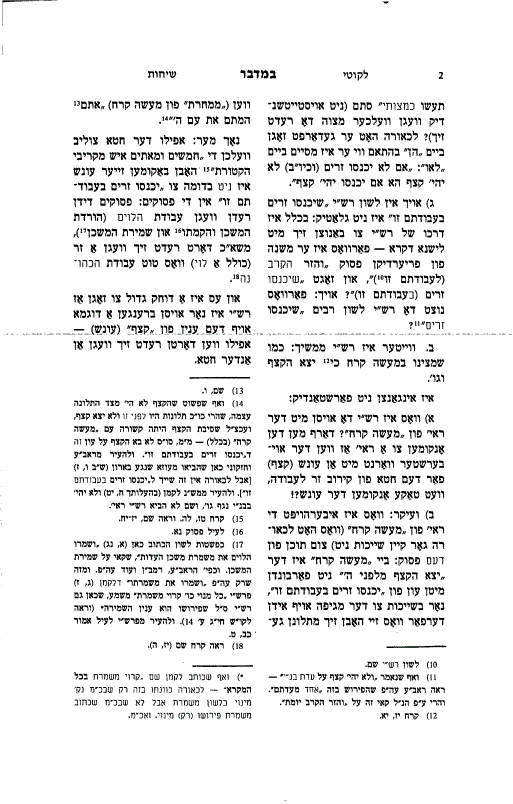
The verse states that if strangers enter, there will be a “ketzef”—a plague or anger—upon the Jewish people. Rashi clarifies that this ketzef is not directed at the Leviyim, but rather at Bnei Yisrael, due to their actions.
The Torah is speaking about the role and service of the Leviim. However, this itself requires explanation. Even afterward, according to Rashi, the matter is still difficult to understand.
As mentioned earlier, what exactly is Rashi adding here? We already know that a Levi can be counted from the age of one month. So what new point is Rashi coming to teach us?
Particularly since the verse is not discussing qualification for active service beginning at a later age, nor is it discussing the prohibition of a non-Levi entering where he does not belong. Rather, the verse simply states the counting itself — that they may be counted from one month old.
If so, what is the novelty in Rashi’s explanation?
Therefore, Rashi adds another point: “lest they enter the holy area and incur punishment.” In other words, the counting is connected to their unique status and relationship to matters of holiness.Rashi’s comment raises questions. If the verse already says that if strangers enter there will be ketzef, what is Rashi adding by emphasizing this? Is he simply restating the obvious? Furthermore, Rashi does not specify which mitzvah he refers to—he just says “like my mitzvah.” The positive and negative should balance: if they do not enter (the negative), there is no ketzef; if they do enter (the positive), there is ketzef. Why does Rashi need to elaborate?
Another point: Rashi changes the language from the verse. The verse says “a stranger who comes close to the service” in singular form; Rashi speaks of “strangers entering” in plural and uses different wording. Normally Rashi sticks closely to the language of the verse—why does he deviate here?
Some commentaries suggest that Rashi wants to clarify who receives the ketzef—that it falls on Bnei Yisrael rather than on the Leviyim. This would explain why he emphasizes that point. However, this still leaves us with difficulties regarding his choice of words and structure.
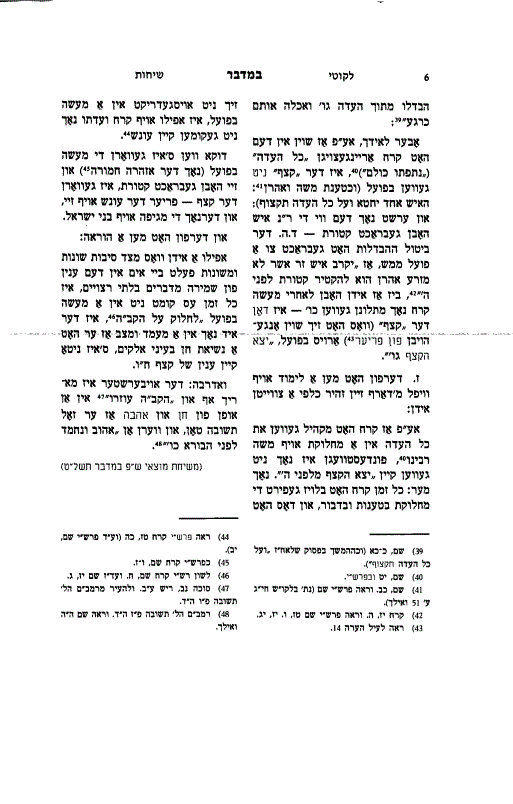
The Rebbe notes that every word in Rashi is precise and meaningful. Before delving into a full explanation of Rashi’s intent here, he points out another major difficulty: in this passage Rashi brings an example from the story of Korach. The Rebbe asks—why is such a proof necessary? If Hashem warns of a punishment for a certain sin (here: strangers entering the service), isn’t it self-evident that there will be consequences?
Rashi cites:
כמו שמצינו בפרשת קרח ויהי הקצף על העדה
The Rebbe questions why we need proof from Korach’s story at all. The case of Korach seems unrelated—the context there was not about non-Levites entering the service but about other sins entirely.
In fact, during Korach’s episode, Hashem’s anger (“ketzef”) was triggered by Bnei Yisrael complaining after 250 people died for offering unauthorized incense—not for strangers performing Levite service as in our parsha. The punishment in Korach’s story was for complaining against Moshe and Aharon (“You have killed Hashem’s people!”), which led to a plague among Bnei Yisrael.
Even at the beginning of Korach’s story—the 250 men who brought incense—their punishment was not for doing Levite work per se; it was for bringing unauthorized incense offerings. This is different from our context where we are discussing non-Levites performing specifically Levite tasks like carrying or assembling parts of the Mishkan.
The Rebbe suggests it is difficult to say that Rashi merely wants to bring an example of where “ketzef” appears elsewhere in Tanach. If so, why choose an example with such a different context? There are likely other places where “ketzef” appears; why select this one?
Before explaining why Rashi brings this example from Korach specifically—and what deeper lesson he intends—the Rebbe signals that more clarification is needed regarding both Rashi’s language and his choice of proof-text.
סעיף ג׳
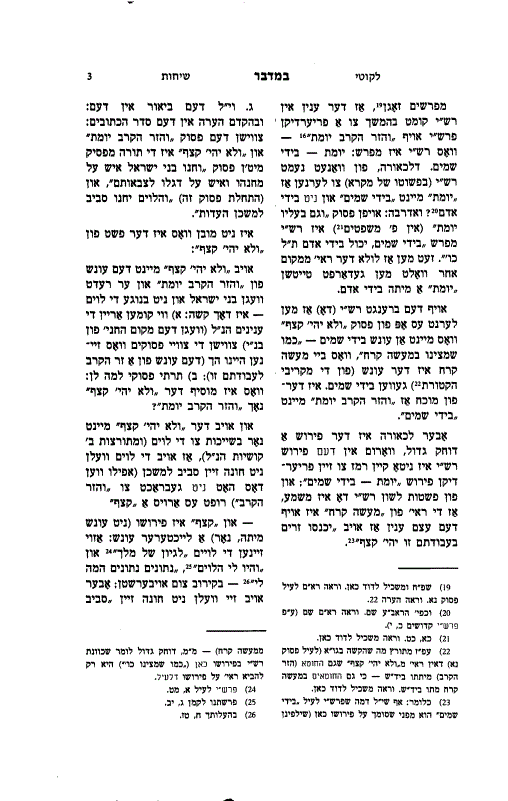
The discussion here revolves around how Rashi interprets the word יומַת—“he shall die”—in the context of the Torah’s warnings regarding approaching or serving in the Mishkan. The question is: How does Rashi know, in the peshat—the plain meaning—that יומַת sometimes means death by Heaven (בידי שמיים) and not execution by a human court? Rashi brings proof from other places where the term קצף—“wrath”—is used, such as in the story of Korach, to show that this is a Divine punishment.
Rashi’s approach is to look for textual clues. For example, when the Torah says “the stranger who comes close shall be put to death,” Rashi asks: Does this mean by human hands or by Heaven? He notes that sometimes יומַת refers to a human court, as in the case of an ox that kills a person (“the ox shall be stoned and its owner also put to death”), but other times it refers to Heavenly punishment. The proof comes from the use of קצף in both contexts.
The Rebbe analyzes why Rashi seems to avoid explicitly stating that “he shall die” means by Heaven in this context. In earlier places, Rashi was clear about this meaning. Here, however, he appears more reserved. The Rebbe suggests that this is because there are two different types of violations being discussed: one involving Israelites entering forbidden areas or performing forbidden service (which brings about Divine wrath), and another involving Levites themselves failing in their duties.
This distinction is reflected in how the verses are structured. Sometimes the Torah speaks about Israelites encroaching on Levitical tasks or areas; other times it addresses Levites’ own responsibilities regarding guarding and assembling the Mishkan. The threat of “wrath” (קצף) is thus not just about an individual act but about breaching boundaries—either physical or spiritual—that separate Israelites from Levites and their respective roles.
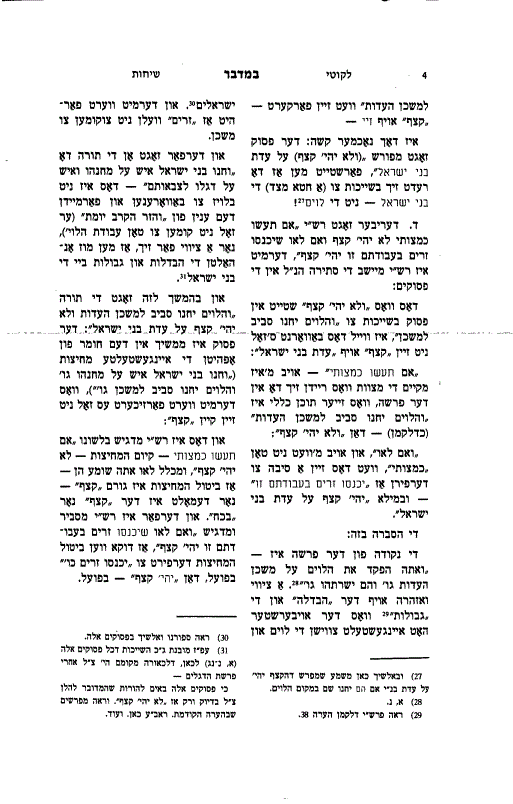
Part of this parsha’s theme is precisely these boundaries: who camps where, who serves where, and what happens if those boundaries are breached. The Torah emphasizes that if these divisions are maintained—if everyone keeps to their assigned place and task—there will be no wrath upon the community. But if they are breached, there is potential for Divine anger to manifest.
The Rebbe further explains that Rashi’s careful language highlights two types of service: one general (setting up and assembling the Mishkan), and one specific (an individual non-Levite performing a particular act of service). The Torah uses singular language (“the stranger who draws near”) to indicate even an individual Israelite can trigger Divine wrath if he crosses into Levitical territory or service.
This helps us understand why sometimes the verse uses plural language—referring to groups—and sometimes singular—referring to individuals. Both scenarios threaten communal harmony and sanctity; both can bring about “wrath” if boundaries are breached.
Ultimately, Rashi’s approach teaches us that maintaining proper divisions within holiness is not just a technical matter but essential for avoiding Divine anger. Only when everyone fulfills their assigned role does peace reign among Israel; when those roles are confused or violated, there is potential for disaster—as seen in Korach’s rebellion.
The lesson here is profound: even when discord arises among Jews—even if it involves an entire community against Moshe Rabbeinu—the actual consequences do not manifest until certain lines are crossed. Just as with Korach’s rebellion, only after specific actions were taken did Divine wrath descend upon them.
Key points
1. We are about to study a sicha from Likkutei Sichos, volume 28, on Parshas Bamidbar, focusing on Rashi’s commentary regarding the arrangement of the Mishkan and the responsibilities of the Leviim. The Torah states that when the Leviim fulfill their designated role, “there will not be anger upon the congregation of Israel.” Rashi explains that if Hashem’s command is followed, there will be no anger; but if not—if strangers (non-Leviim) enter this sacred service—then anger and punishment will result. This raises a question: since the verse itself implies this consequence, what is Rashi adding with his commentary? The Rebbe sets out to explore what is unique in Rashi’s approach here.
2. The Rebbe analyzes Rashi’s novelty in his commentary. While it seems obvious that failing to fulfill Hashem’s command brings about anger, Rashi elaborates with additional details: “If you do like My mitzvos, there won’t be anger; if not, strangers will enter into this service and there will be anger.” This suggests that Rashi is clarifying who the anger is directed toward—not merely the Leviim for failing in their duty, but rather against those non-Leviim who intrude upon the Levitical service. Thus, when the verse says “so there won’t be anger,” it means that ensuring only Leviim perform their designated role prevents others from incurring Divine wrath.
3. The verse states that if strangers enter, there will be “ketzef”—anger or plague—upon Bnei Yisrael. Rashi clarifies that this ketzef is directed at Bnei Yisrael due to their actions. However, questions arise regarding why Rashi elaborates and changes language from the verse (using plural instead of singular), and why he brings proof from Korach’s story—a context seemingly unrelated to non-Levites performing Levitical service. The Rebbe points out that every word in Rashi is precise and signals that further clarification is needed regarding both his language and his choice of proof-text.
4. The discussion turns to how Rashi interprets “he shall die” (יומת) in these verses: does it mean death by Heaven or by a human court? Rashi brings proof from other places where “ketzef” (wrath) appears—such as Korach—to show this refers to Divine punishment. The Rebbe notes that sometimes יומת means execution by a human court (as with an ox that kills), but here it refers to Heavenly punishment. He further explains that there are two types of violations: Israelites encroaching on Levitical roles (bringing Divine wrath), and Levites themselves failing in their duties. This distinction underlies how the Torah structures these warnings and threats of wrath.
5. The parsha emphasizes boundaries within holiness: who camps where, who serves where, and what happens if those boundaries are breached. If these divisions are maintained—if everyone keeps to their assigned place and task—there will be no wrath upon the community; but if they are breached, Divine anger may manifest. This is reflected in both general service (assembling the Mishkan) and specific acts (an individual non-Levite performing a particular avodah). Both scenarios threaten communal sanctity and can bring about ketzef if boundaries are crossed.
6. Ultimately, Rashi’s approach teaches that maintaining proper divisions within holiness is essential for avoiding Divine anger. Only when everyone fulfills their assigned role does peace reign among Israel; when those roles are confused or violated—as seen in Korach’s rebellion—there is potential for disaster. Even when discord arises among Jews—even involving an entire community against Moshe Rabbeinu—the actual consequences do not manifest until certain lines are crossed; only then does Divine wrath descend upon them.