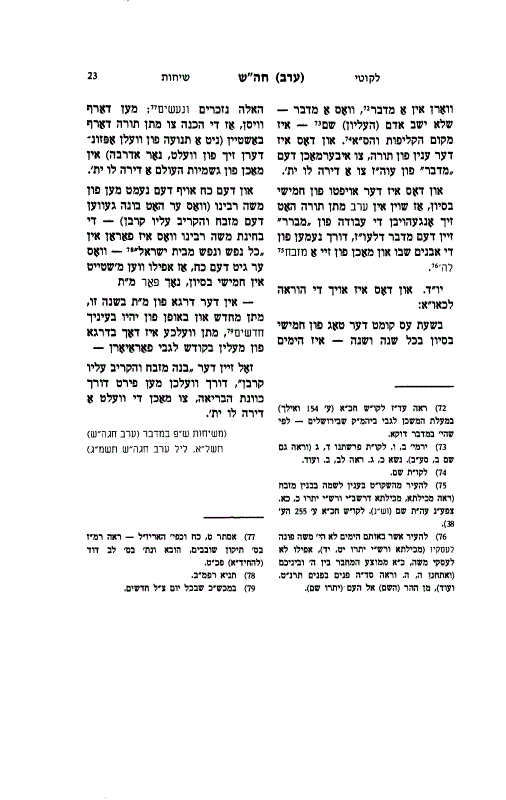
Likkutei Sichos, Volume 28 — Erev Chag HaShavuos
Introduction
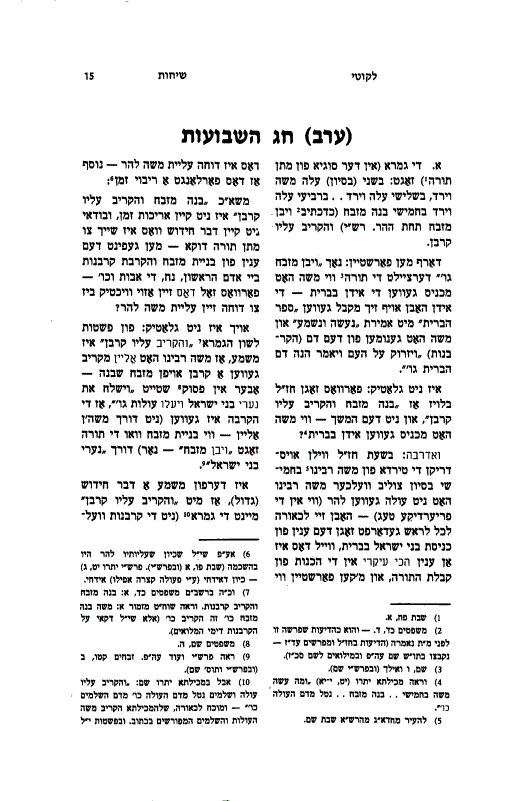
We will study a remarkable sicha from Likkutei Sichos, Volume 28, concerning Erev Chag HaShavuos. Interestingly, in the title itself the Rebbe places the word “Erev” — the eve of Shavuos — in parentheses. This already hints to the central theme of the entire sicha: that the holiness and essence of Shavuos had already begun on Erev Shavuos itself, on the fifth day of Sivan.
Although Matan Torah took place on the sixth of Sivan, the Rebbe will demonstrate that the fifth of Sivan already possessed a unique sanctity and a special connection to Har Sinai and the giving of the Torah. Throughout the sicha, the Rebbe analyzes several difficult passages in the Gemara and the commentaries in order to explain the extraordinary significance of that day.
The Rebbe begins with a puzzling statement in the Gemara. Beyond what is explicitly stated in the Pesukim — that Moshe Rabbeinu built a Mizbeach, offered sacrifices, and brought the Jewish people into a covenant with Hashem — the Gemara appears to imply an additional detail: that Moshe Rabbeinu himself offered a unique Korban specifically connected with the preparation for Matan Torah.
As the Rebbe develops the discussion step by step, many seemingly difficult details in the Gemara and the Pesukim become beautifully clear and precisely connected.
Ois Aleph
The Gemara, in its discussion of Matan Torah in Maseches Shabbos, reviews the sequence of events that took place from Rosh Chodesh Sivan until the giving of the Torah.
According to the opinion cited there that Matan Torah took place on the sixth of Sivan, the Gemara carefully describes the events of each preceding day.
On the second day of Sivan, Moshe Rabbeinu ascended Har Sinai and descended. On the third day as well, he ascended and descended. Likewise on the fourth day of Sivan, Moshe again ascended and descended the mountain, bringing messages between Hashem and the Jewish people.
However, on the fifth day of Sivan, the Gemara states that Moshe did not ascend the mountain.
Why not?
The Gemara explains: because he was occupied with building a Mizbeach and offering a Korban.
The Gemara cites the verse: “Vayiven Mizbeach tachas hahar” — “And he built a Mizbeach beneath the mountain.” The wording implies that Moshe Rabbeinu himself built the Mizbeach. The Gemara then continues: “V’hikriv olov Korban” — “and he offered upon it a sacrifice.”
Thus, according to the Gemara, Moshe Rabbeinu was occupied on the fifth day of Sivan with the building of the Mizbeach and the offering of a Korban, and this explains why he did not ascend Har Sinai on that day.
The Gemara then continues that on the sixth day of Sivan Moshe ascended the mountain and did not descend, since he remained there for the forty days connected with Matan Torah.
The Rebbe now raises a fundamental difficulty.
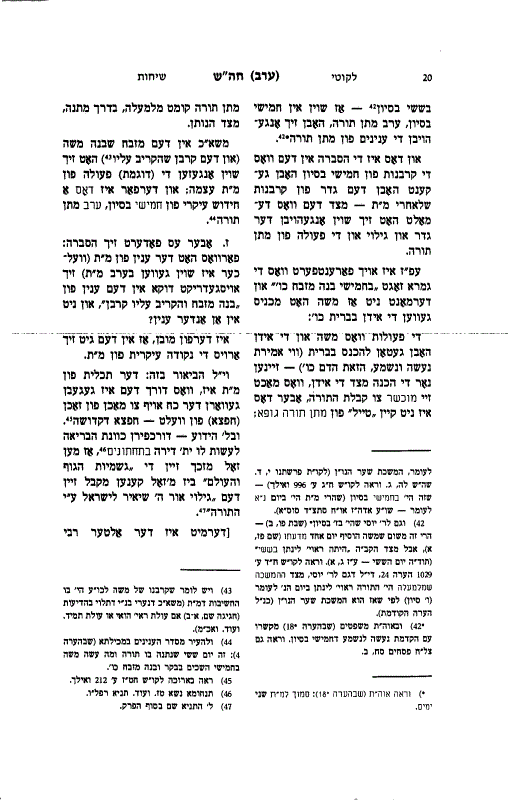
The Pesukim in Parshas Mishpatim describe much more than merely building a Mizbeach and offering sacrifices. After the Mizbeach was built, Moshe Rabbeinu entered the Jewish people into a covenant with Hashem. The Torah describes how the Jewish people accepted the covenant with the declaration of “Naaseh V’Nishma.” Moshe then sprinkled the blood upon the nation and proclaimed: “Hinei dam habris” — “Behold the blood of the covenant.”
This entire process was clearly central to the preparation for Matan Torah.
If so, why does the Gemara omit all these crucial details and mention only that Moshe built a Mizbeach and offered a Korban?
On the contrary, if the Gemara wishes to explain why Moshe Rabbeinu was too occupied on the fifth day of Sivan to ascend the mountain, it would seemingly have been far more appropriate to emphasize the covenant ceremony with the Jewish people. Bringing Klal Yisrael into the covenant was an essential and time-consuming preparation for receiving the Torah.
Why then does the Gemara focus specifically on the building of the Mizbeach and the offering of a Korban?
Furthermore, offering Korbanos was not something new introduced at Har Sinai. We already find Mizbechos and Korbanos brought by Adam HaRishon, by Noach, and by the Avos — Avraham, Yitzchak, and Yaakov.
Why would this activity be considered so significant that it prevented Moshe Rabbeinu from ascending Har Sinai?
The Rebbe raises an additional difficulty.
The wording of the Gemara itself is problematic. The Gemara states in singular form that Moshe Rabbeinu “offered a Korban.” Yet in the Pesukim, the Torah describes multiple sacrifices in plural form: Olos, Zevachim, Shelamim, and Parim.
Moreover, the Torah itself does not say that Moshe Rabbeinu personally offered these sacrifices. Rather, the Pasuk states: “Vayishlach es naarei Bnei Yisrael vaya’alu olos” — Moshe sent the “naarei Bnei Yisrael,” whom Rashi identifies as the Bechorim, and they brought the offerings.
Thus, according to the simple reading of the Pesukim, the Korbanos were brought by the Bechorim, not by Moshe Rabbeinu himself.
Why then does the Gemara phrase it as “V’hikriv olov Korban” — that Moshe himself offered a Korban upon the Mizbeach?
From this wording, the Rebbe derives a remarkable chiddush.
The Gemara appears to imply that besides the Korbanos explicitly mentioned in the Torah — those brought by the “naarei Bnei Yisrael” — there was an additional Korban brought personally by Moshe Rabbeinu himself.
This additional Korban is not explicitly mentioned in the Pesukim.
This understanding also explains why the Gemara uses the singular term “Korban,” whereas the Torah itself refers to the offerings in plural form.
Yet this only deepens the question further.
Why would the Gemara emphasize specifically this additional Korban of Moshe Rabbeinu — something not explicitly written in the Torah — while omitting the covenant ceremony itself?
It emerges that the Gemara is deliberately highlighting something very significant. The essential preparation for Matan Torah on the fifth day of Sivan was specifically connected to Moshe Rabbeinu’s building of the Mizbeach and the special Korban that he himself offered.
This unique avodah of Moshe Rabbeinu reveals the inner significance of Erev Shavuos — that the process and holiness of Matan Torah had already begun on the fifth of Sivan itself.
Thus, the Gemara emphasizes precisely this point: Moshe Rabbeinu’s building of the Mizbeach and his Korban were not incidental details, but the very key to understanding the unique preparation for Matan Torah that took place on Erev Shavuos.
Ois Beis
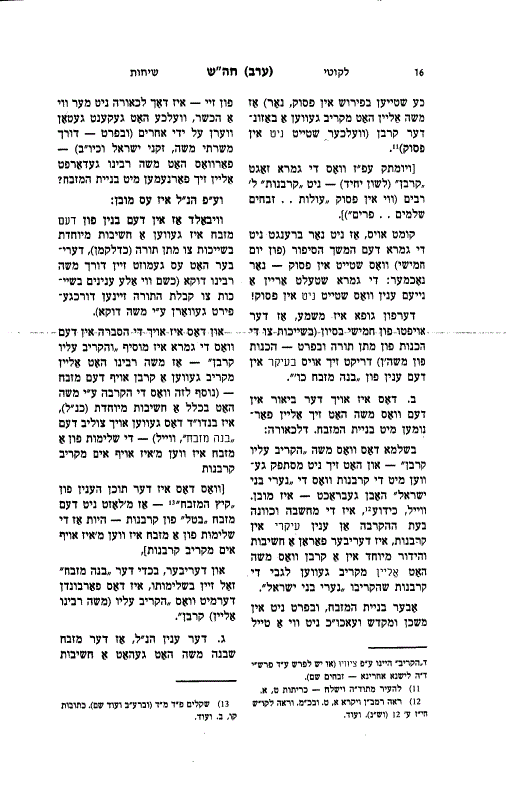
Based on the explanation developed previously, we can now understand why Moshe Rabbeinu himself occupied himself with building the Mizbeach.
At first glance, this itself seems difficult to understand.
We can certainly understand why Moshe Rabbeinu personally desired to offer a Korban. Since a Korban is not merely a physical action, but an avodah deeply dependent upon the person’s intention, thought, and inner devotion, it is understandable that Moshe Rabbeinu would wish to offer a Korban himself.
As is well known, in the avodah of Korbanos the kavana and machshava of the one offering the sacrifice are essential components. Therefore, there is a unique perfection and spiritual quality when Moshe Rabbeinu himself offers the Korban, with all the depth and holiness of his kavana.
This especially stands in contrast to the Korbanos brought by the “naarei Bnei Yisrael,” the Bechorim, mentioned explicitly in the Pesukim.
However, the actual building of the Mizbeach seems far less significant.
The Mizbeach itself was merely a preparation — a hechsher mitzvah — providing a place upon which the Korbanos could later be brought. Moreover, this was not yet the permanent Mizbeach of the Mishkan or Beis HaMikdash. It was simply a temporary Mizbeach constructed beneath Har Sinai.
If so, why did Moshe Rabbeinu himself need to occupy himself personally with its construction?
Surely this task could have been delegated to others — to the elders of Israel or to Moshe’s assistants. Why was it necessary for Moshe himself to build the Mizbeach?
But according to the explanation above, this becomes understandable.
The Mizbeach built on the fifth of Sivan was not merely a technical preparation for offering sacrifices. Rather, the very construction of this Mizbeach possessed unique significance as part of the preparation for Matan Torah itself.
Since this Mizbeach was intrinsically connected to the giving of the Torah, it therefore needed specifically to be built by Moshe Rabbeinu.
Just as all matters connected with Matan Torah were accomplished through Moshe Rabbeinu, so too this preparation for Matan Torah — the construction of the Mizbeach — had to be performed specifically through him.
Thus, the building of the Mizbeach was not simply a secondary preparation for Korbanos. The construction itself formed an essential component in the preparation for receiving the Torah.
This also explains why the Gemara adds that Moshe Rabbeinu himself offered a Korban upon the Mizbeach.
Besides the general importance of Moshe Rabbeinu personally offering a Korban because of the unparalleled level of his kavana, there is another point here as well.
The offering of the Korban completed and perfected the Mizbeach itself.
A Mizbeach only becomes complete through the offering of Korbanos upon it. Therefore, if Moshe Rabbeinu’s special avodah on the fifth of Sivan centered upon building the Mizbeach as preparation for Matan Torah, then it was necessary for him also to offer a Korban upon it in order to complete and actualize the purpose of the Mizbeach.
This concept is reflected in the general idea of “Kayitz HaMizbeach.”
Even during periods when there were no obligatory or voluntary Korbanos being brought, additional Korbanos were nevertheless offered simply so that the Mizbeach should not remain idle.
Why was this necessary?
Because the perfection and wholeness of a Mizbeach is expressed specifically through active Korbanos being brought upon it. A Mizbeach that remains unused lacks its full purpose and completion.
Therefore, once Moshe Rabbeinu built this Mizbeach, he himself needed to offer a Korban upon it, thereby completing and validating the Mizbeach as a true Mizbeach.
Accordingly, the Gemara specifically emphasizes both elements together: Moshe Rabbeinu built the Mizbeach and Moshe Rabbeinu offered the Korban upon it.
The Korban was not merely an additional detail. It completed the entire significance of the Mizbeach that Moshe Rabbeinu constructed as part of the preparation for Matan Torah.
Thus, the Gemara’s wording becomes exact and precise. The unique avodah of the fifth of Sivan consisted specifically in Moshe Rabbeinu’s building of the Mizbeach and his offering of the Korban upon it — an avodah that served as a fundamental preparation for the giving of the Torah.
Ois Gimmel
The Rebbe now develops the discussion further and introduces another remarkable and difficult point connected with the Mizbeach and Korbanos of the fifth of Sivan.
Not only did the Mizbeach built by Moshe Rabbeinu possess a unique significance in preparation for Matan Torah, but the Korbanos brought upon that Mizbeach also acquired a special status directly connected to Matan Torah itself.
The Rebbe begins with the verse concerning the Korban Tamid:
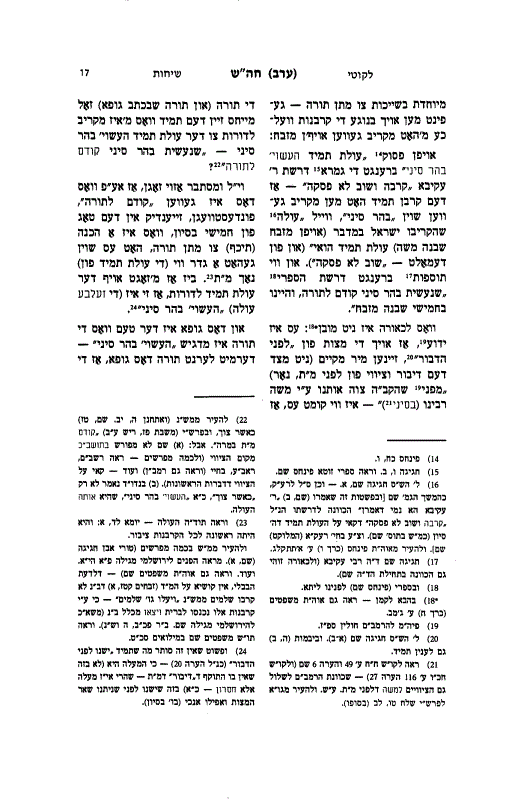
“Olas tamid ha’asuya beHar Sinai” — “The continual burnt offering that was made at Har Sinai.”
At first glance, this wording is astonishing.
What exactly does the Torah mean by “the continual offering made at Har Sinai”?
The regular Korban Tamid was part of the avodah of the Mishkan and later the Beis HaMikdash. Yet at Har Sinai, prior to the Mishkan, before the permanent avodah had begun, and even before Matan Torah itself, what Korban Tamid are we referring to?
The Gemara cites the explanation of Rebbi Akiva:
“Olas tamid ha’asuya beHar Sinai” means that the Korban Tamid was already brought there at Har Sinai and from that point onward it never ceased.
According to Rebbi Akiva, the Olos brought by the “naarei Bnei Yisrael” upon the Mizbeach built by Moshe Rabbeinu on the fifth of Sivan possessed the status of the Olas Tamid.
Thus, the daily Korban Tamid brought throughout all future generations traces its beginning back to the Korbanos brought at Har Sinai before Matan Torah itself.
Tosfos, quoting the Sifrei, emphasizes this even further, stating explicitly that this Korban was offered “beHar Sinai kodem laTorah” — at Har Sinai before the Torah was given.
This refers specifically to the fifth day of Sivan, when Moshe Rabbeinu built the Mizbeach.
At first glance, this is extremely difficult to understand.
It is a well-established principle that although certain mitzvos were observed before Matan Torah, our fulfillment of mitzvos today is not because they were commanded earlier to the Avos or before Sinai. Rather, all mitzvos derive their binding authority from the commandments given through Moshe Rabbeinu at Matan Torah.
For example, even though Avraham Avinu performed Bris Milah before Matan Torah, Jews today perform Bris Milah not because of the command to Avraham, but because Hashem commanded it anew through Moshe Rabbeinu at Sinai.
If so, why does the Torah itself connect the Korban Tamid of all future generations to a Korban offered before Matan Torah?
Why does the Torah specifically describe it as “ha’asuya beHar Sinai”?
The Rebbe explains that herein lies a profound insight.
Although these Korbanos were technically offered before the Torah was given, nevertheless, because they were brought on the fifth of Sivan — immediately as preparation for Matan Torah — they already possessed the halachic and spiritual definition of the post-Sinai Korban Tamid.
In other words, the fifth of Sivan was not merely an ordinary day preceding Matan Torah. It already carried within it the sanctity and essence of Har Sinai itself.
Therefore, the Korban brought on that day is considered the very same Olas Tamid that continued throughout all generations afterward.
This is why the Torah deliberately emphasizes:
“Olas tamid ha’asuya beHar Sinai.”
The Torah is teaching that the Korban offered on the fifth of Sivan already possessed the definition and sanctity of Har Sinai and Matan Torah.
Even though it preceded the actual giving of the Torah chronologically, spiritually and conceptually it already belonged to the reality of Matan Torah itself.
This also explains why the Torah specifically references Har Sinai in describing the Korban Tamid. The Torah wishes to emphasize that the avodah performed on the fifth of Sivan was not merely a preliminary act, but already part of the sanctity and revelation of Sinai.
The Korban offered then already carried the character and holiness of the Korban Tamid that would continue forever afterward.
Thus, the Rebbe demonstrates that not only the Mizbeach itself, but also the Korbanos brought upon it, possessed a unique status directly connected with Matan Torah.
The fifth of Sivan — Erev Shavuos — had already become part of Har Sinai.
As the Rebbe will continue to explain in Ois Daled, this concept is not merely symbolic or conceptual, but carries practical halachic significance as well.
Ois Daled
The Rebbe now demonstrates that the unique status of the Korban brought on the fifth of Sivan is not merely conceptual or symbolic, but carries practical halachic significance as well.
The Torah states regarding a Korban Olah:
“V’hifshit es ha’olah v’nitach osah lintacheha” — the Olah must be skinned and cut into sections before being offered.
The question arises: did the Korban Olah brought on the fifth of Sivan require hifshit and nituach as well?
At first glance, this seems unlikely, since the detailed laws of Korbanos are written later in Parshas Vayikra, after Matan Torah and after the establishment of the Mishkan.
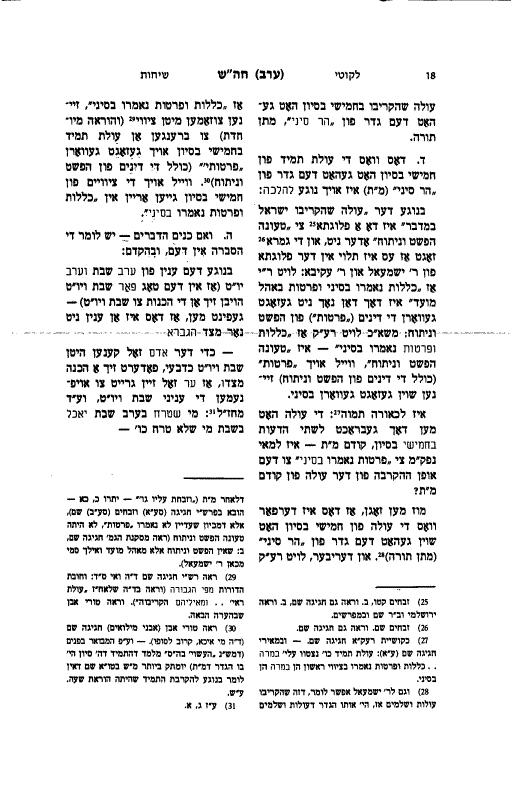
The Gemara discusses this issue and explains that it depends upon the well-known dispute between Rabbi Yishmael and Rabbi Akiva concerning how the Torah was transmitted at Sinai.
Rabbi Yishmael maintains:
“Klalos nemru b’Sinai u’pratos b’Ohel Moed” — the general principles of the Torah were given at Sinai, while the detailed laws were taught later at the Ohel Moed.
Accordingly, at the time the Korban was brought on the fifth of Sivan, the detailed laws of hifshit and nituach had not yet been given, and therefore would not have applied.
Rabbi Akiva, however, maintains:
“Klalos u’pratos nemru b’Sinai” — both the general principles and the detailed laws were already given at Sinai itself, even though they were later repeated again in the Torah.
Therefore, according to Rabbi Akiva, the Korban brought on the fifth of Sivan would indeed have required hifshit and nituach.
At first glance, however, this entire discussion seems difficult to understand.
After all, the Korban under discussion was brought on the fifth of Sivan — before Matan Torah itself.
Even according to Rabbi Akiva, who holds that both general principles and detailed laws were given at Sinai, this refers to Matan Torah on the sixth of Sivan. But the Korban on the fifth of Sivan preceded Matan Torah entirely.
If so, why should Rabbi Akiva’s principle apply here at all?
What relevance does the debate over “klalos u’pratos nemru b’Sinai” have to a Korban brought before the Torah was given?
From this, the Rebbe derives a powerful conclusion.
The very fact that the Gemara connects the Korban of the fifth of Sivan to Rabbi Akiva’s opinion proves that this Korban already possessed the status and definition of Har Sinai and Matan Torah itself.
In other words, although chronologically the fifth of Sivan preceded the giving of the Torah, spiritually and halachically it already belonged to the reality of Sinai.
Therefore, according to Rabbi Akiva — who maintains that the detailed laws accompanied the commandments already at Sinai — the command to offer the Korban on the fifth of Sivan likewise included all its detailed laws, including hifshit and nituach.
Since the Korban of the fifth of Sivan already carried the sanctity and definition of “Har Sinai,” it followed the same halachic structure as the mitzvos of Matan Torah itself.
Thus, together with the command to offer the Korban Olah on the fifth of Sivan, the detailed laws governing the Korban were included as well.
This becomes another powerful proof for the Rebbe’s central thesis:
The avodah of the fifth of Sivan was not merely preparation in an ordinary sense. Through Moshe Rabbeinu’s building of the Mizbeach and offering of the Korban, the fifth of Sivan itself already acquired the status and sanctity of Har Sinai.
This explains why the Torah itself emphasizes:
“Olas tamid ha’asuya beHar Sinai.”
The Korban brought on the fifth of Sivan was already considered part of the revelation of Sinai itself.
Thus, both conceptually and halachically, Erev Shavuos already contained within it the essence of Matan Torah.
The Rebbe concludes that all of this now demands deeper explanation.
Why indeed did the fifth of Sivan possess such extraordinary status?
Why did Moshe Rabbeinu’s building of the Mizbeach and offering of the Korban transform that day into an extension of Har Sinai itself?
This is the deeper concept the Rebbe will now proceed to explain.
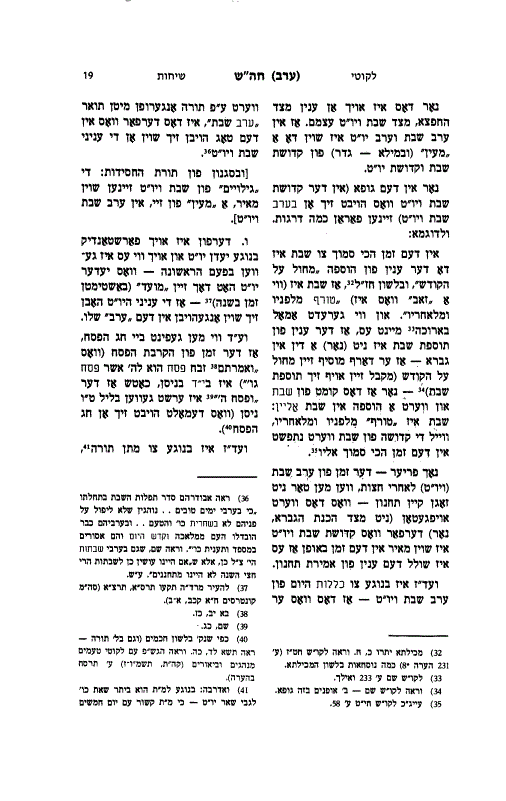
The Rebbe starts off this Sicha with "ve'im kein heim hadevarim." If this is true, the Rebbe's tremendous Chiddush over here—there's a new Karban, that Karban becomes Shavuos.
What's the explanation? So the Rebbe starts off if this is true, the Chiddush gadol that the Rebbe says. If it's true that on Erev Shavuos this already gets the halachos of Shavuos, the Matan Torah.
Yesh lomar dehasborah ba'hem, so we can say what's the explanation, why, how come, how is that? So the Rebbe says ubahegder. The Rebbe wants to introduce that we do find that the day before Shabbos, the day before Yom Tov, gets someone of the Kedusha and at different levels, different degrees, and different times in Erev Shabbos and Erev Yom Tov itself.
Benogaiya dem inyan fun Erev Shabbos and Erev Yom Tov: the fact as the subject of the eve of Shabbos, the eve of Yom Tov, as in dem tug far Shabbos and Yom Tov, that in the day that precedes Shabbos and Yom Tov, huben zich on de hachanos fun Shabbos and Yom Tov—you already start the preparation of Shabbos and Yom Tov.
So the Rebbe says: Gefint men as dos iz a inyan nit nor mit zad hagra. We find that this idea is not just that the person prepares himself to say that Shabbos is Shabbos, but Erev Shabbos, Erev Yom Tov, you have to get ready, but the day doesn't become any change. No, we find that it's more than just the person.
The person we understand, that he needs to start kadei der adom zol kenen hit Shabbos veyom tov kedebayei. In order for a person to be able to observe Shabbos and Yom Tov properly, for de zich hachana mit zido—it requires preparation from his side as er zol zain greit zu aufnehmen de inyanim fun Shabbos veyom tov—that he must be ready to prepare to accept the matters of Shabbos and Yom Tov.
So the person, we know, has to get ready, al derech maimer Chazal, similar to the saying of our sages of blessed memory, "mi shetarach be'erev shabbos yochal be'shabbos." One who puts in effort before Shabbos is going to eat on Shabbos. If you prepare for Shabbos, you're going to have what to eat on Shabbos. Mi shelo tarach, and so on. If you didn't, what are you going to eat on Shabbos if you didn't trouble yourself? So that relates to the Gavra, that relates to the person.
The person must prepare himself before Shabbos, before Yom Tov. But we find more than just the person—the day itself. Noch dos iz oich a inyan mit zad hachefza. It's also a matter from the object, mit zad Shabbos veyom tov atzmom. Shabbos and Yom Tov itself have an impact on the Erev Shabbos and Erev Yom Tov, as in Erev Shabbos veErev Yom Tov. That on the eve of Shabbos, the eve of Yom Tov, is shon do a me'ein—there exists something of—u-mimaila geder—and it has some of the definition fun de Kedushas Shabbos veKedushas Yom Tov—from the sanctity of Shabbos and the sanctity of Yom Tov. In the day that precedes Shabbos and Yom Tov, some of that sanctity passes on to the day before.
To what extent in the day? There are different times within the day of Erev Shabbos and Erev Yom Tov. Nor in dem gufa, but within this itself in the day, in the Erev Shabbos and Erev Yom Tov, in der Kedushas Shabbos veYom Tov hub zich on be'Erev Shabbos veYom Tov. The sanctity of Shabbos and Yom Tov which begins before on the eve of Shabbos and Yom Tov, zeinen faran kama madregas—there are different steps, different levels.
U-le'dugma, and for example, in dem zman hachi samuch zu Shabbos. In the time that is very close—and the very close time to Shabbos—iz do der inyan fun tosefes mechul al hakodesh. We have this concept to add from the weekday on the Kodesh. The time closest to Shabbos, and this actually applies both to the eve of Shabbos and also when Shabbos goes out. A little bit next to Shabbos in the beginning and the end also becomes some of the Shabbos in it.
U-be'lashon Chazal, to use the language of our sages of blessed memory, as Shabbos is vi a zeev—that Shabbos can be compared to a wolf—vos is tora milfanov umilacharav—which grabs in front and in back. Which means in front of Shabbos, before Shabbos starts, and in the back, after. Like a wolf takes in front and in back, the Shabbos encompasses and grabs part of the before Shabbos and part after Shabbos and makes it into Shabbos. That's one area.
U-begerat oimo barucha mentes, what it means, as der inyan fun tosefes Shabbos is nit nor a din gavra. That this idea of addition that we add to Shabbos—we start Shabbos earlier and we stay Shabbos later—this is not just a matter that the person observes the Shabbos later and starts it earlier, but the day of Shabbos becomes earlier. Mentes as der inyan fun tosefes Shabbos is nit nor a din gavra—it's not only a halacha in the person as er darf moisef zain mechul al hakodesh—that he needs to add from the weekday on the Kodesh, mekabel zain af zich tosefes Shabbos—he needs to add, "Oh, I make Shabbos more for me, it's extra."
It's not just the person, but this comes from Shabbos, not from the person, un vert hay-soifa Shabbos aleinei—this becomes an addition in Shabbos itself. The Shabbos becomes extended, extends to the back before Shabbos and to after Shabbos. Shabbos is tora milfanov umilacharav. The language is the Shabbos grabs hold from the back, from the front and the back. So the Shabbos itself, not the person is giving it, the Shabbos is. Vail de Kedushas fun Shabbos vert nispashet in der zman hachi samuch eilav—because the sanctity of Shabbos expands into the time which is very close to Shabbos, it grabs hold of that and makes that into Shabbos too.
That's one idea, the closest time to Shabbos in which the eve of Shabbos and Yom Tov becomes like the Shabbos and Yom Tov. Then you have earlier than right before Shabbos. Noch fri'er, before, der zman fun Erev Shabbos veYom Tov lachar chatzos. The time of Shabbos and Yom Tov after midday when men tur nit zugen kein Tachanun—you're not allowed to say Tachanun. Tachanun you don't say on Shabbos and Yom Tov and we stop saying it after midday. Vos dos vert aufge-ton nit mit zad hachanos hagavra.
That is accomplished not because the person prepares himself, nor derfar vos Kedushas Shabbos veYom Tov is shon mair in dem zman—but the reason is that the sanctity of Shabbos and Yom Tov shines to the extent that we can't say Tachanun. Some of the Shabbos powers and special light that comes on Shabbos already starts from midday in dem zman be'oifen—in such a way that you already have the impact of Shabbos, as es is shoilel dem inyan fun amiras Tachanun—that it negates the idea of saying Tachanun.
So that's midday, Erev Shabbos, close to right before Shabbos and midday. And then we have the entire day of Shabbos. Al derech ze be'nogaya tzu k'lollus hayom fun Erev Shabbos veYom Tov. Similarly is to the general day of Erev Shabbos and Yom Tov. As dos vos er vert al pi Torah ungerufen mit dem to'ar Erev Shabbos—the fact that the Torah, according to Torah we describe it as the eve of Shabbos, Erev Shabbos. And the reason for that is is dos derfar vos in dem tug huben zich shon on de inyonim fun Shabbos veYom Tov—that on this day already starts the matters of Shabbos and Yom Tov.
Un be-signon fun Toras haChassidus, to use the style of the Chassidus teaching, it says de giluyim fun Shabbos veYom Tov—that those revelations of Shabbos and Yom Tov—zeinen shon mair a me'ein fun zai. They're already shining, something of them in Erev Shabbos and Yom Tov. Some of the Shabbos and Yom Tov's giluyim, revelations, already start from Erev Shabbos.
The fact is, the Rebbe says, that in the Erev Shabbos we, the Rebbe divides it into three parts: very close to Shabbos becomes actually Shabbos; midday you can't say Tachanun has a greater light of Shabbos; and generally the eve of Shabbos gets some of that revelations of Shabbos. And that's why it's called Erev Shabbos.
Now with this introduction, the Rebbe is going to explain also the idea of what happens on Erev Shavuos in particularly with the bonu mizbayach, as the Rebbe continues to explain.
Ois Hei
The Rebbe now begins explaining the deeper underlying concept behind the extraordinary status of the fifth of Sivan.
Until now, the Rebbe demonstrated that the Mizbeach built by Moshe Rabbeinu and the Korban offered upon it already possessed the sanctity and definition of Har Sinai and Matan Torah itself. The Rebbe showed this both conceptually and halachically.
The obvious question now becomes:
How is this possible?
How could the fifth of Sivan — Erev Shavuos, before the Torah was actually given — already acquire the sanctity and status of Matan Torah itself?
The Rebbe introduces the explanation through a broader principle concerning Erev Shabbos and Erev Yom Tov generally.
Regarding the concept of Erev Shabbos and Erev Yom Tov, we find that the preparations for Shabbos and Yom Tov begin already on the preceding day.
At first glance, one might assume that this merely relates to the individual person. Since a Jew must properly observe Shabbos and Yom Tov, he therefore needs to prepare himself beforehand so that he will be ready to receive and experience the holiness of the day properly.
As Chazal say:
“Mi shetarach b’Erev Shabbos yochal b’Shabbos” — one who prepares on Erev Shabbos will eat on Shabbos.
Thus, preparation before Shabbos appears to be merely a practical obligation upon the person.
However, the Rebbe explains that there is something much deeper taking place.
The preparations of Erev Shabbos and Erev Yom Tov are not only מצד הגברא — from the perspective of the individual person preparing himself.
Rather, there is also an effect מצד החפצא — from the side of Shabbos and Yom Tov themselves.
The holiness of Shabbos and Yom Tov actually begins extending into the preceding day.
In other words, Erev Shabbos and Erev Yom Tov themselves already contain an aspect and definition of the holiness of Shabbos and Yom Tov.
The Rebbe explains that within this itself there are multiple levels and degrees.
The highest level appears in the period immediately adjacent to Shabbos itself, through the concept of “Tosefes Shabbos” — adding from the weekday onto Shabbos.
This applies both before Shabbos begins and after Shabbos concludes.
Chazal describe this with the expression that Shabbos is “like a wolf that tears before and after” — meaning that Shabbos extends itself backward into the preceding time and forward beyond its conclusion.
Importantly, this is not merely a personal obligation upon the individual to begin observing Shabbos earlier.
Rather, the actual holiness of Shabbos itself expands into the adjacent weekday time and transforms it into part of Shabbos.
The sanctity of Shabbos spreads outward into the time nearest to it.
The Rebbe then describes a second level.
Even earlier on Erev Shabbos and Erev Yom Tov — beginning from midday — we already find practical expressions of the approaching holiness.
For example, after chatzos on Erev Shabbos and Erev Yom Tov, Tachanun is no longer recited.
This is not merely because a person is preparing himself emotionally for Shabbos or Yom Tov. Rather, it is because the holiness and spiritual illumination of Shabbos and Yom Tov have already begun shining into the day itself to the extent that Tachanun is no longer appropriate.
Then there is an even broader level applying to the entire day of Erev Shabbos and Erev Yom Tov.
The very fact that the Torah refers to the day as “Erev Shabbos” means that the matters and revelations of Shabbos have already begun to appear within that day.
Using the terminology of Chassidus, the Rebbe explains that the revelations and spiritual lights of Shabbos and Yom Tov already begin shining in a partial manner throughout Erev Shabbos and Erev Yom Tov.
Thus, Erev Shabbos is not merely a preparation for Shabbos from the perspective of the individual person. Rather, the sanctity of Shabbos itself already begins revealing itself beforehand in various degrees and stages.
With this introduction, the Rebbe will now explain the deeper significance of the fifth of Sivan — Erev Shavuos — and why Moshe Rabbeinu’s building of the Mizbeach and offering of the Korban already carried within them the sanctity and essence of Matan Torah itself.
Ois Vov
Based on the principle explained previously regarding Erev Shabbos and Erev Yom Tov, we can now better understand the unique nature of Erev Shavuos as well.
Just as every Shabbos and Yom Tov already begins extending some of its holiness and revelation into the preceding day, similarly every Yom Tov possesses elements of its essence already present on its eve.
Moreover, this applies not only to later observances of the Yom Tov throughout the generations, but even to the very first occurrence of the Yom Tov itself.
The Rebbe brings an example from Pesach.
The Korban Pesach is brought on the fourteenth of Nissan — Erev Pesach.
Yet the actual miracle of “u’pasach Hashem” — Hashem passing over the Jewish homes in Egypt — occurred on the fifteenth of Nissan, the first day of Pesach itself.
Thus, already on the fourteenth of Nissan, before the Yom Tov has actually begun, a Korban is being offered specifically as the “Korban Pesach.”
This clearly demonstrates that the eve of the Yom Tov already possesses a direct connection to the holiness and essence of the Yom Tov itself.
Similarly, regarding Matan Torah:
Although the giving of the Torah occurred on the sixth of Sivan, nevertheless already on the fifth of Sivan — Erev Shavuos — the revelation and sanctity of Matan Torah had already begun.
This explains how the Korbanos offered on the fifth of Sivan could already possess the status and halachic definition of the Korbanos associated with Har Sinai after Matan Torah.
Because the revelations and holiness of Matan Torah had already begun extending into the preceding day.
Accordingly, we can now also understand why the Gemara specifically emphasizes Moshe Rabbeinu’s building of the Mizbeach and offering of the Korban, while omitting mention of the covenant ceremony with the Jewish people.
The actions performed by the Jewish people — accepting the covenant, declaring “Naaseh V’Nishma,” and the sprinkling of the blood — certainly constituted preparation for Matan Torah.
However, those actions represented primarily preparation מצד הגברא — from the perspective of the people preparing themselves to receive the Torah.
The Jewish people were refining and readying themselves so they could become proper recipients for the Torah that Hashem would soon give them.
But this preparation did not yet constitute the revelation of Matan Torah itself.
Matan Torah fundamentally came from above — a revelation and gift bestowed by Hashem, the Giver of the Torah.
The Jewish people could prepare themselves to receive it, but the actual revelation of Torah came from Above.
By contrast, Moshe Rabbeinu’s building of the Mizbeach and the Korban brought upon it already reflected the actual extension of the sanctity of Matan Torah itself into the fifth of Sivan.
This was not merely human preparation.
Here, the holiness and revelation of Har Sinai itself had already begun descending into the world.
That is why the Gemara focuses specifically upon the Mizbeach and the Korban.
The Korban brought upon Moshe Rabbeinu’s Mizbeach already possessed the sanctity and definition of Har Sinai and Matan Torah itself.
This represented the beginning of the revelation of the sixth of Sivan extending backward into the fifth of Sivan.
Accordingly, the Gemara highlights specifically this avodah as the essential novelty of the fifth of Sivan.
The covenantal preparations of the Jewish people were indeed necessary, but they remained preparations from the perspective of the recipients.
The building of the Mizbeach and the offering of the Korban, however, already represented the beginning of the actual revelation of Matan Torah descending from Above.
This is why the fifth of Sivan acquired such extraordinary significance.
It was not merely the eve of Matan Torah in a chronological sense. Rather, the holiness and revelation of Har Sinai itself had already begun shining and expressing themselves within that day.
Ois Zayin
The Rebbe now proceeds to explain more deeply why the revelation of Matan Torah on the fifth of Sivan expressed itself specifically through the building of the Mizbeach and the offering of the Korbanos.
Until now, the Rebbe established that the fifth of Sivan already possessed an extension of the sanctity and revelation of Matan Torah itself, and that this was expressed specifically through Moshe Rabbeinu’s building of the Mizbeach and offering of the Korban.
The obvious question now becomes:
Why was this concept expressed specifically through the Mizbeach and Korbanos?
Why not through some other aspect of preparation for Matan Torah?
From this itself, the Rebbe explains, we understand that within the Mizbeach and Korbanos lies the essential inner point of Matan Torah itself.
The Rebbe explains the matter as follows.
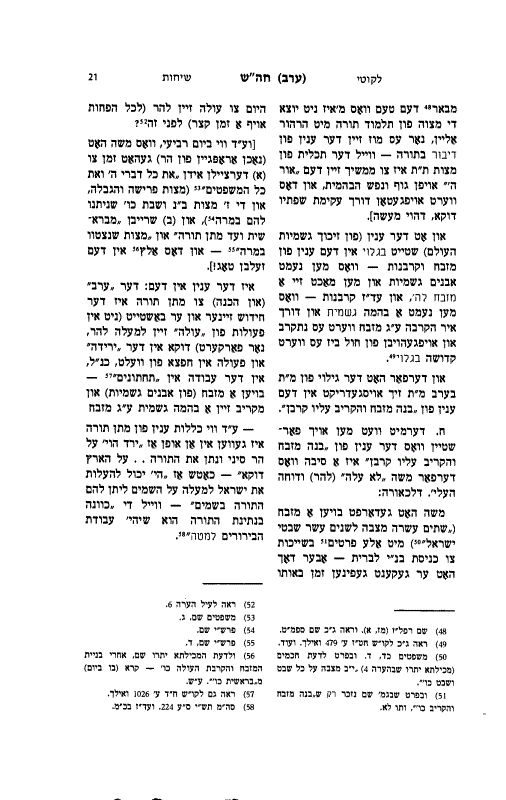
The ultimate purpose of Matan Torah was that through Torah there would be granted the ability to transform physical worldly objects into objects of holiness.
In the well-known terminology of Chassidus, the purpose of Matan Torah is to accomplish the Divine intent of:
“La’asos lo Yisborach dirah b’tachtonim” — to make for Hashem a dwelling place specifically in the lower physical world.
The goal is that the physicality of the body and the material world become refined and elevated to the point that they can receive and reveal the light of Hashem brought into the world through Torah.
The Rebbe references the explanation of the Alter Rebbe in Tanya regarding why one does not fulfill the mitzvah of Talmud Torah merely through thought alone.
A person cannot simply think Torah intellectually in his mind and thereby fully fulfill the mitzvah of Torah study.
Rather, Torah must specifically be spoken verbally.
Why?
Because the purpose of Torah is not merely intellectual comprehension or spiritual contemplation.
The purpose of Torah is to draw down the light of Hashem into the physical body and even into the animal soul, thereby refining physical existence itself.
This transformation occurs specifically through physical speech — through the actual movement of one’s lips and mouth in speaking words of Torah.
Speech constitutes a physical action.
Thus, even the mitzvah of Torah study itself expresses the fundamental goal of Matan Torah: transforming and refining physicality into holiness.
The Rebbe now explains that this concept is revealed most openly and visibly through the Mizbeach and Korbanos.
A Mizbeach consists of ordinary physical stones.
Yet these physical stones become transformed into a Mizbeach for Hashem.
Similarly with Korbanos:
An ordinary physical animal is taken and brought upon the Mizbeach. Through the process of hakravah, the animal becomes elevated and transformed from mundane physical existence into revealed holiness.
Thus, within the Mizbeach and Korbanos one sees openly the very essence and purpose of Matan Torah:
The transformation of the physical world into holiness.
This is precisely the concept of dirah b’tachtonim.
Therefore, the revelation of Matan Torah already on Erev Matan Torah expressed itself specifically through Moshe Rabbeinu’s building of the Mizbeach and offering of the Korbanos.
Because the Mizbeach and Korbanos embody the essential purpose and novelty of Matan Torah itself.
The entire accomplishment of Matan Torah was the ability to transform the physical world into a dwelling place for Hashem.
Accordingly, the very first revelation of Matan Torah extending into the fifth of Sivan manifested specifically in this area — the building of the Mizbeach and the offering of the Korbanos — where the transformation of physicality into holiness is most openly and visibly expressed.
Thus, the Mizbeach on the fifth of Sivan was not merely one detail among many preparations for Matan Torah.
Rather, it represented the very essence and inner content of Matan Torah itself.
Ois Ches
Based on everything explained previously, we can now understand an additional detail in the Gemara.
The Gemara states that Moshe Rabbeinu did not ascend Har Sinai on the fifth of Sivan because he was occupied with building the Mizbeach and offering the Korban.
At first glance, this itself seems difficult to understand.
Why should the building of the Mizbeach prevent Moshe Rabbeinu from ascending the mountain, even briefly?
After all, there were many other responsibilities and activities that Moshe Rabbeinu accomplished during those days while still finding time to ascend Har Sinai.
For example, on the fifth of Sivan itself, Moshe Rabbeinu not only built the Mizbeach, but also erected twelve matzeivos corresponding to the twelve tribes of Israel and performed all the various activities connected with bringing the Jewish people into the covenant.
Nevertheless, seemingly he still could have found some time to ascend the mountain, even briefly.
Furthermore, the Rebbe points out that on the fourth day of Sivan Moshe Rabbeinu accomplished an enormous amount within a single day.
After descending from the mountain, Moshe Rabbeinu conveyed to the Jewish people all the words of Hashem and all the laws contained in Parshas Mishpatim.
According to Rashi, this included numerous mitzvos and teachings already given previously at Marah, including the mitzvah of Shabbos and the Sheva Mitzvos Bnei Noach.
In addition to all this, Moshe Rabbeinu also wrote down from Bereishis until Matan Torah, including the mitzvos given at Marah.
Thus, on the fourth of Sivan Moshe Rabbeinu accomplished many major tasks while still ascending and descending the mountain.
If so, why on the fifth of Sivan did the building of the Mizbeach completely prevent him from ascending Har Sinai even for a short time?
The Rebbe explains that this itself reveals the deeper point.
The essential novelty and preparation of Erev Matan Torah was specifically not ascent upward toward the mountain.
On the contrary.
The unique avodah of the fifth of Sivan consisted specifically in descending into the physical world and transforming physical reality itself into holiness.
This was accomplished through the building of the Mizbeach from physical stones and the offering of a physical animal upon it.
That was the true preparation for Matan Torah.
The purpose of Matan Torah was not that the Jewish people should ascend into heaven and escape the physical world.
Rather, the purpose was the exact opposite:
That holiness and Elokus should descend into the physical world itself.
This was reflected in Matan Torah generally, where Hashem descended upon Har Sinai and gave the Torah specifically here below upon the earth.
As Chassidus explains, Hashem certainly possessed the ability to elevate the Jewish people into the heavenly realms and give them the Torah there.
But that was not the Divine intention.
The purpose of Torah is specifically to refine and transform this physical world into a dirah b’tachtonim — a dwelling place for Hashem.
Accordingly, Moshe Rabbeinu’s avodah on the fifth of Sivan needed specifically to embody this concept.
At that moment, the essential preparation for Matan Torah was not ascent upward toward heaven, but rather involvement within the physical world itself — transforming stones into a Mizbeach and elevating a physical animal into a Korban for Hashem.
Therefore, even though technically Moshe Rabbeinu may have been able to find time to ascend the mountain briefly, that was not the avodah required at that moment.
The very point and novelty of Erev Matan Torah was specifically the descent of holiness into physicality and the refinement of the world below.
Thus, the Gemara emphasizes that Moshe Rabbeinu did not ascend the mountain because he was occupied with building the Mizbeach and offering the Korban.
This was not merely because he lacked time.
Rather, the building of the Mizbeach itself constituted the essential avodah and preparation for Matan Torah.
It embodied the very purpose and inner content of the giving of the Torah — transforming the physical world itself into a dwelling place for Hashem.
Ois Tes
The Rebbe now connects the entire discussion to Parshas Bamidbar.
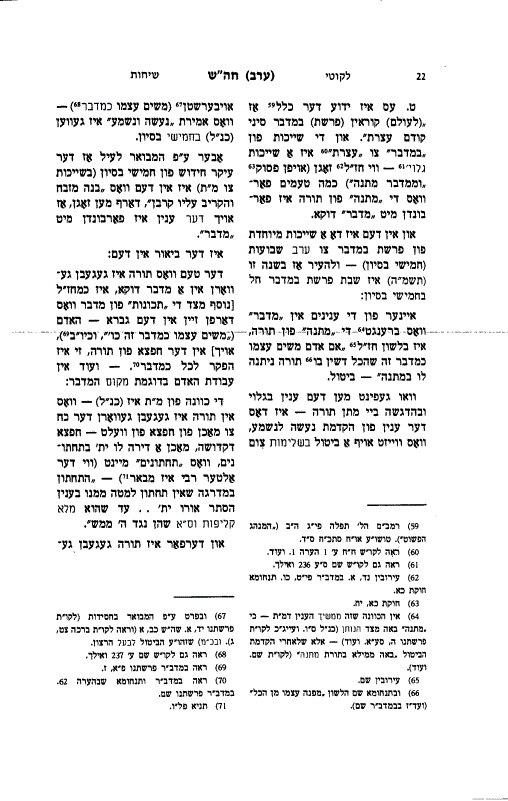
It is well known that Parshas Bamidbar is always read before Shavuos.
This connection between Bamidbar and Matan Torah is openly emphasized by Chazal, who interpret the verse:
“U’mimidbar matanah” — “And from the desert, a gift.”
The “gift” refers to the Torah, which was given specifically through the Midbar.
Thus, there is an intrinsic connection between the desert and the giving of the Torah.
Chazal and the commentaries offer numerous explanations for why the Torah was given specifically in a Midbar. However, based on the explanation developed throughout this sicha, the Rebbe reveals an additional and deeper connection — particularly connected to Erev Shavuos, the fifth of Sivan.
The Rebbe notes that in the year this sicha was said, 5745, Shabbos Parshas Bamidbar fell specifically on the fifth of Sivan — Erev Shavuos itself.
Thus, the reading of Bamidbar directly coincided with the very day whose unique significance the sicha has been explaining.
One of the well-known explanations given by Chazal for the Torah being given in a desert is the statement:
“If a person makes himself like a desert, upon which everyone treads, then the Torah is given to him as a gift.”
The Midbar represents bittul and humility.
A person must make himself humble and self-effacing in order to become a proper vessel for Torah.
This idea was expressed openly at Matan Torah through the declaration of:
“Naaseh V’Nishma” — “We will do and we will hear.”
The Jewish people accepted Hashem’s will with complete submission and self-nullification even before fully understanding.
And, as explained earlier, the declaration of “Naaseh V’Nishma” took place specifically on the fifth of Sivan.
However, based on the explanation throughout this sicha, the Rebbe points out that the primary novelty of the fifth of Sivan was not merely the people’s declaration of “Naaseh V’Nishma.”
Rather, the main novelty was Moshe Rabbeinu’s building of the Mizbeach and offering of the Korbanos.
Accordingly, we must say that this aspect as well — the building of the Mizbeach and the Korbanos — is deeply connected to the concept of Bamidbar.
The Rebbe explains:
The reason the Torah was given specifically in a Midbar is not only because of the humility represented by the desert.
There is another dimension as well.
Chazal state that Torah was given in a Midbar because just as the Midbar belongs to no one and is open equally to all, so too Torah belongs equally to every Jew.
No individual owns Torah exclusively.
Torah is available to all.
But in the inner avodah of a person, the Midbar also represents something deeper.
The Midbar symbolizes a place devoid of revealed holiness — a place empty, desolate, and spiritually barren.
This connects directly to the ultimate purpose of Matan Torah itself.
As explained previously, through Torah there was granted the power to transform the physical world into holiness and make for Hashem a dirah b’tachtonim.
The Alter Rebbe explains that “tachtonim” refers to the lowest level of existence — a realm where the Divine light is most concealed, to the point that it becomes filled with kelipos and sitra achra, forces openly opposing holiness and G‑dliness.
That is the true definition of the “lowest world.”
Accordingly, the Midbar represents precisely this type of spiritual reality — a place barren of holiness and seemingly distant from revelation and G‑dliness.
And this is exactly why the Torah was given there.
The purpose of Torah is specifically to transform the “Midbar” of the world into a dwelling place for Hashem.
Thus, the connection between Bamidbar and the fifth of Sivan becomes especially profound.
Already before Matan Torah itself, the avodah of refining and transforming the “Midbar” had begun.
Moshe Rabbeinu took ordinary physical stones and transformed them into a Mizbeach for Hashem.
He took a physical animal and elevated it into a Korban.
This was already the beginning of transforming the “Midbar” — the lowest and most physical reality — into holiness.
Thus, the avodah of the fifth of Sivan directly embodied the concept of Bamidbar itself.
The Midbar represents both bittul and the transformation of spiritual emptiness into holiness.
The declaration of “Naaseh V’Nishma” expressed the bittul of the Jewish people.
But Moshe Rabbeinu’s building of the Mizbeach and offering of the Korban revealed the deeper accomplishment of Matan Torah itself: transforming the physical world into a dwelling place for Hashem.
This is the profound connection between Parshas Bamidbar, Erev Shavuos, and the avodah of the fifth of Sivan.
Ois Yud — The Practical Lesson
The Rebbe concludes the sicha with the practical lesson derived from the entire discussion.
This is the lesson for each and every Jew.
Every year, when the fifth of Sivan arrives, “these days are remembered and thereby relived” — the spiritual energies and revelations of those original days return and become reawakened once again.
Therefore, each year we must understand what constitutes the true preparation for Matan Torah.
The preparation for receiving the Torah is not through withdrawing from the world or separating oneself from physical reality.
On the contrary.
The true preparation for Matan Torah is specifically to take the physical world itself and transform it into a dwelling place for Hashem.
The power to accomplish this comes from Moshe Rabbeinu.
Just as Moshe Rabbeinu built the Mizbeach and offered the Korban upon it on the fifth of Sivan, thereby transforming physical stones and a physical animal into holiness, so too every Jew receives the power to accomplish this avodah within his own portion of the world.
The Rebbe explains that every Jew possesses within himself a spark and extension of Moshe Rabbeinu.
As Chassidus teaches, “there is an aspect of Moshe Rabbeinu within every single Jewish soul.”
That inner “Moshe” grants every Jew the strength and ability to transform the physical world into holiness and fulfill the purpose of creation.
This applies especially on the fifth of Sivan, Erev Shavuos.
Even before Matan Torah itself arrives, the avodah already begins.
Furthermore, every year the giving of the Torah occurs anew on a higher and deeper level.
As Chazal teach, the words of Torah should always appear “new” in one’s eyes.
Each year, Hashem grants a renewed and elevated revelation of Matan Torah beyond that of previous years.
Accordingly, each year one must add further in holiness and refinement.
Therefore, every Jew must “build the Mizbeach and offer the Korban” in his own avodah — meaning, to transform the physical aspects of his life and environment into holiness and into a dwelling place for Hashem.
Through this avodah we fulfill the ultimate intention of creation:
“La’asos lo Yisborach dirah b’tachtonim” — making for Hashem a dwelling place in the lowest world.
The sicha was delivered on Motzaei Shabbos Parshas Bamidbar, Erev Chag HaShavuos 5741, and further developed on the night of Erev Chag HaShavuos 5743.
Thus, the Rebbe concludes by bringing the entire discussion into practical avodah:
The preparation for Matan Torah is not escape from the world, but transformation of the world.