Introduction
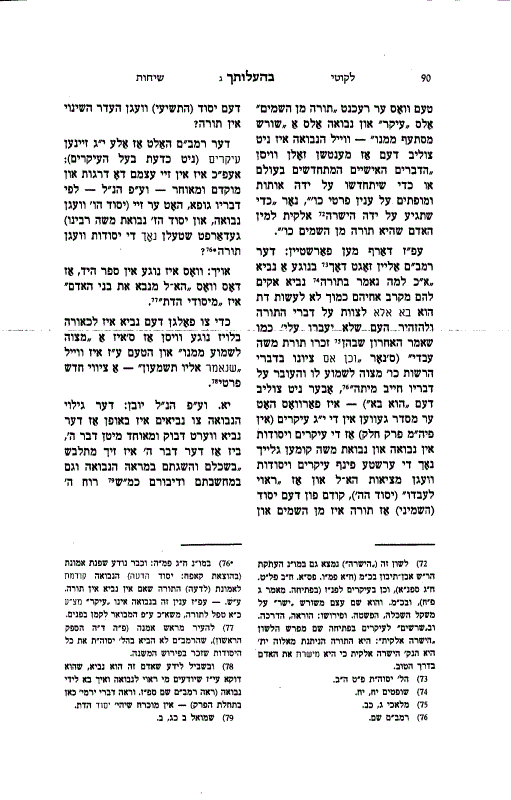
In this sicha, we will be studying from Likkutei Sichos volume 23, the third sicha on Parshas Beha'alosecha. The Rebbe discusses the central places in Torah that address the concept of prophecy, especially as seen in the Rambam. In this parsha, the Rambam emphasizes that Moshe Rabbeinu was the greatest prophet—greater than anyone else. The sicha also touches on other prophecies and how they are described in Torah sources.
The Rebbe examines how these core sources, especially the Rambam, lay out the requirements for prophecy. He connects this with what is stated in Gemara Nedarim and explores how to reconcile these teachings with other Talmudic passages. The focus is on understanding exactly what qualifies someone for prophecy according to Torah law.
Let us look at how the Rambam introduces this topic. In his opening discussion of prophecy, the Rambam writes that prophecy is not granted except to a person who is exceedingly wise and strong in character traits. He must be someone whose inclination never overcomes him—he always has mastery over his desires and emotions. The Rambam describes such a person as a true leader over himself; he does not let his inclinations control him but always rules over them with wisdom and strength of character.
According to the Rambam, then, greatness in prophecy requires being wise, having exemplary character traits, and being a "gibor"—not necessarily physically strong but strong in self-control and discipline. This is not about physical prowess but about moral and emotional strength: always doing what is right and never letting one's yetzer hara dictate one's actions.
After laying out these requirements, the Rambam continues by discussing how prophecy actually comes about—who can receive it and under what circumstances. This leads us to compare his view with what is stated explicitly in Gemara Nedarim.
The commentators ask about a passage in Maseches Nedarim where Rabbi Yochanan says: "The Holy One does not cause His Shechinah to rest except upon one who is mighty (gibor), wealthy (osher), wise (chacham), and humble (anav)." Here we see additional requirements: besides being mighty and wise, one must also be wealthy and humble.
The Gemara explains that all these qualities are learned from Moshe Rabbeinu himself—he was mighty, wealthy, wise, and humble. Each trait is derived from specific verses describing Moshe's life: for example, his humility is learned from the verse:
והאיש משה עניו מאד מכל האדם אשר על פני האדמה.
"And the man Moshe was very humble, more than any man on the face of the earth."
The Rebbe points out that if you read both these verses and the statement of Rabbi Yochanan in the Gemara simply, it seems they are talking about literal physical strength and wealth. The verses cited as proof describe Moshe as physically strong—his body was robust—and as wealthy because he kept the leftover sapphire from carving out the luchos (tablets). So at first glance, it appears that these qualifications for prophecy are meant literally: physical might and material wealth.
This raises a question: Why does the Rambam interpret "gibor" as referring to strength of character—emotional mastery—instead of physical strength? If "osher" (wealth) refers to actual material wealth according to both verse and Gemara, why would "gibor" not also mean literal physical might?
This tension between a literal reading of Chazal's words and the Rambam's interpretation sets up an important discussion for this sicha: What exactly are the qualifications for prophecy? Are they physical or spiritual qualities? And how do we reconcile these different approaches found in our sources?
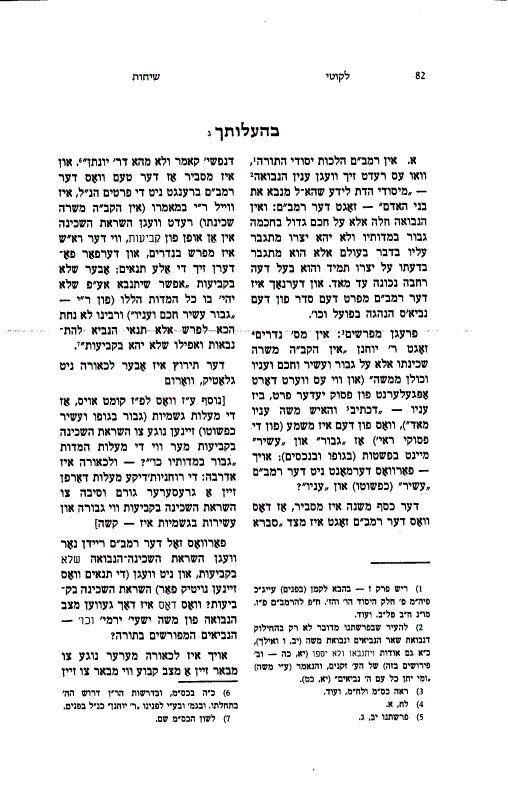
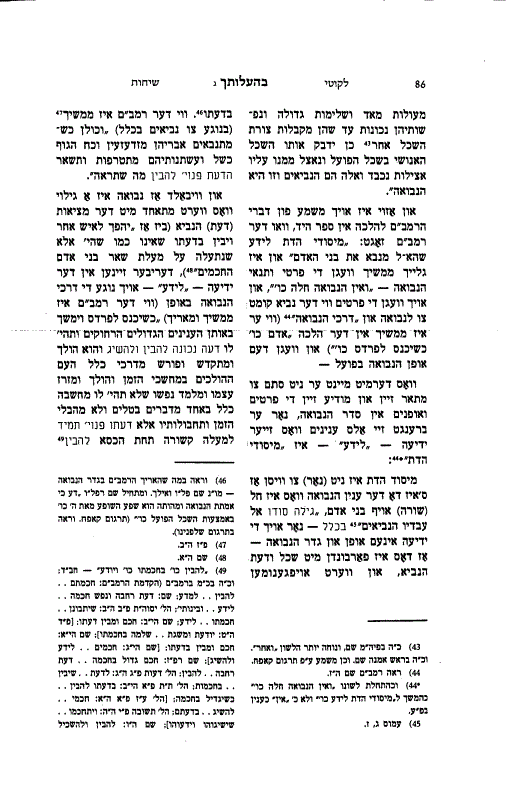
Saif Aleph
The Rambam, when discussing the qualifications necessary for prophecy, does not mention wealth or humility at all. He only lists being emotionally strong—gibber—and wise—chokham. The question arises: why does the Rambam omit the qualities of literal wealth and humility, which are mentioned in the Gemara?
The Kesef Mishneh explains that the Rambam is presenting his own view regarding the requirements for prophecy. He is not simply quoting the Gemara in Nedarim, where Rabbi Yochanan (or perhaps Rabbi Yonasan, as there is some textual uncertainty) lists four qualifications: wisdom, strength, wealth, and humility. Instead, the Rambam chooses to focus on only two—wisdom and strength—and even interprets strength as emotional fortitude rather than physical might.
The Kesef Mishneh further clarifies that in the Gemara, these four qualities are required for a permanent state of prophecy—a continuous resting of the Divine Presence (hashra’as haShechinah). This is based on how Rashi explains the passage in Nedarim. For someone to be a permanent prophet, all four qualities are necessary. However, according to the Kesef Mishneh’s reading of the Rambam, for someone to experience prophecy occasionally—not as a fixed status—only wisdom and emotional strength are required.
Thus, according to this explanation, when the Rambam lists just two qualifications, he is referring to someone who can occasionally receive prophecy. For such a person, it suffices to be wise and emotionally strong; physical strength and wealth are not required unless one seeks a permanent prophetic status.
However, this answer seems problematic. If we follow the Kesef Mishneh’s logic, it turns out that physical advantages like literal strength and wealth are only necessary for permanent prophecy. Yet emotional strength is required even for temporary prophecy. This seems counterintuitive: shouldn’t spiritual qualities like emotional fortitude be more essential for a lasting connection with Hashem? Why would physical attributes be more important for permanence than spiritual ones?
Moreover, it is difficult to understand why the Rambam would focus only on temporary prophecy rather than addressing what is needed for permanent prophecy—the kind exemplified by Moshe, Yeshayahu, or Yirmiyahu. These prophets had an ongoing relationship with Hashem and articulated Torah for all generations. It would seem more relevant for the Rambam to discuss their requirements rather than those of someone who experiences prophecy only once or sporadically.
From both the simple language of the Rambam and from his discussion in subsequent halachos—which address all categories of prophets—it appears that he is indeed talking about permanent prophecy. Therefore, the Kesef Mishneh’s answer does not fit smoothly with either the context or wording of the Rambam.
This leaves us with two main questions: First, why does the Rambam interpret gibber metaphorically (as emotional strength) instead of literally (as physical might), contrary to how it appears in both scripture and Gemara? Second, why does he omit both wealth and humility as requirements for prophecy?
The Rebbe notes that some commentators offer an opposite approach: they argue that according to halacha we do not follow Rabbi Yochanan’s opinion in the Gemara that all four qualities are required. In other words, being physically strong or wealthy in their literal sense is not actually necessary for hashra’as haShechinah, nor even for receiving prophecy at all.
The proof offered is that among our prophets there were individuals who were neither physically strong nor wealthy. The Gemara itself provides evidence that hashra’as haShechinah can occur even with those who lack these attributes.
The Gemara brings several stories showing that Divine inspiration can rest upon someone who is not wealthy or physically mighty—demonstrating that these traits are not absolute prerequisites.
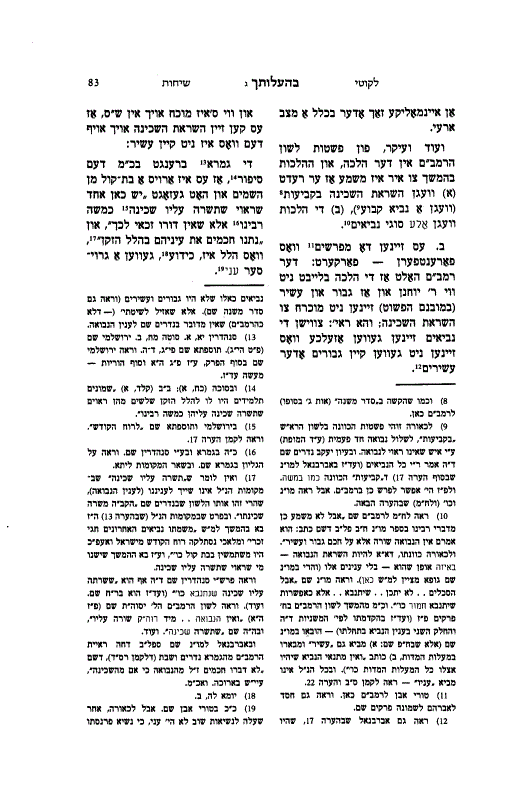
Saif Beis
The Gemara relates that a voice came from heaven and declared, “There is someone here who is fit for the Shekhinah to rest upon him, just as it did upon Moshe Rabbeinu. But the generation is not worthy.” The sages wondered who this referred to, and they set their eyes on the elder Hillel, recognizing that he was the one meant for this distinction. Notably, Hillel was extremely poor, yet the Shekhinah could rest upon him—demonstrating that poverty does not disqualify someone from prophecy.
This raises a question: Why does the Rambam not list humility as a requirement for prophecy? From the story of Hillel, it seems clear that his humility was the main reason he was fit for the Shekhinah to rest upon him. If so, why does the Rambam omit humility as an explicit condition?
We see a similar issue in our Torah portion. The verse tells us that Moshe was “the most humble man on the face of the earth,” and this serves as an introduction to what follows: Hashem says that Moshe is not like other prophets—He speaks to him mouth to mouth, clearly and directly. This suggests that Moshe’s unique level of prophecy is connected to his humility. So again, why doesn’t Rambam mention humility as a separate requirement?
One might suggest that humility is included in what Rambam writes about being strong in character traits—that one’s yetzer hara never overpowers him in any aspect of life. Humility could be considered part of having strong middos (character traits), just as physical strength is included in being a giber (mighty person). The Gemara itself brings examples showing that both physical and character strength are relevant.
But even if we interpret “giber” in Rambam’s words as referring to bodily health and wholesomeness—meaning actual physical strength—it still doesn’t fully answer our question. Why would Rambam only hint at these qualities in passing rather than stating them explicitly at the outset as conditions for prophecy? Why not say directly that one must be a giber b’koach (mighty in strength) or an anav (humble)?
This same issue arises with humility: if it is truly an independent qualification—as Rav Yehoshua and Rav Yochanan list it among the requirements for prophecy—why doesn’t Rambam detail it separately instead of subsuming it under strong middos?
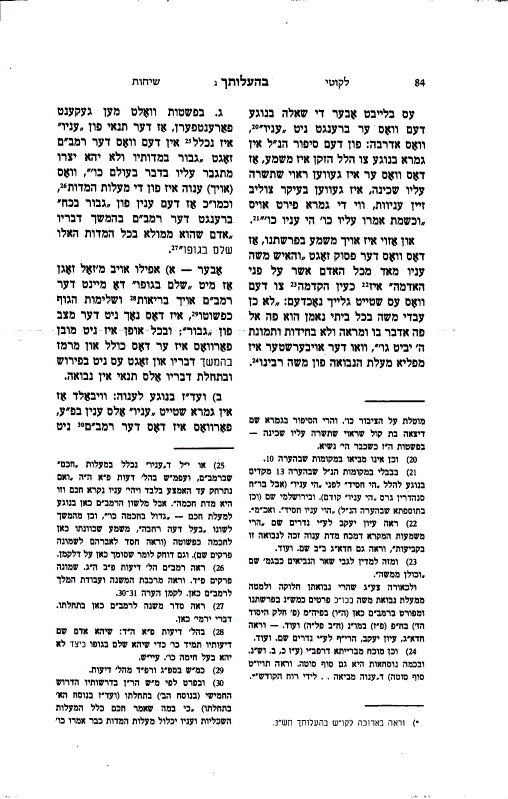
To resolve these questions, we need to compare two Talmudic sources: Gemara Nedarim and Gemara Shabbos. The Rebbe notes that Gemara Nedarim lists certain qualifications for prophecy, while Gemara Shabbos presents them differently. In Shabbos, it says: “The Shekhinah does not rest except on a wise person (chacham), mighty person (giber), wealthy person (ashir), and tall person (balkoma).” Notably, balkoma—being tall—is mentioned here but not in Nedarim; conversely, humility appears in Nedarim but not in Shabbos.
The Lechem Mishneh asks: Why does Gemara Shabbos add balkoma? It can be explained that “giber” sometimes refers specifically to physical stature—a tall person—and this detail is relevant because Shabbos discusses how tall the Levites were. Thus, balkoma is specified there due to context.
However, this explanation still leaves us with difficulties: Why does Gemara Shabbos omit humility—a quality highlighted in Nedarim? And why do these sources differ in their order of listing qualifications? In Nedarim it’s giber, then ashir, then chacham; in Shabbos it starts with chacham and then lists ashir.
There’s also a difference in language between these two sources: Nedarim says Hashem will not “make His presence rest,” while Shabbos says Hashem “does not rest.” What accounts for these variations?
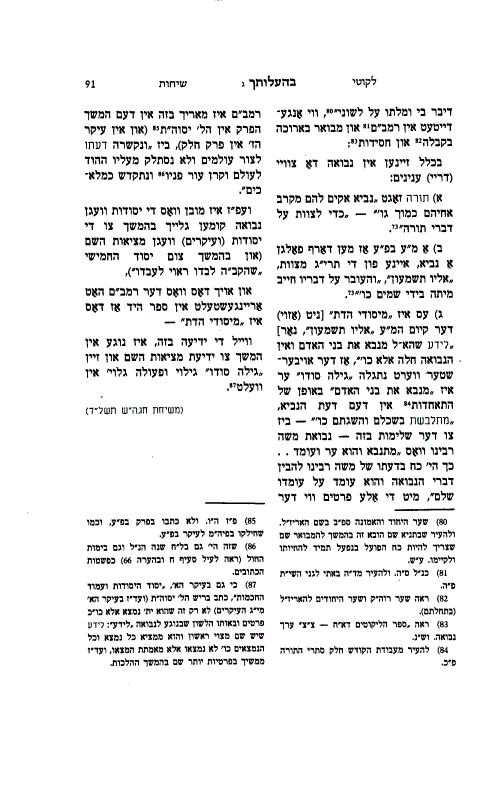
The Rebbe suggests looking at how Rambam defines prophecy both in his 13 Principles and in Mishneh Torah. In his 13 Principles, Rambam teaches that among humans there are individuals who naturally possess elevated character traits and wholesome souls prepared to receive a unique form of intellect from above—this makes them fit for prophecy.
The Rebbe notes a textual nuance: after describing how such people are prepared for this higher intellect (“surat ha-seichel”), Rambam continues by explaining how their human intellect cleaves to an intellect separated from Hashem—a process leading to prophecy.
Similarly, in Mishneh Torah Hilchos Yesodei HaTorah, Rambam writes that one of the foundations of faith is knowing that Hashem bestows prophecy upon humans. He immediately continues with details about who can become a prophet—their special qualities—and describes both the conditions required and the process by which prophecy occurs.
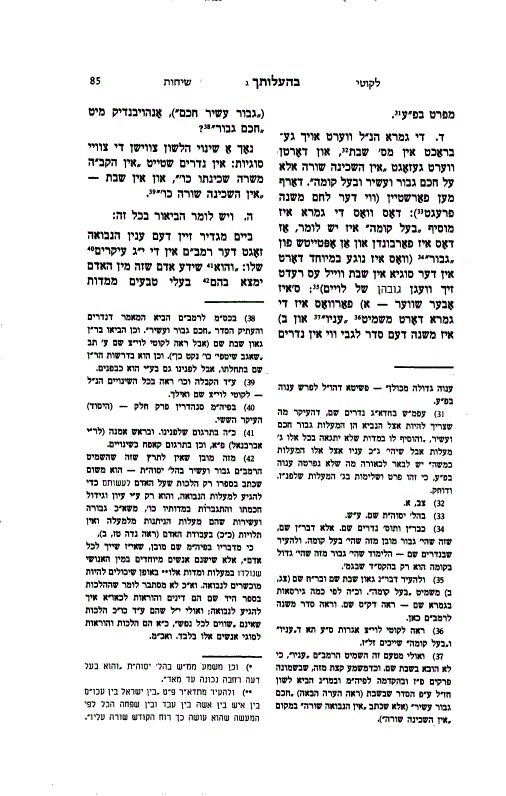
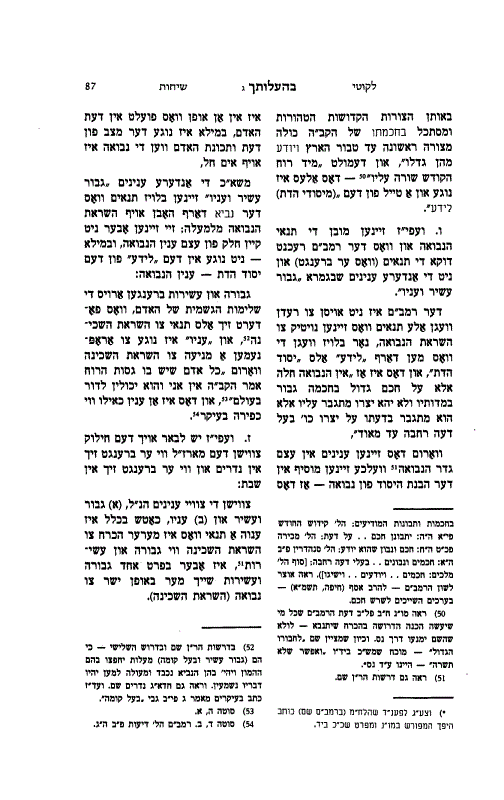
Saif Gimmel
When a person encounters a prophet or seeks to understand the ways of prophecy—how it takes place, how one enters the “orchard” of Torah’s secrets, and the actual process of prophecy—the Rambam provides us with detailed guidance on all these specifics. The Rambam’s intent is not merely to describe the technical details or order of prophecy, but to present them as essential knowledge. These details become foundational to our understanding of faith itself.
This means that it is not enough to simply know that Hashem appoints prophets. Rather, part of the foundation of our religion is to understand how prophecy works: its mechanisms and definitions. It is not sufficient to know in general terms that Hashem reveals His secrets to His servants, the prophets; we must also grasp the intellectual and experiential aspects of prophecy—how it is received in the mind of the prophet.
The Rambam explains that when prophets receive prophecy, their limbs tremble, their bodily strength falters, and their faculties become confused. This allows their minds to be free—unencumbered by other faculties—to fully absorb and comprehend what they see in their prophetic vision. The mind must be clear and receptive, able to understand and internalize what is revealed.
Through this process, a person becomes transformed—“another person”—with an elevated mind that surpasses even other wise individuals. The prophet’s daas—his understanding—becomes united with these higher truths. Therefore, knowing these processes and pathways is crucial; it is part of what we are meant to “know” about prophecy according to the Rambam.
The Rambam continues at length about how one prepares for prophecy: entering into deep contemplation (“the orchard”), developing a prepared mind capable of grasping profound matters, sanctifying oneself, separating from worldly distractions and vanities, and keeping one’s thoughts focused above all else on holy matters. The prophet’s mind must always be free from trivialities and attached instead “under the throne,” contemplating pure forms and gazing upon Hashem’s wisdom from the highest levels down to the lowest depths.
By contemplating these matters—from the heights of creation down to its foundations—the prophet comes to recognize Hashem’s greatness. After all this preparation, says the Rambam, immediately “the holy spirit rests upon him.” All these steps are part of what we must know as foundational knowledge about prophecy.
Based on this approach—that knowing how prophecy works is essential—it follows that it is not only important that a prophet can reveal secrets from Hashem. We must also understand how a prophet achieves this state: by freeing his mind from all else and grasping this revelation of holiness so that the spirit of holiness can rest upon him.
However, while these qualities are necessary for prophecy to rest upon someone from above, they are not themselves part of the essence or definition of prophecy. Therefore, they are not included in what we need to know as part of our religious foundation regarding prophecy itself. We only need to know those conditions intrinsic to receiving prophecy—not those required merely as prerequisites for merit or worthiness.
The qualities such as physical wholesomeness (strength and wealth) and humility serve as conditions for a person becoming a vessel for prophecy. Humility in particular removes obstacles that would prevent God’s presence from resting on someone; arrogance is considered tantamount to denying God’s existence altogether.
As our sages teach: “I and he cannot dwell together in this world”—arrogance makes coexistence with God impossible. Thus, physical strength, wealth, completeness in body, and honor serve primarily to remove negative traits that would block divine revelation.
This distinction helps explain differences between statements found in Gemara Nedarim versus Gemara Shabbos regarding prophetic requirements. On one hand are physical qualities—strength (gibbor) and wealth (osher)—which represent physical wholesomeness needed for prophecy. On the other hand stands humility (anavah), which is even more essential for divine presence but applies more broadly than just prophecy—it is necessary for any connection with Hashem at all.
The Gemara states explicitly: “I and he cannot live together in the world.” This principle applies beyond just prophets; anyone seeking closeness with God must possess humility. As explained in Chassidus (and Tanya), God only rests His presence on something truly nullified before Him (bittul). In contrast, strength and wealth are specifically connected with readiness for prophecy—they enable a person’s ultimate completeness both spiritually (wisdom) and physically (health and resources).
The Rambam notes that just as spiritual greatness (wisdom) is required for prophecy, so too is physical completeness—strength in body and material well-being. These allow a person to serve Hashem without distraction or limitation.
This idea parallels what the Rambam writes regarding physical blessings promised by Torah observance: such blessings are not rewards per se but rather supports enabling one’s full engagement in Torah study and mitzvah observance without hindrance or worry over material needs.
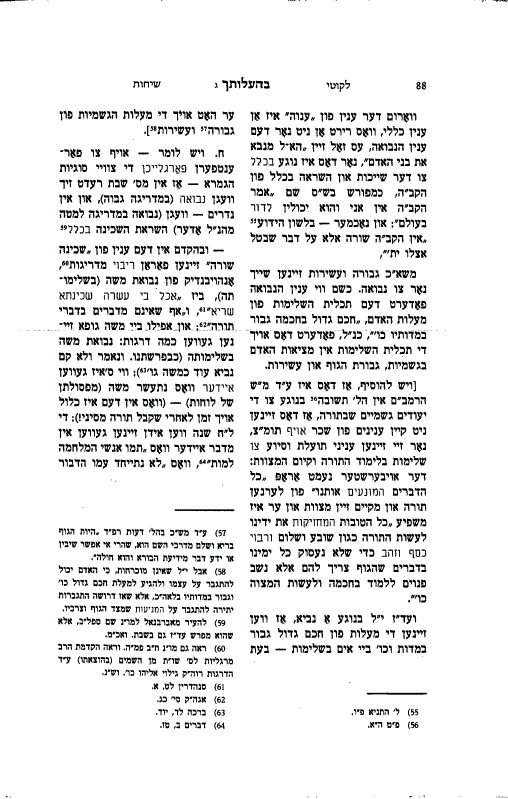
Saif Daled
The Rebbe explains that Hashem provides us with all the good things in life to support our ability to learn Torah and observe mitzvos. For example, there should be plenty of food and an abundance of silver and gold, so that we are not forced to spend all our days on material needs. Instead, we can be free to study Torah and fulfill mitzvos.
Similarly, when it comes to a prophet, his greatness as a chochem—wise person—and his strong character are only complete when he also possesses physical advantages such as strength and wealth. These material blessings support and enhance his spiritual qualities.
This leads to a deeper understanding of the distinction between humility and other character traits. While humility is an essential quality, the other traits are not inherently part of a person's essence but serve as prerequisites or supports for prophecy. The question then arises: how do we reconcile the two discussions about the necessary qualities for prophecy—one in the Torah and one in Tractate Shabbos?
The Rebbe clarifies that these sources refer to different levels of prophecy. The discussion in Shabbos addresses prophecy at its highest level, while the Gemara in Nedarim refers to a lower level—not necessarily full prophecy but perhaps just the resting of the Divine Presence (Shekhinah).
To explain this further, there are multiple levels of Divine revelation. At the highest is Moshe’s prophecy in its complete form. On the opposite end is even a minimal manifestation of Shekhinah, such as when ten Jews gather—even if they are not speaking words of Torah, there is still a presence of Shekhinah among them.
Even within Moshe himself, there were many gradations in his prophetic experience. His most complete prophecy is described in our parsha: “There never arose another prophet like Moshe.” This represents Moshe’s highest level, as discussed in Sanhedrin.
There were also times before Moshe became wealthy from the leftover pieces of the Luchos (tablets), after receiving the Torah at Sinai but before attaining wealth. Later, after Psal lecha, he reached another level. During the 38 years when Bnei Yisrael wandered in the desert—before those destined to die had passed away—Hashem did not communicate with Moshe face-to-face as before.
This demonstrates that there are many different levels at which the Shekhinah can rest upon someone. Therefore, when comparing these two Gemaras—one discussing prophecy at its highest level and one at a lower level—we see that each describes different requirements based on the level being discussed.
The difference is also reflected in their language: one says “the Shekhinah rests,” while another says “Hashem causes the Shekhinah to rest.” There is a known principle that specifically something on a higher spiritual level can descend and rest on something much lower. In Nedarim, where we discuss a lower level of prophecy or even just Divine inspiration (not full-fledged prophecy), it requires Hashem’s active intervention for it to rest upon someone.
In contrast, at higher levels—such as Moshe’s—the Shekhinah comes by itself; it does not need to be made to rest by Hashem because it is drawn naturally by Moshe’s spiritual stature.
This also explains other differences between these sources regarding which qualities are listed first or emphasized. In Shabbos, where true prophecy is discussed, wisdom (chochmah) comes first because intellectual excellence includes all other advantages—even emotional ones like refined character traits (middos). True completeness in middos comes from intellect ruling over one’s inclinations; thus, intellectual refinement becomes a vessel for prophecy.
This is why “chocham”—a wise person—is mentioned first; it encompasses all necessary qualities for prophecy. Physical attributes like strength and wealth are also listed because they help perfect one’s wisdom by removing material distractions.
For this reason, humility (anavah) is not mentioned explicitly here—it is considered a general prerequisite for closeness with Hashem rather than specifically for prophecy alone. In this context, we are not only discussing what is needed for prophecy but also what brings about any form of Divine connection or resting of Shekhinah on a person below.
This explains why in some places humility is emphasized—as it draws down Hashem’s presence—and why wisdom may not be mentioned explicitly if we are discussing more general forms of Divine connection rather than full prophetic revelation.
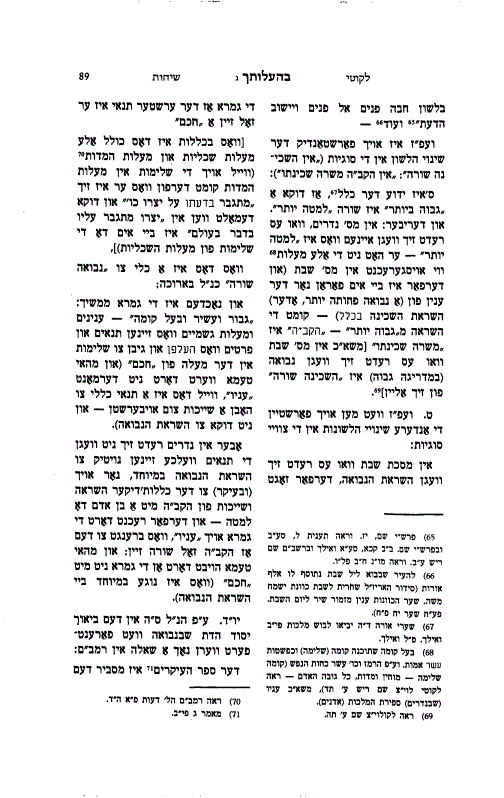
Saif Hei
Building on the previous discussion regarding the foundation of prophecy in Judaism, we can now address another question on the Rambam. The Sefer HaIkkarim explains that the principle of Torah from Heaven is fundamental, and prophecy is a branch that stems from this. Prophecy is not given so people can know personal matters or to reveal new signs about specific issues. Rather, its purpose is to bring divine influence—hashra’ah elokis—to humanity, which is itself an expression of Torah from Heaven.
With this in mind, we can better understand a question about the Rambam’s order of principles. The Rambam writes that when it comes to a prophet, if the Jewish people want a prophet, Hashem tells Moshe He will raise one up from among their brothers, like Moshe himself. This prophet does not come to create a new religion but to instruct about Torah and warn people not to transgress it. For example, Malachi—the last of the prophets—said: “Remember the Torah of Moshe My servant.” If a prophet instructs us in optional matters, there is a mitzvah to listen; but he does not introduce new mitzvos, only warns us to keep those already given.
This raises the question: Why did the Rambam organize his thirteen principles so that belief in prophecy and specifically Moshe’s prophecy come immediately after the first five foundational principles (which deal with Hashem and our obligation to serve Him), but before the eighth principle—that there will be no change in Torah? Logically, since prophecy does not introduce changes in Torah, shouldn’t belief in prophecy follow after these principles?
The Rambam holds that all thirteen are essential principles—not like the Ikkarim who see some as results rather than roots. Still, even among these essentials there is an order: what comes first and what follows. According to what we have explained above, belief in prophecy and specifically Moshe’s prophecy should have been placed after those foundations dealing with Torah itself.
The Sefer HaIkkarim goes so far as to say that prophecy is not even an independent root; rather, it serves only to reinforce Torah from Heaven. All a prophet does is help us participate in and uphold this principle—Torah from Heaven—by reminding us or clarifying its details. But according to the Rambam, belief in prophecy is itself one of the thirteen principles—it stands as its own foundation.
It appears that even though all thirteen are essential for faith according to Rambam, he too agrees that the main function of a prophet is not innovation but reinforcing Torah from Heaven and ensuring it remains unchanged. Occasionally a prophet may tell us something new for a specific time or situation—but this does not constitute a new principle or law.
This leads back to our earlier question: Why doesn’t Rambam list “Torah from Heaven” and “Torah will never be changed” together as consecutive principles before discussing belief in prophets? Since prophets exist only to reinforce these ideas—not to innovate—it would seem logical for them to follow afterward.
Furthermore, why does Rambam include as part of his code of Jewish law (the Mishneh Torah) that Hashem chooses prophets? Why make this part of religious doctrine? It would suffice for him simply to state that there is a mitzvah to listen to prophets; why elevate it into a core principle?
The answer lies in understanding what makes something part of ikkarei ha’emunah—the foundations of faith. It’s not just about knowing there’s a mitzvah; it’s about recognizing how this mitzvah expresses something fundamental about our relationship with Hashem. The reason we must believe in prophecy as an independent principle is because it reflects how Hashem communicates His will directly with humanity—a core aspect of Judaism itself.
This also explains why Rambam emphasizes that prophets must be chosen by Hashem Himself. The process by which someone becomes a prophet—and our obligation to heed their words—isn’t just practical guidance; it’s an expression of divine connection at the heart of our faith.
In Chassidus this idea takes on even greater depth: Prophecy represents one of the highest forms of divine revelation within creation. The Rebbe often divides this into three aspects: two relating directly to prophecy itself (its essence and its function), and one relating specifically to mitzvah observance through prophetic instruction.
Key Points
1. The Rambam defines the essential qualifications for prophecy as wisdom and strength of character, interpreting "gibor" as emotional mastery rather than physical might, and notably omits wealth and humility as explicit requirements, diverging from the literal reading of scriptural and Talmudic sources.
2. The Gemara presents stories, such as that of Hillel the Elder, to demonstrate that prophecy can rest upon someone who lacks material wealth, suggesting that traits like humility may be prerequisites for Divine inspiration but are not formal requirements according to the Rambam’s halachic framework.
3. The Rambam’s approach to prophecy emphasizes understanding both the process and conditions necessary for prophecy as foundational knowledge in Judaism, distinguishing between qualities intrinsic to prophecy itself and those that merely prepare a person to become a vessel for it.
4. Physical completeness—such as strength and wealth—serves primarily to remove obstacles to prophecy by freeing a person from material distractions, while humility is a universal prerequisite for closeness with Hashem but not unique to prophecy alone; thus, these traits are not listed by the Rambam as essential definitions of prophecy.
5. There are multiple levels of Divine revelation, with varying requirements depending on the level discussed; higher forms of prophecy (like Moshe’s) naturally draw down Shechinah due to spiritual stature, while lower levels require more explicit Divine intervention and may have different qualifying traits emphasized in different Talmudic sources.
6. The order and emphasis of prophetic qualifications in various sources reflect their context: intellectual excellence (chochmah) is prioritized when discussing true prophecy because it encompasses all other virtues, while physical or emotional traits serve as supports or prerequisites rather than core requirements.
7. According to Chassidus and the Rambam’s explanation in Mishneh Torah, material blessings are provided by Hashem not as rewards but as means to facilitate Torah study, mitzvah observance, and ultimately readiness for prophecy by removing worldly hindrances from spiritual pursuits.
8. The Rambam includes belief in prophecy—and specifically Moshe’s unique level of prophecy—as one of Judaism’s thirteen fundamental principles because it expresses Hashem’s direct communication with humanity; this stands independently from the principle of Torah from Heaven and is central to Jewish faith even though prophets do not innovate new laws but reinforce existing Torah truths.
9. The placement of belief in prophecy within the Rambam’s list of principles underscores its foundational role: it is not merely practical guidance but reflects an essential aspect of divine revelation and connection at the heart of Judaism, further deepened by Chassidic teachings on the nature and function of prophetic revelation within creation.