Introduction
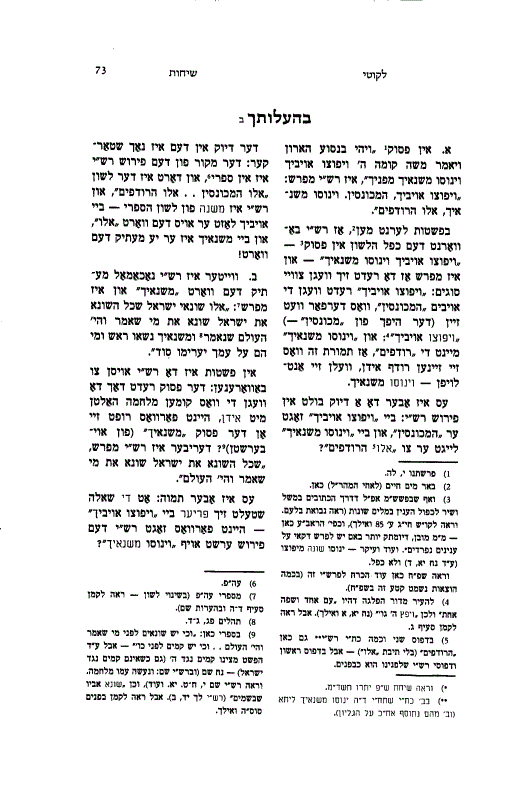
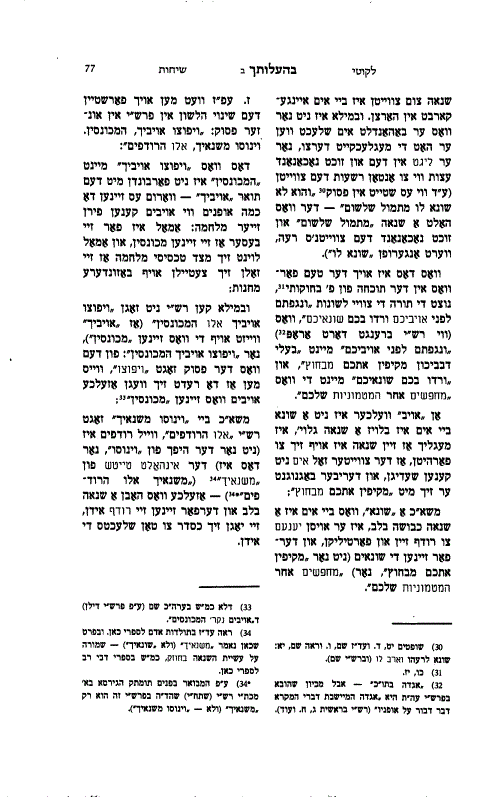
In this sicha, we will review a Rashi from Parshas Beha'alosecha, as found in Likkutei Sichos volume 23, the second sicha on this parsha. The Rebbe focuses on a seemingly minor detail in Rashi’s commentary that, at first glance, one might easily overlook. Yet, as the Rebbe demonstrates, every word in Rashi is deliberate and packed with meaning.
The verse under discussion is well known—it is recited when the Torah is taken out in shul. The Torah says:
ויהי בנסוע הארון ויאמר משה קומה ה׳ ויפוצו אויביך וינוסו משנאיך מפניך.
"And it was when the Ark set out that Moshe said: 'Arise, Hashem, and let Your enemies be scattered; and let those who hate You flee from before You.'"
Rashi comments on the words "V'yafutzu Oivekho"—"let Your enemies be scattered." He explains that "Oivekho" refers to hamukhonosim—those who are gathered or lying in wait. They are not actively chasing after you but are present within, biding their time.
On the next phrase, "V'yanusu Misanekho"—"let those who hate You flee," Rashi explains that "Misanekho" refers to eilu hareitvim—those who pursue you. In other words, there is a distinction between "enemies," who are hidden or gathered together (not yet attacking), and "those who hate you," who are actively pursuing or chasing.
The Rebbe draws attention to a subtlety: by "Misanekho," Rashi uses the language "eilu hareitvim"—"these are the pursuers." The use of the word "eilu" ("these") seems minor but becomes central in the Rebbe's analysis. Why does Rashi use this specific term here? What is he coming to clarify?
This small difference—whether or not Rashi writes "eilu"—is shown by the Rebbe to have major significance for understanding Rashi’s approach to pshuto shel mikra, the plain meaning of the text. Every word in Rashi is precise and intentional.
The Rebbe’s method is to examine these details step by step, showing how even what appears to be a minor nuance can reveal deeper layers of meaning in both Rashi's commentary and the Torah itself. This approach teaches us to appreciate how much depth lies within every word of our tradition.
Saif Aleph
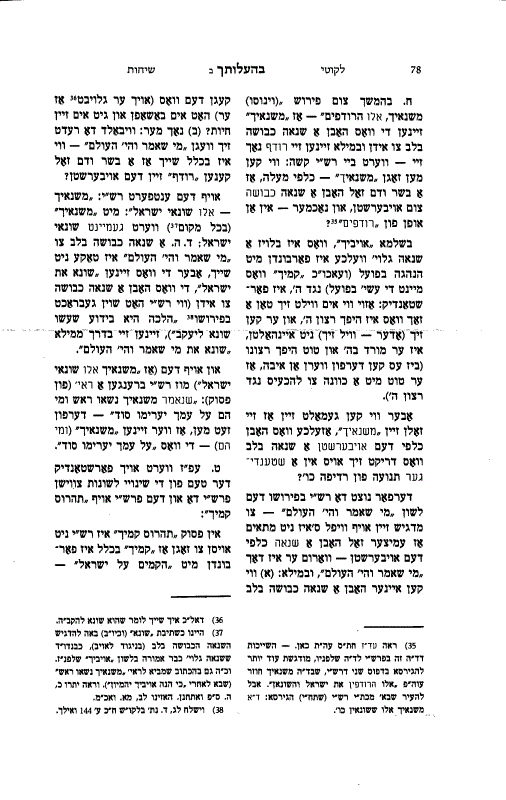
The verse under discussion uses two terms: “your enemies” (oyvekho) and “those who hate you” (misanekho). Rashi comments on this duplication, explaining that these refer to two distinct categories. “Your enemies shall be scattered” refers to those who are gathered together against you, while “those who hate you shall flee” refers to those who actively pursue and chase after you. The Torah is thus describing both the scattering of organized opposition and the retreat of those engaged in pursuit.
Rashi’s wording is precise. When he explains oyvekho, he does not use the word “elu”—“these are”—as he does when explaining misanekho. In the Sifri, which is Rashi’s source, the word “elu” appears for both categories: “elu hamekhonosim” and “elu harodfim.” Yet Rashi omits it for oyvekho and includes it for misanekho. This change in language raises a question: why does Rashi deviate from his source and use different terminology for each group?
The Rebbe points out that this difference is even more striking because in the Sifri, both groups are introduced with “elu,” but Rashi only retains it for one. This suggests that Rashi is making a deliberate distinction between the two categories as they appear in the verse.
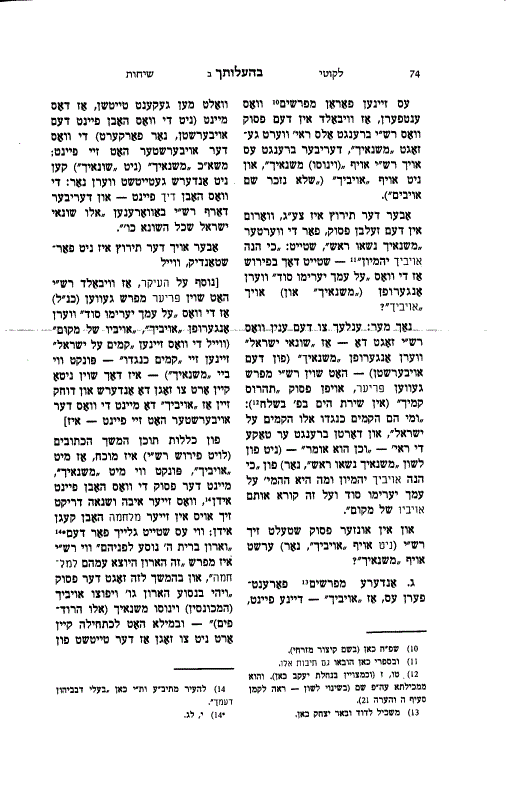
There is another nuance in Rashi’s commentary regarding the term misanekho. The verse seems to say that these are people who hate Hashem, but Rashi clarifies that it refers to those who hate the Jewish people. He explains that anyone who hates a Jew ultimately hates Hashem as well. Therefore, when the verse says “those who hate you,” it means those who hate Hashem because their hatred of Jews translates into hatred of Hashem Himself.
This explanation is supported by a verse that Rashi cites: “Those who hate you have raised their heads,” which continues by describing them as plotting against Hashem’s nation—meaning the Jewish people. Thus, their animosity toward Jews is equated with animosity toward Hashem.
The Rebbe asks why Rashi provides this explanation specifically for misanekho and not earlier for oyvekho, since both terms refer to adversaries of Hashem. If hating a Jew is tantamount to hating Hashem, why doesn’t Rashi clarify this point when first mentioning “your enemies”? Why wait until discussing “those who hate you”?
The Sifsei Chachamim offers an answer: since the proof text that Rashi brings uses the term misanekho, it makes sense for Rashi to elaborate on its meaning specifically at that point in his commentary. The focus remains on clarifying why those who oppose or pursue Jews are described as hating Hashem—because their enmity toward Israel reflects enmity toward God Himself.
Saif Beis
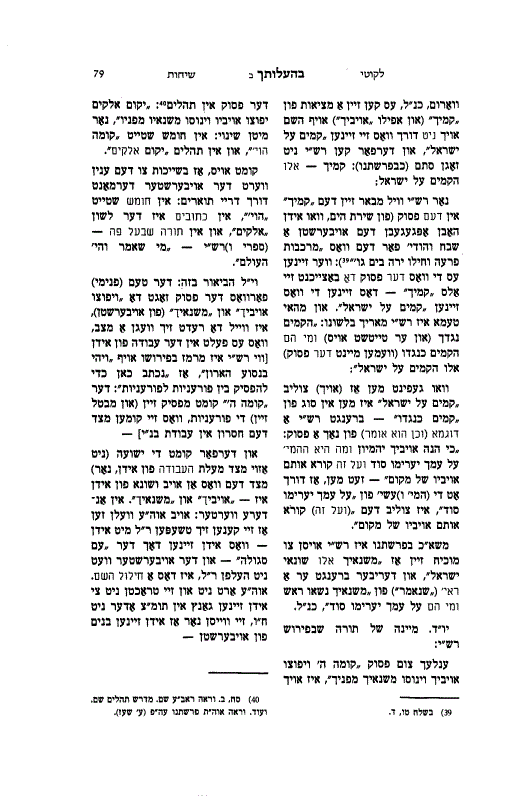
The discussion here centers on why Rashi, when explaining the verse, chooses to comment specifically on the term mesanecha—those who hate You—and not earlier when the Torah mentions oyvecha—your enemies. The Rebbe points out that in the verse itself, both terms appear: it says your enemies have raised their heads, and those who plot against you will be attacked. So, both mesanecha and oyvecha are present in the same context.
This raises a question: if both terms are there, why does Rashi only bring his explanation on mesanecha? The Rebbe notes that Rashi seems to have already addressed this concept earlier—in the song at the sea (Shiras HaYam) in Parshas Beshalach. There, regarding the verse "Taris Komecha," Rashi explains similarly that those who rise up against Israel are called Hashem's enemies.
שאלה שאוהבו ידין, קוראים לה אוהב חשם פונדם עברית, שתונה מסנכו חצי רשעים מפרש גוון פרער רשע, כבר התכנן את זה קודם אוי פן פוסק תריס קומחו אין שירי סייאם בפרסת בשבח אן דה פוסק תריס קומחו שחשם יצטרוי אלה שקיעים על חשם שזה בשיר הידין שייך על הים אוי שירי מיישהו בנה ישראל אין דה פרשת בשבח רשע קוראים ומי המה קומים כנכדי זה אומר קומחו, תתקור מגן שלך מי הם שהם יתקור מגן מהחשם אלו הקומם על ישראל זה נקור מגן של הידין זו איזה דבר רשע קוראים, תקור מגן מהחשם ודורטן ברינטר תקת דה ראיה ואובה דה הוא ברינט דה אבננס וכן הוא אימר וסו דה פוסק סס וניט פון לוש ומסנכה נור סוריישון הקראישי ברינט מסנכה נור פון קהיני אוי וכה יהה מויון אוי וכה
The question is: why does Rashi wait until mesanecha to explain that those who hate Jews are considered haters of Hashem? In Beshalach, Rashi already explained that those who plot against Israel are called Hashem's enemies. So why not clarify this point earlier when discussing oyvecha? The Rebbe brings another answer but does not accept it: some suggest that oyvecha means "those whom You hate"—Hashem's enemies—not necessarily those who hate Hashem.
This interpretation would mean that Rashi doesn't need to explain by oyvecha, since it could simply refer to people whom Hashem hates for their evil actions. However, with mesanecha, which can only mean "those who hate You," Rashi must clarify why they are called haters of Hashem—because hating a Jew is equated with hating Hashem.
The Rebbe rejects this answer for several reasons. First, as already mentioned, Rashi explicitly states elsewhere that those who plot against Israel are called Hashem's enemies. So we already know from earlier commentary what is meant by "enemies of Hashem." Second, from the flow of these verses according to Rashi's approach, it's clear that both terms refer to those who oppose or attack the Jewish people—their enmity expresses itself through war and conflict.
The context is about war: immediately before our verse it says that the Ark of Hashem traveled ahead of them into battle. The Torah describes how Moshe would say "Vayehi binsoa ha'aron"—when the Ark journeyed—and then "Vayafutzu oyvecha"—may Your enemies be scattered. This is all in the context of battle; these are people actively fighting against Israel.
If so, there is no reason to interpret "Your enemies" as merely those whom Hashem hates for other reasons; rather, it refers directly to those attacking His people. Therefore, we must say just the opposite: since we already know from earlier verses and from Rashi's previous explanations who these enemies are—those who stand up against Israel—it makes sense for Rashi to focus his explanation specifically on mesanecha. He needs to clarify why they are called haters of Hashem (not just generic enemies), teaching us that hatred toward a Jew is considered hatred toward Hashem Himself.
This analysis demonstrates how careful attention to language and context leads us to a deeper understanding of Rashi’s commentary and its implications for our relationship with fellow Jews and with Hashem.
Saif Gimmel
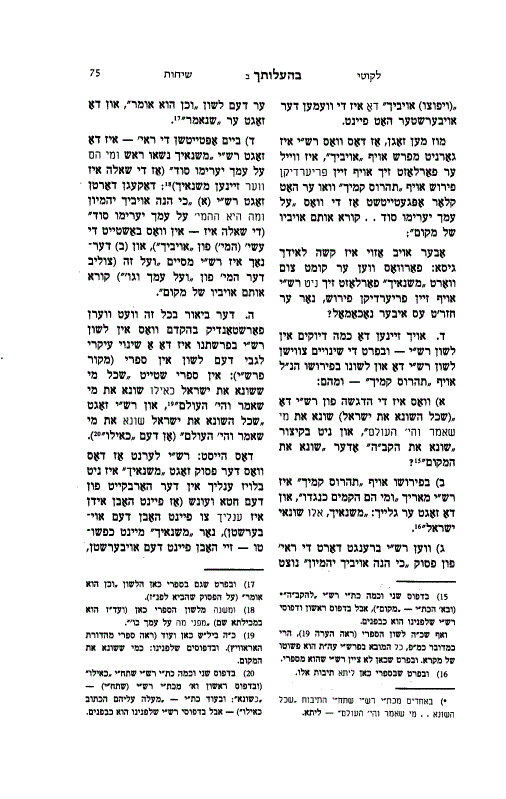
The Rebbe now raises a question regarding Rashi’s approach: why does Rashi, in this context, not explain the term oyvecha—your enemies—since he already clarified it in his previous commentary? In that earlier place, Rashi explicitly translated al am choyerim vesoyd, meaning those who plot against him. So, we already know who the enemies are; there seems to be no need for further explanation here.
When the verse says, “Kumah Hashem veyafutzu oyvecha”—“Arise, Hashem, and let Your enemies be scattered”—Rashi identifies these as those plotting against Him. They are called “enemies of Hashem” because they fight against the Jewish people. Therefore, there is no need to elaborate further on who these enemies are.
The question arises: if Rashi relies on his earlier explanation for oyvecha, why doesn’t he do the same when it comes to the word misanecha—those who hate You? Why does Rashi repeat his commentary here instead of simply referencing his previous remarks? The Rebbe explains that once we understand precisely what misanecha means, we’ll see that while oyvecha can be understood as enemies of Hashem, this is not necessarily true for misanecha. This also clarifies why Rashi uses the expression “elu”—these are—when introducing his explanation.
The Rebbe then compares two places where Rashi comments: one in Shirat HaYam (the Song at the Sea), where Rashi explains oyvecha, and one here regarding misanecha. There are several notable differences between Rashi’s language in our parsha and in his earlier commentary.
Aleph (first): When Rashi says that hating a Jew is equivalent to hating Hashem, he uses an unusual phrase: “he hates the One Who spoke and brought the world into being.” Why doesn’t Rashi simply say “he hates Hakadosh Baruch Hu” or “he hates Hashem”? What is the emphasis on “the One Who said and created [the world]”?
Beis (second): In his commentary on Parshas Shelach regarding “tariz kamecha,” Rashi elaborates at length about who stands up against Hashem—“who are those that stand up against Him?”—but here, when discussing misanecha, he simply says “those who hate Israel,” without specifying who these haters are.
Gimel (third): When bringing proof from the verse “ki hinei oyvecha yehamayun”—“for behold, Your enemies murmur”—Rashi uses different language. In one place he writes “v’chein hu omer” (“and so it says”), while here he writes “shene’emar” (“as it is stated”). This subtle change requires explanation.
Daled (fourth): When quoting the verse as evidence, Rashi sometimes adds explanatory words. For example, regarding misanecha nosu rosh, he adds “umi hein? al am choyerim vesoyd”—“and who are they? Those who plot.” But elsewhere, when discussing murmuring enemies (yehamayun), he focuses on what they do rather than identifying them directly. Here, however, he specifies exactly who these haters are.
The Rebbe notes that in some places Rashi calls them “enemies of Hashem,” but in our context he only says “umi hein? al am choyerim vesoyd”—identifying them as those plotting against Israel without explicitly calling them enemies of Hashem. All these differences will be explained so that everything fits together perfectly.
The Rebbe now introduces a key distinction between Rashi’s wording and that of his source in Sifri. In Sifri it states: “kol mi she-soynei Yisrael ki’ilu soineh mi she-amar v’hayah ha’olam”—anyone who hates a Jew is as if he hates the One Who spoke and brought the world into being. But Rashi omits the words “as if.” He writes: if you hate a Jew, you hate Hashem Himself—not just as if you do.
This change is significant. According to Sifri, hating a Jew is comparable in severity to hating G‑d—it’s as if you did so; both sin and punishment are similar. But according to Rashi, it’s not merely similar—it’s literally true: someone who hates a Jew actually hates G‑d Himself. Either it’s because hatred for Jews stems from hatred for G‑d or because hating Jews is inherently identical with hating G‑d.
A similar pattern appears in Rashi’s explanation of “tariz kamecha.” There too, unlike Mechilta—which says standing up against Jews is like standing up against G‑d—Rashi makes clear that standing up against Jews actually means standing up against G‑d Himself.
Saif Daled
When discussing those who stand up against the Jewish people, it is said that if someone rises against the Jews, it is as if they rise against Hashem. However, this is not considered literally standing up against Hashem Himself, as Rashi’s language indicates—that by opposing the Jews, one is indeed standing up to G‑d. According to Rashi, these are essentially one and the same.
The nations of the world know that the Jewish people are Hashem’s chosen treasure among all nations—His am segulah, His treasured nation. The Jews are also referred to as “B’ni Bechori Yisrael”—G‑d’s firstborn son. Therefore, when someone stands up against Hashem, by extension they are also standing up against a Jew, because Jews are G‑d’s treasure. Thus, opposition to G‑d and opposition to the Jewish people are deeply connected.
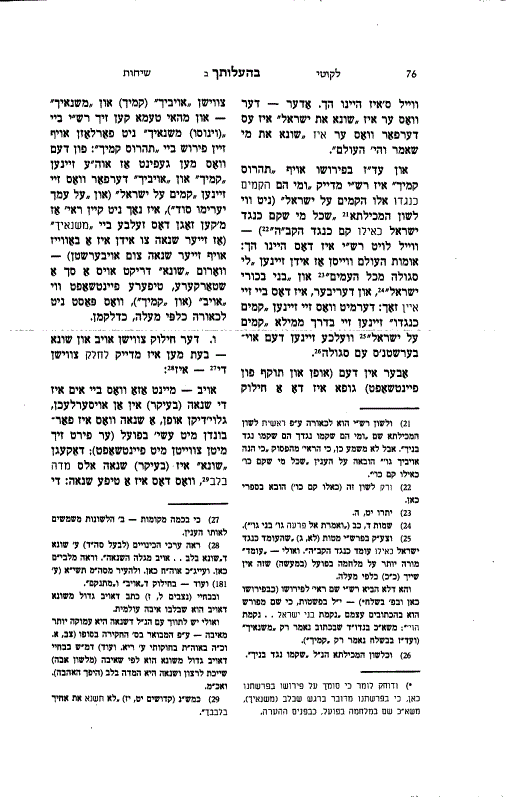
However, when it comes to the nature and intensity of enmity—specifically hatred (sina)—there is a distinction between “your enemies” (oyvecha, komecha) and “those who hate you” (mesanecha). Even though we have established that an enemy of G‑d is really an enemy of the Jew (and vice versa), hatred is not necessarily synonymous with enmity.
Rashi cannot rely on his earlier commentary regarding “komecha” (those who rise up against you) when explaining “mesanecha” (those who hate you). While we find that the nations of the world are called komecha and oyvecha because they stand up against Israel—and thus against Hashem—this does not automatically apply to “mesanecha.” There is no clear evidence that those who hate G‑d must also be those who hate Israel in exactly the same way.
The reason for this distinction is that hatred (sina) expresses a much stronger and deeper animosity than mere enmity or opposition. Hatred implies something more profound than simply being an enemy; it suggests a deep-seated emotional state rather than just outward actions.
This leads us to clarify: what exactly is the difference between an enemy (oyev) and a hater (soynei)? Sometimes these terms are used interchangeably, but when we want to distinguish between them: an oyev, an enemy, is someone whose hatred is primarily external and revealed. It manifests in action—he acts with hostility toward another person. The enmity here is about conduct; he behaves as an enemy when given the opportunity.
A soynei, on the other hand—a hater—is characterized by hatred as a deep emotion rooted in his heart. This hatred is internalized; it’s carved into his very being. Not only does he treat the other person badly when possible, but he constantly seeks new ways to harm him. He lies in wait for opportunities to do evil to his adversary.
This idea appears in Scripture:
וְהוּא לֹא שׂוֹנֵא לוֹ מִתְּמוֹל שִׁלְשׁוֹם
"And he was not his enemy from yesterday or the day before."
This verse describes someone who holds onto hatred from days past and continually seeks ways to harm another—that’s what defines a true hater (soynei). The Torah uses this language deliberately: such a person isn’t just acting out of momentary anger; he harbors ongoing animosity.
This also explains why in rebuke passages such as:
וְנִגַּפְתֶּם לִפְנֵי אֹיְבֵיכֶם וְרָדוּ בָכֶם שֹׂנְאֵיכֶם
"You will be struck down before your enemies; those who hate you will rule over you."
The Torah distinguishes between enemies and haters. Your enemies surround you from without—they represent open hostility. But your haters dominate you—they seek out your hidden vulnerabilities and exploit them from within.
An oyev, an enemy, possesses only open hatred—it may even be possible for him to conceal his feelings or restrain himself from acting on them. He may be content with merely surrounding or threatening from outside. In contrast, a soynei, a hater, has internalized animosity; he actively pursues harm and destruction for his adversary at every opportunity.
This explains why there are two levels described: enemies act externally, while haters seek out hidden weaknesses—they go further in their pursuit of harm.
With this understanding of different levels of enmity and hatred, we can now better appreciate certain nuances in Rashi’s commentary on our verse. For example, Rashi uses different language for “v’yafutzu oyvecha”—“may Your enemies scatter”—and for “v’yanusu mesanecha”—“may those who hate You flee.” For “oyvecha,” Rashi refers simply to those gathered against Israel; for “mesanecha,” he specifies “those who pursue,” indicating a deeper level of antagonism.
The term "mukhunosim" (gathered) used by "oyvecha" refers not so much to their identity as enemies but rather describes their state—they are assembled together in opposition. This does not fundamentally change their status as enemies but highlights their collective action.
Saif Hei
The Rebbe begins by analyzing the phrase “viyafutzu oyvecha”—“may Your enemies be scattered.” He notes that in warfare, there are different strategies: sometimes it is advantageous for the enemy to be gathered together, and other times, military tactics call for the enemy to be split into separate camps. Therefore, Rashi cannot simply say that “oyvecha” refers specifically to those who are gathered together. The word “oyvecha” itself does not imply whether the enemies are united or divided; it is the verb “viyafutzu”—to scatter—that tells us we are dealing with enemies who are currently assembled and thus need to be dispersed.
Rashi’s interpretation focuses on the nuance of the words. The term “misanecha” is explained as referring to those who pursue—“ha-redfim.” These are not merely adversaries in action, but individuals with a deep-seated hatred (“sina kvusha”) in their hearts toward the Jewish people. Their pursuit stems from this internal animosity, which drives them to constantly seek harm against the Jews.
This raises a question: how can such a level of hatred—so intense that it motivates constant pursuit—be directed toward Hashem Himself? Is it possible for a human being, a creature of flesh and blood, to harbor such entrenched hatred against God, to the point of actively pursuing Him?
The Rebbe explains that while rebellion against Hashem’s will can be understood in terms of action—when someone knowingly acts against God’s command out of spite—the notion of having an internal, persistent hatred toward Hashem seems far-fetched. This is especially true when considering that Hashem is “Mi she’amar v’haya ha’olam”—the One who spoke and brought the world into being. How could someone hate and pursue the very source of their existence?
Therefore, Rashi clarifies that “misanecha” does not refer directly to haters of Hashem but rather to those who hate Israel—“sonei Yisrael.” Throughout Torah commentary, whenever we encounter this term in similar contexts, it means those who hate Jews, not those who hate God Himself. The rooted hatred described here is directed at Israel; these are people whose animosity is so deep that it becomes part of their identity.
To support this interpretation, Rashi brings proof from another verse: “noss rosh”—those who lift up their heads against Israel. Who are these people? They are identified as those with enmity toward Israel (“al am cheirem sod”), not direct haters of Hashem. Thus, when discussing “misanecha,” we must understand it as referring to haters of Israel rather than haters of God.
The Rebbe further distinguishes between Rashi’s explanation here and his commentary elsewhere—for example, on the verse “kumah Hashem veyafutzu oyvecha” in Parshas Beshalach or on “kumchu.” In those places, Rashi does not say that all opposition comes from hatred toward Israel; rather, he addresses different aspects depending on context. Here, however, Rashi emphasizes that true enmity—“misanecha”—is rooted in hatred for Jews.
This distinction is important because it clarifies why Rashi must bring scriptural evidence for his interpretation. The Torah’s language is precise: when it says “misanecha,” it means those whose hatred is directed at Israel. This is supported by examples from Chazal (the Sages), such as Esav’s well-known hatred for Yaakov—a paradigm for this type of enmity.
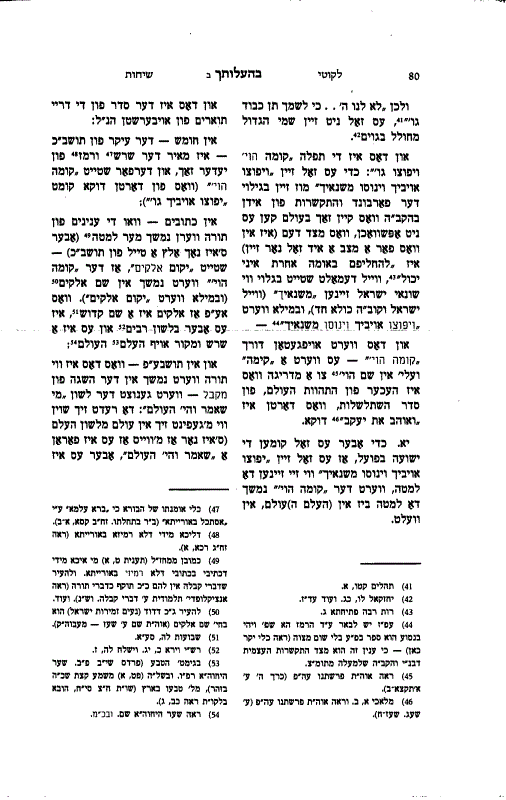
ונעיף דם אז מסענכו אילו סויני ישראל מסענכו מין סויני ישראל מוז ראשי ברנגן ערעיה פעם פוסק ראשי צריך אבידנס לפוסק לדבר שמסענכו מין זה לא ישם זה ידן שנאמר מסענכו נוס רוש מי שאותו נוס רוש ומי הם אל עמכי רימוס סויד דפון זדמן בגלל אז ון ור זיינה מסענכו ומי הם מי הם דיווס אל עמכי רימוס סויד מי שמסענכו אל ידן אז זה נהיה הסינא מהי ידן מין מסענכו זה לא יכול להציג את מסענכו אבל זה יסינא את יד מהי מסענכו זה ותכף ושתנתי את התאם של השוני ללוי אל השוני בין פירוש ראשי ופירוש ראשי ופירוש ראשי וקמחו התחלת הלגה בין ראשי וקמחו בפוסק קמחו איזה ראשי נית אישן צו זוגן ראשי זה לא אמר לך אז קמחו בכלל זה מבונן עם הקומי מאלי ישראל שאלה שמסענכו בגלל צריך להיות בגלל שהם מסענקו את ידן זה לא מה ראשי מנסה להגיד לך בגלל שאתה יכול לסענק בגלל שאתה יכול לסענק ראשי לא מנסה להגיד לך שאיפה שקומחו שם זה בגלל שהם מסענקים בגלל שאתה אמר לי שיש קומחו ויכול להיות שיש קומחו קומחו קומחו קומחו ראשי רוצה למביר סענק קומחו ולדעתו מה זה אומר לכם שחזקו ראשי [...] ולדעתו שם שלי שם שם שם שם שם שם ראשי ראשי ראשי ראשי שם שם שם שמי אדמה גדול שלך אדמה את הדברים נגדך ראשית ראש ירפה מהנושא הכל מלווים מי שצריך להתעלם על ישראל איפה נמצא כדי להתעלם על ישראל רק לתעלם על ישראל אתם עדיין בקטגוריה להתעלם על ה' ראשי שם שם זה רק דוגמא ראשי שם שם שם שם כי לא יש שייכס למסנכו למשה ולריבה ברנטרה ראי אשן נמר ומסנכו ראש וראש ומיהם הוא מסנכו על עם חיילים וסוי כנעל כמו שאמרנו יוד מייני של תוירה שבפירוש ראשי מהווין של תוירה האסוטריק חלק של תוירה שבפירוש ראשי סכמתרית כמו ומסנכו ומפנכו סימלר לפסק הזה אייך זה פסק בטילם סימלר בטילם יוקום אליקים ומסנכו ומפנכו אליקים ואיזה שתיים ום [...] ומסנכו ום [...] ным ום [...] וום [...] וום
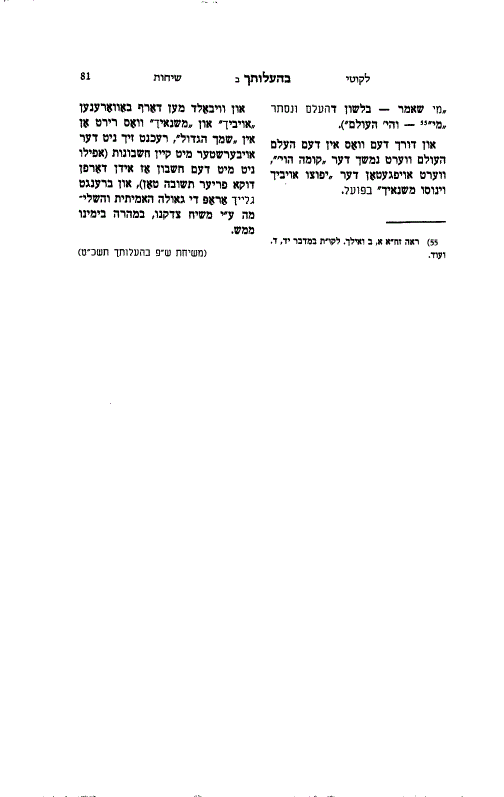
The Rebbe now turns to a deeper layer: even though these verses appear in Torah Shebiksav—the Written Torah—they also have an esoteric dimension alluded to by Rashi’s wording and parallel verses in Tehillim (“yokum Elokim… misanav…”). The use of God’s name Elokim (a plural form) hints at divine concealment and multiplicity within creation; this name represents how godliness descends into a world where opposition can exist.
In Torah Shebaal Peh—the Oral Torah—this concept becomes more accessible: we speak about “Mi she’amar v’haya ha’olam,” the One who spoke and brought the world into being. Even within this obscured world (“olam,” related to he’elem—concealment), we recognize that everything ultimately stems from Hashem’s word.
Through our awareness that there is One Who created everything—even within concealment—we accomplish the scattering of enemies and haters in actuality. This awareness empowers us not to be intimidated by opposition or delay redemption with calculations about whether we deserve it or need more teshuvah first. Instead, invoking Hashem’s great name brings immediate joy and salvation beyond measure.
This leads directly to geulah—the complete redemption through Mashiach Tzidkeinu—speedily and truly in our days.
Key Points
1. The Rebbe highlights the precision of Rashi’s commentary on the verse “Vayehi binsoa ha’aron,” focusing on the distinction between “oyvecha” (your enemies) and “mesanecha” (those who hate You), and how every word in Rashi is deliberate and meaningful.
2. Rashi distinguishes between two types of adversaries: “oyvecha” refers to those who are gathered against Israel but not actively pursuing, while “mesanecha” refers to those who are actively chasing and seeking harm, indicating a deeper level of animosity.
3. The Rebbe analyzes why Rashi uses the term “elu” (“these are”) only for “mesanecha,” showing that this subtle difference reflects a significant interpretive choice, emphasizing the unique nature of hatred as opposed to mere enmity.
4. Rashi clarifies that hatred toward Jews is equated with hatred toward Hashem Himself, citing scriptural proof that those who hate Israel are considered haters of God, and explaining why this point is made specifically regarding “mesanecha.”
5. The Rebbe rejects alternative explanations that would interpret “oyvecha” as simply those whom Hashem hates, demonstrating that both terms refer to adversaries of Israel, but with different levels of hostility and motivation.
6. A key insight is that while an enemy (“oyev”) acts out of revealed opposition, a hater (“soynei”) harbors deep-seated animosity rooted in the heart, constantly seeking opportunities to harm—this distinction underlies Rashi’s nuanced language in his commentary.
7. The verb “viyafutzu” (to scatter) in the verse indicates that the enemies are currently assembled together; it is not their identity as enemies but their collective state that requires dispersal, according to Rashi’s careful reading.
8. The Rebbe explains that it is implausible for a human to harbor such intense hatred toward Hashem directly; therefore, Rashi interprets “mesanecha” as referring specifically to haters of Israel, whose animosity is so profound it becomes part of their very being.
9. Scriptural examples and Chazal illustrate the difference between external enemies and internal haters, with Rashi bringing proof texts to support his interpretation and clarify these categories within the Torah’s language.
10. On a deeper level, the Rebbe connects these distinctions to pnimius haTorah: recognizing Hashem as “Mi she’amar v’haya ha’olam” even within concealment empowers us to overcome opposition and hasten redemption through invoking divine unity and awareness in our world.