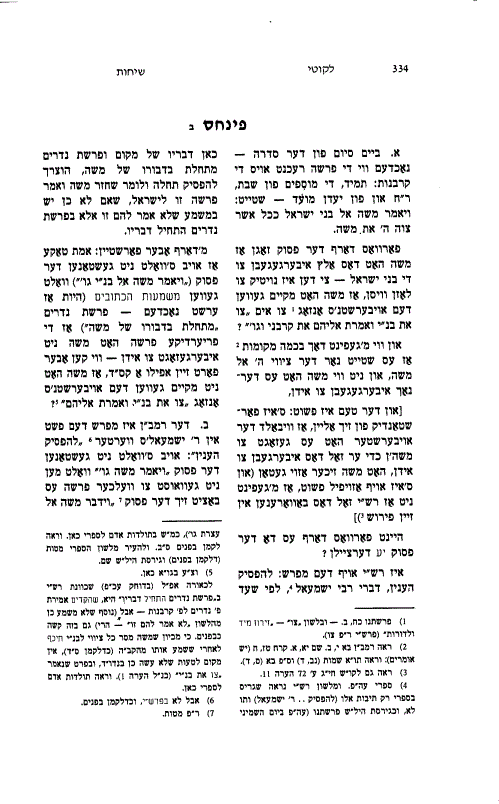
At the conclusion of the section describing the festival offerings (at the end of Parshas Pinchas), the Torah states:
"Moshe spoke to the Children of Israel all that Hashem had commanded Moshe."
Rashi comments:
"To mark a break in the subject—these are the words of Rabbi Yishmael. Until this point, the Torah records the words spoken by Hashem. The section of vows begins with words spoken by Moshe. Therefore, the Torah first interrupts the narrative to tell us that Moshe repeated this section to the Jewish people. Otherwise, one might think that he did not tell them this section."
This requires explanation.
Why would anyone assume that Moshe did not teach this section to the Jewish people?
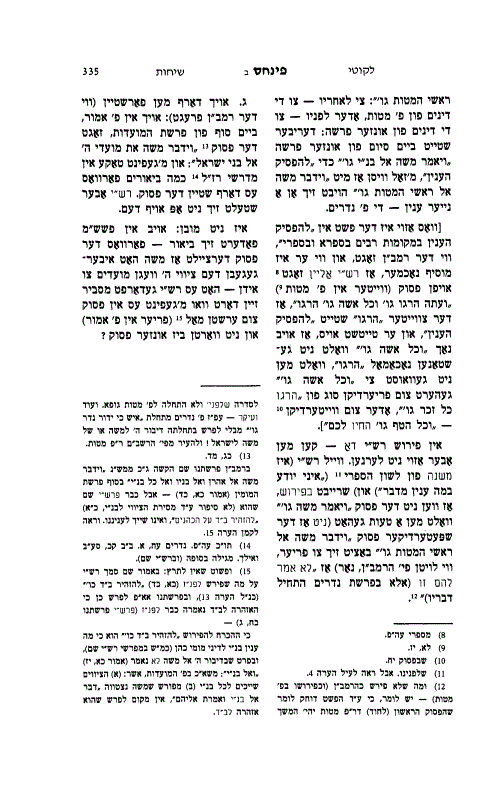
Furthermore, at the end of the festivals in Parshas Emor the Torah similarly states:
"Moshe declared the appointed festivals of Hashem to the Children of Israel."
There, Rashi offers no explanation. If this wording required clarification, why did Rashi not explain it the first time?
The explanation is as follows.
In Parshas Emor, one might have thought that Moshe did not immediately teach these laws to the Jewish people, since they were not yet immediately relevant. At that time many other urgent commands had to be conveyed, such as the construction of the Mishkan and the census of the Jewish people.
Therefore, the Torah explicitly states that Moshe indeed communicated these laws to Israel.
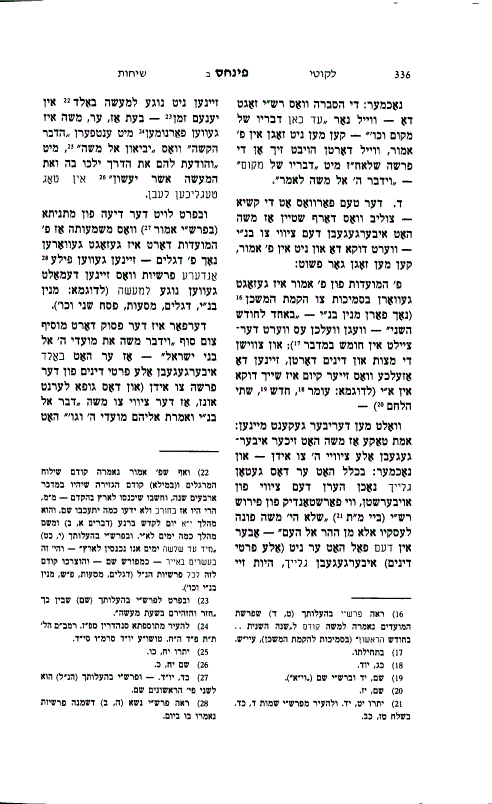
In our parashah, however, this explanation does not suffice.
What reason would there be to think that Moshe delayed teaching these commandments?
Therefore, Rashi explains:
"To mark a break in the subject"—these are the words of Rabbi Yishmael.
This question arises specifically according to Rabbi Yishmael.
Rabbi Yishmael maintains that the general principles of the mitzvos were given at Sinai, while many of the details were taught later in the Tent of Meeting. According to this view, details were recorded where they were actually taught, and Moshe sometimes delayed teaching them until the appropriate time.
Rabbi Akiva, however, holds that both the general principles and the details were taught at Sinai, repeated in the Tent of Meeting, and taught again in the Plains of Moav. According to his opinion, Moshe taught even laws that were not yet immediately relevant.
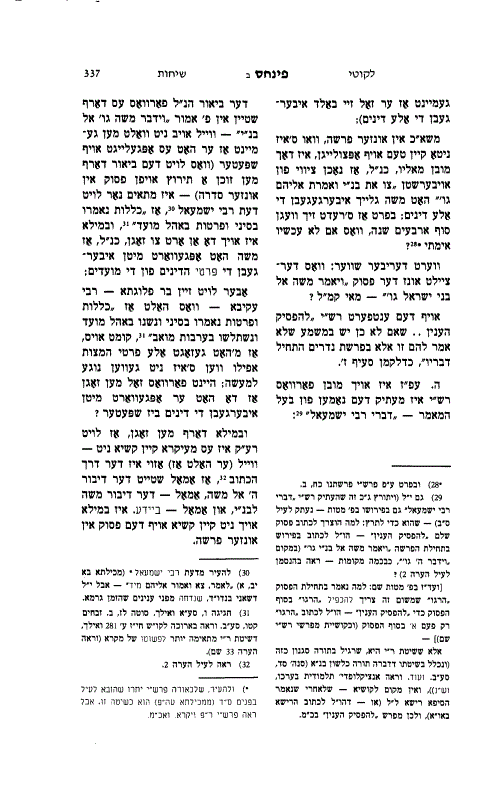
Accordingly, in Parshas Emor, Rabbi Yishmael could have thought that Moshe postponed teaching certain details, and therefore the Torah emphasizes that he did teach them.
Here, however, even according to Rabbi Yishmael, it is difficult to understand why anyone would think Moshe delayed teaching this section.
That is why Rashi explains that the verse serves to separate one topic from the next, marking the transition from Hashem's speech to Moshe's.
A further explanation emerges from the wording of the Torah.
Had the Torah stated only:
"Moshe spoke to the heads of the tribes..."
one might have assumed that the festival offerings in Parshas Pinchas were originally given together with those in Parshas Emor.
Moshe would then have taught the Jewish people only the section in Emor, since that was immediately relevant—the prohibitions of labor and the general obligation of the festival offerings.
The additional details found in Parshas Pinchas might have been viewed as instructions intended primarily for the priests and therefore not yet communicated to the nation.
Indeed, the phrase "Command the Children of Israel" could have been understood as referring only to the general concepts already taught in Emor.
Therefore, the Torah concludes:
"Moshe spoke to the Children of Israel all that Hashem had commanded Moshe."
This teaches that Moshe also conveyed all the detailed festival offerings recorded in Parshas Pinchas.
Accordingly, it can be understood that the offerings listed in Parshas Pinchas were given here as a separate communication and were not delivered together with the section in Parshas Emor.
A Further Insight
There is another significant difference between the two festival sections.
In Parshas Emor, the Torah uses the expression "Vayedaber" ("He spoke"), a firm form of speech.
This is appropriate because the prohibitions against performing labor on the festivals apply everywhere and at all times, and Hashem demands that the Jewish people observe them faithfully.
In Parshas Pinchas, however, the Torah begins with "Vayomer" ("He said"), a gentler expression.
Here the emphasis is on the sacrificial offerings.
In a deeper sense, it is now the Jewish people who plead with Hashem:
"May the Beis HaMikdash be rebuilt speedily in our days."
Until that happens, Hashem gently asks the Jewish people to occupy themselves with the study of the laws of the offerings, for the study of these laws serves as a substitute for bringing the sacrifices themselves.