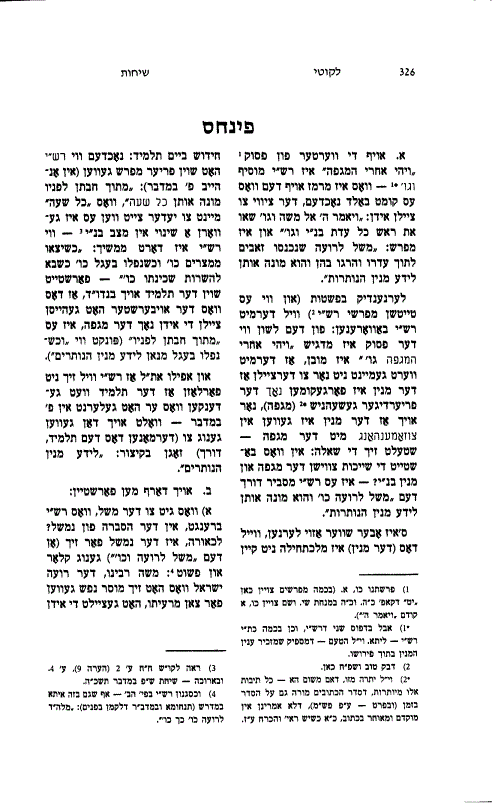
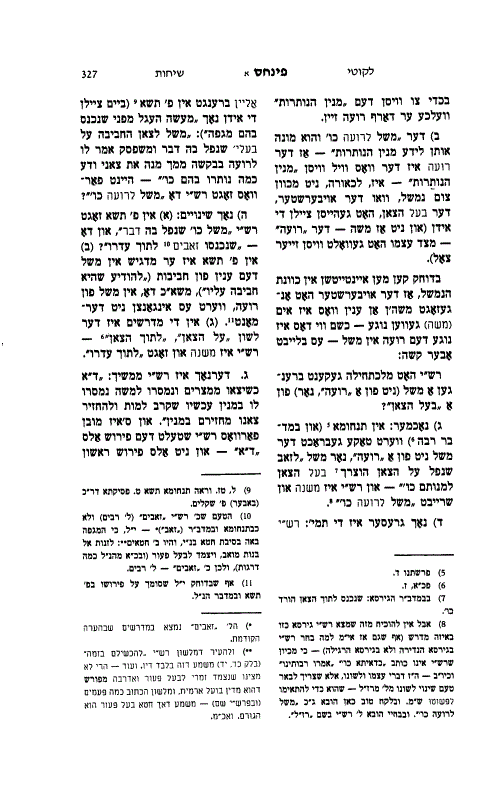
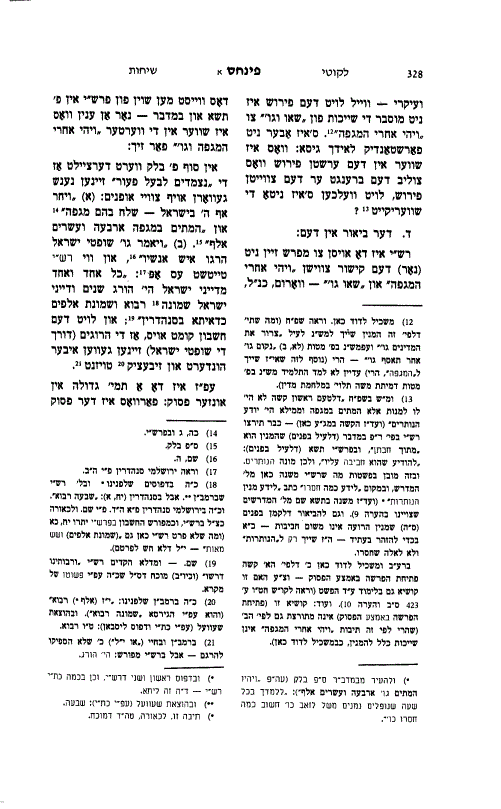
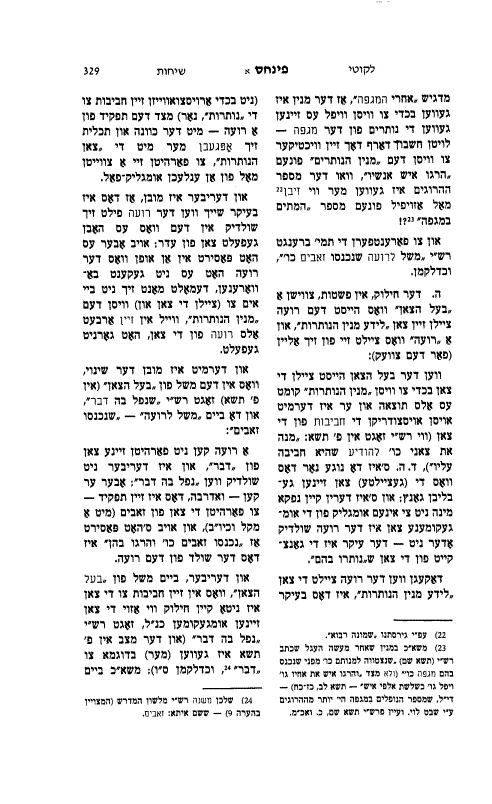
On the verse, "It came to pass after the plague..." (Numbers 26:1), Rashi comments:
"This may be compared to a shepherd whose flock was attacked by wolves, killing some of the sheep. He counts them to know how many remain.
Another explanation: When they left Egypt they were entrusted to Moshe by number. Now that he was approaching his death and was about to return Hashem's flock, he returned them by number."
This requires explanation.
Why does Rashi not suffice with the explanation he gave regarding the previous censuses—that Hashem counted the Jewish people because of His love for them?
What additional point is conveyed by the parable of the shepherd?
And what difficulty with the first explanation compels Rashi to bring a second one?
The explanation is as follows.
Rashi is addressing why the Torah specifically introduces this census with the words:
"It came to pass after the plague."
This teaches that the census is connected specifically to those who died in the plague, rather than to those executed by the judges of Israel. In fact, more people were executed by the judges than died in the plague, for twenty-four thousand died in the plague, while the judges executed over one hundred and seventy thousand, as Rashi explains later (28:5).
Therefore, Rashi uses the analogy of a shepherd, rather than the owner of the flock—as he does in Parshas Ki Sisa.
When a shepherd counts his sheep after an attack, he does so in order to learn how to guard the flock more effectively in the future.
This lesson applies only when wolves attacked the flock, something the shepherd might have prevented, unlike the case in Ki Sisa, where Rashi compares it to a plague that struck the flock.
Accordingly, the verse is not referring to those executed by the judges, who acted according to Torah law. Rather, it refers specifically to those who died in the plague that followed Zimri's sin, when Moshe momentarily forgot the law and Pinchas recalled it.
However, this explanation raises a difficulty.
The census took place at the end of the forty years in the wilderness. If its purpose was to teach the shepherd how to guard the flock better in the future, why was it conducted only by Moshe rather than jointly by Moshe and Yehoshua, who would soon lead the people?
Therefore, Rashi offers a second explanation.
Moshe was about to complete his mission and return Hashem's flock. Just as he had received them by number when they left Egypt, he now returned them by number before his passing.
The difficulty with this second explanation, however, is that it does not explain why the Torah emphasizes, "after the plague."
One further question remains.
Why does Rashi not explain this census, as in earlier censuses, as an expression of Hashem's love for the Jewish people?
The explanation is that the sin involved here was one of immorality.
"The G‑d of these people hates immorality."
Therefore, the emphasis here is not on expressing affection.
Moreover, the Torah teaches that one who cohabits with a non-Jewish woman severs his connection to the Jewish people, to the extent that his child is not regarded as continuing his Jewish lineage. In that sense, he has removed souls from among Israel.
Consequently, with respect to Hashem's special affection for His flock, such individuals are considered outside the flock itself. The remaining Jews are therefore counted as "those who remain," having no connection, in this sense, to those who were lost through the sin.
The Lesson
Despite everything, Moshe still counts these Jews in order to know how to guide and care for them.
This teaches us how far one must go to bring every Jew into Hashem's flock.
Even those who have become distant should never be given up on. Rather, we must do everything possible to help them return and once again become part of His cherished flock.