
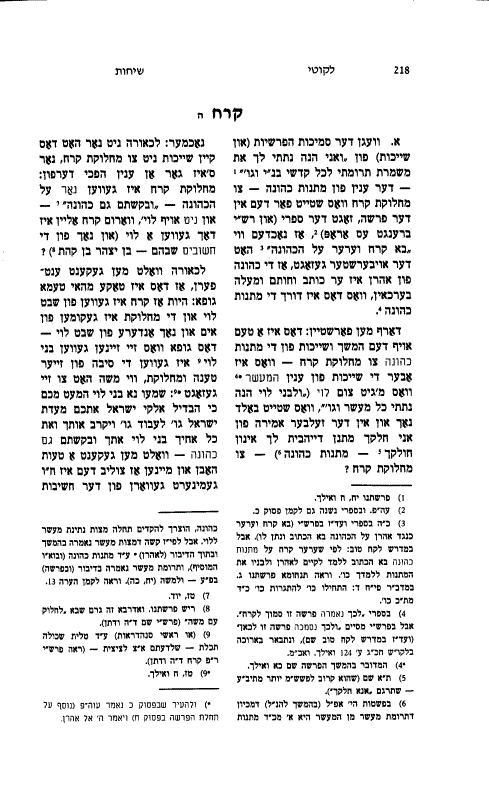
The juxtaposition and connection between the verses "And behold, I have given you the charge of My offerings, all the holy things of the children of Israel, etc." and the gifts of the priesthood to the rebellion of Korach, which precedes this in the parsha, is noted by the Sifri (and Rashi brings it down). "Korach came and disputed the priesthood," and the Holy One, blessed be He, said, "By your life, I will write and seal the priesthood of Aaron through the gifts of the priesthood."
We need to understand the reason for the continuation and connection of the gifts of the priesthood to the rebellion of Korach. What is the connection to the verse "And to the sons of Levi, behold, I have given all the tithes," which appears immediately after and in the same statement as "I am your portion and your inheritance among the children of Israel"? The gifts of the priesthood seem to be unrelated.
Seemingly, this has no connection to the rebellion of Korach, and is even contrary to it. The rebellion of Korach was against the priesthood, as it is written, "And you seek the priesthood also," and not against the Levites, for Korach himself was a Levite (and one of the most distinguished among them — the son of Yitzhar, the son of Kehat). One might have thought to answer that this is precisely the reason: since Korach was from the tribe of Levi and the rebellion came from him and others from the tribe of Levi, the fact that they were from the tribe of Levi was the reason for their complaint and rebellion. As Moshe said to them, "Hear now, O sons of Levi: Is it too little for you that the G‑d of Israel has separated you from the congregation of Israel to bring you near to Himself to perform the service of the Tabernacle of the L‑rd and to stand before the congregation to minister to them? And He has brought you near, and all your brethren, the sons of Levi, with you, and you seek the priesthood also?" One might have mistakenly thought that because of this, G‑d forbid, the role and function of the tribe of Levi were diminished.
Therefore, the Holy One, blessed be He, commanded regarding the gifts of the priesthood and also instructed to give tithes to the sons of Levi, etc., which teaches us that the sons of Levi retained their importance. However, it is difficult to say this, because from the fact that the Torah states the matter of tithes immediately after the gifts of the priesthood, and moreover with a connecting "vav" (and), it implies that the connection of the matter of tithes to the Levites to the rebellion of Korach is in the same manner and content as the connection of the gifts of the priesthood to the rebellion of Korach, namely, to emphasize from the outset the virtue of the Levites and not to negate their virtue.
Also, since all matters of the Torah are with utmost precision, we must say that the connection of the gifts of the priesthood and the Levites needs to be understood.
The dispute of Korach is not merely in a general sense (or the gifts of the priesthood are a sign to strengthen the priesthood of Aaron against any challenge), but rather the content of the gifts of the priesthood and the Levites has a connection to the dispute of Korach and provides an answer to Korach's claims.
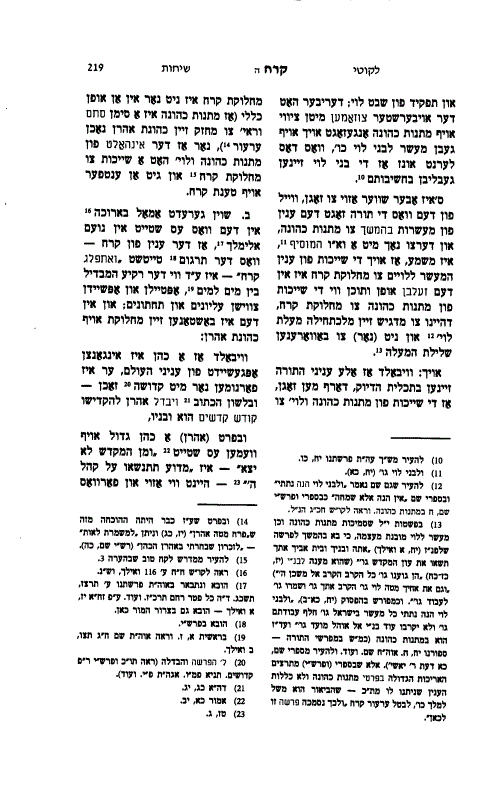
It has been discussed at length elsewhere regarding what is stated in the Midrash Tanchuma, that the matter of Korach — which the Targum translates as "and he separated" — is similar to the firmament that divides between the upper and lower waters, separating and distinguishing between the higher and lower realms. This was the essence of his dispute against the priesthood of Aaron.
For a Kohen is entirely separated from worldly matters, he is wholly occupied with holiness. As the verse states, "And Aaron was separated to sanctify him as holy of holies," and particularly Aaron, the High Priest, about whom it is said, "And he shall not leave the sanctuary." Therefore, "Why do you exalt yourselves above the congregation of the L‑rd?" should have an influence on the Jews (the congregation of the L‑rd), that they too should elevate themselves to be distinct from worldly matters, even though their service involves engaging with physical things and making them vessels for G‑dliness.
Therefore, their argument "Why do you exalt yourselves above the congregation of the L‑rd?" is not in contradiction to their own desire to be priests, because Korach wanted a different type of priesthood, one that has no connection with "the entire congregation." Just as we find in holiness that Shammai — due to his strictness — pushed away the builder, and Beit Shammai in the place of Beit Hillel is not considered a Mishnah, for their matter is in the manner of "and he who sets a way," weighing his ways. Another example: Rabbi Shimon bar Yochai and his colleagues — many tried to follow Rabbi Shimon bar Yochai and did not succeed, and Rabbi Elazar, his son, even after thirteen years in the cave, was still critical. This explains why the instruction regarding the gifts of the priesthood is connected to
Jews with priests — that Jews give their property to the priests (who are separated from worldly matters), meaning that they elevate their physical matters, they become gifts of the priesthood, to the extent that it is said about them, "I am your portion," as mentioned above, giving them to the Almighty.
This is seemingly not sufficient. Indeed, Korach fought against the priesthood, particularly against the priesthood of Aaron, but his intention (and the definition of priesthood) was that there should be a connection only in the manner of separation, that there should be no connection between the "lower" — the world — and the "upper" — holiness and G‑dliness. Accordingly, it would seem that the rectification should have been in a manner where the matters of the world are entirely given over to the Almighty (a complete connection of upper and lower — a worldly matter becomes entirely holy) — like sacrifices that are offered on the altar for the Almighty, they are entirely holy. But not the gifts of the priesthood in general, which...
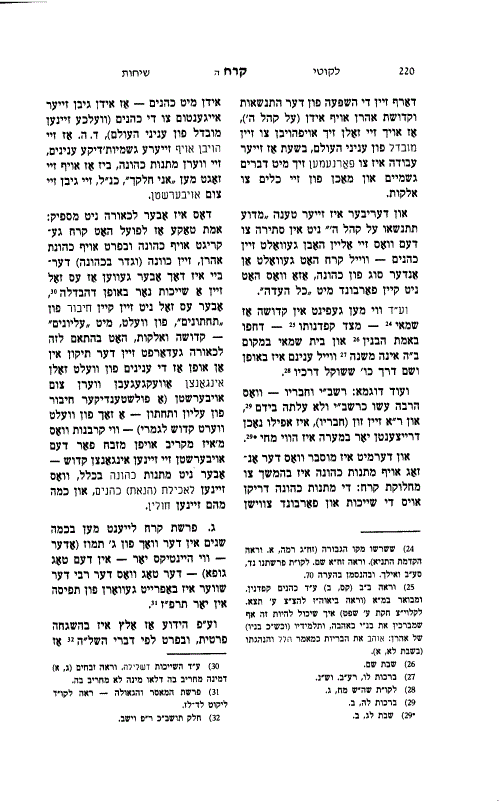
All festivals are alluded to in the Torah portions that are read during the relevant time, so it is understood that the content of the day has a connection to the content of Parshas Korach. According to the aforementioned explanation of the matter of Korach's dispute, one can seemingly explain the connection simply: Just as Korach challenged the concept of the priesthood itself — that priests are separated from worldly matters — his dispute was, as mentioned above, about the fact that they impart this holiness to "the entire congregation."
Similarly, there was also opposition and persecution from those who opposed the Rebbe: what disturbed them (which led to the Rebbe's arrest) was not his personal observance of Torah and mitzvos, but his work in spreading Torah "throughout our entire country" among all Jews who were there at that time.
The (full) liberation of the Rebbe (more than just liberation from imprisonment) because he was then exiled to Kostrama, where he could continue his work of spreading Torah properly — this only came later on the twelfth of Tammuz (and even then there were still difficulties until he left that country).
We must say that the similarity between the Rebbe's redemption and the matter of the gifts of the priesthood and the priesthood of Aaron is connected with the part of the redemption where he was still (at least externally) within the limitations of exile by those who had arrested him.
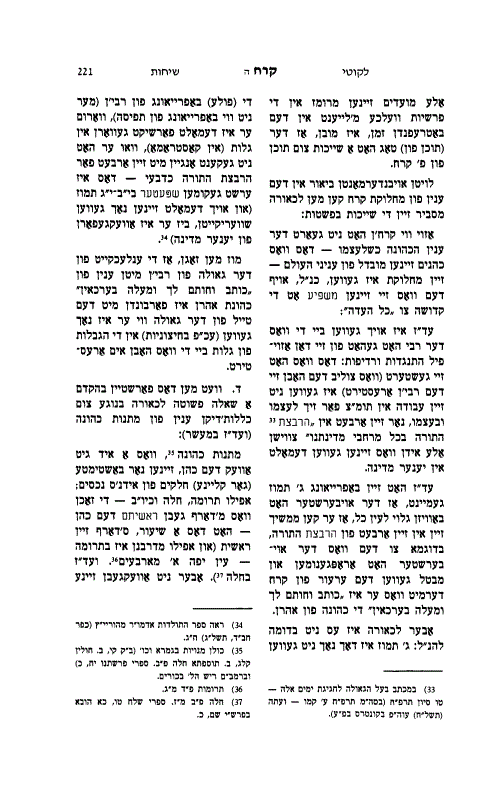
This will be understood by first addressing a simple question regarding the general matter of the gifts of the priesthood (and also tithes): The gifts of the priesthood, which a Jew gives to the priest, are only specific portions. For example, the terumah must be a recognizable measure, and similarly with tithes — it is a tenth of his fruits and produce.
Seemingly, while it is understandable why there is a minimum measure — that one should not give less than the required amount — why is there a maximum measure? Why is one not allowed to dedicate and sanctify all his possessions to the Almighty (and in some cases, not even more than the specified measure)? To the extent that the Rambam rules: "A person should never consecrate or devote all his possessions, and whoever does so acts contrary to the intention of the Torah," but rather, "whoever distributes his money for mitzvos should not spend more than a fifth."
The explanation of all the above: It is explained in Chassidus the difference between priests and Levites, that a priest is characterized by "a man of kindness," and the nature of Levites is...
...strength. And Korach (who was a Levite) sought, through his dispute over the priesthood of Aaron, to elevate his own attribute of strength over kindness, or that the Levites should replace the priests.
In the service of man, the distinction between kindness and strength is as follows: Kindness involves influence from above to below — "return" into the world, while strength involves elevation from below to above — "yearning" (a departure from the world).
The root of Korach's argument was that the primary focus should be on the attribute of strength, the service of yearning and ascent. Korach believed that the lower realms, as they exist in their own reality, are not vessels for G‑dliness, and therefore, they must engage in yearning — to depart from their current state and ascend to G‑dliness.
This does not contradict what was previously discussed (and explained elsewhere) that Korach's dispute was about the priests (and specifically...
In his essence, he therefore acts in such a way that the movement of elevation in a Jew is such that he departs from below, to the extent that the below in its state becomes a vessel for G‑dliness, as in "All your deeds (your actions) should be for the sake of Heaven," "In all your ways (your paths) know Him."
And for this reason, the refutation or correction of Korach's dispute is not through sacrifices and holy offerings, which are given entirely to the Almighty, and are offered on the altar, but through the concept of the gifts of the priesthood.
In the offering of sacrifices (and in general, the concept of holy offerings, where a Jew sanctifies his possessions to the L‑rd), it is not evident that all lower, physical things become vessels for G‑dliness, because the sacrifices indeed depart from the mundane, from their connection to the person below, and become a holy matter — they are offered on the altar.
However, with the gifts of the priesthood, which a person gives from his possessions...
But even with the gifts of the priesthood, it is not completely and perfectly emphasized that also lower things, as they are in their "below" state, become connected with G‑dliness — because:
a) Most of the gifts of the priesthood, the ten in the Temple and four in Jerusalem, become holy first, and only afterward comes the obligation to give them to the priest, and the priests derive benefit from the "table of the Most High." Similarly, with terumah, first fruits, and challah, there is first the act of lifting and giving to the L‑rd, and only afterward comes the giving to the priest, as the verse emphasizes in our portion: "The first of them, which they give to the L‑rd, I have given to you," "The first of all that is in their land, which they bring to the L‑rd, shall be yours," "You shall give the L‑rd's terumah," and even with the redemption of the firstborn, there is first "acquisition of the name" and only afterward is it given to the priest.
b) Even the remaining gifts — from the ten outside the borders, they are still...
The gifts of the priesthood, such as the foreleg, the cheeks, and the maw, as well as the field of possession and the field of the devoted, are discussed explicitly in our portion. These gifts are connected with the act of Pinchas, which occurred later, and therefore, the matter of the tithe to the Levites is also mentioned in continuation in the portion. This is because: a) Only after separating and giving the tithe to the Levite does it remain completely mundane, with no sanctity at all, and it is permitted to non-priests. b) It is not a specific portion that belongs to the Levite before the separation from the Jew.
This further emphasizes that even a reality that is still completely mundane, truly "below," is also connected with the Divine, as it is given to the Levite, for "the L‑rd is his inheritance."
One of the arguments with which Korach began his dispute against the priesthood of Aaron was: "A garment that is entirely techeiles, is it exempt from tzitzis?" Chassidus explains his argument: the concept of a garment (a covering) entirely of techeiles indicates a surrounding light, and such a concept of a surrounding light does not require tzitzis (threads that extend from it) — an internalization. With this, he wanted to express his dispute against the priesthood of Aaron, as explained in Chassidus elsewhere.
In the service of G‑d, this subtly means: when the work of refining the reality of a Jew comes from the drawing of light from above, given by the person working from below to above — even though he becomes united with G‑dliness, since it comes from above, it remains a surrounding light concerning his reality — lacking internalization, which occurs from his own reality. And even though subtly, this is also the...
The second way of "the L‑rd is one" (in the manner of drawing down) from above to below is where G‑dliness spreads and is clothed in every detail, meaning there is a reality of the world, but the reality itself is G‑dliness. This level of unity calls for service (not to separate from the world, but on the contrary): to engage with physical things — he derives pleasure from the physical thing, but the pleasure is a G‑dly pleasure.
However, even this unity, although it is with a physical thing, perceives it as separate entities that have united — G‑dliness and the physical thing. From the unity of the higher unity and the lower unity, it is felt how the physical reality and its...
When arriving there, it was organized to gather the children and establish a cheder, repair the mikveh, and deliver Chassidus there, etc. This expressed that even the lowest realms, as they stand in their most degraded form (still in exile), agree to the dissemination of Torah and Judaism from the Rebbe. This is similar to the ultimate rectification that removed and nullified the dispute of Korach, where the physical things, as they exist in their reality from the lowest realms, are in their essence G‑dliness.
And as the Rebbe, of blessed memory, said, these three matters (which nullified and rectified the dispute of Korach) are generally hinted at in the Torah that the Rebbe said upon leaving imprisonment, before departing for Kastroma. We recite, "May the L‑rd, our G‑d, be with us..." Regarding the name Havayah, it means that the L‑rd is above and beyond having any connection to the world. Therefore, it is necessary to add and inform them that He is "with us," which corresponds to the name Elokim, meaning He is "strong and mighty, who has the ability in the upper and lower realms," or "our G‑d," implying that the L‑rd is our strength and vitality. If the L‑rd is indeed with us, it seems unnecessary to add the word "with us," as it should have simply stated, "May the L‑rd be with us."
Furthermore, "May the L‑rd be with us" is incomparably greater than "He will not abandon us nor forsake us." The Rebbe dared to say, even though we are not like our forefathers, who were truly willing to sacrifice themselves for Torah and mitzvos. It seems that for the Rebbe, there were times when the concept of mesiras nefesh (self-sacrifice) was present.
The redemption for all Jews, even for those who are merely "called by the name Israel," and therefore he specifically brought the verse, "May the L‑rd, our G‑d, be with us," with the addition, "even though we are not like our forefathers." This means that even Jews who are not like our forefathers (where there is no actual mesiras nefesh for Torah and mitzvos) should have "the L‑rd, our G‑d, with us as He was with our forefathers."
According to the above, since the Rebbe sought to bring about redemption even for those who are merely "called by the name Israel," regardless of their level in observing Torah and mitzvos, one can say that with the addition, "even though we are not like our forefathers," the Rebbe intended to hint at the interpretation of the Midrash: "And so Solomon says before the Holy One, blessed be He, a king who hires workers and they perform their work well, and he gives them their reward, what praise is there for the king? And when is he praised? When he hires bad workers who do not perform their work and he gives them their reward, this is a great goodness." And in this manner, "May..."
...the person and his revealed strength and vitality is G‑dliness.
b) "May the L‑rd, our G‑d, be with us" — the person is like a separate entity, a stranger. The Almighty is "with him": the very fact that "our G‑d is with us" is proof that he is connected with G‑dliness.
c) "He will not abandon us nor forsake us" — to affect even those Jews who are truly in the category of "the lowest," yet are "called by the name Israel" — even though it does not appear that they have any connection to G‑dliness. The Rebbe added, "as He was with our forefathers, even though we are not like our forefathers," intending to hint at the interpretation of the Midrash mentioned earlier. With this, he achieved that even among the "bad workers," there should be at least the feeling of "He will not abandon us nor forsake us" — that even in their state, they should not feel, G‑d forbid, separated and abandoned by the Almighty.
In their visible and revealed existence, they are connected to G‑dliness. No matter what level a Jew finds himself in, his true and inner existence is G‑dliness. In the words of the Rebbe: Every Jew (regardless of his personal state in observing and fulfilling the mitzvos) has a heart that is whole with G‑d and His Torah.
This also affected the "lowest" of the world, even those who arrested him, so that even in their state and condition, they agreed to the spreading of the Rebbe's Torah, to the point that they helped in his release and redemption in the literal sense.
Since these days are remembered and reenacted, everyone and all — "with us" — receive the directive and empowerment from the 3rd of Tammuz not to be affected by obstacles and hindrances in spreading Torah and Judaism. We also have the assurance (as the second interpretation of "He will not abandon us nor forsake us") that it will be fulfilled that "May the L‑rd, our G‑d, be with us as He was..."