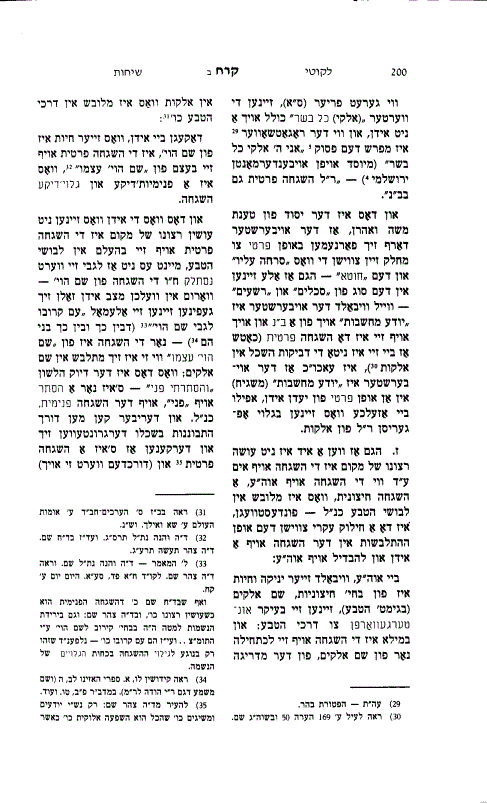
The current Torah portion tells us that the L‑rd said to Moshe and Aharon, "Separate yourselves from among this congregation, that I may consume them in a moment." They responded to the L‑rd, "O G‑d, the G‑d of the spirits of all flesh, shall one man sin, and will You be angry with the entire congregation?"
The reason why, before presenting their argument, "Shall one man sin, and will You be angry with the entire congregation?" they prefaced with the words, "O G‑d, the G‑d of the spirits of all flesh," is explained in Rashi. Rashi interprets "the G‑d of the spirits" to mean "the One who knows thoughts." Since "all thoughts are revealed before You, and You know who the sinner is, it is one man who has sinned, and You are angry with the entire congregation," the Holy One, blessed be He, said, "You have spoken well. I know and will make known who has sinned and who has not sinned."
However, it is not understood: What is the significance of emphasizing that the L‑rd is "the G‑d of the spirits of all flesh"? This phrase implies that He includes non-Jews as well, and since this is the case, it is difficult to understand the relevance of the L‑rd being "the One who knows thoughts" even of a non-Jew ("of all flesh") to the argument of "shall one man sin, and will You be angry with the entire congregation (of Jews)?"
This preface and emphasis on "of all flesh" would seemingly be more fitting in the argument of Avraham Avinu regarding Sodom (which is similar to this matter): "Will You also destroy the righteous with the wicked?" There, it concerns non-Jews, yet it is not mentioned at all in Avraham Avinu's words (he only concluded with "Shall the Judge of all the earth not do justice?").
The explanation: The argument of Moshe and Aharon, in general, was based on the fact that the L‑rd, in His knowledge and specific providence, knows clearly who is the sinner. This explains that the congregation of Korach were not sinners with the intention of rebellion against the L‑rd; rather, they were enticed and drawn in by Korach. Therefore, they were not truly "sinners" but rather akin to "a part of the province has gone astray" — a minor deviation.
This was their argument: Since the L‑rd is the One who knows thoughts and distinguishes between a "sinner" and a "deviation," and the true sinner and rebel was indeed a single individual (one man sinned — "the man who sinned"), and he caused (and is therefore also responsible for) the deviation of the entire congregation, the L‑rd should also, regarding the punishment, differentiate between "deviation" and true rebellion, and punish only the true "sinner."
The explanation of this is as follows: It is known that there are two levels in the divine knowledge (and providence):
a) The knowledge (and providence) in the manner of "revealed and known" — this is through the process of enclothement, but "everything is revealed and known before Him, as a matter of course." Although this knowledge encompasses every detail, since it is above enclothement within creations and is removed from them, it encompasses all creations equally, and it is above being affected by, so to speak, the actions of the lower beings, or being influenced by differences in levels.
b) The knowledge (and providence) in the manner of "knowing" — where He, so to speak, engages in knowing — through the process of enclothement, and within this, there are distinctions in the manner of knowledge (and providence), corresponding to the level of each individual. From this knowledge specifically derives the concept of reward and punishment according to the actions of the lower beings.
This is why Rashi is precise in using "knows" (and not "known") — because here it is relevant to the specific knowledge and providence from which reward and punishment derive; and even more so: the knowledge in the manner of enclothement, of engaging in the specific matters of the congregation of Korach, to the point of "making known" who committed merely a "deviation" and "who is the sinner."
And as it is stated: "And I will hide My face from them, and they will be consumed by many evils and troubles, and they will say, 'Is it not because our G‑d is not among us that these evils have found us?'" This means: By Jews distancing themselves from the Almighty, they become "abandoned to chance," and the troubles come upon them as if by "finding" — as if on their own.
And since the providence over the wicked is different from that over the righteous — without specific providence, it is understandable that even when they are punished from above (not in the manner of "abandoned to chance," but it is clear that the punishment comes with providence from above, as in our case — "if the L‑rd creates a new creation"), the punishment and conduct with them is not in a specific manner, but rather in a general manner. This is what the Rambam writes there, that "the fools who rebel are arranged in the order of other species of animals, and because of this, it is easy to kill them."
According to this approach, the argument "G‑d of the spirits of all flesh, shall one man sin, and You be angry with the entire congregation?" is seemingly not understood.
However, in truth, there is no difficulty, and this will become clear according to what the Mitteler Rebbe explains. He clarifies that the Rambam's view, which suggests there is no providence over the wicked (and that they are abandoned), is not in contradiction to the Baal Shem Tov's teaching that there is divine providence over all creations. For in the higher providence, there are, generally, two types:
a) Inner providence: This is providence that is revealed, meaning it is not concealed or covered by the garments of nature. Regarding this type of providence, the Rambam states that it is dependent on a person's intellectual attachment to G‑dliness. For the wicked and the "species of animals," this specific providence does not exist — only a general manner.
b) External providence: This providence is clothed and hidden within the garments of nature and its forces, and this providence applies to all creations (in accordance with the Baal Shem Tov's approach). Thus, it follows that even according to this view, external providence, though concealed in the garments of nature, still means that every detail comes from the Almighty.
And this is not a contradiction to what is stated, "and many evils and troubles will find them," or as the Rambam interprets it, "they are abandoned to chance." Because even this conduct itself is with specific providence: "I will hide My face from them," it is not a removal of providence, but merely a concealment of the inner providence. Therefore, a person might delude themselves into thinking that their troubles are in a manner of "finding," as if it is "the way of the world" or "a chance occurrence." However, in truth, the higher providence is present even then over every single detail.
According to the above, the connection between the introduction "G‑d of the spirits of all flesh" and the argument "shall one man sin, and You be angry with the entire congregation?" is understood:
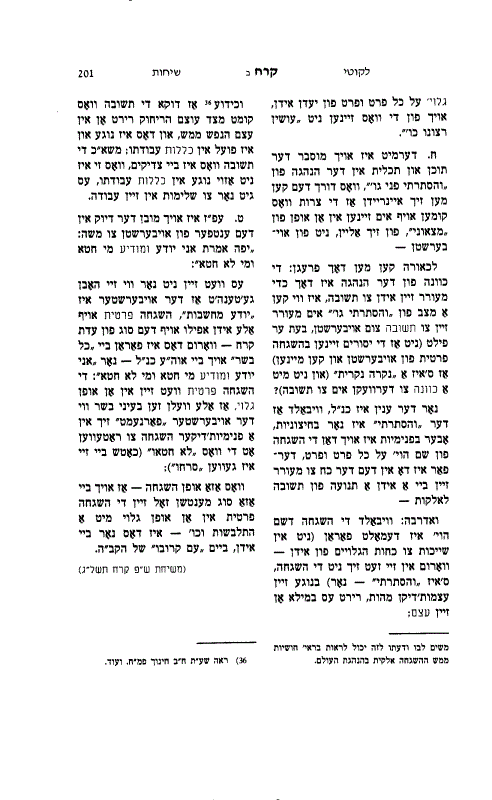
As discussed earlier, the words "(G‑d of) all flesh" include even non-Jews, and as the Rogatchover interprets the verse "I am the L‑rd, the G‑d of all flesh" (based on the aforementioned Jerusalem Talmud), it implies specific providence even over them. This is the foundation of the argument of Moshe and Aaron, that the Almighty should engage in a specific manner to distinguish between those who have "rebelled" and the "sinner" — even though they all fall into the category of "fools" and "wicked." Since the Almighty is "knower of thoughts," even of a non-Jew, and there is specific providence over them (even though there is no intellectual attachment to G‑dliness), it follows that the Almighty is "knower of thoughts" (provides) in a specific manner for every Jew, even those who are openly torn away, G‑d forbid, from G‑dliness.
Even though when a Jew is doing the will of the Omnipresent, the providence over them...
In contrast to the G‑dliness that is clothed within the natural order, for Jews, whose vitality comes from the name Havayah, the specific providence is essentially from the name Havayah itself. This is an internal and fervent providence. Even for those Jews who are not fulfilling the will of the Omnipresent, the specific providence over them is concealed within the garments of nature. This does not mean, G‑d forbid, that the providence from the name Havayah is divided regarding them. For in whatever state Jews find themselves, they are always close to the name Havayah (as it is said, "For what great nation is there that has G‑d so near to it"). The providence is from the name Havayah itself as it is clothed in the name Elokim. This is the precision of the expression "and I will surely hide My face" — it is indeed a concealment of the "face," the internal providence, as mentioned earlier. Therefore, through contemplation with one's intellect, one can reach and recognize that there is specific providence, and through this, it becomes revealed over every detail of every Jew, even those who are not fulfilling His will.
This also explains the content and purpose of the conduct of "and I will surely hide My face," through which one can prepare oneself for the troubles that come upon him, which are in a manner of "they have found me," from themselves, not from the first cause.
One might ask: The intention of this conduct is to awaken Jews to repentance, so how can a state of "and I will surely hide" awaken him to return to the Almighty when he feels (not that the sufferings are with specific providence from the Almighty and can think) that it is a mere coincidence (and not with the intention to awaken him to repentance)?
However, the matter is, as mentioned earlier, since the "and I will surely hide" is only external, but internally, there is still the providence from the name Havayah over every detail. Therefore, there is the power within this to awaken.
As it is known, the repentance that comes from the essence of distance touches the very essence of the soul itself, and this affects and influences his entire service. In contrast, the repentance of the righteous, which is not as impactful, only adds to the perfection of their service.
This also clarifies the precision and the response of the Almighty to Moshe: "You have spoken well; I know and make known who has sinned and who has not sinned." It will not only be as they argued that the Almighty is "knower of thoughts," with specific providence over all Jews, even over the type of Korach's congregation — for this exists with "all flesh," even with non-Jews, as mentioned earlier — but rather, "I know and make known who has sinned and who has not sinned." The specific providence will be in a revealed manner, so that all will see with physical eyes how the Almighty engages in an internal providence to save those who "have not sinned" (even though among them there was "corruption").