
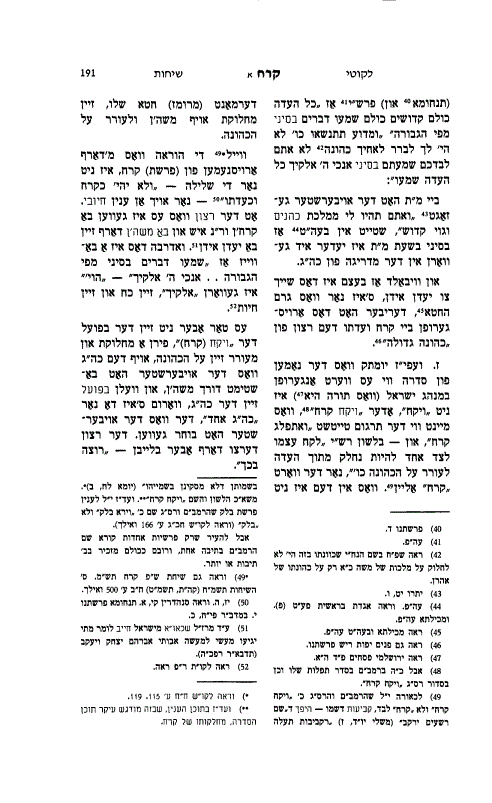
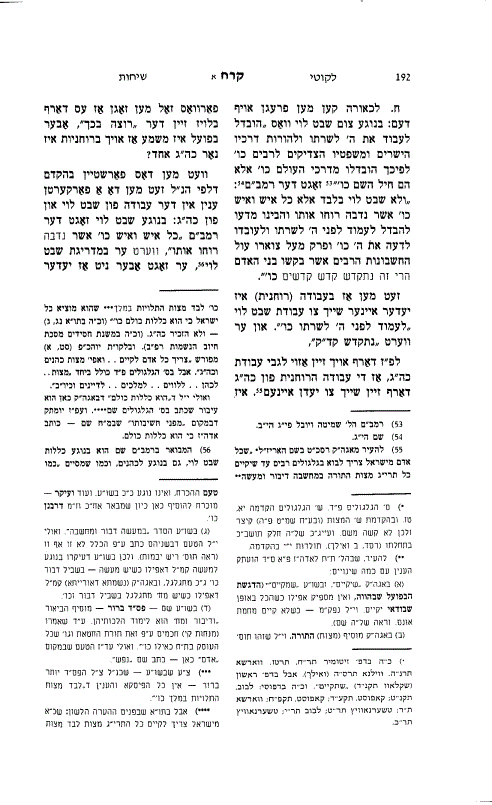
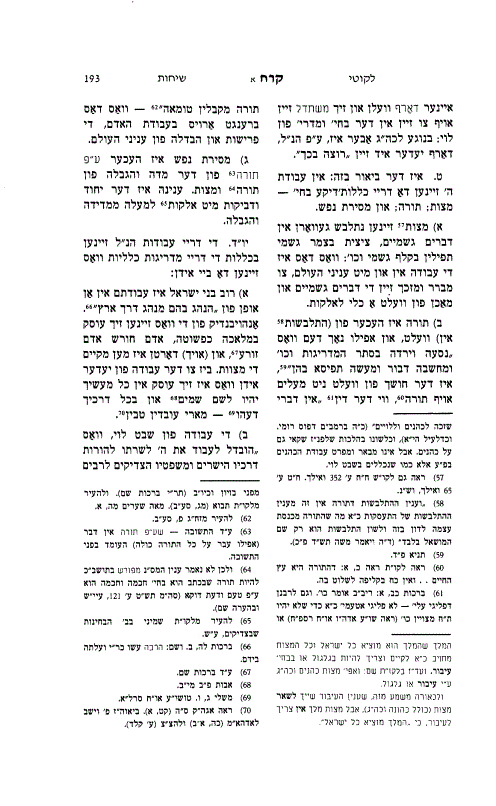
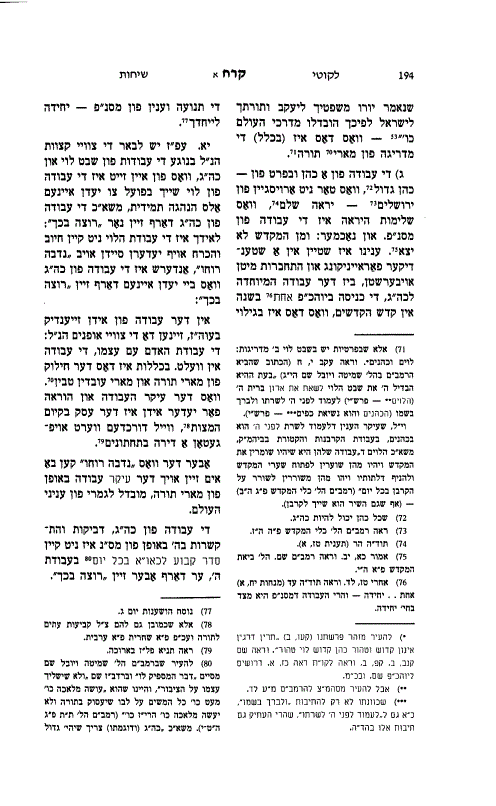
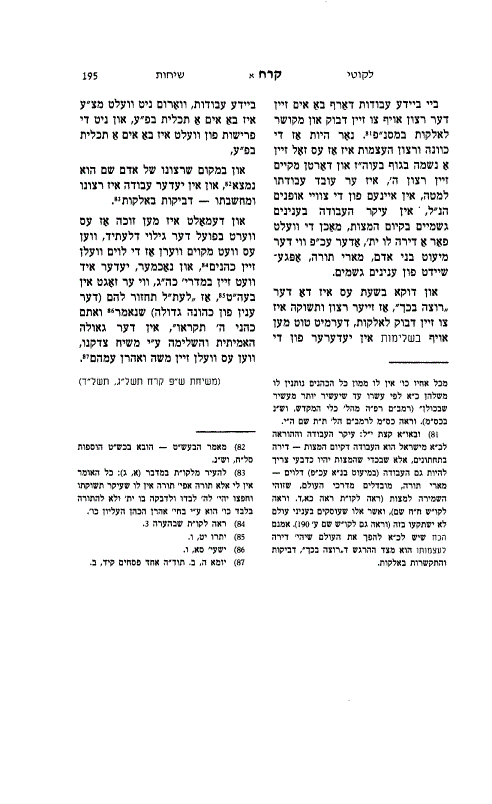
The four approaches of PaRDeS (Peshat, Remez, Derush, Sod) together form a complete Torah. This is emphasized in the language concerning Korach's dispute: in the inner dimension of the Torah, the greatness and lofty level of Korach and the elevated content of his argument are explained at length. It is clarified that his mistake was only in the fact that the Levites should become Kohanim, which will only occur in the future, unlike in the time of "today to do them," when such conduct is not possible.
In the plain meaning of the text, we learn throughout about this matter. Each part of the Torah has its specific rules. Nevertheless, an explanation is required: since these parts of the Torah correspond to the worlds, and one world evolves from the other, it must be that also in the part of Peshat, a certain aspect of Korach's greatness and his argument should emerge, even though this is elaborated in the inner dimension of the Torah.
This will be understood by first addressing some questions and clarifications in the simple meaning of the verses. How did the two hundred and fifty men agree to offer incense, when Moshe Rabbeinu tested them? They knew that offering incense was dangerous, as it had previously caused death. Why did they agree to this?
It is difficult to understand: the Torah commentators explain that these were the heads of the Sanhedrin, wise and understanding men. Why did they risk their lives? The Midrash states that Moshe told them, "Take your censers," indicating that Moshe was involved in this matter. What was the reason for this? It seems that Moshe was, so to speak, participating in this test, which raises questions about his intentions and the purpose of this test.
The explanation is as follows: As it is explicitly stated in the verse, the intention of Korach and his assembly was not to abolish the priesthood, but rather that they all should be priests (great ones) — "and you seek the priesthood as well." Based on this, in his dispute with Moshe, Korach did not deny that Moshe was the emissary of G‑d and that what he had done previously (including the priesthood) did not come from the Almighty. Rather, he held that regarding what Moshe had done by the word of G‑d, one could add or make changes.
Just as through prayer and supplication, one can beseech that the Almighty change and annul a decree, as was seen in the effect of Moshe's prayer after the sin of the Golden Calf, and after the sin of the spies, and so on — similarly, Korach held that one could influence the Almighty to take the high priesthood from Aaron and transfer it. Indeed, we find that previously the service of the priesthood belonged to the firstborn, and only later (due to their sin) was it taken from them and given to the tribe of Levi, Aaron and his sons.
Especially since there is a reason for this: Aaron had a certain connection to the sin of the Golden Calf (since the sin is the reason why the priesthood was transferred to the priests), whereas the Levites, the entire tribe of Levi (including Korach), were completely clean from this sin, and on the contrary — "all the sons of Levi" fought against those who sinned. And what Moshe accepted and said that Korach and his entire assembly were contending against him with the claim that "the L‑rd did not send me," was because "the man Moshe was very humble, more than any person on the face of the earth," and he held that the promise "and they will also believe in you forever" had not been fulfilled, due to which Jacob, his father, feared, "lest I have become sullied by sin."
Thus, it is understood regarding the two hundred and fifty men that they did not mean to contend against Moshe, but they wanted to be high priests, as Rashi emphasizes, "and you, two hundred and fifty men, seek the high priesthood," since Korach wanted to be the high priest himself in place of Aaron, and the two hundred and fifty men wanted all to be high priests in addition to Aaron the high priest.
What was the matter of their desire and request for the high priesthood? The Midrashim (and Rashi) add and explain that Moshe Rabbeinu said, "I also desire this," their desire to be a high priest was also Moshe's desire — it is a good and very lofty matter. Their desire for the high priesthood was not to have authority over the Jews, but because a high priest is indeed greater than all Israel, holy of holies, he is constantly "standing before the L‑rd to serve Him," thus they wanted to be holy of holies — in the aspect and level of a high priest.
And Moshe Rabbeinu answered them.
They were ready to perform the holy service of standing to serve before G‑d, even if only temporarily, as in the case of Nadav and Avihu. (Similar to the explanation regarding the high priests during the Second Temple period, where "each one did not complete his year," yet they still bribed to obtain the high priesthood.) This seems puzzling: since they saw that the previous high priest did not complete his year, and knowing their own level, that they too were not truly fit for it, why did they still push to become high priests? The explanation is that due to their great desire and longing to enter the Holy of Holies (on Yom Kippur), where the Divine Presence is revealed in a manifest way, it was worth it to them, even if it meant they would die as a result.
As the Midrash Tanchuma and Rashi explain, "All the congregation are holy, all of them heard the words at Sinai from the mouth of the Almighty," and "Why do you exalt yourselves?" It was not for you to choose the priesthood for your brother. Did you not hear at Sinai, "I am the L‑rd your G‑d," the entire congregation heard it. At that time, the Almighty said, "And you shall be to Me a kingdom of priests and a holy nation," as it is written in the Torah. At Sinai, during the giving of the Torah, every Jew was on the level of a high priest. And since this is inherently relevant to every Jew, it is only sin that caused otherwise. Therefore, this aroused in Korach and his assembly the desire for the high priesthood.
This also clarifies why the name of the parsha, as it is called in Jewish custom (which is Torah), is not "Vayikach," but "Vayikach Korach," which means, as the Targum translates, "And Korach separated himself," and — in the words of Rashi — "He took himself to one side to separate from the congregation to dispute the priesthood, etc." The word "Vayikach" itself hints at his sin of disputing Moshe and challenging the priesthood.
Because the lesson we must derive from Parshas Korach is not only the negative — "And not be like Korach and his assembly" — but also a positive aspect. The desire that was present in Korach and his assembly, and in every tribe, should be present in every Jew. On the contrary, this is a proof that they heard the words at Sinai from the mouth of the Almighty, "I am the L‑rd your G‑d," meaning He became their G‑d, their strength, and their vitality. However, it should not result in the actual "Vayikach Korach," leading a dispute or challenging the priesthood, which the Almighty appointed through Moshe, and who will actually be the high priest, because there is indeed only one high priest, the one whom the Almighty chose. Yet, the desire for it should remain — "I desire this."
One might ask why it is necessary to say this about the tribe of Levi, who were chosen to serve and minister to G‑d, and to teach His just ways and righteous judgments to the multitudes, as it seems that this is a unique and exclusive role, not for everyone, but only for the Kohen Gadol. However, from the ways of the world, we can understand that this is not the case. The tribe of Levi is not limited to the Kohen Gadol alone; rather, every individual has the potential to reach the level of Levi. Regarding the Kohen Gadol, it is indeed according to the law that every Jew should strive to be worthy of it.
The explanation is as follows: In essence, there are three general categories of mitzvos: Torah, and mesiras nefesh (self-sacrifice). The mitzvos are clothed in physical things, such as tzitzis in physical wool, tefillin in physical parchment, etc. This is the service of refining and purifying the physical world and making it a vessel for G‑dliness. Torah is above the physical world, even though it descended into the lower realms. The darkness of the world does not obscure Torah, as the words of Torah do not contract impurity. This brings about in a person the separation and distinction from worldly matters.
Mesiras nefesh is higher than the Torah and mitzvos. Its essence is the unity and attachment with G‑dliness, beyond measure and limitation.
These three types of service correspond to the three general levels found among Jews. Most of the Jewish people serve in a manner of "conducting themselves in the way of the world," starting from those who are engaged in simple labor, such as plowing and sowing. Even there, they fulfill the mitzvos, and the service of every Jew is to engage in all their actions for the sake of Heaven, and "in all your ways, know Him" — masters of good deeds.
The service of the tribe of Levi, who are designated to serve G‑d, to minister to Him, and to teach His just ways and righteous judgments to the multitudes.
As it is stated, "They shall teach Your judgments to Jacob and Your Torah to Israel," therefore they were separated from the ways of the world, etc. — and this is generally the level of "masters of Torah." The service of a Kohen, and especially of the Kohen Gadol, who is not permitted to leave Jerusalem — the complete awe, whose perfection is the service of mesiras nefesh. Moreover, "he shall not go out from the Sanctuary," his role is to stand in a constant state of connection and attachment with the Almighty, up to the unique service of the Kohen Gadol, entering on Yom Kippur once a year into the Holy of Holies, which is a revelation of the essence of mesiras nefesh — the level of "Yechidah" to "Yachid."
It is possible to explain these two extremes regarding the services of the tribe of Levi and the Kohen Gadol. On one hand, the service of Levi is practically relevant to everyone as a constant conduct, whereas the service of the Kohen Gadol should be only for those who "desire it." On the other hand, the service of the Levi is not an obligation and necessity for everyone unless "his spirit moves him," whereas the service of the Kohen Gadol requires that everyone should "desire it."
In the service of Jews in this world, there are these two modes: the revelation of man's service with himself, and the service in the world. Generally, this is the distinction between masters of Torah and masters of good deeds. The primary service and instruction for every Jew is the engagement in the fulfillment of mitzvos, for through this, a dwelling place is made for the Divine in the lower realms. However, one whose "spirit moves him" can attain a higher level of service.
In both services, there must be the desire to be attached and connected to G‑dliness through mesiras nefesh. However, since the intention and will of the Essence is that there should be a soul in a body in this world and there to fulfill the will of G‑d, he serves his service below, in one of the two aforementioned ways. Either the primary service is in physical matters through the fulfillment of mitzvos, making the world a dwelling place for the Divine, or at least, like the minority of people, masters of Torah, who separate from physical matters.
And specifically when there is the "desire for it," or their will and longing is to be attached to G‑dliness, then it is done completely. Each one of these is "according to his strength," as it is stated, "Each according to his ability, according to the blessing of the L‑rd your G‑d which He has given you."
In both services, because the physical world itself is for him an end in itself, and the separation from the world is for him an end in itself. And where a person's desire is, there he is found, and in every service, his desire and thought are — attachment to G‑dliness. And then one merits, and it becomes in actuality, the revelation of the future, when it will be fulfilled that the Levites will be Kohanim, and even more, every Jew will be on the level of the Kohen Gadol, as it is said in the Midrash, that "in the future, the matter of the High Priesthood will return to them," as it is stated, "And you shall be called the priests of the L‑rd," in the true and complete redemption through our righteous Moshiach, where Moshe and Aharon will be with them.