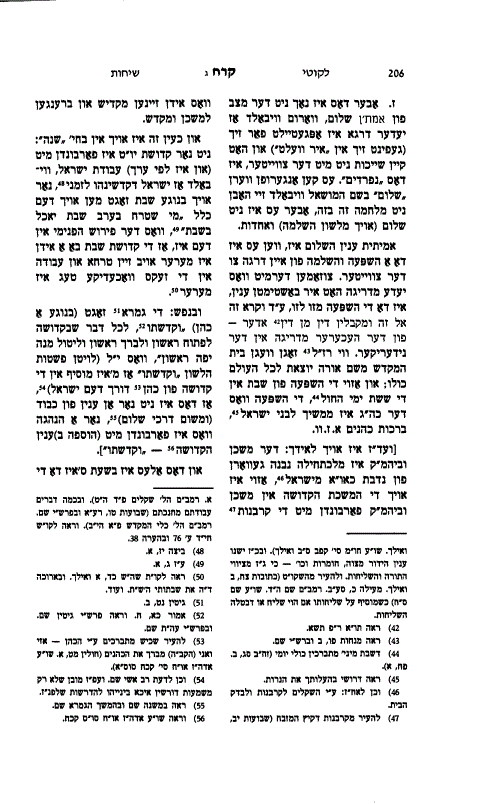
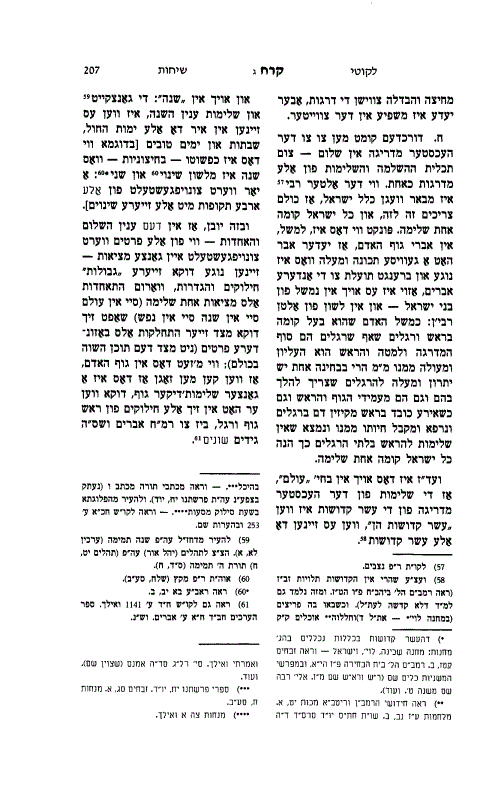
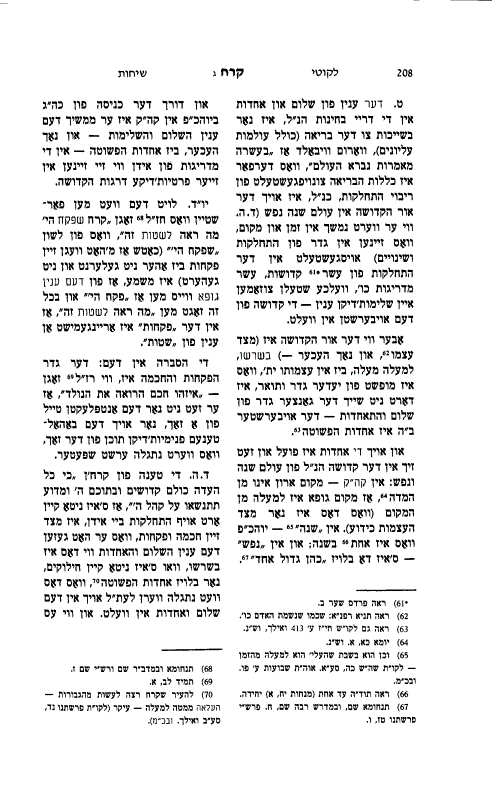
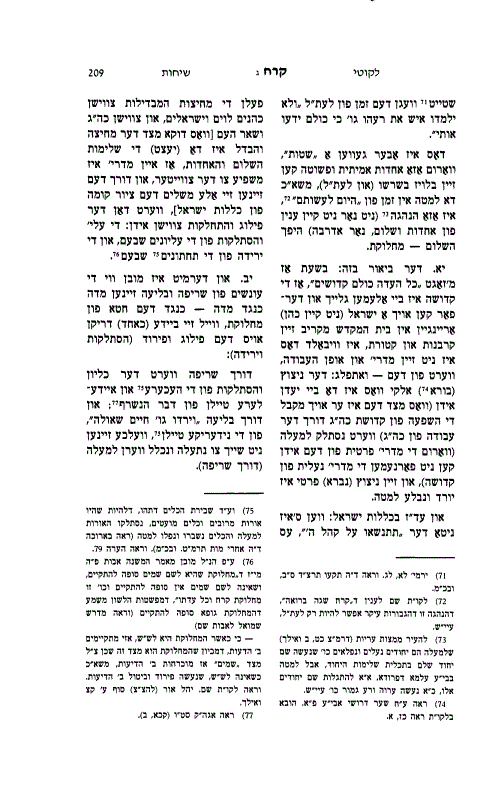
Korach and his assembly were punished with two distinct punishments: "all the men who were with Korach" and Dathan and Abiram were swallowed up, "they and all that belonged to them went down alive into the pit," while the two hundred and fifty men who offered the incense were consumed by fire.
This is because the punishments that come from above are a reflection of the transgression committed by the person. In secular terms, "in the measure that a person measures, it is measured to him." This is universally accepted, even according to the opinion that reward and punishment are not a direct consequence of the mitzvos and transgressions, but rather a mystical matter. All the more so according to the opinion that reward and punishment are a natural consequence of a person's actions.
We must understand: What is the connection and similarity between these punishments and the sins committed by Korach and his assembly?
The simple explanation is that in exchange for Korach and his assembly disputing the appointments made by Moshe, claiming that Moshe acted on his own accord, and seeking to elevate themselves to the priesthood through their dispute, they were brought down to the lowest depths, "they went down alive into the pit." This was a punishment of ultimate descent.
Regarding the punishment of burning: From the simple reading of the verses, it is implied that the punishment of burning came as a result of the act of offering the incense, which is associated with fire. Since this was a foreign fire (as they were not priests), "a fire came forth from the L‑rd and consumed them." However, this is not entirely understood: Moshe had instructed them to offer the incense. It is true that this was to bring about the dispute, as emphasized in the verse itself (after their burning), "these sinners against their own souls," meaning they became sinners against their own souls by disputing against the Holy One, blessed be He.
Furthermore, G‑d commanded that their censers be made into hammered plates as a covering for the altar, so they would serve as a sign and a reminder that these were from those who disputed the priesthood. If we say they were burned because of the fire from offering the incense, the main element of the "sign" is missing, which is that the punishment was because they disputed the priesthood.
We must say that the punishment of "they were burned" itself has a connection to the "reminder that these were from those who disputed the priesthood." We need to understand what this connection consists of.
Similarly, an explanation is required regarding the punishment of being swallowed: According to the above, the main emphasis is on the detail of "they and all that belonged to them went down alive into the pit" (in the punishment...
From all those who were burned and swallowed, why was there a dual punishment? If they had only been burned and not swallowed, those who were swallowed would complain, saying that Korach alone brought this calamity upon us, and thus they were swallowed while Korach was spared. Conversely, if they had only been swallowed and not burned, those who were burned would complain, saying that Korach alone brought this calamity upon us, and thus they were burned while he was spared. Therefore, they were judged with two deaths.
Seemingly, even if they had been judged with only one form of death, even if those punished with the other form would have considered it sufficient, and their punishment was more severe, there would still be no place for the argument "and he was spared," because he too was punished with another punishment.
We will understand this by first explaining the essence of Korach's dispute: Korach's argument was, "For all the congregation are holy, and the L‑rd is among them; why do you raise yourselves above the assembly of the L‑rd?" This is interpreted as "And Korach took" — "and he separated himself." Until it becomes the general matter of dispute — "Anyone who maintains a dispute transgresses a prohibition, as it is stated, 'And he shall not be like Korach and his company.'"
Seemingly, how is it that the matter of unity among Jews becomes a dispute? And a dispute in such a severe manner, when every dispute among Jews is forbidden with the dispute of Korach?
The explanation is hinted at in Moshe Rabbeinu's response, "In the morning, the L‑rd will make known," as it is explained in the Midrash (and Rashi brings it in his commentary on the Torah): "Moshe said to them, 'The Holy One, blessed be He, has set boundaries in His world. Can you mix day with night? This is what the verse says: At first, 'And there was evening, and there was morning,' and G‑d separated between the light and the darkness, etc. And so He separated Israel from the nations, and so He separated Aaron, as it is stated, 'And Aaron was separated to sanctify him as holy of holies.' If you can...'."
The reasoning behind this: Since the world was created with "ten utterances" (not "with one utterance"), therefore, the creation is in a manner of "The Holy One, blessed be He, has set boundaries in His world," meaning there is a division of levels among the creations. Each creation has its limitation with which it distinguishes itself from another creation.
Just as there are 'boundaries' in the times of "evening and morning," where each time has its specific purpose and role. And when each separately fulfills its role according to the definition and limitation of its time, they both become "one day."
So too, regarding the service and role of each creation. The purpose and perfection of creation are achieved when the creation fulfills its role for which it was created.
When a creation takes on a role that was designated for another, it causes a disruption in the order of creation. Just as there are boundaries and distinctions among the creations themselves, so too is this true in the realm of holiness, which is the structure (the concept of beyond creation that exists within creation). There is a division in the levels of holiness, and within each of the three dimensions: world, year, and soul. For example, there is a division in "world" — in space — as the Mishnah enumerates the ten levels of holiness in the Land of Israel, each higher than the other. Similarly, this applies to "year" — time: the weekdays, Yom Tov, Shabbat, and the Shabbat of Shabbats — Yom Kippur. The same is true in "soul," in the souls of Israel. For example, the general division among the Jewish people: Kohanim, Levites, and Israelites (and within the Kohanim themselves: from an ordinary Kohen to the highest level of Kohen Gadol), and the division of the ten types among Jews: "your heads, your tribes" to "the hewer of your wood."
Each individual must fulfill their designated role and not take on the role of another creation, which brings about a state of peace in creation. Just as in the conduct of the world, peace and unity prevail when one does not encroach upon another's boundary, fighting to take for oneself what belongs to another. Similarly, in the levels of holiness, peace is achieved when there is no encroachment or opposition from one level against another — in world, year, and soul, each finds itself within its boundary and role.
However, this is still only a state of true peace, because as long as each level is separated for itself (finding itself in its realm) and has no connection with the other, it is "separated." It can be called "peace" in a borrowed sense because they do not wage war against each other, but it is not true peace (also from the term completion) and true unity. True peace is when there is influence and completion from one level to the other. Together with each level having its designated role, there is influence from one to the other, as it is said, "And they call one to another and receive from each other," or from the higher level to the lower. As it is said regarding the Beis HaMikdash, "From there light goes out to the entire world," and the influence of Shabbat on the six weekdays, the influence that the Kohen Gadol extends to the Children of Israel.
Jews sanctify and bring offerings to the Mishkan and the Beis HaMikdash. Similarly, in the dimension of time, the sanctity of Yom Tov is connected to (and is relative to) the service of the Jewish people, as it is said, "Israel sanctifies the times." This applies also to Shabbat, as it is stated, "Whoever toils on the eve of Shabbat will eat on Shabbat." The deeper meaning of this is that the sanctity of Shabbat for a Jew is influenced by his toil and work during the six weekdays.
In the soul: The Gemara states (regarding a Kohen), "And you shall sanctify him for every matter of holiness: to open first, to bless first, and to take the first portion." It can be said (according to the simple meaning of the phrase "and you shall sanctify him") that this adds to the holiness of the Kohen through the Jew, or it is simply a matter of honor (and for the sake of peace), a conduct that is connected with (an addition in) the matter of holiness — "and you shall sanctify him."
There is a partition and separation between the levels, but each influences the other. Through this, one reaches the highest level of peace — the ultimate completion and perfection of all levels as one. As the Alter Rebbe explains regarding the Jewish people, that all need one another, and all of Israel is one complete entity. Just as this is true, for example, in the limbs of the human body, where each limb has a specific quality and advantage that is relevant and beneficial to the others, so too is it in the analogy of the Jewish people. In the words of the Alter Rebbe: like the analogy of a person who is a complete stature with a head and feet, even though the feet are the end of the level and below, and the head is above and superior, yet in one aspect there is an advantage to the feet, for one needs to walk with them, and they also support the body and the head. Moreover, when there is heaviness in the head, blood is let from the feet, and it is healed and receives its vitality from them. Thus, the head cannot be complete without the feet, and so all of Israel is one complete stature.
This is also true in the dimension of time: the completeness and perfection of the year is when it includes all the weekdays, Shabbatot, and Yomim Tovim. Just as this is literally — externally — where a year is composed of all four seasons with all their changes. In this, it is understood that in the matter of peace and unity — where all details are combined into one complete entity — their boundaries, distinctions, and definitions are specifically significant. For unity as one complete entity (whether in world, year, or soul) is created specifically through their division as distinct details (not through the shared content in all of them). As seen in the human body, one can say that it is a complete and perfect body only when it contains all the distinctions from head to body to feet, up to 248 limbs and 365 sinews.
The concept of peace and unity in the three aforementioned dimensions is very much related to creation (including the higher worlds). Since "the world was created with ten utterances," the entirety of creation is composed of a multitude of divisions, as mentioned earlier. Thus, the light of holiness in the dimensions of world, year, and soul (meaning, as it extends into time and space, which are characterized by division and change) is arranged in the division of ten sanctities, ten levels, which together form a complete entity — the holiness of the Divine in the world.
However, as the light of holiness exists (in its essence, and even higher) in its source, above and beyond, up to His very essence, which is abstracted from any definition or description, there the entire concept of peace and unity is relevant — the simple unity of the Divine. And this unity also acts and is visible in the aforementioned holiness of world, year, and soul.
Through the entry of the Kohen Gadol on Yom Kippur into the Holy of Holies, he draws down the concept of peace and completeness — and even higher, up to the simple unity — into the levels of Jews as they exist in their individual levels of holiness. From this, we can understand what our Sages say: "Korach was a wise man, what did he see to engage in this folly?" The expression "he was wise" (even though we have not learned or heard about his wisdom until now) implies that from this very matter, we know that he was wise, and yet it is said, "what did he see to engage in this folly?" indicating that within this wisdom, there was an element of folly.
The explanation of this is: the definition of wisdom and intelligence is, as our Sages say, "Who is wise? He who sees what is born," meaning he sees not only the revealed aspect of a matter but also the hidden, inner content of the matter, which is revealed only later.
It is stated regarding the future time, "And they shall no longer teach each man his neighbor... for they shall all know Me." However, this was a folly, because such true and simple unity can only exist in its source (and in the future), whereas here below, in the time of "today to do them," such conduct not only does not bring about unity and peace, but on the contrary, it leads to the opposite of peace — to discord.
When it is said, "the entire congregation is holy," or that holiness is equal among everyone and therefore any Israelite (not just a Kohen) can enter the Temple and offer sacrifices or incense, it is because this is not his level and manner of service. From this arises the separation: the Divine spark present in every Jew, which allows him to also receive influence from the holiness of the Kohen through the service of the Kohen Gadol, becomes elevated above. Because the individual level of this Jew cannot contain the general level of holiness.
The partitions that separate Kohanim, Leviim, and Israelites, as well as between the Kohen Gadol and the rest of the people, are essential. It is precisely because of these partitions and distinctions that there is (now) the perfection of peace and unity. One level influences the other, and through this, they all complete the image of the stature of the entirety of Israel. This results in the division and separation among Jews: the elevation and withdrawal of the higher elements of the people, and the descent of the lower elements of the people.
Thus, it is understood how the punishments of burning and swallowing are measure for measure against the sin of discord, as they express the division and separation (the withdrawal and descent). Through burning, there is the destruction and withdrawal of the higher, spiritual parts of the matter that is burned. Through swallowing, "and they went down alive into the pit," the lower parts, which are not suited to be elevated and included above, are swallowed. This is also consistent with the simple understanding of the differences in the punishments. Those punished by burning were the 250 men who offered the incense, who were "princes of the congregation, called to the assembly, men of renown," heads of the Sanhedrin. The punishment of swallowing was for Dathan and Abiram (and all the people who belonged to Korach), who were previously lesser individuals, as the Torah recounts earlier, and due to their sins, they are called wicked.
For this reason, in the punishment of "they went down alive into the pit," the concept of swallowing is emphasized. This also refers to the spark of holiness present in the lower levels, which, through the nullification of the partitions, becomes swallowed in the pit, the three impure klipos, as is known regarding the sparks that are found in the klipos or the sparks of holiness (which from Chai are received by the impure klipos) are in a state of being swallowed within them.
According to this, it is also understood what is said in the Midrash that Korach was punished with both punishments, burning and swallowing. Since he was the source and root of the discord, and he enticed everyone, therefore his punishment also included in a revealed manner both parts and extremes of the division and separation. Had he been punished with only one of them, either burning or swallowing, there would have been the claim that the upper part was saved, or the lower part was saved, as the punishment (the separation) did not affect it. Therefore, Korach received both punishments: "his soul was burned (the higher parts of him) and his body remained (the lower parts of him), and afterward, it rolled to the place of the lowly and was swallowed."
The intention is to create confusion in faith and belief among Jews and, to differentiate, among the nations of the world: a breach in the partition that separates Israel from the nations, Heaven forbid, through what is called a conversion not according to halacha, and so forth.
From the story of Korach, we derive a lesson: when one, Heaven forbid, nullifies the boundaries that G‑d established in the world, besides the primary issue—that this is contrary to the Torah of Moshe, which is the Torah of G‑d, and they are disputing against G‑d—it does not bring peace, but on the contrary, it leads to division of hearts.
Matters that, in essence, are divided or even opposite from one another cannot be united, except through a partition that separates them. For example, the relationship between water and fire can only exist when there is a separation (like the pot where the water is contained, etc.); otherwise, the union is not beneficial, but rather destructive.
There must be a distinction between the different types, because it is a peace built on Torah, which is "all its paths are peace."
Through this, we merit the time when "there will be no more war, nor jealousy and competition," when Moshiach will come, who is from the lineage of David and Solomon (about Solomon it is written, "He will be a man of rest, and I will give peace and quiet to Israel in his days")—although even then, Jews will be distinct from the nations of the world, as it is stated, "And strangers will stand and tend your flocks"—and he will rectify the entire world to serve G‑d together, as it is said, "For then I will turn to the peoples a pure language, that they may all call upon the name of the L‑rd, to serve Him with one consent."