Introduction
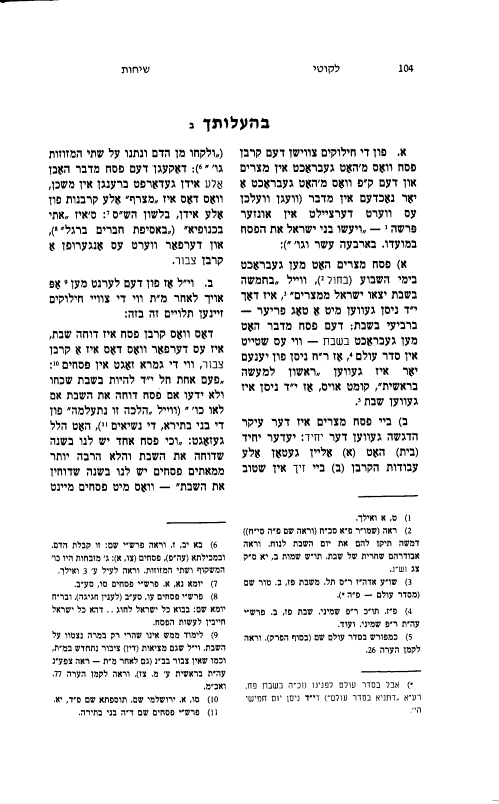
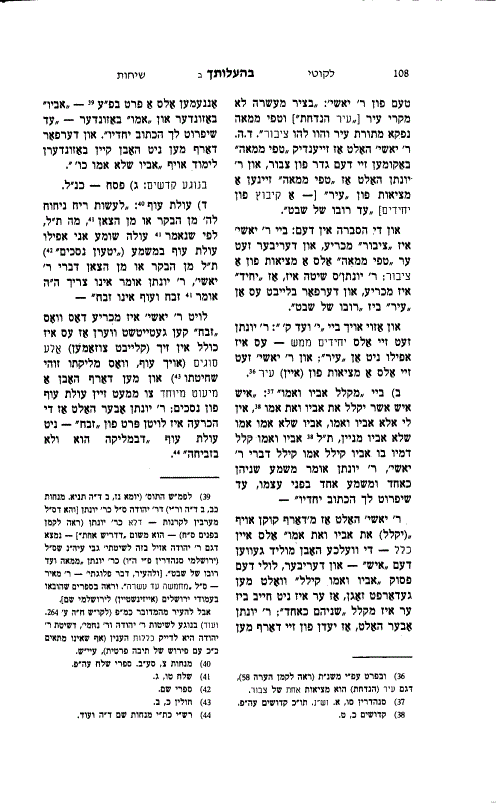
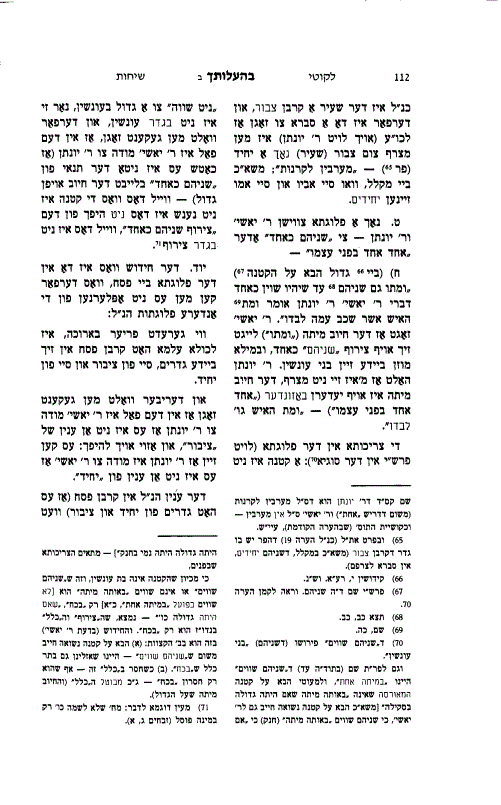
This study will review a sicha from Likkutei Sichos, Volume 18, the second sicha on Parshas Beha'aloscha. In this sicha, the Rebbe explores the nature of the Korban Pesach—whether it is fundamentally a communal offering (korban tzibbur) or an individual offering (korban yochid).
The Rebbe begins by distinguishing between two historical instances of the Korban Pesach. The first was Pesach Mitzrayim—the original Passover offering brought by the Jewish people in Egypt. In that case, it was clearly a korban yochid, an individual offering, and it was performed during the week, not on Shabbos.
In contrast, the Torah portion in Parshas Beha'aloscha describes the Pesach Midbar—the Passover offering brought in the wilderness during the second year after leaving Egypt. This time, it fell on Shabbos and was treated as a communal offering—a korban tzibbur. The Rebbe analyzes how this shift occurred: why was it considered individual in Egypt but communal in the desert?
The sicha delves into both aspects—what makes it a yochid, what makes it a tzibbur, and what factors determine its status. There is also discussion of a dispute between Rabbi Yehuda and Rabbi Yosi regarding this issue, drawing on sources throughout Shas (the Talmud). The Rebbe connects their opinions consistently across different contexts (lishitosei) and examines why each view holds as it does.
This is a detailed and analytical sicha, addressing subtle distinctions in halacha and exploring their broader implications. We will proceed step by step through each section, beginning with Ois Aleph.
Among the differences discussed is that when the Jewish people first brought the Pesach offering in Egypt, they were commanded to take the lamb, tie it to their beds, and then offer it at the designated time. This unique context sets up many of the questions explored in this sicha.
Saif Aleph
In this section, we explore the differences between the original Korban Pesach in Egypt and the first Korban Pesach brought a year later in the wilderness. The Torah in our parasha, Parashat Beha'alotcha, describes how the Jewish people were commanded to bring the Korban Pesach at its appointed time—on the 14th of Nisan. This raises the question: what are the distinctions between the Pesach offering in Egypt and that first one in the desert?
The first difference is in timing. The Korban Pesach in Egypt was brought on a weekday. If we calculate based on the chronology, we see that the Jews left Egypt on a Thursday, which means that the 14th of Nisan—the day they brought the sacrifice—was a Wednesday, a regular weekday.
In contrast, according to Seder Olam, when they brought the Korban Pesach a year later in the wilderness, it fell on Shabbat. Seder Olam explains that Rosh Chodesh Nisan of that year was on a Sunday. Counting forward two weeks brings us to Shabbat for the 14th of Nisan. Thus, while in Egypt it was a weekday, in the wilderness it was Shabbat.
The second major difference concerns who performed the service and where it took place. In Egypt, there was an emphasis on individual responsibility—yochid. Each person or family performed all aspects of preparing and offering their own Korban Pesach. They even sprinkled its blood themselves on their own doorposts as described: “velak’chu min ha-dam ve-nat’nu al shtei ha-mezuzot”—they took from the blood and placed it on their two doorposts.
This highlights how each household acted independently; there was no communal aspect to this service. Every family did everything themselves within their own home.
By contrast, for the Korban Pesach brought in the wilderness, all Jews were required to bring their offerings to the Mishkan—the Tabernacle—which served as a communal space. The Mishkan unified all these offerings from across Israel into one central location.
The Gemara refers to this as osi biknufya, meaning it is brought together as a group. Rashi explains that this gathering of friends and families for Yom Tov creates a sense of community around bringing these offerings together on Erev Pesach.
Because of this communal aspect—everyone bringing their sacrifices to one place at one time—the Korban Pesach in the wilderness is considered a korban tzibbur, a communal offering, rather than an individual one.
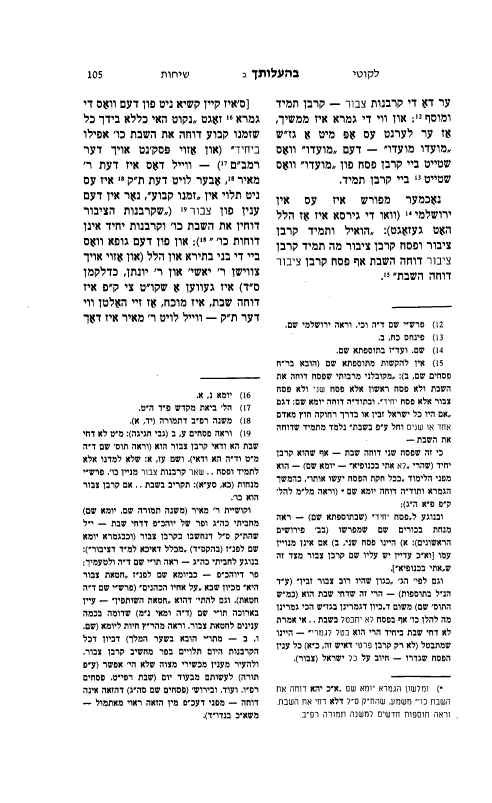
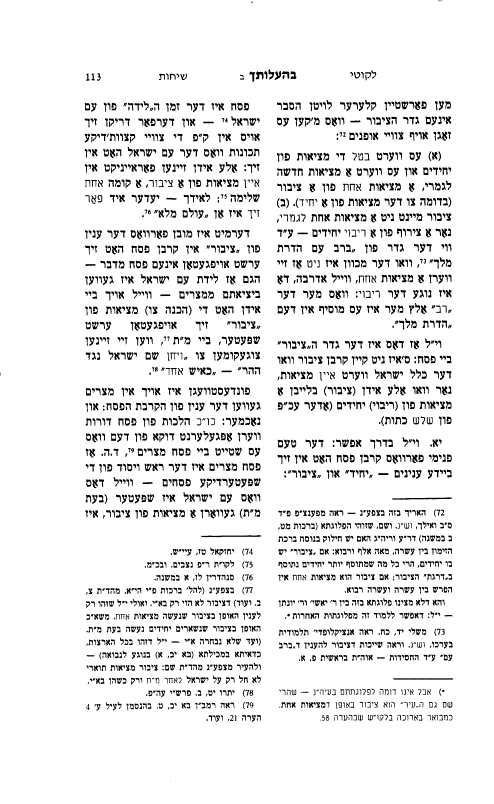
Saif Beis
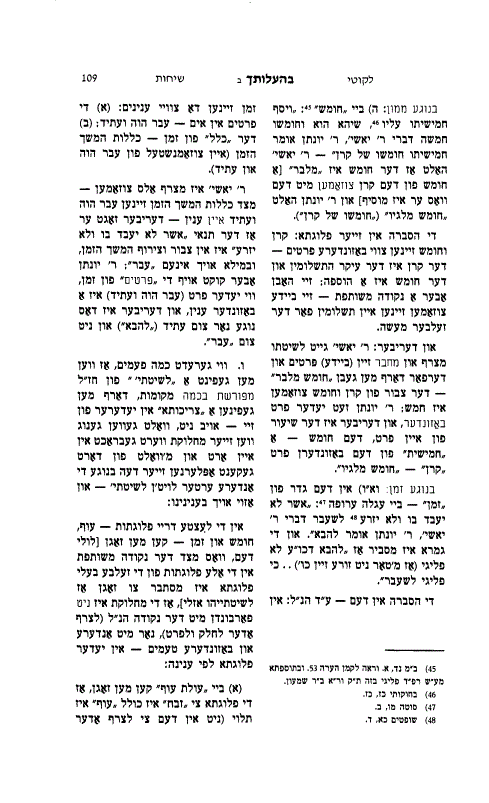
The Rebbe explains that the key distinction between the first Pesach offering in Egypt and the later Pesach offerings in the wilderness lies in their communal versus individual nature. In Egypt, each person brought their own korban Pesach, emphasizing the individual's role. In contrast, in the wilderness, the offering was brought collectively, as a community, in the Mishkan. This shift is why the later korban Pesach is referred to as a karbon tzibur—a communal offering.
This difference has practical halachic consequences. The original Pesach in Egypt was brought on a weekday because it was an individual offering; such offerings do not override Shabbos. However, once the korban Pesach became a communal offering in the wilderness, it gained the ability to override Shabbos. That is why, as noted earlier, the first communal korban Pesach took place on Shabbos.
The Rebbe connects these two points: The fact that Pesach Mitzrayim was on a weekday and was an individual offering are linked, just as Pesach in the wilderness being on Shabbos and being a communal offering are connected. The ability of the korban Pesach to override Shabbos stems from its status as a karbon tzibur. If it were still an individual offering, it would not have this power.
The Gemara in Pesachim discusses this at length. It records an incident where Erev Pesach fell on Shabbos and there was uncertainty whether the korban Pesach should be brought. The leaders at that time had forgotten whether or not it overrides Shabbos. Hillel resolved their doubt by comparing it to other communal offerings like the Tamid and Musaf sacrifices, which are always brought even on Shabbos.
Hillel asked rhetorically: “Is there only one korban Pesach a year?” He pointed out that there are actually more than 200 communal offerings throughout the year that override Shabbos—referring to all of the Tamid and Musaf sacrifices. Thus, since these communal offerings override Shabbos, so too does the korban Pesach when it is considered a karbon tzibur.
The Gemara further clarifies this with a gezeirah shavah—a comparison based on similar language in verses. The Torah uses the word moyadein (“appointed time”) both for korban Tamid and for korban Pesach. Just as Tamid is offered even on Shabbos because of its appointed time, so too must korban Pesach be brought at its appointed time even if it falls on Shabbos.
This idea is stated even more explicitly in Yerushalmi: Hillel says directly that since both Tamid and Pesach are communal offerings (karbon tzibur), just as Tamid overrides Shabbos, so does korban Pesach.
The Rebbe concludes that this explains why only from the second year onward—when Israel had a Mishkan and brought korbanot communally—did korban Pesach gain this status and thus could override Shabbos. In Egypt, where each person brought their own offering individually, it did not have this power.
Up until now, according to this approach, whether or not korban Pesach overrides Shabbos depends entirely on its status as a karbon tzibur. If it is communal, it overrides; if individual, it does not.
The Rebbe then notes that there is another aspect discussed in Gemara which will further clarify or add nuance to this principle.
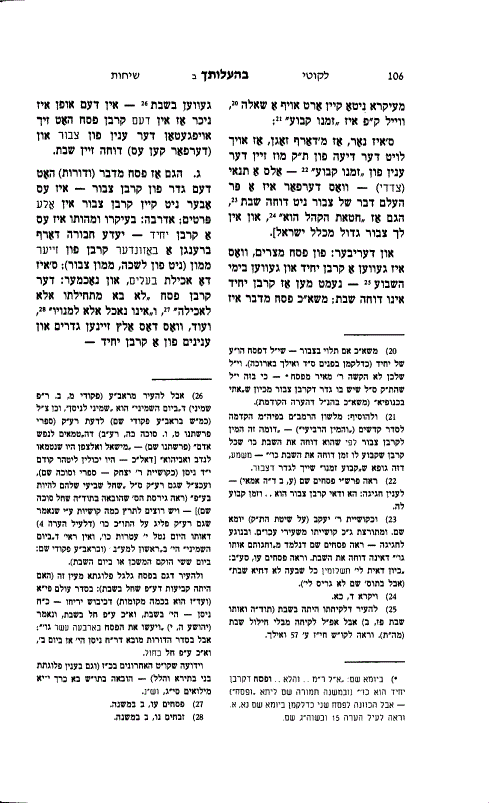
Saif Gimmel
The discussion here centers on what conditions are necessary for a sacrifice to override Shabbos. It's not enough for a sacrifice to simply be a communal offering—karbon tzibbur; it must also have a set, fixed time—zman kavua. The Gemara seems to suggest that if an offering has a set time, even if it's an individual offering—karbon yachid—it would override Shabbos. However, the Rebbe clarifies that both conditions are required: it must be a communal offering and have a set time.
The Gemara in Yoma (daf nun amud alef) states: nekoit hai klolo biyotcho, "hold on to this rule in your hand," that anything with a fixed time overrides Shabbos, even if it's an individual offering. This would imply that the Pesach offering overrides Shabbos because its time is fixed—the 14th of Nissan. According to this logic, we wouldn't need to classify it as a communal offering for it to override Shabbos; the fixed time alone would suffice.
The Rambam also rules this way, following the opinion that the fixed time is what allows the Pesach offering to override Shabbos. But the Rebbe points out that this is actually the view of Rabbi Meir, as found in the Mishnah and brought down in Temurah. According to the tanakameh, however, it's not dependent on having a set time. For them, only communal offerings override Shabbos; individual offerings do not—even if they have a fixed time.
The tanakameh's position is clear: only communal sacrifices (karbonos tzibbur) can override Shabbos. Even if an individual sacrifice had a set time, like the Pesach offering on the 14th of Nissan, it would not override Shabbos unless it was also communal.
This distinction is evident from the story of Bnei Beseira and Hillel. They were unsure whether or not the Pesach offering should override Shabbos. If simply having a set time was enough for any sacrifice—even an individual one—to override Shabbos (as Rabbi Meir holds), there would have been no question for them. Their uncertainty shows they understood that being a communal offering was essential for overriding Shabbos.
The same logic applies when considering later debates between sages such as Rabbi Yoshiya and Rabbi Yonasan (to be discussed further in section 4). If everyone agreed with Rabbi Meir's view—that any sacrifice with a set time overrides Shabbos—there would be nothing left to debate regarding whether or not Pesach overrides Shabbos.
This all demonstrates that according to the tanakameh, both elements are necessary: it must be a communal sacrifice and it must have a set time. If you had a communal sacrifice without a fixed time, it would not override Yom Tov or Shabbos. Similarly, an individual sacrifice with a fixed time would also not suffice.
The Rebbe concludes that even according to the tanakameh, there must be both aspects present—a communal nature and a set time—for an offering to override Shabbos.
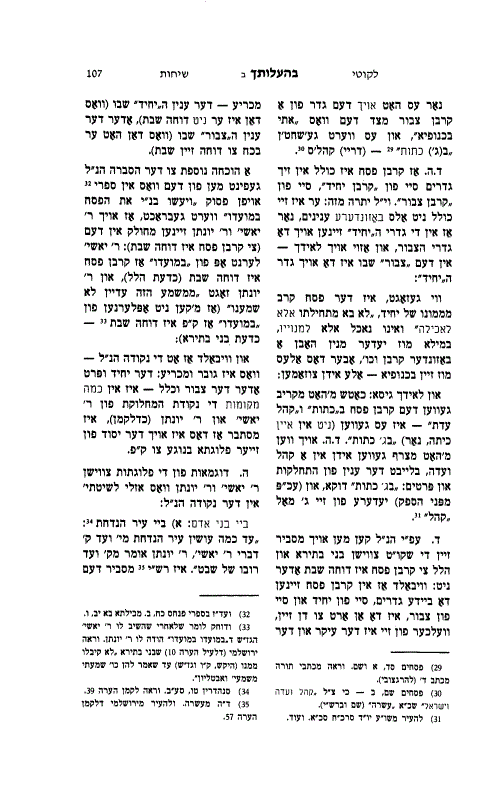
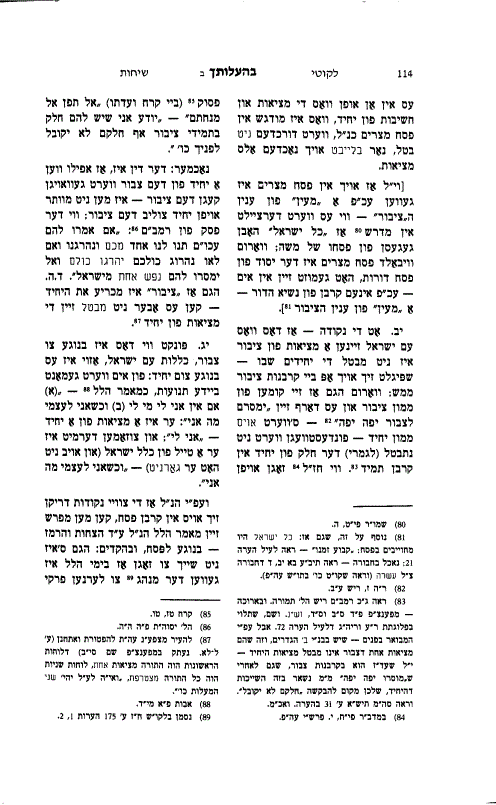
Saif Daled
The discussion here focuses on the distinction between a korban yochid—an individual offering—and a korban tzibbur, a communal offering, particularly in the context of whether such offerings override Shabbos. The example given is the par helem davar tzibbur, the communal bull brought when the entire community errs in halacha. This offering, despite being for all of Israel, does not have a set time and therefore does not override Shabbos.
Even though this is a sin offering for the whole community, and there is no greater community than all of Israel, it still does not push aside Shabbos because it lacks a fixed time. The principle emerges: to override Shabbos, an offering must be both a korban tzibbur and have a set time. An individual offering, even with a set time, does not suffice.
This explains why the Pesach in Egypt (Pesach Mitzrayim) was brought as an individual offering and occurred during the weekdays. Since it was not communal, it could not override Shabbos. In contrast, the Pesach in the desert (Pesach Midbar) was brought on Shabbos, indicating that it had acquired the status of a communal offering.
The Rebbe elaborates that while we refer to korban Pesach as a communal offering for later generations, it is not entirely so in every detail. Its essence remains primarily that of an individual offering (korban yochid). Each group (chaburah) brings its own animal from its own funds—not from communal money collected in the Temple treasury.
Additionally, those who bring the offering are also those who eat it. Unlike most sacrifices eaten by priests, here the owners themselves partake. Furthermore, from its inception, the purpose of korban Pesach is for eating by those specifically counted for that animal—making it highly individualized.
All these aspects—personal funding, consumption by owners, and designation for specific individuals—highlight its character as an individual sacrifice. Yet at the same time, there are elements of communal sacrifice present as well.
This communal aspect appears because all groups bring their offerings together at once. The slaughtering occurs in three groups (gimol kitot) corresponding to three collective terms used in Torah: kol, edah, and Yisrael. This grouping underscores its communal dimension.
The result is that korban Pesach uniquely blends both definitions: it contains within itself both individual and communal qualities. Not only are these present side by side as separate features; rather, within each aspect you can find traces of the other. The individuality is expressed communally and vice versa.
The Rebbe illustrates this further: although each group must bring its own animal (individualization), all these animals are brought together (communal). Conversely, even when performing as one large group (community), there remain divisions into three subgroups (individualization within community).
This structure arises because of uncertainty regarding whether "kol", "edah", and "Yisrael" refer to one group or three distinct groups. To fulfill all possibilities, three groups of thirty are formed during slaughtering.
This dual nature leads directly to the debate about whether korban Pesach overrides Shabbos. If its primary definition is individual (yachid), then it would not override Shabbos; if communal (tzibbur) dominates, then it would.
This question underlies the dispute between Beis Hillel and Bnei Beseira: which aspect is decisive? Beis Hillel rules that since there is sufficient communal character, it does override Shabbos.
The Rebbe adds further proof from Sifri on the verse:
ויעשו בני ישראל את הפסח במועדו
"And the children of Israel performed the Pesach at its appointed time."
This supports the idea that timing and communal status together determine whether an offering can override Shabbos—a key insight into how halacha classifies sacrifices with complex identities like korban Pesach.
Saif Hei
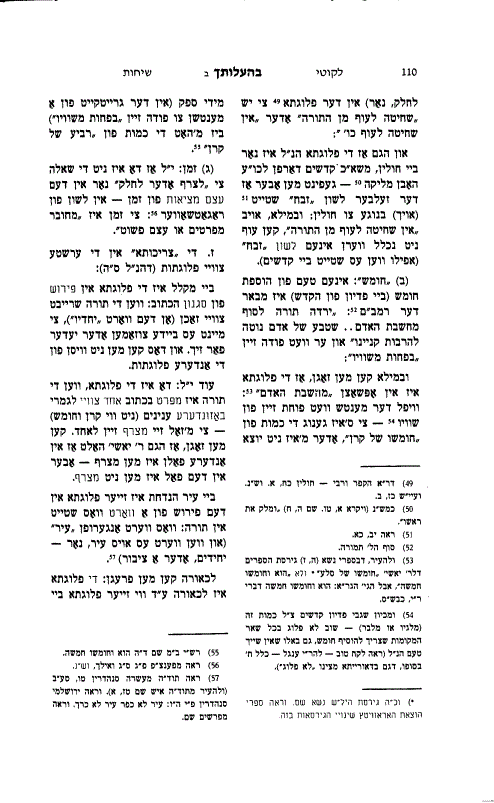
Rabi Yoshiya and Rabi Yonison disagree about whether the korban Pesach overrides Shabbos. Rabi Yoshiya learns from the word b'meyadei—“in their appointed times”—that the korban Pesach does override Shabbos, following the opinion of Hillel. In contrast, Rabi Yonison argues that we cannot derive from b'meyadei that the korban Pesach overrides Shabbos, aligning with the view of the Bnei Beserah, who hold that it does not.
The Rebbe points out that this dispute reflects a deeper principle: what is decisive—the community (tzibur) or the individual (yachid)? This underlying question appears in several disagreements between Rabi Yoshiya and Rabi Yonison throughout Shas. Here too, their positions on korban Pesach stem from whether they see it as primarily a communal or individual offering. According to Rabi Yoshiya, it is mainly a communal offering and therefore overrides Shabbos; according to Rabi Yonison, it remains an individual offering and does not override Shabbos.
This distinction supports the Rebbe’s interpretation of the debate between Hillel and Bnei Beserah regarding whether korban Pesach is doicheh Shabbos—whether we view it as a communal or individual sacrifice. The Rebbe will later bring six examples where Rabi Yoshiya and Rabi Yonison disagree in various areas—regarding people, time, sanctified items (kodshim), and monetary matters—demonstrating how their disputes consistently revolve around this point: which is primary, the community or the individual?
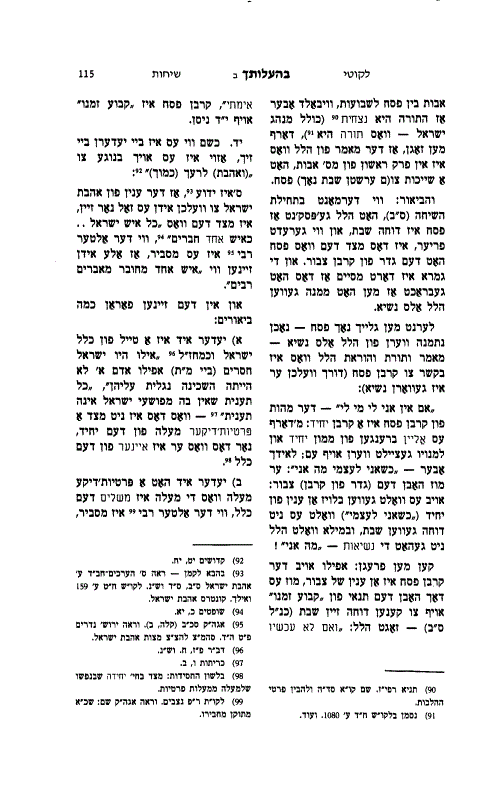
The Rebbe also notes that each of these cases must be stated separately because, while they share a common theme, each contains unique details that would not be clear without explicit mention.
The first example concerns people: specifically, the laws of ir hanidachas, a city led astray to idolatry. The question is how many people are needed for a city to qualify as an ir hanidachas, which has special halachos distinct from those applying to individuals who worship idols.
The Gemara asks: up to how many people can still be considered an ir hanidachas? A city is defined as a collection of individuals. According to Rabi Yoshiya, an ir hanidachas must have at least 10 but no more than 100 people. Less than 10 is not considered a city; more than 100 is no longer considered a city for these laws.
Rabi Yonison disagrees. He holds that only when there are at least 100 people does it become an ir hanidachas, and this status continues until you reach the majority of a tribe (rubei shel shevet). Once you reach most of a tribe, it ceases to be considered just a city—it becomes like an entire community or tribe—and thus different rules apply.
Rashi explains Rabi Yoshiya’s reasoning: fewer than 10 is not called a city—it’s just individuals. More than 100 is also not called a city; at that point, it becomes classified as a community (tzibur). So for Rabi Yoshiya, less than 10 isn’t yet a city; more than 100 has already become something greater—a communal entity.
This means that according to Rabi Yoshiya, once there are more than 100 people, they acquire the status of tzibur. In contrast, Rabi Yonison maintains that even with more than 100 people, it’s still considered an entity made up of individuals—a city—until reaching most of a tribe.
The core disagreement here is whether exceeding 100 people transforms the group into a community (tzibur) or if they remain individuals within a city until surpassing most of the tribe. For Rabi Yoshiya, once you pass 100 people, communal identity takes precedence; for Rabi Yonison, individuality remains dominant until reaching tribal majority.
This reflects their broader approaches: for Rabi Yoshiya, communal status is decisive; for Rabi Yonison, individual status remains primary until overwhelmed by sheer numbers (the majority of a tribe). Thus from 100 up to most of the tribe: for Rabi Yoshiya it's already tzibur; for Rabi Yonison it's still considered individuals within one city.
This same logic applies in reverse when considering groups between 10 and 100. According to Rabi Yonison, fewer than 100 are still true individuals—not even qualifying as a city—while for Rabi Yoshiya they already form one entity: an ir, not just separate individuals.
Saif Vov
We see a recurring theme in the debates between Rabbi Yoshiya and Rabbi Yonasan regarding whether we view a group as a collective entity or focus on the individual components. For example, when considering the status of a city, even Rabbi Yoshiya agrees that if there are fewer than ten people, it is not considered a city. However, for populations between ten and one hundred, Rabbi Yoshiya still sees them as an ir—a city—because he views the group as a tzibur, a collective. Only when the number exceeds one hundred does he consider it a true community. In contrast, Rabbi Yonasan maintains that the individual is decisive; if there are fewer than one hundred, he sees them as individuals who do not even qualify as a city.
This distinction highlights the principle: is it the individual (yachid) or the community (tzibur) that determines status? This debate appears in other areas of halacha as well.
Another example concerns the verse about cursing one's parents. The Torah states:
איש איש אשר יקלל אביו ואמו מות יומת דמיו בו.
"Any man who curses his father and his mother shall surely be put to death; his blood is upon him."
If you read this verse simply, you might think that only someone who curses both parents receives the death penalty. The Gemara asks: how do we know that cursing only one's father or only one's mother also incurs this punishment? The answer is that since the Torah repeats "his father and his mother," we learn that either case—cursing just one parent—makes him liable.
This is specifically Rabbi Yoshiya's position: he requires an extra verse to teach us that cursing either parent alone suffices for liability. Without this additional teaching, he would interpret "his father and his mother" as referring to both together—the general category of "parents." Thus, unless specified otherwise, he would require both parents to be cursed for liability.
Rabbi Yonasan disagrees. He holds that from the wording itself we can derive both meanings: together and individually. Unless the Torah explicitly says "together," we assume each parent is considered separately. Therefore, no extra verse is needed to teach liability for cursing just one parent.
The underlying logic of their disagreement is clear: Rabbi Yoshiya tends to see things in terms of general categories (klal)—the collective or whole—while Rabbi Yonasan focuses on particulars (prat)—the individual components.
This same pattern appears in other areas. For example, regarding korban Pesach (the Passover offering), their dispute centers on whether it is considered an offering of the community (tzibur) or of individuals (yachid). This affects whether it overrides Shabbat or not.
A further illustration comes from parashat Shelach concerning nesachim—>wine libations brought with offerings. The Torah says:
ועשיתם אישה לה' עולה או זבח ... מן הבקר או מן הצאן ...
"When you make a fire-offering to Hashem: an olah or a zevach ... from cattle or from sheep ..."
According to Rabbi Yoshiya, specifying "from cattle or sheep" teaches us not to include bird offerings (olah sa'of) in this law about libations. Otherwise, since "olah" could refer to any burnt offering (even birds), we might mistakenly think birds also require libations. The verse excludes them by specifying cattle and sheep.
Rabbi Yonasan argues that such specification isn't necessary because the word "zevach" refers only to animals slaughtered by shechita (ritual slaughter), which excludes birds (since they are killed by melikah). Thus, birds are automatically excluded without needing an extra phrase in the verse.
The rationale behind these disagreements again reflects their broader approaches: Rabbi Yoshiya emphasizes general categories and needs explicit exclusion for exceptions, while Rabbi Yonasan focuses on details and assumes each case stands on its own unless stated otherwise.
Saif Zayin
According to Rabbi Yoshiya, the term zevach can be interpreted as being all-inclusive. He explains that it means to gather everything together, so in his view, the word zevach encompasses all types of offerings. This includes even those cases where the bird is slaughtered through melikah—the unique method where the kohen uses his fingernail instead of a knife. In this context, melikah is considered equivalent to regular slaughtering (shechitah). Therefore, when the Torah uses the phrase “to offer a zevach,” it refers to everything, making Rabbi Yoshiya’s interpretation very inclusive.
Because of this inclusivity, there is a need for a special exclusion in the Torah to teach that the olah sa’of (the bird burnt-offering) does not require libations (nesachim). That’s why a specific verse is necessary—to exclude this case from the general rule. This is how Rabbi Yoshiya understands the text: when it says “min habakar u’min hatzon,” it comes to include everything according to his approach.
Rabbi Yonasan, however, disagrees. He holds that we follow the specific detail implied by the word zevach. For him, zevach refers only to those offerings that are actually slaughtered in the standard way and does not include olah sa’of, since its ritual is performed through melikah, not regular slaughtering. Thus, Rabbi Yonasan’s interpretation is more limited and precise; he does not require an additional verse for exclusion because he only includes what fits exactly into the definition of zevach.
This difference in approach between Rabbi Yoshiya and Rabbi Yonasan appears again in monetary cases. For example, in Vayikra (Leviticus) chapter 27, verse 27, we find a discussion about redeeming an unclean animal that was consecrated for Temple maintenance (bedek habayis). If someone wants to redeem such an animal after having donated it for this purpose, he must pay its value plus an additional fifth.
The Torah says: “וְיָסַף חֲמִישִׁיתוֹ עָלָיו” (“And he shall add its fifth upon it”). The question arises: how do we calculate this fifth? Suppose the animal’s value is $500. A straightforward calculation would suggest adding one-fifth of $500—that is, $100—making a total payment of $600.
However, there’s another way to interpret “its fifth.” According to one view, once you add the extra amount, the total sum should itself be divisible into five equal parts. In this scenario, you would need to add $125 (since $500 + $125 = $625; dividing $625 by five gives $125 per part). Thus, after adding this amount, what you added becomes exactly one-fifth of the new total.
This is how Rabbi Yoshiya understands it: “וְיָסַף חֲמִישִׁיתוֹ עָלָיו” means that together with what you add—the principal plus the addition—it should form five equal parts. So if each part is $125 and there are five parts ($625), you must add $125 on top of the original value.
Rabbi Yonasan disagrees and interprets “its fifth” as simply meaning a fifth of the principal amount. In our example, since one-fifth of $500 is $100, you just add $100 for a total payment of $600.
The core of their argument lies in how they view these two components—the principal (keren) and the additional fifth (chomesh). The principal represents the main payment required for redemption; the fifth is an added penalty or supplement. While they are two separate details, they share a commonality: together they make up one unified payment for a single act—the act of redemption.
This analysis shows how both opinions recognize that although there are distinct elements (the original value and its addition), ultimately they combine into one obligation at the moment of redemption. Each sage’s approach reflects his broader perspective on whether scriptural terms should be interpreted inclusively or specifically—an outlook that influences their rulings across different areas of Jewish law.
Saif Ches
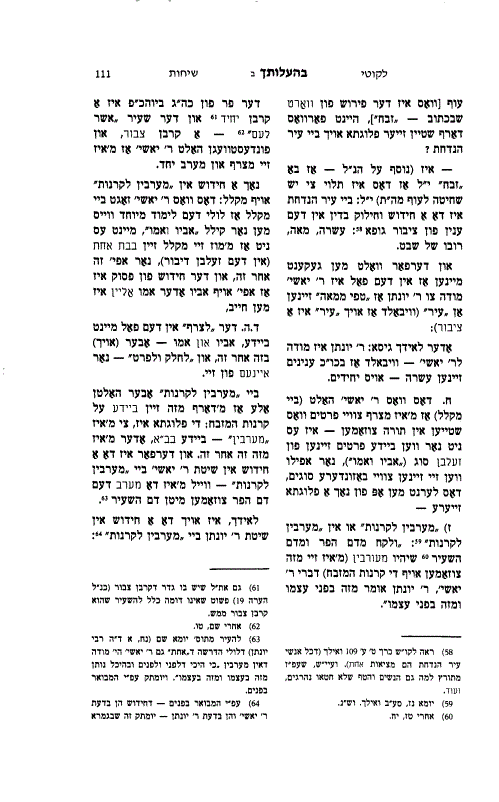
The discussion here revolves around the redemption of a sanctified animal, specifically the behemoth mayor that was consecrated. Rabbi Yeshia approaches this by combining and connecting two details—he views them together as a unit. Because of this, when calculating the required additional payment (the fifth), it must be calculated from the outside, after everything is included. When you collect both the principal and the fifth, you arrive at five parts in total, with one part representing the additional fifth that must be given.
This means that the amount required is based on one detail alone—the principal. The fifth is taken from this individual amount, not compounded within itself. In other words, it is a chemish milgav—a fifth from the outside. We do not include the fifth within itself for further calculation; rather, we simply pay a fifth of what exists now, which in practical terms would be one hundred in this case.
Turning to the law of egla arufa, as described in Sefer Shoftim: when a murdered body is found and its perpetrator is unknown, the elders of the nearest city are to measure to determine proximity. The verse states:
וְיָרְדוּ זִקְנֵי הָעִיר הַהִוא
"And the elders of that city shall go down..."
The elders take a calf and bring it to a piece of land described as asher lo ye'aved bo ve'lo ye'zare'a—land that has not been worked or sown. This refers to land that is completely unused and fresh.
The question arises: does this requirement refer only to its past use or also to its future? Rabbi Yeshia says it refers to the past—that it has not been worked up until now. Rabbi Yonasan says it refers to the future—that from now on it may not be worked.
The Gemara clarifies: everyone agrees that for the future, working or sowing there is forbidden. The disagreement concerns whether prior use disqualifies it. Is it valid if it was previously used?
This debate reflects two ways of looking at time. First, there are details within time: past (ovar), present (hoyve), and future (osid). Second, there is time as a whole—the continuous flow encompassing all three phases.
Rabbi Yeshia combines these aspects and looks at time as an ongoing continuum. For him, past, present, and future are all part of one reality; therefore, he holds that if land was ever used in the past, it cannot be used for egla arufa. The condition applies across all time frames.
Rabbi Yonasan focuses on each detail separately—past, present, and future are distinct entities. Therefore, he maintains that only future use matters: as long as from now on it will not be worked or sown, prior use does not disqualify it.
This mirrors earlier discussions about whether we view things collectively (as a tzibur) or individually (as separate details). According to Rabbi Yonasan's approach, only what happens going forward is relevant; what happened before does not affect eligibility.
The Rebbe continues by noting that although we find six cases where Rabbi Yeshia and Rabbi Yonasan disagree based on this principle, each case must be stated explicitly in its context. If their dispute were mentioned only once, we might have assumed their reasoning applied identically elsewhere without exception.
The repetition teaches us that each context presents unique factors requiring clarification. The Torah (and Chazal) specify their disagreement in every instance so we understand how their principles apply differently depending on circumstances.
This method—articulating each dispute separately—ensures we do not mistakenly generalize from one case to another where subtle distinctions exist. Thus, even though their underlying logic remains consistent across cases, each scenario demands its own articulation and analysis.
Saif Tes
The discussion here revolves around whether certain Torah verses are meant to include or exclude specific cases, and how this logic applies across different halachic debates. For example, when it comes to the law of adding a fifth (choymesh) to a principal amount, the question is whether the fifth is calculated after adding it or from the original amount. Similarly, with issues of timing—whether a prohibition applies only going forward or also retroactively—these are all areas where the same underlying logic might be at play.
We can suggest that in these three cases, if not for the fact that we see a shared reasoning across them, each could be understood independently. However, because there is a common thread—a shared point of contention among the same authorities (Reb Yoshiya and Reb Yonasan)—it makes sense to say that their positions are consistent with their general approach. This is known as l’shitosayu azla—they follow their own line of reasoning throughout.
But if not for this shared logic, we might have thought that each disagreement stands on its own and is not necessarily connected to the others. Each debate could be based on its own unique reasoning and context, rather than a unified principle about combining or splitting categories.
The Rebbe now examines each case individually. First, regarding oylus oif (the bird offering), there’s a debate about whether the term zevach (sacrifice) includes birds. Reb Yoshiya generally holds that all forms of slaughtering—whether standard shechita or melika (the special method used for birds in the Temple)—are included. Reb Yonasan argues that zvicha refers specifically to shechita; melika is not considered zvicha.
This leads to the question: Is the debate about whether zevach includes birds really about whether we want to combine categories (l’tzaref) or split them (l’chalek)? Or does it hinge on something more fundamental—namely, whether there is such a thing as shechita for birds according to Torah law?
The Gemara in Chullin discusses whether shechita applies to birds at all. Some opinions hold that there’s no requirement for shechita by birds; you simply kill them and may eat them without ritual slaughter. If so, then there’s no concept of zvicha for birds in those cases, and the verse wouldn’t include them regardless of any desire to combine or split categories.
However, when it comes to sacrificial birds (kodshim), everyone agrees that melika must be performed by a kohen using his fingernail—this is explicit in the Torah. So even if there’s no shechita for non-sacred birds (chullin), there is still melika for sacrificial ones.
This raises another question: When the verse mentions zevach, and requires certain procedures like pouring out blood (mesochim) for sacrifices, why shouldn’t this include birds? Even if regular shechita doesn’t apply to birds outside the Temple, within sacrificial service there is melika—so perhaps they should still be included under zevach.
The Rebbe notes that while this particular dispute about shechita for birds exists only regarding non-sacred animals (chullin), when it comes to sacrificial offerings (kodshim) everyone agrees melika is required. Therefore, perhaps in this context, we should indeed consider bird offerings as included under zevach.
Saif Yud
The discussion here centers on whether certain distinctions in the Torah are simply about combining or separating categories, or if there is a deeper conceptual difference at play. The Rebbe clarifies that when the Torah uses the term zevach—which usually refers to slaughtering for sacrifices—it sometimes applies even to non-sacrificial animals, known as chullin. For example, in Parashat Re'ei, the verse states:
רק בכל אות נפשך תזבח ואכלת בשר, כברכת ה׳ אלוקיך אשר נתן לך
"Only whenever your soul desires you may slaughter and eat meat, according to the blessing of Hashem your God which He has given you."
Here, the Torah uses the word tizbach, referring to regular eating and not sacrificial offerings. The question arises: does this term include birds (ofot)? If we say that there is no such thing as shechitah (ritual slaughter) for birds in the context of chullin, then this verse cannot be referring to them. Thus, when the Torah says tizbach, it must be talking only about animals that require shechitah, not birds.
This distinction shows that sometimes a term like tizbach is limited by context. In sacrificial contexts (kodshim), it might mean one thing; in chullin, it means another. Therefore, the issue is not just about combining or splitting categories (litzaref o l'chalik) but about whether a concept—like shechitah for birds—exists at all in a given context.
The Rebbe then moves on to discuss the concept of chomesh, an additional fifth added in certain cases of redemption or restitution. The question is whether this fifth is calculated by combining it with the principal amount (keren) or if it's an independent detail. The Rambam explains that people tend to underestimate value when redeeming something from hekdesh (sanctified property), so the Torah requires adding a fifth to ensure full value is paid.
This leads to further analysis: Is the calculation of chomesh based on how much people typically underestimate? If so, do we add more or less depending on whether we calculate from within (milgav) or from outside (milbar)? This isn't just about combining amounts; it's about understanding human nature and ensuring fairness in redemption.
The Rambam writes that when someone redeems hekdesh, they often try to pay less than its true value. To counteract this tendency, the Torah commands adding a chomesh. The debate among authorities revolves around how much people are likely to underestimate and how much extra should be required to compensate for this.
An example: If someone owes 100 and underestimates by 25%, they would pay only 75. To make up for this shortfall and ensure they reach 100 after adding a fifth, you need to calculate carefully—sometimes requiring more than just a simple fifth of the original amount.
The third topic discussed is whether time periods should be combined or separated when determining certain laws—for example, whether past use affects present status. This isn't merely a technical question of combining or splitting time; it's about how time itself is viewed: as a simple essence or as composed of distinct parts.
The Rebbe concludes that these three cases—slaughtering birds, calculating chomesh, and combining time periods—are not simply examples of combining versus separating categories. Each involves unique considerations rooted in logic and human behavior.
The reason these cases are grouped together is because they follow similar reasoning patterns found elsewhere in halacha. However, without careful analysis, one might mistakenly think they're all based on the same principle when each actually has its own rationale.
The next section (Ois Zayin) will explain why it's necessary to bring down these first two arguments specifically and how they relate to earlier discussions about interpreting verses regarding cursing one's parents (Mekallel aviv v'imo). There too, there's debate over whether both parents must be included together or separately—a disagreement rooted in how we interpret the language of the Torah itself.
Section 11
The discussion here centers on the style of the verse—when the Torah writes two things in one phrase, without explicitly combining them, does it mean they are to be understood together, or does each stand alone? This is a question about the Torah’s wording: does it indicate a combined meaning, or are we meant to interpret each item independently?
This cannot be resolved by looking at other disputes, because here the issue is specifically about the style and structure of the verse. What is the intent behind how the Torah phrases these matters?
Another point to consider is why we need a separate debate regarding Mekallel v'Imo—one who curses his mother. In this case, the Torah details in a single verse two completely separate matters. Unlike cases such as Keren v'Chemish (principal and fifth), which become one payment, here they remain entirely distinct. We might have thought that both—the father and mother—should be combined, but since they are so different, perhaps they should not be joined together.
Therefore, even though Rav Yoshiyah generally holds that in other cases we do combine such items, perhaps in this instance—where the matters are totally separate—we would not combine them. That’s why we need this specific debate: Rav Yoshiyah says we would think both are meant together and do not require “yachdav” (together), but actually, the verse teaches us that father and mother are treated separately.
Turning to the case of ir hanidachas—the condemned city—the argument there is about how to interpret a word in the Torah. What does “ir” (city) mean? When does something lose its status as a city? Is it only when individuals remain, or does it require more than that—a community?
The question is how far the definition of “ir” extends. Is it similar to another dispute regarding “zevach”—whether that term includes birds or not? There too, we want to know what exactly is included in the meaning of a word.
However, beyond these similarities, there are unique aspects to each case. For example, with “zevach,” whether birds are included depends on whether there is such a thing as shechita (ritual slaughter) for birds according to Torah law. If there isn’t, then birds can’t possibly be included under “zevach.”
In addition, with ir hanidachas there is a novel legal distinction regarding tzibur—the community itself changes status depending on its size. According to Rav Yeshiyah, you need at least ten; according to others, one hundred; and some say even more than one hundred may still be considered an “ir.” The threshold for what constitutes an “ir” varies depending on opinion.
Thus, you might think that in this context Rav Yeshiyah would agree with Rabbi Yonasan—that even more than one hundred could still be called an “ir,” since once you have a community (tzibur), perhaps it continues beyond that number.
Alternatively, you could argue in reverse: Rabbi Yonasan might agree with Rav Yeshiyah that since in many areas ten people are no longer considered individuals (yichidim), then if a city has fewer than one hundred residents it should still not be considered just individuals—it remains an “ir.”
This demonstrates why each of these debates must be addressed separately: although they share structural similarities about interpreting terms and combining concepts in Torah law, each has its own unique considerations and legal ramifications.
Section 12
The Rebbe discusses a parallel between two debates: one about cursing father and mother (mekalel aviv v’imoy), and another about the Yom Kippur service, specifically regarding the blood of the par (bull) and so’ir (goat). In both cases, the question is whether two elements are combined or treated separately. For mekalel aviv v’imoy, the Torah’s wording could imply that both parents must be cursed to be liable, unless an extra verse teaches otherwise. Similarly, in the Yom Kippur service, the Torah says to take from the blood of both the bull and goat and sprinkle it on the altar’s corners. The debate is whether these bloods are mixed together or applied one after the other.
The Rebbe explains that this is not just a matter of combining two details from the same category, like father and mother. We also find this concept when combining two entirely different categories—such as an individual offering (korban yachid) and a communal offering (korban tzibur). The bull is brought by the Kohen Gadol as an individual, while the goat is for all of Israel as a community.
This leads to a seventh disagreement between Rabbi Yonason and Rabbi Yesha: Do we mix the bloods for sprinkling on the altar’s corners (ma’arvin likronos) or not? The verse states:
וְלָקַח מִדַּם הַפָּר וּמִדַּם הַשָּׂעִיר
"He shall take from the blood of the bull and from the blood of the goat."
Rabbi Yesha learns that you combine them—mixing both bloods together before sprinkling on the altar’s corners. Rabbi Yonason disagrees; he holds that you sprinkle each blood separately—first from one animal, then from the other.
This is significant because it shows Rabbi Yesha’s approach even extends to combining offerings of different types. Despite their differences—one being individual, one communal—he still holds they can be mixed for this ritual purpose.
The Rebbe points out an additional novelty in this debate compared to mekalel aviv v’imoy. There, Rabbi Yesha only requires both parents to be cursed if not for a special verse teaching otherwise. Importantly, this does not mean both must be cursed simultaneously; even if one curses them sequentially—one after another—it would count as cursing both.
The extra verse comes to teach that liability applies even if only one parent is cursed. So without it, we would have thought both parents must be cursed (even if not at once), but with it, either parent suffices for liability.
This means that in mekalel aviv v’imoy, “combining” refers to including both parents in any order—not necessarily at once. By contrast, in mixing bloods for Yom Kippur (ma’arvin lechronos), everyone agrees that both elements are required; there’s no option for “either/or.” The only question is whether they are mixed together at once or applied sequentially.
This distinction clarifies how these debates operate: sometimes combining means including multiple details in any sequence; other times it means physically mixing elements together. The Rebbe uses these examples to illustrate how nuanced Torah law can be when interpreting similar language across different contexts.
Section 13
Whether we mix them both together, or do one after the other, there is a novelty in both opinions. According to the view of Rabbi Yehoshua regarding ma'arvim lechrones—mixing the bloods—he holds that you actually mix them, not just sprinkle from both pots separately, but you combine them. That means you are mixing the blood of the bull with the blood of the goat together.
On the other hand, there is also a novelty in Rabbi Yehoshua’s opinion regarding ma'arvim lechrones when he says to do it separately. As mentioned earlier, in that case, the goat is a communal offering—a korban tzibur. So here we already have a communal aspect. Therefore, there could be a logical reason to say that even according to Rabbi Yehoshua, you should combine them—add an individual’s offering to the communal one and mix them together. However, by the case of one who curses his father or mother (mekallel aviv ve’imo), Rabbi Yehoshua does not combine them because both parents are individuals. This is the novelty here: each case has its own unique aspect and cannot be learned from the other.
This explains why each scenario requires its own teaching—the principle of tzrichusa, that each case is necessary and cannot be derived from another. In section nine (ois tes), the Rebbe brings another dispute between Rabbi Eliezer and Rabbi Yehoshua involving a case where an adult man had relations with a minor girl (ktana). The minor does not receive capital punishment because she is not subject to legal liability (bar onshim). The question arises: since she does not get punished, perhaps the man should also be exempt because the verse says “they shall both die” for such a prohibited relationship.
This leads to a disagreement: Rabbi Eliezer says we cannot give capital punishment in this case, while Rabbi Yehoshua says that whoever is liable—the adult man—should still receive it. This brings up another argument between them: must both parties be equally liable for punishment (“both together”—shneim ke’echad) as in communal offerings, or can each detail stand alone?
This eighth dispute concerns an adult who had prohibited relations with a married minor girl. The verse states:
ומתו גם שניהם
"They shall both die."
The Gemara explains that they must be equal in liability; if only one is punishable (the man), perhaps neither should be punished. Rabbi Eliezer holds that since the minor is not liable, neither receives capital punishment. Rabbi Yehoshua disagrees and says that whoever is individually liable should be punished.
The logic behind their positions is as follows: Rabbi Eliezer maintains that the obligation for death (“chiyuv misah”) applies only when both are equally liable—both must be subject to punishment for either to receive it. Therefore, if one party (the minor) cannot be punished, neither can. In contrast, Rabbi Yehoshua holds that each person’s liability stands independently; if one party (the adult) deserves punishment, he receives it regardless of the other’s status.
This raises a question: why do we need this specific case? Couldn’t we derive it from previous disputes? Rashi explains in his commentary on this Gemara that a minor girl is not simply unequal to an adult in terms of liability; rather, she does not fall under legal liability at all (b’geder onshim). Therefore, one might have thought that even Rabbi Eliezer would agree with Rabbi Yehoshua here—that although they are not “together,” perhaps the man’s obligation would remain.
The point being clarified is that her lack of liability does not contradict their being considered “together” for punishment; rather, she simply isn’t included in legal liability at all. Thus, this case needs its own teaching—it cannot simply be derived from others.
The discussion then returns to Pesach and whether its offering overrides Shabbos or not—continuing into further analysis in subsequent sections.
Section 14
The Rebbe continues the discussion about the unique status of the korban Pesach, explaining why its halachic classification is not straightforward. Pesach contains elements of both yochid—the individual—and tzibbur—the community. Because of this dual nature, it is not immediately clear how the opinions of Rabbi Eliezer and Rabbi Yehoshua would apply in this context, as their disagreements elsewhere do not map directly onto the case of Pesach.
The novelty here is that the disagreement regarding Pesach cannot simply be learned from other disputes about communal versus individual offerings. As discussed earlier at length, all agree that korban Pesach possesses both characteristics: it is brought by a group (knufia), yet each person participates individually, especially in the act of eating. This means that in certain cases, Rabbi Yehoshua might agree with Rabbi Eliezer that Pesach is not entirely a matter of tzibbur, since it also has an individual aspect. Conversely, perhaps Rabbi Eliezer would agree with Rabbi Yehoshua that it is not purely an individual offering.
The Rebbe now clarifies what it means for korban Pesach to have both aspects of yochid and tzibbur. To understand this, we must define what constitutes a tzibbur. There are two possible ways to conceptualize a community in halacha:
The first approach sees the community as a single entity: when individuals come together as a tzibbur, their separate identities are nullified and they form a completely new existence—a single communal being. Just as there is an existence called an individual, there can be an existence called a community.
The second approach understands tzibbur differently. Here, the community does not become one new entity; rather, it remains a collection or combination of many individuals. The value lies in the multitude itself—the more people involved, the greater the honor to God (bereiv am hadrat melech). The focus is not on erasing individuality but on amplifying collective participation.
This second definition best fits korban Pesach. It is not like other communal offerings where all Jews merge into one collective identity. Instead, each Jew remains an individual within the group; or at least, there are several groups (sholosh chaburot) making up the whole. Thus, korban Pesach represents a tzibbur composed of many individuals acting together.
This duality explains why korban Pesach uniquely combines both aspects: each participant retains their individuality while also being part of a larger collective effort.
The Rebbe notes that in Section 11 he will explain on a deeper level why specifically korban Pesach embodies both individual and communal dimensions. This relates to how the Jewish people became a nation: at the first Pesach (in Egypt), they were still individuals; after receiving the Torah at Sinai, they became a true community (tzibbur). Thus, by the time of the second year’s Pesach in the wilderness, they had achieved communal status.
The inner reason for this duality lies in what Pesach represents: it is “the time of birth” for Am Yisrael. In korban Pesach are expressed two extreme characteristics found within every Jew: on one hand, all Jews unite as one entity—a complete body or story; on the other hand, each Jew remains an entire world unto themselves.
This helps us understand why only with the second Pesach (in the wilderness) did this communal aspect fully manifest. Although Am Yisrael’s birth occurred with their exodus from Egypt, their preparation for becoming a true community was only completed later.
Section 15
The status of the Jewish people as a true community, a Tzibbur—an entity with communal identity—was only fully realized after Matan Torah. Although they were born as a nation earlier, this new dimension was accomplished when they reached the moment described by the verse “Vayichan sham Yisrael neged ha-har”—“They camped there, opposite the mountain.” The Torah uses the singular form “vayichan,” indicating that they camped as one, “ke’ish echad”—like one person. This unity marked their transformation into a Tzibbur.
Nevertheless, even in Egypt during the first Pesach, there was already an element of communal sacrifice. If Pesach is essentially a Tzibbur offering and that status only emerged later, how could there be a Pesach offering in Egypt? Not only was there such an offering, but many laws of Pesach for future generations are actually derived specifically from what is written about Pesach in Egypt.
This means that Pesach Mitzrayim—the Passover offering in Egypt—serves as the foundation and head for all subsequent Passover offerings. We cannot say that something was completely lacking in Pesach Mitzrayim just because the full communal identity of Israel would only be established later at Sinai.
At the same time, the unique character of Pesach Mitzrayim is emphasized: everything was done individually, each family in its own home, each person eating for themselves. This focus on individuality did not disappear with the later emergence of communal identity; rather, it remained part of the Jewish experience even after becoming a Tzibbur.
We can suggest that even in Pesach Mitzrayim there was already some aspect of Tzibbur. The Midrash describes how all Israel ate from Moshe’s Passover sacrifice: they smelled its aroma and wanted to partake, leading to their circumcision so they could join. This demonstrates that some communal element existed even then.
Since Pesach Mitzrayim serves as the basis for all future generations’ Passover offerings, it needed to contain at least some aspect of communal sacrifice. That is why Moshe’s offering had this collective dimension.
The Rebbe cites sources such as Tosafot and other commentaries to show that this principle—that Israel is an entity of Tzibbur—does not negate or erase individual identity within it. This idea is also reflected in actual communal sacrifices (korbanot tzibbur) brought on behalf of all Israel.
Even though these sacrifices are purchased with communal funds and must be so thoroughly mixed that no individual’s contribution can be distinguished from another’s—so much so that it ceases to be considered individual money—the individuality within the community is not entirely nullified.
This is illustrated by what Chazal say about the verse “al teifen el minchatam”—that Moshe prayed Hashem should not accept the mincha (offering) brought by Korach’s followers. Moshe said he knew they had a share in the constant communal offerings (temidei tzibbur), yet he prayed their portion should not be accepted. Even though everything was mixed together and belonged to everyone collectively, there still remained some notion of individual participation within the communal act.
Section 16
The halacha addresses the tension between the value of an individual and the needs of the community. Even when there is a connection with that individual, we are not permitted to sacrifice him for the sake of the community. The Rambam brings down a case: if non-Jews demand, “Give us one person from among you and we will kill him, otherwise we will kill all of you,” it is forbidden to hand over even a single Jew. The law is that all should be killed rather than surrender one soul from Israel.
This teaches that even though, in some respects, the community may seem to outweigh the individual, we cannot negate or erase the existence of a single Jew for the sake of the many. The value of one soul is so great that it stands equal to the entire community in this context. Thus, while there are situations where communal needs override those of an individual, there remains an inviolable core—the existence and dignity of each person cannot be nullified by communal considerations.
This principle is reflected in the laws of korban Pesach as well. Although it is brought as a communal offering, it still retains aspects of individuality. The korban Pesach demonstrates both collective and personal dimensions—each Jew participates as part of klal Yisrael, yet also brings his own portion.
Just as these two dynamics exist regarding the community as a whole—klal Yisrael—they also apply to every individual Jew. Both movements are demanded from each person: on one hand, he must recognize his own unique role and responsibility; on the other hand, he must see himself as part of something greater.
Hillel expresses this duality in Pirkei Avos: “If I am not for myself, who will be for me?” This emphasizes personal responsibility and individuality. Yet he continues: “But if I am only for myself, what am I?”—reminding us that true identity comes only through connection with others and with klal Yisrael.
Thus, a Jew must see himself both as an individual—yechid—and as an inseparable part of klal Yisrael. If he isolates himself completely from the community, he loses his significance; but if he neglects his own unique mission and potential, he also fails in his purpose.
Based on what was explained earlier regarding korban Pesach—that it embodies both individuality and collectivity—we can now understand Hillel’s statement in a new light. These two ideas are hinted at in his words: personal initiative (“If I am not for myself…”) alongside communal belonging (“If I am only for myself…”).
Although it might seem unlikely that Hillel’s statement was originally intended as a direct commentary on Pesach—since Pirkei Avos was not yet organized in Hillel’s time—the tradition to study Pirkei Avos between Pesach and Shavuos has become part of Torah practice. Since Torah includes not only written law but also enduring customs (minhag Yisrael), this custom itself becomes Torah and carries eternal relevance.
Therefore, Hillel’s teaching—which appears at the beginning of Pirkei Avos—is always read around Pesach time. This suggests a special connection between his words and the themes of Pesach, particularly as they relate to individuality within collectivity.
The explanation is rooted in what was discussed earlier (in Section 2): Hillel ruled that korban Pesach overrides Shabbos because it is considered a communal offering (korban tzibbur). Yet at its core, it still preserves elements unique to each participant. This duality mirrors Hillel’s message about balancing selfhood with communal identity.
Section 17
The discussion begins with the connection between the appointment of Hillel as Nasi and the events surrounding Pesach. After Pesach, which was pivotal in Hillel’s rise to leadership, we learn the teachings and lessons of Hillel that are directly linked to the Korban Pesach. It was specifically Hillel’s ruling—that the Korban Pesach could be brought even on Shabbos—that led to his appointment as Nasi.
This connection is significant: immediately after Pesach, because it was this festival and its laws that elevated Hillel to his position, we study his statement regarding the essence of the Korban Pesach. Hillel teaches that the Korban Pesach is fundamentally a korban yochid—an individual offering. Each person must bring it themselves, using their own money, and only those who are specifically counted for this offering are included. This highlights its individual nature.
However, there is also an essential communal aspect to the Korban Pesach. If it were only about individual fulfillment—shani le'atzmi, just for myself—it would not override Shabbos. The fact that it does override Shabbos demonstrates its communal dimension. This duality is what granted Hillel his leadership: he became Nasi not just through personal merit but because he represented the community.
Hillel’s famous saying, “If I am not for myself, who will be for me? But if I am only for myself, what am I?” can be understood in this context. The Korban Pesach cannot be solely about personal fulfillment; it must also serve a communal purpose. If it were only a private matter, it would not have the power to override Shabbos or confer leadership.
This raises a question: if the Korban Pesach is indeed a communal offering, why does it still require certain conditions? As explained earlier, one such condition is that it must be brought at its appointed time in order to override Shabbos. This is reflected in Hillel’s statement: “If not now, when?” The timing of the Korban Pesach is crucial—it must be brought on Erev Pesach in Nissan, which is why it overrides other considerations like Shabbos.
The Rebbe points out how these ideas are embedded in Hillel’s words: “If I am not for myself…” refers to the individual aspect; “But if I am only for myself…” refers to the necessity of being part of a community; and “If not now, when?” alludes to fulfilling mitzvos at their designated times.
This duality—balancing individuality with communal responsibility—is also relevant to ve’ahavta l’reyacha kamocha, loving your fellow as yourself. Even in interpersonal relationships, both aspects are necessary: one must care for each Jew as an individual while recognizing their place within the collective Jewish people.
It is well known that ahavas Yisroel, love for one’s fellow Jew, stems from this unity. Every Jew is considered part of a single entity—ki ish echad b’lev echad, like one person with one heart. The Alter Rebbe explains that all Jews are like different limbs of one body; each limb has its unique function but together they form a complete whole.
This concept has several explanations. First, every Jew is an integral part of klal Yisroel—the collective Jewish people. As our sages teach: had even one Jew been missing at Mount Sinai during Matan Torah, the Divine Presence would not have rested upon them. Similarly, any fast day lacking participation from all segments of Israel—including those who have strayed—is incomplete.
This unity does not stem from any particular greatness or merit of an individual Jew but from their being part of the whole. Each person’s value comes from being included within klal Yisroel.
Secondly, every Jew possesses unique qualities or advantages that contribute something essential to the collective body of Israel. The Alter Rebbe elaborates that even within a body there are distinctions—for example, there are advantages found in the foot over the head: without feet, even the head cannot move forward.
Section 18
The analogy of the body is brought to illustrate how, just as the head cannot move without the feet, in certain respects the feet become the head. This demonstrates that every limb, even those that seem less significant, can take on a primary role depending on the situation. Here, we sense the unique greatness of each individual part.
However, the main point is not that this advantage is important only for the individual limb itself. Rather, its true value lies in how it contributes to the perfection and completeness of the entire body. The advantage of each part adds to the overall wholesomeness and harmony of the whole.
The Alter Rebbe takes this concept even further by explaining a third level regarding ahavas Yisroel—the love for a fellow Jew. He teaches that it is not enough to say that all Jews are fitting and have one father, and therefore are called brothers. Instead, he introduces a deeper idea: “But who knows the greatness and virtue of their soul and spirit, as they are rooted in the Source of living beings?”
This means that every Jew possesses a unique soul and spiritual quality whose true greatness is known only at its root in Godliness. Each Jew must be loved not just because we share a common source or because we all contribute to the collective, but because every individual has an intrinsic value as an irreplaceable limb of one body.
Even in places or situations where only the specific quality or function of one limb is apparent—where it seems like just an individual detail matters—it remains inseparably connected with all other limbs as part of one unified body. The individuality does not stand alone; it exists within and for the sake of this greater unity.
This teaches us that loving another Jew means recognizing both their unique qualities and their essential place within the collective Jewish people. Through engaging in ahavas Yisroel in this way—loving your fellow as yourself on both an individual and communal level—one brings about a profound unity among Jews.
When Jews unite with such love, Hashem Himself (who is also referred to as “your friend” or Re’yakho) reciprocates this love. He will redeem each Jew individually from exile, holding each one by hand and leading them out personally. At the same time, Hashem Himself goes out with them from exile, fulfilling the verse that God returns together with His people.
This results in all Jews being united into one great community—a true tzibur—and experiencing complete redemption together. The Rebbe concludes with a prayerful hope for this true and complete redemption to come speedily in our days.
This sicha stands out as one of the longest and most comprehensive discourses from the Rebbe, weaving together many cases where there are debates between Rabbi Yoshiya and Rabbi Yonasan. Each section could be studied as a full sicha on its own, yet here they are all integrated into one sweeping discussion.
The Rebbe encourages us to keep our focus strong in learning Torah—to study deeply, review again and again, and appreciate how all these teachings flow together under his guidance.
Key Points
1. The Korban Pesach (Passover offering) uniquely blends aspects of both individual (yochid) and communal (tzibbur) offerings, with its status shifting from individual in Egypt to communal in the wilderness, affecting whether it overrides Shabbos.
2. The ability of the Korban Pesach to override Shabbos depends on its communal status and its fixed time; only when both conditions are met does it have this halachic power, as demonstrated by Hillel’s ruling and the Gemara’s analysis.
3. There is a fundamental debate among the sages—especially between Rabbi Yoshiya and Rabbi Yonasan—about whether communal or individual status is primary in various halachic contexts, with their positions remaining consistent across multiple areas of Jewish law.
4. The dual nature of Korban Pesach is reflected in its halachic details: each group brings its own animal and eats it themselves (individual), yet all offerings are brought together at the Mishkan in three groups (communal), creating a unique blend of individuality within collectivity.
5. This core debate about community versus individual recurs in other laws, such as ir hanidachas (the condemned city), cursing parents, wine libations for offerings, monetary calculations for redeeming hekdesh, and the egla arufa ritual—each illustrating different facets of how Torah law treats collective versus particular identity.
6. The Rebbe demonstrates that although these disputes share a common theme, each case must be addressed separately due to unique contextual factors; Torah law articulates each scenario explicitly to avoid overgeneralization.
7. The concept of community (tzibbur) can be understood either as a single unified entity or as a collection of individuals acting together; Korban Pesach exemplifies the latter, maintaining both personal responsibility and collective participation.
8. Even after becoming a nation at Sinai, the individuality present at Pesach Mitzrayim remains integral to Jewish identity; later communal sacrifices do not erase individual value but incorporate it within the whole, as seen in halachos regarding communal funds and offerings.
9. Halacha upholds the inviolable worth of every Jew—even for the sake of the community, one may not sacrifice an individual soul; this principle is mirrored in Korban Pesach’s preservation of both collective and personal dimensions.
10. Hillel’s teaching—“If I am not for myself, who will be for me? But if I am only for myself, what am I?”—encapsulates this duality: Jews must balance self-initiative with belonging to klal Yisrael, just as Korban Pesach balances individuality and community to fulfill its purpose and override Shabbos.
11. The unity of klal Yisrael is not merely theoretical; every Jew contributes unique qualities essential to the whole. True ahavas Yisroel (love for one’s fellow) recognizes both each person’s distinct greatness and their indispensable role within the collective body of Israel.
12. Through fostering unity that honors both individuality and collectivity—especially as embodied by Korban Pesach—Jews merit Hashem’s reciprocal love and redemption, culminating in the ultimate geulah when all are redeemed together as one people.