
Introduction
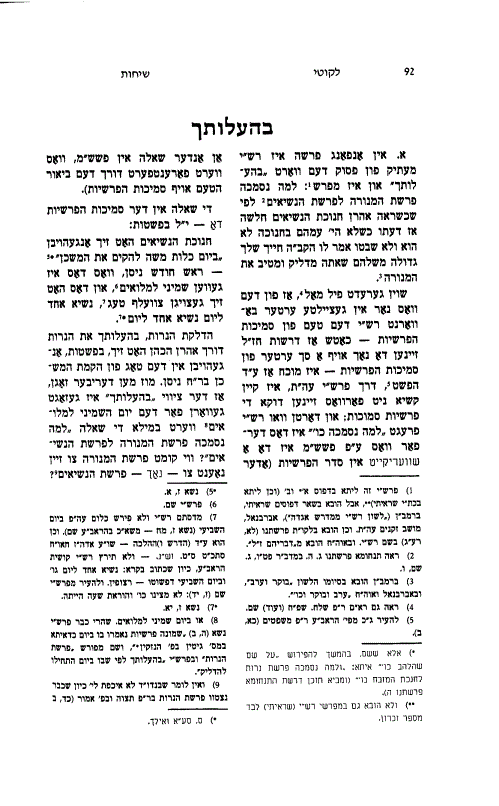
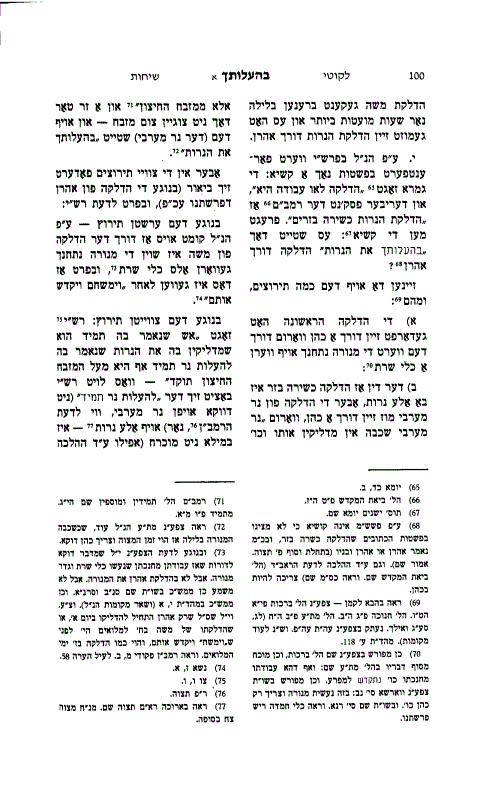
In this review, we will be studying a sicha from Likkutei Sichos, Chelek Yud Ches (Volume 18), specifically the first sicha on Parshas Beha'aloscha. This is a Rashi-focused sicha, but the Rebbe uses it as an opportunity to discuss the entire topic of the dedication of the Mishkan, touching on many important details that help us understand the parsha more deeply. Many of these insights are introduced almost incidentally within the sicha, yet they offer a completely new perspective on the peshat—the plain meaning—of the verses.
The sicha also contains significant chidushim—novel insights—in halacha. The Rebbe explains various concepts as understood by Rashi and contrasts them with how they are presented according to the Rambam. Since this is a lengthy and detailed sicha, we will proceed step by step. With Hashem's help, we hope to gain at least some understanding of the Rebbe's approach and explanations.
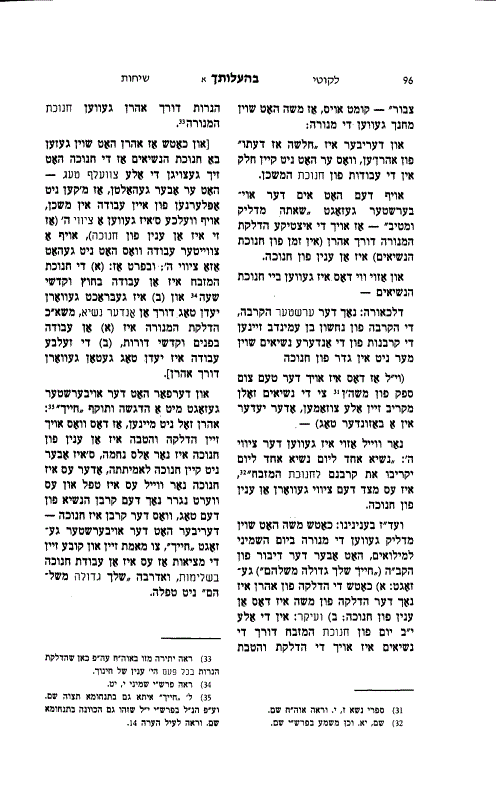
The first point addressed is in Ayis Aleph, where the Rebbe focuses on clarifying the simple meaning in Rashi's commentary. The Torah discusses the menorah: Hashem tells Aharon, "Beha'aloscha es ha-neiros el mul pnei ha-menorah"—the commandment regarding kindling the menorah lamps. Rashi comments on why this section about lighting the menorah follows immediately after the section about the offerings brought by the leaders of each tribe (Nesi'im) in Parshas Naso, which we just completed.
Rashi explains this juxtaposition, but before delving into his answer, the Rebbe asks: Why does Rashi even feel compelled to explain why these two parshas are placed next to each other? It's not Rashi's usual practice to comment on every instance where sections are adjacent in the Torah. Clearly, something specific here is troubling Rashi that requires clarification.
The Rebbe will analyze what exactly is bothering Rashi in this context and why he chooses to address it here when he does not always do so elsewhere. In Ayis Aleph, we will see a thorough explanation of what prompts Rashi's question and how it fits into understanding peshat.
After establishing what motivates Rashi's comment, the Rebbe will present Rashi's answer. However, further questions about Rashi's approach will arise in Ayis Beis. While we may begin to grasp what bothers Rashi and his initial response, a deeper understanding of his precise wording and intent will only become clear as we continue through the Rebbe's analysis.
With that introduction, let us look inside Parshas Beha'aloscha and begin exploring these ideas directly from the text.
Saif Aleph
At the beginning of Parshas Beha'aloscha, Rashi comments on the verse that describes the mitzvah of lighting the menorah. He asks why the section about the menorah follows immediately after the section about the dedication offerings brought by the leaders of the tribes—the Nesim. The Rebbe points out that Rashi’s question is not just about proximity, but specifically about why this portion comes after Parshas Hanessim, rather than simply being placed next to it for any reason.
Rashi explains that during the twelve days of dedication described in the previous parsha, each tribe brought its offering to inaugurate the Mishkan. Aaron, representing both himself and his tribe—mateh Levi—was not included in this process. He saw all the other tribes participating in this special dedication, but neither he nor anyone from his tribe was involved.
This exclusion caused Aaron distress; he felt left out from a significant communal event. In response, Hashem reassures him: “Chayecha—by your life—I promise you that yours is greater than theirs.” Hashem tells Aaron not to feel bad because his role in kindling and preparing the menorah surpasses what the Nesim accomplished with their offerings. The Rebbe will later explain in detail how this response addresses Aaron’s feelings and what makes his service unique and superior.
Before delving into those specifics, however, the Rebbe first addresses a more fundamental question: Why does Rashi even raise an issue about one parsha following another? Usually, Rashi does not comment on why one sedra comes after another; we read through parsha after parsha without such explanations. Only in rare cases does Rashi discuss why two sections are juxtaposed.
The fact that Rashi only occasionally explains why two portions are adjacent shows that, according to his approach—focused on peshat—the simple meaning—it is generally not a question at all. The Torah’s order is accepted as it is unless there is some difficulty or inconsistency in understanding the sequence according to peshat. Only then does Rashi address it.
Sometimes, there may be another issue in the literal meaning of a verse that can be resolved by explaining why two portions are placed together. But unless there is such a problem or confusion for the reader, Rashi does not feel compelled to comment on their order.
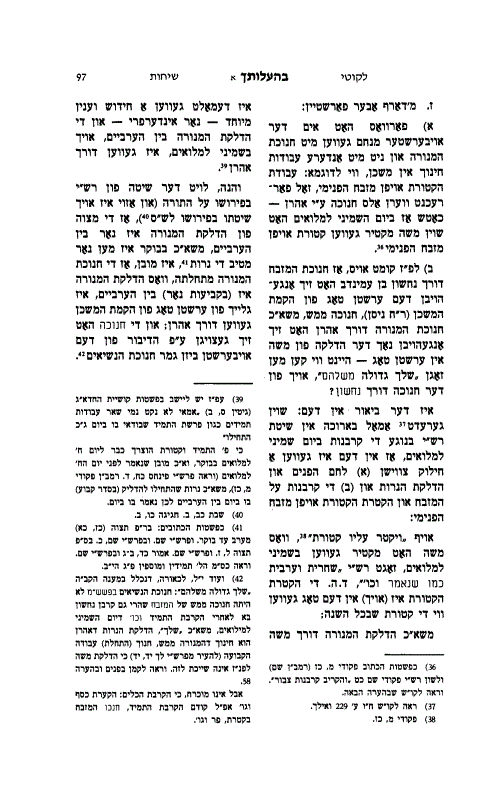
In our case, what prompts Rashi’s question? The Torah describes twelve days of inauguration offerings by the Nesim—from Rosh Chodesh Nisan through Yud-Beis Nisan. Presumably, Aaron began lighting the menorah from Rosh Chodesh Nisan as well—the mitzvah applies from when the Mishkan was erected. So why does the Torah wait until after describing all twelve days of offerings before introducing Aaron’s mitzvah with “Beha’aloscha es haneiros”?
This placement seems out of order and could lead someone to mistakenly think that Aaron only began lighting after those twelve days were over. To prevent such confusion and clarify why these sections are ordered as they are, Rashi addresses their juxtaposition here.
The dedication of the Nesim began on the day Moshe finished erecting the Mishkan—the eighth day of inauguration—which was Rosh Chodesh Nisan. From then on, each day for twelve days a different tribe brought its offering; one tribe per day. During this entire period, Aaron was already performing his service with the menorah.
Saif Beis
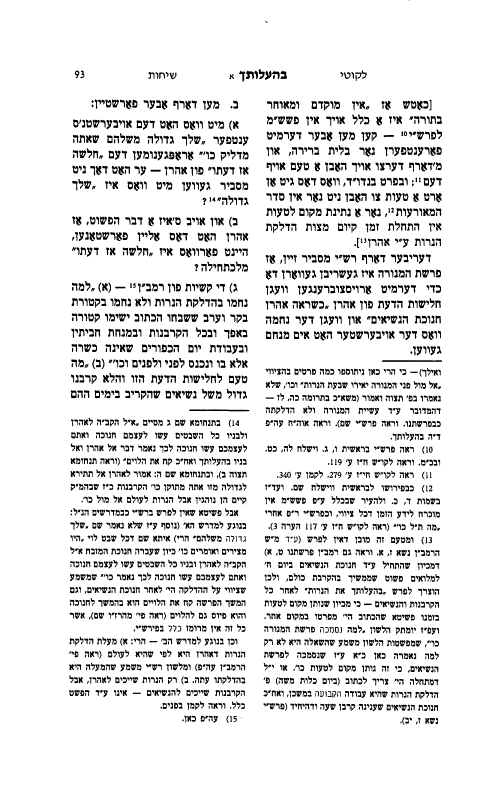
In the previous section, we discussed the order of the parshiyot: first, the Torah describes the offerings of the Nesiim, and only afterward does it speak about the lighting of the menorah by Aaron. However, if we look at the timeline, the command to light the menorah was given before the eighth day of inauguration, so that Aaron could perform this service on that very day. This raises a question: why does the Torah place the section about lighting the menorah after that of the Nesiim? Logically, it should have appeared earlier.
The standard answer often given is based on a well-known rule in Torah study: “There is no earlier or later in Torah”—the Torah does not always follow chronological order. Rashi himself brings this principle many times. So, even though it would make sense for this passage to appear earlier, it is placed here for reasons beyond simple chronology.
However, this explanation is not entirely satisfying. We cannot simply invoke this rule every time something seems out of order and leave it at that—especially when placing these sections out of sequence could lead to confusion about when certain events actually took place. In our case, someone might mistakenly think that Aaron’s command to light the menorah came after all twelve tribes brought their offerings, when in fact it preceded them.
Therefore, Rashi feels compelled to address this issue directly. He explains that there is a special reason for placing these passages together: to highlight Aaron’s reaction upon seeing the dedication offerings brought by each tribe’s leader. Aaron felt left out and saddened that he and his tribe were not included in this aspect of inaugurating the Mishkan.
This arrangement in the Torah sets up an opportunity for Hashem to comfort Aaron. The placement is intentional—not just a random disregard for chronology—so that we can learn about Aaron’s feelings and Hashem’s response.
Now that we understand why Rashi addresses this question, another issue arises: what exactly is Hashem’s answer to Aaron? How does Hashem comfort him? The Torah records Hashem telling Aaron that his role in lighting the menorah is “greater than theirs.” But how does this truly address Aaron’s disappointment?
Aaron was upset because he wanted to participate in dedicating the Mishkan alongside the other leaders. Simply telling him “yours is greater” may not seem like much of a comfort if he still feels excluded from that specific event. What makes his service with the menorah superior? How does this answer truly ease his pain?
The Rebbe points out that Rashi will clarify later how Hashem explains to Aaron why his service is indeed greater than theirs. For now, though, we are left with questions: If lighting the menorah is obviously such an important task—one everyone recognizes as special—why did Aaron need Hashem to tell him not to feel bad? If it was so clear, why did he feel bad in the first place?
Furthermore, Ramban raises additional questions: If Hashem wanted to comfort Aaron by highlighting his unique service, why mention only lighting the menorah? There were other significant services performed exclusively by Aaron and his descendants—the burning of incense (ketores), offering sacrifices (karbanos), bringing daily meal offerings (menachas chavitin), and especially serving as Kohen Gadol on Yom Kippur. Why single out only one aspect?
The verse itself singles out ketores as a particularly special service: “They shall place incense before You.” Burning incense was considered extremely holy—perhaps even more so than lighting the menorah. And what about all other sacrifices offered by kohanim? Or Yom Kippur service performed solely by Aaron as Kohen Gadol?
These questions set up a deeper exploration into what makes Aaron’s role unique and how Hashem’s words truly serve as comfort. The answers will unfold as we continue through Rashi’s commentary and analyze each element of Hashem’s response.
Saif Gimmel
The Rambam lists various privileges and opportunities given to the Kohen Gadol, the tribe of Levi, and the descendants of Aaron. Given all these honors, why does Hashem specifically comfort Aaron by telling him about the lighting of the Menorah? Furthermore, Aaron himself brought many offerings—on the day of inauguration, he offered several sacrifices. Why would he feel left out when his own offerings were so significant?
According to the Rambam, even during the seven days of inauguration before the eighth day, it was Aaron who brought all the sacrifices. This means that Aaron had a major role in dedicating the Mizbeach. However, the Rebbe points out that according to Rashi and the simple meaning of the verses, Moshe Rabbeinu was actually the one who brought those sacrifices during the first seven days; Aaron only began on the eighth day. Still, even if Moshe physically offered them, they were considered Aaron’s offerings—he was their owner and beneficiary.
The Torah makes it clear that on the eighth day—the shmini l’miluim—Aaron himself brought and offered sacrifices. So whether we follow Rashi or Rambam, Aaron was deeply involved in sacrificial service and dedication of the altar. Why then does he feel excluded from participating in the dedication (Chanukas HaMizbeach) alongside the Nesiim?
Adding to this question: The Nesiim themselves did not actually offer their own sacrifices; it is logical to assume that Aaron was the one who performed those offerings on their behalf. So not only did he have his own role in bringing korbanos, but he also facilitated theirs! Why would he feel bad about not being included in their specific dedication?
The Rebbe explains that there is something unique about Hashem’s comfort to Aaron—“aval shelcha gedolah mishelahem”—which addresses this very point. The comfort is not just about having important tasks or privileges; it is about having a unique role in dedication itself.
Now, turning to Rashi’s specific language: First, why does Rashi use an oath (“Chayecha”)? Why is it necessary for Hashem to swear that “yours is greater than theirs”? Second, Rashi says “you light and you make good (clean) the lamps,” but the verse itself does not mention cleaning or preparing them—only lighting. Why does Rashi add this detail? Third, Rashi uses present tense (“you light,” “you make good”), even though this conversation takes place after all twelve tribes have already brought their gifts for inauguration. Shouldn’t it say “you lit” or “you made good,” referring to what happened at that time?
All these questions point toward a deeper explanation that will be developed further in this sicha. The Rebbe clarifies that Hashem’s comfort was not simply about giving Aaron another important job; rather, it was about including him in Chanukah—the act of dedication itself.
Aaron felt bad because he wanted to participate specifically in dedicating something within the Mishkan—not just performing ongoing service or enjoying privileges. Hashem’s response is that lighting and preparing (making good) the Menorah is itself an act of dedication—a Chanukah—just as much as bringing inaugural offerings for the Mizbeach.
This means: Just as each Nasi dedicated a part of the altar through their korbanos, so too did Aaron dedicate a key vessel—the Menorah—through his unique service. The other vessels’ dedications were done by Moshe Rabbeinu (as will be explained later), but only Aaron had this special role with regard to lighting and preparing the Menorah.
This distinction comforts Aaron: Not only does he have a share in Chanukah, but his share—the dedication of the Menorah—is even greater than theirs. Rashi highlights three details (to be discussed further) which show how Aaron’s role surpasses that of the Nesiim.
Saif Daled
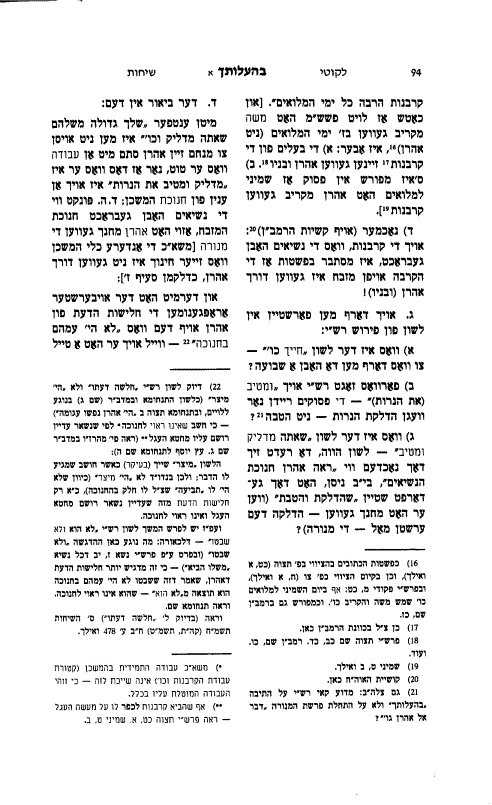
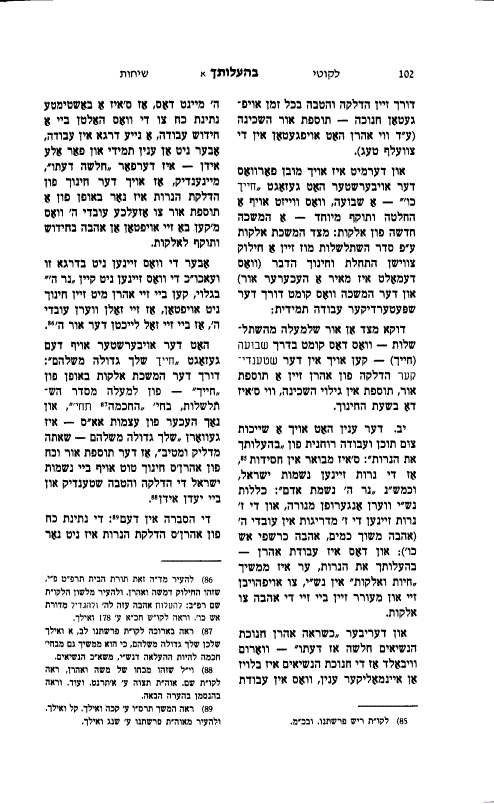
Rashi enumerates three points: first, “sha'ato”—that it is you, Aaron, who performs the act; second, “beis madlikum etiv”—you both light and prepare the Menorah; and third, that this is done with the lamps themselves. The Rebbe explains in the next section how these aspects make Aaron’s dedication of the Menorah greater than the dedication of the altar by the leaders of the tribes.
To begin with, regarding “sha'ato”—the sacrifices brought by the leaders for the dedication of the altar were not actually offered by them. They brought their gifts, but the actual offering on the altar was performed by the kohanim. In contrast, when it comes to Aaron’s role in inaugurating the Menorah, he himself performs all aspects of its service. This means that Aaron is directly involved in every step, unlike the leaders who only initiated but did not complete their offerings.
The second point addresses both preparation and action—“madlikum etiv.” The Menorah requires two steps: preparing and cleaning it (making it ready), and then actually lighting it. The leaders of the tribes prepared for inauguration by bringing their offerings, but someone else completed the actual offering. If Aaron had only lit the Menorah without preparing it, he would have performed only part of its dedication. Rashi emphasizes that Aaron does both—he prepares and lights—unlike the leaders who only did one part.
This distinction clarifies a potential question: what is considered greater—the beginning of an act or its completion? The leaders began their service by bringing offerings, but did not finish with the actual sacrifice. If Aaron had only lit without preparing, he would have completed but not begun. Since he does both preparation and lighting, Aaron’s involvement encompasses every stage of dedication.
The third aspect is that this service involves “sanedus”—the lamps inside the Ohel Moed (Tent of Meeting). The dedication by the leaders took place on the outer altar in the courtyard. Even though they brought incense (ketores), which is usually offered on the inner altar, in this case their incense was an exception and was brought on the outer altar as a one-time instruction for that occasion. Their entire dedication occurred outside.
In contrast, Aaron’s dedication involves lighting inside—the Menorah stands within the Mishkan itself. This inner service gives his role a higher status than that of those who dedicated from outside. Thus, we see that Aaron’s act is not just a consolation prize; rather, Hashem tells him that his service is more significant because he personally performs every aspect—preparation and lighting—and does so in a holier place.
The Rebbe further explains why Aaron felt distressed to begin with if his role was so significant. Perhaps Aaron thought that Moshe Rabbeinu had already dedicated the Menorah and that his own involvement was secondary or merely a continuation rather than an inauguration. However, just as each leader’s offering—even after day one—was still considered part of dedicating the altar over twelve days, so too Aaron’s continuous lighting is counted as ongoing dedication.
Given all this clarity about Aaron’s special role in dedicating the Menorah—even greater than that of the tribal leaders—it raises a question: why did Aaron initially feel left out? He saw himself inaugurating something even more important than what others had done! It cannot be said that he simply didn’t understand this advantage; if it were truly novel or hidden from him, Hashem would have needed to explicitly tell him so when offering comfort.
Saif Hei
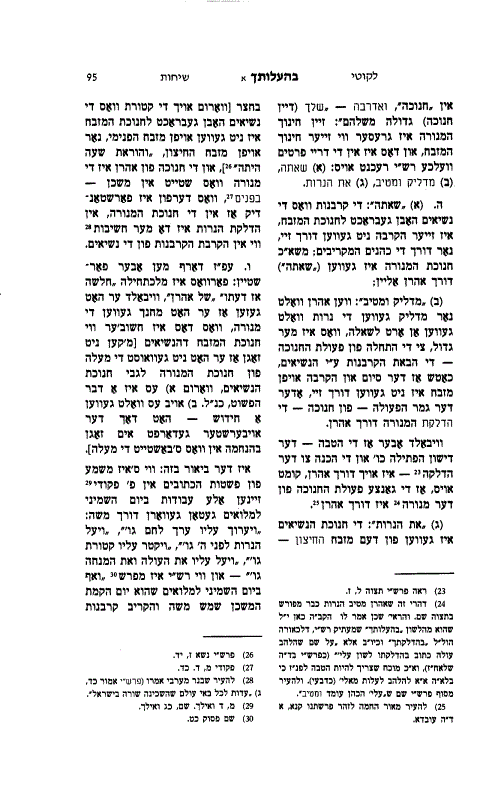
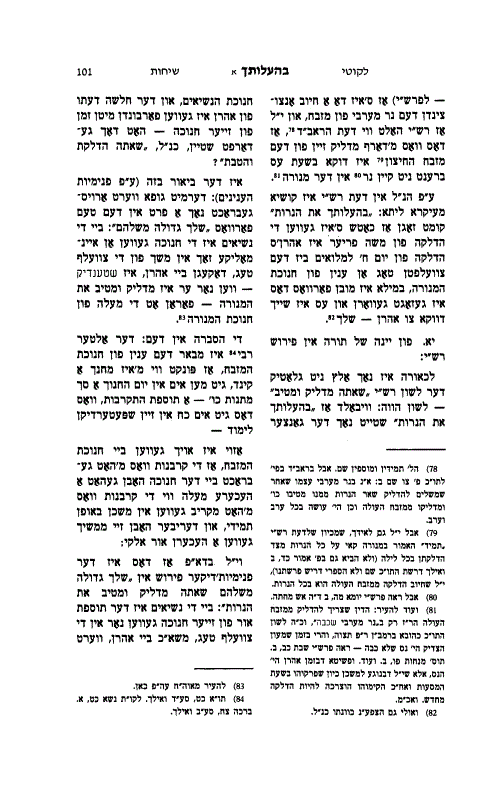
The explanation here is that, in fact, the very first time the menorah was dedicated, it was not Aaron who performed the service, but rather Moshe. We learn from the simple reading of the verses in Parshas Pekudei that all the services on the eighth day of inauguration were done by Moshe. Even on that eighth day, some of the avodahs—services—were performed by Moshe Rabbeinu himself, as Rashi explains on the relevant verses.
For example, it says that Moshe arranged the lechem hapanim—the showbread—on the table. It also says that he lit the lamps before Hashem and burned incense on the inner altar. Additionally, Moshe brought up both the burnt offering and the meal offering on the outer altar. Rashi clarifies that even on this eighth day—the day when the Mishkan was erected—Moshe served and offered communal korbanos (sacrifices).
This means that Moshe had already dedicated (mechanech) the menorah. Therefore, Aaron’s concern was that he had no share in the service of dedicating the Mishkan; he felt left out from this special avodah.
Hashem’s response to Aaron was that his work during these twelve days—the days when each tribal leader brought their offerings—would be considered his own dedication. Even though Moshe performed these acts first, Aaron’s service now is still regarded as a true inauguration.
Hashem told Aaron: “You will light and prepare.” This means that even though Moshe had already lit the menorah during the original inauguration, Aaron’s lighting during these twelve days is still considered an act of dedication—in a present and ongoing sense.
This parallels what happened with the leaders (nesi’im) who brought offerings for twelve consecutive days. Although only one leader could bring an offering on any given day, each one’s sacrifice was still considered part of the inauguration—even after the first day had already established it as such.
The Rebbe points out that this is why Moshe Rabbeinu initially hesitated about whether all leaders should bring their offerings together in one day or each on a separate day. He wondered: if only one brings it first, how can subsequent ones be considered inaugurators? Hashem clarified: each leader would bring his offering on a separate day, and each would count as an act of dedication for him.
Because there was a divine command for each leader to bring his korban as an act of dedication—even if not on the very first day—it became an authentic inauguration. The same logic applies to Aaron: even though Moshe had already lit the menorah once before, Aaron’s lighting during these twelve days is also counted as an act of inauguration.
Therefore, Hashem emphasized to Aaron: “Yours is greater than theirs.” Even though your lighting follows after Moshe’s initial lighting, it is still considered a true act of dedication.
During these twelve days—when each leader inaugurated with his korban—the lighting and preparation of the menorah by Aaron was likewise considered an inauguration, despite not being technically “the first.”
This raises a question: why did Aaron not realize this himself? After all, he saw that with regard to inaugurating the altar through sacrifices, all twelve days were called “Chanukas Hamizbeach”—dedication of the altar—even though only one leader went first.
The answer is that there are important differences between those cases. First, regarding Chanukas Hamizbeach (the altar’s dedication), there was a specific command from Hashem for it to take place over twelve days; thus every offering was included in this special status by divine decree. But with regard to lighting the menorah, there was no such explicit instruction from Hashem making every subsequent lighting part of a continuing inauguration.
Additionally, Chanukas Hamizbeach involved different leaders each day bringing their own korbanos; but with lighting the menorah, it was always Aaron performing this service inside (not outside like with sacrifices), and it continued for generations—not just during those inaugural days.
Because of these distinctions—especially since only one person (Aaron) did all twelve lightings—it seemed less obvious to consider every single lighting as its own act of dedication. That’s why Hashem needed to reassure Aaron emphatically: your daily service is indeed counted as true inauguration—not merely as consolation or something secondary following after each leader’s korban.
Hashem promises and establishes this fact: Aaron’s avodah—the lighting and preparation of the menorah—is fully recognized as an act of Chanukah (dedication). In fact, Hashem tells him explicitly: “Yours is greater than theirs.” Not only is it not less than theirs; it surpasses them in significance.
Saif Vov
The Rebbe explains that although at first glance, Aaron’s role in the inauguration of the Menorah might seem secondary to the offerings brought by the tribal leaders, in truth, his privilege is even greater. This is because, while the original command did not include Aaron’s specific service, once Hashem gave him this unique task, it became a matter of special significance and honor.
Since Hashem Himself granted Aaron the privilege of inaugurating the Menorah—even after the completion of the seven days of dedication and following Rosh Chodesh Nisan—this act was elevated to a true Chanukah (inauguration). The question arises: why did Hashem choose to comfort Aaron specifically with the lighting of the Menorah, rather than with another form of service or inauguration?
For example, Hashem could have given Aaron a special role in offering incense (ketores) on the inner altar (mizbeach hapnimi), which is also located inside the sanctuary. If so, why was it specifically through the Menorah that Aaron received his unique Chanukah? After all, on the eighth day of dedication, Moshe already offered incense on the inner altar. It would have been possible for Hashem to extend that inauguration to Aaron as well.
Another point to consider: if we look at when these inaugurations began, we see that Nachshon ben Aminadav—the first tribal leader—began his offerings on Rosh Chodesh Nisan itself. In contrast, Aaron’s inauguration through lighting the Menorah started only after Rosh Chodesh Nisan. This seems to suggest that Aaron’s role was not greater than Nachshon’s; Nachshon had already begun before him.
This leads to a further question: how can we say that “yours is greater than theirs”—that Aaron’s Chanukah surpasses those of all the tribal leaders—when Nachshon’s inauguration actually took place first? The Rebbe addresses this by clarifying that as far as the Menorah is concerned, Aaron’s act was indeed an original and primary inauguration.
The explanation lies in a careful analysis of Rashi’s view regarding the various services performed during these days. There were differences between what Moshe Rabbeinu did with regard to lechem hapanim, lighting the Menorah, bringing sacrifices on the altar, and offering incense on both altars. Not all these acts were performed in exactly the same way or at exactly the same times.
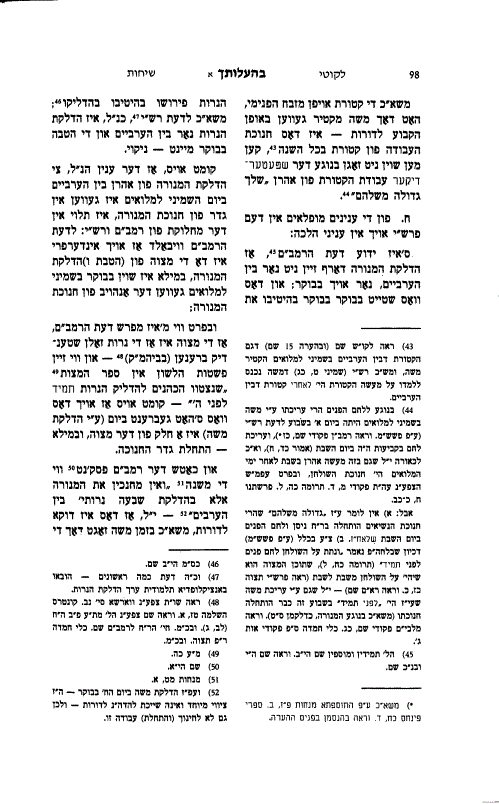
For instance, regarding incense (ketores) offered by Moshe Rabbeinu on both altars during the eighth day of dedication, Rashi explains that it was brought both morning and evening—just as it would be throughout the year. This means that Moshe performed this service in its regular fashion from day one.
However, when it comes to lighting the Menorah by Moshe Rabbeinu during this period, there was something unique about it. Unlike other services done twice daily (morning and evening), Moshe only lit the Menorah once—in the morning—as a special act for that occasion. The regular nightly lighting did not begin until later.
The actual mitzvah of lighting the Menorah according to Rashi (both in his Torah commentary and his commentary on Shas) is only at night—beyn ha’arbayim. In contrast, in the morning they would simply clean and prepare (meitiv) the lamps but not light them anew.
This means that when did true regular lighting—the mitzvah itself—begin? Only with Aaron’s service in the afternoon. That marked not just a continuation but an actual beginning: it was then that nightly lighting commenced as an ongoing mitzvah for generations.
Therefore, immediately after setting up (hakamas) the Mishkan, Aaron began this new phase—the true Chanukah (inauguration) of nightly Menorah lighting—which continued throughout all twelve days of offerings by each tribal leader. This extension was based directly on Hashem’s command and comfort: “Yours is greater than theirs.”
Saif Zayin
The discussion here focuses on the distinction between the inauguration of the incense on the inner altar and the lighting of the menorah. The incense service, as performed by Moshe Rabbeinu, was done in a permanent manner—according to how it would be done for all generations. This means that Moshe Rabbeinu inaugurated the incense service for the entire year, setting a precedent for how it would be performed going forward.
However, when it comes to the later services of incense, we cannot say that Aaron's service was greater than that of the tribal leaders (nesiim), because Aaron did not perform the first incense offering; that was done by Moshe. Even though Hashem could have arranged for Aaron’s service to be a continuation, he would then be like the second tribal leader, not like Nachshon ben Aminadav, who was actually first. Therefore, Hashem chose to highlight Aaron’s role with the menorah specifically—because there he could have a full and unique inauguration.
Still, this raises a question: if Aaron truly inaugurated the menorah by lighting it himself, why did he feel diminished? After all, Moshe Rabbeinu also lit the menorah during his time. Was Moshe’s act considered an inauguration or not? The answer is nuanced: while Moshe did light the menorah, his act was not considered an inauguration in the same sense as Aaron’s. Nevertheless, there is room to perceive it otherwise—hence Aaron’s concern.
This leads to another point: why did Hashem make it so that Aaron’s inauguration of the menorah would extend over twelve days? If only the altar’s inauguration required such an extended period (as Rashi explains), why was this necessary for the menorah as well? It seems that even though Aaron’s lighting was not technically the very first time (since Moshe had already lit it), his act constituted the true mitzvah-inauguration. To emphasize this, Hashem gave him an extended period so that throughout all twelve days it would be considered an ongoing inauguration.
The Rebbe then introduces a deeper analysis in Section 8 (Ois Ches), drawing from halachic discussions about whether Aaron’s lighting of the menorah on the eighth day of miluim (the dedication period) counts as its true inaugural mitzvah. This hinges on whether we follow Rashi or Rambam regarding when and how the mitzvah of lighting is fulfilled.
According to Rambam, lighting the menorah is required both in the morning and in the afternoon. The Torah says "baboker baboker beitibo es haneros"—instructing us to prepare (and according to Rambam, light) them in both timeframes. Thus, Rambam interprets "beitibo" as referring to actual lighting in addition to cleaning.
Rashi disagrees: he holds that lighting occurs only in the afternoon ("bein ha'arbayim"), while "beitibo baboker" refers solely to cleaning out and preparing the lamps—not lighting them anew. Therefore, according to Rashi, only afternoon lighting is counted as fulfilling this mitzvah.
This difference leads to a practical question: when Aaron lit the menorah on that first afternoon after miluim, was he inaugurating it? According to Rambam—since Moshe had already lit it in the morning—that act itself could count as an inauguration. Especially since Rambam views both morning and afternoon lightings as part of one continuous mitzvah: ensuring there is always light burning in the Temple.
Rambam even writes in Sefer HaMitzvos that kohanim are commanded "lehadlik ner tamid lifnei Hashem"—to maintain a constant flame before God. This suggests that even what burned during daytime after Moshe's initial lighting is part of this ongoing mitzvah; thus Moshe began its fulfillment and its inaugural use.
However, Rambam also rules (following Mishnah) that you cannot inaugurate (chanukas) a menorah except by lighting all seven lamps specifically in "bein ha'arbayim," during twilight/afternoon hours. So if Moshe only lit them in the morning, perhaps his act does not qualify as a true inauguration according to this standard.
The Rebbe suggests that perhaps this requirement—to inaugurate specifically with seven lamps at twilight—applies only for future generations ("ledoros"). In Moshe's time itself, things may have been different; thus his morning lighting could still count as an inaugural act under those unique circumstances.
Saif Ches
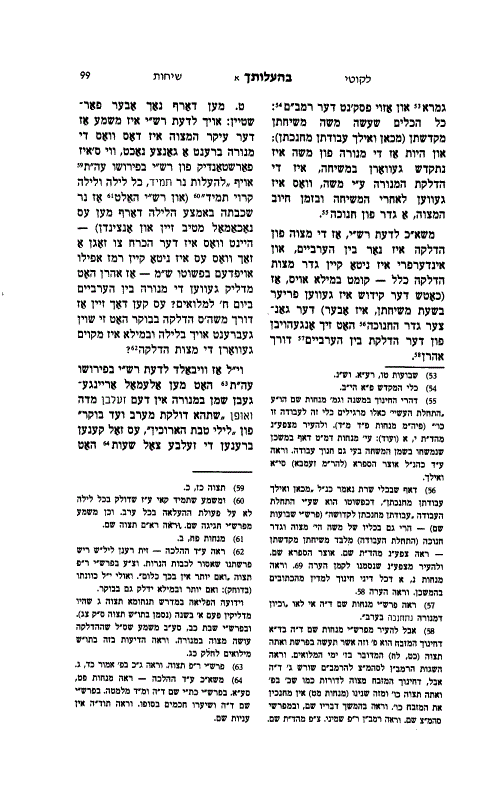
The Gemara discusses, and the Rambam rules accordingly, that all the vessels made by Moshe were consecrated through anointing. This act of anointing sanctified them, making them holy vessels—klei kodesh—fit for service in the Mishkan. From that point onward, however, it was not anointing but rather their use in service—avodah—that inaugurated new vessels for holy use.
Since the menorah made by Moshe was consecrated through anointing, when Moshe lit the menorah after its anointment, during the time of the mitzvah (in the morning), this act already constituted its inauguration. The Rambam derives this from the laws of Chanukah: once a vessel is inaugurated through its initial use, further formal inauguration is unnecessary. Thus, for subsequent generations, when there was no longer anointing, it was the actual service—lighting at night—that inaugurated new menorahs. But for Moshe’s menorah, since it had already been anointed and used by Moshe in the morning, that itself served as its inauguration.
This understanding follows the Rambam’s view that there is a mitzvah to light both in the morning and at night. However, according to Rashi’s opinion, the mitzvah of lighting applies only at night—bein ha’arbayim. Therefore, Moshe’s lighting in the morning would not count as part of the menorah’s inauguration according to Rashi. For Rashi, since there is no mitzvah to light in the morning at all, only Aaron’s lighting at night could serve as the inaugural act.
This leads to a question: if according to Rashi only nighttime lighting is a mitzvah and thus counts toward inauguration, how do we know that Aaron actually lit it at night? Perhaps Moshe’s morning lighting sufficed and burned through the night so Aaron did not need to light it again. The Rebbe addresses this by noting that each day a fixed amount of oil was used—enough only for one night. What Moshe lit in the morning would not have lasted through the entire night; therefore Aaron necessarily had to add oil and light it again at dusk. This act would then be considered his role in inaugurating the menorah.
Furthermore, Rashi comments on “ner tamid”—the perpetual lamp—that every night is called “constant,” meaning it must burn throughout every night. If a lamp extinguishes during the night, it must be relit; this demonstrates that nighttime burning is essential to fulfilling the mitzvah. Thus, even though there is no explicit verse stating Aaron lit it at dusk during inauguration, logic dictates he had to do so because otherwise there would not have been enough oil for a full night’s burning.
The Rebbe continues by addressing another difficulty: why did Hashem need to command Aaron specifically with “ba’aloscha es ha’neros”—“when you kindle the lamps”? The answer is that this commandment was meant to give Aaron personal involvement and privilege in inaugurating the menorah. Even though technically any Jew could light (since lighting itself is not considered a formal avodah, and thus permissible even for non-priests), Hashem wanted Aaron himself to perform this inaugural act.
This answers why we need a special portion about “ba’aloscha es ha’neros.” It wasn’t simply about who could light; rather, it was about granting Aaron honor and distinction as he inaugurated this central service of the Mishkan.
The Rebbe notes that some explanations suggest only a kohen could inaugurate or dedicate vessels as klei shareis, but this does not fully resolve our issue—since Moshe already performed an inaugural lighting in the morning. Why then does Aaron need his own separate commandment? This question undermines those alternative explanations.
Another answer cited is that since lighting can be done by any Jew (zar), perhaps “ba’aloscha” comes merely to clarify permissibility—but again, this does not explain why Aaron specifically needed to be commanded or honored with this task if anyone could do it.
The Rebbe concludes that these other answers are unsatisfactory; rather, “ba’aloscha es ha’neros” comes precisely to establish Aaron’s unique role in inaugurating and elevating this aspect of Temple service.
Saif Tes
The discussion here revolves around the unique status of the ner ma'aravi—the western lamp of the menorah. While most of the menorah's lamps could be lit by others, the western lamp specifically required a kohen for its lighting. The reason is that this lamp had to be kindled from the outer altar, and a non-kohen was not permitted to approach the altar. This distinction raises questions about the deeper meaning behind these requirements.
ונזר תורדך נש צוגעין צום מזבח—A stranger is not permitted to come close to the Mizbeach.
This restriction leads us to examine why, even after Moshe Rabbeinu had already inaugurated the menorah as a kli shares—a sacred vessel—Aaron still needed to perform his own act of inauguration through lighting it. The menorah had already been anointed and sanctified, so what was added by Aaron’s involvement?
The Rebbe explores two answers given in the commentaries but finds that both require further clarification. According to one answer, since Moshe Rabbeinu had already used the menorah during its inauguration, it should have acquired its sanctity as a kli shares. If so, why was Aaron’s lighting necessary for its dedication?
The second answer involves Rashi’s view: that only fire from the outer altar—the mizbeach hachitzon—could be used for lighting the lamps. Rashi cites verses such as:
אש תמיד תוקד על המזבח
"A constant fire shall burn upon the altar."
This fire is used to light the lamps, as it says:
להעלות נר תמיד
"To kindle a constant lamp."
According to Rashi, this requirement applies not just to the ner ma'aravi but to all lamps of the menorah. Therefore, if all lamps can be lit from this fire, and if there is no explicit proof that only a kohen must do so (since technically anyone could light from another lamp), why does tradition insist on a kohen for this task?
The Rebbe suggests that according to Rashi, there is no real question here. The verse about lighting is not primarily teaching us who may perform this service or how to inaugurate the menorah. Rather, it refers back to what happened during those twelve days of dedication—the chanukas hanesi’im. Even though Moshe Rabbeinu had already lit the menorah each morning during those days, Aaron’s act of lighting marked his own unique role in its ongoing service.
The Rebbe then points out a subtlety in Rashi’s language: Rashi uses present tense ("you light and prepare") even though these events occurred in the past during those twelve days. This choice of words highlights an important distinction between Aaron’s role and that of the tribal leaders (nesi’im). The leaders’ inauguration was a one-time event over twelve days; Aaron’s service continues every day whenever he lights and prepares the menorah.
This ongoing aspect of Aaron’s service demonstrates why his contribution is considered greater than theirs. The leaders’ inauguration was limited in time; Aaron’s connection with kindling and preparing the menorah endures perpetually. This reflects a deeper lesson about spiritual dedication—not just performing an inaugural act once but maintaining continual involvement and renewal in sacred service.
Saif Yud
The gifts and offerings brought during the inauguration of the altar represented an additional closeness to Hashem. This extra connection gave the participants strength in their later Torah study and spiritual endeavors. The same idea applied at the inauguration of the Mizbeach, where the sacrifices brought by the leaders during Chanukas HaMizbeach had a unique advantage and a higher level than the regular sacrifices offered in the Mishkan on an ongoing basis.
Because of this special quality, these inaugural offerings drew down a higher, more intense godly light. This is the deeper meaning behind the “additional light” that was revealed during those twelve days of inauguration—an illumination that was unique to that period. In contrast, Aaron’s lighting and preparing of the menorah accomplished a similar additional divine light, but not just for those twelve days; it continues at all times.
This explains why King David refers to a decision and special strength connected with this service. There is a new drawing down from godliness—from a level above the regular order of spiritual evolution—that occurs between the beginning and inauguration of the menorah. The light revealed at that time is higher than what follows in regular service, which lacks that elevated quality. Yet, even in ongoing service, there can be an “additional light”—an increase in revelation similar to what was experienced during the inauguration.
In other words, what was experienced during those twelve days can continue throughout all time through Aaron’s ongoing lighting of the menorah. This concept also applies to the spiritual meaning behind lighting the menorah: it represents igniting and elevating Jewish souls. As it says, “the soul of man is a lamp of Hashem”—meaning every Jewish soul is like one of Hashem’s lamps.
The menorah itself represents all Jewish souls collectively, with its seven lamps symbolizing seven different paths or levels in serving Hashem. Some serve with love like water—gentle and flowing—while others serve with love like fire—intense and passionate. Each lamp represents a different approach or emotional quality in divine service.
When Aaron lights these lamps, he brings vitality and godliness into Jewish souls. He raises them up and awakens within them love for Hashem. His role is to ignite this flame—to draw down divine energy so that Jews are inspired with renewed love for God.
Therefore, when Aaron saw that the inauguration was only for those twelve days—a one-time event—he felt distressed. In terms of spiritual service, such inaugurations represent unique moments when people can achieve something novel or extraordinary in their relationship with Hashem. But these moments are not constant; they are reserved for those capable of such novelty.
Aaron worried that his own role—the daily lighting of the menorah—might only benefit those already capable of spiritual renewal or innovation, leaving out those who do not openly display their inner divine spark. He thought perhaps his service could not reach everyone equally.
Hashem reassured him: “Yours is greater than theirs.” Through Aaron’s lighting of the menorah, godliness is drawn down from an even higher source—a level associated with Chochmah (wisdom), which transcends ordinary spiritual progression. This means Aaron’s influence is constant and ongoing; it continually brings additional light and power to all Jewish souls.
The explanation is that Aaron’s act does not merely prepare Jews for future service (as did the inaugural offerings), but actually becomes part of their inner being—it transforms their very soul. This transformation comes specifically through revealing Chochmah within each Jew’s soul; it becomes an intrinsic aspect of who they are as Jews.
As a result, every Jew—even one who does not openly serve Hashem—possesses this inner light. Deep within every Jewish soul lies a spark rooted in Chochmah that naturally yearns for its divine source. Through Aaron’s lighting—the transmission of Chochmah into each Jew—they become true “lamps of Hashem,” capable themselves of radiating divine light.
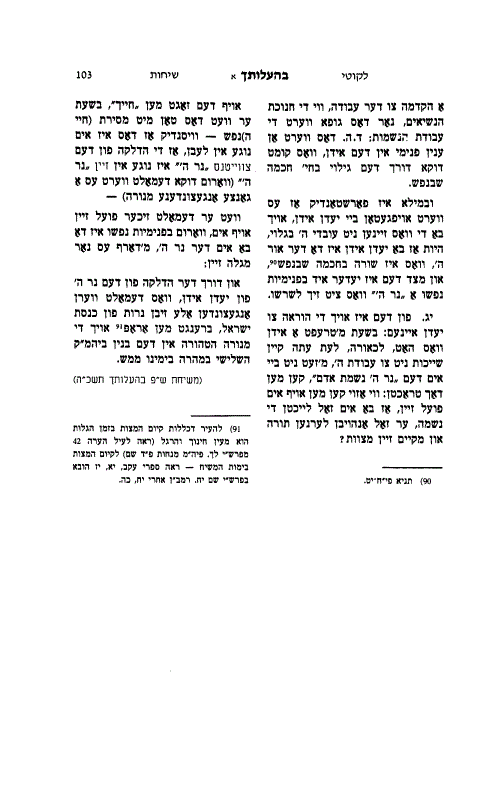
This leads to a practical lesson: When you encounter another Jew who seems disconnected from Torah or mitzvos—someone whose inner lamp appears hidden—you might wonder how you could possibly inspire them to study Torah or observe mitzvos.
The answer is found in approaching this task with genuine self-sacrifice—with mesiras nefesh—a sense that igniting another person’s lamp is vital to your own life as well. When you kindle another Jew’s lamp with sincerity and dedication, you also illuminate your own soul more brightly.
When all individual lamps are lit together, they form one unified menorah—a collective illumination representing all Jewish souls shining as one before Hashem. Even if someone appears distant from holiness on the outside, deep within they possess this spark; our job is simply to reveal it by kindling their inner lamp.
When we succeed in lighting up every Jew’s lamp—in gathering together all seven branches representing every type within our people—we draw down pure divine light into our world. This collective illumination hastens the building of the third Beis Hamikdash speedily in our days.
Key Points
1. The Rebbe analyzes why Rashi comments on the juxtaposition of the menorah section with the offerings of the tribal leaders, noting that Rashi only addresses such questions when there is a difficulty in the plain meaning of the text.
2. Rashi explains that Aaron felt left out from the dedication of the Mishkan, and Hashem comforts him by saying his role in lighting and preparing the menorah is greater than the offerings of the Nesiim, raising questions about what makes Aaron’s service unique.
3. The Rebbe clarifies that Aaron’s distress was not about lacking important tasks but about not participating in an act of dedication; Hashem’s response highlights that lighting and preparing the menorah is itself a form of inauguration, even greater than that of the tribal leaders.
4. Three aspects make Aaron’s role superior: he personally performs both preparation and lighting; he completes every stage of dedication; and his service takes place inside the Mishkan, giving it a higher status than the external altar dedications of the Nesiim.
5. Although Moshe Rabbeinu performed many inaugural services—including lighting the menorah—Hashem assures Aaron that his own lighting during the twelve days is also considered an act of dedication, paralleling how each Nasi’s offering was counted as inauguration even after day one.
6. The Rebbe explains that Hashem specifically chose to comfort Aaron with menorah lighting because this service marked a new phase—the true ongoing mitzvah for generations—beginning with Aaron’s nightly lighting after Moshe’s initial act in the morning.
7. The distinction between incense and menorah inaugurations lies in who performed them first; only with the menorah could Aaron have a full and unique inauguration, which was extended over twelve days to emphasize its ongoing significance despite Moshe’s earlier involvement.
8. According to Rambam, both morning and afternoon lightings are mitzvos, while Rashi holds only nighttime lighting counts; this difference affects whether Moshe or Aaron is credited with inaugurating the menorah as a mitzvah act.
9. The command “ba’aloscha es ha’neros” establishes Aaron’s personal privilege in inaugurating and elevating menorah service, emphasizing his unique honor even though technically any Jew could light it once it was already sanctified as a holy vessel.
10. The ongoing nature of Aaron’s service—lighting and preparing the menorah every day—surpasses the one-time inauguration by the tribal leaders, reflecting a continual spiritual renewal rather than a limited event.
11. Spiritually, Aaron’s daily kindling represents igniting Jewish souls and drawing down divine light not just at special moments but constantly, reaching every Jew through revealing their inner spark rooted in Chochmah (wisdom).
12. The lesson for all is to approach inspiring others with mesiras nefesh (self-sacrifice), recognizing that kindling another Jew’s inner lamp also brightens one’s own soul and unites all Jews into one collective illumination before Hashem, hastening redemption.