
Introduction
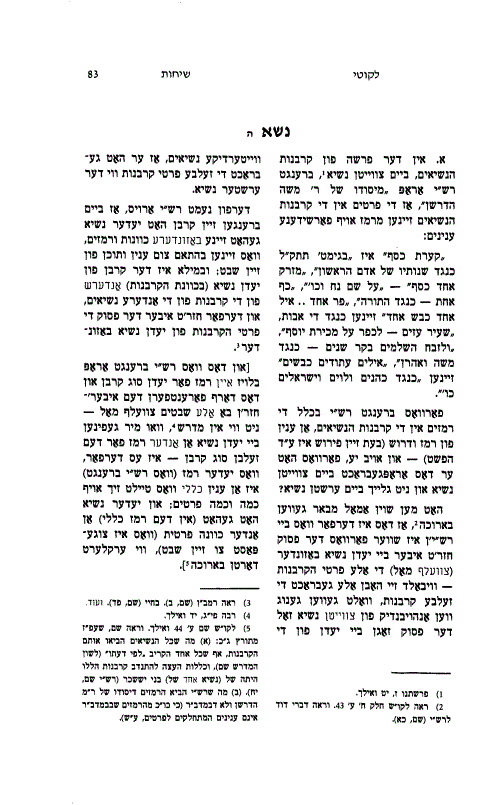
In this sicha, we will be studying Lekutei Sichos, volume 18, the fifth sicha for Parshas Naso. This is a Rashi sicha, but the Rebbe focuses on the second Rashi in Naso that discusses the offerings brought by the leaders of each tribe—the nesiim. The Torah describes how each nasi brought his offering, starting with Nachshon ben Aminadav on the first day of Nissan, and then continuing with each subsequent leader over twelve days. Although their offerings were identical, Rashi brings in the teachings of Rav Moshe HaDarshan to explain the deeper meanings and allusions behind each detail of what they brought.
The Rebbe will analyze how Rashi presents these explanations and will clarify many nuances in Rashi’s wording. He notes that he has already discussed this Rashi in a previous sicha, but here he will continue to explore and clarify many points about Rashi’s approach—especially how Rashi divides his commentary into two main categories or themes, as we will see inside.
First, the Rebbe points out that in the section of the Torah describing the offerings of the tribal leaders, there is a unique style: when it comes to the second nasi, Rashi brings in Rav Moshe HaDarshan’s interpretation. Rav Moshe explains that every detail in these offerings alludes to something significant.
For example, regarding the “ka’arat kesef”—the silver bowl—Rashi says its numerical value is 930. What does 930 represent? It corresponds to the years of Adam HaRishon’s life; Adam lived for 930 years. Thus, the silver bowl alludes to Adam HaRishon.
Another example: “Mizrak echad kesef”—one silver basin. Rashi explains that this refers to Noach. In fact, throughout these verses and Rashis, we find that each item or number hints at a different figure or concept from Jewish history.
The Rebbe will go through these Rashis and show how each detail—the weights, numbers, and items—are interpreted numerically or symbolically according to Rav Moshe HaDarshan’s method. For instance, “mizrak echad kesef” is explained by its gematria (numerical value), and so forth.
This approach raises questions: Why does Rashi bring these explanations specifically here? What is unique about Rav Moshe HaDarshan’s method? And how do these allusions fit into Rashi’s general style of commentary?
The Rebbe will address these questions by analyzing both categories within Rashi’s commentary—those explanations based on gematria and those based on symbolic association—and will clarify their significance as we proceed through the sicha.
Saif Aleph
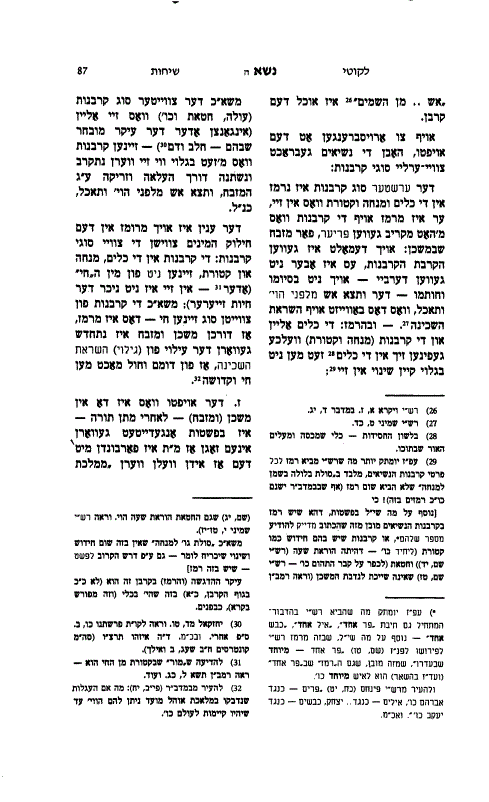
Rashi brings various hints regarding the sacrifices of the leaders—each one, even though it is the same category of korban, has its own unique hint. That is why the Torah repeats these details, but in truth, it does not seem to add any new meaning behind these korbanos. The Rebbe explains that every hint Rashi brings is a general idea—a inyan kloli—which then divides into many specific details. Each leader had within this general hint a particular aspect that was unique to him and his tribe, fitting specifically with their character and mission.
This approach is elaborated at length in Likkutei Sichos, where it is explained how each tribe’s special korban reflected something essential about that tribe. So far, this general explanation has been given. Now, the Rebbe seeks to understand the specific hints found in these korbanos: what are the details hinted at by each leader’s offering?
The question arises: are these hints just a collection of unrelated ideas? Is it simply that one detail hints to this concept and another to something else, with no connection between them? Or is there a unifying theme running through all the details of each leader’s sacrifice?
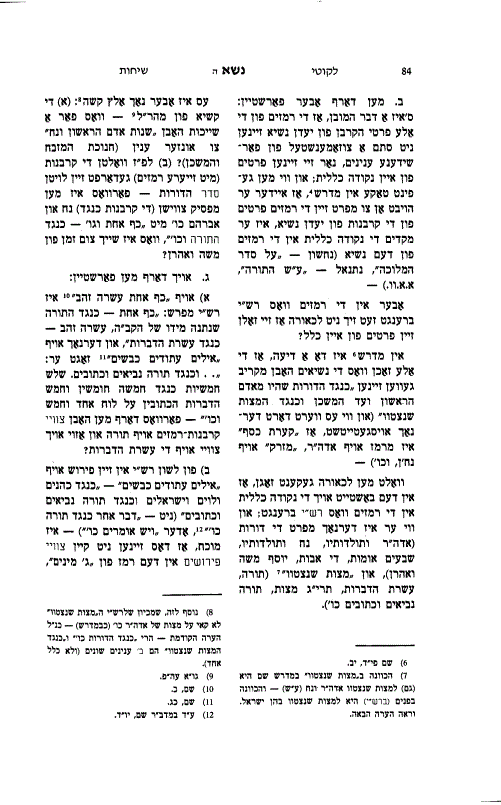
The Medrash actually addresses this point. Before specifying the individual hints for each leader’s offering, the Medrash introduces a general theme: what was each nasi doing with his korban? Only after establishing this does it go on to explain how each detail fits into that overall theme. For example, Nachshon represents kingship—he was from Yehuda—and so his offering reflects themes of royalty. Yissachar represents Torah study, so his offering reflects that focus. Each tribe has its own overarching theme, and from there flow all the individual details.
However, when we look at Rashi’s commentary on these verses, it does not seem like he presents these hints as details of one unified idea. Instead, they appear as a collection of separate hints without an obvious common thread.
The Medrash offers an opinion that all of these items brought by the leaders correspond both to generations—from Adam HaRishon until the time of the Mishkan—and to mitzvos that were commanded throughout history. For example, ka’arat kesef (the silver bowl) alludes to Adam HaRishon; other items correspond to Noach and so forth. The order follows from Adam through to the Mishkan itself.
Based on this Medrash, we might have said that this is indeed the general theme: first Adam HaRishon and his children (Shem, Cham, Yafes), then Noach (and through him the seventy nations), then Avraham, Yitzchak, Yaakov—the forefathers—followed by Moshe and Aharon. The mitzvos referenced include Torah itself: Aseres Hadibros (the Ten Commandments), taryag mitzvos (the 613 commandments), Torah Nevi’im Kesuvim (the three sections of Tanach). All these elements are found in Rashi’s explanations on these verses.
So it would seem there is a general theme here based on what the Medrash says: these offerings correspond to key figures and mitzvos throughout Jewish history.
However, difficulties remain with this explanation. First is a question raised by the Maharal in Gur Aryeh: what connection do Adam HaRishon’s and Noach’s years have with our topic—the dedication of the altar and Mishkan? The main focus should be Avraham, Yitzchak, Yaakov—the forefathers—and Torah itself; those are directly related to building an altar for Hashem. What relevance do Adam HaRishon and Noach have here?
A second difficulty: if these korbanos are meant as hints for those generations or mitzvos specifically connected to our subject—the inauguration of the Mishkan—then why do some details seem out of place or unrelated?
Saif Beis
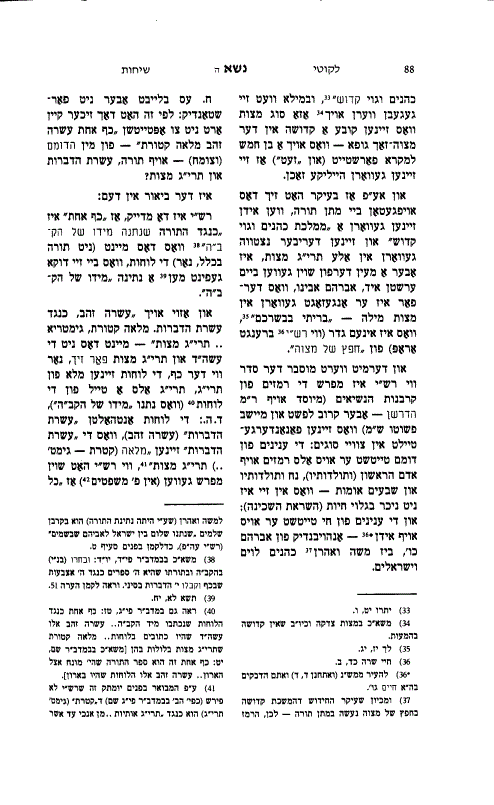
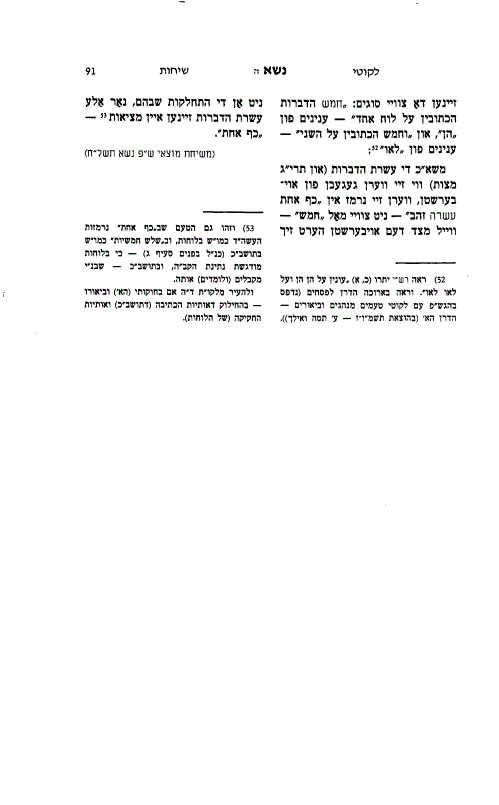
The Rebbe begins by analyzing the order of the hints in the parsha, specifically how the Torah interrupts between the korbanos of Noach and Avraham. As previously mentioned, Noach is hinted at by “mizrak echad kesev,” which equals 520, and this is associated with Avraham. But then the verse says “kaf achas asarah zahav,” a spoon of ten gold, which seems to interrupt between the korbanos and Avraham. The question arises: why is this detail inserted here, when it really belongs to the time of Avraham? The kaf achas asarah zahav, filled with ketores, seems out of place.
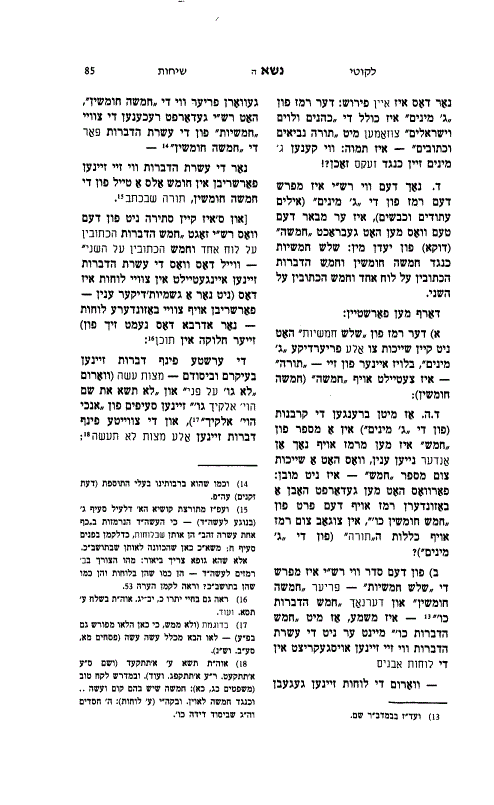
The Rebbe will later explain this in section three, focusing on the meaning of “kaf achas asarah zahav mele’ah ketores.” For now, we note that Rashi explains “kaf achas asarah zahav” as alluding to one spoon given from Hashem’s hand. The “asarah zahav”—ten gold—corresponds to the ten commandments. So we already have references to Torah and to the ten dibros.
Later on, when the verse discusses different types of korbanos—elim (rams), atudim (he-goats), and kevasim (lambs)—Rashi again brings down that these correspond to Torah, Nevi’im, and Kesuvim—the three sections of Tanach. The verse says: “elim chamishah, atudim chamishah, kevasim bnei shanah chamishah”—five rams, five goats, five lambs. Rashi explains that these three sets of five correspond to the five chumashim (books) of Torah. There are also five dibros on one tablet and five on the other; thus, there are multiple layers of symbolism.
This leads to a question: why do we need two separate hints for Torah? We have both kaf achas (the spoon) corresponding to Torah and also hints for the aseres hadibros (ten commandments). Why do we need two for aseres hadibros—the two tablets? When Rashi explains this verse about the three types of animals brought as korbanos in groups of five each, he first says they correspond to kohanim, levi’im, and yisraelim—the three main groups within Israel. Then he adds that they also correspond to Torah, Nevi’im, and Kesuvim.
It’s important to note that Rashi does not say “davar acher” (“another explanation”) or “yesh omrim” (“some say”) here; he simply continues his commentary. This indicates that these are not two separate interpretations but rather one unified explanation: the three types—elim, atudim, kevasim—simultaneously allude both to kohanim/levi’im/yisraelim and to Torah/Nevi’im/Kesuvim.
This raises a difficulty: how can three types correspond to six different things? If they are not two separate explanations but one combined hint, how do three categories represent six concepts?
In Hebrew:
זה נכנס לתשע דברים ולאחר זה...
This enters into nine things... (The transcript continues with a detailed discussion in Hebrew.)
The Rebbe points out that when Rashi lists elim, atudim, kevasim—three kinds—they correspond both to kohanim/levi’im/yisraelim and also to Torah/Nevi’im/Kesuvim. But only one among them is actually Torah; yet within Torah itself there are five chumashim. So when bringing korbanos in sets of five for each type of animal, it’s not simply counting three fives; rather there’s an additional layer—one set corresponds specifically to Torah’s five books.
The question then becomes: why does it matter that one set is specifically for Torah? Why emphasize that it’s five for Torah? If so much emphasis is placed on this number five within Torah itself—and especially since only one category among them is actually Torah—why highlight this detail?
Furthermore: within Torah itself there are already hints for five chumashim; so why add another layer by connecting it back again through these korbanos? Why do we need repeated allusions?
The Rebbe notes that perhaps this repetition serves a purpose—it strengthens or highlights something unique about these connections or about what is being hinted at through these numbers and groupings.
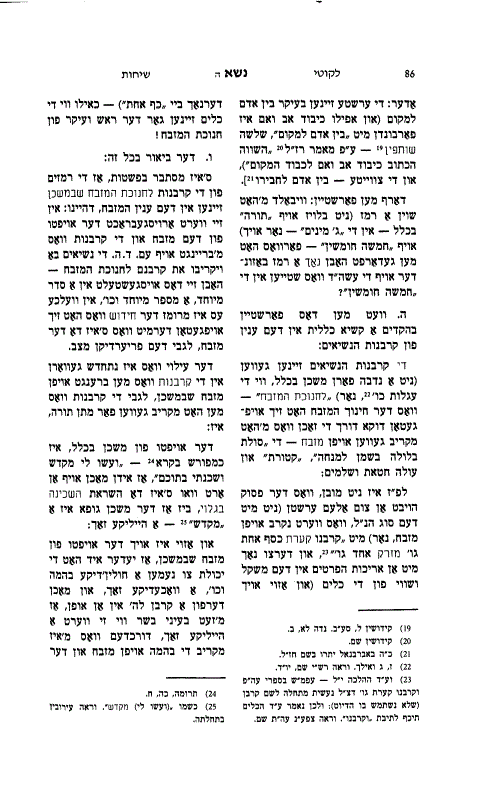
He then transitions into a discussion about how even within the ten commandments themselves there are divisions: five written on one tablet and five on another. This division isn’t merely physical but reflects deeper thematic groupings—such as those mitzvos between man and Hashem versus those between man and fellow man.
For example: honoring parents appears interpersonal but actually bridges both realms since Hashem is considered a partner in creation along with father and mother. Thus honoring parents honors Hashem as well.
This division between tablets reflects broader themes in mitzvos—some primarily bein adam laMakom (between man and God), others bein adam lechaveiro (between people), though sometimes a mitzvah straddles both categories.
The Rebbe concludes by emphasizing that understanding these layers isn’t just about counting numbers or finding clever hints; rather it reveals deeper truths about how all aspects of Torah interconnect—the written law (Torah), prophetic teachings (Nevi’im), sacred writings (Kesuvim), communal roles (kohanim/levi’im/yisraelim), and even how mitzvos themselves are structured within our relationship with Hashem and with others.
Saif Gimmel
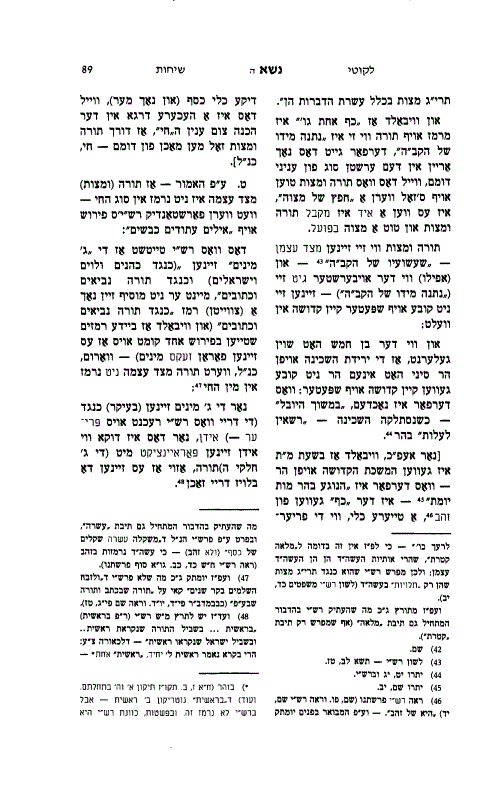
The uniqueness of the offerings brought by the leaders of the tribes is due to their connection with the Mishkan. For example, the mincha offering and other items that were brought for the inauguration of the altar are not like regular korbanos. We do not immediately understand why these specific offerings were chosen for the dedication of the Mishkan, since they are not standard sacrifices. The Torah begins by listing their gifts: silver bowls, basins, incense, and so on. But it does not explain why these particular items were selected or what their significance is in relation to the Mishkan.
We can distinguish between two categories regarding korbanos mentioned before and after the giving of the Torah. Before Matan Torah, there were sacrifices brought by individuals such as Adam and Noach, but these did not have a permanent status or a set place for offering them. After Matan Torah, however, korbanos became part of an ongoing connection with Hashem—there was a designated place (the Mishkan), and a consistent system for bringing offerings.
This distinction is also reflected in the dedication offerings for the altar in the Mishkan. The leaders saw themselves as inaugurating not just a physical structure but also a new spiritual reality—the altar’s function as a place where Hashem’s presence would rest among Bnei Yisroel. The unique nature of these korbanos is that they established this new relationship; they were not simply repeating what had been done before but creating something fundamentally new.
When we look at what makes these offerings special, we see that they are directly tied to the function of the altar itself. The leaders’ korbanos were meant to activate or dedicate this function—to transform ordinary materials into vessels for holiness. This is different from earlier korbanos, which did not have this transformative power because there was no permanent kedusha (holiness) attached to them or to their location.
The Mishkan and its altar represent a new halachic reality: now there is a place where mundane things can be elevated into holiness through avodah (service). For example, when an animal is brought as a sacrifice on the altar, it becomes holy and is consumed by fire from heaven—this demonstrates how something physical can be transformed into something spiritual through Hashem’s command.
To clarify further: there are two types of korbanos discussed here. The first type refers to offerings that existed before kedusha was established—these did not require an altar or any special sanctity; they were simply gifts or acts of devotion. The second type refers to true korbanos—offerings that are intrinsically holy and must be brought on an altar after Matan Torah.
The first category includes things like meal offerings and incense that could be brought even before there was an official altar; they did not require sanctification through fire from heaven. The second category includes actual animal sacrifices that must be offered on a sanctified altar after Matan Torah—they represent a transformation from mundane to holy.
This distinction helps us understand why bris milah (circumcision) is considered unique—it is itself a mitzvah that creates holiness within the person who performs it.
With this background, we can better appreciate how Rashi interprets allusions in the leaders’ offerings. Rashi brings teachings from Rabbi Moshe HaDarshan (the expounder), who explains that many details in these offerings hint at earlier events or people—for example, Adam HaRishon and his descendants, Noach and his descendants, and even the seventy nations of the world are alluded to in these verses. These hints refer to inanimate objects (domeim), such as flour or incense—things that do not openly reveal Hashem’s presence.
In contrast, when Rashi discusses items representing living beings (chai), he connects them with Avraham and his descendants—alluding to Jews who have already undergone transformation from mundane to holy through mitzvos like bris milah.
This brings us back to our original question: if so, why does Rashi include “kaf achas” (one spoon) filled with incense as representing Torah? Shouldn’t this belong in the second category—with living beings who have already experienced transformation? Why does it appear among items associated with domeim?
Rashi specifically writes that “kaf achas” corresponds to Torah “as it was given from Hashem’s hand”—that is, before any human involvement or change occurred. This refers specifically to the luchos (tablets) given at Sinai—not Torah as it exists later on through study or observance by people. The luchos themselves contained all 613 mitzvos; they were full (“malei”) of Torah because every mitzvah was included within them at that moment of giving.
Thus, when Rashi says “kaf achas” hints at Torah given directly from Hashem’s hand, he means precisely this stage—the original luchos containing both Aseres HaDibros (the Ten Commandments) and all 613 mitzvos as one unified gift from above. It does not refer to Torah as it later unfolds through human action or interpretation; rather, it represents Torah in its pristine state as received directly from Hashem.
Saif Daled
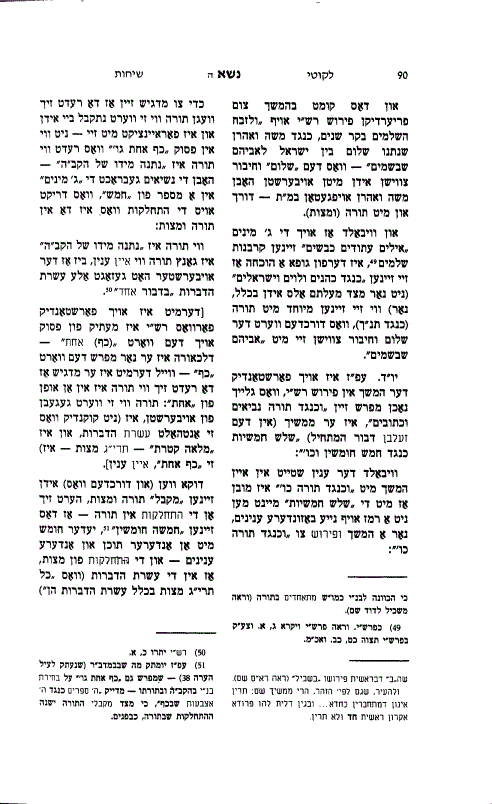
The ten sayings—the Aseres Hadibros—are described as being “full,” meaning they are complete. What is hinted at here, and what connects them to the Ten Commandments, is that the word “ketores” has the same gematria as taryag mitzvos—613 mitzvos. Rashi already explained in Parshas Mishpatim that all 613 mitzvos are included within the ten sayings.
This idea is alluded to in the fact that the Torah was given by the hand of Hashem. Since this “kaf achas”—the one spoon—represents the Torah as it was given from Hashem’s hand, it therefore belongs in the first category, which corresponds to inanimate objects.
The reason is because Torah and mitzvos, as they are given from above, do not yet accomplish a transformation of physicality into an object of a mitzvah. That transformation only happens when a Jew receives the Torah and mitzvos and actually performs them. The Torah and mitzvos themselves, as they exist on their own, are like Hashem’s playthings—they remain spiritual and do not yet bring about a change in the world below.
Even though Hashem gave them with His own hand, this revelation does not itself create lasting holiness in the world. Just as at Matan Torah—the giving of the Torah—the Shechinah descended on Mount Sinai but did not permanently sanctify it; after Matan Torah, Mount Sinai reverted to being an ordinary mountain. As every five-year-old learns, once the Shechinah left and the shofar sounded, people were allowed to ascend Mount Sinai again. This shows that a revelation from above does not automatically transform or sanctify physicality below.
However, at the time of Matan Torah itself, there was indeed holiness present; while the Shechinah rested on Mount Sinai, anyone who touched it would die because of its sanctity. This is why gold was used—it represents something precious and elevated compared to silver—and it reflects a higher level in preparing for future generations.
This higher level is necessary because through Torah and mitzvos we prepare ourselves to become a living generation—one that brings life into creation. But as explained above, Torah and mitzvos by themselves do not create something new; their transformative power only comes when we receive them and act upon them.
This explains why only certain aspects of Torah are hinted at in the category of “chai”—living things—as brought down regarding the kaf achas (the one spoon) of ketores. Now we can understand Rashi’s explanation regarding the three types of animals brought for korbanos: rams (ayilim), sheep (kevasim), and goats (udim).
Rashi teaches that these three types correspond to Kohanim, Leviim, and Yisraelim—and also to Torah, Neviim, and Kesuvim (the three sections of Tanach). However, Rashi does not mean that there is an additional hint here—he is not adding another layer so that there would be six categories instead of three. Rather, both sets correspond together: Kohanim/Leviim/Yisraelim parallel Torah/Neviim/Kesuvim.
The main point is that these three kinds represent different groups among Jews—Kohanim, Leviim, Yisraelim—and also correspond to different parts of Torah. This connection becomes clear when discussing zevach hashelamim—the peace offering—which involves two rams in the morning (boker shnayim). The two rams correspond to Moshe and Aharon; their role was to bring peace between Israel and their Father in Heaven.
This peace—this connection between Jews and Hashem—was accomplished through Matan Torah by means of giving us Torah and mitzvos. That is why these three types of animals also represent bringing peace between Jews themselves and between Jews and Hashem.
Therefore, it’s not just about Kohanim/Leviim/Yisraelim but also about Torah/Neviim/Kesuvim because this process brings about peace—that’s why these offerings are called shelamim (peace offerings). Through fulfilling Torah and mitzvos in all their forms—as represented by these three categories—we achieve true harmony among ourselves and with Hashem.
Now we can also understand Rashi’s conclusion regarding “chamishuyos”—the fivefold aspect—which refers to five sets or groups corresponding to Chamisha Chumshei Torah (the Five Books of Moses). The mention of five here connects back to earlier explanations about how everything ties into Torah itself.
The number five is not just a detail; it links these offerings directly with all aspects of Torah. When discussing “five” in this context, it refers specifically to Chamisha Chumshei Torah—not just any groupings or divisions found elsewhere.
This distinction helps clarify what Rashi means when he says “yado shel kadosh baruch hu achas”—that there was one hand from Hashem involved. Rashi emphasizes “achas” (“one”) because he wants us to understand that even though all ten commandments contain within them all 613 mitzvos, they are still unified as one essential aspect—the unity of Torah as given from above before being received below.
This unity explains why each chumash (book) builds upon those before it; each one contains within itself elements from previous ones but remains part of a single whole—the achas (“oneness”) reflected throughout all levels of Torah transmission.
Key Points
1. The Rebbe analyzes Rashi’s commentary on the offerings of the tribal leaders (nesiim) in Parshas Naso, focusing on how Rashi—drawing from Rav Moshe HaDarshan—finds deep symbolic meaning and allusions in every detail of their identical offerings.
2. Each tribe’s offering, though externally the same, contains hints that reflect the unique character and mission of that tribe; these hints are not random but are rooted in overarching themes that connect to Jewish history and spiritual concepts.
3. The Medrash and Rashi both present the idea that the leaders’ offerings correspond to key figures and mitzvos throughout history—from Adam HaRishon through Noach, the Avos, Moshe, Aharon, and the giving of Torah—yet questions remain about why certain figures like Adam and Noach are included in this context.
4. The Rebbe explores why certain details appear out of order or seem repetitive in their allusions to Torah and mitzvos, showing that these repetitions serve to highlight different aspects or layers within Torah itself and its transmission to the Jewish people.
5. Rashi’s commentary does not treat multiple allusions as separate explanations but rather as a unified system where items like elim, atudim, and kevasim simultaneously correspond to both communal roles (kohanim/levi’im/yisraelim) and sections of Tanach (Torah/Nevi’im/Kesuvim), reflecting an integrated spiritual structure.
6. The distinction between korbanos before and after Matan Torah is emphasized: only after Sinai do offerings become vehicles for transforming physicality into holiness through Hashem’s command, with the Mishkan inaugurating a new reality where mundane objects can be elevated through avodah.
7. Rashi distinguishes between items representing inanimate objects (domeim), which allude to Torah as given directly from Hashem without human transformation, and those representing living beings (chai), which symbolize Jews who have already been transformed through mitzvos like bris milah.
8. The “kaf achas” (one spoon) filled with ketores represents Torah as it was given from Hashem’s hand—containing all 613 mitzvos within the Ten Commandments—but before it is actualized by Jews through performance of mitzvos; thus, it belongs among hints connected to domeim rather than chai.
9. The unity of Torah is highlighted by Rashi’s emphasis on “achas” (“one”)—even though there are ten commandments containing 613 mitzvos, they remain unified as one essential aspect when given from above; this unity is reflected in both the structure of Torah and its role in bringing peace among Jews and between Jews and Hashem.
10. Ultimately, these detailed allusions reveal how every aspect of Torah—from its written form to its fulfillment by different groups within Israel—is interconnected; understanding these connections deepens our appreciation for how Torah transforms individuals and communities into vessels for holiness.