
Introduction
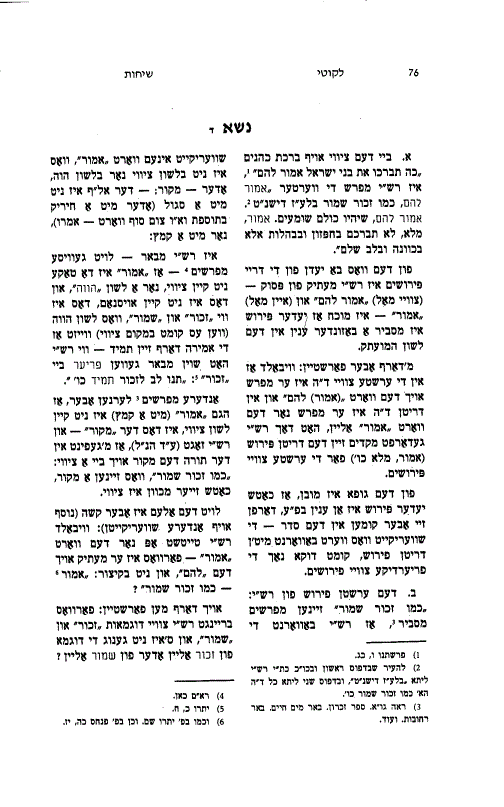
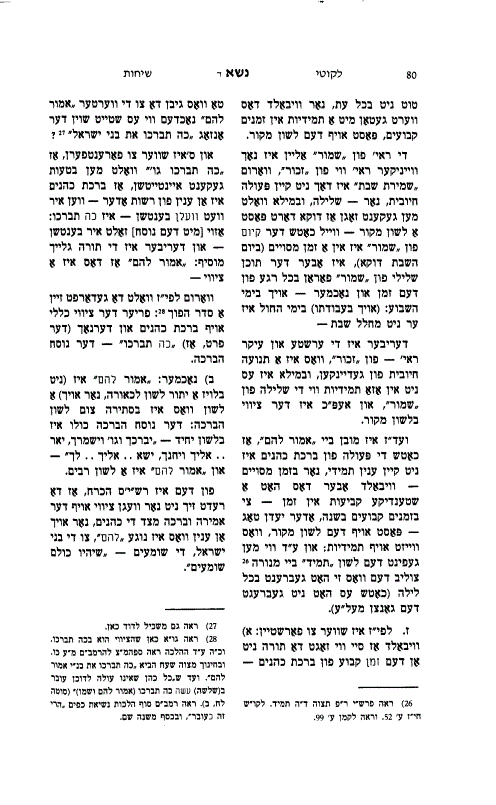
In this sicha, we will be reviewing Lekutei Sichos, volume 18, the fourth sicha for Parshas Naso. This is a Rashi sicha, where the Rebbe analyzes in detail Rashi’s commentary on Birchas Kohanim—the priestly blessing.
The verse states: “Omeir Lohem.” There are three separate dibur hamaschil headings in Rashi on these words, and Rashi explains each one. The Rebbe will examine the order of these Rashis and various nuances in their wording, as we will see inside.
We are learning this sicha l’ilui nishmas Harav Hachosid Harav Hatamim Harav Menachem Mendel ben Meir Yaakov, who passed away at a very young age. May the learning be for the elevation of his soul, and also as a merit for a refuah shleima for Golda Rachel bas Sarah Naomi.
Let’s look inside. When Hashem commands that the Kohanim should bless the Jewish people, the verse says: “So you shall bless the Bnei Yisroel; say to them—Omeir Lohem.” Rashi comments on the words “Omeir Lohem.”
Rashi explains that one might expect this to be phrased as a direct command to the Kohanim to bless—so it should have said “Emeir” with a segol vowel, which would indicate an imperative form. Why does it say “Omeir” instead? Rashi brings other examples where it also says “Omeir” with a kometz vowel and it still means a command. The Rebbe will elaborate on this at length.
The next Rashi again cites from the verse “Omeir Lohem,” and explains that all of the Kohanim should be listening when they recite the blessing. The Rebbe will also clarify this point in detail.
Finally, Rashi brings another comment on “Omeir,” noting that here it is written molei—spelled fully with an extra vav (Alef Mem Vav Resh), as opposed to Alef Mem Resh without the vav. This teaches that they should not bless hastily or in an agitated manner (beholus), but rather with intention and with focus.
All of these points together show us what exactly is meant by these instructions—what is considered kipazon, haste, and what is considered beholah, agitation or excitement—and how Birchas Kohanim should be performed properly.
Saif Aleph
The Rebbe begins by addressing the order in which Rashi explains the phrase “Omeir Lohem” in the verse. Notably, Rashi comments on “Omeir Lohem” twice and only afterward explains just the word “Omeir.” One might expect that Rashi would first explain the simpler term—“Omeir”—before moving on to the more complex phrase, but here the order is reversed. This suggests that Rashi’s final comment on “Omeir” is only relevant after understanding his explanations of “Omeir Lohem.”
It is also significant that in each of these three comments, Rashi re-quotes from the verse: twice he brings “Omeir Lohem,” and once just “Omeir.” This indicates that each commentary is clarifying a different aspect of the language used in the verse. The fact that Rashi repeats these words shows that there are distinct questions or difficulties in each part of the phrase, requiring separate explanations.
We must therefore understand why Rashi presents his comments in this particular order. In the first two dibur hamaschil—the opening words of Rashi’s comments—he addresses “Omeir Lohem,” interpreting both words together. Only in the third does he focus solely on “Omeir.” Seemingly, since this last comment deals with just one word, it should have come first. However, from this very order we learn that the difficulty addressed by Rashi’s third explanation arises only after considering his first two interpretations.
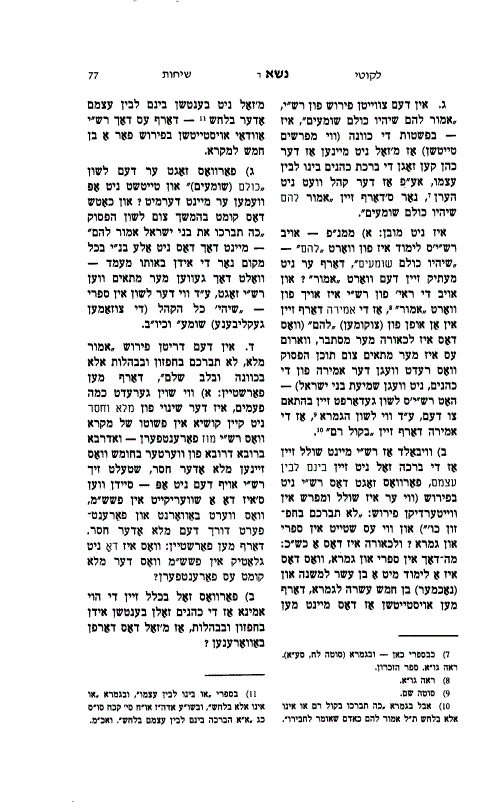
The Rebbe now turns to analyze each of these Rashis individually. The first explanation Rashi gives is “Zohar Shomer.” What does this mean? Before delving into it, we must clarify what difficulty exists with the word “Omeir.” The issue is that it does not appear in a typical command form—such as “Emor”—but rather as a present tense or root form. Normally, if it were a command, we would expect to see a segol under the alef (“Emor”) or perhaps a chirik with an added vav at the end (“Imru”). Here, however, it appears with a komatz: “Omeir.”
There are two approaches among commentators regarding what Rashi means by referencing “Zohar Shomer.” Some say that because it says “Omeir” with a komatz and not in a command form, it is not actually an imperative; rather, it is similar to how we find in other places like “Zohar” and “Shomer”—words which also appear as roots but function as commands. According to this view, Rashi brings proof from those examples to show that even though it looks like a root form, it can still serve as an instruction.
Other commentators take an opposite approach: even though “Omeir” with a komatz is not technically a command form, it can still be used by the Torah as an imperative. They point out that we find similar usage elsewhere—such as with “Shomer” and “Zohar”—where root forms are used for commands. Thus, whether or not one sees this as an actual command depends on how one understands these grammatical nuances and how Rashi intends his comparison.
In summary, according to some explanations, when Rashi references “Zohar Shomer,” he means to show that although these words appear in their root forms (not standard commands), they are nevertheless used by the Torah as instructions—constant reminders or ongoing obligations. Others maintain that even though they are not classic imperatives grammatically, their context makes them function as commands.
This analysis sets up further discussion about why Rashi structures his comments as he does and how each interpretation addresses specific textual challenges within the verse.
Saif Beis
There are two main ways to interpret what Rashi means regarding the phrase “Omer Lahem.” According to one approach, Rashi is simply translating the meaning of “Omer,” but this raises a difficulty: if Rashi’s only goal is to explain the word “Omer,” why does he also quote the word “Lahem” from the verse? Clearly, Rashi is addressing something specific about the phrase “Omer Lahem,” as the Rebbe will elaborate.
This leads to another question: why does Rashi bring two examples—one from “Shomer”—instead of just one? Wouldn’t a single example suffice? Why is it necessary for Rashi to cite both?
Turning to Rashi’s second commentary, where he writes that they should all be listening, we encounter further questions. First, why does Rashi use this wording? One might think that a person could say the blessing privately, without the Kohanim present, and that would not fulfill the requirement for the community to hear. Therefore, it must be said in a way that everyone can listen. But if that’s what Rashi means, why doesn’t he simply quote from the verse and explain it directly?
If Rashi’s proof comes from “Omer,” then it would seem that the emphasis should be on how the Kohanim say it—that their words reach those listening—rather than focusing on whether everyone actually hears. The main point is that the Kohanim must speak in such a way that their words are directed toward Bnei Yisrael. This fits better with the content of the verse, which discusses what the Kohanim are saying rather than what Bnei Yisrael are hearing.
Given this, it would have been more fitting for Rashi to state explicitly that it should be said in a loud voice so all can hear, rather than emphasizing that everyone must be listening. Why does he choose this particular phrasing?
Furthermore, if Rashi’s intent is that the Kohanim should not recite among themselves but rather so people can hear them, why doesn’t he state this openly? In his later commentary, Rashi clearly says what not to do; here too, he could have been explicit.
The Gemara uses similar language when discussing those who praise God among themselves for everyone’s benefit. If even a ten-year-old learning Mishnah or a fifteen-year-old learning Gemara needs clarity when encountering “Omer Lahem,” then surely Rashi should articulate his explanation clearly and directly for young students as well.
Instead of saying vaguely that they should not recite quietly or among themselves, Rashi could have stated outright what is required. Why does he use ambiguous language like “Kulam Shemim”—they should all be listening? Who exactly is included in “Kulam”? The verse says “speak to Bnei Yisrael and say to them,” but this does not necessarily mean every single Jew everywhere; it refers specifically to those present for Birchas Kohanim.
It would seem more precise for Rashi to use language like “the congregation gathered should be listening” instead of simply saying “everyone.” This raises further questions about his choice of words in his second commentary.
The third point concerns another comment of Rashi on “Omer”—whether it appears with or without a vav (full or deficient spelling). Here, Rashi says not to bless hastily or in confusion but with intention and understanding. We need to understand why this detail matters in peshat—the plain meaning—of the verse.
We have discussed many times that when there are changes in how a word appears (sometimes with an extra letter, sometimes without), this usually isn’t an issue for peshat. Unless there’s something unclear in context, Rashi typically doesn’t address these variations. Only when there’s an actual difficulty in understanding does he comment on such details.
So we must ask: What difficulty exists here in our verse that requires explanation based on whether “Omer” is written full or deficient? Why would anyone even think that Kohanim might bless Bnei Yisrael hastily or carelessly—so much so that they need explicit warning against it?
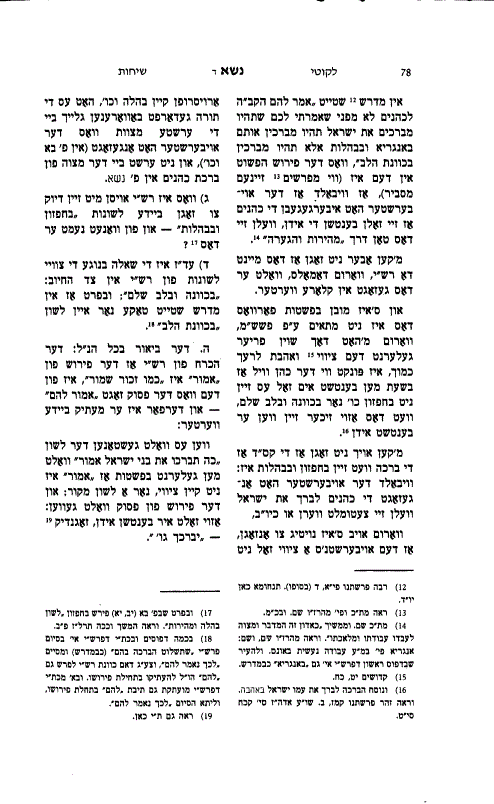
The Midrash states: Hashem told the Kohanim not to think that just because they were commanded to bless Israel they could do so hurriedly or without care (“be’angaria u’be’bahlah”—in haste and confusion). Rather, they must bless with intention and wholeheartedness (“bekavanat halev”).
The simple meaning of this Midrash is clear: Hashem wants blessings given thoughtfully and sincerely. But we still need clarification as to why such a warning was necessary at all—what might have led someone to think otherwise?
Saif Gimmel
The commentators explain that when Hashem gave the mitzvah of birkas kohanim—the priestly blessing—to the kohanim, He instructed them to bless the Jewish people. Some suggest that this command might be carried out in a rushed or even loud manner, as if a master tells his servant to do a task quickly and forcefully. The Rebbe cites sources that describe such scenarios, but then questions whether this is truly Rashi’s intent.
If Rashi meant to say that the kohanim would bless in haste or with shouting, he would have stated so explicitly. It is clear why Rashi does not take this approach: it does not fit with the simple meaning of the verse. We already learned earlier that when it comes to commandments like “love your fellow as yourself,” just as you would want others to act toward you thoughtfully and sincerely, so too should the kohanim bless with intention and a full heart—not in a hurried or careless way.
Therefore, there is no reason to suspect that the kohanim would perform birkas kohanim hastily or without proper focus. If Hashem’s command could cause confusion—if it was important enough for Hashem to instruct them not to do it hastily—then the Torah should have made this clear from the outset, perhaps when first commanding about birkas kohanim in Parshas Naso or even earlier. The Torah does not mention such a warning here, which suggests that this is not the issue at hand.
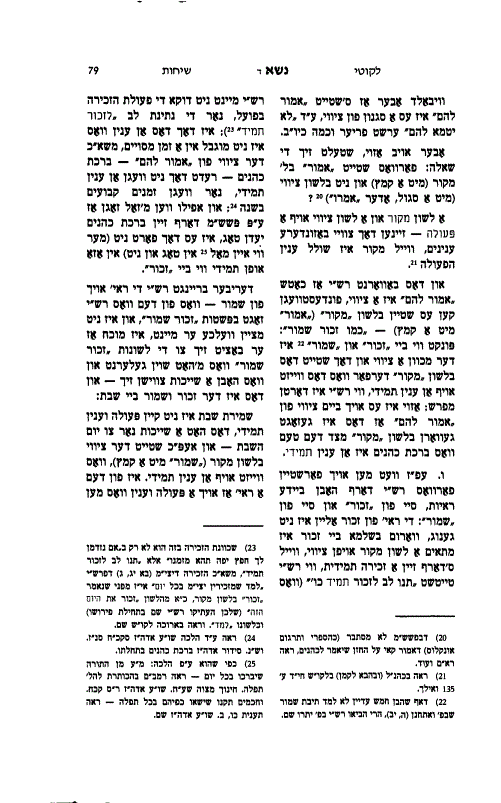
The Rebbe points out that the language used in the verse—emor lahem—is significant. The word emor is written with a kometz vowel, which is a form called loshon moker, meaning “the source form” or infinitive. This differs from the usual imperative form used for direct commands (imru). Why does the Torah use this form here?
The difference between these forms is important: loshon moker refers to something ongoing or constant, while an imperative is about performing an action at a specific time. Rashi addresses this by explaining that even though it is a command, it can still be expressed in the source form—just like we find with zachor (“remember”) and shamor (“keep”) regarding Shabbos.
For example, “zachor” and “shamor” are both commands related to Shabbos, yet they are expressed in this source form rather than as direct imperatives. The reason for using this language is because these mitzvos are meant to be constant—they should always be on one’s mind or heart, not just performed at isolated times.
This explains why Rashi brings both examples—zachor and shamor. If he had only brought “zachor,” we might think it means simply remembering Shabbos mentally at all times. But by bringing both examples, Rashi clarifies that even mitzvos performed at specific times (like keeping Shabbos) can use this language if their impact is meant to be ongoing.
The constancy here does not mean literally every moment; rather, it means regularity—a recurring obligation rather than something done once and forgotten. In contrast, birkas kohanim is not performed constantly; even if kohanim bless every day, it happens only once per day or sometimes only on special occasions like Yom Kippur. It’s not like remembering Shabbos, which must always be present in one’s consciousness.
This distinction helps us understand why Rashi uses these examples and what he intends by referencing loshon moker. The Torah uses this form when describing mitzvos whose influence should be steady and enduring—even if their actual performance happens at set intervals.
The Rebbe further notes that when Rashi brings both “zachor” and “shamor,” he does so without specifying which aspect of Shabbos each refers to because they are interconnected: remembering and keeping Shabbos are two sides of one coin. Both are expressed in this ongoing form because their effect must permeate all of Jewish life—not just during Shabbos itself but throughout the week as well.
This leads us back to birkas kohanim: although it is not performed constantly like remembering Shabbos, its impact should linger beyond its actual recitation. The blessing given by the kohanim should remain with those who receive it throughout their daily lives.
This analysis clarifies why the Torah uses emor lahem, employing a language of constancy for an act that happens regularly but whose effect endures far longer than its moment of performance.
Saif Daled
The discussion here revolves around the use of the term mocca—meaning “constant” or “regular”—in the context of the mitzvah of Birchas Kohanim. The question is raised: why does the Torah use this language, and why not simply use a term like shomer, which means “to guard” or “to observe”? The command of shomer alone is considered less than that of zohar, and even less than mocca. The implication is that shomer is a weaker proof for constancy than zohar, and both are less than what is conveyed by mocca.
The example given is Shabbos. The mitzvah to “guard” Shabbos (shomer Shabbos) does not mean performing a positive act, but rather refraining from desecrating it. This is a negative commandment—not to do something. One could argue that in such cases, the law of mocca fits, because even though the command to “guard” applies only on Shabbos itself, the idea of refraining from desecration applies at every moment. Even during the week, when one is working, one is not desecrating Shabbos—one is always guarding it by not violating it.
This concept of constant restraint is contrasted with positive commandments like Birchas Kohanim, where there is an active performance at set times. The act of blessing isn’t as constant as refraining from desecration, yet it still uses the language of mocca. This shows that even if something isn’t literally constant but occurs at fixed times (whether daily, monthly, or weekly), it can still be described as regular or ongoing.
This idea is further illustrated with the menorah in the Temple. The Torah uses the word tamid—“constant”—for lighting the menorah, even though it was only lit every evening and did not burn 24 hours a day. Since it was done regularly each night, it was considered constant in Torah terminology.
The same applies to Birchas Kohanim: whether performed daily or at other set intervals, its regularity qualifies it for this language. Thus, both positive acts done at fixed times and ongoing restraint from negative acts can be described as constant in Torah terms.
This leads to a question: if the Torah doesn’t specify exactly when Birchas Kohanim should be recited and just says “all the time,” what does this add? After already commanding “so shall you bless Bnei Yisrael,” what does adding “emor lahem” (“say to them”) contribute? If we’re not told when these regular occasions are, what’s gained by this extra phrase?
The answer offered is that without “emor lahem,” one might interpret “so shall you bless Bnei Yisrael” as optional—that whenever you want to bless them, this is how you should do it. By adding “emor lahem,” the Torah makes clear that this is a commandment and not merely an option.
If so, perhaps the order should have been reversed: first state “emor lahem” (the command), then specify how to bless (“so shall you bless…”). Yet the Torah puts them in this order for a reason.
An additional point: “emor lahem” seems to contradict another aspect of Torah style. Throughout Birchas Kohanim, everything else is phrased in singular form (“may Hashem bless you [singular]”), yet here we have a plural instruction (“say to them”). Why switch from singular to plural?
This supports Rashi’s interpretation: Rashi learns from this that Birchas Kohanim isn’t just about reciting words or conveying blessing through speech. Rather, there’s an essential requirement for all Kohanim to be attentive and involved in blessing every Jew individually—that each Jew should receive personal attention as if they were unique.
The Kohanim must wish for every Jew to be blessed as an individual (yochid). At the same time, each individual should hear their own blessing while also being part of the collective community. There’s an interplay between individuality and communal unity in how these blessings are given and received.
This dual focus can create confusion: if one must intend for each person individually while also keeping everyone in mind collectively, there’s a risk of rushing through or becoming mixed up in trying to include everyone quickly. Therefore, there’s a special emphasis here that Birchas Kohanim must be said with complete intent and wholeheartedness—a full heart directed toward each individual Jew.
The two expressions used highlight this dual intention: for each Jew individually and for all Jews together as a community.
Saif Hei
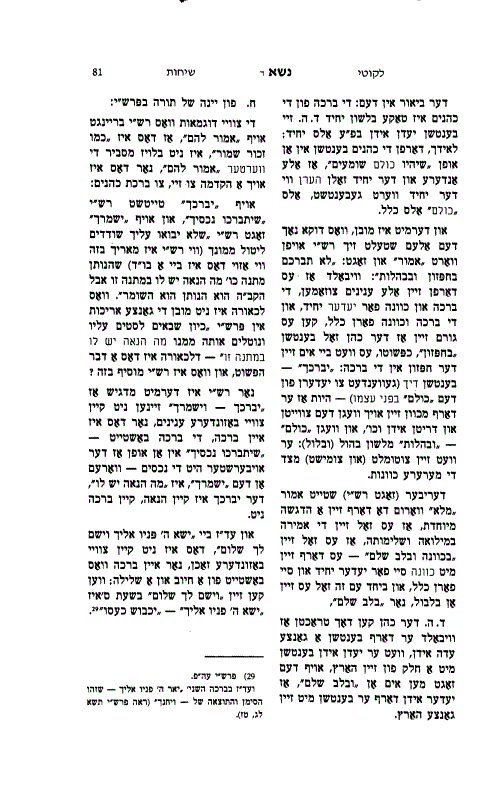
The blessing given by the Kohanim must be with a whole heart, not a confused or divided one. The Kohen might think that since he is blessing an entire community of Jews, he can give each person only a part of his heart. However, the Torah instructs that every Jew must be blessed with a complete and undivided heart.
When we look at the “wine of Torah” and Rashi’s commentary, we see that Rashi brings two examples from “emor lahem”—this is similar to the concepts of zachor and shamor. Not only do these explain the words “emor lahem,” but they also serve as an introduction for the Kohanim regarding how to bless. Just as zachor and shamor are not two separate matters but one unified concept, so too with the blessings of the Kohanim.
Rashi explains that when Hashem blesses you, He also protects your assets: “so that robbers should not come to take your money.” Rashi elaborates at length—when a human being gives you a gift, he cannot guarantee it will not be stolen; all he can do is give it to you. If robbers come and take it away, what benefit do you have from such a gift? But when Hashem gives you something, He also guards it for you.
This leads to an important question: why does Rashi need to spell this out? It seems obvious—if someone gives you a gift and then it is taken away, there is no real enjoyment in that gift. Why does Rashi emphasize this point?
The answer is that Rashi wants us to understand that “yivarechecha” (“He will bless you”) and “veyishmerecha” (“He will guard you”) are not two separate blessings. Rather, they are one unified blessing. The true blessing is when your assets are blessed in such a way that Hashem also protects them.
If there is no protection, then there is no real benefit to the blessing. Without “veyishmerecha,” what value does the blessing have? Therefore, Rashi teaches us that protection is an integral part of the blessing itself—they are inseparable.
This idea parallels zachor and shamor regarding Shabbos: they are not two separate commandments but one unified concept. Only when both aspects are present—remembering and guarding—is Shabbos observed in its fullness.
Similarly, every blessing given by the Kohanim contains both positive content (the actual blessing) and protection from harm or loss. These are not two distinct ideas but one complete act of blessing.
The true giver—Hashem—is also the protector. Only then is the blessing truly complete and wholesome.
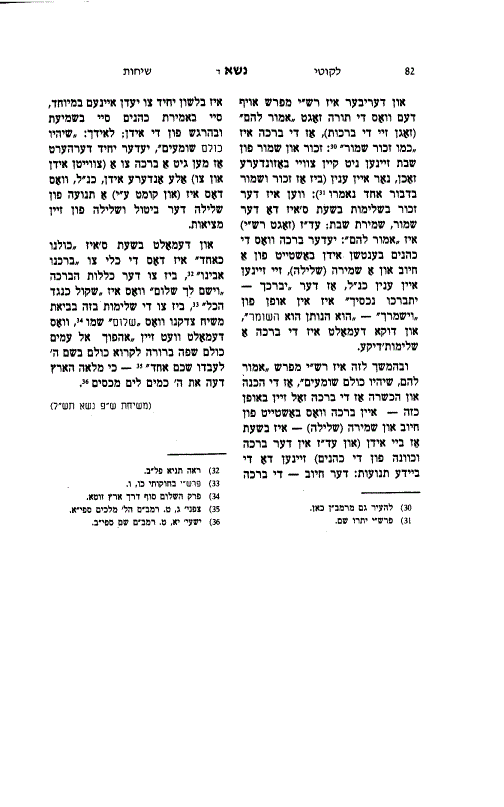
Following this explanation, Rashi adds: “Amar lahem sheyihyu kulam shomrim”—they should all listen. This refers to both preparation for receiving the blessing and what makes them worthy of it: unity among all Jews.
The language used in Birchas Kohanim is singular—each individual Jew receives the blessing personally. The Kohanim direct their words to each person individually, and each Jew feels they receive it directly from Hashem through the Kohanim.
At the same time, there must also be unity: “sheyihyu kulam shomrim”—that all should listen together as one community. Each individual senses their own unique connection while also being part of Klal Yisrael as a whole.
This unity comes through bittul—self-negation for the sake of another Jew and for the community at large. When all Jews stand together as one, this becomes the vessel for Hashem’s ultimate blessing: “Barecheinu Avinu kulanu ke’echad”—“Bless us our Father as one.”
This leads up to the general blessing: “Veyasem lecha shalom”—“And He shall grant you peace,” which encompasses all other blessings and represents their ultimate fulfillment.
This peace will reach its perfection with the coming of Moshiach Tzidkeinu—whose very name is Shalom (peace). At that time, all nations will turn together in clarity to call upon Hashem’s name:
לִקְרֹא כֻּלָּם בְּשֵׁם ה׳ לְעָבְדוֹ שְׁכֶם אֶחָד
"To call upon all in Hashem’s name, to serve Him shoulder to shoulder."
The world will be filled with knowledge of Hashem as water covers the ocean bed—a state of complete unity and peace for all creation.
Key Points
1. The Rebbe analyzes Rashi’s three distinct comments on the phrase “Omeir Lohem” in Birchas Kohanim, highlighting the significance of their order and the nuances in Rashi’s wording to clarify different aspects of the priestly blessing.
2. Rashi’s first two explanations address the phrase “Omeir Lohem” together, while his third focuses on “Omeir” alone, teaching that the Torah sometimes uses root forms as commands, as seen with “zachor” and “shamor,” to indicate ongoing or constant obligations.
3. The use of both “zachor” and “shamor” as examples demonstrates that even mitzvos performed at set times can be described with language of constancy if their impact is meant to be enduring, paralleling the effect of Birchas Kohanim beyond its moment of recitation.
4. The Torah’s use of terms like “tamid” (constant) for acts performed regularly but not literally at every moment—such as lighting the menorah or blessing the people—shows that regularity qualifies as constancy in Torah terminology, applying also to Birchas Kohanim.
5. The phrase “emor lahem” is not merely instructional but establishes Birchas Kohanim as a commandment rather than an option, emphasizing both individual attention to each Jew and collective unity within the community during the blessing.
6. Rashi teaches that the Kohanim must bless with complete intention and a full heart for every Jew individually, avoiding haste or confusion; this dual focus on individuality and communal unity is essential for proper fulfillment of Birchas Kohanim.
7. The blessings “yivarechecha” (He will bless you) and “veyishmerecha” (He will guard you) are not separate but form one unified blessing—true blessing from Hashem includes both abundance and its protection, just as remembering and guarding Shabbos are inseparable aspects of one mitzvah.
8. The requirement that all should listen (“kulam shomrim”) underscores both preparation for receiving Hashem’s blessings and the necessity of Jewish unity; each individual receives a personal blessing while being part of Klal Yisrael as a whole through self-negation and communal harmony.
9. The ultimate fulfillment of Birchas Kohanim is realized in peace (“veyasem lecha shalom”), which encompasses all blessings and will reach perfection with Moshiach, when all humanity will unite in serving Hashem together in harmony and knowledge.