
Introduction
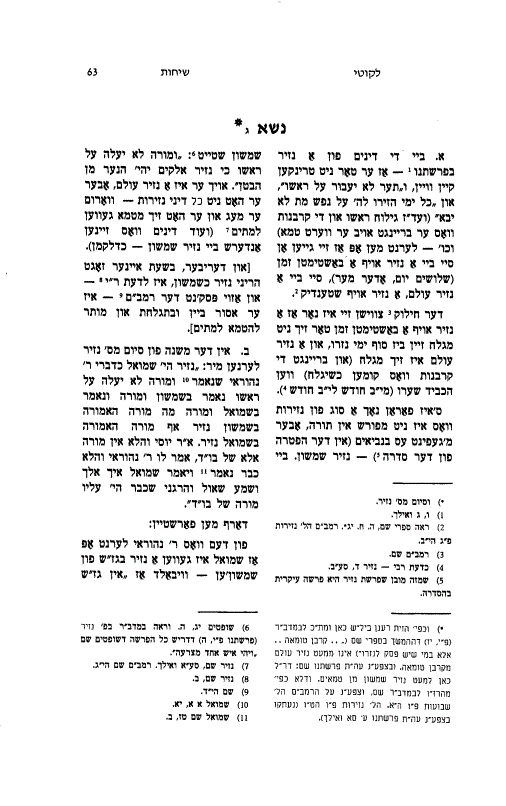
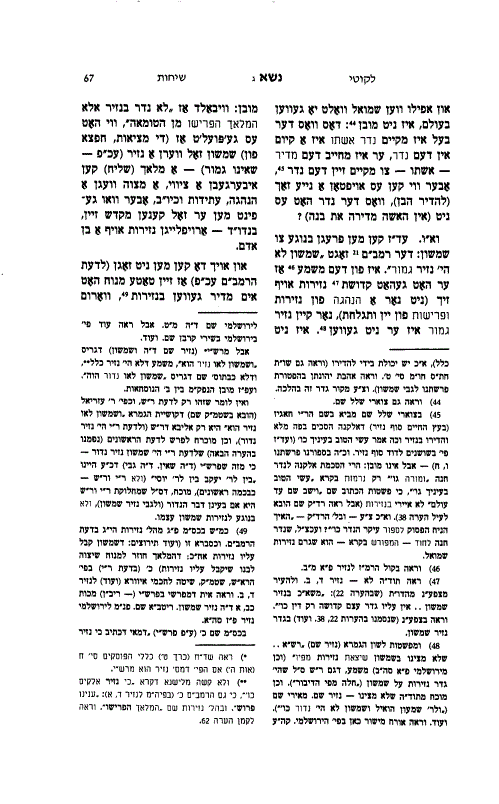
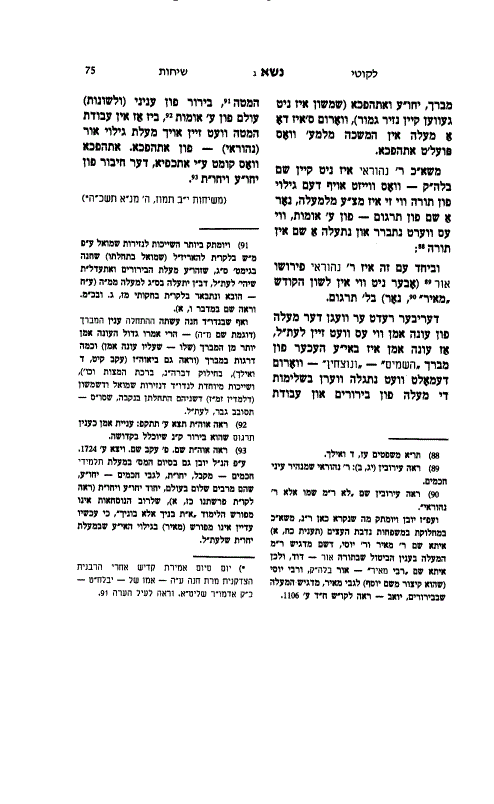
In this sicha, we will be studying Lekutei Sichos, volume 18, the third sicha for Parshas Naso. This is a lengthy and complex sicha that also serves as a siyum on Maseches Nazir. The Rebbe delves into the various forms of nezirus—the Nazirite vow—that we find in Torah and in the words of the prophets.
Generally, there are two main types of nezirus: the standard Nazirite vow, where a person accepts upon themselves to be a nazir for a set period (commonly thirty days, but it can be longer), and the nazir olam—a lifelong nazir. A nazir olam is considered a permanent nazir, but with one unique leniency: once a year, he is permitted to cut his hair.
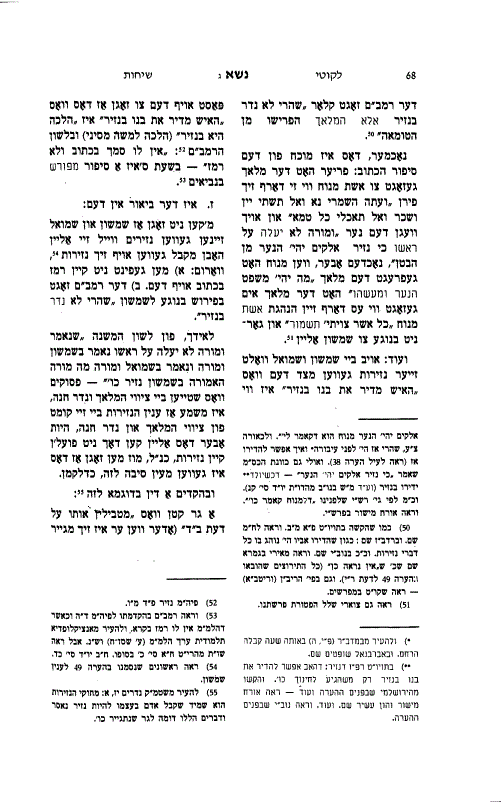
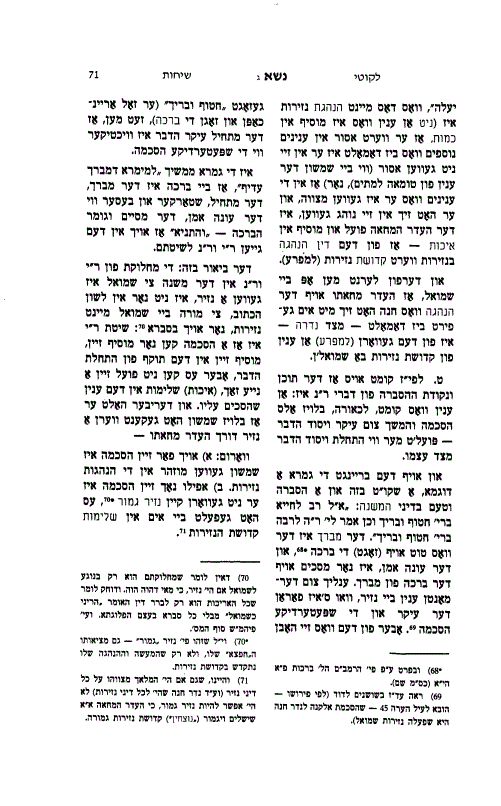
Beyond these categories, the Gemara brings examples from the Neviim of other forms of nezirus. We find by Shimshon that when he was born, an angel told his parents that he should be a nazir. The question arises: what exactly was Shimshon's status as a nazir? Similarly, regarding Shmuel Hanavi, his mother Chana prayed and vowed that she would dedicate him to Hashem. This also seems to imply some form of nezirus.
The discussion in this sicha will revolve around clarifying the status of these unique cases of nezirus. What kind of Nazirite status did Shimshon and Shmuel have? How do their situations fit within the halachic framework?
The Rebbe introduces an innovative approach to understanding how it was possible for Shimshon's parents or Chana to make their children into nezirim. Since neither Shimshon nor Shmuel personally accepted the vow upon themselves at that time, how did it take effect?
The Rebbe brings an analogy from the laws of conversion (gerus). When a minor converts together with his family, he has the option to protest upon reaching adulthood. However, if he does not protest, then retroactively the conversion is binding from the beginning. Even with an adult convert who has only had circumcision but has not yet immersed in the mikveh, there is still an opportunity to retract until all steps are completed—the final act establishes everything retroactively.
This concept helps explain how nezirus could work for Shimshon and Shmuel: even though they did not personally accept it at first, certain later actions or lack of protest could establish their status as nezirim retroactively. The details and differences between these cases will be explored throughout this sicha.
Saif Aleph
In this section, the Rebbe begins by outlining the main categories of naziriteship as discussed in our parsha. The Torah describes three primary prohibitions for a nazir: he may not drink wine, he may not cut his hair, and he may not become impure through contact with a corpse. These three aspects are all mentioned explicitly in the verses regarding the laws of the nazir.
The Rebbe notes that there are additional details in the verses, such as the requirement to shave at the end of the nazir period and to bring specific offerings. If a nazir becomes impure through contact with a corpse before completing his term, he must shave, bring offerings, and restart his count.
These laws apply both to a nazir who accepts upon himself a set period—such as thirty days or more—and to a nazir olam, someone who becomes a lifelong nazir. However, there is an important distinction: while a regular nazir cannot cut his hair at all during his term, a nazir olam is permitted to cut his hair once every twelve months when it becomes too heavy. Each time he does so, he brings the associated offerings.
The Rebbe then introduces another category of naziriteship that is not explicitly detailed in the Torah itself but is found in the Prophets—specifically in the haftarah for Parshas Naso. This is known as nazir Shimshon, referring to Shimshon (Samson), who was designated as a nazir from birth by divine instruction.
The verse regarding Shimshon states:
ומורה לא יעלה על ראשו כי נזיר אלקים יהיה הנער מן הבטן
"And a razor shall not come upon his head; for the child shall be a nazirite unto God from the womb."
Although Shimshon was an eternal nazir from birth, his status did not include all of the standard laws of naziriteship. For example, while an ordinary nazir is forbidden from becoming impure through contact with corpses, Shimshon was permitted to do so—as evidenced by events in his life. There are other differences as well between regular nazirus and that of Shimshon.
This leads to practical halachic implications: if someone declares, "I am a nazir like Shimshon," according to Rabbi Yehuda—and this is how Rambam rules—he is only prohibited from drinking wine and cutting his hair, just as these were the restrictions placed on Shimshon himself.
Saif Beis
The discussion begins with the law regarding a Nazir who is not permitted to become tameh lamesim—impure through contact with the dead. However, in certain cases, such as Nazir Shimshon, he is allowed to become tameh lamesim. This distinction sets the stage for analyzing the last Mishnah in Tractate Nazir.
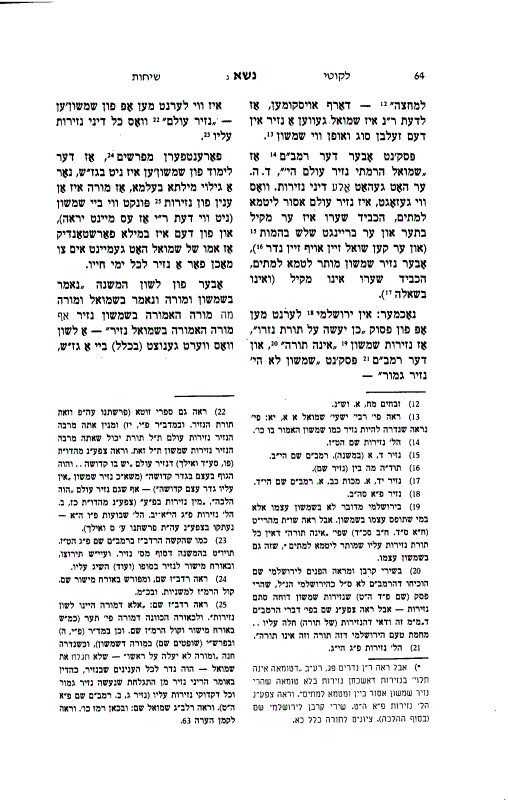
In that Mishnah, we learn about Shmuel Hanavi and whether he was considered a Nazir. Rabbi Nehorai holds that Shmuel was indeed a Nazir, based on the verse where Chana dedicates him to Hashem and says, umoyre lo ya’aleh al rosho. Rabbi Nehorai draws a parallel between this phrase and what is written about Shimshon: both use the word umoyre, so just as by Shimshon it refers to Nazirus, so too by Shmuel.
Rabbi Yosi disagrees and interprets umoyre differently. According to him, it does not refer to a razor or hair-cutting blade but rather means “fear”—that no fear of man would rest upon Shmuel’s head. He argues that this has nothing to do with Nazirus.
Rabbi Nehorai challenges Rabbi Yosi’s explanation by pointing out that Shmuel did experience fear—specifically, he feared Shaul would kill him when he went to anoint David as king. This demonstrates that “no fear” cannot be the meaning of umoyre, so it must refer instead to a razor, indicating Nazirus.
This leads to a question: If we derive Shmuel’s Nazirus from Shimshon through a gezeirah shavah, does that mean Shmuel’s status as a Nazir was identical to Shimshon’s? For example, Shimshon was permitted to become tameh lamesim; would Shmuel have had the same leniency?
The Rambam rules that Shmuel was subject to all the laws of a regular Nazir olam—a lifelong Nazir—which includes prohibitions such as not becoming tameh lamesim. Unlike Shimshon, who could become impure for the dead, Shmuel could not. Additionally, if his hair became heavy, Shmuel could lighten it once every twelve months and bring the required sacrifices after shaving—another law of Nazir olam not applicable to Shimshon.
Furthermore, a Nazir olam like Shmuel could seek absolution from his vow by consulting a sage (chocham). In contrast, Shimshon’s Nazirus did not allow for such absolution or even for lightening his hair if it became heavy.
This raises an important question: If we are learning about Shmuel’s Nazirus from Shimshon via gezeirah shavah, why are there so many differences between them? Why does Rambam rule that Shmuel had all the laws of Nazir olam while Shimshon did not?
The Yerushalmi clarifies that certain laws apply only when there is a Torah-prescribed form of Nazirus in Israel—such as regular Nazirus or Nazir olam—but not for someone like Shimshon. The Rambam therefore rules that Shimshon was not considered a complete Torah-defined Nazir.
This creates an apparent contradiction: We derive Shmuel’s status from Shimshon, yet only Shmuel is considered a full-fledged Nazir according to halacha. How can this be reconciled?
Some commentaries suggest that the comparison between Shmuel and Shimshon is not meant as an actual gezeirah shavah in halachic terms but rather serves only to clarify what umoyre means in context—that it refers to Nazirus and not fear. The main point is simply to establish that Chana intended for her son to be dedicated as a lifelong Nazir; it does not mean all details of their Nazirus are identical.
This approach resolves the issue: Although we use Shimshon's case as proof for interpreting the verse about Shmuel, their respective forms of Nazirus remain distinct according to halacha. Thus, Chana's intent was indeed for her son to be a full-fledged Nazir olam—even though some aspects were learned from Shimshon's story.
The Rebbe notes that this distinction is reflected in the language of the Mishnah itself and will elaborate further on its implications.
Saif Gimmel
The Mishnah uses the phrase, “It is stated regarding Shimshon and it is stated regarding Shmuel.” The language is: just as it says by Shimshon and by Shmuel, so too here. This is the exact wording—“just as it is said by Shimshon, Nazir; so too, what is said by Shmuel, Nazir.” This type of language is generally used when establishing a gezeirah shavah—a legal equivalence between two cases in Torah law—not merely for a gilu milsa, which would simply clarify the meaning of a word.
The Rebbe points out that if the intention was only to clarify the meaning of the word “meir,” then the Mishnah should have simply explained that “meir” means a blade or a razor, or that it refers to metal. Instead, the Mishnah uses a formula typical of a gezeirah shavah, indicating that we are learning something substantive about Nazirus from the comparison between Shimshon and Shmuel.
This suggests that the teaching here is not just about defining “meir” as a blade, but rather that there is an actual halachic connection being drawn between the Nazirus of Shimshon and Shmuel. The language used implies we are deriving laws about Nazirus itself from this comparison.
The Rebbe then raises another question: It seems from this discussion that there are different types of Nazir. He plans to ask further questions on this point. Additionally, he notes that the continuation of the Gemara in this section appears out of place with respect to the flow from the Mishnah.
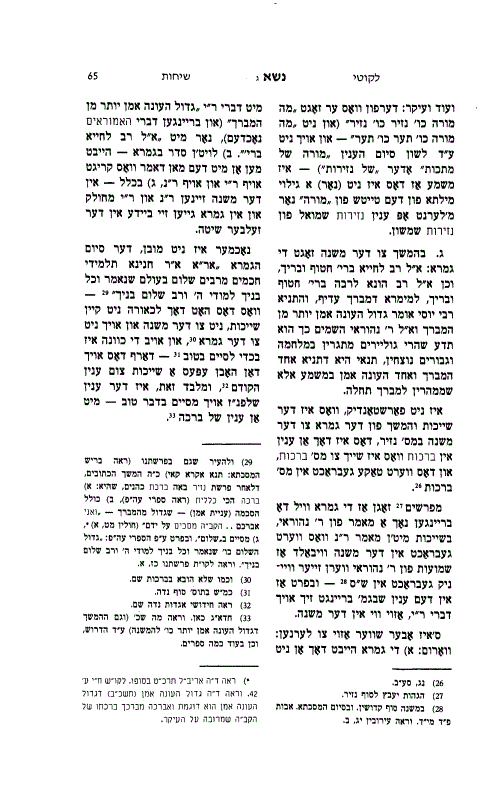
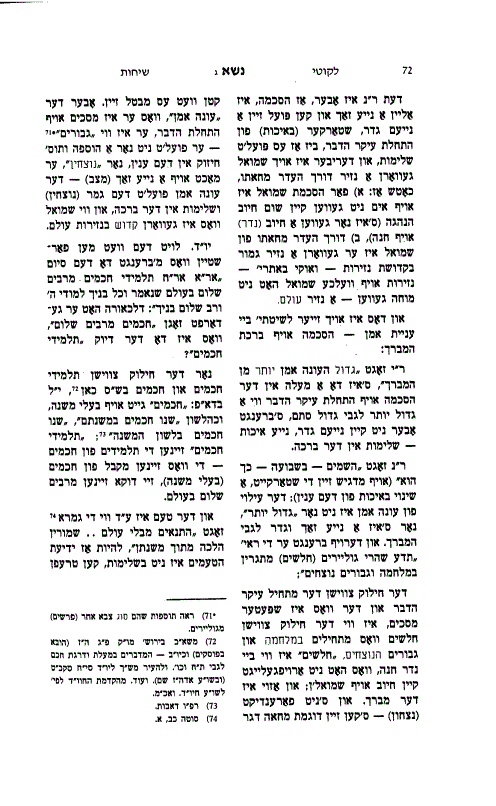
The Gemara brings an incident where Rabbi told his son Chiya to quickly make the blessing—meaning to be prompt in leading zimun. The implication is that making the blessing has some advantage. The Gemara then asks: Does this mean making the blessing is greater than responding “amein”? But elsewhere it says that answering “amein” is even greater than making the blessing!
Rabbi Yosi brings a Baraisa stating that both one who makes the blessing and one who answers “amein” are considered praiseworthy. However, he adds that reward comes more quickly to one who makes the blessing first. Thus, according to this Baraisa, making the blessing has an advantage.
The Rebbe questions what connection this whole discussion about blessings and answering “amein” has with our Mishnah in Nazir. This topic belongs in tractate Berachos, where these laws are discussed at length. Why does it appear here?
One might suggest that since our Mishnah mentions Rabbi Nehroyi, and since another statement from Rabbi Nehroyi appears in Berachos regarding blessings, perhaps that's why it's brought here. But if so, why does the Gemara begin with Rabbi Yosi’s statement about blessings? If its purpose was simply to bring another teaching from Rabbi Nehroyi, it should have started with his words directly.
Furthermore, in our Mishnah Rabbi Nehroyi and Rabbi Yosi disagree; yet here their statements seem aligned—they both say that responding at the end (answering “amein”) is greater. So why does the Gemara start by presenting an opinion (that making the blessing is better) which contradicts their view?
Additionally, if these statements were brought merely because they share authorship (Rabbi Nehroyi), why present them in such a way that seems to go against their established positions? And why bring them together when in our Mishnah they actually disagree?
The Rebbe concludes that all these points indicate there must be a deeper reason for why these teachings appear here and in this order. The flow of the Gemara and its conclusion remain difficult to understand based on what we've seen so far.
The Rebbe will soon introduce an innovative explanation for all these questions. But before doing so, he notes there are still several linguistic issues within the Gemara’s wording itself which require clarification.
On a simple reading, it appears as though Rabbi Nehroyi merely supports Rabbi Yosi’s statement about answering “amein.” However, upon closer analysis—especially given his emphatic language (“I swear by Heaven”)—it seems he intends to add something new or different to what Rabbi Yosi said. The Rebbe will explain what unique contribution Rabbi Nehroyi makes with his statement.
Saif Daled
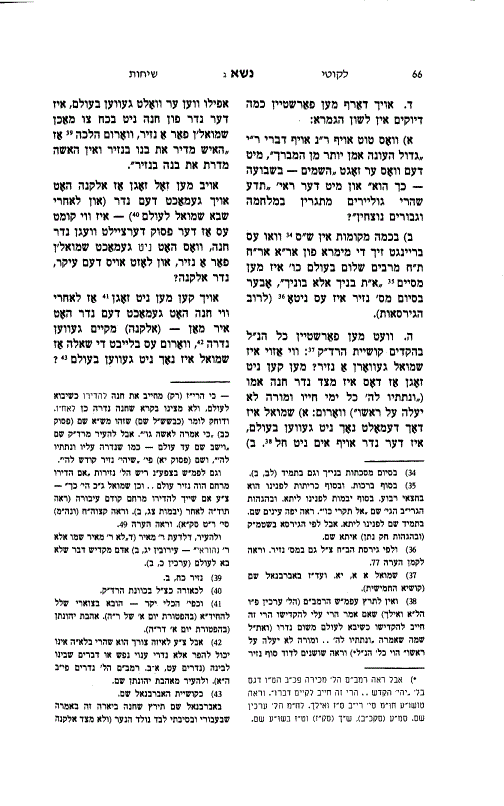
The Rebbe begins by addressing the proof brought regarding the Goliaths, who initiate and win the war. He asks: what is Rabbi Nehroyi really adding, and what is Moshe’s position over Rabbi Yoisi? The Rebbe notes that there is a significant difference here, which he will clarify.
In many places in the Gemara, when the memory of Rabbi Elazar and Rabbi Chanina is brought, we find the phrase: “Do not call them your sons, but your builders.” However, according to most versions, this does not appear in our context. With this introduction, the Rebbe turns to analyze how Shmuel became a Nazir through his mother’s actions.
To understand all of the above, the Rebbe first raises a fundamental question: how did Shmuel become a Nazir? We cannot say it was due to his mother’s vow. Chana said, “I will give him to Hashem for all the days of his life, and a razor shall not go upon his head.” But this cannot be the source for several reasons.
First, Shmuel was not yet born when Chana made her vow. She said, “If You will give me a child, then I will do this.” A vow on something that does not yet exist—on someone not yet in the world—does not take effect. Although there are lengthy discussions among the commentaries about these details, for now it suffices to follow the flow of the sicha itself.
Second, even if Shmuel had already been born at that time, Chana’s vow would still not have had the power to make him a Nazir. The halacha is that only a father can make such a vow for his son; a mother does not have this ability. The Rebbe notes that although there are further discussions in the footnotes—such as whether Shmuel’s birth through Chana’s prayer changes anything—this is another topic entirely.
Perhaps one might suggest that Chana made her vow and that there were other vows involved—maybe Elkanah (Shmuel’s father) also made or upheld such a vow. But if so, why doesn’t the Torah mention Elkanah’s involvement? If Elkanah was responsible for making Shmuel into a Nazir or sustaining Chana’s vow so it would apply to their son after he was born, why would this crucial detail be omitted from the narrative?
It cannot be argued that Elkanah simply sustained Chana’s vow after Shmuel was born and thus made him into a Nazir. Even if he did sustain it after Shmuel was already in existence, sustaining a wife’s vow does not create an entirely new obligation—it merely affirms her own commitment. The husband’s role is to allow or annul his wife’s vow; he cannot use her words as a vehicle to create an independent status of Nazirus for their son.
Therefore, even if Elkanah sustained Chana’s vow after Shmuel was born, it would only obligate Chana herself—not transform Shmuel into a Nazir. The core question remains unresolved: how did Shmuel become a Nazir if neither parent could effectuate this status through their vows?
A similar question arises regarding Shimshon. The Rambam writes that Shimshon was not a complete Nazir (Nazir she’eino gamur) but nevertheless possessed some sanctity of Nazirus—not merely living as if he were one by abstaining from wine and refraining from cutting his hair. This suggests Shimshon had an actual status of Nazirus—albeit incomplete—but how did this come about?
Shimshon himself never took upon himself any Nazirus; rather, it was an angel (Malach) who separated him from impurity and instructed his mother about certain restrictions. But where do we find precedent for an angel being able to sanctify someone or confer upon them an actual halachic status such as Nazirus? An angel can deliver instructions or foretell future events but does not have halachic authority to create new obligations or statuses in people.
Furthermore, according to Rambam (and at least some interpretations), Shimshon’s father Maneach did not make any such vow either. If Maneach had made Shimshon into a Nazir by virtue of parental authority—as halacha allows for fathers—then why doesn’t Scripture mention this? Instead, all we find is that “the Malach separated him from impurity,” which does not suffice to establish Nazirus in halacha.
This point becomes even clearer when examining the verses themselves. The Malach first instructs Maneach’s wife on how she should behave: “Be careful; do not drink wine or strong drink; do not eat anything impure.” Only afterwards does he mention restrictions regarding “the lad” who will be born—that no razor should pass over his head because he will be dedicated as a Nazir from birth. Yet nowhere does it say explicitly that Shimshon himself accepted Nazirus or that anyone formally imposed it upon him according to halacha.
If Shimshon became a Nazir because his father made such a declaration—as allowed by law—then both Maneach and Elkanah could have done so for their sons (Shimshon and Shmuel). If so, why does the Gemara refer specifically to “a son who is made into a Nazir by his father” as something novel? And why does Rambam write that there is no hint (remez) for this concept in Scripture when there seem to be clear stories about both Shimshon and Shmuel?
The Rebbe concludes this section by setting up for further explanation: beginning with Section 7 (Ois Zayin), he will clarify exactly what happened with Shimshon and Shmuel. On one hand, neither took Nazirus upon themselves; on the other hand, both are described as having some form of Nazirus according to Mishnah and Rambam. The resolution lies ahead in understanding how these unique cases fit within Torah law.
Saif Hei
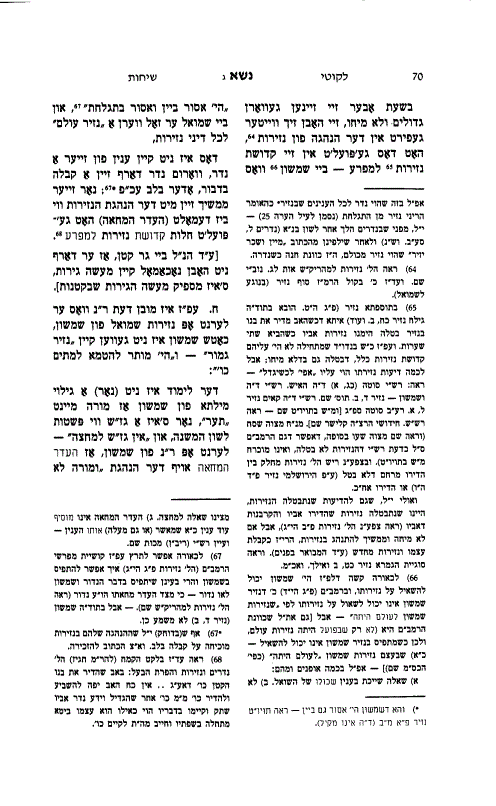
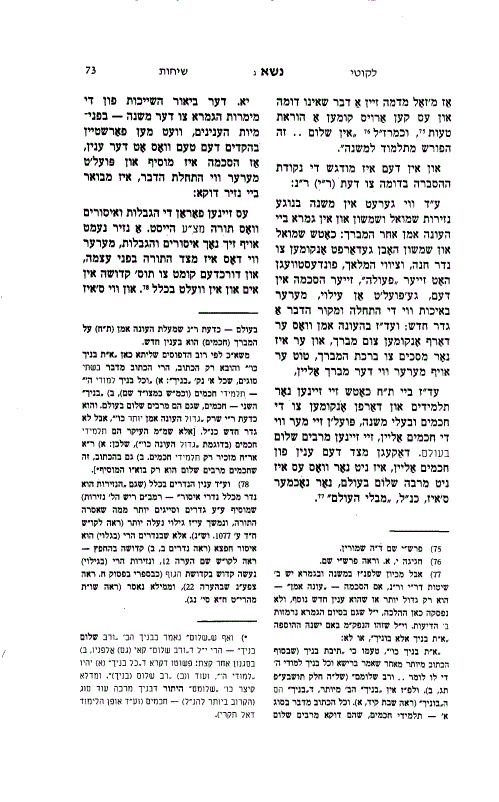
The discussion here draws a parallel between the process of conversion for a minor—ger koton—and the status of Shemshon and Shemuel as nezirim. In the case of a minor who is converted by a court, or together with his father, the sanctity of being Jewish does not fully rest upon him at the moment of immersion. Rather, when he reaches adulthood and continues in that path without protest, the sanctity is retroactively confirmed from the earlier time.
This concept is used to address whether Shemshon and Shemuel themselves accepted upon themselves the status of nazirus. The answer is that there is no indication in the verses that they personally made such an acceptance. The Rambam explicitly states regarding Shemshon that he did not take a vow of nazirus himself. Instead, their status as nezirim was initiated by external factors: for Shemshon, it was the instruction of an angel; for Shemuel, it was Chana’s vow.
This seems to contradict what is stated in the Mishnah, which derives from verses that both Shemshon and Shemuel were nezirim, based on instructions given about them. However, these instructions were not their own vows but rather came from others—the angel or Chana. The Mishnah’s language suggests that their nazirus originated from these external declarations.
The Rebbe explains that neither an angel nor Chana had the power to create true kedusha—sanctity—of nazirus. Their words served only as a cause or reason for what would later become actualized. This is similar to how a minor’s conversion does not immediately confer full Jewish sanctity until he reaches adulthood and does not protest.
The halacha regarding a minor convert is that although he undergoes circumcision and immersion as a child, he can protest upon reaching adulthood and revert to his original non-Jewish status. If he does not protest and continues living as a Jew for some time after reaching maturity, he then acquires full Jewish sanctity retroactively from his original conversion.
This process demonstrates that while the act of conversion (circumcision and immersion) occurs earlier, its effect depends on later confirmation through continued conduct without protest. The same applies to any convert: even after circumcision and blessings are recited, if immersion in the mikvah has not yet occurred, he can still withdraw from becoming Jewish. Only after immersion does the sanctity fully take effect.
The Rebbe uses this analogy to clarify what happened with Shemshon and Shemuel. The instruction of the angel or Chana’s vow could not create actual kedushas nazir—the sanctity of being a nazir—for them. It merely obligated them in certain behaviors: abstaining from wine or hair-cutting. Even Chana’s vow was her own commitment regarding her son’s conduct; it was not an actual vow taken by Shemuel himself.
Therefore, just as with a minor convert who only receives full Jewish status upon reaching adulthood without protest, so too with Shemshon and Shemuel: when they matured and continued living according to the laws of nazirus, without objecting or changing course, they thereby confirmed upon themselves retroactively the status of nazirus.
This means there was no need for them to make a new acceptance or vow when they became adults. Their ongoing conduct established their status as nezirim, based on what had been initiated for them by others when they were minors or before they could accept it themselves.
The specific type of nazirus each observed depended on what had originally been set out: for Shemshon, it included abstaining from wine and hair-cutting but did not include all prohibitions such as impurity from corpses; for Shemuel, it was more complete—he was considered a lifelong nazir with all associated laws.
This continuous observance without protest effectively brought about their sanctified status as nezirim, similar to how continued Jewish practice confirms the conversion of a minor once he becomes an adult.
Saif Vov
The acceptance of Nazirus by Shemshon and Shmuel was not through their own vow or explicit declaration. Normally, to make a neder, one must either articulate it verbally or at least accept it in their heart. In these cases, however, the children simply continued the conduct of a nazir as established for them—either by their mother’s actions or by the instruction of the angel—without objecting when they reached adulthood. This lack of protest had a significant effect: it validated and extended the original sanctity of their Nazirus from before, based on what their mother did or what the angel had commanded.
This is similar to the case of a minor who converts (ger katan). The conversion that took place while he was still a minor is affirmed when he reaches maturity if he does not protest. Likewise, with Nazirus: if the child continues the conduct without objection upon reaching adulthood, there is no need for a new acceptance. Their silence and continued behavior serve as an affirmation, making the original act effective for them as adults.
It is important to note that each case follows its own parameters. For Shemshon, his Nazirus was unique—he was only prohibited from wine and contact with corpses, but not from other things typically forbidden to a regular nazir. For Shmuel, his restrictions were different as well. The point is not that they became identical types of nazirim; rather, each one’s Nazirus was established and continued according to how it began for them.
This helps us understand the opinion of Rab Nehorai regarding Nazirus Shemshon. Rab Nehorai learns that even though Shemshon was not a complete nazir (since he was allowed to become impure through contact with corpses), his Nazirus still serves as a model. The learning here is not about deriving every detail from Shemshon’s case; rather, it’s about how the establishment of Nazirus can occur through lack of protest—she lo michah—when reaching maturity.
The comparison is not about increasing stringency or adding new prohibitions beyond what existed before. Instead, it’s about sustaining and continuing what was already established—the same quality and type of Nazirus that began in childhood carries forward into adulthood if there is no objection.
This principle can be seen in other areas as well. For example, in the Gemara we find Rav telling his son Chiya to quickly recite the blessing (chateuf u’vareich). The one who makes the blessing initiates and accomplishes something fundamental; those who answer “amen” are merely agreeing with what has already been established by the one who blessed. Similarly, with Nazirus: the initial act (whether by vow or instruction) establishes the status, and later agreement (or lack of protest) simply affirms it—it does not create something new or add further obligations.
Thus, according to Rab Nehorai’s approach, when someone continues in a state established for them as a minor without protesting upon reaching maturity, this continuation validates and retroactively affirms their status as a nazir—whether partial like Shemshon or otherwise—according to how it began for them.
The Rebbe concludes that this understanding explains why subsequent conduct does not add more than what existed previously; it merely confirms and sustains what was already there. This idea underlies both the halachic reasoning in these cases and helps clarify how we view such transitions from childhood status to adult obligation in Jewish law.
Saif Zayin
The absence of a protest—herder machose—establishes and transforms the quality of the blessing, making it stronger. The Gemara continues by asking: should we say that the one who answers “Amen” is greater than the one who recites the blessing? Is the one who concludes and affirms the blessing, through their agreement, considered superior to the one who initiates it?
The Gemara brings a teaching that connects to this: Rabbi Yosi and Rabbi Nehorai each have their own approach regarding this matter. At first glance, it seems they are saying similar things, but as the Rebbe will explain, there are actually two distinct opinions here. This difference aligns with their respective views in another Mishnah regarding whether Shmuel was a nazir or not—whether “moira lo ya’aleh al rosho” means he was a nazir, as Rabbi Nehorai says, or simply that no fear would be upon him, as Rabbi Yosi holds.
This is not just a technical debate about wording; there is a logical distinction between them. According to Rabbi Yosi, when someone later agrees or confirms something that was previously established, their agreement can only add strength to what already exists—it cannot introduce an entirely new quality or completeness to what was agreed upon. In other words, you can reinforce what’s already there but not fundamentally change its nature.
Therefore, Rabbi Yosi holds that only Shimshon could become a nazir through lack of protest—not Shmuel. Why? Because even before any agreement from Shimshon himself, he was already warned and instructed in the conduct of naziriteship. So his later agreement did not create something new; it merely reinforced what was already present. Even after his agreement, Shimshon did not become a complete nazir in a new sense—it just brought out more fully the sanctity of his existing status.
In contrast, Rabbi Nehorai maintains that an act of agreement—hazkama—can itself create something entirely new. It can define and establish an entirely new status or quality from when the matter truly begins. This means that through lack of protest, Shmuel actually became a full-fledged nazir—a nazir gamur. Before Shmuel’s own acceptance (or lack of protest), there was no obligation on him; it was only Chana’s vow. But once he did not object, he acquired an entirely new status as a nazir for life (nazir olam)—something that simply did not exist for him before.
This is why Rabbi Yosi does not learn from Shimshon to Shmuel: in his view, you cannot create a greater level than what existed previously just by agreeing later on; you can only reinforce what’s already there.
The Gemara brings two related teachings from these sages about blessings. Rabbi Yosi says: “Greater is the one who answers ‘Amen’ than the one who recites the blessing.” This means there is some advantage in affirming or agreeing with something beyond simply initiating it—but this advantage does not fundamentally change its nature; it only enhances what already exists.
Rabbi Nehorai responds more forcefully: “I swear by Heaven!” He wants to emphasize that answering ‘Amen’ doesn’t just add—it transforms and redefines the entire matter. The advantage of answering ‘Amen’ is not just being “bigger”; it creates something entirely new relative to the original reciter of the blessing.
To illustrate this point, Rabbi Nehorai brings an analogy: those who begin a battle are like the weak ones—the chaloshim. They start things off but do not guarantee victory. The strong ones—the giborim—are those who finish and win the war. In this analogy, Chana’s vow (and likewise the person reciting a blessing) is like starting off weakly; it does not yet obligate Shmuel (or guarantee completion). There remains uncertainty—it could still be negated or fail to take effect.
But when someone later agrees or affirms—like answering ‘Amen’ or accepting neziriteship—they are like those who finish strong and secure victory. Their action doesn’t merely add; it completes and transforms what began as uncertain into something definite and powerful.
Saif Ches
The Rebbe begins by highlighting an additional strength in the concept of the nozir, as seen with Shimshon. In Shimshon's case, he was given kedusha, holiness, but nothing around him changed. However, when it comes to those who are victorious—nozchim—they open up something entirely new. Their actions create a massive impact in a single moment, breaking through previous limitations and transforming both the strong and the weak. For example, Shmuel became even holier than before when he accepted upon himself the vow of nezirus.
The Rebbe now turns to explain the continuation of the Gemara and why it brings in another statement: "Omar Rabbi Elazar, Omar Rabbi Chanina: Talmidei chachamim increase peace in the world." The verse cited is:
וכל בניך לימודי ה׳ ורב שלום בניך
"And all your children will be taught by Hashem, and great will be the peace of your children."
The Rebbe previously asked why this teaching is brought here. Why specifically mention talmidei chachamim—students of sages—in this context? What is unique about them?
The distinction between talmidei chachamim and chachamim is important here. In the Gemara's context, chachamim refers to masters of the Mishnah—the Tannaim. The language of chachamim is used in the Mishnah itself, so they are called chachamim. But who are talmidei chachamim? They are students who receive from these sages—the ones who transmit and restore their teachings.
The Gemara emphasizes that it is specifically these students—talmidei chachamim—who increase peace in their time. This parallels another teaching: that sometimes those who teach based solely on Mishnah can actually cause destruction in the world. Why? Because if one does not fully understand the reasoning behind a law, one might make mistaken comparisons and issue incorrect rulings.
This idea is reflected in another saying from our sages: "There is no peace for one who leaves Talmud study for Mishnah," because Mishnah alone lacks sufficient reasoning to guide proper decision-making.
This point connects back to our earlier discussion about Shmuel and Shimshon regarding their nezirus. The Mishnah compares them, noting that both required not only their own vows or their mothers' vows but also an act of agreement or acceptance that elevated them even further than before.
This concept is similar to answering "Amen" after a blessing. By answering "Amen," one does more than just agree; one adds something new and greater than what was present at first. So too with talmidei chachamim: although they are only students, they bring about more peace—they add more to the world than even their teachers do.
If we were to rely only on the original source—the teacher or master—we would not achieve this increase; sometimes we might even cause harm. It is through those who receive and expand upon what they have learned that true growth and peace come into the world.
This explains matters on a revealed level—how students can surpass their teachers in bringing peace—but now the Rebbe moves deeper into its inner meaning.
This deeper explanation begins by reintroducing a key idea: consent or agreement (haskamah) adds more than just initiating something new—it has a greater impact than even the original statement or action. This principle finds its fullest expression with a nozir.
A nozir takes upon himself additional prohibitions beyond what Torah requires by default. The Torah itself does not obligate these restrictions; rather, it allows a person to voluntarily accept extra limitations and holiness upon themselves. Through this act, there is an increase in holiness—not only for the individual but for the entire world.
This idea is explained in Chassidus: a nozir draws down and adds into seder hishtalshelus, bringing down holiness from above—from beyond creation—into creation itself. Therefore, with a nozir it is especially emphasized that there is an advantage accomplished through the recipient—the one who accepts upon himself these extra measures—more so than through the initiator or influencer (mashpia). The main thing comes from below—from those who receive and agree.
This parallels why answering "Amen" after a blessing has an advantage over making the blessing itself. The one making the blessing (mevarech) draws down holiness from above to below; this brings about unity on a higher level (yichuda ila’ah). However, when someone answers "Amen," they consent below to what has been drawn down from above—this creates unity on a lower level (yichuda tata’ah)—from below upward.
The act of agreement or acceptance from below transforms reality even more powerfully than what comes from above alone. This dynamic explains both why talmidei chachamim increase peace in the world and why a nozir’s voluntary acceptance brings added holiness into existence.
Saif Tes
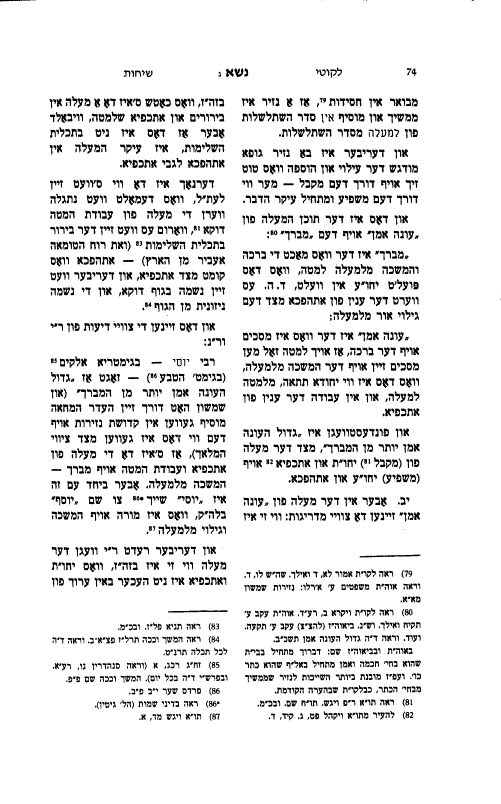
In the context of serving Hashem, there is the concept of iskafya—subduing oneself. This is a form of service that comes from below, from the person’s own effort. Yet, we find the teaching: “Godol ha’oneh amen yeser min ha’mevorekh”—the one who answers “amen” is greater than the one who makes the blessing.
This highlights the unique advantage of being a recipient—of receiving and affirming holiness through yichud tata’ah, the lower unification, which is achieved through iskafya. This type of service, coming from below and involving self-subjugation, is considered even greater than the influence that comes from above—yichud ila’ah, or ishapcha, which refers to transformation.
However, within this idea that “the one who answers amen is greater,” there are two levels. The first level applies as things are now, in our current era. Even though there is an advantage in our work of clarifying and subduing—berurim and iskafya—from below, this advantage is not yet complete or perfect. Since our iskafya is limited and not absolute, the main superiority still lies with ishapcha, transformation from above.
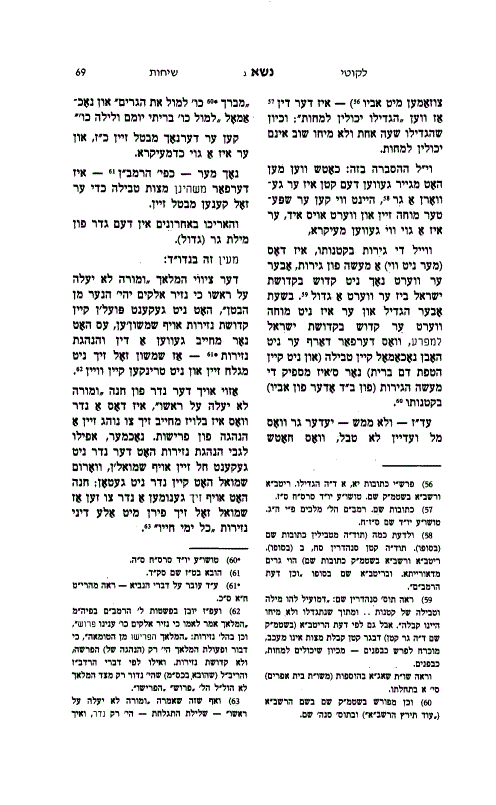
The second level will be revealed in the future, in the time to come. Then, the true greatness of service from below will be fully revealed. At that time, our clarifications—berurim—will reach their ultimate completion: “Ve’es ruach ha’tumah avi min ha’aretz”—the spirit of impurity will be removed from the land.
ואת רוח הטומאה אעביר מן הארץ.
“And I will remove the spirit of impurity from the land.”
This future state represents an iskafya that leads to complete transformation (ishapcha). The soul will then be nourished by the body itself—a reversal of today’s order—and this expresses how ultimate elevation comes specifically through physicality and effort from below.
This distinction between present and future corresponds to two opinions: Rabbi Yosi and Rabbi Nehorai. Rabbi Yosi’s name numerically equals “Elokim” (86), which also equals “ha’teva”—nature. He teaches that “the one who answers amen is greater than the one who blesses,” emphasizing how even within nature (ha’teva) there can be a unique spiritual elevation through human effort.
The discussion about gematria (numerical values) here highlights how Rabbi Yosi’s perspective relates to sanctifying nature itself through our actions. For example, Shemshon’s lack of protest added holiness to his status as a Nazir beyond what was commanded by an angel—showing how human initiative can elevate what begins as a heavenly decree.
This all points to the advantage found in iskafya, where human effort draws down holiness into nature (ha’teva). At the same time, Rabbi Yosi also acknowledges that there remains an incomparable advantage in what comes directly from above (yichud ila’ah, or transformation).
The name Nehorai is not Hebrew but Aramaic (“nehora” means light in Aramaic). This hints at a revelation that comes not directly from Torah as it exists above but rather as it impacts and transforms other languages and nations—the seventy nations (ayin umos). Rabbi Nehorai thus represents Torah’s influence as it spreads outward into all aspects of creation.
The word “nehoy” means light but not in Hebrew (“meir”), rather in Aramaic (“nehoy”). That’s why Rabbi Nehorai speaks about the advantage of answering “amen” as it will be in the future—when this response will be infinitely higher than making a blessing. He uses language like “I swear by heaven” (“hashamayim”) and “you are victorious,” adding new dimensions over previous teachings.
This future revelation will fully express the greatness of clarifying and elevating all aspects of creation—even those associated with other languages or nations. Then, service from below will include both clarification (berurim) and revelation of light (gilui ohr nehoy) through transformation (ishapcha) that emerges out of subjugation (iskafya). There will be a true connection between higher unity (yichud ila’ah) and lower unity (yichud tata’ah)—a fusion only possible when both top-down and bottom-up approaches are united.
The Rebbe notes that these ideas were discussed on 12 Tammuz 5725 (1965), shortly after he completed saying Kaddish for his mother, Rebbetzin Chana. He suggests reviewing these concepts multiple times to fully absorb their depth and significance.
Key Points
1. The sicha explores the unique forms of nazirus found in Torah and Neviim, focusing on the cases of Shimshon and Shmuel, and analyzes how their Nazirite status fits within halachic categories despite not being self-initiated vows.
2. The Rebbe distinguishes between standard nazirus, nazir olam (lifelong nazir), and the special category of Nazir Shimshon, highlighting key differences in their laws—such as the ability to become tameh lamesim (impure through contact with the dead) and hair-cutting regulations.
3. The Mishnah’s discussion about Shmuel’s status as a nazir is based on a comparison to Shimshon, but halacha ultimately rules that Shmuel was a full-fledged nazir olam with stricter prohibitions than Shimshon, illustrating that scriptural parallels do not always yield identical legal outcomes.
4. The Rebbe questions how Shimshon and Shmuel could become nezirim if neither personally accepted the vow nor had it imposed by their fathers—since halacha does not recognize a mother’s vow or an angel’s instruction as sufficient to create kedushas nazir (Nazirite sanctity).
5. Drawing an analogy from the laws of conversion for minors, the Rebbe explains that just as a minor’s conversion is retroactively validated by continued Jewish practice without protest upon maturity, so too did Shimshon and Shmuel’s ongoing conduct as nezirim establish their status retroactively when they reached adulthood without objecting.
6. This principle means that their Nazirite status was not created by a new act at maturity but was affirmed and extended from what had been initiated for them in childhood—each according to the specific parameters originally set (Shimshon with partial restrictions, Shmuel as a full nazir olam).
7. The Gemara’s discussion about blessings and answering “amen” is linked to this theme: just as answering “amen” affirms and even elevates the original blessing, so too does lack of protest upon maturity confirm and potentially enhance the original state established in childhood.
8. Rabbi Yosi and Rabbi Nehorai represent two approaches: Rabbi Yosi holds that later agreement can only reinforce what already exists, while Rabbi Nehorai maintains that such agreement can create an entirely new status—paralleling their differing views on whether Shmuel could become a full nazir through lack of protest alone.
9. The role of talmidei chachamim (students of sages) is emphasized—they increase peace in the world by receiving, expanding upon, and actualizing teachings beyond what was initiated by earlier generations; this dynamic mirrors how recipients or those who affirm can surpass initiators in spiritual impact.
10. On a deeper level, Chassidus teaches that voluntary acceptance from below—such as becoming a nozir or answering “amen”—draws down greater holiness than what comes from above alone; this reflects the unique power of human initiative to transform creation itself.
11. The advantage of service from below (iskafya) over influence from above (ishapcha) is especially significant in our era but will be fully revealed in the future when human effort will bring about ultimate transformation; this is reflected in both Rabbi Yosi’s focus on elevating nature and Rabbi Nehorai’s vision of future revelation spreading to all nations and languages.
12. The sicha concludes by connecting these themes to personal growth, communal peace, and cosmic transformation—encouraging repeated study to internalize how affirmation, consent, and continued effort can retroactively elevate both individual sanctity and the world at large.