Introduction
In this sicha, we will review Lekutei Sichos, volume 18, the second sicha for Parshas Naso. This sicha is based on the parsha of Naso, which contains both the section of Sotah and, immediately following it, the section of Nazir. The Torah first discusses the laws of a Sotah—a woman suspected of unfaithfulness—and then moves on to the laws of a Nazir, someone who accepts upon themselves a vow of Nazirus, which includes prohibitions such as abstaining from wine.
This topic is also connected to the conclusion of Tractate Sotah in the Talmud. The discussion centers around the order in which these topics appear—both in the Torah and in the Mishnah—and whether there is significance to their sequence. The Rebbe explores why the Rambam places these laws differently than they seem to appear in the Gemara, and what deeper meaning lies behind this difference.
The Rebbe will explain that there is a distinction between Rashi’s interpretation of “Sotah bikilkula”—the Sotah in her degradation—and how the Rambam understands it. This leads into an analysis of two types of kinuy—the warning given by a husband: whether it comes as a reaction to inappropriate behavior that has already occurred, or as a precaution to prevent such behavior from happening in the first place.
The Rebbe’s approach is very analytical and detailed, addressing some difficult questions with new insights that clarify these issues. We will go step by step through his explanations.
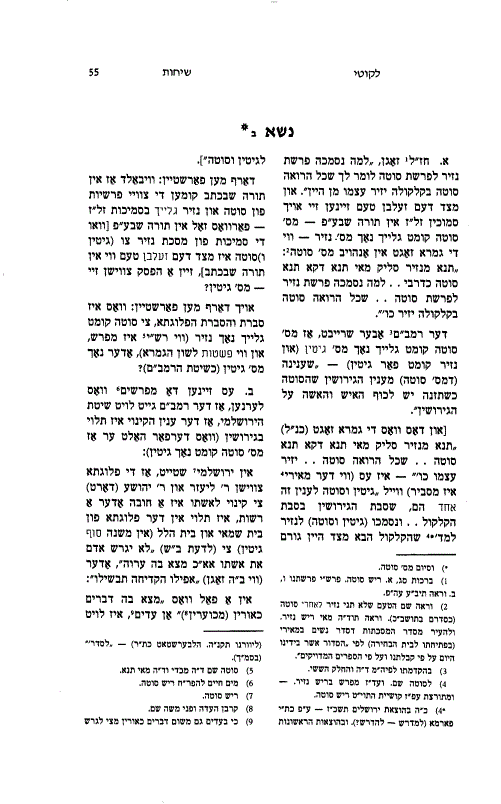
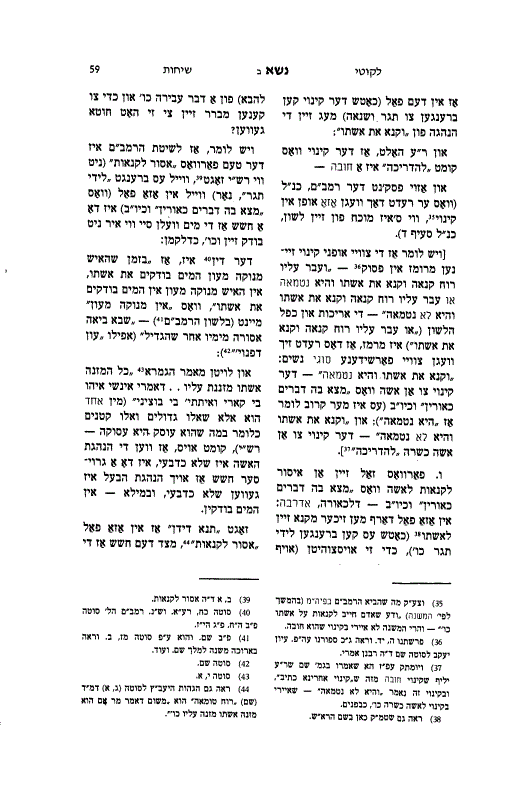
Our sages say: Why was the section of Nazir placed next to the section of Sotah? In Chumash, we first read about Sotah, and immediately after comes Nazir. What is their connection? The answer given is that anyone who sees a Sotah in her degradation should separate himself from wine. As Rashi explains at the beginning of Tractate Sotah, witnessing what happens to a woman who becomes a Sotah should prompt one to reflect on what led her down this path—specifically, how wine or intoxication may have contributed—and therefore inspire him to take precautions for himself.
Saif Aleph
The Torah places the section of Nazir immediately after the section of Sotah. The reason for this, as explained in Chumash, is that witnessing the disgrace and shame of the Sotah—her downfall—should inspire a person to distance themselves from wine, which can lead to frivolous behavior and ultimately to situations like that of the Sotah. In other words, if one does not want to end up in such a degraded state, they should avoid wine, which is often the root cause.
This connection between Sotah and Nazir is not only found in the written Torah but also reflected in the Oral Torah—in the order of the Talmudic tractates. The Gemara notes that Maseches Sotah comes immediately after Maseches Nazir. At the beginning of Tractate Sotah, the Gemara asks: since we just finished learning Nazir, why do we now learn Sotah? What is their connection?
The Gemara answers with a similar idea to what is found in Chumash: anyone who sees a Sotah in her disgrace should become a Nazir. Thus, both in Torah and Talmud, there is an intentional proximity between these two topics—Sotah and Nazir.
However, the Gemara raises a question: if the logic is that seeing a Sotah leads one to become a Nazir, then shouldn’t Nazir follow Sotah? In other words, first comes Sotah (the cause), then Nazir (the effect). Yet, in the order of tractates, Nazir precedes Sotah.
The Gemara explains that this order is due to other connections: Nazir is linked to Nedarim (vows), and Nedarim connects to Kesubos (marriage contracts) through Perek HaMadir. Therefore, even though logically it would make sense for Sotah to come before Nazir based on their thematic connection, practical considerations about tractate sequencing place Nazir first.
Despite this order, there remains an effort to keep Sotah close to Nazir because of their thematic link—that seeing a woman’s downfall due to wine should inspire abstinence through Nazirus.
From the language of the Gemara, it seems clear that after Tractate Nazir comes Tractate Sotah. However, when we look at Rambam’s introduction—where he lists all tractates according to Rabbi Yehuda HaNasi’s arrangement—he writes that Maseches Sotah comes right after Maseches Gittin (divorce), with Nazir coming before Gittin. This means that in Rambam’s order it goes: Nazir, Gittin, then Sotah—not directly from Nazir to Sotah as implied by the Gemara.
Rambam explains his reasoning: since the subject matter of Maseches Sotah revolves around divorce—because if a woman is proven guilty as a Sotah (having had an extramarital affair), both she and her husband are forced to divorce—it makes sense for Gittin (which deals with divorce) and Sotah to be placed together.
This raises a question: how can Rambam arrange things differently than what seems explicit in the Gemara—that Sotah follows immediately after Nazir?
The Rebbe addresses this by referencing an explanation from Me’iri. According to Me’iri, for this purpose Gittin and Sotah are considered as one unit. When the Gemara asks why we learn Sotah after Nazir, it does not mean only Tractate Sotah but also includes Gittin. The reason is that both deal with consequences stemming from marital breakdown—the “kilkul” or corruption caused by inappropriate behavior—and both are related thematically.
Therefore, even though Rambam places Gittin between Nazir and Sotah, he is not contradicting the Gemara. The proximity referred to by the Gemara includes both Gittin and Sotah as one conceptual block following Nazir. Both divorce (Gittin) and marital breakdown (Sotah) are outcomes triggered by similar causes—such as wine-induced misconduct—which Nazirus seeks to prevent.
Saif Beis
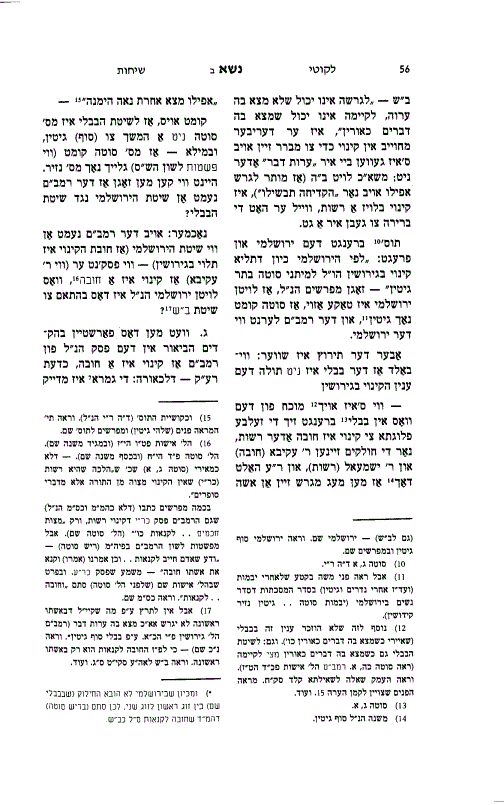
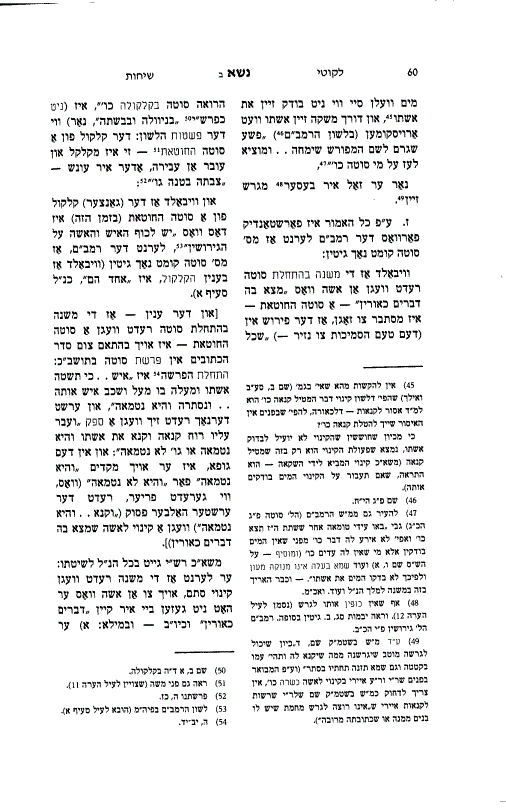
The discussion here revolves around the order of the tractates in the Mishnah and Talmud, specifically why Maseches Nazir comes after Sota, and why Gittin is placed between them in the oral Torah, even though in the written Torah—specifically in Parshas Naso—the portions of Sota and Nazir are directly adjacent. In the Torah, there is no mention of Gittin between Sota and Nazir; only those two topics are juxtaposed. This raises a question: if the order in the oral Torah is meant to reflect their sequence in the written Torah, why does Gittin interrupt between Sota and Nazir?
We need to understand both the textual basis for this order and its underlying logic. According to Rashi and the simple reading of the Gemara, Sota should come immediately after Nazir with no interruption. However, according to the Rambam’s arrangement, Sota comes after Gittin rather than directly after Nazir. The question is: what is the reasoning behind these different arrangements? Why does Rashi see Sota as following Nazir directly, while Rambam places Gittin in between?
To address this, the Rebbe brings an explanation from various commentaries based on a passage in Yerushalmi. The Yerushalmi explains that the entire reason for instituting kinuy—the warning a husband gives his wife regarding suspected infidelity—is because sometimes divorce is not an option. If divorce were always possible when there was suspicion, then one could simply give a get (divorce document) and resolve matters that way. However, according to Beis Shammai’s opinion, divorce is only permitted if there are witnesses to actual infidelity; otherwise, it is forbidden.
This creates a dilemma: if a husband suspects his wife but lacks proof or witnesses, he cannot divorce her according to Beis Shammai’s strict standard. At the same time, he cannot continue living with her due to his suspicions. Therefore, Hashem commands kinuy, making it a mitzvah for him to warn her so that matters can be clarified through the process of Sota.
According to this logic from Beis Shammai, kinuy—and thus the whole parsha of Sota—only becomes relevant when divorce is not an option. That means that Sota hinges on Gittin: first comes Gittin (the laws of divorce), and only when divorce is not possible do we turn to Sota (the laws of kinuy). This explains why Rambam places Maseches Gittin before Maseches Sota.
Beis Hillel disagrees with Beis Shammai’s restrictive view; according to Beis Hillel, one may divorce even for lesser reasons (such as burning food). Therefore, kinuy becomes optional rather than obligatory—since one can always choose to give a get instead.
This approach also helps explain why at the end of Maseches Gittin there is discussion about when one may or may not divorce his wife. According to Beis Shammai’s view that only “motza ba ervas davar”—finding something promiscuous—is grounds for divorce, there are cases where a person would be stuck: unable to live with his wife due to suspicion but unable to divorce her without proof. That’s where kinuy comes in as an alternative.
The Rebbe points out that while this reasoning fits well with Yerushalmi and explains Rambam’s order of tractates (Gittin before Sota), it does not align with how Bavli presents things. In Bavli, it is clear that kinuy does not depend solely on whether one can give a get; rather, it stands as its own process regardless of whether divorce is possible or not.
This leads us back to our original question: if Bavli does not tie kinuy exclusively to situations where divorce is impossible, why would Rambam base his order on Yerushalmi’s reasoning? Shouldn’t Bavli’s approach determine our understanding and arrangement?
The Rebbe then cites some commentaries who argue that Rambam indeed follows Yerushalmi’s view—that kinuy, and thus Sota, depends on whether one can give a get—and therefore places Maseches Gittin before Maseches Sota.
The Yerushalmi itself discusses a dispute between Rabbi Eliezer and Rabbi Yehoshua about whether kinuy is obligatory or optional. The Yerushalmi connects this debate back to Beis Shammai and Beis Hillel’s disagreement about grounds for divorce: if you follow Beis Shammai (divorce only for proven infidelity), then kinuy becomes obligatory because there are cases where you cannot simply give a get; if you follow Beis Hillel (divorce allowed even for minor reasons), then kinuy remains optional since you could always choose divorce instead.
Tosafos at the beginning of Maseches Sota quotes this Yerushalmi and raises questions about its implications for our understanding of these laws.
Saif Gimmel
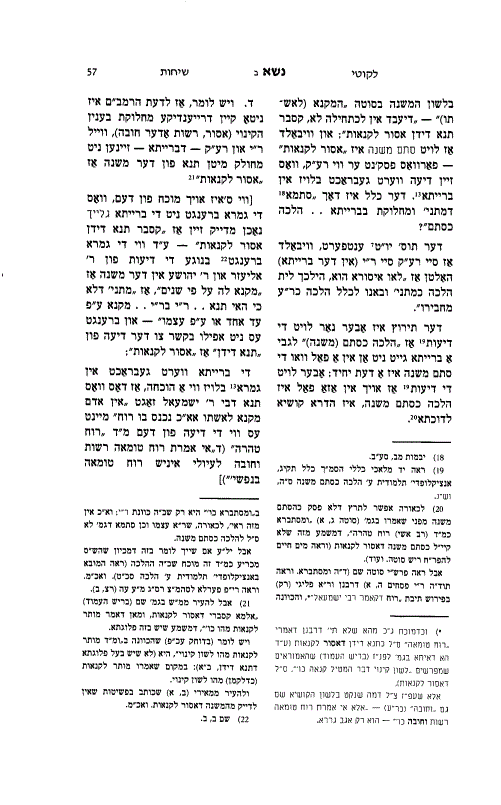
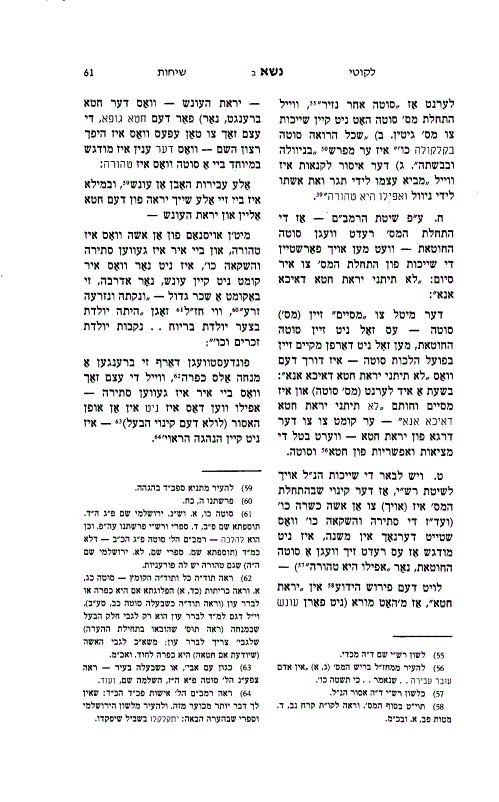
The discussion here centers on the reasoning behind the order of tractates in the Talmud, specifically why Sotah follows Gittin. According to the Yerushalmi, the reason for this order is that the obligation or permission to perform kinuy—the warning a husband gives his wife in the Sotah process—depends on whether divorce is possible. If so, then Sotah should logically follow Gittin, which deals with divorce.
Some commentators, like Shimon Al, explain that according to the Yerushalmi and as understood by the Rambam, Sotah comes after Gittin because the laws of Sotah are contingent on whether one can divorce his wife. The question is whether kinuy is obligatory or optional depends on this point. However, the Rebbe points out that this reasoning does not appear in the Bavli (Babylonian Talmud). The Bavli does not connect the obligation of kinuy to whether divorce is possible.
In the Bavli, whether one must perform kinuy or may do so optionally is a separate issue from whether divorce is allowed. The question there is simply: Is it a mitzvah or just permitted? This is independent of any inability to divorce. Evidence for this comes from the fact that in the Bavli, both opinions—that it is mandatory or optional—are presented without reference to divorce.
The two main opinions cited are those of Rabbi Akiva and Rabbi Yishmael. Rabbi Akiva holds that kinuy is an obligation, while Rabbi Yishmael says it is optional. Importantly, Rabbi Akiva also holds elsewhere that a man may divorce his wife even for superficial reasons, such as finding someone more attractive. Yet he still maintains that kinuy is a mitzvah. This shows that his view about kinuy being obligatory has nothing to do with whether divorce is possible.
This leads to an important conclusion: According to the Bavli, Sotah does not necessarily follow Gittin because its laws are not dependent on those of divorce. This reading fits with the plain language of the Gemara and stands in contrast to how some interpret Yerushalmi and Rambam.
The Rebbe questions how it could be said that Rambam follows Yerushalmi against Bavli when our general rule is to follow Bavli in halachic matters. If Bavli does not tie kinuy to divorce at all, how could Rambam base his ruling on Yerushalmi’s logic?
The issue becomes even sharper if one suggests that Rambam accepts Yerushalmi’s view—that kinuy only becomes obligatory when divorce isn’t possible. If so, how could Rambam rule like Rabbi Akiva (who says kinuy is always an obligation), when according to Yerushalmi’s logic this would only apply if there was no option for divorce? But Rabbi Akiva himself allows for easy divorce!
This indicates there must be another explanation for why Rambam places Gittin between Nazir and Sotah and why he rules as he does regarding kinuy. According to Rashi and the straightforward reading of Gemara, Sotah follows Nazir directly.
The Rebbe then raises another difficulty: Why would Rambam rule like Rabbi Akiva (that kinuy is obligatory) when this seems to contradict a Stam Mishnah (an anonymous Mishnah), which usually sets halacha? The opening Mishnah in Maseches Sotah begins with “HaMekaneh,” implying that only after-the-fact should one perform kinuy, but ideally one should not do so at all.
The Gemara derives from this language (“HaMekaneh”) that our Tanna holds it is actually prohibited (osur) to perform kinuy. Since this Stam Mishnah presents an anonymous ruling prohibiting kinuy, why would Rambam side with Rabbi Akiva’s view from a Braisa (which says it’s obligatory), seemingly against established halachic principles?
The general rule states: When there’s a Stam Mishnah versus a dispute in a Braisa, halacha follows the Stam Mishnah. Thus, we would expect halacha to follow the Tanna of our Mishnah who prohibits kinuy, rather than Rabbi Akiva who obligates it.
The Tur offers an answer: In the Braisa we have two Tannaim—Rabbi Akiva and Rabbi Yishmael—both agreeing that performing kinuy is not prohibited; they only disagree if it’s obligatory or optional. So while our Mishnah presents one anonymous opinion prohibiting it, two authorities in the Braisa permit it (with different nuances). Therefore, we have two against one and can rule like them over the Stam Mishnah.
The Rebbe notes this answer isn’t universally accepted. Some maintain that even when two Tannaim in a Braisa disagree with a Stam Mishnah’s single opinion, halacha still follows the Stam Mishnah. The discussion continues as we look deeper into how Rambam rules and what underlying principles guide his decisions regarding these laws.
Saif Daled
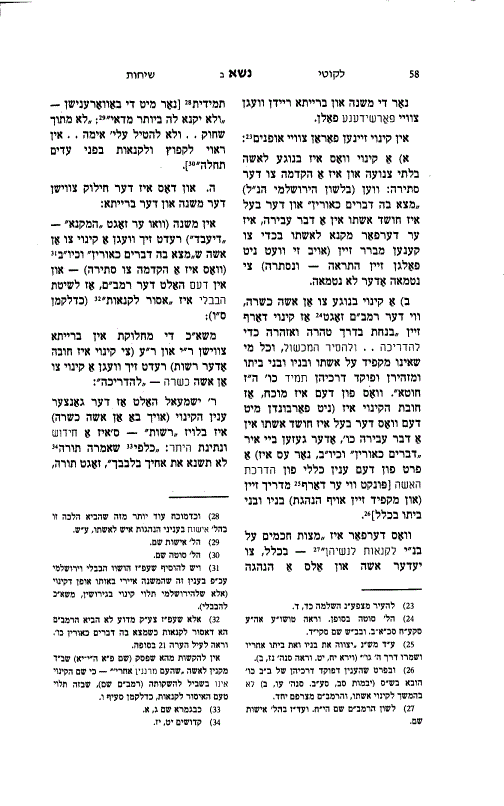
Rabbi Akiva and Rabbi Yishmael both present views that seem to go against the Mishnah, raising the question of how we rule when there is a disagreement between Tannaim in a Bresa and the Mishnah. The Rambam appears to side with one over the other, even though the Mishnah seems to have a clear stance. This leads to the general rule: when Rabbi Akiva disagrees with another individual Tanna, we follow Rabbi Akiva. However, this only applies in certain cases—specifically, when the law is against the Mishnah due to a majority in the Bresa or other factors.
There are sources, such as from Yad Malachi, that clarify: if there is a majority opinion in the Bresa against a Stam Mishnah (an anonymous Mishnah), we follow the Bresa. But if the Stam Mishnah represents only one opinion (a yachid), and there is a majority in the Bresa, then again, we follow the Bresa. In such cases, if it’s just one opinion in the Mishnah versus a majority in the Bresa, we do not automatically follow the Mishnah.
This brings us back to our main question: how could Rambam rule like Rabbi Akiva against what appears to be a Stam Mishnah? The answer lies in understanding what each source is actually discussing. In this section, the Rebbe explains that there isn’t really a three-way dispute between our Mishnah and Rabbi Akiva and Rabbi Yishmael. Rather, they are discussing two separate scenarios.
The Mishnah addresses one case—where someone is faced with an immodest woman and must decide whether or not to issue a warning (kinui). In this context, the Mishnah says that warning should only be done after the fact (b’dieved). The Bresa, on the other hand, discusses a different context entirely: it deals with general behavior—how one should conduct themselves at home to ensure their family follows Torah ways. Here arises the debate between Rabbi Akiva and Rabbi Yishmael: is it a mitzvah to warn (to be mekanneh), or is it merely optional?
So according to this distinction, there isn’t actually a three-way dispute about kinui. The Mishnah’s case is unique—it’s about when there’s already an issue of immodesty; only then does it say warning should be b’dieved. The debate between Rabbi Akiva and Rabbi Yishmael in the Bresa concerns regular conduct—should you proactively warn your wife as part of maintaining Torah standards at home?
The Rebbe points out that this distinction answers many questions clearly. We can now say that according to Rambam’s view, there isn’t a direct conflict between our Mishnah and Rabbi Akiva or Rabbi Yishmael regarding kinui; they’re simply addressing different situations.
Further proof for this comes from how these sources are presented in Gemara. The Gemara does not immediately bring down this Bresa after quoting our Mishnah—as would be expected if it were presenting an opposing view on exactly the same case. Instead, it brings them separately because they address different issues.
For example, elsewhere when there is an explicit disagreement between opinions quoted in a Mishnah and those found in a Bresa—such as regarding whether two witnesses are needed for warning—the Gemara brings down both sources together to highlight their disagreement. Here, however, since our case deals with two distinct scenarios (the specific versus general approach), there’s no need for such juxtaposition.
The Gemara uses these Bresos not to show dissenting opinions on whether warning is permitted or required in cases of suspected immodesty (as per our Mishnah), but rather as evidence for other points—such as clarifying what kind of “spirit” enters someone who warns his wife. Thus, when discussing whether kinui is optional or obligatory as part of household conduct (not specifically tied to suspicion), that’s where Rabbi Akiva and Rabbi Yishmael disagree.
This careful analysis resolves why Rambam can rule like Rabbi Akiva without contradicting our Stam Mishnah: they’re simply not talking about exactly the same thing. Each source addresses its own unique context within halacha.
Saif Hei
The Gemara discusses two distinct cases regarding the concept of kinui—the warning a husband gives to his wife. The Mishnah and the Braisa each address separate scenarios. In the context of kinui, there are two situations: one relates to a woman whose behavior is immodest, and the other pertains to a woman who is otherwise kosher, meaning she is not suspected of wrongdoing.
The first case involves a woman who has already exhibited promiscuous behavior. As mentioned in the Yerushalmi, this warning occurs before she goes into seclusion. The husband suspects his wife of an inappropriate act and warns her in order to determine whether she will heed his warning or proceed into seclusion, which would then clarify whether she was defiled or not.
The second case concerns a warning given to a kosher woman. Here, the warning is meant as gentle guidance—an educational measure to direct her conduct and prevent any potential stumbling. The purpose is not suspicion but rather positive direction within the family dynamic. The Mishnah emphasizes that anyone who does not pay attention to his wife, children, or household members by guiding them and monitoring their ways is neglecting his responsibility. Such guidance ensures that no one in the home stumbles spiritually or morally.
This demonstrates that the obligation of kinui is not inherently tied to suspicion of sin. Instead, it is part of the general duty to guide one's family members, just as one must guide children or others in the household. The Rambam writes that it is a mitzvah for every man in Israel to warn their wives—not only when there is suspicion but as an ongoing aspect of proper conduct within marriage.
However, caution must be exercised. As the Rambam notes, one should not warn excessively or in jest, nor should he instill fear through such warnings. It is improper to immediately warn in front of witnesses unless truly necessary; rather, these warnings should be part of regular guidance and not based on suspicion.
This distinction between cases explains why there are different approaches in the Mishnah and Braisa. In one place, it discusses a warning given after discovering inappropriate behavior—a prelude to seclusion—while elsewhere, it refers to general guidance without any prior suspicion.
The Rambam rules that it is prohibited to issue a warning when there are grounds for suspicion if certain conditions are present. This differs from other opinions found in the Braisa regarding whether such warnings are mandatory or optional when dealing with a kosher woman for purposes of education and direction.
The concept of kinui, even when directed at a kosher woman, is considered optional—a novel allowance by Torah law. Why? Because generally, Torah prohibits harboring hatred toward another Jew in one's heart. In this unique case, however, Torah permits such conduct since its purpose is constructive guidance.
The Rambam maintains that when suspicion arises due to observed misconduct, it may actually be prohibited for the husband to warn his wife. This prohibition stems from another principle: if there are signs of promiscuity on her part, it often reflects similar failings on his part as well. As explained by the Gemara, if the husband himself has been involved in infidelity or similar matters, then even if he warns her and she drinks the bitter waters prescribed by Torah law for suspected adultery (sotah), those waters will not test her innocence because he too is guilty.
This explains why it may be forbidden for him to issue such a warning—not because it will lead to arguments (as Rashi suggests), but because halachically, if he himself has sinned similarly, the process cannot work as intended.
Therefore, according to Rambam’s view (as clarified by the Rebbe), even though one might think that discovering inappropriate behavior should obligate a husband to warn his wife (to protect her from future sin and clarify what happened), Torah law actually prohibits this if he himself has been involved in similar transgressions.
This nuanced approach highlights how Torah law balances between protecting marital harmony and upholding spiritual integrity within the home. The halacha follows what the Gemara states later on: if there are grounds for suspicion but also reason to believe mutual guilt exists, then issuing a warning becomes prohibited rather than obligatory.
Saif Vov
If the husband is clean from any sin, then the water that the wife drinks will check her. But if the husband is not clean from sin—meaning that from the time he became an adult, if he ever had a prohibited relationship, even with a non-married woman—then the water will not check his wife. In other words, if he himself was involved in any unfaithfulness, the water will not test his wife.
The idea is that anyone who is not faithful himself cannot expect his wife to be faithful. The Gemara illustrates this with a metaphor: he is by the big vegetables, she is by the small ones—meaning, whatever he is involved with, she mirrors. As Rashi explains, whatever he is busy with, that's what she is busy with. If the wife's conduct isn't proper, it reflects that the husband's conduct also isn't proper. Therefore, in such a case, the water will not check her.
For this reason, our Sages say it is prohibited to give her to drink if there is concern that the water will not check her anyway. What would happen if he gives his wife to drink? He would be causing a sin—a crime—by causing Hashem's name (the Shem HaMeforash) to be erased for no purpose. This could lead to a bad reputation and people saying that it didn't work. Therefore, it's better for him to divorce her than to give her the water in these circumstances.
This also explains why, as discussed in the next section (Ois Zayin), the Rambam places Gittin before Sotah in his order of tractates. The Mishnah in Sotah discusses a case where there are clear signs of impropriety—motzi bo dvarim ki'urim, meaning there was an actual sin involved. The Rambam understands that when we're dealing with such a case—a Sotah who has sinned—the solution is divorce. Nowadays, since we do not have the waters of Sotah, all we can do is force them to divorce.
Thus, Gittin and Sotah become intertwined: both deal with situations of marital breakdown due to sin. When there is a kilkul—a corruption or breakdown—that leads directly to divorce; they are essentially one matter. Therefore, Gittin comes before Sotah in Rambam's order.
Rashi, on the other hand, learns that the first Mishnah in Sotah does not refer specifically to a case of kilkul, but rather simply discusses a woman about whom there are suspicions but no clear evidence of wrongdoing (dvarim ki'urim). Therefore, there isn't necessarily a direct connection between Sotah and Gittin according to Rashi; instead, Sotah follows Nazir for other reasons.
The Rebbe points out that this distinction also fits with how each understands the verses themselves. According to Rambam's reading of the Mishnah—that it deals with an actual sinner—the order fits well with how these topics appear in Torah: first comes Gittin (divorce), then comes Sotah (the unfaithful wife). This reflects both halachic logic and scriptural sequence.
In summary: according to Rambam's approach—which sees Sotah as dealing primarily with cases of actual sin—the tractate naturally follows Gittin because both address marital breakdown due to infidelity or suspicion thereof. This approach aligns with both halachic reasoning and the order found in Torah itself.
Saif Zayin
The beginning of the tractate Sotah discusses a woman who has strayed—she violated her marriage and had intimacy with another man, going into seclusion and becoming defiled. Later, the tractate addresses a different scenario: a spirit of jealousy comes over her husband, he warns his wife, and there is uncertainty about what she did or did not do. Even in this case of doubt, the Torah introduces the topic with a preface.
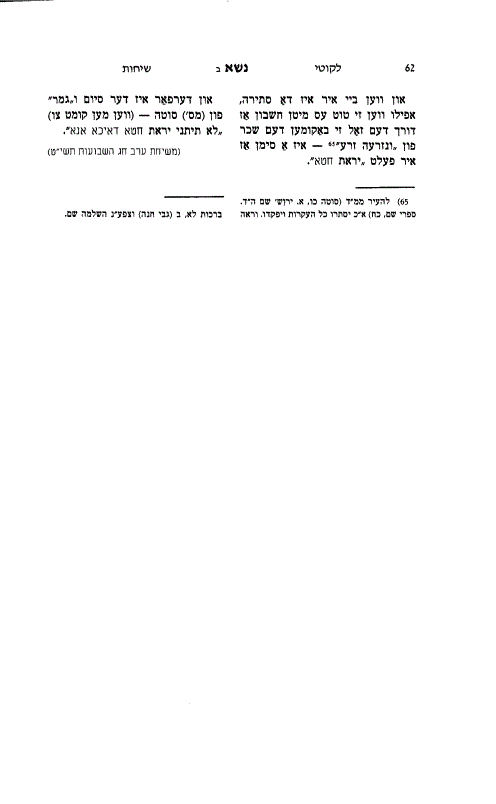
According to the Rambam’s view, the beginning of the tractate speaks about a Sotah who has actually sinned—a Sotah chattas. This helps us understand the connection between the start and end of the tractate. The Mishnah at the end says “when yiras cheit (fear of sin) is nullified,” but an Amora responds: don’t say there is no more fear of sin—there still is! In other words, even if it seems that yiras cheit is gone, it must remain.
The conclusion of Maseches Sotah is that we should not reach a state where there is no yiras cheit. When a Jew studies this tractate and concludes with “don’t say there is no yiras cheit,” it means he has reached a level where fear of sin exists within him. This itself nullifies the possibility for sin and for the situation of Sotah to arise.
So, according to the Rambam’s approach—that the first Mishnah discusses a Sotah chattas—the connection from beginning to end is clear: we start by addressing actual sin and conclude by emphasizing that yiras cheit must never be lost.
Rebbe Neustadt explains that even according to Rashi’s view, which holds that the warning at the beginning applies also to a kosher woman (one who has not sinned), there remains a connection from start to finish. The Mishnah later discusses seclusion and drinking even when it’s not clear that any sin occurred; it’s not only about an actual sinner.
How then do we explain concluding with “don’t say there is no yiras cheit” if we’re not talking about an actual sinner? We must understand what true fear of sin means. Yiras cheit isn’t just fear of punishment—it’s being afraid of doing something against Hashem’s will itself. The essence is not about consequences but about avoiding anything contrary to Hashem’s desire.
This aspect—fear of sin itself—is especially emphasized in yiras cheit. While all sins have punishments, one can have both fear of punishment and fear of sin itself. However, in the case of a woman who truly emerges innocent after drinking—the Torah says she receives great reward: she will conceive children more easily or have sons instead of daughters, as Chazal explain.
Even so, despite her innocence and reward, she still brings a meal offering as atonement for having entered into seclusion at all—even if it was permitted or calculated for positive reasons (like hoping for blessing in children). This shows that even when no prohibition was transgressed, such conduct isn’t proper; there remains something lacking.
Therefore, the tractate concludes: don’t rely on calculations or loopholes—even for someone completely innocent—because yiras cheit demands avoiding questionable situations altogether. The message is clear: maintain true fear of sin itself so that such scenarios never arise—not only avoiding punishment but upholding Hashem’s will in every respect.
Key Points
1. The juxtaposition of the Sotah and Nazir sections in Parshas Naso—and their parallel arrangement in the Talmud—reflects a thematic connection: witnessing the downfall of a Sotah should inspire one to distance themselves from wine and frivolity, leading to the path of Nazirus.
2. The order of tractates in the Mishnah and Talmud differs from their sequence in the Torah. While Rashi and the Gemara suggest Sotah should follow Nazir directly, Rambam places Gittin between them, based on deeper halachic reasoning connected to divorce and marital breakdown.
3. According to Yerushalmi, the mitzvah of kinuy (warning) is only relevant when divorce is not an option—primarily following Beis Shammai’s opinion. This explains why Rambam places Gittin before Sotah: only when divorce is impossible does kinuy become necessary.
4. The Bavli presents kinuy as an independent process, not contingent on whether divorce is possible. Both Rabbi Akiva and Rabbi Yishmael debate whether kinuy is obligatory or optional, regardless of divorce laws, challenging the idea that Rambam would base his order solely on Yerushalmi’s logic.
5. The apparent contradiction between Rambam’s ruling like Rabbi Akiva (that kinuy is obligatory) and a Stam Mishnah (which seems to prohibit kinuy) is resolved by distinguishing between different cases: the Mishnah addresses warnings after immodest behavior, while the Braisa discusses general household guidance.
6. There are two types of kinuy: one as a response to actual suspicion or immodesty (where warning may be prohibited if mutual guilt exists), and another as proactive educational guidance within marriage (which may be optional or even a mitzvah according to some views).
7. Rambam rules that issuing a warning when there are grounds for suspicion can be prohibited if the husband himself has sinned similarly, since in such cases the Sotah waters will not test her innocence; this upholds spiritual integrity within marriage and prevents desecration of Hashem’s name.
8. The intertwining of Gittin and Sotah in Rambam’s order reflects their shared focus on marital breakdown due to sin or suspicion; when actual impropriety occurs, divorce becomes the solution rather than pursuing the Sotah process, especially in times when the ritual cannot be performed.
9. According to Rambam, the tractate Sotah begins with cases of actual sin (Sotah chattas), while Rashi sees it as addressing even cases without clear wrongdoing. This distinction shapes their respective understandings of both halachic sequence and scriptural context.
10. The conclusion of Maseches Sotah emphasizes that yiras cheit—fear of sin itself—must always remain present. Even those found innocent must avoid questionable situations entirely, highlighting that true yiras cheit means upholding Hashem’s will beyond mere avoidance of punishment or technical transgression.