
Introduction
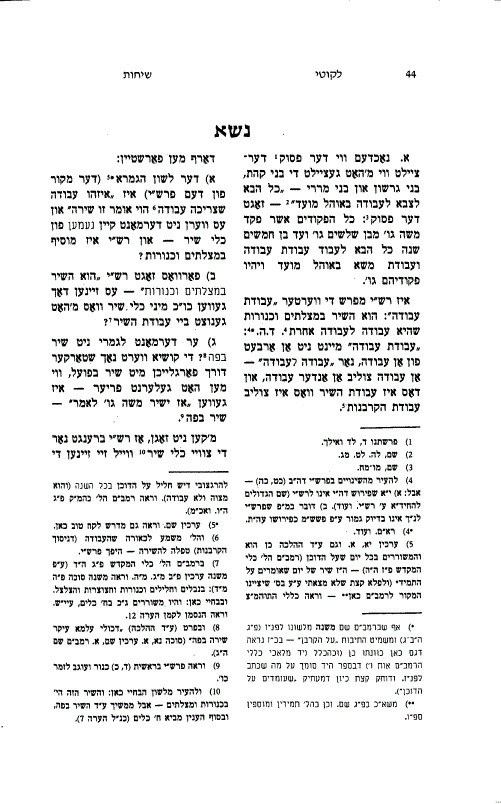
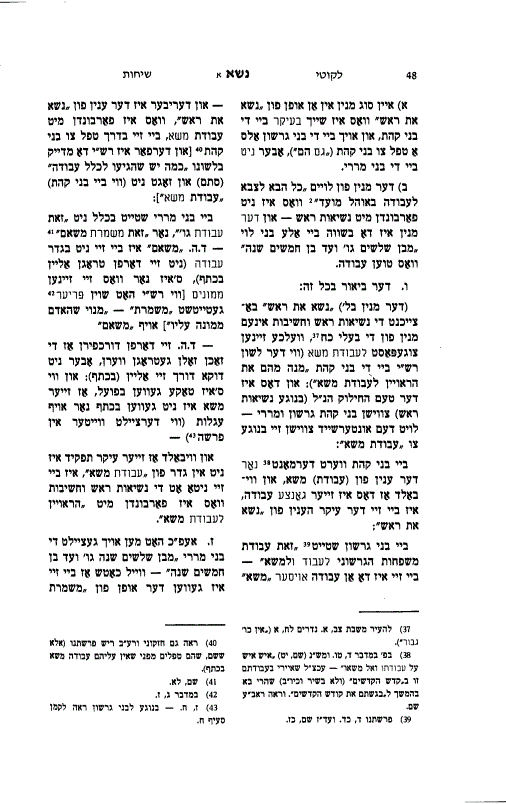
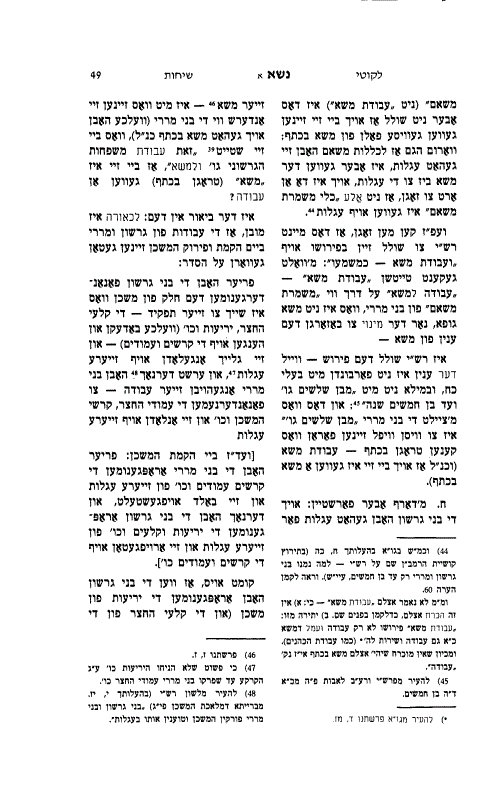
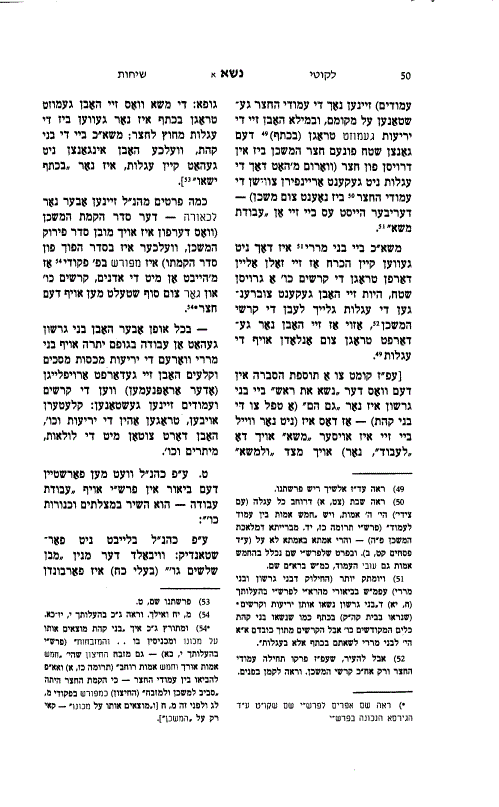
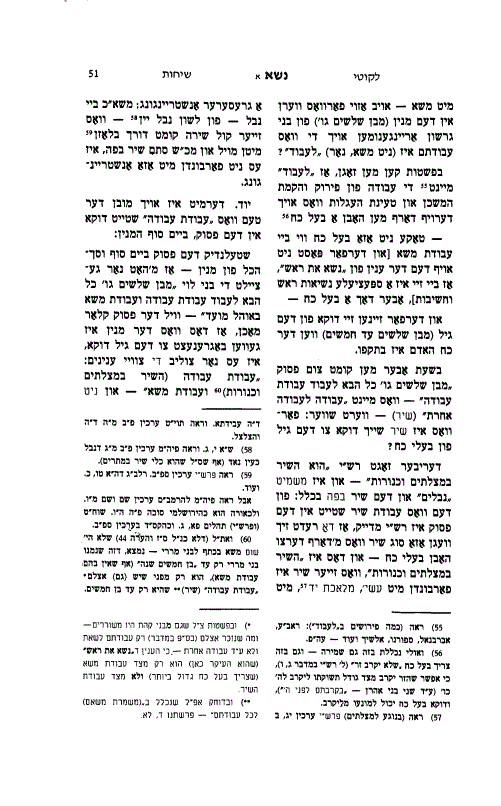
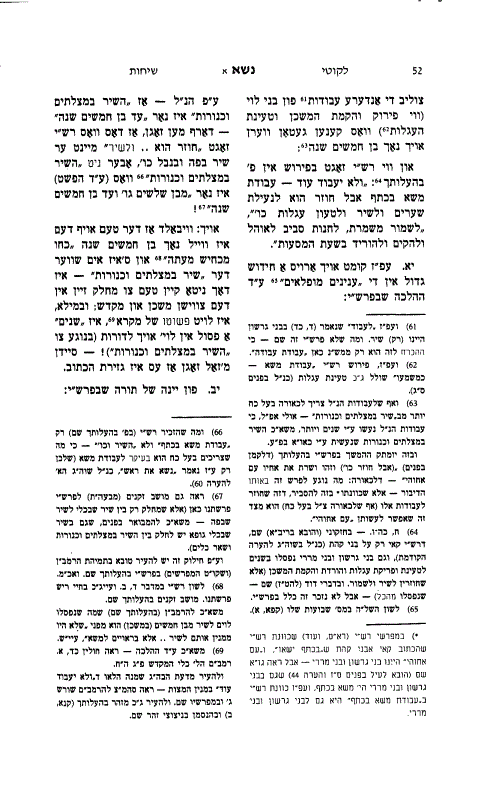
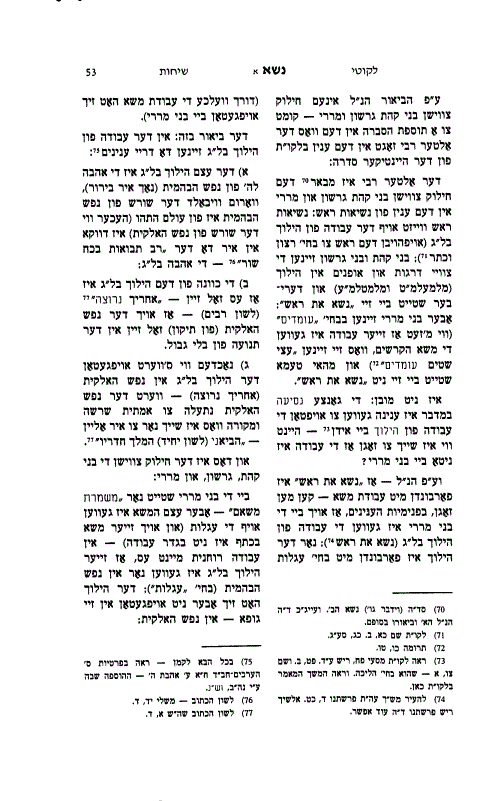
In this sicha, we will review Lekutei Sichos, Chelek Yud Ches, the first sicha for Parshas Naso. This is a Rashi sicha, where the Rebbe focuses on a Rashi in the portion of Naso. However, it is an all-encompassing discussion that sheds light on many details throughout the parsha.
The Rebbe will explain the Rashi according to peshuto shel mikra—the plain meaning of the verse. He will explore the different languages used when describing the families of Kehos, Gershon, and Merari, as well as their distinct roles in carrying and serving in the Mishkan. Many beautiful details and aspects of the parsha will be clarified along the way, each contributing to a deeper understanding of Rashi’s question and answer.
Let’s look inside at what the Torah says. This section of the parsha discusses the various counts of the families of Levi. The verse begins with “Naso es rosh bnei Gershon”—counting the family of Gershon. Earlier in Bamidbar, the Torah instructed to count Bnei Kehos, who were responsible for carrying the vessels of the Mishkan.
Here, in our parsha, it says to count Bnei Gershon as well—again specifying from thirty years old until fifty—those who are eligible to perform the work. The Torah details exactly what tasks Bnei Gershon were assigned. Then it moves on to Bnei Merari: again, they are counted from thirty years old and up, with their specific responsibilities listed—“zoys avodas mishpachos bnei Merari”—this is the service of Merari’s family.
Each family is described separately with its own count and unique role. The Torah then states how Moshe and Aharon counted each group: first Kehos and their total number; then Gershon and their total; then Merari and theirs. These are presented as individual families within Shevet Levi.
Finally, in verse 45 (pasuk mem-hei), it summarizes: “Eileh pekudei mishpachos bnei Merari asher pogad Moshe v’Aharon…”—these are the numbers of Merari’s family that Moshe and Aharon counted by God’s word through Moshe.
Saif Aleph
The Torah, after detailing the counting of the sons of Kohos, proceeds to discuss the families of Gershon and Merori in Parshas Naso. The summary verse states that all those counted were from thirty to fifty years old, and they came to serve in two ways: avoydas avoydo and avoydas maase in the Ohel Moed. This is a summation of all the work assigned to the three families of Leviim as previously described.
Rashi explains these terms. What is avoydas avoydo? Rashi says it refers to the song performed by the Leviim with instruments—specifically, with mitzoltaim (cymbals) and kinoyres (harps). These instruments were used when the Kohanim brought korbanos (offerings); the Leviim would sing and play music as an accompaniment. This musical service was not an end in itself but served another service—the primary service being the korbanos. Thus, avoydas avoydo means a service for another service: their singing and playing music supported the main avodah of bringing offerings.
Rashi further explains that avoydas maase refers simply to carrying—the physical labor involved in transporting parts of the Mishkan.
The Rebbe notes that after describing how each family was counted, the Torah summarizes: all who came to serve in these capacities, from thirty to fifty years old, are included in this total. The verse uses the phrase “kol habo l’atsovo l’avoyda b’oyl mo’ed”—all who come for duty in the Ohel Moed—then lists those who came for avoydas avoydo and avoydas maase. This includes all Leviim from Kohos, Gershon, and Merori.
The focus then returns to Rashi’s explanation of “avoydas avoydo.” Rashi defines it as “the song with cymbals and harps,” which is a service for another service—the korbanos. In other words, this is not just any work but specifically a supportive role: their music enhances or accompanies another primary act of service.
The Rebbe raises several questions about Rashi’s commentary. First, why does Rashi specify only these two instruments—cymbals and harps—when there were many other musical instruments used by the Leviim? Furthermore, why does Rashi mention instruments at all? In the Gemara, which is Rashi’s source for this explanation, it simply says that “avoydas avoydo” refers to shira—song—as a service for another service (the korbanos), but does not mention any specific instruments.
This leads to a second question: if Rashi wants to highlight musical accompaniment, why single out only cymbals and harps when there were many other vessels used for song? The Leviim had a variety of instruments at their disposal during their service; why are only these two mentioned?
The Rebbe signals that he will address these questions later on by exploring what makes these particular instruments significant and why Rashi chose this language despite its absence from the Gemara.
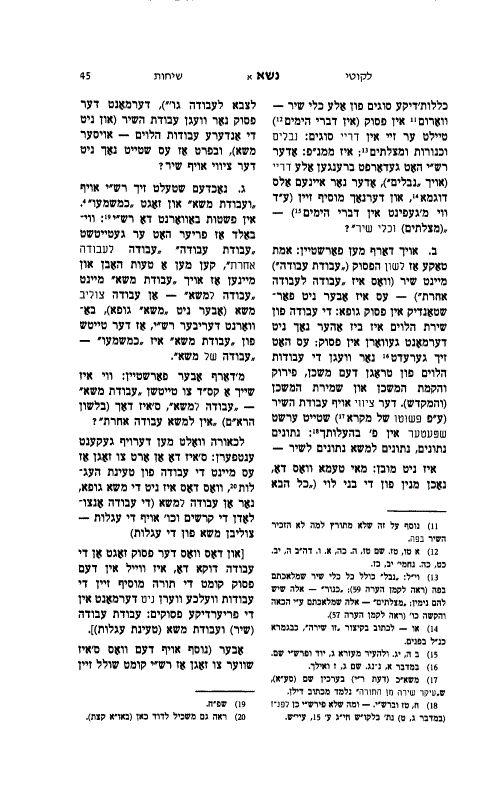
Saif Beis
The Rebbe begins by noting that there is a lengthy discussion here, but he wants to give us an idea of the approach. The main question is why Rashi specifically mentions the song with instruments—kinor and metziltayim—but omits the song with the mouth, which is also a form of song. The Rebbe says that this omission is not simply because singing with the mouth is less difficult; rather, Rashi is addressing something specific about these types of service that required those aged thirty and above.
Rashi brings down only the song performed with two instruments and does not mention plain singing. This question becomes even stronger when we recall that earlier in the Torah, we already learned about a song sung by Moshe—Az Yashir—which was clearly a song with the mouth (shir bepeh). If so, why does Rashi omit this and only mention instrumental music?
Perhaps one might suggest that kinor and metziltayim are simply the two main instruments, but the Rebbe explains that Rashi’s intent is deeper. These two instruments represent general categories for different types of musical instruments used in the Temple service. However, this explanation does not fully satisfy, because in Divrei HaYamim (Chronicles), when discussing the preparation of the Leviim for their service, three categories of instruments are mentioned: nevel (which some translate as lyre), kinor (a string instrument), and metziltayim (an instrument you strike).
The Rebbe clarifies that nevel is actually an instrument you blow into, kinor is played with strings, and metziltayim are struck. Thus, there are three primary categories: wind, string, and percussion. If Rashi’s goal was to reference general categories, he should have included all three or at least noted that these were examples among others. By mentioning only two without further clarification or reference to Divrei HaYamim, something seems lacking in Rashi’s explanation.
The Rebbe then turns to a broader question on the verse itself: Why does the Torah find it necessary here to mention specifically the service of singing by the Leviim? Up until now, their tasks have been described as carrying and assembling/disassembling the Mishkan, as well as guarding it. The commandment regarding singing appears much later in Parshas Beha’aloscha when it says “nissunim nissunim”—they were given over for both carrying and for song.
Therefore, it is puzzling why after counting Bnei Levi and stating “kol habah letzava la’avodah”—everyone who comes to serve—the Torah singles out only two activities: singing (with instruments) and carrying. It does not mention other forms of service such as guarding or assembling/disassembling. This omission is especially striking since at this point in the narrative there has not yet been any explicit commandment regarding their musical service.
The Rebbe points out that if “avodas avodah” means song—as Rashi explains—it remains unclear why this particular aspect of their service is highlighted here before it has even been formally introduced in the Torah text.
Moving on to Rashi’s second comment on “avodas massa,” Rashi explains that it means literally—the actual carrying itself. The Rebbe asks what exactly Rashi seeks to clarify here. Since previously Rashi explained “avodas avodah” as a service for another service (i.e., singing accompanying another avodah), one might mistakenly think “avodas massa” means a preparatory act for carrying rather than carrying itself.
Therefore, Rashi emphasizes that “avodas massa” refers specifically to the act of carrying—not merely preparing for it or performing some related task. Nonetheless, questions remain about why these particular aspects are singled out at this stage in the Torah’s description of Leviim’s duties.
Saif Gimmel
The Rebbe begins by analyzing the phrase “avodah lemassa,” which means “service for carrying.” Rashi is trying to clarify that this refers specifically to the actual act of carrying, not just any service related to transporting items. The Ramban, quoting the Mizrachi, explains that there is no other avodah—no other service—for carrying besides the actual act itself. When it comes to korbanos, there are different types of service, but for carrying, it’s straightforward: it simply means transporting the items.
However, the Rebbe raises a question: perhaps Rashi is coming to exclude something else. Maybe “avodah lemassa” doesn’t mean loading the wagons, but rather the actual act of carrying. One could have thought that loading the wagons is also considered part of this service. So why does Rashi need to clarify that “avodah lemassa” means only the actual carrying and not loading?
There is room to suggest that the Torah might be referring here to two distinct services: one is loading the wagons with items like the kerashim (beams) and other parts of the Mishkan; the other is actually transporting them. If so, perhaps “avodah lemassa” could include both loading and carrying. But if that's true, why would the Torah mention only loading in this context? It wouldn’t fit with what’s being discussed in these verses.
The Rebbe explains that in these verses, two new forms of service are introduced: song (shir) and loading (tinas agolos). Neither was mentioned earlier. Therefore, one might think that when the Torah speaks about “avodah,” it refers both to singing and to loading. That’s why Rashi clarifies that “avodah lemassa” means specifically carrying—not just loading.
But even with this explanation, there’s still a difficulty. Why would Rashi need to exclude loading from “avodah lemassa”? The Torah discusses loading later on in Parshas Naso regarding Gershon and Merari. If so, why not include both loading and carrying as part of “avodah lemassa”? Why does Rashi insist on a narrow definition?
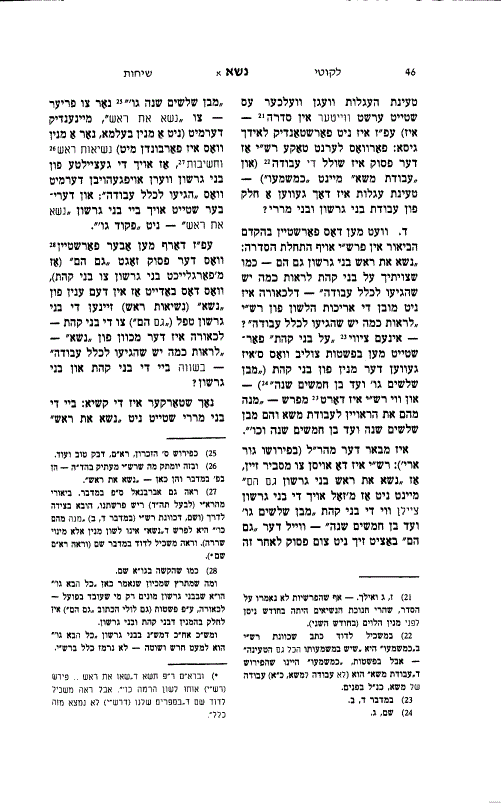
The Rebbe now turns to another point at the beginning of Parshas Naso: “Naso es rosh bnei Gershon gam heim”—“Count also the sons of Gershon.” The word “gam heim”—“also them”—is unique here; it doesn’t appear regarding Merari. What does this extra phrase teach us?
The Maharal of Prague explains that “gam heim” doesn’t mean they are counted from age thirty to fifty just like Kehos; rather, it emphasizes their importance—they too are significant enough to be counted for a special purpose.
However, if they are important, why does it say only “also them” for Gershon and not for Merari? And what exactly is Rashi coming to teach with his lengthy explanation at the beginning of Parshas Naso?
To understand this, we look at Rashi’s comment on “Naso es rosh bnei Gershon gam heim.” Rashi says: just as I instructed you regarding Kehos—to see how many reached an age fit for service—so too count Gershon for those able to serve. This seems unnecessarily wordy; what is Rashi emphasizing?
When discussing Kehos in Parshas Bamidbar, it’s clear why they needed counting: only those between thirty and fifty were strong enough for their task—carrying holy vessels on their shoulders required strength. But with Gershon and Merari, whose work involved less strenuous tasks (like transporting curtains or beams), why was such a count necessary?
The Maharal in his commentary Gur Aryeh explains that Rashi wants us to know that counting Gershon isn’t just about numbers—it’s about identifying those fit for their particular service. The phrase “gam heim” connects back not just to counting but specifically to those eligible for avodah.
This clarifies why only Gershon gets this special mention and not Merari—their roles differed in significance or type of work required. Thus, Rashi elaborates here more than elsewhere because he wants us to understand what makes each group’s count unique.
Saif Daled
What does it mean when the verse says, “not a simple counting,” but rather a counting that is connected with nisi es rosh—raising their heads and importance? This is not just a tally, but a count that elevates those included. The same applies to those counted from the children of Gershon: they too are raised up by being included in the service.
That’s why the Torah says about Bnei Gershon, “noso es rosh”—raise their heads—not just “count them.” Rashi explains that this is a special kind of counting, one that brings elevation and significance to those counted. When Rashi says this, he means that for Bnei Gershon as well, being counted is itself an act of raising them up because they have reached the age and status to serve.
But if so, we need to understand: why does the verse say “also them” (gam heim) regarding Bnei Gershon? It sounds like Bnei Kohos are primary, and Bnei Gershon are secondary—“also them.” Yet, when it comes to being fit for service, both groups are equal; both have reached the age and status required for inclusion in the work. So why this distinction?
The question becomes even stronger with Bnei Merori. There, the Torah doesn’t say “noso es rosh” at all—it just says to count them (tifkod). They too are counted from age thirty to fifty, just like the others. If what raises someone up is simply reaching the age for service (thirty to fifty), then why does only Bnei Kohos get “noso,” Bnei Gershon get “also them,” and Bnei Merori get neither? All three groups meet the same criteria regarding age and eligibility for service.
This suggests there must be some deeper difference between these groups. If all that mattered was reaching the appropriate age for service, then all three should be described with “noso.” The fact that they are not points to another factor at play.
The Rebbe anticipates a possible answer: perhaps it depends on the importance of their respective tasks. Bnei Kohos carried the holiest vessels of the Mishkan—the Ark, Table, Menorah—so their role was most significant and thus warranted “noso es rosh.” Bnei Gershon carried items visible from inside the Mishkan, so they receive a secondary mention (“also them”). Bnei Merori carried more external or less prominent items and therefore do not receive this special language at all.
This explanation seems supported by Rashi later on in Parshas Beha’aloscha. There, Rashi notes that each group’s level of elevation corresponds to what they carried: Kohos gets primary mention because they served in carrying holy objects; Gershon gets secondary mention because their load was also important but less so; Merori’s load did not include anything visible in the Holy of Holies and thus receives no special mention.
This fits with Rashi’s comment about three times raising up among Leviim: once uniquely for Kohos (who served in the holiest capacity), once for Gershon (whose work was also holy), and once for Merori (who did not have such a role). Each group’s status reflects what they carried.
However, we cannot apply this reasoning here based on Rashi’s own words in our section. When Rashi comments on Bnei Kohos’ counting here, he does not mention anything about their importance or about carrying holy vessels. He simply states: count those who are fit for service—meaning those who have reached eligibility by age or ability.
This indicates that in our context, Rashi is not distinguishing between these groups based on what they carried or their relative importance within the Mishkan. Instead, he focuses solely on whether they are fit for service. This leaves us with our original question: if eligibility alone is what matters here, why do we see different language used for each group?
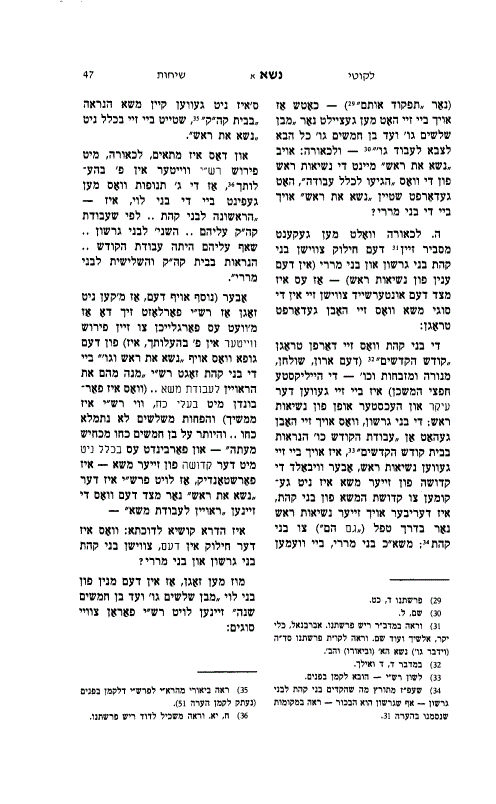
Saif Hei
The discussion here centers on the criteria for counting the Levites, specifically regarding their strength and suitability for carrying. Rashi explains that those younger than 30 have not yet reached their full strength, while those older than 50 begin to weaken. Thus, the age range of 30 to 50 is significant because it represents the period when a person’s strength is at its peak for this demanding service.
When it comes to the Kodesh HaKadoshim, Rashi does not mention anything about the sanctity of what is being carried as a reason for counting. Instead, the focus is solely on whether they are fit to carry. Therefore, according to Rashi, the reason for “raising their heads”—counting them—is not due to what they carry but simply because they are capable of carrying.
This brings us back to a fundamental question: If the qualification is strength and fitness for carrying, and all three families—Kehos, Gershon, and Merori—are counted from age 30 to 50, what distinguishes them from one another?
The Rebbe explains that within this positive count—from age 30 to 50—there are actually two categories according to Rashi. The first category is a count that involves “nasi es rosh”—raising their heads—which primarily applies to Bnei Kehos and secondarily to Bnei Gershon. This special status does not apply to Bnei Merori.
The second category is a general counting of all Levites at the end of the section: “kol habo latzovot la’avodah b’ohel moed”—all who come for service in the Tent of Meeting. This verse appears by Bnei Merori and refers broadly to all Levites who are eligible for service between ages 30 and 50. Here, there is no mention of “nasi es rosh”; it is simply an inclusive count.
Now we can understand why there are different types of counting among the Levite families. The concept of “nasi es rosh” relates specifically to those whose main task was carrying—the ones with exceptional strength. For Bnei Kehos, whose primary role was carrying holy objects on their shoulders, this requirement was most pronounced.
Bnei Gershon also had some responsibility for carrying, but their service included additional tasks beyond just carrying. Therefore, while “nasi es rosh” applies somewhat to them (“gam heim”—they too), it is secondary compared to Kehos.
Bnei Merori’s role was different; their work did not center on physically carrying objects in the same way. The Torah does not use “nasi es rosh” language regarding them but instead refers simply to their appointment or assignment—“mishmeres masom”—which means overseeing or guarding their load rather than actively carrying it themselves.
Rashi’s precision in language highlights these distinctions. When discussing Bnei Kehos, he says explicitly: count those fit for carrying (“mon ne’mehem es haruyim la’avod es masah”). For Bnei Gershon, Rashi uses more general terms—how many reached the stage of service (“kama yesh hegi’u leklal avodah”)—not specifying “avodas masah,” since their role included other forms of service as well.
For Bnei Merori, there is no mention at all of “avodas masah” or even general avodah; instead, it speaks only about their appointment over what needs transporting (“mishmeres masom”). This indicates that their connection with actual carrying was minimal or indirect compared to Kehos and Gershon.
In summary, these differences in terminology and focus reflect each family’s unique role among the Levites: Kehos as primary carriers requiring maximum strength (and thus deserving special recognition through “nasi es rosh”), Gershon with a mix of duties (receiving partial inclusion), and Merori mainly assigned oversight rather than direct physical labor.
Saif Vov
The Rebbe explains that for the b'nei Merari, their role was not truly defined as avodah—active service—in the sense of carrying. Their task was more supervisory; they were responsible to ensure that the load was transported, but not necessarily to carry it themselves on their shoulders. This is reflected in the language of the verses, which do not describe their work as avodah or require them to personally bear the load.
Rashi clarifies this point by translating “mishmeres” as an appointment—a designation of responsibility rather than physical labor. The b'nei Merari were appointed to oversee the transport of certain items, but this did not mean they had to physically carry them. Their main function was to make sure that everything was moved as needed, but not necessarily by their own strength.
In practice, the b'nei Merari did not usually carry items on their shoulders. Instead, their loads were placed on wagons, as described in the Torah. This arrangement set them apart from other groups of Leviim whose service involved direct physical labor.
Because their primary role was not avodas masa—service involving carrying—they did not receive the special status or “raising of the head” (naso es rosh) associated with those who performed this type of work. The unique significance and honor attached to carrying the sacred objects did not apply to them in the same way.
This raises a question: if the b'nei Merari generally did not need great physical strength for their duties, why were only those between thirty and fifty years old—the age of peak strength—counted for this work? The Rebbe answers that there were occasions when even they had to carry items directly. For example, before loading onto wagons or with certain vessels that could not be transported by wagon, physical carrying was required.
Therefore, even though most of their work involved supervision and oversight rather than manual labor, there remained situations where actual carrying was necessary. This justified restricting their service to those within the age range capable of such tasks.
The Rebbe cites Gur Aryeh’s commentary in support of this explanation: while most vessels assigned to b'nei Merari traveled by wagon, some may have required direct handling and transport by shoulder.
Based on this understanding, Rashi’s interpretation becomes clear. When Rashi explains “avodas masa” as “kemashma'o”—in its literal sense—he means actual carrying. Rashi rejects any interpretation that would define avodas masa as merely overseeing or facilitating transport (like mishmeres masom), because such a role does not require physical strength and would not justify limiting service to those aged thirty to fifty.
Thus, when counting b'nei Merari from thirty to fifty years old, it is specifically to identify those capable of performing actual carrying when needed—even if it was only occasional. The appointment or supervisory aspect alone would not require this age restriction.
This also explains why “naso es rosh”—the phrase denoting special distinction—is absent regarding b'nei Merari: since their main job was not defined by active carrying but rather by oversight and appointment, they did not merit this unique honor.
The discussion then turns to b'nei Gershon. Although they too used wagons for transporting some items, there was a key difference: due to logistical constraints in the mishkan’s layout, b'nei Gershon often had no choice but to carry items themselves into areas where wagons could not reach. In contrast, b'nei Merari could bring wagons right up to where they worked and thus had less need for manual transport.
This means that b'nei Gershon actually performed more direct carrying than b'nei Merari. Therefore, their service retained a higher level of chashivus—significance—and warranted mention of “naso es rosh.”
In summary: while both groups sometimes used wagons and sometimes carried loads directly, it is the frequency and necessity of manual labor that determines whether their service is called avodas masa and whether they are given special distinction in the Torah’s language.
Saif Zayin
The discussion here focuses on the different roles of the families of Gershon and Merori in transporting the Mishkan. The Torah describes the tasks of each family, but there is a noticeable difference: by Bnei Merori, it does not explicitly mention that their task involved carrying (maso), while by Bnei Gershon, it clearly states there was a maso. This raises the question—why would Bnei Gershon have more carrying than Bnei Merori?
The explanation is as follows. The service of Gershon and Merori in dismantling and assembling the Mishkan was done in an organized sequence. First, Bnei Gershon would dismantle their designated parts of the Mishkan—the curtains of the courtyard, the coverings, and so on. They would immediately load these onto their wagons. Only after they finished would Bnei Merori begin their work, dismantling the posts of the courtyard and the beams of the Mishkan, and then loading them onto their own wagons.
Similarly, when setting up the Mishkan, this process was reversed. First, Bnei Merori would take down and set up the beams and posts from their wagons. Afterward, Bnei Gershon would take down and set up the curtains and coverings from their wagons, placing them over the beams and posts.
The Rebbe emphasizes that this process was orderly; they did not simply take everything apart at once and leave it lying around. Rather, each group performed its task in turn—first Gershon with the outer parts, then Merori with the inner parts—and when assembling, first Merori with structural elements, then Gershon with coverings.
This order leads to a practical difference: when Bnei Gershon removed the curtains from the Mishkan or from around the courtyard to load them onto their wagons, the posts were still standing in place. Therefore, to get these items out to where their wagons were stationed outside of the courtyard, they had to carry them by hand across the entire area of the courtyard. The wagons could not fit between the posts to come closer to where these items were being removed.
This necessity explains why for Bnei Gershon there is an emphasis on avodah—the labor—and maso—the carrying—since they had to physically transport these items a significant distance before loading them onto their wagons.
By contrast, Bnei Merori did not face this challenge. They could bring their wagons right up next to where they were dismantling—the beams and posts—and immediately load them without needing to carry them far by hand. Their task involved less manual carrying over distance.
This distinction clarifies why for Bnei Gershon it says “gam heim”—also them—in relation to being counted together with Bnei Kehos. It is not just because they had both maso (carrying) and avodah (service), but also because even within their carrying itself, there was a unique aspect: they had to carry items on their shoulders from inside all the way out to where their wagons waited outside of the courtyard.
Bnei Kehos had no wagons at all; all their work was pure shoulder-carrying (b’kosif yisau). For Bnei Gershon, although much was loaded onto wagons eventually, there was still a significant element of manual carrying required before reaching that point.
The Rebbe notes that some details here are only apparent (l’choira)—for example, according to Parshas Pekudei’s description of how they assembled and disassembled the Mishkan: first removing sockets and beams before taking down curtains. If so, perhaps technically one could bring a wagon right up to where needed for both families. However, even if this is possible in practice according to some opinions, it remains true that Bnei Gershon’s work involved more bodily effort than that of Bnei Merori because they dealt with heavy curtains while pillars were still standing.
This analysis helps us understand why Torah describes these roles differently for each family and highlights how every detail in Torah reflects practical realities as well as deeper lessons about service and responsibility within Klal Yisrael.
Saif Ches
The Levim faced a particularly challenging task. They had to climb up and carry the curtains, dealing with various hooks and attachments, making their load even heavier. Even if we don't accept the earlier suggestion that their work was lighter, we see that Bnei Gershon actually had a more substantial burden than Bnei Merari.
The Rebbe now returns to explain why Rashi chose to highlight these specific details. One might think that simply bringing or placing the items, rather than carrying them, would not be as strenuous. However, even loading and unloading is demanding work. This raises the question: why does Rashi emphasize the aspect of song—shira—as something significant here? What is so unique about this requirement?
Rashi specifies two instruments—the cymbals and the harps—because these require physical effort to play. Based on what we've discussed, the song performed with these instruments parallels the act of carrying: just as Bnei Kehos did all the carrying and Bnei Gershon had more carrying than Bnei Merari, so too does playing these instruments demand strength.
Accordingly, when it comes to counting Bnei Gershon, we see that their service also involves strenuous activity. For Bnei Kehos, it says masa—carrying—and we questioned why for other types of service one doesn't need to be between 30 and 50 years old. The answer is that even dismantling and raising the Mishkan, as well as loading the wagons, requires strength—though not as much as actual carrying. Therefore, only those aged 30–50 are counted for these tasks.
This explains why they are called Nosse Esroish—"lift up the head"—even though their work isn't identical to that of Kehos. While it doesn't match exactly in terms of physical demand, it still requires significant strength, justifying this special designation for those between 30 and 50 years old.
The phrase Nosse Esroish sums up the idea: it refers to those who perform service through song for the Levites. But why is this age range so crucial? Rashi clarifies by specifying that it's specifically for playing cymbals and harps—tasks requiring physical effort—not merely singing with one's mouth.
From the context of this verse, Rashi derives that we're talking about a type of song requiring strength—namely, playing stringed or percussion instruments with one's hands. For example, a nevel, which literally means "jug," refers here to a stringed instrument played by hand; similarly, banging cymbals requires manual effort. In contrast, singing or blowing into an instrument does not demand as much physical strength.
This distinction is why Rashi associates these tasks with those aged 30–50: only such strenuous musical service requires people in their prime years. The Torah places this verse at the conclusion of counting to clarify that only those within this age range were counted for these two specific services: playing strenuous musical instruments (the cymbals and harps) and carrying heavy loads.
Other tasks—such as dismantling or raising the Mishkan—could be performed even after age 50. However, once a Levi turned 50, he no longer served in these physically demanding roles: he would not play these instruments or carry loads but could still close gates or guard around the Mishkan.
This leads to a novel insight: both forms of strenuous service—the musical performance with hand-played instruments and carrying—are limited to ages 30–50. When Rashi refers back to last year's discussion about shira, he means specifically this period when such service was required.
This limitation applied not only in the time of the Mishkan but also in later generations: once a Levi reached age 50, he was exempt from these roles.
The Rebbe points out an additional novelty according to halacha based on Rashi's explanation: after age 50, a Levi cannot return to perform these specific services but may participate in other forms of song or less strenuous duties.
The reason for this restriction is practical—the Torah recognizes that after age 50 a person's strength diminishes, making it difficult to play physically demanding instruments like cymbals and harps. This was true even in Rashi's time; older Levites would struggle with such tasks.
Therefore, there is no reason to distinguish between service in the Mishkan and later in the Beis HaMikdash regarding this rule—it is based on physical capability rather than spiritual status. As such, future generations also follow this guideline: Levites over age 50 do not serve in roles requiring significant physical strength.
However, one might argue that perhaps it's not about physical ability at all—that maybe Torah simply set an arbitrary age limit for shira. If so, perhaps only those counted at that time were limited by age while later generations could continue serving regardless of age. But according to Rashi's approach—and as clarified by halacha—the limitation remains due to practical considerations of strength.
The Rebbe concludes by noting that in Ois Yud Beis he will explain a deeper dimension (yeina shel Torah) behind Rashi's commentary using insights from Likkutei Torah on our parsha. There it discusses how "Nosse Esroish" by Bnei Gershon represents a level of unlimited spiritual movement (halicha bligvul). The discussion will continue regarding Bnei Merari’s unique role.
Saif Tes
The Rebbe raises a question: although we have explained that the journeying in the Mishkan represents an unlimited movement—hiluch b’li g’vul—how does this fit with the distinction between the families of Kehos, Gershon, and Merori? The Alter Rebbe, in Likkutei Torah on this week’s portion, explains that these three families represent different spiritual paths and levels in serving Hashem.
The sons of Kehos and Gershon correspond to two directions in spiritual movement: from above to below (milmaalah l’matah) and from below to above (milmatah l’maalah). That is why it says about them naso es rosh—“raise up the head”—because their service involves reaching higher levels, specifically the level of ratzon b’keser, a will rooted in the highest crown.
In contrast, the sons of Merori are described as “standing” (omdim). Their main task was carrying the beams (kroshim) of the Mishkan, which were stationary. This reflects their spiritual state—they represent stability rather than movement. Therefore, by them it does not say naso es rosh, because they do not embody this unlimited ascent or journeying to keser.
This seems puzzling. The entire purpose of traveling through the desert was to achieve what is represented by Bnei Merori’s service. How can we say that their service lacks this aspect of unlimited movement? After all, they too were involved in carrying parts of the Mishkan during travel.
The answer lies in how each family carried their load. Bnei Merori’s work was connected with wagons (agolos). They did not carry their burden directly on their shoulders; instead, they loaded it onto wagons. This means that while there was movement associated with them, it was indirect—the wagons moved, but they themselves did not bear the weight personally.
The Rebbe explains that within hiluch b’li g’vul, there are three stages. The first stage is when the animal soul (nefesh ha-behamis) is transformed and elevated. Since its root is from tohu, which is even higher than the godly soul’s source, when refined it can reach a love for Hashem that is truly without limit—ahavah b’li g’vul. This is like harnessing a wild ox: once controlled, its strength produces far more than a tame animal.
The second stage involves both souls together—the animal soul and godly soul running after Hashem as one unit: “We will run after You.” Here, even the godly soul (from tikkun) joins in this boundless journey alongside the animal soul.
The third and highest stage is when only the godly soul ascends to its true root and source—beyond even where the animal soul can reach. This is alluded to by “the King brought me into His chambers”—a singular elevation unique to the godly soul alone.
This framework maps onto Kehos, Gershon, and Merori: Merori corresponds to refining and elevating the animal soul; Gershon represents both souls running together; Kehos signifies just the godly soul reaching its ultimate source.
Bnei Merori are described only as having “the charge of their burden” (mishmeres masam). Their actual carrying was done via wagons—not direct personal effort. Spiritually, this means their unlimited journey was only external; it did not penetrate their inner being. The movement happened through an outside force (the wagon), not through their own transformation.
Bnei Gershon had both aspects—they carried some loads directly and some via wagons. Thus, they experienced both personal effort and external assistance in their spiritual journey.
Bnei Kehos reached even higher: their main burden was carrying the Aron (Ark), which represents Torah itself. Their service was entirely direct and personal—no wagons were used for the Aron. This symbolizes a level where only the godly soul ascends to its highest root without any external aid or limitation.
This entire structure reflects how each type of service corresponds to a different aspect of spiritual growth: starting with refining our base instincts (Merori), then integrating both sides of our personality (Gershon), and finally reaching pure divine connection (Kehos).
This theme culminates at Shavuos—the festival celebrating receiving Torah—where every Jew has access to these highest levels through Torah study and observance.
This sicha was delivered Motzei Shabbos Parshas Naso 5725 (1965) and 5734 (1974).
Key Points
1. The Torah details the distinct roles and counts of the three Levitical families—Kehos, Gershon, and Merari—highlighting their unique contributions to the service of the Mishkan and using different language for each to reflect their specific tasks and status.
2. Rashi explains “avoydas avoydo” as the Leviim’s musical accompaniment with cymbals and harps during korbanos, emphasizing that this supportive role required physical strength, while “avoydas maase” refers to the actual act of carrying Mishkan components.
3. The Rebbe analyzes why Rashi singles out only certain instruments and omits vocal song, clarifying that only physically demanding forms of service—such as playing specific instruments or carrying—required Leviim aged thirty to fifty, thus justifying their inclusion in the count.
4. The Torah’s use of phrases like “naso es rosh” (“raise up the head”) by Kehos and “gam heim” (“also them”) by Gershon signals a hierarchy of significance among the families, rooted in the nature and prominence of their respective tasks within the Mishkan service.
5. Rashi’s commentary distinguishes between types of counting: Kehos receives primary elevation due to their direct carrying of holy vessels; Gershon receives secondary mention for their mixed duties; Merari is noted only for oversight, reflecting a lesser degree of physical labor and spiritual distinction.
6. For Bnei Merari, their main role was supervisory—overseeing transport rather than direct carrying—which is why they do not receive “naso es rosh.” However, since occasional manual labor was still required, only those aged thirty to fifty were counted for potential carrying duties.
7. The logistical realities of dismantling and assembling the Mishkan meant that Bnei Gershon often had to carry items by hand over significant distances before loading them onto wagons, making their service more strenuous than that of Bnei Merari and justifying their elevated status in the count.
8. Rashi’s focus on physically demanding musical service (with cymbals and harps) parallels the requirement for strength in carrying; both forms of strenuous avodah were limited to Leviim aged thirty to fifty, while less demanding tasks could be performed by older Levites after age fifty.
9. This age-based restriction on strenuous service applied not only in the Mishkan but also in later generations, reflecting a practical halachic principle rooted in physical capability rather than arbitrary limitation or spiritual status alone.
10. On a deeper level (yeina shel Torah), Kehos, Gershon, and Merari represent ascending spiritual paths: Merari corresponds to refining the animal soul through external movement; Gershon integrates both animal and godly souls; Kehos embodies pure divine ascent. Each family’s method of transport—direct carrying or via wagons—mirrors these inner spiritual dynamics in our own avodah.
11. The structure and distinctions among the Levitical families teach enduring lessons about individual roles within communal service, emphasizing how every detail in Torah reflects both practical realities and profound spiritual truths accessible through Torah study and observance.