
Introduction
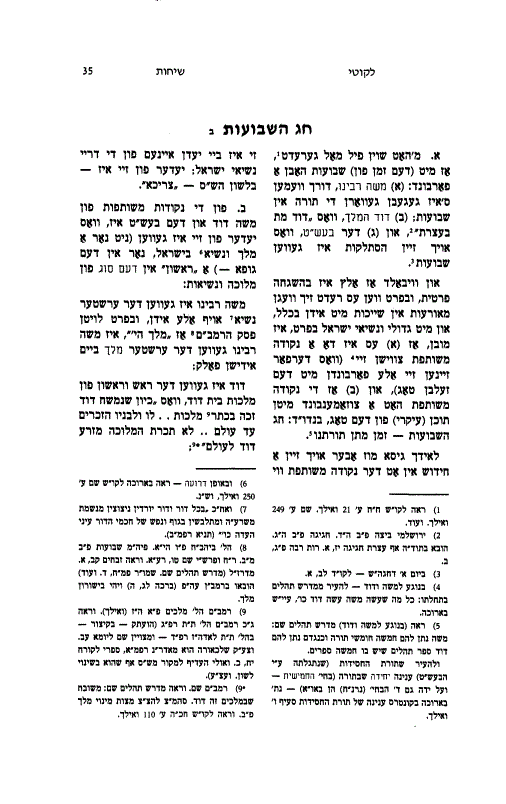
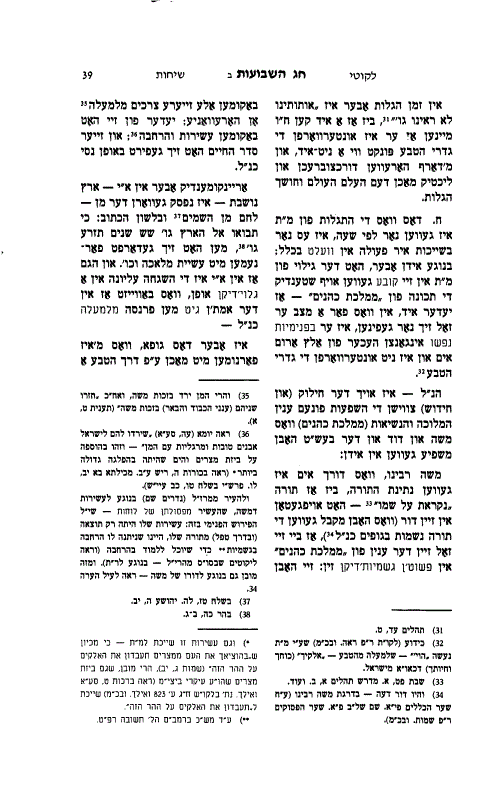
In this sicha, we will review Lekutei Sichos, volume 18, the second sicha for Chag HaShavuos. The Rebbe discusses the three main leaders of the Jewish people who are connected to Shavuos: Moshe Rabbeinu, David HaMelech, and the Baal Shem Tov. Each of these figures played a unique role as a leader in their generation, and all share a common denominator—they were like kings, or melech, which ties directly into the theme of Shavuos.
Shavuos is described as the time when we became a mamleches kohanim—a kingdom of priests. The Rebbe will explore what it means to be a mamleches kohanim, and what it means to be a king in this context. He examines both the shared qualities of these leaders and what makes each one unique in their contribution to their generation and to all generations.
The Rebbe also connects these ideas to the three pillars of Torah, Avodah (service), and Gemilus Chasadim (acts of kindness), and will delve into many specific details as we study inside.
To begin, the Rebbe notes that there is an established connection between Shavuos and each of these leaders. First, Moshe Rabbeinu is connected to Shavuos because he was the one through whom the Torah was given on this holiday. This direct link between Moshe and Shavuos is clear: he gave us the Torah on this day.
Second, David HaMelech is associated with Shavuos because he passed away on Atzeres (another name for Shavuos). The Rebbe cites sources such as the Yerushalmi that confirm David died on Shavuos.
Third, the Baal Shem Tov’s passing also occurred on Shavuos. The Rebbe points out that his histalkus—the passing of the Baal Shem Tov—was on the first day of Shavuos. This fits historically because in the times of Moshe Rabbeinu and David HaMelech, Shavuos was observed for only one day. Thus, all three leaders are deeply connected to this special time.
Saif Aleph
The first day of Shavuos is marked by a unique connection between Moshe, David, and the Baal Shem Tov. Since everything occurs by divine providence—especially significant events for the Jewish people, and particularly those involving the great leaders of Israel—when these three are associated with Shavuos, it is clear that their connection is not coincidental.
When three such leaders are linked to the same day, there must be a common denominator—a shared point that unites them. This shared quality is what binds them to Shavuos. At the same time, this commonality must also relate directly to the central theme of Shavuos itself.
Shavuos is the time of matan Torah—the giving of the Torah. Moshe gave us the Torah; David and the Baal Shem Tov both passed away on Shavuos. Therefore, their connection to this day must be rooted in its essential idea. The main point of Shavuos must be reflected in all three leaders.
However, while they share this bond, each one also possesses a unique quality. There must be something novel in how each embodies this shared point. As expressed in the language of the Gemara—tzricha, "we need"—each one adds something distinct that the others do not.
The Rebbe begins by discussing their common denominator: melukha—kingdom or leadership. This trait is present in all three: Moshe, David, and the Baal Shem Tov. Not only were they all leaders or kings in Israel, but each was also a pioneer—the first in his particular category of leadership.
Moshe Rabbeinu was the first leader over all Jews—nosi al kol Yisrael. According to the Rambam's ruling, he was not just a leader but also a king; melukha yesh bo. Thus, Moshe was both our first leader and our first king.
David was the first of his dynasty—the House of David—which received eternal kingship. He was reish v’rishon lemalchus Beis David, head and founder of that everlasting kingdom. Once David was anointed, he merited an unbreakable crown: “For himself and for his sons after him forever,” meaning that kingship would never depart from his lineage.
The Baal Shem Tov was likewise a trailblazer—the first among Hasidic leaders on a general level (not just within Chabad). He inaugurated Hasidus as a movement for all Jews.
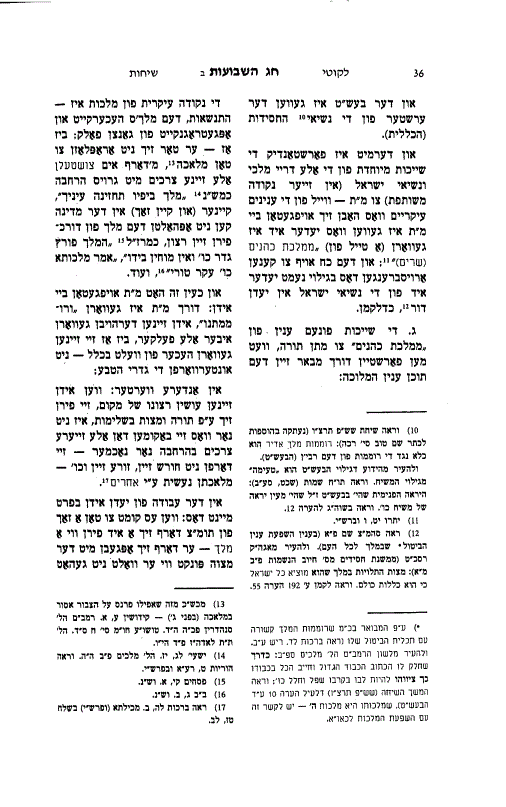
This shared aspect of leadership and kingdom explains their connection to matan Torah—when every Jew became part of mamleches kohanim, a kingdom of priests. One of the main accomplishments at matan Torah was that every Jew became part of this royal priesthood; we were empowered to be officers and leaders ourselves.
This power—to express our inner royalty openly—is drawn by every Jew from these Jewish leaders in every generation. The Rebbe will explain further how this relates to matan Torah: what it means for us to become a nation of kings or officers (sorim). The essence of being a king is that nothing can stand in his way; he has absolute authority and freedom to act.
Saif Beis
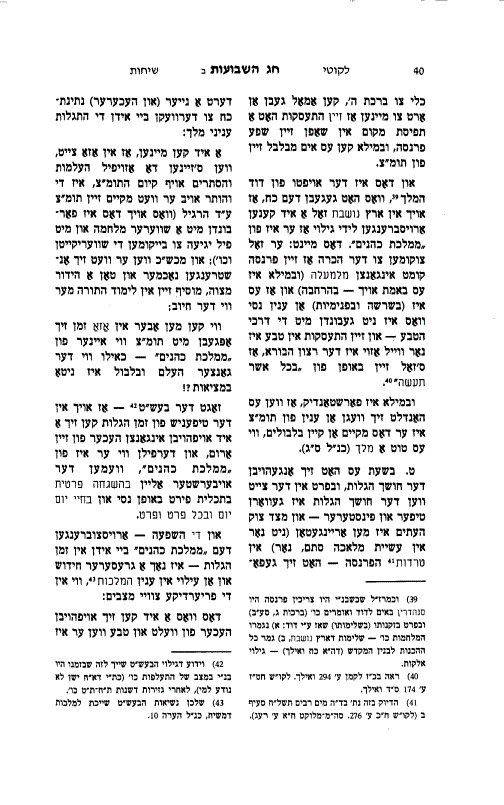
The concept of a king, or melech, is someone who stands above all the rules and does what needs to be done without anything holding him back. On Shavuos, at the giving of the Torah (matn teure), Hashem infused the Jewish people with this very power: that a Jew is like a king regarding Torah and mitzvos—nothing can stand in his way.
To understand the connection between being a “kingdom of priests” (mamleches kohanim) and matn teure, we need to clarify what true kingship means. The essence of malchus—sovereignty or kingdom—is hisnasus, being elevated and exalted above the people. The king is set apart, distant, and on a higher level than everyone else. In fact, halacha states that a king should not lower himself to do ordinary work; rather, all his needs are provided for him in the most expansive way possible.
This is reflected in the verse:
תראינה עיניך מלך ביופיו
"Your eyes shall see the king in his beauty."
This means seeing the king at his highest and most glorious state. There is nothing in the country that can prevent the king from doing as he wishes. As our sages say, “The king can break through fences”—if he wants to go somewhere, he doesn’t need to take detours; he simply goes straight through, and no one may protest. Another saying: “The king said—he can uproot mountains.” In other words, kingship means being so elevated that nothing can stand in your way.
This is precisely what happened to the Jewish people at matn teure. Through receiving the Torah, they were elevated above all other nations and even above nature itself. They were no longer subject to natural limitations; when Jews fulfill Hashem’s will by keeping Torah and mitzvos fully, they not only receive all their needs abundantly—they receive even more than that.
The sages say that when Jews are truly connected to Hashem’s will, they don’t even need to plow or sow—their work is done by others (melechten naasis al yedei acherim). This means that when Jews are living on the level of matn teure, there are no boundaries holding them back; everything comes to them in abundance without toil.
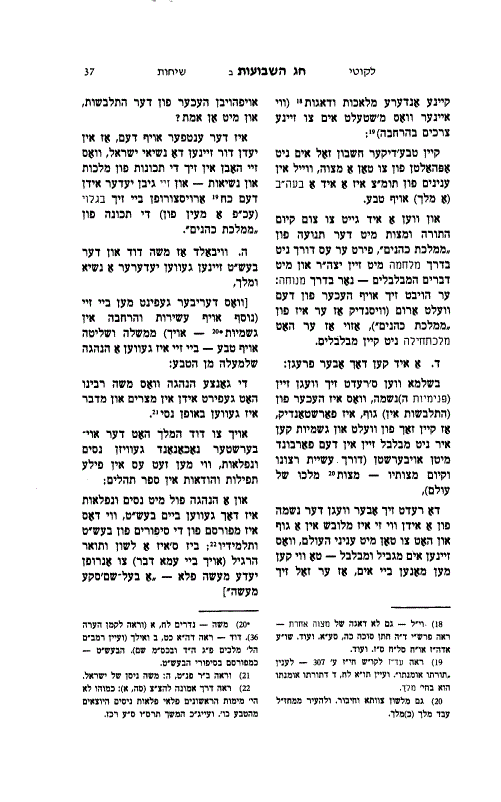
What does this mean for every individual Jew? It means that nothing should stop a Jew from fulfilling Torah and mitzvos. When it comes time to do something related to Torah or mitzvos, a Jew must conduct himself like a king—devoting himself entirely to the mitzvah without distraction or worry about other jobs or concerns. Just as a king has all his needs provided for him expansively, so too should a Jew approach Torah and mitzvos with confidence that nothing will deter him—not natural worries nor calculations.
No external factor should prevent him from performing mitzvos. When it comes to matters of Torah and mitzvos, every Jew is in charge—a king over nature itself. When one approaches Torah and mitzvos with this sense of being part of a kingdom of priests (mamleches kohanim), he accomplishes them not through struggle or inner conflict but with tranquility—everything else falls away because he knows he is above it all.
This awareness—that one belongs to a nation of kings and priests—lifts him above confusion or interference from others. But how can this be practically achieved? After all, we live in physical bodies within a material world full of limitations and distractions. If we were only talking about souls, perhaps it would be easier—but how can someone truly rise above physicality?
The answer lies in Jewish leadership throughout history. In every generation there are leaders who possess qualities of kingship and leadership; they empower every Jew to reveal within themselves—even if only partially—the trait of being part of a kingdom of priests.
Each leader in their generation was unique because they embodied this quality of transcendence; they could elevate their generation by giving them strength to reach this level as well. These leaders were both rulers and kings—they possessed wealth, abundance, dominance over nature itself. Their conduct was beyond natural limitations.
The Rebbe explains that we will see how all aspects of Moshe Rabbeinu’s life—and later leaders like the Baal Shem Tov—were conducted above nature entirely.
Saif Gimmel
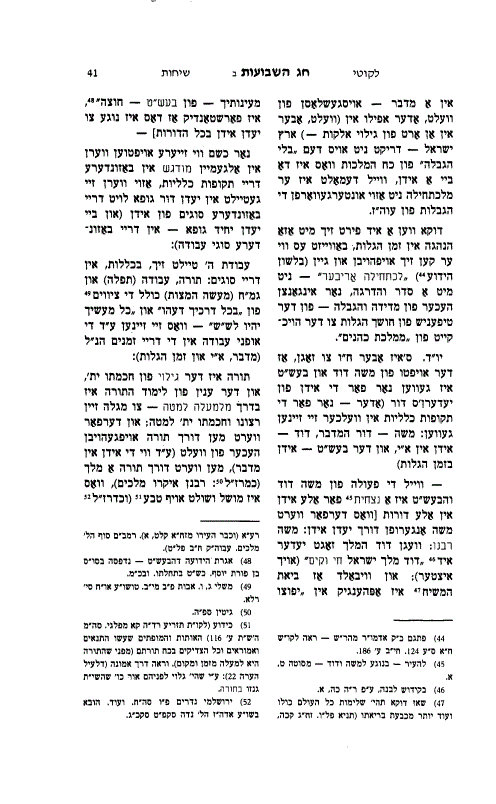
When Moshe led the Jews in Egypt and in the desert, it was in a manner that was miraculous—full of wonders. God constantly showed them miracles and wonders, as we see reflected in many prayers and expressions of gratitude in Sefer Tehillim, the Book of Psalms composed by David HaMelech. The same was true with the Baal Shem Tov; his conduct was also filled with miracles and wonders. This became so well known that stories about the Baal Shem Tov and his students became public knowledge, to the point that even ordinary people, when they want to describe something wondrous, refer to it as a “Balshemske maise”—an act of the Baal Shem Tov—meaning something above nature.
Through these four leaders—Moshe Rabbeinu, David HaMelech, and the Baal Shem Tov—the flow of divine influence is revealed to every Jew. The Rebbe now explains the differences between Moshe Rabbeinu, David HaMelech, and the Baal Shem Tov, focusing on how each impacted their generation. He notes that within every generation itself, these three categories are present among its leaders.
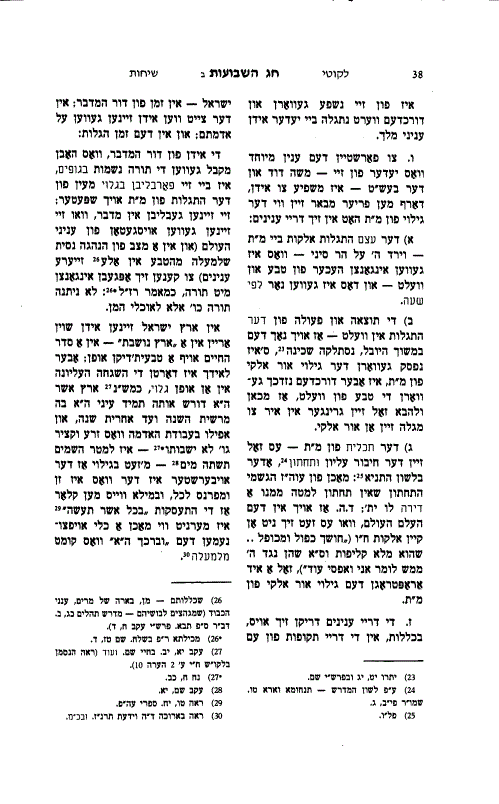
To understand this unique aspect—how each leader provides spiritual sustenance to the Jewish people—we first need to explain how the revelation at Matan Torah (the giving of the Torah) contains three distinct aspects. Each aspect will then be associated with one of these leaders.
The first aspect is the essence of revelation itself: God’s actual descent onto Mount Sinai. As it says by Matan Torah, “Vayeired Hashem al Har Sinai”—God descended upon Mount Sinai. This event was completely beyond nature; for a brief moment, God’s presence was manifest in this world. However, this revelation was only temporary.
The second aspect is what this revelation accomplished—the impact it had on the world even after God’s presence was no longer openly manifest. When the shofar sounded at Sinai and the overt godly light ceased, there remained a refinement within nature itself. The world became more receptive to godliness; from then on, it became easier to reveal divine light within creation.
The third aspect is the ultimate purpose of Matan Torah: to create a connection between higher and lower realms. Using the language of Tanya, this means transforming our physical world—which is described as “the lowest,” with nothing lower than it—into a dwelling place for God. Even in this dark world, filled with concealment and forces opposed to holiness (klippah), where godliness seems utterly hidden or denied, Jews are tasked with drawing down godly light through Torah and mitzvos. This is the ultimate goal—to make this lowest realm into a “dira lo yisbarech,” a dwelling place for God Himself.
These three aspects—the revelation itself, its impact on nature, and its ultimate goal—are expressed generally throughout Jewish history in three periods corresponding to these leaders.
First is the period of Moshe Rabbeinu: during their time in the desert (Midbar), Jews experienced an existence that mirrored Matan Torah’s miraculous revelation. Those who lived through Matan Torah remained openly connected to that level; they were removed from worldly concerns and lived entirely above nature. Their lives were sustained by miracles—the manna from heaven, clothing that never wore out—so they could devote themselves completely to Torah study.
As our sages say: “The Torah was given only to those who ate manna.” In other words, those who had no distractions or material worries were able to fully receive and engage with Torah because their needs were miraculously provided for.
The second period is when Jews entered Eretz Yisrael (the Land of Israel). Here they lived a natural life—a settled existence involving agriculture and daily work—but still experienced an open connection with God’s providence. As it says:
ארץ אשר ה' אלוקיך דורש אותה תמיד עיני ה' אלוקיך בה מרשית השנה ועד אחרית שנה.
"A land which Hashem your God seeks always; His eyes are upon it from the beginning of the year until year’s end."
This means that even though life followed natural patterns—sowing, harvesting, seasonal cycles as promised after Noach’s flood—they still depended on rain from heaven rather than irrigation like Egypt. This dependence made it clear that their sustenance came directly from Hashem; they had to pray for rain each year.
Saif Daled
The Rebbe explains that during the time in the desert, it was absolutely clear to every Jew that their occupation—whatever they did—was not the source of their sustenance. Rather, all their efforts were simply to create a vessel to receive Hashem’s blessing, which comes from above. This is the second stage, corresponding to Eretz Yisroel, where even though one must work the land and engage in natural means, the true source of blessing remains divine.
However, when we reach the period of exile—Zman HaGolos—the situation changes. In Golus, we do not see any clear signs of Hashem’s providence. Sometimes it can even seem as though a Jew is subject to the same natural laws as everyone else. The darkness and obscurity of exile can make it appear as if there is no difference between a Jew and a non-Jew regarding how sustenance is obtained.
In such times, a Jew must exert effort to break through and illuminate the darkness of Golus. The challenge is to reveal that inner light and connection to Hashem even when it is hidden by external circumstances.
The Rebbe now addresses a deeper point: although the revelation at Matan Torah was described as temporary—lasting only until the shofar blast at Yovel—the truth is that its impact on the Jewish people was permanent. While its effect on the world at large may have been fleeting, for the Jewish people themselves, Matan Torah established them forever as a Mamleches Kohanim—a kingdom of priests.
This means that every Jew, no matter his situation or environment, possesses an inner essence that is completely above nature. He is not truly subject to natural limitations; he has permanently acquired this elevated status as part of being a Mamleches Kohanim.
Here lies an important distinction between two types of influence: that of kingship (malchus) and leadership (nesius). Moshe Rabbeinu’s influence was through giving us the Torah; his generation experienced this priestly status in a very literal way. All their needs were provided miraculously from above without any effort—they lived entirely beyond nature.
When entering Eretz Yisroel, however, things changed. The miraculous manna ceased; now Jews had to work the land for their livelihood. Even though Hashem’s supervision remained open and evident in Eretz Yisroel, there was now an element of human effort involved in making a vessel for Hashem’s blessing.
This shift could lead someone to mistakenly think that his own efforts are what create his livelihood—that he is responsible for generating his own success. Such thinking can interfere with one’s fulfillment of mitzvos, because it introduces confusion about who truly provides sustenance.
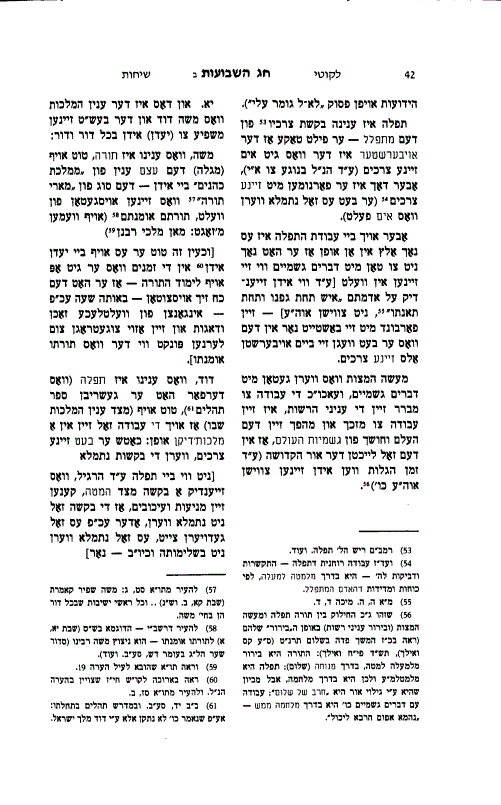
This is where King David’s contribution comes in. David HaMelech gave Jews the strength to recognize—even while living in a settled land and engaging in natural occupations—that their true source of livelihood remains Hashem alone. A Jew can reveal his identity as part of Mamleches Kohanim, understanding that all blessing comes from above regardless of outward appearances.
Therefore, when it comes to matters of mitzvah observance, one should act without hesitation or confusion—knowing with certainty that nature does not limit him and nothing interrupts his divine flow. He serves Hashem with confidence and dignity, like a king.
The Rebbe then turns to our current reality: after both the desert experience and life in Eretz Yisroel came exile—a time when darkness deepened further due to suffering and hardship. In Golus, Jews are preoccupied with making a living; worries about material needs can distract from Torah study and mitzvah observance.
In such times, an even greater empowerment from above is needed so that Jews can awaken within themselves this royal quality—the ability to rise above all obstacles and distractions and remain connected to Torah and mitzvos despite external pressures.
The Rebbe acknowledges how difficult this can be: sometimes there are so many blocks and distractions that it feels almost impossible to focus on learning Torah or fulfilling mitzvos properly. One might feel spiritually drained or insufficiently motivated due to these challenges.
Yet even in these situations—when everything seems overwhelming—a Jew still possesses within himself this special power granted by King David: he can draw upon his inner strength as part of Mamleches Kohanim. With determination, he can push through difficulties and reconnect with Torah study just as before.
This process may not always be easy or immediate; sometimes it takes time for one’s efforts to bear fruit or for clarity to return. But when serving Hashem with this royal mindset—with confidence rooted in one’s essential connection—it becomes possible to overcome obstacles more readily than would otherwise be expected.
Key Points
1. Shavuos is uniquely connected to three great Jewish leaders—Moshe Rabbeinu, David HaMelech, and the Baal Shem Tov—each of whom embodies the quality of kingship and leadership, reflecting the festival’s theme of becoming a "mamleches kohanim," a kingdom of priests.
2. The shared trait among these leaders is their pioneering role as "melech"—a king or sovereign—in their respective domains: Moshe as the first leader and king over all Israel, David as founder of an eternal dynasty, and the Baal Shem Tov as the originator of Hasidus for all Jews.
3. Shavuos, the time of matan Torah, empowered every Jew with an inner sense of royalty and authority in Torah and mitzvos, drawing from the example and spiritual influence of these leaders in every generation.
4. The essence of kingship is hisnasus—being elevated above limitations. At matan Torah, Jews were endowed with this quality, enabling them to fulfill Torah and mitzvos without being hindered by natural constraints or worldly concerns.
5. This royal empowerment means that when a Jew approaches Torah and mitzvos, he should do so with confidence and tranquility, knowing that nothing can truly stand in his way—mirroring the king’s absolute authority over his domain.
6. Throughout Jewish history, leaders like Moshe Rabbeinu and the Baal Shem Tov lived above nature through open miracles. Their conduct demonstrated how divine influence can be manifest in miraculous ways for the benefit of all Jews.
7. The revelation at Matan Torah contains three aspects: (a) God’s direct revelation at Sinai; (b) its lasting impact on making nature more receptive to godliness; (c) its ultimate purpose—to transform even the lowest realms into a dwelling place for God through Torah and mitzvos.
8. These three aspects are reflected in Jewish history: miraculous existence under Moshe in the desert; natural life with open divine providence in Eretz Yisroel; and the challenge of exile, where godliness must be revealed despite concealment and hardship.
9. Even after open miracles ceased, every Jew retains an essential status as part of mamleches kohanim—a permanent inner elevation above nature—regardless of external circumstances or environment.
10. King David’s unique contribution was empowering Jews to recognize Hashem as their true source of sustenance even while engaged in natural occupations, enabling them to serve Hashem confidently without confusion or hesitation about material needs.
11. In exile, when distractions and hardships intensify, Jews are given additional strength from above to awaken their royal quality within—the ability to overcome obstacles and remain steadfast in Torah study and mitzvah observance despite external pressures or spiritual fatigue.
12. Ultimately, every Jew possesses an indestructible inner power drawn from these leaders to act with dignity and confidence as part of mamleches kohanim, ensuring that no challenge can prevent full engagement with Torah and mitzvos.