Introduction
In this sicha, we will study Lekutei Sichos, Chelek Yud Ches, the first sicha for Shavuos. The Rebbe addresses the many explanations and debates regarding why the angels objected when Moshe came to receive the Torah. The angels argued that the Torah should remain with them, rather than being given to humans. There is a well-known halachic principle called din over b’metzra—the law of the neighbor—which states that if someone wants to buy a field adjacent to his own, he has priority over an outsider. The angels claimed that since they were already “neighbors” of the Torah in heaven, it should remain with them.
The Rebbe explores the various approaches found in the commentaries as to why this argument does or does not apply. He examines whether the angels’ claim truly fits within the framework of din over b’metzra, and whether their reasoning stands up to scrutiny. The Rebbe also discusses how this halacha works: if you want to build a structure on a field and someone else wants it for planting, the one who wishes to build has priority. You must give it to him without any further conditions.
The central question is: do you need the field (in this case, heaven) in order to fulfill the purpose of making a dwelling place for Hashem in the lower worlds (dira b’tachtonim)? The Rebbe will show that you do not need heaven for this purpose; rather, it is specifically in this world that Hashem’s dwelling is accomplished.
The Rebbe analyzes all these arguments and points out that none of them are expressed in Moshe Rabbeinu’s actual response as recorded in Chazal. Instead, Moshe’s answer takes a different approach entirely.
As we go through this sicha, we will follow along with Rabbi Menachem Mendel ben Meir Yaakov’s printed edition, and dedicate our learning for a complete recovery for Golda Rachel bas Surah Nechama—a refuah kerovah shleimah.
This is the first sicha for Shavuos in Chelek Yud Tes.
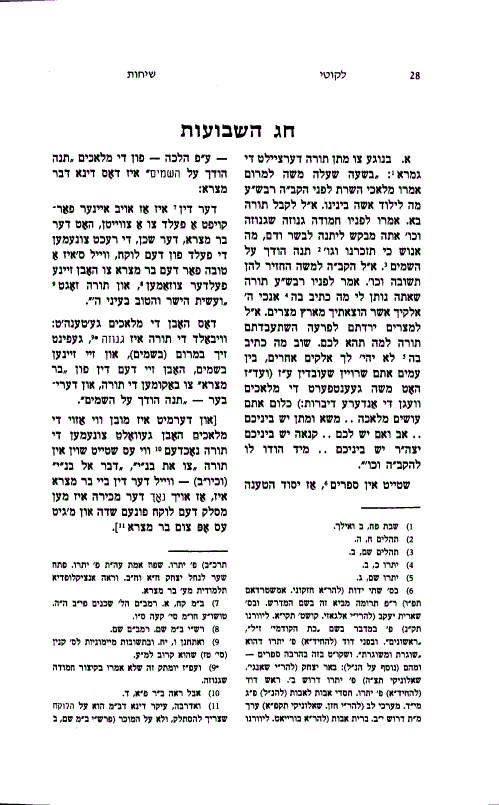
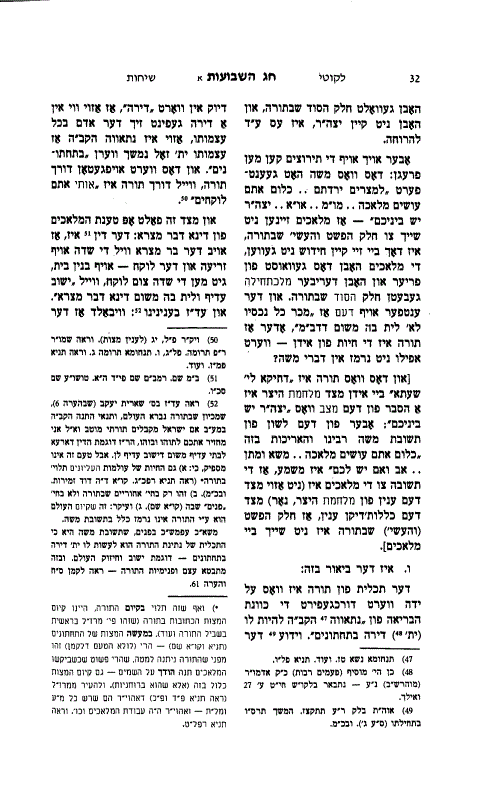
The Rebbe begins by quoting from Gemara Shabbos, which describes what happened when Moshe ascended Mount Sinai. The Gemara relates that when Moshe went up to receive the Torah, the ministering angels protested before Hashem: “Master of the Universe! What is a human being doing among us?” They questioned why Moshe was allowed into their domain.
Hashem told Moshe to respond to their challenge. The angels then said before Him: “You have a hidden treasure—chamudah g’nuzah—that was stored away for nine hundred and seventy-four generations before creation. Now You intend to give it to flesh and blood?” This phrase—chamudah g’nuzah, “a precious hidden treasure”—is how they referred to the Torah.
Saif Aleph
The section begins with a discussion about the relationship between Torah and humanity, specifically addressing why Torah was given to people of flesh and blood rather than to angels. The speaker notes that Moshe Rabbeinu asks Hashem about the meaning of the verses, questioning why Torah is being given to humans when angels seem more fitting recipients. The angels themselves raise objections, suggesting that Torah should remain in the heavenly realm.
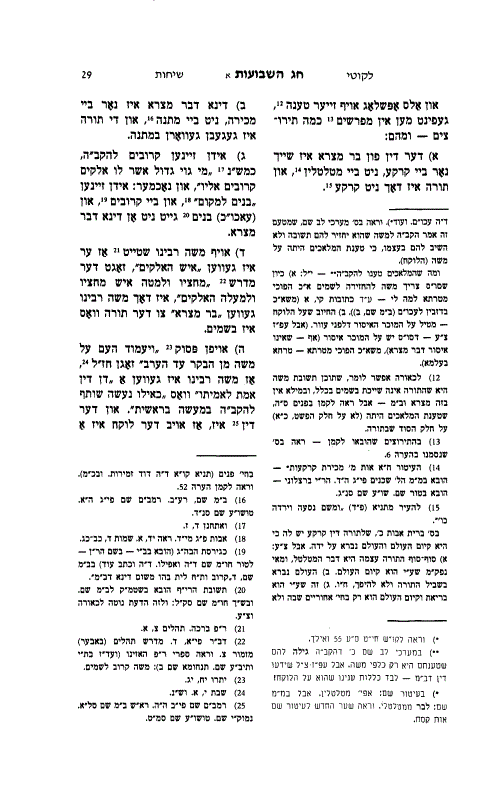
Moshe responds by pointing out that the angels did not descend to Egypt or experience servitude under Pharaoh. He emphasizes that the Torah’s commandments are relevant only to those who live in the physical world and experience its challenges—something angels do not share. The mitzvos require engagement with daily life, such as honoring parents or refraining from forbidden labor on Shabbos, which are not applicable to angels.
He continues by explaining that the mitzvos are designed for those who have a connection to worldly matters. Since angels lack these experiences, they cannot fulfill the mitzvos. Therefore, it is appropriate for Torah to be given to people who can observe its commandments in practical terms.
The Rebbe then references halachic sources and discusses how this debate is reflected in Jewish law. He notes that there is a principle called bar metzra—the neighbor’s right of first refusal in property sales—and explores whether this concept applies when considering who should receive the Torah. The question arises: if someone has a partnership or prior claim, does that override another’s right?
He brings up a teaching from Chazal about Moshe Rabbeinu’s unique status. Moshe is described as both “ish” (a man) and “elokim” (godly), indicating his dual role bridging heaven and earth. This duality made him uniquely suited to receive the Torah on behalf of all Jews.
The discussion continues with an analysis of partnership law: if two parties are partners, one may take precedence over a neighbor’s claim. Similarly, Moshe Rabbeinu acted not just for himself but as a representative of all Israel, making him a partner with Hashem in receiving the Torah.
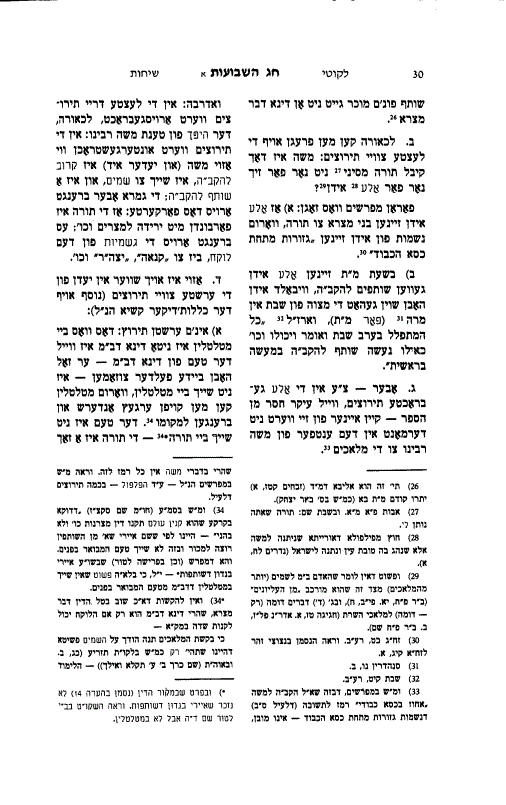
The Rebbe points out that even though Moshe had this special status, he received the Torah for everyone—not just for himself or his own benefit. This parallels halachic cases where a partner may acquire something on behalf of others as well.
He then raises further questions: If Moshe Rabbeinu was considered a bar metzra, could we say he received the Torah only because he was Jewish or because he was Hashem’s partner? What about all Jews—do they also have this status? The answer is that all Jews are considered partners with Hashem regarding Torah; every Jew has an intrinsic connection to it.
This idea is supported by teachings that describe every Jew as having a portion “under Hashem’s throne,” emphasizing our collective partnership in receiving and keeping the Torah. Thus, when Moshe received the Torah, it was on behalf of all Jews—each one being a true partner in this covenant.
The Rebbe concludes by noting that since we were already partners at Sinai, there was no room for any claim of bar metzra from another party (such as angels). When Shabbos arrived before Matan Torah, we had already entered into this partnership through our observance and preparation.
Chazal teach that anyone who prepares for Shabbos receives special merit; similarly, by preparing ourselves spiritually before Matan Torah, we became full partners in receiving it. This answers why no other claim could override our right to receive the Torah—it belonged to us collectively as partners with Hashem from the outset.
The section ends by acknowledging that while these answers address many aspects of the question, there remain deeper points yet to be explored regarding Moshe Rabbeinu’s unique role and status.
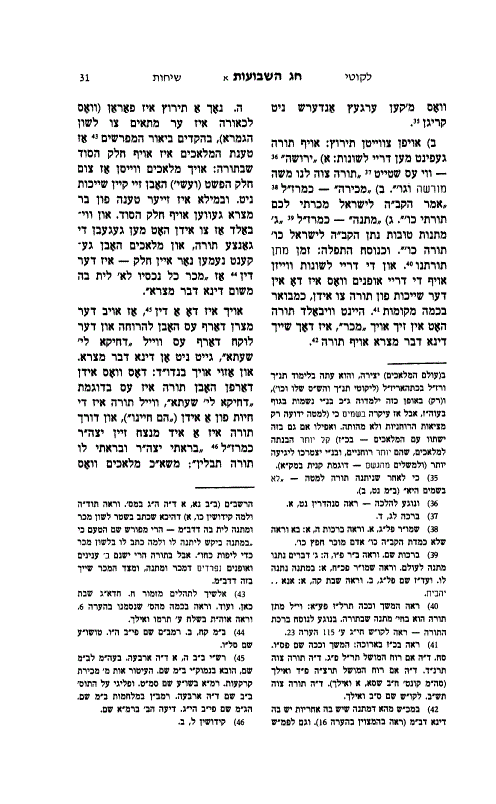
Saif Beis
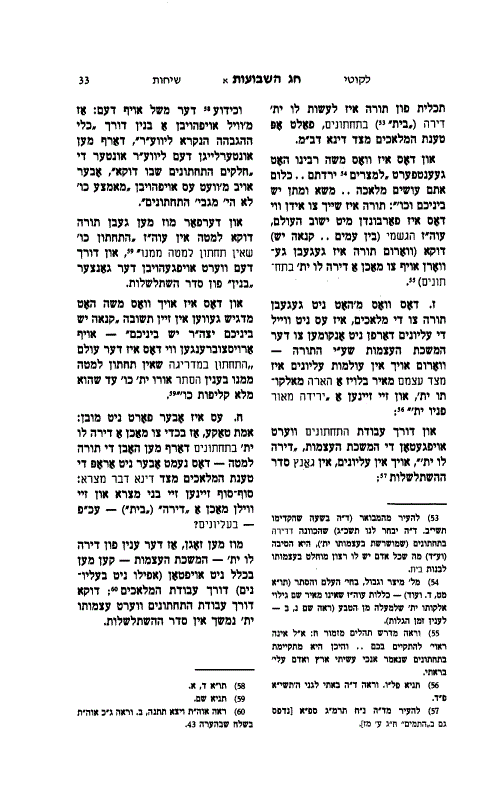
We need to look at all the answers that have been offered, but there is something fundamentally missing from them. The main issue is that these answers seem to focus on what is written here, but none of them truly address the process or reasoning behind Moshe Rabbeinu’s response to the angels. It appears that none of these explanations are fully satisfactory in explaining why Moshe Rabbeinu answered as he did.
Some of the recent explanations we considered—such as why the Torah was not given to the angels—actually contradict the essence of Moshe Rabbeinu’s answer. These approaches try to resolve the question by suggesting that the Torah is inherently unsuited for angels, but this does not align with what Moshe actually said.
Let’s consider another angle: when someone is close to Hashem, we call them “relative” or “connected,” meaning they are associated with Heaven and are partners in Hashem’s unity. The Gemara in Berachos discusses this idea, but actually brings out the opposite point: that Torah is bound up with the descent into Egypt and associated with physicality and challenge, not just spirituality. The Torah emphasizes its connection to physical descent and struggle, rather than spiritual elevation.
This creates a problem for those other answers. Not only do they fail to fit with Moshe’s actual words, but they also don’t align with how the Gemara frames the issue. In addition, there are difficulties with some of the earlier answers regarding how they fit with the Gemara’s language and logic.
For example, one question is why certain distinctions made in halacha—such as between a sale and a gift—are not relevant here. In halacha, if someone sells all his property to one person (even if a neighbor would have preferred it), there is no law requiring him to give preference to his neighbor. But if it’s a gift, he can give it to whomever he wants. However, Torah was both sold and given; it has elements of both sale and gift.
We find three expressions used regarding Torah: inheritance (yerusha), sale (mechira), and gift (matana). The Torah refers to itself as an inheritance (“morasha”), our Sages say Hashem “sold” us the Torah (“mcharti lachem”), and also that He gave us three good gifts—the Torah being one of them (“matana”). Each term points to a different aspect of how Jews connect with Torah.
The Rebbe explains elsewhere that these three terms reflect three different ways a Jew relates to Torah: as an inheritance (something essential), as a purchase (something acquired through effort), and as a gift (something bestowed beyond merit). Since all three apply, none of these distinctions alone can explain why angels were denied access—they do not capture what Moshe was conveying.
The Gemara’s language actually points in another direction entirely: it focuses on descent rather than elevation. The first two answers we discussed do not work for this reason. The Rebbe then brings down yet another answer—but even this one does not fully resolve the issue.
This alternative answer suggests that perhaps the argument between Moshe and the angels was only about the esoteric part of Torah—the sod, or secret dimension—not about peshat, remez, or drush. The claim is that angels wanted only access to sod, since they have no connection to practical mitzvos or revealed aspects of Torah. However, since all parts of Torah were given together as one unit—including sod—the angels could not receive even that portion separately.
An analogy is drawn from halacha: when someone sells all his fields—including one adjacent to a neighbor—the law of giving preference to a neighbor (bar metzra) does not apply because everything was sold together as one package. Similarly, since Jews received all aspects of Torah together, including sod, angels could not claim just one part for themselves.
A further analogy: sometimes a neighbor wants land simply for expansion (le-revacha) while another buyer needs it urgently (le-itztrichusa). In such cases, halacha gives preference to urgent need over mere convenience. Likewise, Jews desperately need Torah—it is their life force and their tool for overcoming the evil inclination—as our Sages say: “I created the evil inclination; I created Torah as its antidote.” For us, receiving Torah is an urgent necessity; for angels it would be only an enhancement.
This perspective fits within Moshe Rabbeinu’s answer: Jews need every aspect of Torah—including its secrets—to survive spiritually; angels do not have this need. Therefore, they cannot claim any part of it for themselves.
However, even these answers are incomplete. If Moshe Rabbeinu’s response was simply that angels have no connection to practical mitzvos or revealed aspects of Torah—and only wanted access to its secrets—then there would be no novelty in his answer; this was already obvious from their initial request. The angels knew from the outset which parts were relevant or irrelevant for them; their request was specifically for those parts they felt applied.
Moshe Rabbeinu’s answer must therefore be addressing something deeper than just which parts of Torah are relevant for whom. The real question remains: what exactly did Moshe add in his response that refuted even their claim on the esoteric dimension?
Saif Gimmel
The answer given is that when you sell all your assets, the law of Bar Metzra—the neighbor’s right of first refusal—does not apply. In other words, if the entire property is being transferred, the neighbor cannot claim priority. This is compared to the Torah: it’s not just about needing Torah as our vitality or because we’re oppressed by the yetzer hara. Moshe’s response to the angels isn’t simply that we need Torah to fight our evil inclination. Rather, he’s telling them that they don’t belong in the simple context of Torah; they are not “children.”
The Rebbe explains that the real point is that through Torah, the purpose of creation is fulfilled—to make a dwelling place for Hashem in this lower world. The emphasis on “dwelling place” (dirah) means not just being present, but being fully at home with one’s entire essence. Hashem desires that His very essence should be revealed here below, not just a ray or a limited aspect.
This is accomplished specifically through Torah. Therefore, the angels’ argument falls away: even if they are “neighbors” (abutters) to Torah in a spiritual sense, since the goal is to settle and transform this world into Hashem’s home, there is no law of Bar Metzra here. The Torah must go to those who will actually settle and transform the world—namely, human beings.
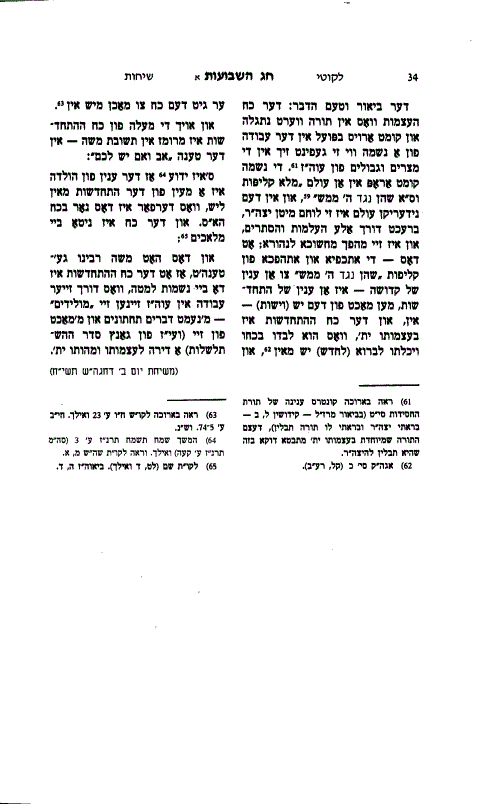
This idea is reflected in what the Gemara says: “Did you go down to Egypt?” In other words, have you experienced exile and struggle? The work of making a dwelling for Hashem happens specifically in this physical world among people, with all its challenges and natural phenomena. That’s why death was not given to angels—not because they don’t need it, but because even in higher worlds without Jews drawing down Hashem’s essence through Torah and mitzvos, there is only a limited revelation.
Even the upper worlds are only a descent from Hashem’s light. Through our service below, we draw down Hashem’s essence and make Him truly at home here. When we bring Hashem into this world through Torah and mitzvos, it elevates not only our world but also all higher realms.
The Rebbe gives an analogy: when you want to lift an entire structure using a lever, you must place it under the lowest part. If you put it in the middle, only part of the structure rises; but from below, everything is elevated together. So too with Torah—it must be given here in this lowest world so that all of creation can be uplifted.
Moshe emphasizes this point by highlighting jealousy and hatred among people—these are unique challenges found only here below. Precisely because this world is so lowly and filled with strife, it becomes the ideal place for Hashem’s dwelling.
Therefore, it turns out that we need Torah specifically in this world to fulfill its ultimate purpose. Even though angels may desire Torah for themselves as “neighbors” in spiritual realms, their claim does not stand because they cannot accomplish what needs to be done below.
איזה מקום יש במהלך? דרף, מנהוב, די טורל המטה ודי די טורל בלו דוס נמט אובן איתה רוב די טיינס המלוכים מצד דינת דבר מצרה אבל איך זה יקיים את הארגמנט המלוכים? הלכה של המחירים, סויף, סויף, יזען, זבירי, מצרה הם הם המחירים...
What place does their argument have? We must say that giving Torah below removes most of the angels’ claims based on Bar Metzra law. But how does this fully answer their argument? After all, according to Halacha regarding buyers and neighbors: ultimately both are buyers who want to build their own homes (i.e., draw down Hashem’s essence), but only one can truly accomplish it.
The concept of making a dwelling for Hashem means drawing down His very essence—something even angels cannot achieve on their own. Only through human action below can Atzmus (Hashem’s essence) be revealed within creation itself.
This power of renewal (koach hischatchus) exists uniquely within people—the ability to create something new from nothingness. Angels do not possess true independence or creative power; they merely reflect what already exists above them.
The Rebbe notes that just as a father imparts creative potential to his child (koach hischatchus), so too does Hashem impart this power specifically to those below. This capacity for renewal and transformation exists only where there is true independence and selfhood—qualities found uniquely among people in this world.
Therefore, despite any claims from above or from spiritual “neighbors,” only through our efforts here can Hashem’s ultimate desire be fulfilled: making His home in the lowest realm through our unique power of renewal and transformation.
Key Points
1. The angels objected to Moshe receiving the Torah, arguing that as its “neighbors” in heaven, they had a prior claim based on the halachic principle of din over b’metzra (the law of the neighbor), but the Rebbe explores whether this argument truly applies to the giving of Torah.
2. Moshe Rabbeinu responded by highlighting that Torah’s mitzvos are only relevant to those who live in the physical world and face its challenges—something unique to humans and not applicable to angels, thus justifying why Torah was given to people.
3. The Rebbe analyzes halachic concepts such as bar metzra and partnership, showing that all Jews are considered partners with Hashem regarding Torah, making them rightful recipients and nullifying any angelic claim of precedence.
4. Despite various explanations offered by commentators, none fully capture the reasoning behind Moshe’s answer; many focus on technicalities or distinctions that do not align with Moshe’s actual response or the language of the Gemara.
5. The Torah is described using three terms—inherited (yerusha), sold (mechira), and given as a gift (matana)—each reflecting a different aspect of our connection, but none alone explain why angels were denied access or what Moshe’s answer truly addressed.
6. Even when considering that angels might only want access to the esoteric dimension (sod) of Torah, Moshe’s answer shows that all aspects of Torah—including its secrets—are inseparable and must be given together to those who can fulfill its purpose in this world.
7. The core reason for giving Torah to humans is that only through our actions can Hashem’s ultimate desire—a dwelling place in the lowest world—be fulfilled; angels cannot achieve this purpose because they lack engagement with physicality and challenge.
8. The analogy of lifting a structure from below illustrates that true elevation of all worlds occurs only when Torah is given and fulfilled here; human beings have the unique power to draw down Hashem’s essence into creation through their service below.
9. The power of renewal (koach hischatchus) exists uniquely within people, granting them creative independence and the ability to transform reality—qualities not found among angels—which is essential for making Hashem’s home in this world.
10. Ultimately, despite any spiritual “neighbor” claims from above, it is specifically through human effort in this physical world that Hashem’s deepest desire is realized, validating why Torah was given exclusively to us rather than remaining with the angels.