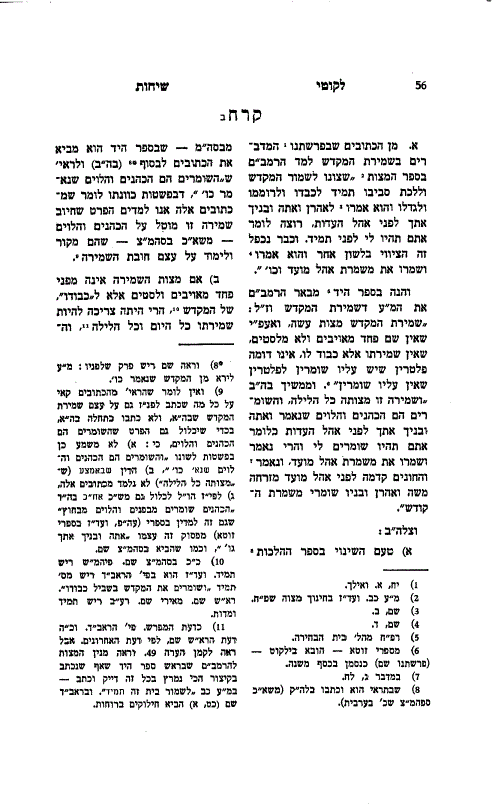
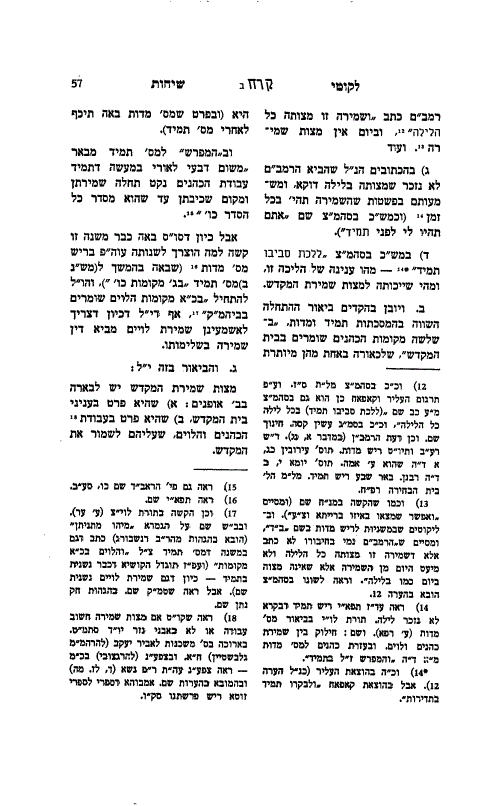

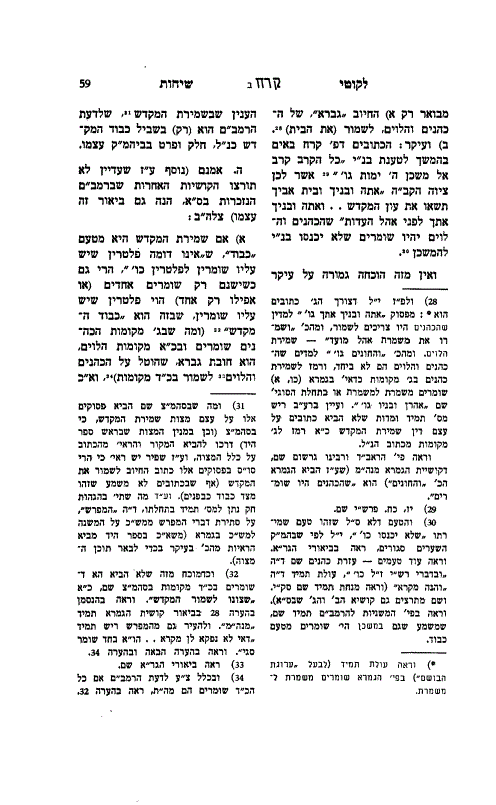
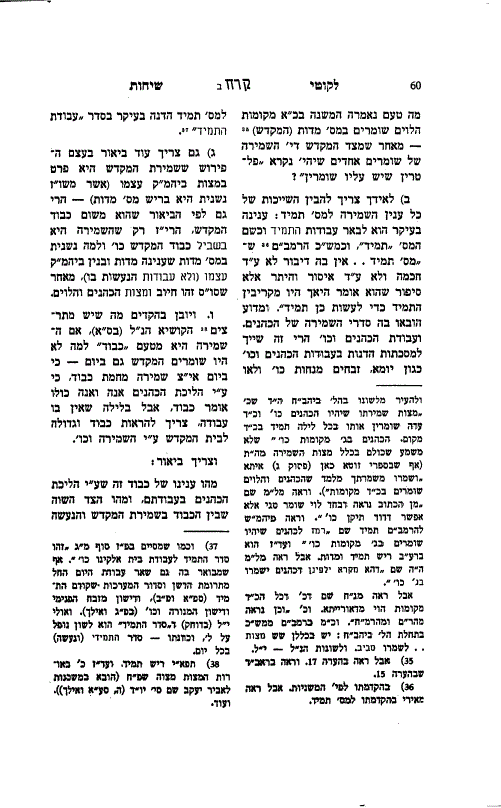
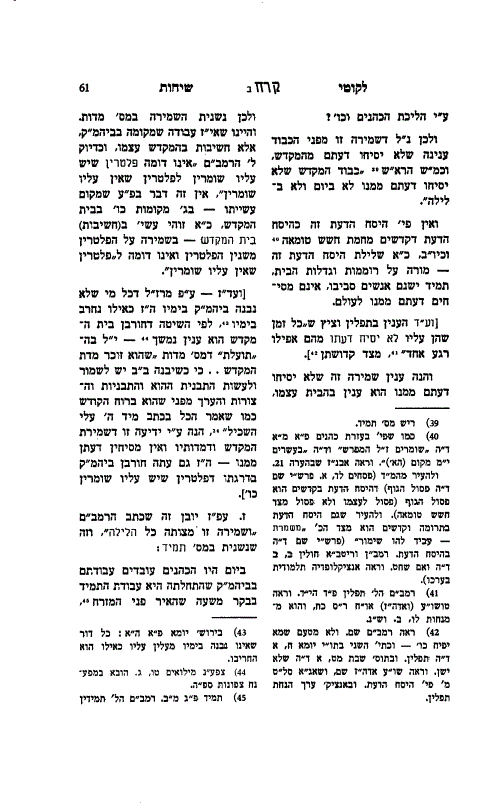
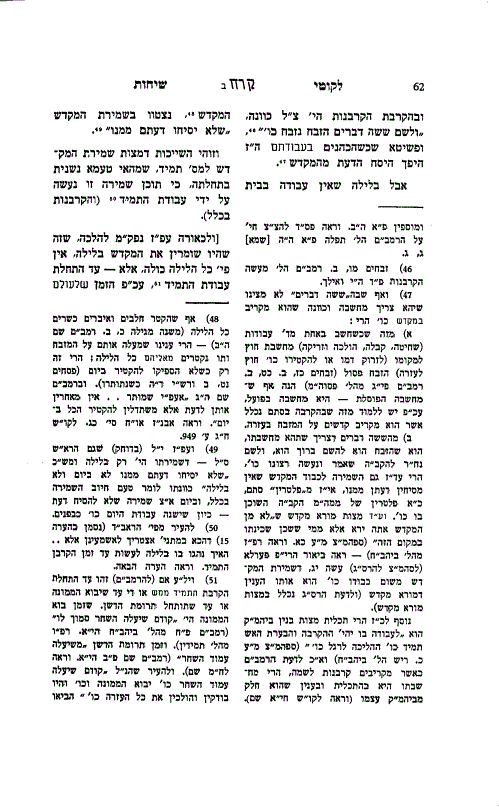
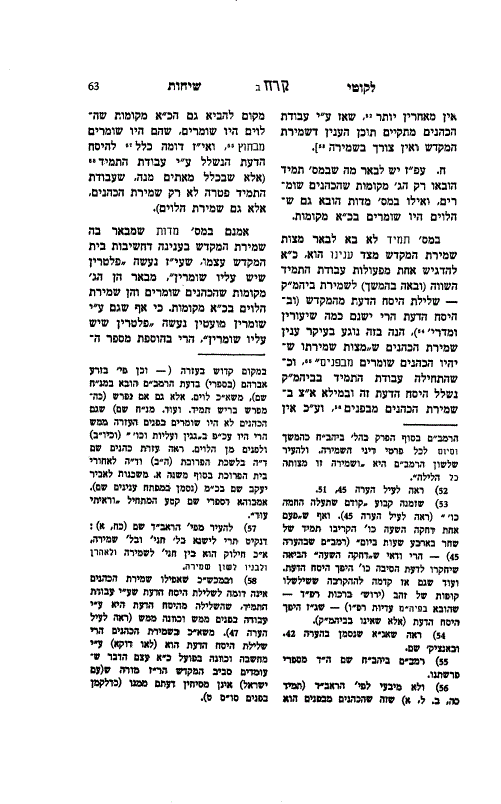
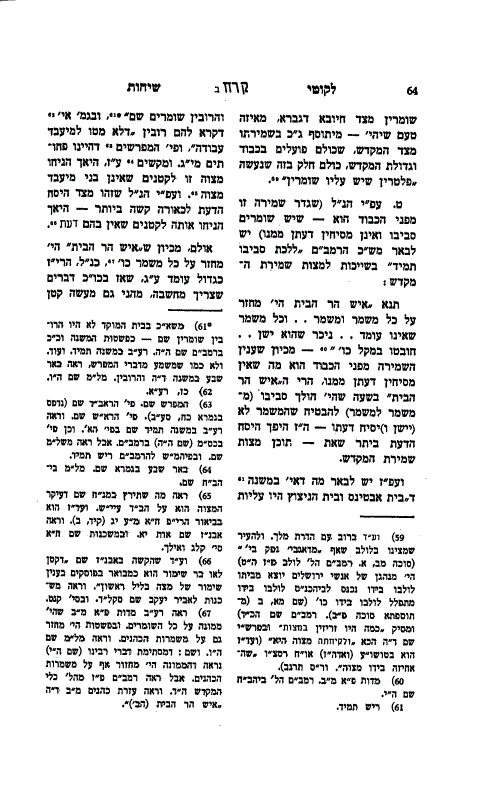
In the verses of our parsha, the Rambam discusses the commandment to guard the Temple. In the Sefer HaMitzvos, he writes that we are commanded to guard the Temple and to walk around it constantly to honor, elevate, and glorify it. This is expressed in the verse, "And you and your sons with you shall be before the Tent of the Testimony," meaning, you shall be before Me always. This commandment is repeated in another form, as it is said, "And they shall keep the charge of the Tent of Meeting." In the Mishneh Torah, the Rambam explains the concept of guarding the Temple: "Guarding the Temple is a positive commandment. Even though there is no fear of enemies or robbers, its guarding is only for the honor of the Temple, like a palace that has guards, as opposed to a palace that does not have guards." He continues, "This guarding is commanded for the entire night, and the guards are the Kohanim and the Levites, as it is said, 'And you and your sons with you shall be before the Tent of the Testimony,' meaning, you shall be guards for Me." It is further stated, "And they shall keep the charge of the Tent of Meeting," and "And those who camp before the Tent of Meeting eastward."
In the Sefer HaMitzvos, the Rambam brings the verses at the end (in the Mishneh Torah) to prove that the guards are the Kohanim and the Levites, as it is stated. It seems that the intention is to say that from these verses we learn the detail that this obligation of guarding is placed upon the Kohanim and the Levites, unlike in the Sefer HaMitzvos, where they are the source and teach about the very obligation of guarding.
b) If the commandment of guarding is not due to fear of enemies and robbers but for the honor of the Temple, then its guarding should be both day and night. Moreover, see there in the previous chapter: "It is not from fear," as it is stated, etc.
One cannot say that the proof from the verses applies to everything written before, including the very guarding of the Temple, which is not written initially in the Mishneh Torah, to include also the detail that the guards are the Kohanim and the Levites, because: a) This is not implied in the simple language, "And the guards are the Kohanim and the Levites," etc. b) The Rambam wrote, "And this guarding is commanded for the entire night," and during the day there is no commandment of guarding. Furthermore,
c) In the aforementioned verses that the Rambam brought, it is not mentioned that its commandment is specifically at night. Their simple meaning implies that the guarding should be at all times (as it is written in the Sefer HaMitzvos there, "You shall be before Me always").
d) Regarding what is written in the Sefer HaMitzvos, "to walk around it constantly," what is the meaning of this walking, and what is its connection to the commandment of guarding the Temple?
To understand this, we must first explain the beginning that is common in the tractates Tamid and Middos. In three places, the Kohanim guard in the Temple, which seems redundant in one of them. This is also stated in the Sefer HaMitzvos, and the translation of the Peirush and Kapach is the same in the Sefer HaMitzvos. Positive commandment 22 there (to walk around it constantly) all night. So too in the Sefer Mitzvos Gadol, positive commandments 165, and in the Sefer HaChinuch there. Similarly, the Ramban (Bamidbar 1:49, beginning of Da'at Zekeinim and Tosafot, beginning of Middos, Tosafot Eruvin 23a, that it is 70 cubits, Tosafot Yoma 2b, that it is Rabbinic, Be'er Sheva, beginning of Tamid, Mishneh Torah, Hilchos Beis HaBechirah).
In particular, since the tractate Middos follows immediately after Tamid, the commentator on Tamid explains that the reason for beginning with the guarding and the place where the Kohanim sleep is because it is necessary to illuminate the practice of the Tamid service. Therefore, it first mentions their guarding and sleeping place until it arranges the entire order, etc.
However, since this Mishnah already appears, it is difficult to understand why it needed to be repeated at the beginning of Middos, which follows Tamid. It should have started with "in the 21 places the Levites guard in the Temple," even though one could say that since it needs to inform us about the guarding of the Levites, it brings the law of guarding in its entirety.
The explanation for this can be given as follows: The commandment of guarding the Temple can be explained in two ways: a) it is a detail concerning the matters of the Temple, b) it is a detail in the service of the Kohanim and Levites, who are tasked with guarding the Temple.
In other words, the commandment of guarding the Temple is either a matter concerning the Temple itself, a requirement that the object (the Temple) must be guarded (though this obligation of guarding is placed upon the Kohanim and Levites), or it is initially a duty of the individuals (the Kohanim and Levites) as part of their service, with the obligation being to guard the Temple.
Seemingly, this depends on the reasons for the commandment of guarding. If the commandment of guarding the Temple is due to "honor," as the Rambam writes — "a palace with guards is not like a palace without guards" — then it is a detail concerning the palace itself. However, if the guarding of the Temple is to prevent unauthorized entry, or to protect the vessels, etc., then it is a detail in the duties of the Kohanim and Levites.
According to this, it is possible to explain why the Mishnah states "in three places the Kohanim guard" both at the beginning of Tamid and at the beginning of Middos. The tractate Middos, as its name implies, deals with the measurements of the Temple, its structure, and all its details, meaning its focus is not on the services and commandments performed in the Temple, but rather on the Temple itself. Whereas in Tamid, the discussion is about the actual services performed in the Temple, and in the words of the Rambam, "how they would offer the Tamid."
In both tractates, it states "in three places the Kohanim guard" because the commandment of guarding the Temple encompasses both aspects: a matter of the Kohanim's service and a matter concerning the Temple itself.
Regarding the matter of guarding the Temple, according to the Rambam, it is (only) for the honor of the Temple, as mentioned earlier, a part and detail of the Temple itself. However, (in addition to the fact that the other questions on the Rambam mentioned earlier remain unresolved, this explanation itself) requires further clarification.
If the guarding of the Temple is for the reason of "honor," as "a palace with guards is not like a palace without guards," then even if there are only a few guards (or even just one), it would still be considered a palace with guards, which confers honor upon the Temple. The fact that the Kohanim guard in three places and the Levites in twenty-one places is a personal obligation imposed on the Kohanim and Levites to guard in twenty-four places. And if so, why does the Mishnah state in twenty-one places that the Levites guard in Tractate Middos (the Temple)? Since from the perspective of the Temple, it suffices to have a few guards to be called "a palace with guards."
On the other hand, it is necessary to understand the connection of the entire concept of guarding to Tractate Tamid: its main purpose is to explain the service of the Tamid, as the name of the tractate "Tamid" implies, and as the Rambam writes that Tractate Tamid "does not contain any discourse about wisdom or about prohibition and permission, but rather a narrative of how they would offer the Tamid in order to do so always." Why then are the arrangements of the Kohanim's guarding and the Kohanim's duties included, which belong to tractates dealing with the Kohanim's services, such as Yoma, Zevachim, Menachos, etc., and not to Tractate Tamid, which primarily discusses the order of the Tamid service?
Additionally, it requires further explanation regarding the interpretation that the guarding of the Temple is a detail in the mitzvah of the Temple itself (which is why it is repeated at the beginning of Tractate Middos) — even according to the explanation that it is for the honor of the Temple, it is only that the guarding is for the honor of the Temple. Why then is it repeated in Tractate Middos, which deals with the measurements and construction of the Temple itself (and not the services performed therein), since ultimately it is a duty and commandment of the Kohanim and Levites?
And it is possible to precede with what is explained to resolve the aforementioned question (in the first section), if the guarding is for the reason of "honor," why was the Temple not guarded during the day? Because during the day, there is no need for guarding due to the multitude of Kohanim walking back and forth, which itself expresses honor. However, at night, when there is no service, it is necessary to demonstrate honor and greatness for the Temple through guarding, etc.
Therefore, it is said that this guarding for the sake of honor is intended so that they do not divert their attention from the Temple, as the Rosh writes — the honor of the Temple is that they do not divert their attention from it, neither by day nor by night.
This diversion of attention is not like the diversion of attention from the beams due to fear of theft. Rather, the negation of this diversion of attention indicates the exaltedness and greatness of the Temple, that there are people around it who never divert their attention from it.
[Similar to the matter of tefillin and the tzitz, as long as they are upon him, he should not divert his attention from them even for a moment, due to their holiness.] Thus, this matter of guarding so that they do not divert their attention from it is a matter of the Temple itself.
Therefore, the guarding is repeated in the Mishnah. This indicates that it is not a service whose place is in the Temple itself, but rather it is about the importance of the Temple itself, as the Rambam states: "A palace that has guards is not comparable to a palace that does not have guards." This is not a separate matter, as its place of execution is in three locations: in the Temple, because this is the importance of the Temple — guarding the palace. It is not comparable to a palace that does not have guards.
(Similarly, as our Sages say, anyone who did not witness the Temple in his days, it is as if it was destroyed in his days. According to the view that the destruction of the Temple is an ongoing matter, it can be said regarding the benefit of the tractate Middos — that it remembers the measure of the Temple. For when it will be rebuilt speedily in our days, it is necessary to guard and make the design and the forms and the arrangement because it is with divine inspiration, as it is said, "All this in writing, as the L‑rd made me understand by His hand upon me.") Thus, through this matter of guarding the Temple and its measures, and not diverting attention from it, even now the destruction of the Temple is at the level of a palace that has guards.
And in the offering of the sacrifices, there must be intention, "and for the sake of six things the altar was chosen," etc. It is obvious that when the Kohanim are in their service, there is no diversion of attention from the Temple. But at night, when there is no service in the Temple, and they add the guarding, see the commentary of the Tzemach Tzedek on the Rambam, Laws of Prayer, chapter 1, and the Laws of the Offering of Sacrifices, chapter 1.
And even though in the "six things" it does not state that there needs to be thought and intention that it is being offered in the place, etc.
The commandment of guarding the Temple is so that they do not divert their attention from it. This is the connection of the commandment of guarding the Temple to the tractate Tamid, which is why it is repeated at its beginning, because the content of this guarding is accomplished through the service of the Tamid (and the sacrifices in general).
[Seemingly, according to this, there is a practical halachic implication that when they guarded the Temple at night, it was not for the entire night, but until the beginning of the service of the Tamid, at least the time when it is always offered, even though the burning of the fats and limbs continues all night (Mishnah Megillah 20b and Rambam there, Laws of the Temple Service, chapter 6) — they say that they are brought up on the altar and are burned all night: this is only when they did not manage to burn them during the day (Menachos 59b and Rashi there, s.v. "when they did not manage"). And the Rambam there, chapter 6 — even though it is permitted, they do not delay them until the night but strive to burn everything during the day. And even though "etc." he curses one who delays them.]
And according to this, it is explained why in the tractate Tamid only the three places where the Kohanim guard are mentioned, whereas in the tractate Middos it is mentioned that the Levites also guarded in twenty-one places. In the tractate Tamid, it does not come to explain the commandment of guarding the Temple from its own perspective, but rather to emphasize one of the functions of the service of the Tamid, which is similar (and follows) the guarding of the Temple — the negation of diversion of attention from the Temple (and in the matter of diversion of attention, there are several measures and levels). In this, the main concern is the guarding of the Kohanim, whose commandment of guarding is that the Kohanim guard from within. And once the service of the Tamid begins in the Temple, this diversion of attention is negated, and consequently, there is no need for the guarding of the Kohanim from within. Therefore, the Rambam does not mention at the end of the chapter in the Laws of the Temple Service as a continuation and conclusion for the entire chapter of guarding. According to the Rambam, this guarding is commanded for the entire night.
In the tractate Middos, which explains the guarding of the Temple in terms of the importance of the Temple itself, as it becomes a palace that requires guards, both the places where the Kohanim guard and the guarding of the Levites in twenty-one places are explained. Although even with a few guards it becomes a palace with guards, the addition of a number of guards in a holy place adds to its honor and greatness. This is similar to what is mentioned in the Sifrei regarding the opinion of the sages, which is brought in the Gemara, that the guarding is due to the obligation of the person, and for whatever reason it may be, it also enhances the guarding from the perspective of the Temple. All are part of making it a palace with guards.
According to the above (that this guarding is due to honor — that guards surround it and do not divert their attention from it), we can explain what the Rambam writes about "walking around it always" in relation to the commandment of guarding the Temple. The Mishnah states that the "man of the Temple Mount" would go around to each guard post, and any guard who was found sleeping was punished. The guarding is due to honor, and not diverting attention from it. Thus, the "man of the Temple Mount" when he would go around (from post to post) to ensure that the guard was not sleeping, was the opposite of diversion of attention, which is the essence of the commandment of guarding the Temple.
And it is possible to say that in the Mishnah, where it states "and the young ones guard," and in the Gemara, where it is stated that they are called young ones because they are not yet fit to perform the service, the commentators explain that this means they are less than thirteen years old. They question how this commandment was given to minors who are not obligated in mitzvos. According to the above, which equates it to the matter of diversion of attention, it seems even more difficult — how could they entrust it to minors who lack understanding? However, since the "man of the Temple Mount" would go around to each guard post, as mentioned above, it is as if an adult is standing over them. In many matters that require thought, even the action of a minor is effective. Therefore, in the Chamber of the Hearth, they did not have young ones guarding there, as is the simple understanding of the Mishnah, and also in the Mishnah Tamid it states that they were not there. This is not as it seems from the words of the Mishnah, see Be'er Sheva on the Mishnah regarding the young ones, where it explains that they were there in conjunction with the thought of the adult standing over them.
And especially in our case, where no intention or thought is required in practice, but rather the very presence of standing around the Temple is sufficient. This is similar to the matter of the guards surrounding it and not diverting their attention from it, which suffices even if they are not standing over it all the time, but rather going around the Temple and checking each guard post.