Introduction
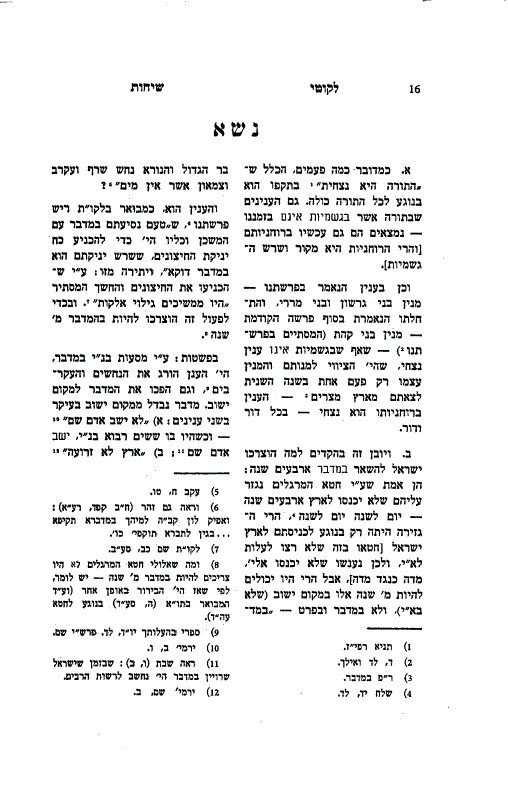
This sicha is based on the beginning of Parshas Naso, just as the parsha itself is divided into sections. The Rebbe explains that, just as the Torah divides the parsha into different parts, our avodah—our divine service—also has different aspects. In Likkutei Torah, it is explained that these divisions correspond to spiritual realities, and our job is to elevate the world and prepare it for Moshiach.
But before we get into the details of the parsha—specifically about Gershon, Kehos, and Merari—the Rebbe asks: how can we relate to these topics in our own lives? As has been discussed many times, there is a fundamental principle that Torah is eternal. We know that Torah is true; sometimes we may wonder if it’s really relevant to us, but Torah tells us to keep Shabbos—it’s true for all times. We always need to keep Shabbos, no matter what. This isn’t just an abstract idea; it applies to every aspect of Torah.
This means that everything in Torah—even things that seem only historical or unique to a certain time—remains relevant today. Even those parts of Torah that seem disconnected from our current reality are still present spiritually. Therefore, we don’t ignore them; in fact, Torah is the foundation and source of everything physical. The fact that we still have Torah today shows how deeply relevant it remains for us.
In this week’s parsha, we finished reading about the census of the sons of Gershon and Merari—their counting and their specific roles. There’s a lot of detail about their work and their responsibilities. The entire discussion about Gershon and Merari appears in a particular place in the parsha; earlier sections introduce them because they are being counted, and then later on the Torah describes how they are counted.
The Rebbe points out that this introduction—that they are being counted—is not just a technical note. Many commentaries focus on this point: why does the Torah emphasize their being counted? It’s as if Hashem is telling them: you matter; you are people who can accomplish what needs to be done.
The Rebbe wants us to realize that we too can fulfill this introduction today. Specifically, this relates to our parsha—the introduction regarding Gershon and Merari—and also connects with what was begun at the end of last week’s parsha, which leads directly into our section.
Later on in the parsha, we learn exactly what Gershon and Merari did—their actual tasks—but here we have an introduction: this is really an introduction for all generations regarding Gershon and Merari. Even though physically their work was not eternal—they aren’t doing those jobs anymore—the essential point remains: there was a command given regarding them, and its inner meaning continues to apply.
Saif Aleph
The episode of the Jewish people wandering in the desert for forty years was not just a one-time historical event. While it happened physically only once, its significance is eternal and public, affecting every generation and every word of Torah we study. The lessons from that period are relevant to us whenever we engage with Torah, as Hashem engages with us through it.
Before delving into the unique role of the tribe of Levi during those years, we need to understand why the Jewish people had to wander in the desert for forty years. What was the purpose of this prolonged stay in such a desolate place? The punishment was not simply because they refused to enter Eretz Yisrael after the sin of the spies; rather, it was specifically decreed that they would remain in the desert for forty years—one year for each day the spies scouted the land.
But why did this punishment have to take place in a desert? Couldn’t they have been delayed somewhere else, perhaps in a settled area? The answer is that their wandering had to be specifically in a place that was “not a land,” a space devoid of holiness and settlement—a place dominated by external forces, by kelipos. The Jews’ presence there served to refine and elevate even such spiritually barren places, preparing the world for when Mashiach will come and transform all deserts into places of settlement and holiness.
This brings us to an important question: what was unique about the tribe of Levi during these years? The Leviim were counted separately from the rest of Bnei Yisrael. While all other tribes were counted from age twenty and up, Leviim were counted from age thirty because their service required greater maturity. Their job was specific: to carry and care for the Mishkan and its vessels during travels, ensuring its sanctity wherever Bnei Yisrael camped.
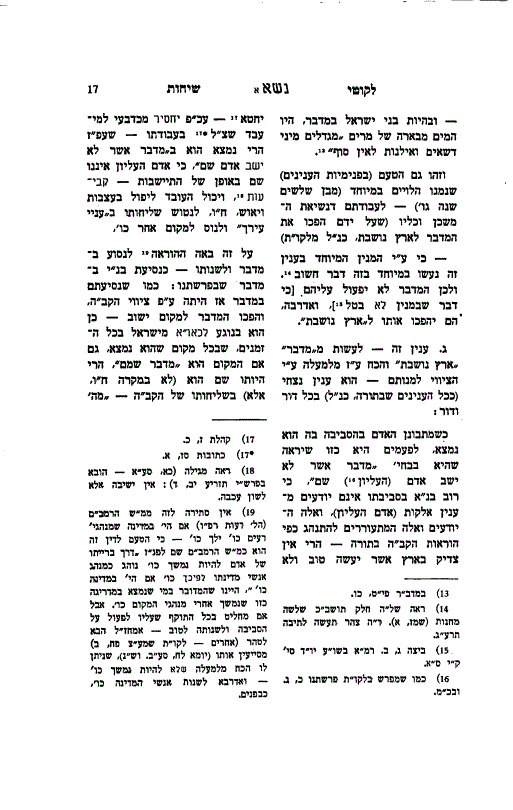
The Mishkan and its vessels transformed even the harshest parts of the desert into places fit for Hashem’s presence. Through their service, the Leviim made these spaces suitable for holiness. This special role meant that while everyone else was subject to the spiritual dangers of the desert, Leviim were protected—they elevated their surroundings rather than being affected by them.
This concept is reflected in halacha: something that is counted individually—davar shebiminyan—cannot become nullified or lost among others. Its importance keeps it distinct no matter how many other things surround it. Similarly, because their service was so significant, Leviim could not be “nullified” by their environment; instead, they transformed it.
Understanding this principle helps us see that transforming one’s environment—from a spiritual “desert” into a place of holiness—is an eternal concept. It applies not just historically but in every generation and every situation where Jews find themselves in spiritually barren places.
Sometimes we find ourselves or our communities in situations comparable to a desert—a place where there seems to be no awareness or knowledge of Hashem. This can mean being surrounded by people who are ignorant of Torah or even among those who know but are indifferent or resistant to living according to Hashem’s will.
The verse says:
במדבר אשר לא ישב אדם שם
"In a desert where no man dwells."
This refers not only to physical desolation but also spiritual emptiness—a place where “man,” representing higher spiritual consciousness (adam elyon), is absent. Even so, Hashem’s presence can reach there through our efforts.
When someone finds themselves spiritually isolated or surrounded by negative influences—whether among non-Jews or Jews estranged from Torah—the challenge is not merely survival but transformation: turning that “desert” into a settled place filled with holiness.
This is why we learn about these episodes—to teach us how to act when faced with spiritual deserts today. Just as Bnei Yisrael transformed their surroundings through Torah and mitzvos in the wilderness, so too must we strive to bring holiness wherever we are placed—even if it feels like a desert.
Saif Beis
Every Jew, in every time and place, can find themselves in a situation that feels like a desolate desert. Why are you there? It is not by accident or coincidence, God forbid. Rather, this is a mission from Hashem. The reason you are in that place is because Hashem wants you there—He wants you to journey through it and transform it.
You might wonder: who says Hashem sent me here? Maybe it just happened by chance. But the verse says:
מֵיְהוָה מִצְעֲדֵי גֶבֶר כּוֹנָנוּ
"From Hashem, the steps of man are established."
This verse from Tehillim teaches that wherever you find yourself, Hashem has sent you there with a purpose—to transform that place through your service and make it a dwelling for the supreme Adam, for holiness to reside.
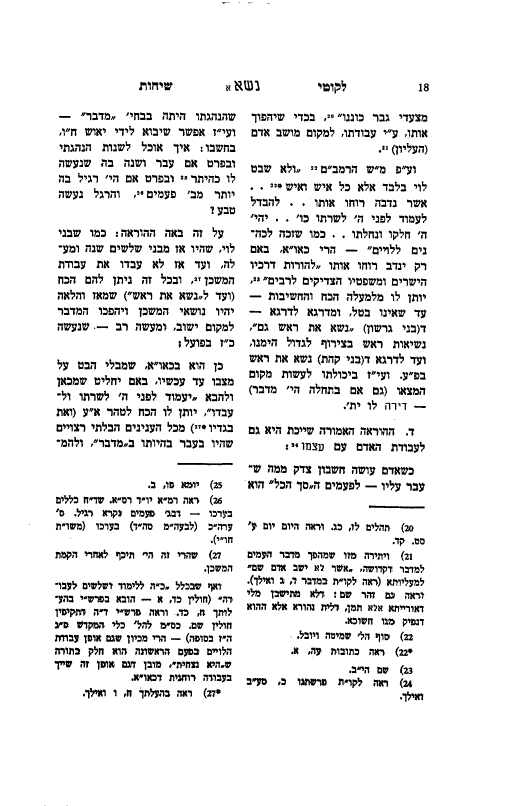
But perhaps you'll argue: I am not a Levi; I am just a Yisrael. Who says I have this mission? The Rambam explains that this calling is not only for the tribe of Levi, who physically served in the Beis Hamikdash—the kohanim and Leviim—but applies to every single person whose heart and spirit move them to dedicate themselves to Hashem’s service.
The Rambam writes that anyone whose spirit inspires him to separate himself and stand before Hashem to serve Him—so that Hashem becomes his portion and lot, just as He gave to the kohanim and Leviim—can do so as well. This means that each person, if only his spirit will be benevolent (again quoting the Rambam), and he seeks to teach righteousness and justice to others, is given power from above. He receives both the strength and significance needed for this task, so much so that he will not be nullified by obstacles but will progress step by step.
This idea is reflected in the Torah’s description of the sons of Gershon. The Torah first discusses the counting of Kohos in Parshas Bamidbar—Kohos being considered more prominent among Levi’s sons, as Amram, Yitzhar, Chevron, and Moshe Rabbeinu all descend from Kohos. Yet Parshas Naso begins with "Naso es rosh gam heim"—raise up their heads also—which means even those not at Kohos’ level are elevated together with them.
First comes Gershon, who is then joined with Kohos; ultimately they reach the level where they are counted on their own merit. The Torah does not say "also" regarding Bnei Kohos because they themselves are already raised up. The message is: everyone can be elevated—first together with others, then on their own—and empowered with special strength from above to fulfill their unique mission.
Through this empowerment, each person has the ability to transform their environment—even if it began as a desert—into a dwelling place for Hashem. This applies both to one's community and surroundings: even if those around you seem like a spiritual desert, your job is to uplift them.
The same principle applies internally. Sometimes a person finds within themselves an inner desert—a sense of spiritual desolation or distance from holiness. When making an honest reckoning of one’s life over the years, one might realize their conduct has been like a desert. This realization can lead to despair: how can I possibly change?
This feeling intensifies if one has transgressed repeatedly; our sages say that when someone repeats an act several times, it becomes as if it were permitted—it becomes second nature. Once something feels natural or habitual, change seems nearly impossible.
That is why the Torah instructs us: just as with the sons of Levi—who until age thirty had never served in the Mishkan but were suddenly given new power and told "raise their heads"—so too every Jew can be uplifted at any moment. No matter how long one has been in their personal desert or how entrenched their habits may seem, Hashem empowers each person anew to rise above their past and transform themselves into a dwelling place for holiness.
Saif Gimmel
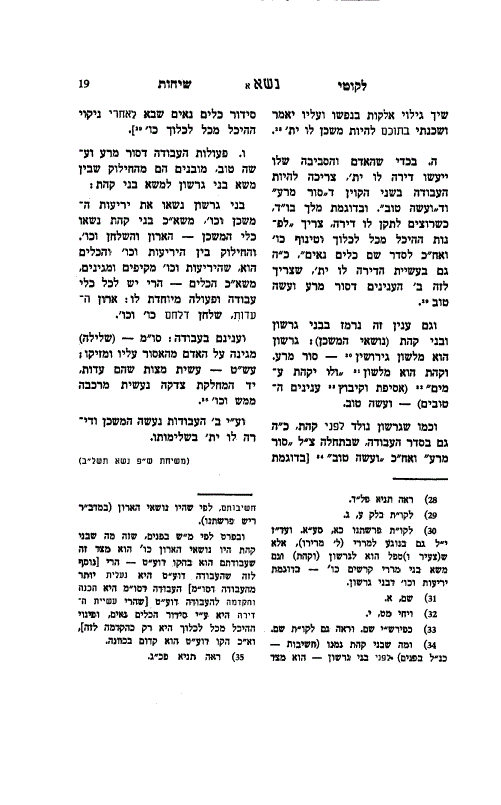
The Leviim became the carriers of the Mishkan, transforming the desert into a settled place. This was not just an instruction, but an actual deed—a significant action that took place in reality.
Similarly, this applies to every individual. Regardless of your previous situation, if you decide from now on to stand before Hashem and serve Him, you will be empowered to purify yourself and your garments. Just as the Leviim were cleansed along with their garments, so too can a person cleanse himself from all unwanted matters that accumulated during his time in the “desert”—the spiritual wilderness.
This process draws down a revelation of godliness into one’s soul. About such a person, Hashem says, “I will rest among you,” making him into a Mishkan—a dwelling place—for Hashem.
At this point, the Rebbe focuses on the specific services among the Leviim who carried parts of the Mishkan. There are two aspects: removing negativity and bringing down holiness. When preparing a dwelling for a king, you must first clean out all dirt and then bring in beautiful vessels. The same is true when making a dwelling place for Hashem—both steps are necessary: “stay away from evil” (sur mei’ra) and “do good” (asei tov).
Just as we learned previously about transforming one’s environment into a dwelling for Hashem, both aspects—removing evil and doing good—are required.
This is similar to preparing a room for a human king: first you clean out all dirt, then you arrange beautiful vessels. Likewise, when making a dwelling for Hashem, both steps are essential.
The two groups who carried parts of the Mishkan illustrate these two aspects. The Bnei Gershon carried the beams—the structure—while Bnei Kehas carried the vessels of the Mishkan.
The name Gershon comes from “gerushin”—divorcing or pushing away—which hints at rejecting evil (sur mei’ra). Kehas relates to gathering or collecting positive things—bringing in goodness (asei tov).
The order is important: first comes cleaning up (removing negativity), then comes bringing in the vessels (positive actions). Gershon was older; he was born before Kehas. Similarly, in serving Hashem, one must begin with “stay away from evil” before proceeding to “do good.”
This is like arranging beautiful vessels after cleaning out all dirt—you can only bring in the vessels once the room is clean. Thus we have Gershon (removal) followed by Kehas (positive action).
The distinction between sur mei’ra and asei tov is also reflected in what each family carried. Bnei Gershon carried the covers of the Mishkan; Bnei Kehas carried its vessels.
The difference between covers and vessels is significant. The curtains and covers surrounded and protected—their function was to shield what was inside. Each vessel had its own unique purpose: for example, the Aron housed the Luchos (tablets), while the Shulchan held the Lechem Hapanim (showbread).
In our service of Hashem, sur mei’ra—staying away from evil—is about rejecting negativity; it protects us from what is forbidden or harmful. Asei tov, doing mitzvos, is about positive action; these mitzvos are testimonies—like the Aron HaEidus (Ark of Testimony).
When your hand gives tzedakah, you become like a vehicle or chariot for Hashem’s will.
Thus, through both aspects—protection from evil and positive action—the dwelling place for Hashem becomes complete and wholesome.
This teaching is based on a sicha delivered on Shabbos Parshas Naso, 5732 (1972).
Key Points
1. The divisions within Parshas Naso reflect different aspects of our divine service, and every detail in Torah—even those that seem historical—remains spiritually relevant and applicable to our lives today.
2. The forty years of wandering in the desert were not merely a punishment but a mission to refine and elevate spiritually barren places, with the Leviim playing a unique role by transforming the desert into a dwelling for holiness through their service in the Mishkan.
3. Every Jew is placed in their particular environment by Divine Providence, tasked with transforming even spiritual “deserts” into places of holiness; this mission is not limited to Leviim but extends to anyone inspired to dedicate themselves to Hashem’s service, as explained by the Rambam.
4. The Torah’s emphasis on elevating Gershon alongside Kehos teaches that everyone can be uplifted and empowered—first together with others and ultimately on their own—to fulfill their unique mission, regardless of their starting point or spiritual standing.
5. Even if one feels personally distant from holiness or entrenched in negative habits, Hashem grants new strength at any moment to rise above past conduct and transform oneself into a dwelling place for the Divine, mirroring the empowerment given to the Leviim at age thirty.
6. The process of becoming a Mishkan for Hashem involves two stages: first removing negativity (“sur mei’ra”), then bringing in positive actions (“asei tov”), as illustrated by the roles of Gershon (removal/protection) and Kehos (positive vessels) among the Leviim who carried parts of the Mishkan.
7. Both aspects—protection from evil and active mitzvah performance—are essential for making oneself and one’s environment a complete dwelling place for Hashem, fulfilling the eternal lesson derived from Parshas Naso and the service of Gershon and Kehos.