Introduction
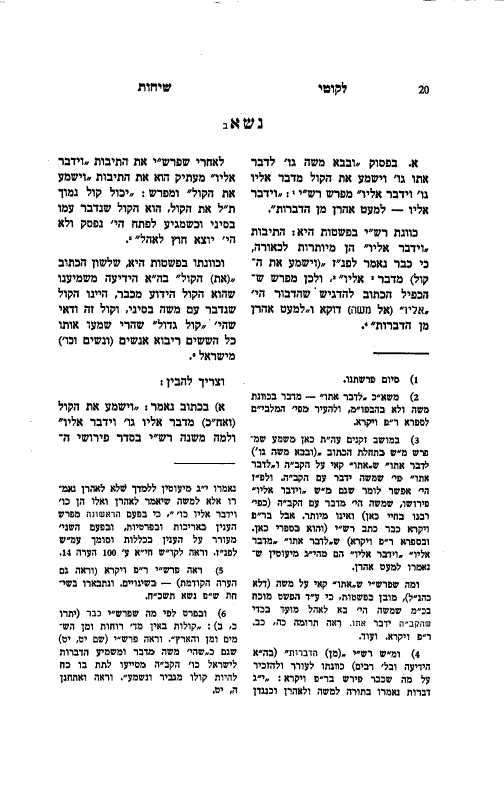
In this study, we will be reviewing a sicha from Likkutei Sichos, Chelek Yud Gimel, specifically the second sicha for Parshas Naso “Naso Beis.” This particular sicha is focused on Rashi’s commentary and is relatively short and straightforward compared to some of the more complex sichos.
The discussion centers around the end of Parshas Naso. The verse in question describes Moshe coming to the Ohel Moed—the Tent of Meeting. The Rebbe points out, based on Rashi and his sources, that when Moshe entered the Ohel Moed, it was so that Hashem would speak with him. There are differing opinions: some say it means Moshe would speak to Hashem, but the Rebbe clarifies that the intent is for Hashem to speak with Moshe.
The verse continues by describing how Moshe heard the voice speaking to him from above the lid—the kapores—that covered the aron (the ark) which contained the testimony. The voice came from between the two keruvim (cherubs), and it spoke to him. Rashi’s first comment explains that the voice originated from between these two keruvim.
However, our main focus will be on the very last verse and Rashi’s commentary there. The Rebbe notes an interesting detail: Rashi’s headings and explanations do not follow the same order as they appear in the verse itself. In the verse, certain words come last, but in Rashi’s printed commentary—at least according to some editions—the explanation for “Vaidaber eilav” (“and He spoke to him”) comes first, even though those words are last in the actual verse.
This leads to one of the central questions of this sicha: Why does Rashi choose to explain “Vaidaber eilav” first—before explaining other phrases—even though it appears last in the verse? The Rebbe will analyze this editorial choice and its implications for understanding both Rashi’s method and the meaning of the Torah text.
Saif Aleph
The Rebbe begins by analyzing the verse where Moshe comes to the Ohel Moed and hears Hashem’s voice speaking to him. The Torah says, “Vaidaber eilav”—Hashem spoke to him. The question arises: why does the verse repeat “Vaidaber eilav”? Rashi explains that this repetition is meant to exclude Aharon from these particular statements—these dibreis—that Hashem spoke. Sometimes, the Torah describes Hashem speaking to both Moshe and Aharon, but as Rashi points out (citing the beginning of Vayikra), in reality, Hashem only spoke directly to Moshe, who then relayed the message to Aharon. The Torah sometimes mentions both names together as a form of honor for Aharon, but here, the repetition emphasizes that only Moshe heard these words.
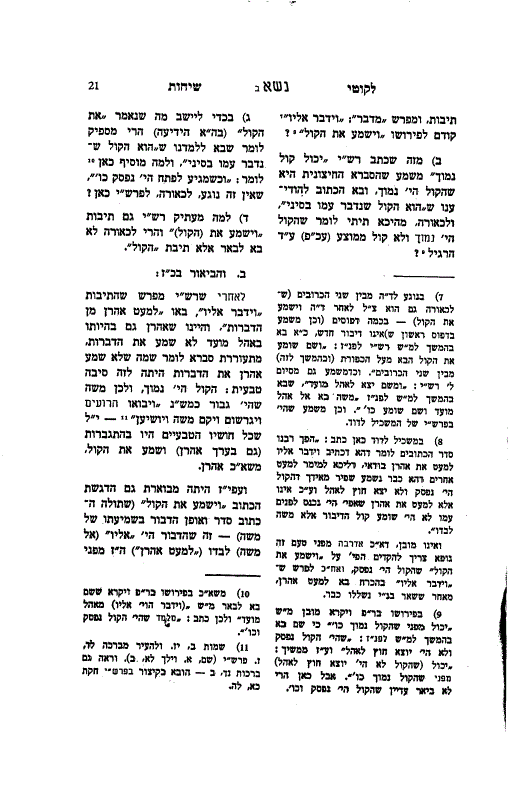
After clarifying “Vaidaber eilav,” Rashi addresses the earlier phrase in the verse: “Vayishma es hakol”—he heard the voice. Why does Rashi explain this phrase now? Rashi clarifies that one might think this voice was quiet or subdued. Therefore, the Torah specifies “hakol”—the voice—which refers to a known voice, specifically the same powerful voice that spoke at Sinai. This was not a low or soft sound; it was a mighty voice, one that all of Israel had previously heard at Sinai.
Rashi further explains that although it was a powerful voice, once it reached the entrance of the Ohel Moed—the doorway—it stopped and did not go outside. No one outside could hear it, even though inside it was loud and clear for Moshe. This detail highlights a unique miracle: a thunderous divine voice could be contained within a specific space.
The Rebbe notes that Rashi’s intention in his commentary is to clarify why the Torah uses “hakol” with a definite article—the known voice. This signals to us that it is not just any sound but specifically the same great and powerful voice from Sinai. Since all 600,000 men, along with women and children, heard it at Sinai, we know it must have been an extraordinary sound.
However, there is an order issue in Rashi’s explanation compared to the verse itself. The verse first says Moshe heard the voice (“Vayishma es hakol”), then says Hashem spoke to him (“Vaidaber eilav”). Yet Rashi explains “Vaidaber eilav” before discussing “Vayishma es hakol.” Why does he reverse their order?
The Rebbe suggests that this order in Rashi is deliberate. First, Rashi establishes that only Moshe heard these words—excluding Aharon—then he addresses what kind of voice Moshe heard. This sequence helps clarify why someone might think it was a low or subdued voice: since only Moshe could hear it (not even Aharon), perhaps it was quiet by nature.
This leads to another question: why would anyone assume it was a low voice? Why not simply assume it was an average or normal tone? The Rebbe points out that since only Moshe could hear it—and no one else—it would be logical to think perhaps Hashem spoke quietly or softly so others wouldn’t hear. Therefore, Rashi needs to clarify that despite being exclusive for Moshe’s ears, it was still as powerful as at Sinai; its limitation was spatial rather than due to volume.
The Rebbe concludes by noting that these two questions—why assume a low voice and why Rashi changes the order—are actually connected. Because only Moshe heard Hashem’s words (as established first), one might think this required lowering the volume; hence Rashi immediately addresses and negates this assumption by referencing Sinai’s mighty sound.
Saif Beis
The third question raised is about Rashi’s explanation of the word koel—the voice. If Rashi’s goal is simply to clarify which voice is being referred to, he could have just said that it’s the same voice with which Hashem spoke to Moshe at Sinai. Yet, Rashi adds more: he notes that when this voice reached the entrance of the Ohel Moed, it was interrupted. This detail seems unrelated to the immediate context—why does Rashi need to mention that the voice stopped at the entrance?
The Rebbe explains that it’s precisely because of Rashi’s interpretation that this question arises. Since Rashi says it was a powerful, Sinai-like voice, we wonder why Moshe needed to enter the Ohel Moed at all—shouldn’t such a loud voice be heard everywhere? That’s why Rashi must clarify that the voice stopped at the entrance; only inside could Moshe hear it.
The fourth question concerns why Rashi brings up who heard the voice in the first place. If his purpose is just to explain what kind of koel it was—a powerful one—why does he mention that only Moshe heard it? The answer lies in understanding that this whole issue revolves around Moshe being uniquely able to hear Hashem’s words, and Rashi is addressing why Moshe had to enter the Ohel Moed for this communication.
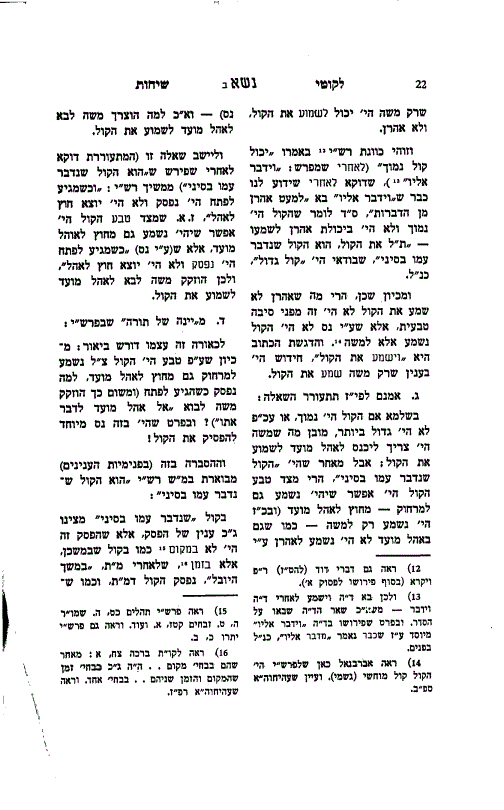
To summarize: after Rashi explains that “He spoke to him” comes to exclude Aharon from these communications, we understand that even when Aharon was present in the Ohel Moed with Moshe, he did not hear Hashem’s words. The Torah emphasizes “Vayedaber elav”—He spoke to him—to indicate only Moshe heard it, not Aharon.
This leads us to ask: how could Aharon not hear? Perhaps there was a natural explanation—maybe it was a low or quiet voice, and only Moshe, who had unique qualities or stronger senses, could perceive it. The Torah describes Moshe as a mighty person; perhaps his physical or spiritual strength allowed him alone to hear.
If so, this would also explain why the verse stresses “he heard the voice”—it would mean only Moshe had the ability to listen. This is what Rashi addresses when he says you might think it was a low voice; after all, if only Moshe heard and Aharon did not, maybe it was simply too quiet for anyone else.
But Rashi rejects this idea by clarifying: no, it wasn’t a low or weak sound—it was actually a powerful voice like at Sinai. Therefore, we cannot attribute Aharon’s inability to hear to natural causes or differences in ability between him and Moshe.
If so, what prevented Aharon from hearing? It must have been miraculous—a supernatural event where only Moshe could perceive Hashem’s words even though they were spoken with a mighty voice. The novelty here is not just that Hashem spoke powerfully but that only Moshe heard despite others being present.
This brings up another question: if it was such a strong voice (like at Sinai), why did Moshe need to enter the Ohel Moed at all? Shouldn’t he have been able to hear from outside as well? And if others couldn’t hear due to a miracle anyway, what difference did his location make?
That’s why Rashi concludes by explaining that when this powerful voice reached the entrance of the Ohel Moed, it stopped—it didn’t go beyond. This means there was both a miraculous aspect (only Moshe could hear) and a physical boundary (the sound itself did not pass outside).
Saif Gimmel
The miracle of the voice in the Mishkan was that, although it was a powerful, loud voice, it stopped at the entrance of the tent and did not go outside. This is why Moshe had to enter the Ohel Moed to hear Hashem’s voice. The Torah emphasizes that only Moshe—and not Aaron—heard the voice, not because it was quiet, but because of this miraculous interruption.
Rashi addresses this by clarifying that the voice was indeed a strong one—hakol, a loud voice—yet it was miraculously contained within the Ohel Moed. Even when both Moshe and Aaron were inside, only Moshe heard it. This answers why Rashi quotes “vayishma es hakol”—it’s not just about what kind of voice it was, but about who could hear it. The uniqueness is not in its volume but in its miraculous limitation: only Moshe could hear it inside, and no one outside could.
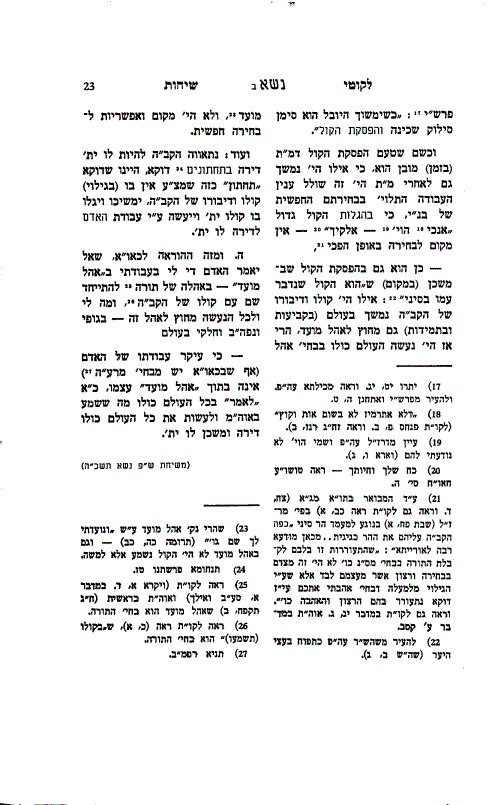
This leads to a deeper question: Why did Hashem’s powerful voice stop at the entrance? Why require Moshe to come inside to receive prophecy? If naturally such a voice would be heard far away, why did Hashem perform a miracle to interrupt it?
The Rebbe explains that this interruption teaches us something fundamental. Hashem does not want His presence and revelation to automatically fill every place in the world. Instead, He wants there to be places where His voice is not openly heard—so that we can bring His presence there through our own efforts. The world should not be overwhelmed by G‑dliness; rather, we are meant to draw G‑dliness into those places ourselves.
This idea is highlighted by Rashi’s comment that this was “the same voice that spoke at Sinai.” At Sinai, too, there was an interruption—but there it was in time rather than space. After Matan Torah ended—bimshoch ha-yovel, when the shofar blast finished—the Shechinah departed and the revelation ceased. Rashi explains that when the shofar sounded, it signaled that Hashem’s presence had withdrawn and the overwhelming revelation had stopped.
Why did this revelation stop? Because if such open G‑dliness continued indefinitely, there would be no room for free choice. When Hashem’s presence is so manifest—“I am Hashem your G‑d”—there is no possibility of choosing otherwise; everyone would automatically do what is right. That would defeat the purpose of avodah—divine service based on free will.
The same principle applies to the Mishkan: if Hashem’s voice extended beyond its boundaries into all space, then everywhere would become holy like the Ohel Moed itself. There would be no place left for human effort or choice; everything would already be filled with G‑dliness.
Hashem’s desire is for a dirah betachtonim—a dwelling place in the lowest realms. That means He wants us to bring His presence into places where it is not already revealed. If even those “low” places were filled with open revelation from above, they wouldn’t truly be low anymore—and our task would lose its meaning.
Therefore, Hashem limits His revelation so that we have space—both literally and figuratively—to work and draw down holiness ourselves. The miracle of the interrupted voice teaches us that our job is to bring G‑dliness into those areas where it isn’t automatically present.
The lesson for each of us is clear: A person should not say, “It’s enough for me to serve Hashem within my own Ohel Moed,” remaining secluded in spiritual pursuits while ignoring everything outside. We cannot remain only within our personal sanctuaries or spiritual comfort zones.
Even though everyone has moments or aspects of their life akin to being in the Ohel Moed—a direct connection with holiness—the main purpose is to bring what we experience there out into every part of our lives and into the world around us.
Our mission is to make all of existence a dwelling place for Hashem—not just within holy spaces or moments but throughout all aspects of creation. This is how we fulfill our role in preparing for Moshiach and making a true dirah betachtonim.
Key Points
1. The Rebbe analyzes Rashi’s commentary on the verse describing Moshe hearing Hashem’s voice in the Ohel Moed, focusing on why Rashi explains “Vaidaber eilav” (“He spoke to him”) before “Vayishma es hakol” (“he heard the voice”), even though the order is reversed in the Torah text.
2. Rashi clarifies that only Moshe, and not Aharon, heard Hashem’s words directly. The Torah sometimes mentions both names for Aharon’s honor, but here the repetition emphasizes Moshe’s unique role as the recipient of Hashem’s direct communication.
3. The phrase “hakol”—the voice—refers to the same powerful voice that was heard at Sinai. Despite its might, this voice was miraculously contained within the Ohel Moed and did not extend outside, so only Moshe could hear it inside.
4. Rashi reverses the order of explanation to first establish that only Moshe could hear Hashem (excluding Aharon), which then raises the logical question of whether the voice was quiet; he immediately addresses and negates this by explaining it was a mighty voice like at Sinai.
5. The miraculous nature of this event is twofold: not only was Hashem’s voice powerful and yet contained within a specific space, but also only Moshe could perceive it—even when others were present in the Ohel Moed with him.
6. This containment of Hashem’s revelation teaches a fundamental lesson: Hashem does not want His presence to automatically fill every place. Instead, He desires that we draw G‑dliness into the world through our own efforts and free choice.
7. Just as at Sinai there was an interruption in time (the revelation ceased after Matan Torah), so too in the Mishkan there was an interruption in space (the voice stopped at the entrance). This preserves human free will and allows for meaningful divine service.
8. Our mission is not to remain secluded within our own spiritual sanctuaries but to bring holiness into all aspects of life and into every part of creation, thereby fulfilling Hashem’s desire for a dwelling place in the lowest realms—dirah betachtonim—and preparing for Moshiach.