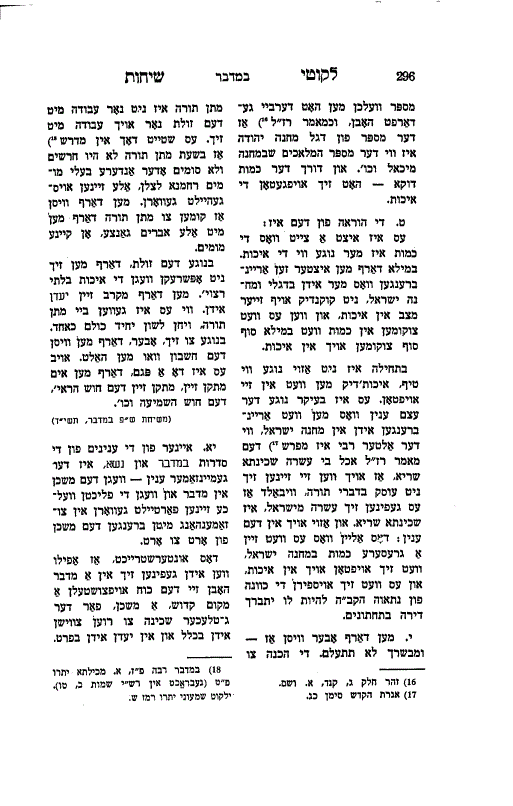
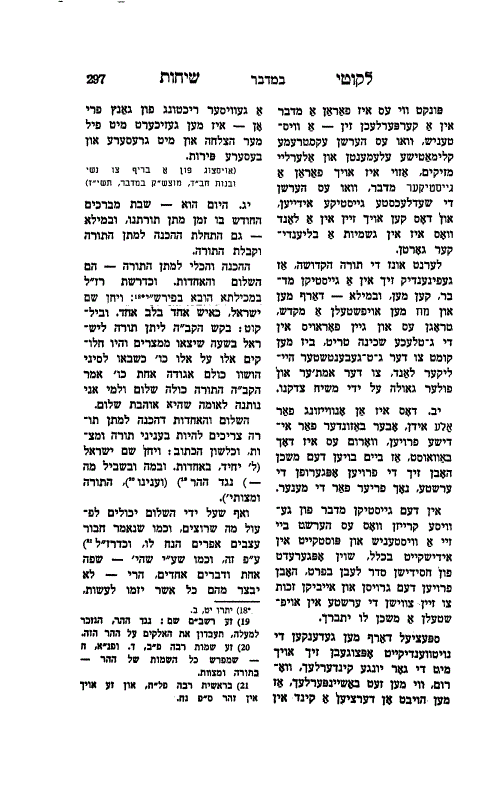

In Likkutei Sichos, Helek Beis, this is the second sicha on Parshas Bamidbar, which begins from Os Yud Aleph in Likkutei Sichos Helek Aleph on Parshas Bamidbar. This sicha is taken from a letter that the Rebbe wrote to a gathering of the N’shei U’Bnos Chabad—the women and daughters of Chabad.
The Rebbe highlights that both of the parshiyos we read, Bamidbar and Nasso, describe the Mishkan—how it was built, how it was transported from place to place, how it was repeatedly erected, and the procedures involved in doing so. The lesson derived from this is that even while one is in a midbar (a desert), a place where the conditions are extreme, there is still a command and an obligation to build the Mishkan.
The Rebbe explains that this parallels the spiritual “deserts” in which a person may find themselves. One may be in a place that, materially and physically, is very convenient and comfortable, yet spiritually it is a midbar. Nevertheless, one is obligated to build a Mishkan—to create a dwelling place for Hashem even there. There is a special privilege and responsibility placed upon Jewish women, who are entrusted with raising their children from a very young age with a commitment to building this Mishkan—both in general and within their own homes and families.
Os Yud Aleph
One of the topics discussed in these sections of Bamidbar and Nasso is the shared subject of the Mishkan—the sanctuary in the desert—and the various responsibilities assigned in connection with transporting it from place to place. There were different roles and tasks designated to individuals in carrying the Mishkan during the journeys.
This emphasizes that even when Jews find themselves in a desert, they possess the strength and ability to establish a holy place—a Mishkan, a sanctuary—for the Divine Presence to dwell among them in a general sense, as represented by the structure of the Mishkan, and also specifically within each individual Jew.
Just as there exists a physical desert—an empty land, a place of barrenness, where climatic conditions are extreme and where harmful elements (“mazikim”) are present—so too there exists a spiritual desert, where destructive spiritual influences are prevalent. This is a midbar in the spiritual sense. Such a desert can even exist in a place that, physically, appears like a flourishing garden. Outwardly, it may be a beautiful and comfortable environment, yet spiritually it is barren.
The holy Torah teaches us that even when we find ourselves in such a spiritual desert, we are able—and therefore obligated—to erect a sanctuary, to carry it forward, and to continue marching in the path of the Divine until we reach the holy land, blessed by Hashem, with the coming of the true and complete redemption through our righteous Moshiach.
Os Yud Beis
This serves as an instruction and lesson for all Jews, and especially for Jewish women. It is well known that when the Mishkan was built, the women were the first to respond to the call—even before the men. This demonstrates that women possess a special connection and responsiveness to the mission of building a Mishkan. The same applies to the spiritual Mishkan that must be established in the “desert.”
In those spiritual deserts found in certain environments—places characterized by emptiness and a lack of Yiddishkeit in general, and certainly distant from a Chassidic way of life in particular—Jewish women have the great and eternal merit and privilege to be the first to establish a dwelling place, a sanctuary, for Hashem.
In particular, one must recognize the importance of dedicating oneself to the education of very young children. As is clearly evident, when a child is guided in a certain direction from a very early age, this ensures far greater success and yields richer and more lasting results.
This is adapted, in shortened form, from a letter to N’shei U’Bnos Chabad, Motzaei Shabbos Kodesh Parshas Bamidbar, 5717 (1957).