Likkutei Sichos vol. 2 – Bamidbar 1
In the first sicha—talk—for Parshas Bamidbar, the Rebbe emphasizes the importance of numbers and quantity in Jewish life. The focus is on attracting and bringing in as many Jews as possible into Yiddishkeit—Judaism—and into the camp of Israel, without being overly concerned about the quality or spiritual level of each individual. The Rebbe teaches that, at this stage, the numbers themselves are of utmost importance, and through increasing quantity, quality will eventually follow.
The Rebbe connects this idea to Chumash Bamidbar, which opens with Parshas Bamidbar and is called Chumash HaPekudim—the Book of Counting. The reason for this name is the census of the Jewish people recorded at the beginning of the parsha. In the opening sections, the Rebbe questions the value of numbers, pointing out that, on the surface, numbers seem insignificant. However, he ultimately demonstrates that, when it comes to Jews, numbers represent something deeply significant and powerful. The sheer quantity is itself of tremendous importance and serves as a great support in fulfilling Hashem’s will.
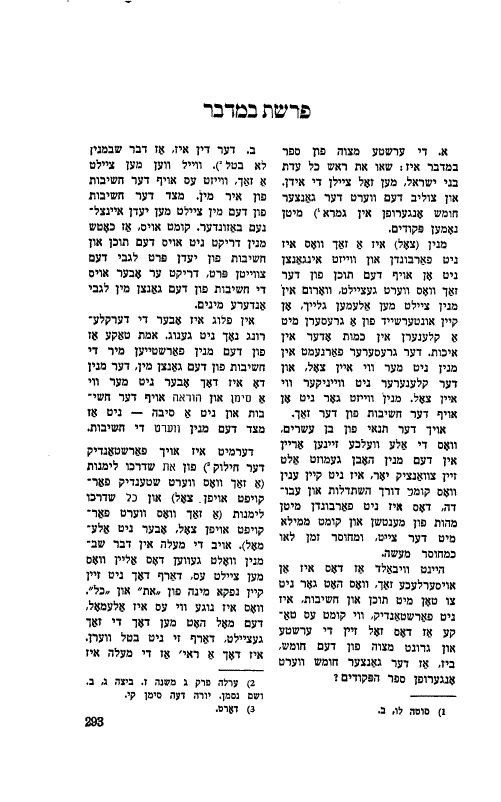
In Sif Aleph—Section One—the Rebbe explains that counting does not reflect the quality of what is being counted. A number, whether one or two, does not indicate the greatness or simplicity of the individual. When counting, each person is simply a number, regardless of their stature. The Torah’s first mitzvah in Bamidbar is to count the heads of the Jewish community: “Count the community of Israel.” This act of counting, as the Gemara notes, gives the entire book its name, Pekudim—Counting.
The Rebbe continues by noting that numbers are not inherently connected to the essence of what is being counted. In a minyan—counting—everyone is counted equally, regardless of their individual greatness or simplicity. The greatest person and the simplest person each count as one. Thus, the act of counting does not reflect the importance or content of the individual.
However, in this census, only those twenty years and older were counted, as the verse states, mi ben esrim shana—from twenty years old. One might argue that this age requirement adds significance to the count. Yet, the Rebbe clarifies that being twenty is not an achievement or a reflection of one’s efforts or qualities; it is simply a matter of time passing. Therefore, this condition does not add real qualitative value to the count.
The Rebbe then raises a question: If counting is merely external and does not reflect the inner content or importance of the individual, why is it the first and foundational mitzvah of Chumash Bamidbar? Why is the entire book named after this act of counting? This indicates that, despite appearances, counting is of great significance, as the Rebbe will further explain.
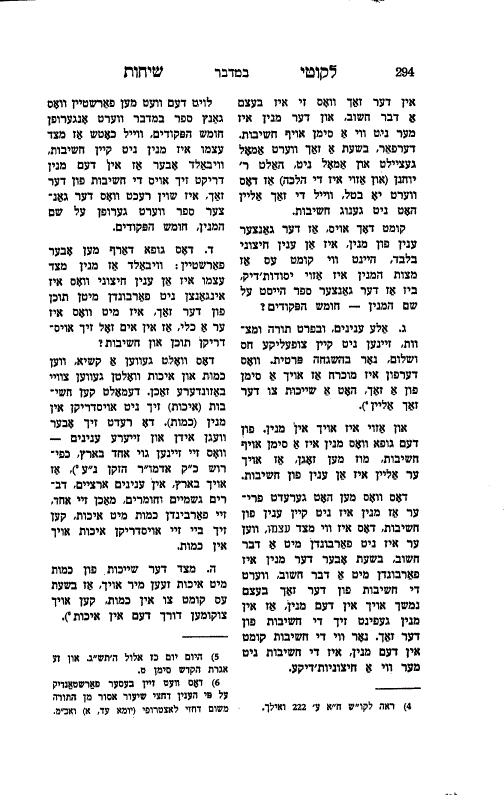
In Sif Beis—Section Two—the Rebbe shows that counting does, in fact, indicate importance. The halacha is that something which is counted cannot become batel—nullified—in a mixture. For example, if a non-kosher egg is mixed with kosher eggs, and eggs are sold by number, each egg is considered important and cannot be nullified. Counting an item demonstrates its significance. However, the Rebbe points out that this only shows the importance of the entire category, not the individual items. When we count Bnei Yisrael, the count does not highlight the unique value of each Jew, but it does express the collective importance of the Jewish people as a whole.
Nevertheless, the Rebbe notes that it is not the act of counting that makes something important; rather, important things are counted. The counting is a sign of importance, not its cause. This is evident in halacha: only items that are always counted are never nullified, while those sometimes counted can be nullified, showing that the inherent importance of the item, not the act of counting, is what matters.
The Rebbe explains that, although counting is only an external sign, it still expresses the importance of the item being counted. The Torah’s emphasis on counting Bnei Yisrael as the foundational mitzvah of Bamidbar demonstrates that, in this context, numbers themselves are significant because they express the importance of the Jewish people.
In Sif Gimmel—Section Three—the Rebbe elaborates that all matters, especially in Torah, are by divine providence. If numbers are a sign of importance, then numbers themselves must possess a degree of importance. While numbers alone may not be inherently significant, when they are associated with something important—such as the Jewish people—the importance of the item is drawn down into the number. Thus, the Book of Bamidbar is called the Book of Numbers because the act of counting expresses the essential importance of the Jewish people.
In Sif Daled—Section Four—the Rebbe addresses the question: How can something seemingly external, like a number, express the inner essence and importance of what is being counted? The answer is that, in the case of the Jewish people, quantity and quality are uniquely intertwined. The Jewish nation is described as “one nation in the land,” and even in physical matters, they are united. For Jews, quality can be expressed through quantity.
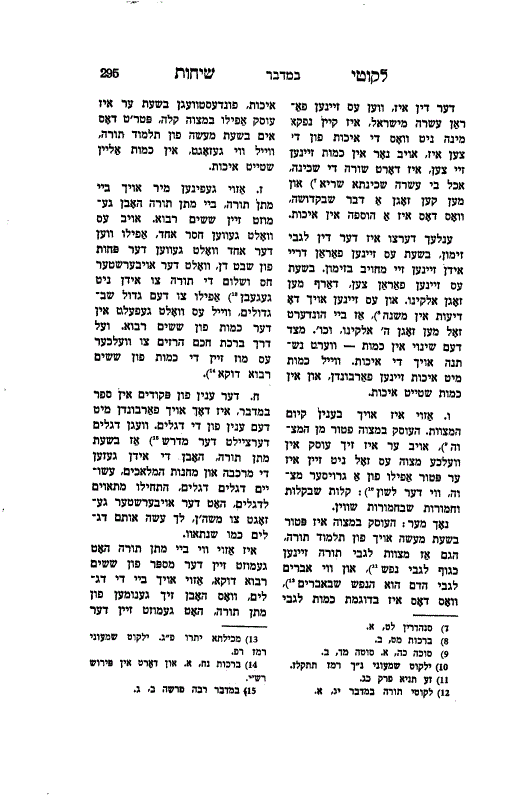
The Rebbe brings examples where quantity impacts quality. For instance, when there are ten Jews, regardless of their individual spiritual level, the Shechinah—Divine Presence—rests among them, and matters of holiness can be performed. Even if there are nine Moshe Rabbeinus, without a tenth Jew, the Shechinah does not rest. The number ten itself brings about a new quality. Similarly, in the mitzvah of zimun—inviting others to recite Grace after Meals together—three Jews are required, and with ten, there is an added level of sanctity. Each increase in number brings a new level of blessing and Divine presence, demonstrating that quantity itself creates quality.
The Rebbe further illustrates this with the laws of mitzvah observance. If a person is occupied with one mitzvah, even a seemingly lesser one, he is exempt from performing another, even greater mitzvah. This shows that the act of doing a mitzvah—the quantity—can override considerations of quality. Even when comparing mitzvos to Torah study, which is qualitatively superior, being engaged in a mitzvah exempts one from Torah study. The quantity of mitzvah performance itself carries a unique quality.
This principle is also seen at Matan Torah—the giving of the Torah. There had to be 600,000 Jews present; even if one was missing, even the simplest from the tribe of Dan, Hashem would not have given the Torah. The quality of the individuals was not enough; the quantity was essential. The same applies to the special blessing for Hashem, which is only recited in the presence of 600,000 Jews. The number itself brings about a new reality.
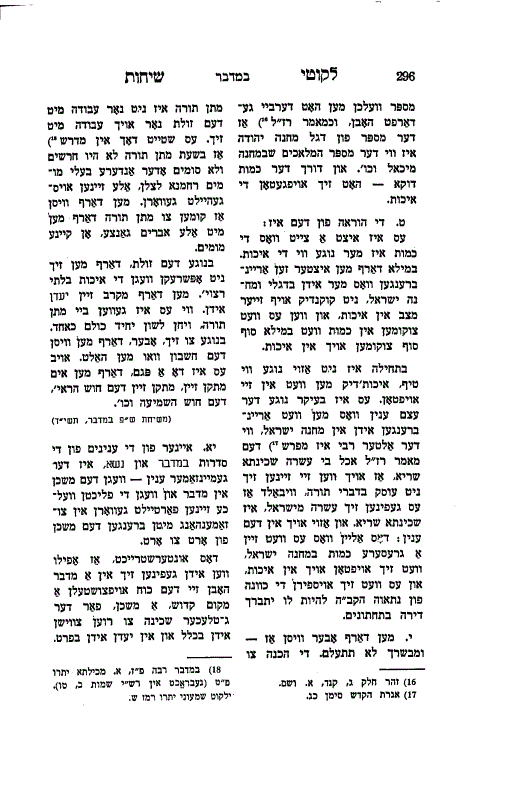
The Rebbe connects this to the journeys of the Jewish people in the desert, where the numbers recorded in Bamidbar are also linked to the arrangement of the degalim—flags or camps. When the Torah was given, the Jews saw the camps of angels and desired similar arrangements. Hashem granted them the degalim, and the necessary numbers were required for this as well. The numbers in Bamidbar correspond to the numbers of angels in the camps of Michael and others, continuing the theme from Matan Torah. Thus, the quantity of Jews was essential not only at Matan Torah but throughout their journeys, as the numbers themselves brought about the desired quality.
The practical lesson is that, in our time, quantity is more important than quality. We must strive to bring as many Jews as possible into the camp of Israel, regardless of their spiritual level. By increasing quantity, we will ultimately enhance quality as well. As the Alter Rebbe explains, when ten Jews are together, the Divine Presence rests among them, even if they are not engaged in Torah study. The same applies to increasing the numbers in the Jewish camp; greater quantity leads to greater quality and fulfills Hashem’s desire for a dwelling in this world.
However, the Rebbe adds an important caveat: while we must focus on quantity when it comes to others, each person must ensure that their own quality is intact. One cannot neglect their own spiritual state. The preparation for Matan Torah requires that each individual be whole and without blemish, as was the case when the Torah was given—no one was deaf, blind, or blemished. Each person must ensure they are spiritually ready, fixing any deficiencies in their abilities, such as sight or hearing. For oneself, quality is essential; for others, we focus on bringing them in, regardless of their current level, just as all Jews stood together at Matan Torah as one.
This is the message of the sicha for Parshas Bamidbar, delivered by the Rebbe in the year Tov Shin Yud Daled—5714.