Likkutei Sichos Vol. 2 – Bamidbar 3
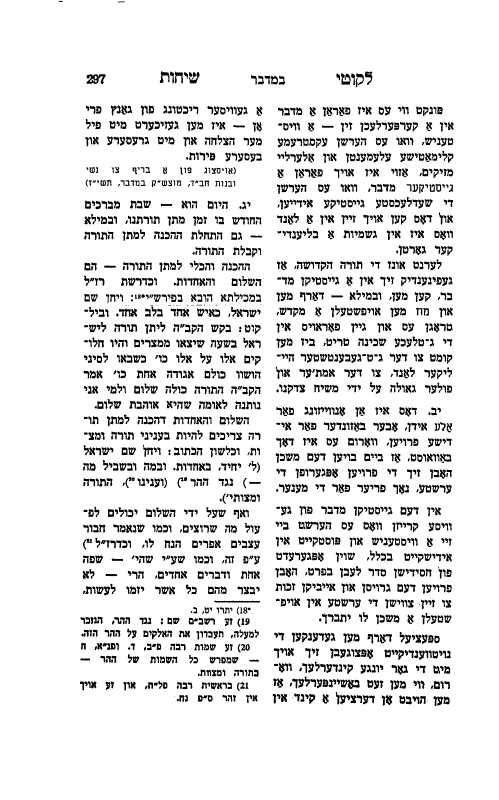
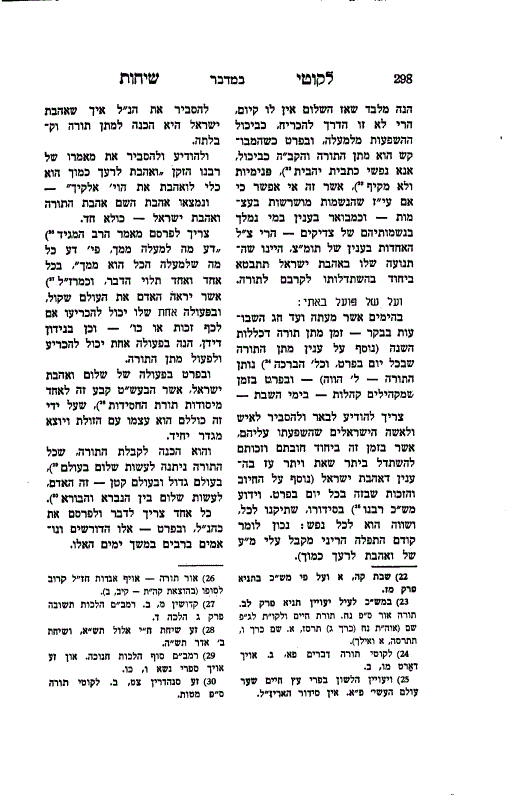
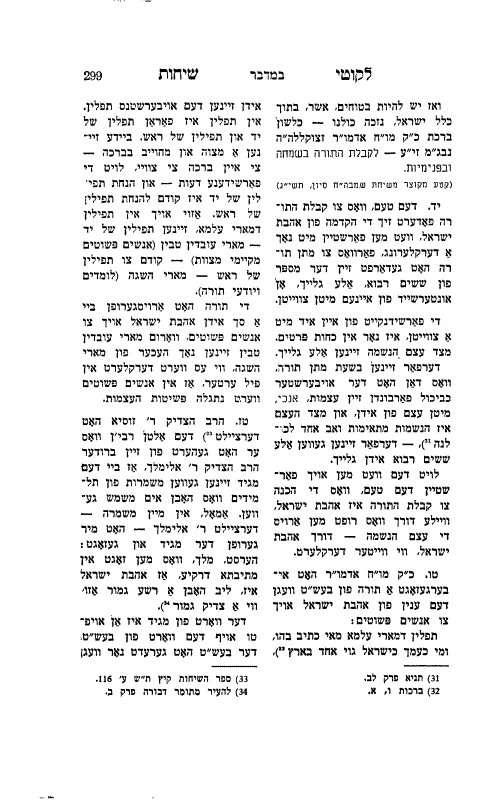
This is the third sicha in Likkutei Sichos Chelek Beis for Parshas Bamidbar, specifically Os Yud Gimel. In this sicha, the Rebbe calls upon everyone to prepare themselves for the upcoming holiday of Shavuos by practicing Jewish unity and ahavas Yisrael—love of a fellow Jew—in connection with Torah and mitzvos. The Rebbe emphasizes that encouraging others to become involved in Torah is a true sign of unity, and that this is the proper way to prepare for receiving the Torah: through unity and by bringing everyone into Torah.
The Rebbe notes that the sicha was delivered on Shabbos Mevorkhim in the month of zman matan Toraseinu—the time of the giving of the Torah, Shavuos. Since it was already the Shabbos that blesses the month of Sivan, it marks the beginning of the preparation for matan Torah—the giving of the Torah—and kabbalas haTorah—the receiving of the Torah. The Rebbe therefore encourages everyone to prepare for this occasion, for zman matan Toraseinu, through the proper vessels: peace and unity.
As our teachers of blessed memory expound in the Mechilta, and as Rashi brings in Chumash, Parshas Yisro, the Torah writes “vayichan sham Yisrael”—the Jewish people camped there—in the singular form. The Mechilta and Rashi explain that this means “ki ish echad, b’lev echad”—as one person with one heart. This was the level of unity that the Jewish people achieved as they camped before Mount Sinai in preparation for matan Torah at the beginning of the month of Sivan.
The Rebbe also quotes the Yalkut, which states that when Hashem sought to give the Torah to the Jewish people as they left Egypt, they were divided and fragmented. Only when they arrived at Sinai and became united as one group did Hashem say, “The Torah is all peace. To whom shall I give it? To the nation that loves peace.” Thus, the preparation and the reason for receiving the Torah, as explained in the Yalkut, is the love of peace and unity.
However, the Rebbe stipulates that shalom—peace—and achdus—unity—as preparation for matan Torah must be specifically in matters of Torah and mitzvos. It is not sufficient to have peace and unity in general; it must be unity in Torah matters. This is also reflected in the wording of the verse: “vayichan sham Yisrael… neged ha’har”—they camped there opposite the mountain—meaning in matters of Torah and mitzvos.
The Rebbe cites the Rashbam, who explains that neged ha’har refers to serving Hashem on the mountain where the Torah would be given. In footnote 20, the Rebbe references Shemos Rabbah, which explains how all the names of the mountains relate to Torah and mitzvos. Thus, the unity described here is not merely general unity, but unity in Torah matters.
The Rebbe continues that unity can accomplish many things, even outside of Torah. However, the unity required here is specifically unity through Torah. Although peace can sometimes bring about desired results—as seen regarding “atzabim Efraim”, the worshippers of idols, whose unity sustained them, or in the generation of the Tower of Babel, whose unity enabled them to achieve much—such unity is not lasting if it is not connected to Torah.
Furthermore, such unity is not the way to elicit a Divine flow from Above, especially when what is sought is the giving of the Torah, which is essentially seeking Hashem Himself, since Hashem placed Himself in the Torah (“anon nafshi ksovis yehovis”—“I Myself wrote Myself into the Torah,” as the Gemara in Shabbos states).
Therefore, the unity that is required must be unity in Torah and mitzvos, which is the true preparation for Torah. The Rebbe explains that the expression of ahavas Yisrael—love of a fellow Jew—should specifically be through efforts to bring others closer to Torah. It is not sufficient merely to be kind or peaceful; the goal is to create unity through Torah.
Practically, the Rebbe calls upon everyone that from now until the festival of Shavuos—which is the time of the general giving of the Torah for the year—and especially during gatherings such as Hakhel and on Shabbos, they should publicize and explain to both men and women under their influence that their obligation and privilege at this time is to increase their efforts in ahavas Yisrael. This is in addition to the constant, daily obligation of loving a fellow Jew.
The Rebbe references what the Alter Rebbe writes in the Siddur: that it is proper for everyone to say before davening, “I accept upon myself the mitzvah of ve’ahavta l’reiacha kamocha”—to love your fellow as yourself. The Rebbe instructs that one should explain how ahavas Yisrael is a preparation for the giving and receiving of the Torah, and to publicize the teaching of the Alter Rebbe that ve’ahavta l’reiacha kamocha is a vessel for ve’ahavta es Hashem Elokecha—loving Hashem your G‑d.
Through loving a fellow Jew, one comes to love Hashem. Thus, love of Hashem, love of Torah, and love of a fellow Jew are all one.
The Rebbe further instructs to publicize the teaching of the Maggid: “da mah l’maalah mimcha”—know what is above you. The Maggid explains that everything that occurs Above is dependent upon you; everything depends on each individual. As our sages teach in Kiddushin, a person should view the world as perfectly balanced, and with one action, he can tip the scale toward merit—or, G‑d forbid, the opposite.
In our context, one action can influence and tip the scale regarding the giving of the Torah—especially an act that fosters peace and ahavas Yisrael.
The Baal Shem Tov established that this is one of the fundamental principles of Chassidus: through this, a person includes himself with others and leaves the state of being an isolated individual, becoming part of a unified whole. This is the preparation for receiving the Torah, which was given to bring peace into the world—both in the larger world and within each individual—creating harmony between the creation and the Creator.
Each person must speak about and publicize all of the above, especially those who deliver public lectures and sermons during these days. Then we can be assured that all Jews will merit—as the Rebbe’s father-in-law would bless—to receive the Torah with joy and in an inward, internalized manner.
This is a condensed version of the sicha delivered on Shabbos Mevorkhim Sivan, in the year Tov Shin Yud Gimel.