
לקוטי שיחות חלק ל״ג – במדבר ב׳
Likkutei Sichos, Vol. 33 – Bamidbar II
סעיף א׳
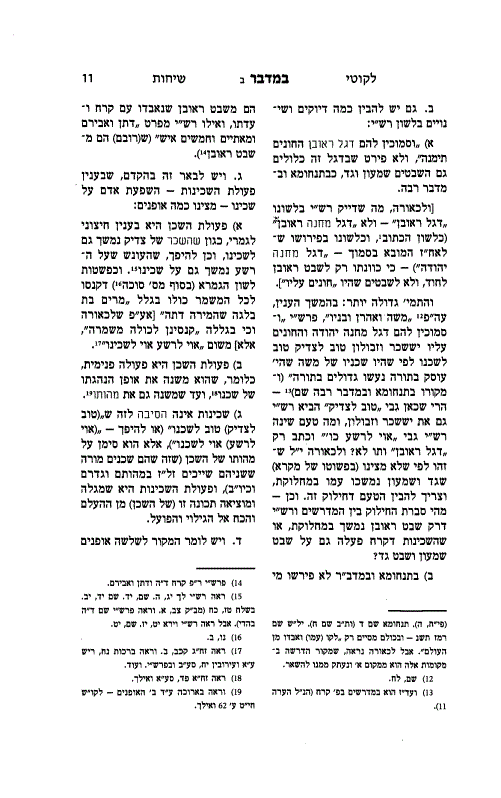
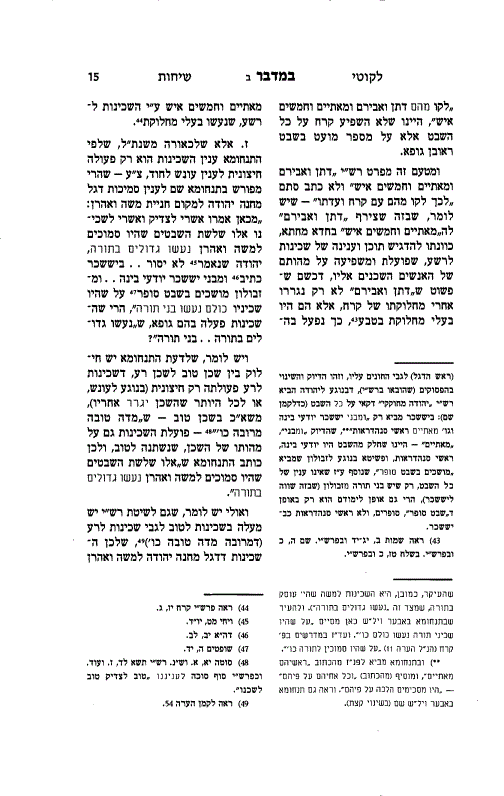
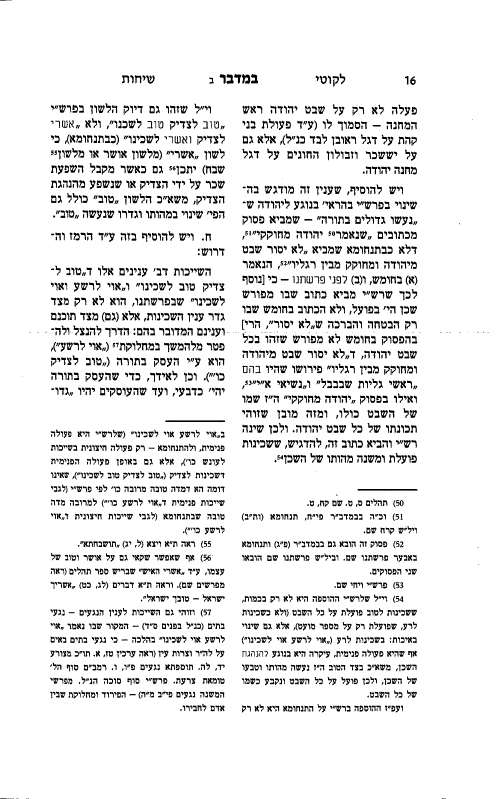
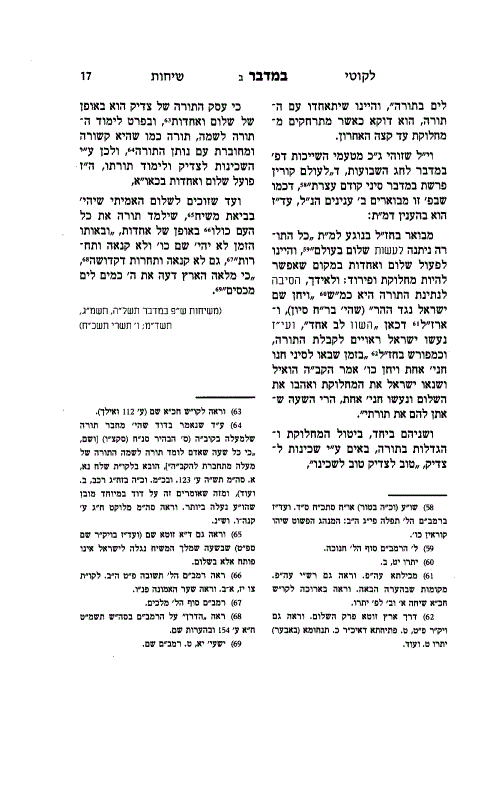
We will review a sicha in Likkutei Sichos, Chelek Lamed-Gimmel (Volume 33). This is the second sicha on Parshas Bamidbar, and it is also a Rashi sicha.
In this sicha, the Rebbe discusses the well-known teaching brought by Rashi:
“אוי לרשע ואוי לשכנו, טוב לצדיק וטוב לשכנו.”
Woe to the wicked and woe to his neighbor; good for the righteous and good for his neighbor.
This concept is derived from the arrangement of the encampments of the Jewish people in this week’s parsha.
The Rebbe analyzes how this idea is presented in the Medrash Tanchuma, Bamidbar Rabbah, and Rashi, highlighting the precise differences between them. Through this, the Rebbe will explain that the influence of one’s neighbor can manifest in three distinct ways:
- The neighbor may be affected in terms of punishment—that the consequences that befall one person extend to those around him.
- The neighbor may be actively influenced, becoming good or bad through association.
- The neighbor is not truly influenced at all; rather, his own nature is revealed through the proximity—his behavior emerges, but is not caused by the other.
These three approaches will be developed step by step, drawing from the parsha and related sources.
The Rebbe begins with the arrangement of the encampments:
“דגל מחנה ראובן” — the proximity of the banner of the camp of Reuven.
As is known, the Jewish people were divided into groups, each consisting of three tribes under one flag. The camp of Reuven included two additional tribes, forming דגל מחנה ראובן.
Regarding their position, the Torah states:
“יחנו תימנה… על ירך המשכן תימנה” —
they camped on the southern side of the Mishkan.
The Levites surrounded the Mishkan, and within them, בני קהת were positioned on the southern side. Beyond them, forming the outer circle, was the camp of Reuven, also on the southern side.
Chazal teach, and Rashi brings this on the spot:
“אוי לרשע ואוי לשכנו” —
Woe to the wicked and woe to his neighbor.
Korach, who initiated the rebellion against Moshe and Aharon, came from בני קהת. Since the camp of Reuven was positioned nearby, they were drawn into the same conflict.
Indeed, the Torah records that those who joined Korach included:
- דתן ואבירם
- און בן פלת
- and the group of 250 men
All of these came from the tribe of Reuven.
Thus, we see clearly:
Woe to the wicked—Korach—and woe to his neighbor—the tribe of Reuven.
The Rebbe now asks:
What exactly does this statement mean?
What is the nature of the influence of a “rasha” upon his neighbor?
The Rebbe explains that there are three interpretations of this teaching as it applies to our case:
We find these interpretations in:
- Medrash Tanchuma
- Bamidbar Rabbah
- Rashi
The View of Medrash Tanchuma
The Tanchuma explains that the neighboring tribes were punished together with Korach.
It describes that on the southern side were:
- בני קהת (including Korach),
- and next to them: ראובן, שמעון, וגד
From here Chazal derive:
“אוי לרשע ואוי לשכנו”
These three tribes, being neighbors to Korach, were destroyed together with him in his dispute.
As the verse states:
“ותפתח הארץ את פיה ותבלע אותם… ואת כל האדם אשר לקרח ואת כל הרכוש”
The earth opened its mouth and swallowed them and all that belonged to them.
According to this, the meaning is:
The punishment of the wicked spreads to his neighbor.
The View of Bamidbar Rabbah
Bamidbar Rabbah adds a further dimension.
It explains that these neighboring tribes did not merely suffer punishment—they became “בעלי מחלוקת” themselves.
Because they were close to Korach, they too became people of conflict.
Even though the verse explicitly mentions only the בני ראובן, the Midrash extends this to include also שמעון and גד, stating that they too became participants in the dispute.
The View of Rashi
Rashi, however, presents the matter with precise nuance.
On the verse:
“משפחות בני קהת יחנו תימנה”
Rashi writes:
“וסמוכים להם דגל ראובן החונים תימנה”
Notably, Rashi does not say “דגל מחנה ראובן” (which would include שמעון and גד), but specifically דגל ראובן.
Rashi then states:
“אוי לרשע ואוי לשכנו”,
and explains:
From them came:
- דתן ואבירם
- און בן פלת
- and the 250 men
who were punished together with Korach,
“שנמשכו עמהם במחלוקתם” —
they were drawn into the dispute.
Here, Rashi introduces a crucial point:
The neighbor is not merely punished.
Rather, the wicked person draws his neighbor into the wrongdoing itself.
Three Distinct Levels
The Rebbe now highlights the precise distinctions:
- Tanchuma: The neighbor is punished together with the wicked.
- Rashi: The neighbor is drawn into the wrongdoing.
- Bamidbar Rabbah: The neighbor becomes independently a בעל מחלוקת.
These represent three different levels of influence:
- External effect — punishment spreads
- Influence — one is drawn into wrongdoing
- Revelation — one’s own inner state emerges
The Rebbe notes that Rashi omits the verse brought in the Tanchuma regarding the punishment:
“ותפתח הארץ את פיה”
because Rashi’s focus is not on punishment, but on the process of being drawn into the dispute.
Finally, the Rebbe emphasizes a key point:
According to Rashi, this concept applies specifically to Reuven, not to שמעון and גד.
This is because, in the simple reading of the verses, only בני ראובן are explicitly described as participating in the rebellion.
The Rebbe will now proceed to analyze this point in detail—why Rashi limits it specifically to Reuven, and how this fits with the precise wording of the פסוקים.
סעיף ב׳
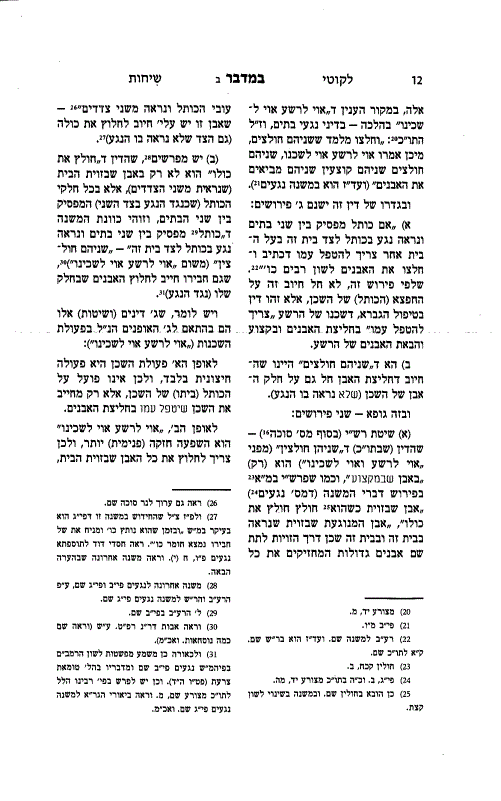
We must now understand several precise details and changes in Rashi’s language in this commentary.
First Question (א׳)
Rashi writes:
“וסמוכים להם דגל ראובן החונים תימנה” —
those who were near them were the banner of Reuven, who camped to the south.
However, Rashi does not explain that within this banner are also included the tribes of Shimon and Gad, as is explicitly stated in the Tanchuma and Bamidbar Rabbah.
Why does Rashi mention only Reuven?
At first glance, one might suggest that Shimon and Gad are implicitly included in the phrase “דגל ראובן”.
However, the Rebbe rejects this.
Rashi is extremely precise in his wording. He writes “דגל ראובן”, and does not say “דגל מחנה ראובן”, which is the language used in the Torah itself.
Moreover, elsewhere in his commentary, Rashi does use the fuller expression—for example, when discussing the camp of Yehudah, he writes:
“דגל מחנה יהודה”
which clearly includes all the tribes encamped under that banner.
Thus, here too, had Rashi intended to include Shimon and Gad, he would have written “דגל מחנה ראובן”.
Since he did not, it is clear that his intention is specifically the tribe of Reuven alone, and not the other tribes that camped with them.
This raises a strong question:
Why, in the case of a negative influence—“אוי לרשע ואוי לשכנו”—does Rashi limit the effect to Reuven alone, while in the case of a positive influence—“טוב לצדיק וטוב לשכנו”—Rashi includes all the neighboring tribes?
Indeed, later in the parsha, regarding Moshe and Aharon, the Torah states:
“משה ואהרן ובניו”
and Rashi explains:
“וסמוכים להם דגל מחנה יהודה”
Those who camped near Moshe and Aharon were the entire camp of Yehudah, including Yissachar and Zevulun.
Rashi then says:
“טוב לצדיק, טוב לשכנו” —
Good for the righteous and good for his neighbor.
Because they were near Moshe, who was engaged in Torah, they too became great in Torah.
Notably, Rashi’s source there is the same as here—Tanchuma and Bamidbar Rabbah.
And there, Rashi follows the Midrash fully, including all three tribes.
Yet here, in the case of “אוי לרשע”, Rashi departs from the Midrash and mentions only Reuven.
Why does Rashi make this distinction?
One might suggest that the reason is that, in the simple reading of the verses (פשוטו של מקרא), we only find that members of the tribe of Reuven actually participated in Korach’s rebellion.
We do not find any explicit involvement of Shimon or Gad.
However, this itself requires explanation:
Why indeed were Shimon and Gad not drawn into the dispute?
And more broadly:
What is the conceptual difference between the various approaches?
- According to Tanchuma, the neighbors are punished.
- According to Bamidbar Rabbah, they become participants in the conflict.
- According to Rashi, only Reuven is drawn in.
What underlies these differences?
Second Question (ב׳)
There is another difference:
In Tanchuma and Bamidbar Rabbah, it is stated generally that the neighboring tribes were affected, but they do not specify which individuals from the tribe of Reuven were involved.
However, Rashi explicitly identifies them:
- דתן ואבירם
- and the 250 men, most of whom were from the tribe of Reuven
Why does Rashi provide these details, while the Midrashim do not?
This suggests an important distinction:
According to Rashi, these individuals were not merely influenced by proximity—they were already people of dispute, and their involvement reveals something intrinsic about them.
Thus, we now have two major points that require explanation:
- Why does Rashi limit the influence to Reuven alone, unlike the Midrashim?
- Why does Rashi specify the individuals involved, while the Midrashim speak in general terms?
These questions will lead us to the Rebbe’s deeper explanation in the next section.
סעיף ג׳
The Rebbe now begins to clarify the matter by first defining the different ways in which a neighbor can influence another.
In the concept of השפעת אדם על שכנו—how one person affects his neighbor—we find several distinct modes.
First Mode — External Influence (השפעה חיצונית)
The influence of the neighbor can be entirely external.
That is, the neighbor does not affect the inner character of the person at all. Rather, what happens to one extends to the other in an external way.
For example:
The reward of a tzaddik can extend to his neighbor, or conversely, the punishment of a wicked person can extend to his neighbor.
The Rebbe brings an example from the Gemara (end of מסכת סוכה):
There was a daughter of a Kohen, Miriam bas Bilgah, who acted in a disrespectful and disgraceful manner toward the Mizbeach. She converted to another religion. As a result, Chazal imposed a punishment—not only on her, but on the entire mishmar (the group of Kohanim serving that week).
The Gemara asks:
Why should the entire mishmar be punished because of one individual?
And answers:
“אוי לרשע ואוי לשכנו” —
Woe to the wicked, and woe to his neighbor.
This demonstrates that the punishment of the wicked can extend to those around him, even if they themselves are not guilty.
This is an external effect—it does not mean that the neighbors became worse people, or that they were influenced internally. Rather, they were simply included in the consequences.
Second Mode — Internal Influence (השפעה פנימית)
The second possibility is that the neighbor has a deep, internal impact.
That is, he influences the conduct of his neighbor.
He may cause the neighbor to adopt his behavior—to act in a negative way.
Furthermore, this influence can reach even deeper:
It can alter the very nature of the person, transforming him into someone different.
Thus, the neighbor does not merely share in consequences—he is changed from within.
Third Mode — Revelation, Not Influence
The third possibility is fundamentally different.
Here, the neighbor is not the cause of the behavior at all.
The concept of:
“טוב לצדיק טוב לשכנו”
or
“אוי לרשע אוי לשכנו”
does not mean that the tzaddik makes his neighbor good, or the rasha makes his neighbor bad.
Rather, it is a sign of who the person already is.
If a person is found in the proximity of a tzaddik, it indicates that he belongs in that environment.
If he is found near a rasha, it indicates a connection in their essence.
The fact that they are neighbors shows that they are inherently related in their character and identity.
In this model:
The neighbor does not create the behavior.
Instead, the proximity reveals what was already present.
The effect of being neighbors is that it brings out this inner quality:
From a hidden, potential state
מן ההעלם והכח
into a revealed and active state
אל הגילוי והפועל.
Thus, the person already possesses certain tendencies.
However, being in that environment allows those tendencies to emerge into action.
Summary of the Three Modes
We now have three distinct types of influence:
- External effect — reward or punishment extends to the neighbor
- Internal influence — one person changes the behavior and even nature of the other
- Revelation — the neighbor does not cause the behavior, but reveals what already exists
The Rebbe will now explain that these three models correspond to the three approaches found in:
- Tanchuma
- Bamidbar Rabbah
- Rashi
This will be developed in the next section.
סעיף ד׳
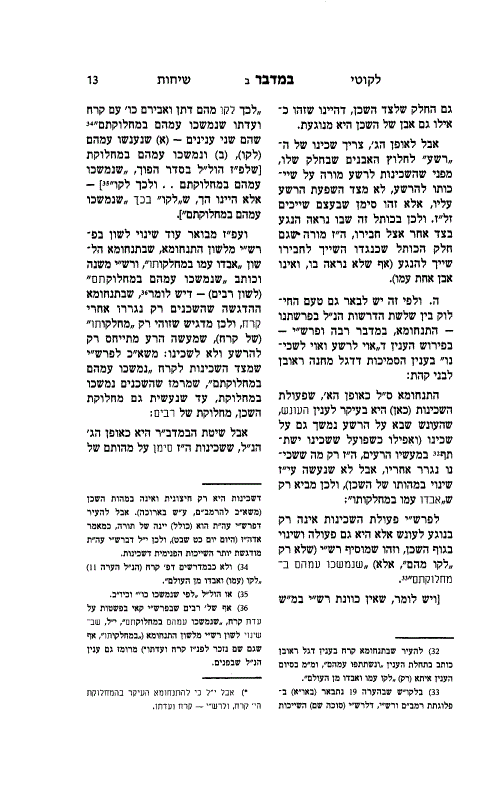
The Rebbe now explains that the source for these three types of influence can be found in Halachah—in the laws of נגעי בתים (plagues that appear on a house).
Specifically, this concept is derived from the verse that teaches:
“אוי לרשע ואוי לשכנו”
in the context of a shared wall between two houses.
The תורת כהנים explains the verse:
“וחילצו” — “and they shall remove [the stones]” (in plural form)
teaching that both parties—both homeowners—must participate in removing the affected stones.
From here Chazal derive:
“אוי לרשע ואוי לשכנו” —
Woe to the wicked, and woe to his neighbor.
The Toras Kohanim continues:
“שניהם חולצים, שניהם קוצעים, שניהם מביאים את האבנים” —
Both must remove, both must dismantle, and both must bring the replacement stones.
Even though the plague appears only on one side, the neighbor must also participate fully in the process.
This same concept is also found in the Mishnah in מסכת נגעים.
Three Interpretations of This Halachah
The Rebbe explains that there are three ways to understand this דין, corresponding to the three modes of influence described earlier.
First Interpretation — Obligation on the Person (גברא)
According to the first explanation (as brought by the ברטנורא):
We are dealing with a wall shared between two houses, and the plague appears only on one side.
The neighbor is obligated to assist—not because his portion of the wall is affected, but because the Torah imposes a responsibility upon him.
The verse uses plural language—“וחילצו”—indicating that both must act.
However, this obligation applies only to the person (גברא), not to the object (חפצא).
In other words:
- The neighbor’s wall is not considered affected
- The neighbor is simply required to assist in removing and rebuilding
This reflects a purely external effect—the neighbor is involved, but not intrinsically impacted.
Second Interpretation — The Wall Itself Is Affected
According to a second approach, the obligation extends beyond the person.
Here, the דין is that the removal applies also to the portion of the stone belonging to the neighbor—even if the plague is not visible there.
In this understanding, the neighbor’s side is considered to be affected as well.
Within this approach, there are two sub-interpretations:
(a) Rashi’s Interpretation
Rashi explains (in the end of מסכת סוכה) that this דין applies specifically to a cornerstone:
A large stone placed at the corner of the house, which is visible from both sides and supports the entire thickness of the wall.
If a plague appears on one side of such a stone, the entire stone must be removed—even the side where the plague is not visible.
Thus:
- The stone is considered one unit
- The plague on one side affects the entire stone
(b) A Broader Interpretation
Other commentators (such as the משנה אחרונה) explain more broadly:
Even if the stone is not a shared cornerstone, any portion of the wall opposite the plague must also be removed—even if the plague is visible only on one side.
That is:
The influence of the plague extends to the corresponding section on the other side, even if it is a separate stone.
Connection to the Three Types of Influence
The Rebbe now explains that these three halachic interpretations correspond precisely to the three models of neighborly influence discussed earlier:
1. External Influence
According to the first interpretation:
The effect is purely external.
The neighbor is not intrinsically affected—he is simply obligated to assist.
This parallels the idea that:
The consequences of the wicked extend outward, without changing the essence of the neighbor.
2. Internal Influence
According to the second interpretation (Rashi):
There is an internal impact.
Since the stone is shared, the plague affects both sides.
This reflects a deeper influence—the neighbor is affected because of a real connection.
3. Essential Connection (Revelation)
According to the third interpretation:
The neighbor’s involvement is not due to external or even internal influence.
Rather, it reveals that the neighbor is inherently connected to the situation.
The fact that the plague appears on one side indicates that the other side is also, in essence, related—even if the plague is not visibly present there.
Thus:
- The neighbor is not affected because of influence
- Rather, the situation reveals an essential connection
Summary
These three halachic interpretations align perfectly with the three types of neighborly influence:
- External effect — obligation without intrinsic change
- Internal influence — shared impact
- Essential connection — revelation of what already exists
This framework now enables the Rebbe to explain the differences between:
- Tanchuma
- Bamidbar Rabbah
- Rashi
which will be clarified in the next section.
סעיף ה׳
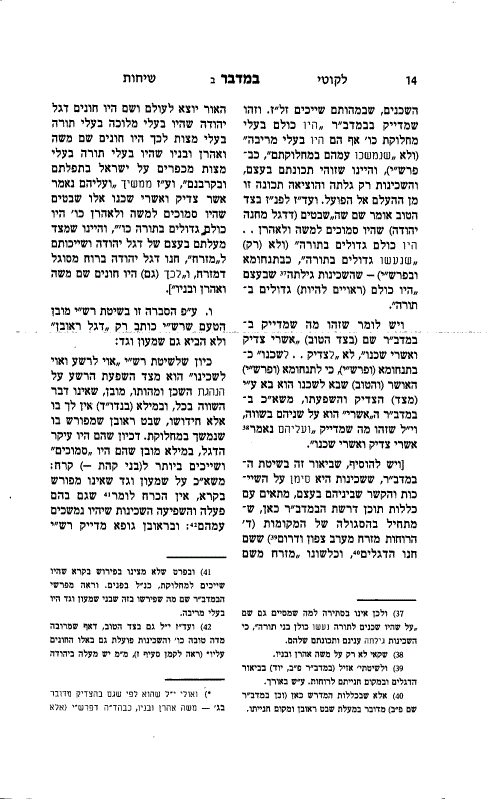
Now that the Rebbe has established the three possible modes of influence—and shown how they are rooted in Halachah, in the Toras Kohanim and the Mishnah in Negaim—he now explains how these correspond to the differences between:
- Tanchuma
- Bamidbar Rabbah
- Rashi
in their explanation of:
“אוי לרשע ואוי לשכנו”
in the context of the proximity of דגל מחנה ראובן to בני קהת.
The Approach of Tanchuma
The Tanchuma follows the first model—the external effect.
According to this approach, the primary impact of a wicked neighbor is in the realm of punishment.
That is:
The punishment that befalls the rasha extends also to his neighbor.
Even if the neighbor becomes involved in the wrongdoing, this does not represent a true internal change.
The neighbor is merely drawn along, but his essence is not transformed.
He does not become a rasha in his own right.
Therefore, the Tanchuma emphasizes:
They were destroyed with Korach in his dispute.
The wrongdoing is still attributed primarily to Korach—it is his machlokes, not theirs.
The Approach of Rashi
Rashi, however, follows the second model—the internal influence.
Here, the neighbor does not merely share in punishment.
Rather, the rasha influences and transforms his neighbor.
This is reflected in Rashi’s wording:
They were not only punished, but:
“נמשכו עמהם במחלוקתם” —
they were drawn into the dispute.
The Rebbe emphasizes an important nuance:
Rashi is not describing two separate events—first that they were punished, and then that they were drawn in.
If that were the case, the order would have been reversed:
First they were drawn in, and then punished.
Rather, the meaning is:
Their punishment was that they were drawn into the dispute.
This itself is the consequence of:
“אוי לרשע ואוי לשכנו”
Thus, according to Rashi:
The influence of the rasha creates a real internal change.
The neighbors become participants in the dispute.
This is further reflected in a subtle difference in wording:
- Tanchuma says:
“במחלוקתו” — his dispute - Rashi says:
“במחלוקתם” — their dispute
According to Tanchuma:
The dispute remains Korach’s; the neighbors are only pulled along externally.
According to Rashi:
It becomes their dispute.
The neighbors are transformed—they become part of the machlokes itself.
The Approach of Bamidbar Rabbah
Bamidbar Rabbah follows the third model—the idea of revelation, not influence.
According to this approach:
The neighbor does not influence or change the other at all.
Rather, the proximity reveals what was already inherent.
This is expressed in the Midrash’s statement:
“היו כולם בעלי מחלוקת” —
they were all people of dispute.
Not that they became בעלי מחלוקת,
but that they already were.
The proximity to Korach merely revealed this trait:
It brought their inner nature from potential to actuality.
Thus:
- It is not that Korach made them into such people
- Rather, their placement near him reflects their own nature
Parallel on the Positive Side
This same principle appears in the positive case.
When Bamidbar Rabbah discusses the tribes near Moshe and Aharon, it states:
They were already great in Torah.
This contrasts with Tanchuma and Rashi, where it is understood that they became great in Torah through their proximity.
According to Bamidbar Rabbah:
There is no influence.
Their greatness already existed; the proximity simply revealed it.
This is also reflected in the precise wording:
“אשרי צדיק ואשרי שכנו”
Not:
“טוב לצדיק טוב לשכנו”
The absence of the word “ל” indicates:
It is not that goodness flows from the tzaddik to the neighbor.
Rather, both are inherently on that level.
Thus:
- The tzaddik is fortunate
- The neighbor is fortunate
because both already possess this quality.
Similarly, the Midrash says:
“ועליהם נאמר” —
upon them it was said
indicating that the statement applies equally to both.
Connection to the General Theme of Bamidbar Rabbah
The Rebbe adds that this interpretation aligns with the broader theme of Bamidbar Rabbah in this section.
There, the Midrash explains the significance of the four directions—east, west, north, and south—and their spiritual qualities.
For example:
The east is associated with light, as the sun rises there.
Accordingly:
- The camp of Yehudah was positioned in the east
- From Yehudah came kingship—David and Moshiach
- Yissachar and Zevulun were masters of Torah and Mitzvos.
Moshe and Aharon were also situated there, as they represent Torah and spiritual leadership.
Thus, the arrangement reflects inherent qualities:
Each group is positioned according to its intrinsic nature.
Therefore, when Bamidbar Rabbah says:
“אשרי צדיק ואשרי שכנו”
it is not describing an influence, but a revelation of what already exists.
The neighbor is in that place because he belongs there.
The proximity does not create the quality—it reveals it.
Conclusion of This Section
We now clearly see the three approaches:
- Tanchuma — external effect (punishment)
- Rashi — internal influence (transformation)
- Bamidbar Rabbah — revelation of inherent nature
These distinctions explain all the differences in their language and approach.
סעיף ו׳
Based on all the above, we can now clearly understand Rashi’s precise wording.
Since, according to Rashi, the concept of:
“אוי לרשע ואוי לשכנו”
is not merely about punishment, but about the influence of the wicked on the conduct of his neighbor, transforming him and affecting his very essence—this explains why Rashi limits the case specifically.
Rashi therefore writes only:
“דגל ראובן”
and does not include Shimon and Gad.
This is because, according to Rashi, the effect of a wicked neighbor is not something that applies equally to all those in proximity.
Rather, it depends on actual influence—who was truly affected and drawn in.
From the simple reading of the פסוקים, we only find that those who were influenced and drawn into Korach’s dispute were from בני ראובן.
There is no explicit indication that Shimon and Gad were affected in this way.
Therefore, Rashi—whose approach is always פשוטו של מקרא—mentions only those for whom there is clear textual evidence.
In contrast:
- According to Tanchuma, where the concept is primarily about punishment spreading externally, it can apply broadly to all neighboring tribes.
- According to Bamidbar Rabbah, where proximity is merely a sign of inherent character, it can also include all those positioned in that area.
However, according to Rashi:
Since the focus is on actual influence and transformation, we can only include those whom the Torah explicitly identifies as having been affected.
Thus, only Reuven is mentioned.
Furthermore, even within the tribe of Reuven, Rashi is precise.
He does not say that the entire tribe was affected.
Rather, he specifies:
- דתן ואבירם
- and the 250 men
This shows that the influence was not universal, even within the tribe itself.
Only those individuals who were actually drawn into the dispute are mentioned.
Why Does Rashi Specify These Individuals?
Rashi does not simply write that they were punished together with Korach.
Instead, he explicitly names:
דתן ואבירם והחמשים ומאתים איש
The Rebbe explains:
This is to emphasize the nature of the influence.
דתן ואבירם are known in the Torah as “בעלי מחלוקת”—people whose nature is bound up with dispute
Their behavior reflects an intrinsic tendency.
By mentioning them together with the 250 men, Rashi is teaching:
That the 250 were not merely dragged along externally.
Rather, through their proximity to Korach, they were influenced to the point that they became like דתן ואבירם.
They did not simply participate.
They were transformed into people of dispute.
This reflects Rashi’s precise wording:
“נמשכו עמהם” —
they were drawn in
—not merely dragged, but drawn in a way that reflects an internal pull and transformation.
Thus, the influence of the wicked neighbor caused a change in their essence.
Conclusion of This Section
We now understand:
- Why Rashi limits the case to Reuven alone
- Why he specifies דתן ואבירם וה־250 איש
- And how this reflects his fundamental view:
That “אוי לרשע ואוי לשכנו” means
a real, internal influence that transforms the neighbor.
This completes the explanation of Rashi’s approach in contrast to Tanchuma and Bamidbar Rabbah.
סעיף ז׳
The Rebbe now revisits and refines the earlier explanation regarding the view of the Tanchuma.
Previously, it was explained that according to Tanchuma, the concept of:
“אוי לרשע ואוי לשכנו”
reflects only an external influence, primarily in the realm of punishment.
However, the Rebbe now challenges this understanding.
A Difficulty in Tanchuma
At first glance, this explanation seems difficult.
For in the very same Tanchuma, when discussing the positive counterpart:
“טוב לצדיק וטוב לשכנו”
it states explicitly that the neighboring tribes were actively affected.
The Tanchuma says regarding the proximity of דגל מחנה יהודה to Moshe and Aharon:
“אשרי לצדיק ואשרי לשכנו”
And it continues:
These three tribes—יהודה, יששכר, וזבולון—who were close to Moshe and Aharon,
“נעשו גדולים בתורה” —
they became great in Torah.
It even brings פסוקים to demonstrate this:
- יהודה — “לא יסור שבט מיהודה”
- יששכר — “יודעי בינה לעיתים”
- זבולון — “מושכים בשבט סופר”
And the Tanchuma concludes:
Because they were neighbors of Moshe and Aharon,
“נעשו בני תורה” — they became תלמידי חכמים.
This clearly shows:
That in the positive case, Tanchuma holds that the neighbor does affect and transform the other.
A New Distinction
The Rebbe therefore explains:
There is a fundamental difference between a good neighbor and a bad neighbor.
Influence of a Bad Neighbor
When it comes to a rasha:
The influence is primarily external.
- It may lead to punishment
- Or at most, cause the neighbor to be drawn along
However, it does not transform the essence of the person.
The neighbor may follow, but he does not fundamentally change.
Influence of a Good Neighbor
However, when it comes to a tzaddik:
The influence is much deeper.
This is based on the principle:
“מידה טובה מרובה ממידת פורענות” —
The measure of good is greater than the measure of punishment.
Therefore, the effect of a good neighbor is not merely external.
Rather:
“פועלת השכנות גם על מהותו של השכן” —
the proximity affects the very essence of the neighbor.
This explains why the Tanchuma states:
“נעשו גדולים בתורה”
They did not merely receive influence—they were transformed.
They became entirely different people.
Application to Rashi
The Rebbe now adds:
Even according to Rashi, who holds that both good and bad neighbors have an influence, there is still a distinction.
A good neighbor has a greater impact than a bad one.
Again, because:
“מידה טובה מרובה”
Explaining Rashi’s Language
This explains why, in the positive case, Rashi writes:
“דגל מחנה יהודה”
including all three tribes—יהודה, יששכר, וזבולון.
Unlike the negative case, where only ראובן is affected,
here, the influence extends to all the tribes in the camp.
Because the influence of good is stronger and more expansive.
Thus:
- A bad neighbor influences only those closest and most susceptible
- A good neighbor influences even those further removed
Rashi’s Choice of פסוק
The Rebbe now explains a subtle but important detail.
When Rashi brings proof that Yehudah became great in Torah, he does not quote the פסוק used in Tanchuma:
“לא יסור שבט מיהודה”
Instead, Rashi brings a פסוק from כתובים:
“יהודה מחוקקי”
Why does Rashi choose this פסוק?
The Rebbe explains:
The פסוק in Chumash—“לא יסור שבט מיהודה”—is only a promise.
It indicates that from Yehudah there will always be leaders and scholars.
But it does not say that this applies to the entire tribe.
Rashi himself explains that this refers to:
- The heads of the exiles in Bavel
- The leaders in Eretz Yisrael
In other words:
Some members of Yehudah will hold this status.
However, the פסוק:
“יהודה מחוקקי”
describes the entire tribe.
It defines Yehudah as a whole as a tribe of Torah.
The Key Point
Rashi brings this פסוק to emphasize:
That the influence of a good neighbor does not affect only individuals.
It transforms the entire identity of the group.
The proximity to Moshe and Aharon caused:
A complete change in the nature of the tribe.
They became, in essence:
“יהודה מחוקקי”
Another Precise שינוי in Rashi
The Rebbe adds another nuance:
Rashi says:
“טוב לצדיק טוב לשכנו”
Whereas the Tanchuma says:
“אשרי לצדיק ואשרי לשכנו”
This difference is significant.
The term “אשרי” (fortunate) can apply even when:
- One receives benefit from the tzaddik
- Or is influenced externally
However, the word “טוב” (good) implies:
A change in essence.
That the person himself has become good.
Thus, Rashi’s wording emphasizes:
That the neighbor is not merely benefiting from the tzaddik,
but is transformed into a good person.
Conclusion of This Section
We now understand:
- Even Tanchuma distinguishes between good and bad influence
- A bad neighbor affects externally
- A good neighbor transforms internally
And according to Rashi:
- Both good and bad influence
- But the good influence is far greater
This explains:
- Why all three tribes are included on the positive side
- Why Rashi changes the פסוק
- And why he uses the word “טוב”
All to emphasize:
That the influence of a good neighbor transforms the essence of the person.
סעיף ח׳
The Rebbe now adds, על דרך הרמז והדרש, a deeper and more practical connection between the two teachings:
“אוי לרשע ואוי לשכנו”
and
“טוב לצדיק טוב לשכנו”
At first glance, these appear to be two separate ideas, both discussing the concept of neighbors—one in the negative and one in the positive.
However, the Rebbe explains that their connection is not merely because they share the same category of “neighboring.”
Rather, they are intrinsically connected in their content and purpose.
The Deeper Connection
The idea is as follows:
The way to avoid being drawn into machlokes, which is the concept of:
“אוי לרשע ואוי לשכנו”
is through attaching oneself to the opposite:
“טוב לצדיק טוב לשכנו”
That is:
The path to be saved from being influenced by a rasha
and from becoming involved in dispute,
is through engagement in Torah—being connected to a tzaddik.
At the same time, this connection works in both directions.
In order for one’s Torah learning to be proper and complete, to the extent that one becomes:
“גדולים בתורה”
and even more so, to become united with the Torah itself,
this is only possible when one distances oneself completely from machlokes.
True Greatness in Torah
What does it mean to become truly great in Torah?
Not merely to acquire knowledge,
but:
“שיתאחדו עם התורה” —
to become one with the Torah.
And this is only possible when one distances oneself from dispute to the furthest extreme.
Connection to Parshas Bamidbar and Shavuos
The Rebbe adds:
This also explains the connection between Parshas Bamidbar and Chag HaShavuos.
It is known that:
לעולם קורין פרשת במדבר סיני קודם עצרת —
we always read Parshas Bamidbar before Shavuos.
Just as in this parsha we learn these two themes:
- Avoiding machlokes
- Attaining greatness in Torah
so too, this is central to Matan Torah itself.
Torah Brings Peace
Chazal teach:
“כל התורה ניתנה לעשות שלום בעולם” —
The entire Torah was given to bring peace into the world.
This means:
To create unity and harmony in a place where there could otherwise be division and conflict.
Peace Brings Torah
On the other hand:
The reason the Jewish people merited to receive the Torah was because of their unity.
As it is written:
“ויחן שם ישראל נגד ההר”
Chazal explain:
“כאיש אחד בלב אחד” —
they were like one person with one heart.
This unity made them worthy of receiving the Torah.
Chazal further state:
When the Jewish people came to Har Sinai and camped as one,
Hashem said:
Since they have removed discord and embraced peace,
and have become a single unified camp,
“הרי השעה שאתן להם את תורתי” —
this is the moment to give them the Torah.
Thus:
- Peace and unity bring Torah
- Torah brings peace and unity
The Role of Proximity to a Tzaddik
Both of these are achieved through:
“שכנות לצדיק”
By being close to a tzaddik, one is influenced:
- To remove machlokes
- To grow in Torah
This is because the Torah of a tzaddik is studied in a manner of:
שלום ואחדות
peace and unity.
Especially when one learns Torah לשמה—for its own sake—
the Torah is then connected with:
נותן התורה
the Giver of the Torah.
Through this connection, the influence of the tzaddik brings about:
שלום ואחדות בכל אחד ואחד
peace and unity within every individual.
The Ultimate Outcome
Through this process, one merits the ultimate and true peace:
The peace that will come with the coming of משיח צדקנו.
At that time:
He will teach Torah to the entire Jewish people,
in a manner of complete unity.
As the Rambam writes:
“לא יהיה שם לא קנאה ולא תחרות”
There will be no jealousy and no competition.
Even spiritual competition will cease.
Because:
“מלאה הארץ דעה את ה׳ כמים לים מכסים”
The world will be filled with the knowledge of Hashem as the waters cover the sea.
Conclusion
Thus, the teachings of:
“אוי לרשע ואוי לשכנו”
and
“טוב לצדיק טוב לשכנו”
are not merely descriptive.
They provide a clear directive:
To distance oneself from machlokes,
and to attach oneself to Torah and to tzaddikim.
Through this, one attains:
- Unity
- True Torah greatness
- And ultimately, the complete peace of the future redemption.