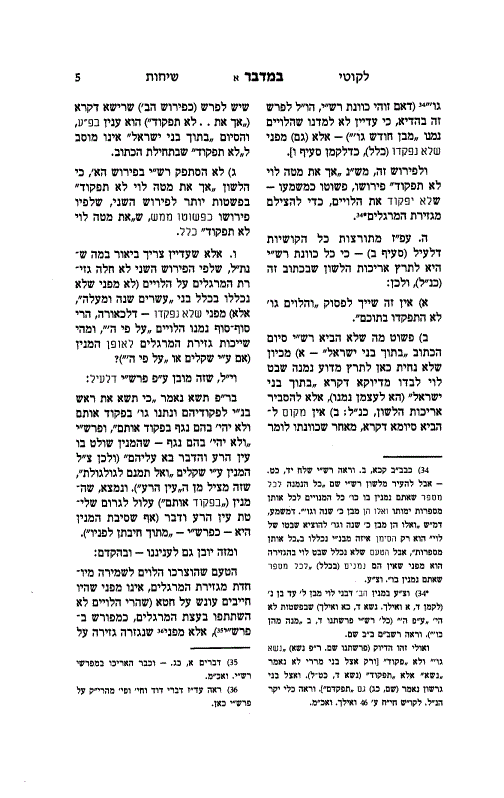
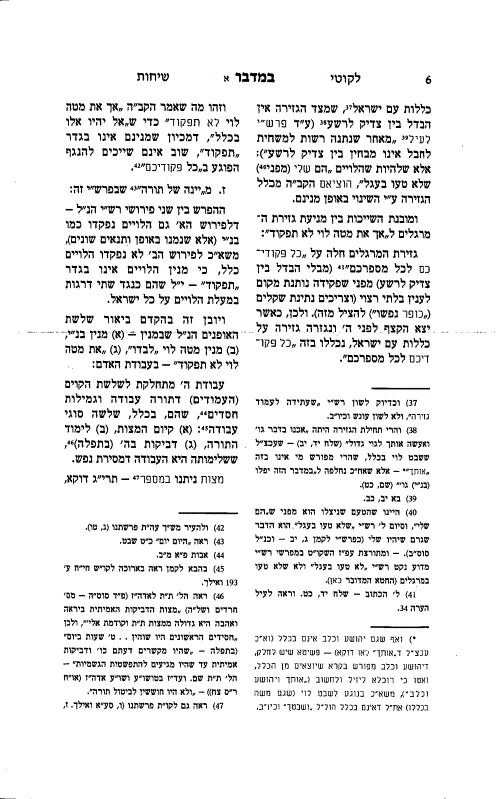
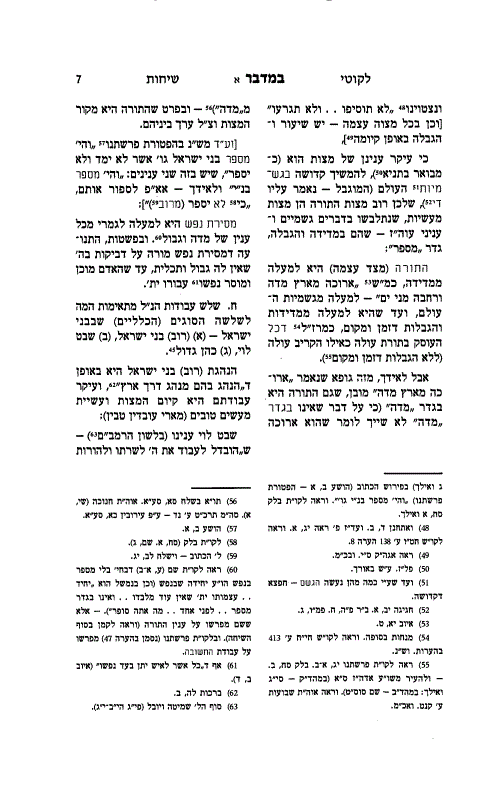
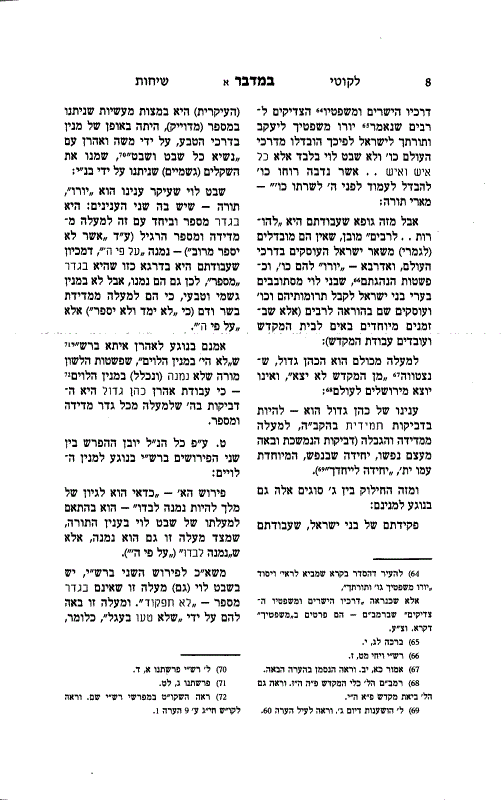
לקוטי שיחות חלק ל״ג – במדבר א׳
Introduction
We will study a sicha in Likkutei Sichos, Chelek Lamed-Gimmel (Volume 33). This is the first sicha on Parshas Bamidbar, and it is a Rashi sicha.
The Rebbe presents a remarkable chiddush regarding the verse:
“אך את מטה לוי לא תפקוד ואת ראשם לא תשא בתוך בני ישראל.”
While the rest of the Jewish people were counted, the tribe of Levi was not counted “among the children of Israel.”
The Rebbe explains that there are two distinct aspects here. One aspect is “לא תפקוד”, which refers to the actual counting. The second is “ואת ראשם לא תשא”, which refers to determining the total number.
The Rebbe will explain that this is the basis for the two explanations brought by Rashi. Through this, all the details of the sugya will become clear. The Rebbe will also explain in Avodas Hashem how this corresponds to three levels—Torah, mitzvos, and tefillah—and to the distinctions between Yisrael, Levi, and the Kohen Gadol, all connected to the different ways of counting, as will be developed throughout the sicha.
סעיף א׳
The Rebbe begins with the verse:
“אך את מטה לוי לא תפקוד ואת ראשם לא תשא בתוך בני ישראל.”
This verse follows the counting of all Bnei Yisrael. First, the Torah counts the Jewish people, and then it states that the tribe of Levi should not be counted among them.
Rashi quotes the words:
“אך את מטה לוי לא תפקוד”
and explains:
“כדאי הוא לגיון של מלך להיות נמנה לבדו” —
It is fitting that the King’s legion be counted separately.
This is the first explanation.
Rashi then adds a second explanation:
“דבר אחר” —
Hashem foresaw that there would be a decree upon all those counted from twenty years and older, that they would die in the desert. Therefore, He said that the Levites should not be included among them:
“אל יהיו אלו בכלל… לפי שהם שלי שלא טעו בעגל” —
They are Mine, because they did not sin with the Golden Calf.
Thus, Rashi provides two reasons why the tribe of Levi was counted separately:
First, because of their elevated status—they are the King’s legion.
Second, in order to protect them from the decree upon those counted from twenty years and up who would die in the desert.
At first glance, one might think that Rashi’s purpose here is to clarify that the tribe of Levi was in fact counted, and that the verse does not mean they were not counted at all.
However, the Rebbe explains that this is not Rashi’s intent.
If Rashi were coming to clarify that Levi was counted, he should have emphasized this explicitly—that they were counted, but separately—and only afterward explained the reasons. Especially since, at this point in the text, it has not yet been explicitly stated that Levi was counted.
Since Rashi does not do this, it is clear that he is not addressing whether Levi was counted.
Rather, Rashi’s question is:
Why was the tribe of Levi counted separately from the rest of Bnei Yisrael?
That is the issue Rashi is addressing, and therefore he gives two reasons:
First, because they are the King’s legion.
Second, so that they would not be included in the decree upon those counted from twenty years and above who died in the desert.
This is the entire focus of Rashi here—to explain why Levi was counted separately.
One may ask: why does Rashi not clarify that “לא תפקוד” does not mean they were not counted at all?
The answer is that this is self-understood.
Earlier in the parsha, Rashi explains that Hashem counts the Jewish people repeatedly “מתוך חיבתן לפניו”—because of their great love before Him. Counting expresses Hashem’s affection.
If so, it is obvious that the tribe of Levi, who are especially beloved, were certainly counted. Not only is there no doubt, but on the contrary, it is even more obvious regarding Levi.
Therefore, Rashi does not need to address that point at all.
Instead, Rashi is addressing a different difficulty:
In the earlier verses, when the Torah describes the counting of Bnei Yisrael, the tribe of Levi is clearly not included. This shows that the command to count Bnei Yisrael did not include Levi.
If so, why does the Torah then add:
“אך את מטה לוי לא תפקוד… בתוך בני ישראל”?
We already know they were not included in the general count.
From here it is clear that the verse is teaching something new—that Levi must not be counted together with the rest of the Jewish people, and that there is a specific reason for this separation.
Therefore, Rashi explains the reason for this distinction:
Because they are the King’s legion, and because they were to be spared from the decree.
סעיף ב׳
Rashi is coming to explain why the tribe of Levi was counted separately—that this was the command, to count them apart from the rest of Bnei Yisrael. However, the Rebbe now raises three questions on this explanation.
First question:
Rashi, in his heading (dibbur hamaschil), omits the second part of the verse. The verse says not only “do not count the tribe of Levi,” but also “among the children of Israel.” Yet Rashi quotes only the beginning of the verse and does not include the words “among Bnei Yisrael.”
But the entire point of Rashi’s explanation is precisely this—that Levi is not counted among Bnei Yisrael. So why does Rashi not quote these words? Not in the heading, not in the explanation, and not even by hinting with “etc.” This omission is difficult to understand, since those words seem central to the issue Rashi is addressing.
Second question:
This entire question—the novelty of not counting Levi together with the rest of the Jewish people—already arises earlier.
The Torah previously states:
“והלוים למטה אבותם לא התפקדו בתוכם”
—The Levites were not counted among them.
Already there, we see that Levi is excluded from the general count. That itself should raise the question: why are they not counted together with the others?
Yet Rashi says nothing there.
If so, why does Rashi wait until our verse to address the issue? What is unique about this verse that specifically here Rashi is compelled to explain why the Levites are counted separately?
Third question:
What is lacking in the first explanation of Rashi?
Rashi’s first interpretation is that the tribe of Levi is “לגיון של מלך”—the King’s legion—and therefore worthy to be counted separately.
This seems to fit very well with the simple meaning of the verse.
So why is Rashi not satisfied with this explanation? Why does he bring a second interpretation?
Especially since the second explanation appears to be further from peshat.
The Rebbe explains that the second interpretation—that Hashem separated Levi in order to spare them from the future decree—is closer to an Aggadic style than to the straightforward meaning of the verse.
Not only in its content, but also in how it fits into the flow of the verses.
The next verse states:
“ואתה הפקד את הלוים על משכן העדות”
—“And you shall appoint the Levites over the Tabernacle of the Testimony.”
This describes their appointment and authority over the Mishkan.
According to the first interpretation, everything flows perfectly:
They are not counted among Bnei Yisrael because they are the King’s legion—and therefore they are appointed to serve and guard the Mishkan. Their special role explains their separate status.
However, according to the second interpretation, there seems to be no connection.
If the reason they are not counted is in order to protect them from the decree, then what does that have to do with their appointment over the Mishkan?
There is no clear continuation between:
- “Do not count them,”
and - “Appoint them over the Mishkan.”
Furthermore, according to the second explanation, the Torah should have continued differently.
Instead of saying:
“ואתה הפקד את הלוים…”
it would have been more fitting to say the later verse:
“ואני הנה לקחתי את הלוים מתוך בני ישראל והיו לי הלוים”
—“And I have taken the Levites from among the children of Israel, and the Levites shall be Mine.”
That verse directly relates to the idea that they belong to Hashem because they did not sin with the Golden Calf.
As Rashi explains there, the Levites were chosen specifically because they did not participate in the sin of the Eigel.
That would fit perfectly with the second explanation—that they were separated in order to be spared, because they are Hashem’s.
But that is not the continuation here.
Here, the Torah continues with their role in the Mishkan—which fits far better with the first explanation.
So the question remains:
Why does Rashi bring the second explanation at all?
What is lacking in the first explanation?
Especially when:
- The second explanation is further from peshat
- And it does not fit smoothly into the flow of the verses
From all of this, it is clear that there is something deeper in Rashi’s explanation.
Rashi is not merely explaining that Levi was counted separately and giving a reason for it. There is a deeper issue here, which the Rebbe will go on to explain.
סעיף ג׳
The Rebbe now explains that there are two distinct aspects in the counting:
one is the actual counting itself, and the second is determining the total number.
The Leviyim were indeed counted—but not in the same manner as Bnei Yisrael.
Moshe Rabbeinu would come to the entrance of each tent, and a heavenly voice would tell him how many people were inside. This was different from the counting of the Jewish people, where each person gave a half-shekel, and the coins were counted to determine the total.
Thus, there are two separate ideas:
(1) the act of counting, and
(2) knowing the final total number.
The Rebbe explains that the words in the verse reflect this:
“תפקוד” refers to the act of counting,
and “תשא” refers to determining the total number.
This double expression in the verse is therefore precise and intentional.
The verse states:
“אך את מטה לוי לא תפקוד ואת ראשם לא תשא”
At first glance, this seems repetitive—both phrases appear to say “do not count them.”
It would have been sufficient to say either:
- “לא תפקוד” — do not count them,
or - “לא תשא” — do not take their number,
and add “בתוך בני ישראל”—that they should not be counted among Bnei Yisrael.
So why does the Torah use both expressions?
From the simple reading, it is clear that these are not repetitions, but rather two separate details in the concept of counting.
The difference between them is as follows:
- “תפקוד” refers to the actual process of counting—the method used to count individuals.
- “נשיאת ראש” (“תשא”), according to Rashi, refers to receiving the final tally—the total number, knowing how many there are.
Based on Rashi, there is a fundamental distinction between the counting of Bnei Yisrael and the counting of the Leviyim.
The counting of Bnei Yisrael was done through the half-shekel:
Each individual gave a מחצית השקל, and then the coins were counted. In this way, the number of people was determined indirectly, by counting the shekalim rather than the individuals themselves.
This follows Rashi’s explanation earlier, in Parshas Ki Sisa:
When one wants to determine the number of the Jewish people, one should not count individuals directly, but rather have each person give a half-shekel, and then count the coins.
In contrast, the counting of the Leviyim was “על פי ה׳”—by Hashem.
As Rashi explains:
Moshe would stand at the entrance of the tent, the Shechinah would precede him, and a heavenly voice would emerge and announce how many children were inside the tent.
Through this, Moshe knew the number of the Leviyim—even the infants.
This was necessary because the Leviyim were counted from one month old and up, including babies, who could not participate in giving a shekel.
Thus, their counting was fundamentally different.
This explains the verse:
“אך את מטה לוי לא תפקוד ואת ראשם לא תשא בתוך בני ישראל”
Meaning:
Not only was the total number of the Leviyim (“תשא”) not included among the total number of Bnei Yisrael—
that is, their number was not combined with the general count—
but also the method of counting (“תפקוד”) was entirely different from the way Bnei Yisrael were counted.
So there are two separate points:
- The Leviyim were not included in the overall total of Bnei Yisrael.
- The Leviyim were counted in a completely different manner.
This is the meaning of the double expression in the verse:
- “לא תפקוד” — they are not counted in the same way.
- “לא תשא” — their total is not combined with the rest of the Jewish people.
This sets the stage for understanding Rashi’s explanations and the deeper distinction the Rebbe will now develop in the next section.
סעיף ד׳
The Rebbe now builds on the previous foundation—that there are two distinct elements in the verse:
- פקידה — the act of counting
- נשיאת ראש — determining the total number
Based on this, we can analyze the meaning of the verse:
“אך את מטה לוי לא תפקוד”
There are two possible ways to understand this phrase.
First approach
In the simple reading, the end of the verse:
“בתוך בני ישראל”
also applies to the beginning of the verse.
Meaning:
“לא תפקוד… בתוך בני ישראל” —
Do not count the tribe of Levi among Bnei Yisrael.
According to this, the Torah is not saying that they were not counted at all, but rather:
They were not counted in the same manner as Bnei Yisrael.
Their counting was different.
Second approach
Since the counting of the Leviyim was done through a Bas Kol—a heavenly voice that informed Moshe how many individuals were in each tent—this is not considered counting in the usual sense.
Why?
Because counting normally involves two elements:
- A human being performing the count
- Counting individuals one by one
In this case, neither of these conditions was present. The Shechinah revealed the number, rather than Moshe counting individuals.
Therefore, this is not considered “פקידה” at all.
According to this second approach, the verse divides into two separate statements:
- “אך את מטה לוי לא תפקוד” —
The tribe of Levi is not counted at all. - “ואת ראשם לא תשא בתוך בני ישראל” —
Their total number is not included among the total of Bnei Yisrael.
Connection to Rashi’s two explanations
These two approaches correspond directly to the two interpretations in Rashi.
According to the first interpretation:
“כדאי הוא לגיון של מלך להיות נמנה לבדו”
The verse is emphasizing a positive directive:
The tribe of Levi should indeed be counted—but separately, not among Bnei Yisrael.
Meaning:
They were counted, but in their own category, in a distinct manner.
According to the second interpretation:
Hashem foresaw the future decree upon those who were counted and therefore said:
They should not be included at all.
Here, the verse is not emphasizing a special form of counting, but rather the opposite:
Because of their elevated status and closeness to Hashem,
they were not counted altogether.
In this interpretation:
Their exclusion is not about honor in counting,
but about protection from the decree.
The Rebbe further clarifies:
According to this second explanation, the reason the Leviyim were not included in the decree of the Meraglim is not merely because they were counted from one month old (and therefore not part of those counted from age twenty and up).
If that were the reason, Rashi should have stated it explicitly—especially since we have not yet learned that the Leviyim were counted from one month.
Rather, the deeper explanation is:
They were not included in the decree because they were not counted at all.
Since the decree applied to those who were counted,
the Leviyim, who were not counted, were not subject to it.
Thus, the phrase:
“אך את מטה לוי לא תפקוד”
is to be understood literally:
Do not count the tribe of Levi—so that they will be saved from the decree.
This establishes the fundamental distinction between the two interpretations:
- According to the first: they were counted separately
- According to the second: they were not counted at all
This sets the stage for the Rebbe’s resolution of all the earlier questions in the next section.
סעיף ה׳
Based on this, all the above questions (section B) are resolved—for Rashi’s entire intent is to explain the extended wording of this verse (as above). Accordingly:
(1) This is not relevant to the earlier verse, “And the Levites… were not counted among them.”
(2) It is self-understood why Rashi does not cite the conclusion of the verse, “among the children of Israel”:
(a) because he is not addressing here the question of why the tribe of Levi was counted separately based on the precise wording “among the children of Israel” (since, in any case, they were counted separately), but rather explaining the extended wording, as stated above;
(b) there is no place to cite the end of the verse, since his intent is to explain (according to the second interpretation) that the opening of the verse (“However… you shall not count”) is an independent statement, and the conclusion “among the children of Israel” does not refer back to the “you shall not count” at the beginning of the verse.
(3) Rashi does not suffice with the first explanation, because the phrase “However, the tribe of Levi you shall not count” more readily lends itself, in its simple meaning, to the second interpretation—that it is to be understood literally, that “the tribe of Levi you shall not count” at all.
סעיף ו׳
The Rebbe now seeks to clarify the idea explained earlier—that according to the second interpretation in Rashi, the Leviyim were not counted at all, and for this reason the decree of the Meraglim did not apply to them.
However, this itself requires explanation:
If the Leviyim were ultimately counted—albeit “על פי ה׳”—what difference does it make how they were counted? Whether through shekalim or through a heavenly voice, in the end they were counted. So why would the decree depend on the method of counting?
The Rebbe explains that the very act of counting itself is what creates the possibility for the decree.
This can be understood from Rashi earlier, in Parshas Ki Sisa.
The Torah states:
“כי תשא את ראש בני ישראל לפקודיהם… ולא יהיה בהם נגף בפקוד אותם”
When counting the Jewish people, each person must give a half-shekel, so that there will not be a plague when they are counted.
Rashi explains:
“שהמנין שולט בו עין הרע והדבר בא עליהם” —
Counting brings the influence of the evil eye, and as a result, a plague may come upon them.
Therefore, the Torah commands that the counting be done through shekalim, and not by counting individuals directly. This protects them from the harmful effects associated with counting.
From here we see that counting itself—even when it expresses Hashem’s love, as Rashi explains at the beginning of Bamidbar—can nonetheless bring about a negative consequence.
With this in mind, we can understand our case.
Why did the Leviyim require special protection from the decree of the Meraglim?
Not because they were liable for punishment—they did not participate in the sin of the spies, as Rashi states explicitly.
Rather, the decree was issued upon the Jewish people as a whole.
When a general decree is issued, it does not distinguish between righteous and wicked.
As Rashi states elsewhere:
Once permission is given to the destroyer, it does not differentiate between a tzaddik and a rasha.
Similarly here, once the decree applied to Klal Yisrael as a whole, it could have included the Leviyim as well.
Therefore, they required a special protection.
Since the Leviyim are “שלי הם”—they belong to Hashem, because they did not sin with the Golden Calf—Hashem removed them from the decree.
How?
By changing the manner in which they were counted.
This now explains the connection between the decree and the command:
“אך את מטה לוי לא תפקוד”
The decree of the Meraglim applied to:
“כל פקודיכם לכל מספרכם” —
All those who were counted.
Since counting itself creates a vulnerability—requiring protection such as the half-shekel—when the decree was issued, it naturally applied to all those included in the count.
Therefore, Hashem ensured from the outset:
The Leviyim would not be counted in this manner.
Since they were not part of the category of “פקודיכם”, they were not subject to the decree that affected those who were counted.
Thus, according to the second interpretation:
The phrase “לא תפקוד” is literal—
They were not counted at all in the sense that would associate them with the decree.
And this is why the decree of the Meraglim did not apply to them.
This now prepares the way for the Rebbe’s deeper explanation in the next section—the יינה של תורה contained within this Rashi.
סעיף ז׳ – יינה של תורה
The Rebbe now explains the יינה של תורה—the inner dimension—of this Rashi.
The difference between the two explanations in Rashi—whether the Leviyim were counted in a different way, or not counted at all—corresponds to two distinct levels in the superiority of Levi over the rest of Bnei Yisrael.
Before explaining this, the Rebbe first establishes a broader framework by analyzing three general modes of counting:
- The counting of Bnei Yisrael
- The counting of Levi separately
- Not being counted at all
These correspond to three general categories in a person’s Avodas Hashem.
A person’s service of Hashem is divided into three primary pillars:
- Torah
- Avodah (tefillah)
- Gemilus chasadim (mitzvos)
More specifically, these represent three types of service:
- Kiyum hamitzvos — performance of mitzvos
- Limud haTorah — study of Torah
- Dveikus baHashem — cleaving to Hashem through tefillah
The ultimate expression of this third level is mesirus nefesh—complete self-sacrifice.
Mitzvos — Measured and Limited
Mitzvos are defined by number:
There are exactly תרי״ג מצוות—613 commandments—and we are commanded not to add or subtract from them. Each mitzvah itself has precise measurements and defined parameters.
The purpose of mitzvos, as explained in the Tanya, is to draw holiness into the physical world.
The physical world is inherently limited—Chazal teach that the world expanded until Hashem said “די”—“enough.” Therefore, most mitzvos involve physical action within a measured and limited framework.
Thus, mitzvos are fundamentally connected to the concept of number and limitation.
Torah — Beyond Measure, Yet Connected
Torah, on the other hand, is essentially beyond limitation.
As the verse states, it is “longer than the land in measure and broader than the sea.” This means it transcends the constraints of time and space.
For example, one who studies the laws of a korban is considered as if he actually offered the sacrifice—even without the Beis HaMikdash. This shows that Torah operates beyond physical limitations.
Yet, Torah still retains a connection to measure.
The very fact that it is described as “longer” and “broader” implies that it is still within the framework of comparison—within the concept of midah (measure), even as it transcends it.
Similarly, the Haftarah describes Bnei Yisrael as:
A number that cannot be counted.
This reflects a dual nature:
- There is a number
- Yet it cannot be counted due to its vastness
This is the level of Torah—beyond measure, yet connected to it.
Mesirus Nefesh — Beyond All Limitation
The highest level is mesirus nefesh.
This is completely beyond any concept of measure or limitation.
It reflects a boundless connection to Hashem—to the extent that a person is ready to give up everything, even life itself, for Hashem.
This is absolute, infinite connection—בלי גבול.
סעיף ח׳
Three Levels Within the Jewish People
These three levels are reflected in three general categories among Bnei Yisrael:
- The majority of Bnei Yisrael
- Shevet Levi
- The Kohen Gadol
Most of Bnei Yisrael are engaged in worldly matters.
Their primary service is in mitzvos—actions within the framework of the physical world, governed by measure and limitation.
Shevet Levi is set apart for Torah.
They are designated to teach Hashem’s ways and guide the people. They are separated from ordinary worldly life and are devoted to Torah study.
However, since their role is to teach the masses, they remain connected to the rest of the people. They travel among the communities, receive their support, and instruct them.
Thus, they represent a level that is above limitation, yet still connected to it.
The Kohen Gadol, however, is on an entirely higher plane.
He is commanded:
“ומן המקדש לא יצא” — he may not leave the Mikdash.
His entire existence is one of constant attachment to Hashem.
This represents the level of יחידה שבנפש—the essence of the soul, which is completely unified with Hashem.
This is a state beyond all limitation—pure, continuous dveikus.
Connection to the Three Modes of Counting
These distinctions are also reflected in how each group was counted:
- Bnei Yisrael were counted in a natural, measured way—through the half-shekel, a physical and precise method.
- Shevet Levi was also counted, but in a higher manner—“על פי ה׳”, not through physical means. This reflects their level: connected to number, yet transcending it.
- The Kohen Gadol was not counted at all. His level is entirely beyond number and limitation.
Thus, the different modes of counting reflect the different levels of connection to Hashem:
- Measured connection (mitzvos)
- Transcendent yet related (Torah)
- Completely beyond measure (mesirus nefesh)
This prepares us to understand the deeper meaning of the two interpretations in Rashi, which the Rebbe will now explain in the next section.
סעיף ט׳
Based on all the above, we can now understand the difference between the two interpretations in Rashi regarding the counting of the Leviyim.
According to the first interpretation—that it is fitting for the King’s legion to be counted separately—this corresponds to the level of Shevet Levi in Torah.
Torah, as explained earlier, is connected to the concept of number, yet it transcends ordinary limitation. Accordingly, the Leviyim are counted—but they are counted separately, “על פי ה׳,” in a higher and distinct manner.
However, according to the second interpretation in Rashi, the Leviyim possess an even higher level.
They are not counted at all:
“לא תפקוד”—they are beyond the very concept of counting.
How did they attain this higher level?
Not merely through their role of “יורו משפטיך ליעקב”—teaching Torah—but because they did not err in the sin of the Eigel.
This does not mean only that they did not sin in action.
Rather, they were so completely bound to Hashem that they were entirely removed even from the possibility of error—even in thought.
Their level of dveikus was such that separation from Hashem was inconceivable.
Therefore:
“שלי הם”—they belong to Hashem.
They were acquired by Hashem in a manner that reflects a connection beyond all measure and limitation.
Because of this elevated state, they are not within the category of number at all.
They transcend even the level of Torah, which still retains some connection to measure.
They are in a state of complete dveikus—entirely beyond counting.
סעיף י׳
The three modes of counting described above are also reflected in the time when Parshas Bamidbar is read—at the end of the days of Sefiras HaOmer, just before Shavuos.
It is known from the explanation of the Alter Rebbe on the verse:
“תספרו חמישים יום” — “You shall count fifty days.”
In practice, we count only forty-nine days.
Why then does the Torah say fifty?
Because the fifty days correspond to the fifty gates of understanding (Binah).
We count only forty-nine days because the fiftieth gate is beyond the capacity of human effort.
It cannot be attained through one’s own service.
However, after a person completes the full service of counting the forty-nine days, the fiftieth gate is then drawn down from above.
Within this fiftieth level itself, there are two distinct aspects:
First level of the fiftieth gate
A lower aspect, which still has a connection to the forty-nine days.
Although it is not counted directly, it is drawn down through the effort of counting.
Therefore, it can still be included in the expression:
“תספרו חמישים יום”
It is beyond counting, yet still related to the process of counting.
Second level of the fiftieth gate
A higher aspect, which has no connection whatsoever to human effort.
It comes entirely as a gift from above.
This is the essential dimension of Chag HaShavuos—the giving of the Torah as a pure gift.
Parallel to the three modes of counting
Accordingly, we now have three corresponding levels:
- Counting the forty-nine days —
Human effort, within the realm of number - Drawing down the fiftieth gate (lower aspect) —
Beyond counting, yet connected to counting - The fiftieth gate as a pure gift —
Completely beyond number and limitation
Final insight
This is the inner and true elevation revealed in Bnei Yisrael at the time of Shavuos.
Not only is the Torah given anew, but Hashem reveals Himself:
“פנים בפנים”—face to face.
This is similar to the original giving of the Torah, when with each utterance, the souls of the Jewish people ascended.
This represents the ultimate unity—
the level of יחידה, complete oneness with Hashem.
Thus, the three levels:
- Counting (Bnei Yisrael)
- Higher counting (Levi)
- Beyond counting (Kohen Gadol / highest Levi level)
are reflected both in the structure of the census and in the spiritual preparation for Matan Torah.
Key points
1.
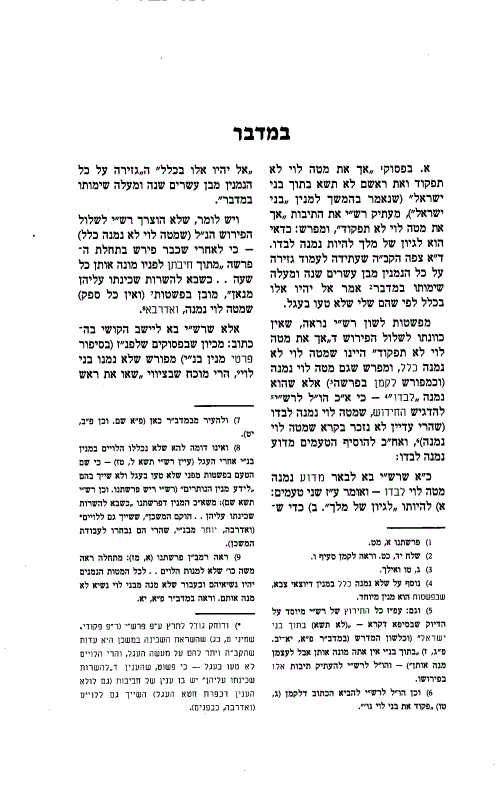
On the verse¹: “However, the tribe of Levi you shall not count, and you shall not take their number among the children of Israel” (which follows the counting of “the children of Israel”), Rashi cites the words “However, the tribe of Levi you shall not count,” and explains: “It is fitting that the King’s legion be counted separately. Another explanation: The Holy One, blessed be He, foresaw that a decree would ultimately be issued against all those counted from the age of twenty and upward, that they would die in the desert². He therefore said: Let these not be included among them, for they are Mine, since they did not err with the Calf.”
From the simple reading of Rashi’s wording, it appears that his intent is not to reject the interpretation that “However, the tribe of Levi you shall not count” means that the tribe of Levi was not counted at all. Rather, he holds that the tribe of Levi was indeed counted (as is explicitly stated later in the parsha³), but that it was counted “separately”⁴. For if his intention were otherwise, Rashi should have emphasized the novelty⁵—that the tribe of Levi was counted separately (especially since the verse has not yet stated that the tribe of Levi was counted⁶)—and only afterward added the reasons why it was counted separately.
Instead, Rashi comes to explain why the tribe of Levi was counted separately, and gives two reasons for this:
(1) because it is “the King’s legion,” and
(2) so that “they not be included” in the decree upon all those counted from the age of twenty and above, who were destined to die in the desert.
It may be suggested that Rashi did not need to reject the aforementioned interpretation (that the tribe of Levi was not counted at all), because after he already explained at the beginning of the parsha, “Because of His affection for them, He counts them at every opportunity… when He came to cause His Divine Presence to rest among them, He counted them,” it is self-understood⁷ (beyond any doubt) that the tribe of Levi was also counted—and indeed, even more so⁸.
Rather, Rashi’s intent is to resolve a difficulty in the verse: since in the preceding verses (which detail the counting of the children of Israel), it is explicitly stated that the Levites were not counted⁹, it follows that the command “Take the sum of the entire congregation of the children of Israel…”¹⁰ did not include the tribe of Levi. If so, what is the meaning of the command “However, the tribe of Levi you shall not count… among the children of Israel,” which implies a new instruction not to count them together with the rest of Israel¹¹? To this, Rashi provides the two explanations mentioned above.
2.
However, this still requires clarification:
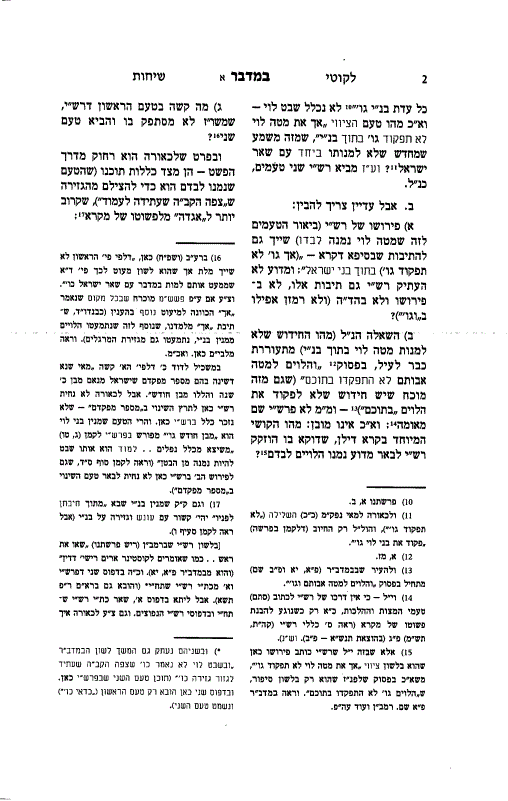
(1) Rashi’s explanation (providing the reasons why the tribe of Levi was counted separately) also relates to the words at the end of the verse—“(however… you shall not count…) among the children of Israel.” Why, then, does Rashi not cite these words as well, neither in his explanation nor in the heading (and he does not even allude to them with “etc.”)?
(2) The above question (what is the novelty in not counting the tribe of Levi among the children of Israel) already arises earlier, in the verse¹²: “And the Levites, according to their ancestral tribe, were not counted among them” (which likewise indicates that there is a novelty in not counting the Levites “among them”)¹³. Yet Rashi offers no comment there¹⁴. This is difficult to understand: what is unique about our verse that specifically here Rashi finds it necessary to explain why the Levites were counted separately¹⁵?
(3) What is lacking in Rashi’s first reason, such that he is not satisfied with it and therefore adds a second reason¹⁶?
Particularly, the second explanation appears, at first glance, to be distant from the straightforward meaning of the text—both in terms of its general content (that the reason they were counted separately is in order to spare them from the decree, which “the Holy One, blessed be He, foresaw would ultimately be issued”), which is closer to homiletics than to the plain meaning of Scripture¹⁷; and also in terms of the continuation of the verses here:
In the following verse¹⁸ it states, “And you shall appoint the Levites over the Tabernacle of the Testimony, etc.” — referring to the appointment and authority¹⁹ of the tribe of Levi over the Tabernacle. Accordingly, this flows well according to Rashi’s first explanation—that the tribe of Levi was counted separately because it is “the King’s legion,” for then the command “And you shall appoint the Levites over the Tabernacle…” serves as the reason for “However, the tribe of Levi you shall not count… among the children of Israel” (since they are “the King’s legion” appointed over the Tabernacle of the Testimony)²⁰.
However, according to the second explanation, there appears to be no connection between “And you shall appoint the Levites…” and “However, the tribe of Levi you shall not count…”?
[According to this second explanation, it would have been more appropriate for the verse here to state (not “And you shall appoint the Levites…,” but rather) the verse later in the parsha²¹: “And I, behold, I have taken the Levites from among the children of Israel… and the Levites shall be Mine”²²—corresponding to the reason that they (the Levites) were spared from the decree “because they are Mine, since they did not err with the Calf”²³ (as Rashi explains there²¹ that the taking of the Levites occurred “when they sinned with the Calf… and the Levites, who did not serve idolatry, were chosen”)²⁴.]
3.
The explanation may be as follows:
In this verse, there appears—at first glance—to be a redundancy of expression: “(However, the tribe of Levi) you shall not count, and you shall not take their number.” Seemingly, it should have sufficed to say either “However, the tribe of Levi you shall not count among the children of Israel,” or “However, the number of the children of Levi you shall not take among the children of Israel” (or something similar).
From the simple wording, it appears that “you shall not count” and “you shall not take (their number)” refer to two distinct aspects of the census.
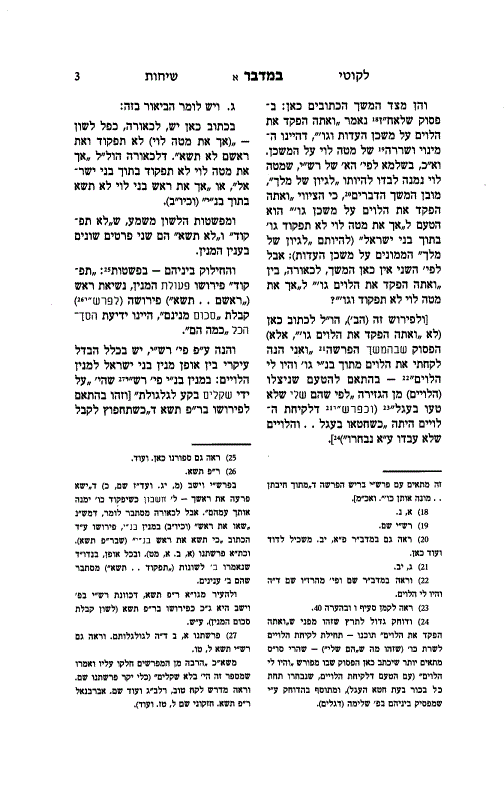
The difference between them is, simply understood²⁵: “you shall count” refers to the act of counting, whereas “taking their number” (“their heads… you shall take”) means (according to Rashi²⁶) determining the “total of their number,” that is, knowing the overall sum—“how many they are.”
Now, according to Rashi’s interpretation, there is a fundamental difference between the manner in which the children of Israel were counted and the manner in which the Levites were counted:
Regarding the census of the children of Israel, Rashi explains²⁷ that it was conducted “by means of shekels—half a shekel per head.” This corresponds to his explanation at the beginning of Parshas Ki Sisa, that “when you wish to determine the total of their number… do not count them directly, head by head; rather, each shall give a half-shekel, and you shall count the shekels, thereby knowing their number.”
In contrast, the counting of the Levites was “by the command of Hashem”²⁸, as Rashi explains: “Moshe went and stood at the entrance of the tent, and the Divine Presence preceded him, and a heavenly voice emerged from the tent and declared: ‘Such-and-such number of infants are in this tent.’” Through this, Moshe knew “the number of their infants”—for the Levites were counted “from one month old and above”²⁹.
This, then, is the meaning of the verse: “However, the tribe of Levi you shall not count, and you shall not take their number among the children of Israel”—namely, not only was the total number of the Levites (“their number… you shall take”) not included “among the children of Israel” (i.e., their total was not to be combined with the total of the children of Israel³⁰), but even the very method of counting (“you shall count”) the Levites was entirely different from the manner in which the children of Israel were counted, as explained above³¹.
4.
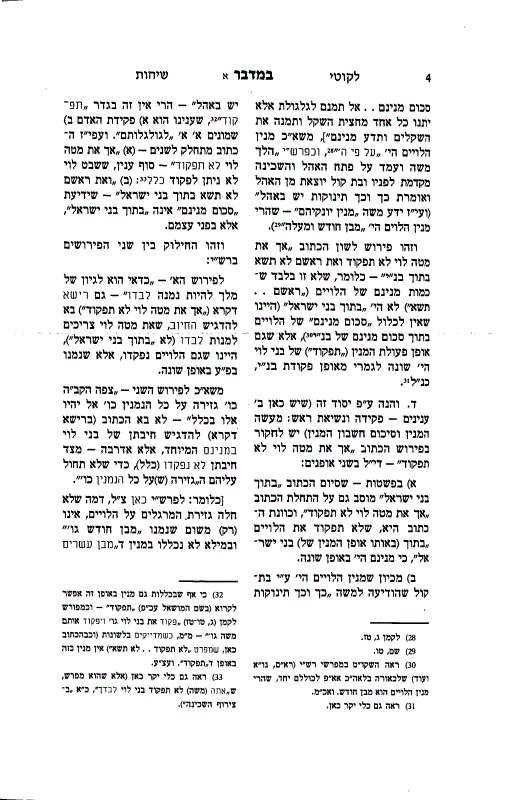
Based on this foundation (that there are two distinct aspects here—pekidah [the act of counting] and nesias rosh [taking the sum]; the act of counting and the summation of the count), we may analyze the meaning of the phrase “However, the tribe of Levi you shall not count” in two possible ways:
(1) In the straightforward sense—that the conclusion of the verse, “among the children of Israel,” also applies to the beginning of the verse, “However, the tribe of Levi you shall not count.” The intent of the verse would then be that the Levites should not be counted “among (i.e., in the same manner of counting as) the children of Israel,” since their counting was conducted in a different way.
(2) Since the counting of the Levites was carried out through a heavenly voice that informed Moshe, “such-and-such number of infants are in the tent,” this does not fall within the definition of “counting” (tifkod)³², which entails (a) a person performing the count, and (b) counting individuals one by one, “head by head.” According to this, the verse divides into two distinct parts:
(a) “However, the tribe of Levi you shall not count” — concluding one idea, that the tribe of Levi was not subject to counting at all³³;
(b) “and you shall not take their number among the children of Israel” — meaning that the knowledge of their total number is not “among the children of Israel,” but rather separate and independent.
This is the difference between the two interpretations in Rashi:
According to the first explanation—“It is fitting that the King’s legion be counted separately”—the opening phrase of the verse (“However, the tribe of Levi you shall not count”) also serves to emphasize the requirement that the tribe of Levi must be counted separately (not “among the children of Israel”), meaning that the Levites were indeed counted, but in their own distinct manner.
However, according to the second explanation—“The Holy One, blessed be He, foresaw… a decree upon all those counted… let these not be included”—the verse (in its opening phrase) is not emphasizing the special affection for the Levites expressed through their unique counting. On the contrary, because of this affection, they were not counted (at all), so that the decree “upon all those counted…” would not apply to them.
[That is to say: according to Rashi here, the fact that the decree of the spies did not apply to the Levites is not (only) because they were counted “from one month old and above,” and thus were not included in the census of those “from twenty years and above”³⁴ (for if this were Rashi’s intent, he should have stated it explicitly, since we have not yet learned that the Levites were counted “from one month old and above”). Rather, it is (also) because they were not counted at all, as will be explained below in section Vav.]
According to this interpretation, the phrase “However, the tribe of Levi you shall not count” is to be taken in its literal sense—that they were not to be counted—in order to spare them from the decree of the spies*³⁴.
5.
Based on this, all the above questions (section B) are resolved—for Rashi’s entire intent is to explain the extended wording of this verse (as above). Accordingly:
(1) This is not relevant to the earlier verse, “And the Levites… were not counted among them.”
(2) It is self-understood why Rashi does not cite the conclusion of the verse, “among the children of Israel”:
(a) because he is not addressing here the question of why the tribe of Levi was counted separately based on the precise wording “among the children of Israel” (since, in any case, they were counted separately), but rather explaining the extended wording, as stated above;
(b) there is no place to cite the end of the verse, since his intent is to explain (according to the second interpretation) that the opening of the verse (“However… you shall not count”) is an independent statement, and the conclusion “among the children of Israel” does not refer back to the “you shall not count” at the beginning of the verse.
(3) Rashi does not suffice with the first explanation, because the phrase “However, the tribe of Levi you shall not count” more readily lends itself, in its simple meaning, to the second interpretation—that it is to be understood literally, that “the tribe of Levi you shall not count” at all.
6.
However, further clarification is still required regarding what was explained above—that according to the second interpretation, the decree of the spies did not apply to the Levites (not because they were not included among those “twenty years and above,” but rather) because they were not counted at all.
At first glance, this is difficult: ultimately, the Levites were counted “by the command of Hashem.” What, then, is the connection between the decree of the spies and the method of counting (whether by shekels or “by the command of Hashem”)?
This may be understood based on Rashi’s earlier explanation:
At the beginning of Parshas Ki Sisa it states: “When you take the sum of the children of Israel according to their count, they shall give… when they are counted, so that there will not be a plague among them when they are counted.” Rashi explains: “So that there will not be a plague among them—because the counting brings the influence of the evil eye, and pestilence comes upon them.” Therefore, the counting must be done through shekels—“do not count them head by head”—which protects them from the “evil eye.”
It follows that the act of counting (“when they are counted”) can bring about the influence of the evil eye and pestilence—even though the very reason for the counting is, as Rashi explains, “because of His affection for them.”
From this, we can also understand our case—with the following introduction:
The reason the Levites required special protection from the decree of the spies was not because they were deserving of punishment for the sin (for the Levites did not participate in the counsel of the spies, as Rashi explicitly states³⁵), but rather³⁶ because a decree was issued upon the entire Jewish people³⁷—and with respect to such a decree, there is no distinction between the righteous and the wicked³⁸ (similar to Rashi’s earlier statement³⁹: “Once permission is given to the destroyer, it does not distinguish between the righteous and the wicked”).
However, since the Levites are “Mine (because⁴⁰) they did not err with the Calf,” Hashem removed them from the scope of the decree by altering the manner of their counting.
The connection between the avoidance of the decree of the spies and “However, the tribe of Levi you shall not count” is thus understood:
The decree of the spies applied to “all your counted ones, according to your entire number”⁴¹ (without distinction between the righteous and the wicked), because the act of counting creates the possibility for an undesirable influence (and therefore requires the giving of shekels—“a ransom for his soul”—to protect against this). Consequently, when divine wrath was aroused and a decree was issued upon the entire Jewish people, it included “all your counted ones, according to your entire number.”
This is the meaning of Hashem’s statement, “However, the tribe of Levi you shall not count,” so that “they shall not be included”—for since their counting is not within the category of pekidah (counting in the conventional sense), they are no longer subject to the affliction that befalls “all your counted ones”⁴².
7.
From the *“wine of Torah”*⁴³ in this Rashi:
The difference between the two interpretations of Rashi above—that according to the first explanation, the Levites were also counted like the rest of Israel (albeit in a different manner and under different conditions), whereas according to the second explanation, the Levites were not counted at all, since their counting does not fall within the category of pekidah—can be understood as corresponding to two levels in the superiority of the Levites over the rest of Israel.
This can be understood by first explaining the three aforementioned modes of counting—(a) the counting of the children of Israel, (b) the counting of the tribe of Levi “separately,” and (c) “the tribe of Levi you shall not count”—as they apply to a person’s Divine service:
Service of Hashem is divided into the three lines (pillars) of Torah, service (avodah), and acts of kindness⁴⁴. These correspond, in general, to three types of Divine service⁴⁵:
(a) the observance of mitzvos,
(b) the study of Torah, and
(c) cleaving to Hashem (through prayer)⁴⁶, whose ultimate expression is the service of self-sacrifice (mesiras nefesh).
Mitzvos were given in a specific number⁴⁷—precisely 613—and we are commanded⁴⁸, “Do not add… and do not subtract.” Likewise, each individual mitzvah has defined parameters and limits in its performance⁴⁹.
This is because the essential purpose of mitzvos is (as explained in the Tanya⁵⁰) to draw holiness into the physicality of the world⁵¹—which is inherently limited (as expressed in the phrase “He said ‘enough’”⁵²). Therefore, most mitzvos are practical commandments, enclothed in physical objects and matters of this world, which are defined by measure and limitation—i.e., the category of “number.”
Torah, on the other hand, in its own essence, is beyond measure, as it is written⁵³: “It is longer than the earth in measure and broader than the sea”—beyond the physicality of the world, and even beyond the limitations of time and space. As our Sages state⁵⁴, “Whoever engages in the study of the laws of a burnt offering is considered as if he has offered a burnt offering,” without the limitations of time and place⁵⁵.
Yet, on the other hand, from the very fact that it says “longer than the earth in measure,” it follows that Torah is also within the category of “measure” (for regarding something that is not at all within the concept of measure, it would not be appropriate to say that it is longer than measure)⁵⁶. This is especially so since Torah is the source of the mitzvos, and there must therefore be a relationship between them.
[This is similar to what is stated in the Haftarah of this parsha⁵⁷: “And the number of the children of Israel shall be… which cannot be measured nor counted.” Here, too, there are two aspects: “the number of the children of Israel,” yet at the same time it is impossible to count them—“for it cannot be counted (due to its great abundance)”⁵⁸⁻⁵⁹.]
Self-sacrifice (mesiras nefesh), however, is entirely beyond any concept of measure or limitation⁶⁰. Simply understood, the movement of self-sacrifice expresses a bond with Hashem that has no limit or end, to the extent that a person is prepared to give over his very life⁶¹ for Him, may He be blessed.
8.
The three forms of Divine service mentioned above correspond to three general categories within the Jewish people:
(a) (the majority of) the children of Israel,
(b) the tribe of Levi, and
(c) the High Priest⁴⁵.
Concerning the tribe of Levi, it is stated that “they shall teach Your just ordinances and righteous laws to the many, as it is said⁶⁵: ‘They shall teach Your judgments to Jacob and Your Torah to Israel.’ Therefore, they were set apart from the ways of the world… Yet not only the tribe of Levi, but any individual whose spirit generously motivates him… to separate himself and stand before Hashem to serve Him…”—these are the masters of Torah.
However, from the very fact that their service is “to teach… to the many,” it is understood that they are not completely separated from the rest of Israel who are engaged in worldly matters. On the contrary—they “teach” them, etc. As seen in their practical conduct⁶⁶, the Levites would travel among the cities of Israel to receive their tithes and contributions, and there they would engage in teaching the public (only at specific times would they come to the Beis HaMikdash to perform the Temple service).
Above all of them is the High Priest, who was commanded⁶⁷: “He shall not leave the Sanctuary,” and he did not leave Jerusalem at all⁶⁸.
The essence of the High Priest is to exist in a constant state of cleaving to Hashem, beyond all measure and limitation—a bond that flows from the very essence of his soul, the yechidah of the soul, which is uniquely united with Him, may He be blessed—“yechidah le’yachedcha”⁶⁹.
From this, we can understand the differences between these three categories also with regard to their counting:
The counting of the children of Israel—whose primary service is in the practical mitzvos, which are given in a precise number—was conducted through a natural process, by Moshe and Aharon together with “the leader of each tribe”⁷⁰, who counted the (physical) shekels contributed by the people.
The tribe of Levi, whose primary role is “they shall teach”—Torah—which contains both aspects: it is within the category of number, and yet at the same time transcends ordinary measure and number (similar to “which cannot be counted due to its great abundance”)—was counted “by the command of Hashem.” Since their service exists on a level that still relates to “number,” they too were counted; however, not through a physical, natural counting, because they transcend the measurements of flesh and blood (for “it cannot be measured or counted”), but rather “by the command of Hashem.”
However, regarding Aharon, Rashi states⁷¹ that “he was not included in the counting of the Levites,” and the simple meaning of this wording implies that he was not counted (nor included) among the Levites⁷²—because the service of Aharon as High Priest is a state of cleaving to Hashem that is entirely beyond any framework of measure or number.
9.
Based on all the above, we can understand the difference between the two interpretations in Rashi regarding the counting of the Levites:
The first explanation—“It is fitting that the King’s legion be counted separately”—corresponds to the unique distinction of the tribe of Levi in the realm of Torah. Because of this distinction, they too are counted, but they are “counted separately” (“by the command of Hashem”).
However, according to the second explanation in Rashi, the tribe of Levi possesses an additional quality—that they are not within the category of number at all—“you shall not count.” This quality stems from the fact that “they did not err with the Calf,” meaning not only that they did not sin with the Calf, but furthermore, that they were entirely removed even from any mistaken thought or initial consideration of such a sin, due to their deep attachment to Hashem, which leaves no possibility for separation.
Therefore, “they are Mine”—the Levites were acquired by Hashem in such a way that this connection, which transcends all measure and limitation, is openly manifest within them. Because of this quality, they are above the category of number—“you shall not count.”
10.
The three modes of counting of the children of Israel discussed above have a parallel in the time when Parshas Bamidbar is read—at the conclusion of the days of the Omer count⁷³, “before Atzeres (Shavuos)”⁷⁴:
It is known from the explanation of the Rabbi Schneur Zalman of Liadi⁷⁵ on the verse⁷⁶, “You shall count fifty days”—even though in practice only forty-nine days are counted—that the fifty days correspond to the fifty gates of understanding (Binah). Therefore, in practice we count only forty-nine days, because the fiftieth gate is beyond the capacity of created beings, and they are unable to count (or draw down) the fiftieth gate. Rather, after a person completes his own service (through counting the forty-nine days), the fiftieth gate is drawn down from Above.
Within this itself (the drawing down of the fiftieth gate), there are two levels⁷⁷:
(1) A lower aspect of the fiftieth gate, which has a relationship and connection to the service and counting of the forty-nine days—to the extent that it can be said, and is indeed stated, “You shall count fifty days,” meaning that the drawing down of the fiftieth gate is related to, and considered part of, the counting performed by Israel.
(2) A higher level within the fiftieth gate, which has no relation whatsoever to the service of created beings, but comes entirely as a gift from Above. This is the primary concept of the festival of Shavuos, the time of the giving of our Torah—a revelation granted as a gift.
Accordingly, we find here three aspects corresponding to the three aforementioned modes of “number”:
(a) The counting of the forty-nine days—representing number as generated by human effort;
(b) The drawing down of the fiftieth gate from Above, which comes (following and) through the counting of the forty-nine days—within the category of number, yet “beyond counting due to its abundance”;
(c) The fiftieth gate that comes entirely as a gift—beyond the category of number (and counting) altogether⁷⁸.
This is the inner and ultimate distinction revealed within the Jewish people on the festival of Shavuos, the time of the giving of our Torah—that at that time⁷⁹, in addition to the Torah being given anew, Hashem reveals Himself to the Jewish people “face to face”⁸⁰, in a state of ultimate cleaving to Him (similar to the original giving of the Torah, when at each utterance their souls departed⁸¹)—the level of “yechidah le’yachedcha.”
(From the talks of Shabbos Parshas Bamidbar, 5726 and 5740