
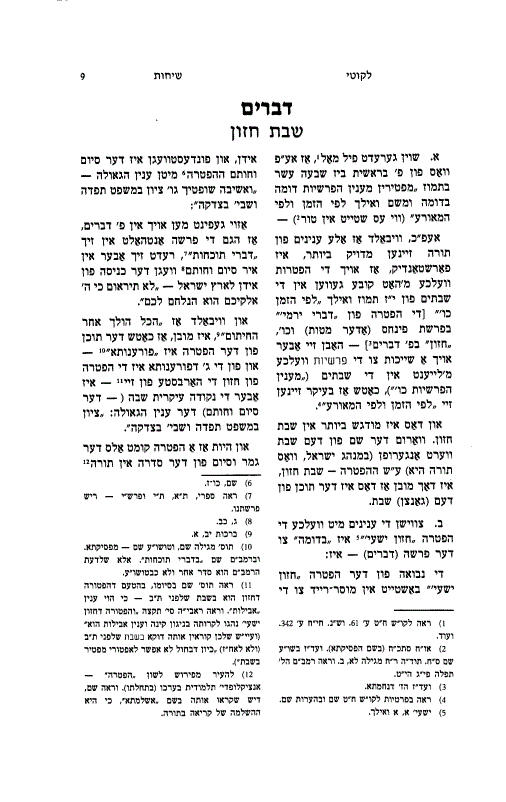
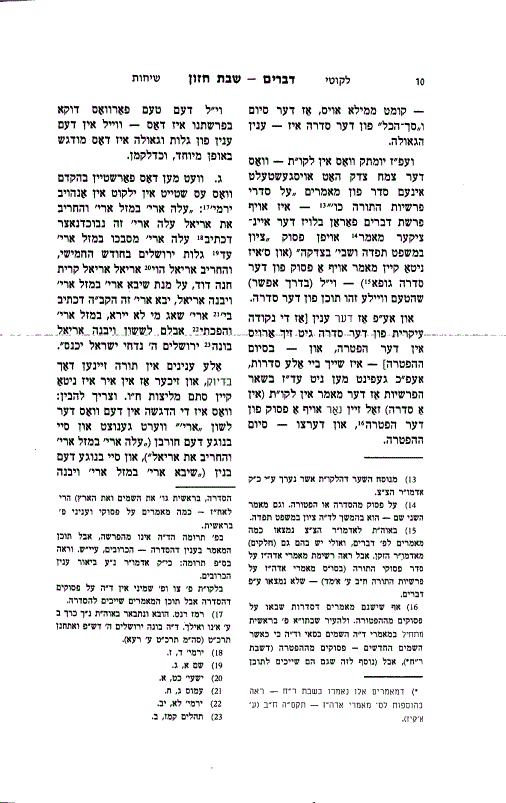
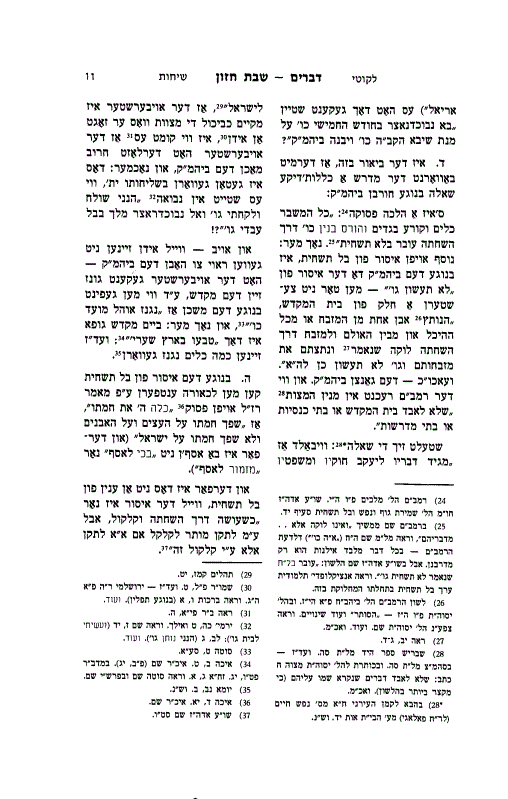
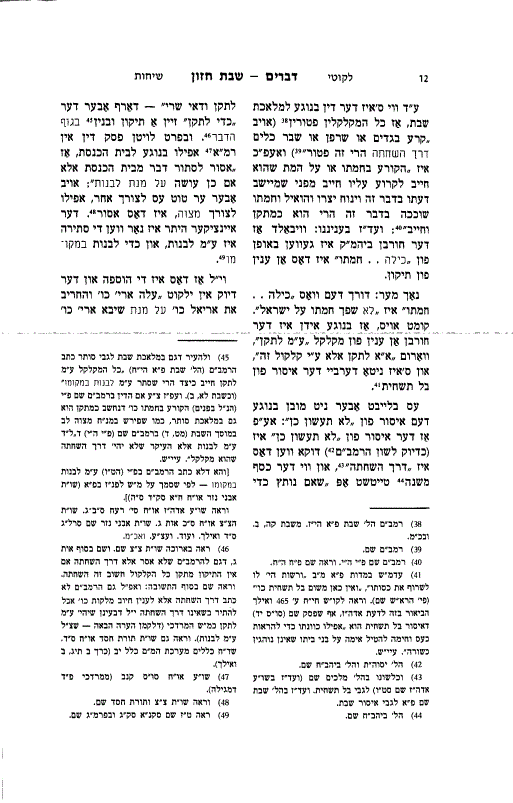

It has been discussed many times that although from Parshas Bereishis until the seventeenth of Tammuz, the haftaros are chosen based on the content of the weekly Torah portions, and from then on according to the time and the event, nevertheless, since all matters of Torah are extremely precise, it is understood that the haftaros established for the Shabbosos from the seventeenth of Tammuz onwards, according to the time, etc., also have a connection to the Torah portions read on those Shabbosos (from the content of the portions, etc.), even though they are primarily according to the time and the event.
This is particularly emphasized on Shabbos Chazon. Since the name of this Shabbos is called (in the custom of Israel, which is Torah) after the haftarah — Shabbos Chazon, it is understood that this is the theme of the entire Shabbos.
Among the matters in which the haftarah "Chazon Yeshayahu" is similar to the parsha is:
The prophecy of the haftarah "Chazon Yeshayahu" consists of words of rebuke to the Jewish people, and yet, the conclusion and seal of the haftarah is with the theme of redemption — "And I will restore your judges... Zion shall be redeemed with justice, and her returnees with righteousness."
Similarly, in Parshas Devarim, although the parsha contains words of rebuke, its conclusion and seal speak about the entry of the Jewish people into the Land of Israel — "Do not fear them, for the L‑rd your G‑d is the one who fights for you."
And since "everything follows the conclusion," it is understood that although the content of the haftarah is about calamity — and among the calamities, the haftarah of Chazon is the harshest of them — the main point within it (the conclusion and seal) is the theme of redemption: "Zion shall be redeemed with justice, and her returnees with righteousness."
And since a haftarah always comes as the conclusion and seal of the Torah reading, it follows that the conclusion and "sum total" of the Torah portion is the theme of redemption.
Based on this, it is sweetened why in Likkutei Torah — which the Tzemach Tzedek arranged in the order of the maamarim "according to the order of the Torah portions, etc." — there is only one maamar on Parshas Devarim, on the verse "Zion...
...with justice and her returnees with righteousness." (And there is no maamar on a verse from the parsha itself.) One could say (possibly) that the reason is because this is the essence of the parsha. And although the idea that the main point of the parsha is expressed in the haftarah, and — in the conclusion of the haftarah — is relevant to all parshas, nevertheless, we do not find in other parshas that the maamar in Likkutei Torah (in a parsha) is only on a verse from the haftarah, and moreover — the conclusion of the haftarah.
The reason why specifically in our parsha this is the case is because in the matter of exile and redemption, it is emphasized in a special way, as will be explained.
We will understand this by first examining what is stated in the Yalkut at the beginning of Yirmiyahu: "A lion has ascended in the constellation of the lion and destroyed Ariel. A lion, Nebuchadnezzar, as it is written, 'A lion has ascended from his thicket,' in the constellation of the lion, until the exile of Jerusalem in the fifth month, and destroyed Ariel, 'Woe, Ariel, Ariel, the city where David encamped,' so that a lion will come in the constellation of the lion and rebuild Ariel. The lion is the Holy One, blessed be He, as it is written, 'The L‑rd will roar, who will not fear?' in the constellation of the lion, 'and I will turn it to joy,' and rebuild Ariel, 'The L‑rd builds Jerusalem, He gathers the dispersed of Israel.'
All matters in the Torah are precise, and certainly, there are no mere poetic expressions, G‑d forbid. We need to understand: What is the emphasis in using the term "lion" both regarding the destruction ("A lion has ascended in the constellation of the lion and destroyed Ariel") and regarding the building ("A lion will come in the constellation of the lion and rebuild Ariel")? It could have simply stated, "Nebuchadnezzar came in the fifth month, etc., so that the Holy One, blessed be He, will come, etc., and rebuild the Temple?"
The explanation is that the Midrash addresses a general question regarding the destruction of the Temple:
It is a clear halacha: "Anyone who breaks vessels, tears garments, or demolishes a building, etc., destructively, transgresses the prohibition of 'do not destroy.'" Furthermore, beyond the prohibition of 'do not destroy,' there is...
Regarding the Beis HaMikdash, there is the prohibition of "You shall not do so" — one must not destroy any part of the Beis HaMikdash. "One who demolishes a stone from the altar or from any part of the sanctuary or from between the hall and the altar destructively is liable to lashes, as it is stated, 'And you shall break down their altars, etc., you shall not do so to the L‑rd your G‑d.'" Certainly, this applies even more so to the entire Beis HaMikdash. As the Rambam enumerates in the count of the mitzvos, "Not to destroy the Beis HaMikdash or synagogues or study halls."
The question arises: Since "He declares His words to Jacob, His statutes and judgments to Israel," and the Holy One, blessed be He, fulfills the mitzvos that He commands the Jews, how is it that He allowed the destruction of the Beis HaMikdash? Moreover, this was done by His command, as it is stated in prophecy, "Behold, I am sending and I will take Nebuchadnezzar, the king of Babylon, My servant, etc."!
And if — because the Jews were not worthy of having the Beis HaMikdash — the Holy One, blessed be He, could have concealed the Temple, similar to what we find regarding the Mishkan, that "the Tent of Meeting was hidden, etc." And even more so: regarding the Temple itself, "Its gates were sunk into the ground"; and similarly, several vessels were hidden.
Regarding the prohibition of 'do not destroy,' one might seemingly answer based on the saying of our Sages on the verse "The L‑rd has completed His wrath," that "He poured out His wrath on wood and stones and did not pour out His wrath on Israel." Therefore, it is not a matter of 'do not destroy,' because the prohibition is only "when one acts destructively and ruinously, but if it is to repair, it is permissible to ruin if it cannot be repaired except through this ruin."
Similar to the law concerning the work of Shabbos, that all who ruin are exempt (if one tears garments or burns them or breaks vessels destructively, he is exempt), and yet one who tears in anger or for a deceased person for whom he is obligated to tear is liable because it settles his mind and calms his inclination, and since his anger...
...is calmed through this act, it is considered as if he is repairing and is therefore liable. Similarly, this indicates that since the destruction of the Beis HaMikdash was in the manner of "He poured out His wrath," it is an aspect of repair.
Even more so: through the fact that "He poured out His wrath" and "did not pour out His wrath on Israel," it turns out that regarding the Jews, the destruction is a matter of damaging "in order to repair," because "it cannot be repaired except through this damage," and therefore, the prohibition of "do not destroy" does not apply.
However, it remains unclear regarding the prohibition of "You shall not do so": Although the prohibition of "You shall not do so" is specifically when it is "in a destructive manner," and as the Kesef Mishneh explains, "if it is done in order to repair, it is certainly permitted" — the "in order to repair" must be a repair and construction in the very essence of the thing. Especially according to the ruling in the Rema, even concerning a synagogue, that "it is forbidden to demolish anything from a synagogue unless it is done with the intention to build"; however, if it is done for another purpose, even for the sake of a mitzvah, it is forbidden. The only permission is when the demolition is in order to build, and to build in its place.
This is the addition and precision in the Yalkut, "The lion ascended, etc., and destroyed Ariel, etc., in order that the lion should come, etc."
This emphasizes that the purpose of the destruction of the Temple was not for the sake of destruction itself, but for an additional matter, "in order that the lion should come, etc., and build Ariel" — "with the intention to build." Consequently, it is understood that here there is no prohibition of demolishing the house, the destruction of the Beis HaMikdash. On the contrary, "this demolition is called construction" — the destruction and demolition itself is, in essence, construction.
For this reason, the Yalkut repeats the same name: "The lion ascended in the constellation of the lion and destroyed Ariel, etc., in order that the lion should come in the constellation of the lion and build Ariel." This explains and emphasizes that the inner content of the destruction — the demolition — is "called construction"; to the extent that the matter and cause of the destruction has the same name (which "the name by which it is called in the Holy Tongue" indicates the content of the matter) as the one who effects the building of the Beis HaMikdash in the literal sense — "the lion will come in the constellation of the lion and build Ariel."
From this emerges a wondrous concept regarding the destruction of the Temple, the First Temple, and certainly the Second Temple: the building of the Third Beis HaMikdash by the Almighty — "The lion, this is the Holy One, blessed be He, etc., in the constellation of the lion, and I will turn their mourning into joy and build Ariel" — is not something that will only begin in the future, but its construction began immediately with the destruction of the Temple.
Moreover, this is the entire purpose of the destruction of the Temple: the Almighty wanted to "repair" the Beis HaMikdash so that it would not be as it was before, a "structure of man" which does not have permanence, but rather it should be a "structure of the Holy One," an eternal building — and therefore there was...
The destruction of the Temples, the First and Second Temples, was in order to repair and build a rectified Temple, the Third Beis HaMikdash, which is the "structure of the Holy One." It turns out that the destruction of the Temples is actually a form of "building," not destruction and demolition.
Based on this, we can delve deeper into the story in the Midrash, where an Arab, upon hearing the cry of a cow from a Jew at the time of the Temple's destruction, told him that the Beis HaMikdash had just been destroyed. Immediately afterward, when the cow cried out again, he told him that "the savior of Israel has been born."
This indicates that, in the inner dimension, it is not only that at that time Mashiach was born, meaning that from the moment after the destruction he is ready to redeem the Jews, but that with the destruction also came the preparation, the beginning, and the possibility of redemption.
(And this is obviously necessary in the simple sense: since when they do teshuvah, "they are immediately redeemed," and "I am asleep in exile but my heart is awake to the Holy One," Mashiach must be ready at the moment after the destruction so that redemption can occur — "immediately when they do teshuvah.")
Moreover, the destruction of the Temple and the redemption and building of the Beis HaMikdash are not separated by time, not even by a moment — rather, immediately after the destruction, in this world, in the land of Israel itself, the beginning of the redemption occurred, the birth of the redeemer.
Openly, the Jews perceive the matter of the destruction, and consequently — the laws of Tisha B'Av, etc. — but the purpose of fasts and Tisha B'Av in particular is to bring about teshuvah, and in the words of the Rambam at the beginning of the Laws of Fasts: "This is one of the ways of teshuvah." So that the redemption and the building of the Temple will come through the teshuvah and the actual service of the Jewish people.
This concept (that the beginning of the repair and building of the Temple starts immediately after the destruction, because this is the entire purpose of the destruction, for the repair of the Temple) —
We find explicitly right at the first exile, the exile in Egypt, that immediately — right after the decree of the exile, "and they will enslave them and oppress them," G‑d told Avraham Avinu, "and afterward they will go out with great wealth." As is known, the explanation of this is that the entire matter of the Egyptian exile was for the sake of the elevation (the "great wealth") of the Jews, and to receive the Torah (only the Jews being in exile and enslavement in Egypt had this...
It was not felt, therefore they wanted to leave the exile as soon as possible and were willing to forgo the great wealth.
[It can be said that this is the inner explanation of why the tribe of Levi was not enslaved: because they were always engaged in the study of Torah and upheld the commandments of their forefathers, they knew and perceived in Egypt that the exile and enslavement itself brought about refinement and elevation, the great wealth — and therefore, they did not feel the enslavement.]
Similarly, since all kingdoms (exiles) are named after Egypt, this applies to all exiles, and especially to this last exile: outwardly and in feeling, the redemption begins after a period following the destruction (the beginning of the exile), but internally, since the entire matter of exile is for the sake of the elevation of the redemption (the great wealth taken out of exile), the very first moment after the exile is inseparable from the moment of redemption.
And so, this is not only in the matter of destruction and exile as it is from Above, from the perspective of the Almighty, but also in the service of the Jews. Even — when a cow bellows, even an animal, here below, and furthermore, in the words of the Alter Rebbe, "the ultimate perfection of the Messianic era and the resurrection of the dead, which is the revelation of the Infinite Light in this physical world, depends on our actions and service throughout the duration of the exile." And since the revelations and matters of redemption come through "our actions and service throughout the duration of the exile," it is understood that these revelations and matters are prepared, they are "present" in our actions and service.
With physical eyes, this is not seen, but the righteous and the leaders of Israel, who have enlightened eyes, see within the exile itself (both in the descent and darkness of the exile and in our actions and service) the matter of the redemption within it.
According to the above, we can explain a puzzling matter regarding the concept of the end time.
The Gemara states: "May the spirits of those who calculate the end times expire." And the Rambam brings this in his book (which is "laws of laws") at its conclusion: "And similarly, one should not calculate the end times, as the sages said, may the spirits of those who calculate the end times expire."
However, we find many calculations of end times — in addition to those of the sages in the Gemara, also from the great ones of Israel after the time of the Talmud in all generations. Moreover, the Rambam himself writes an end time in his "Letter to Yemen"; and similarly in later generations, and it is known the end time of the Alter Rebbe in the well-known maamar, "And the one thousand and seven hundred."
Simply put, the teaching that "may the spirits of those who calculate the end times expire" refers to those who say, as the Gemara continues, "since the end time has arrived and he has not come, he will never come." And as the Rambam explains (in his Letter to Yemen), this brings harm and misfortune to the people, because "they might err when they see that the end times have come and he has not arrived," which would lead to a lack of faith in the coming of the Messiah. "Therefore, the sages prayed for them that their minds should expire and their calculations be destroyed."
However, when the great ones of Israel revealed end times, it was, on the contrary, for the highest purpose. This was because these were times when Jews were in a low state, "with many erroneous beliefs," and the great ones of Israel gathered and drew the masses through the calculation of the end times, thereby strengthening their faith and awakening hope for the redemption by announcing that the redemption is very near, even though "the Torah forbade this."
Based on the above, it can be suggested that since the righteous see at all times during the exile how the service in every day and moment of exile includes and brings about matters of redemption, and after each day, etc., in exile, they see an increase in the revelations and elevations of the redemption (a great wealth), until these increases accumulate and reach a state of completeness in the addition — they revealed the time of completeness — the year of the end time, indicating that we are reaching and coming to the completeness of the addition, of the higher revelation. Consequently, the service of the Jewish people during the time between the revelation of the end time and the day of the end time must be in accordance with the completeness of this revelation, so that it should come through their actual service.
The revelation of the end time, the calculation of the end time by the Rambam, and similarly by the Alter Rebbe, serves as an awakening to further increase in the service of Torah and mitzvos, so that they should be in accordance with this, and it provides the strength for this.
It is therefore clear that the prohibition against "calculating the end times" — which, as mentioned, the Rambam brings as law — does not apply to great tzadikim who see the great elevation and the great wealth that the Jewish people have already achieved in this time. This brings them to marvel greatly at the praise of the Jewish people, their love for Israel, and the merit of the Jewish people, all Jews. On the contrary, they must reveal this as an awakening to increase in the service of G‑d and to provide the strength for this, so that the Jewish people will further increase their service in accordance with this, as mentioned above.
Based on this, we can understand the matter of the name of the Shabbos — "Shabbos Chazon":
Simply, it is named after the beginning of the haftarah "Chazon Yeshayahu," which openly refers to the undesirable matters — the three haftaros of calamity. On the other hand, it is known that Reb Hillel Paritcher brings in the name of the Rebbe of Barditchev that "Shabbos Chazon" is from the term "vision," that on this Shabbos, "each individual is shown the future Beis HaMikdash."
According to the above, it is understood that these are not contradictory interpretations; rather, they are related to each other. Moreover, they are immediately connected to one another: in the destruction of the Beis HaMikdash, down to the lowest level as it is on Shabbos Chazon, which is the Shabbos before (and related to) Tisha B'Av — one "sees" (on this Shabbos itself — and it begins from the very first moment it is called Shabbos Chazon) the building of the future Beis HaMikdash.
This influences the Jew not to be affected by all the difficulties of the darkness of exile, and consequently, his service, "our deeds and our service throughout the duration of the exile," is on an even higher level. This brings about the third Beis HaMikdash, which is "built and perfected above," so that it should be "a vision" in the literal sense, to be seen here below, less than ten handbreadths, because: the lion will come in the month of the lion and build the lion's house — "The builder of Jerusalem is the L‑rd; He will gather the dispersed of Israel," speedily in our days and in this month — the month of the lion — literally.