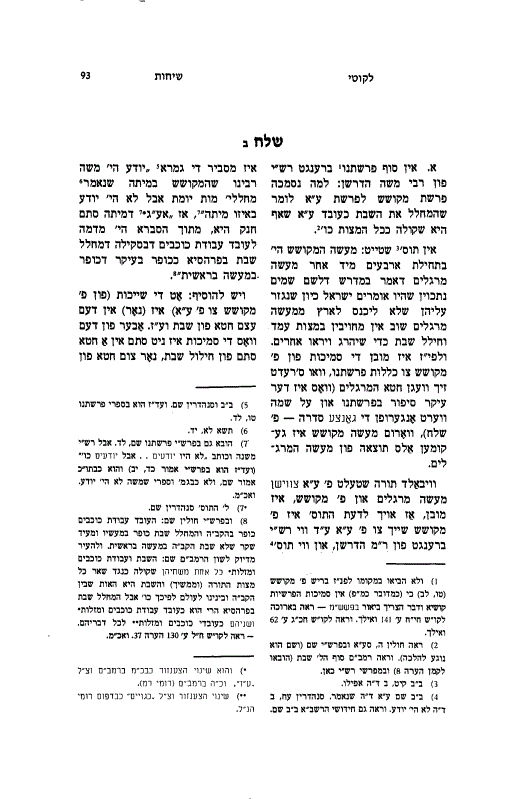
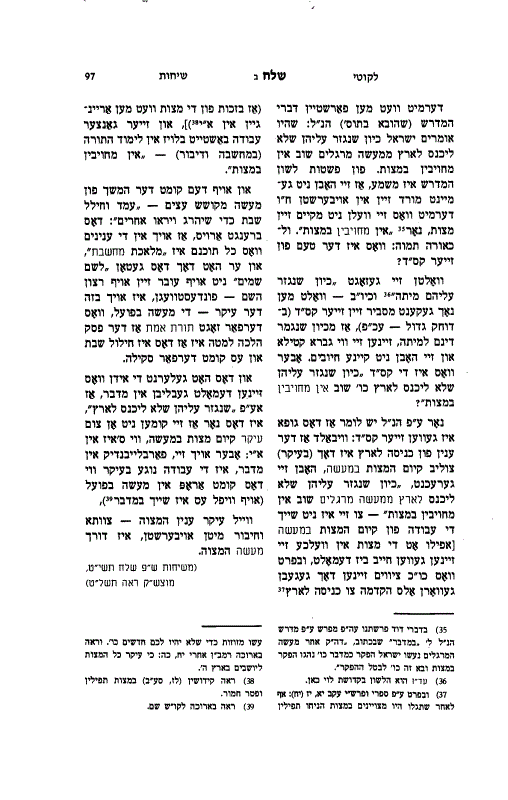
The juxtaposition of the sections of the wood-gatherer (mekoshesh) and idolatry to the story of the spies teaches that the Jewish people mistakenly thought that, since they would remain in the wilderness, practical action—which reaches its fullest expression in the Land of Israel—was no longer of primary importance.
The intent of the wood-gatherer was to demonstrate that even in the wilderness, and even regarding mitzvos such as Shabbos whose essence is connected with thought and intention, actual deed remains of decisive importance. The same lesson applies to idolatry, where the essence of the prohibition is a matter of belief, yet action still plays a critical role.
At the conclusion of our parshah, Rashi writes:
“From the teachings of Rabbi Moshe HaDarshan I have copied: Why is the section of the wood-gatherer placed next to the section of idolatry? To teach that one who desecrates Shabbos is like one who worships idols, for each of them is equivalent to all the mitzvos.”
Tosafos adds:
“His intention was for the sake of Heaven. Since the people were saying that, because it had been decreed upon them after the sin of the spies that they would not enter the Land, they were no longer obligated in the mitzvos, he intentionally desecrated Shabbos so that he would be executed and others would see and learn.”
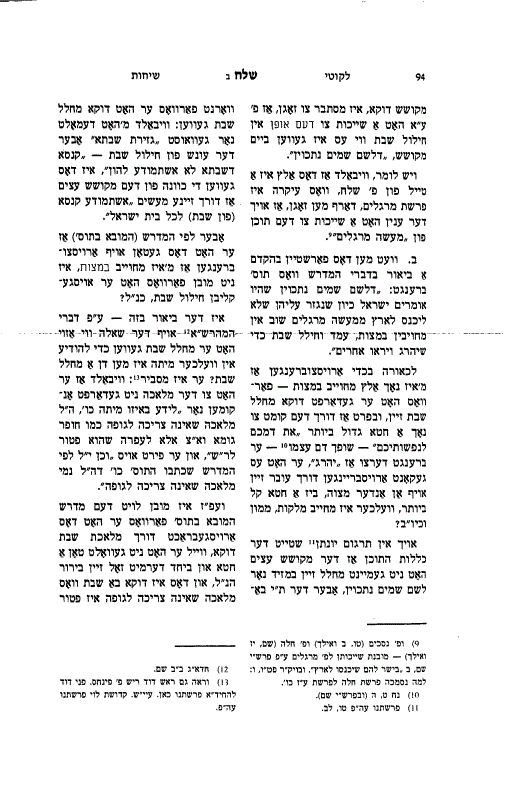
This raises a question.
If his purpose was merely educational, why did he choose such a severe prohibition as Shabbos desecration? Why not violate a lesser prohibition involving lashes or monetary penalties?
Explanation
The explanation follows the approach of the Maharsha, who explains that the wood-gatherer performed a melachah she'einah tzerichah legufah—an act whose productive result was not needed for its own sake.
He did not actually need the wood. His purpose was only to demonstrate a lesson.
This explains why he specifically chose Shabbos.
He did not want to commit a genuine sin. Shabbos uniquely contains categories of labor that can be performed in a way that is technically prohibited in practice but lacking the full intent usually associated with the labor itself.
Thus, from his perspective, his act was not motivated by sinful intent.
Nevertheless, the earthly court could judge only the external action. Since they could not determine his inner motivation, they were required to impose the Torah's prescribed punishment.
The Importance of Action
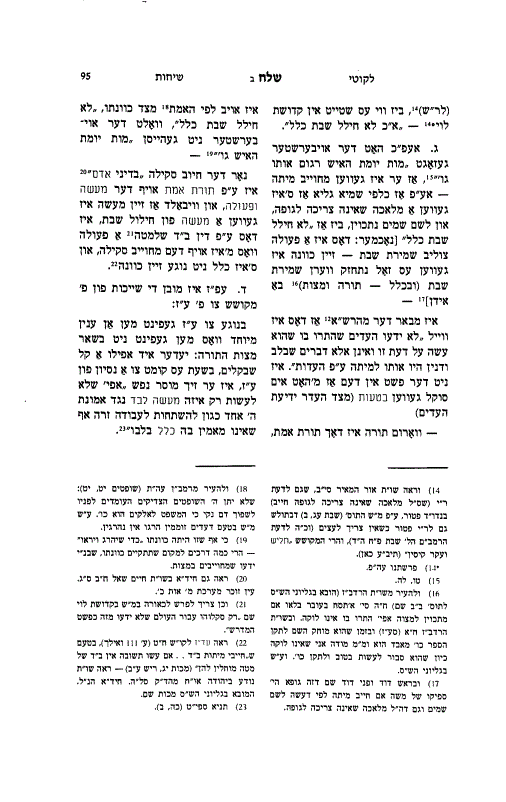
The deeper lesson is that although the laws of Shabbos depend heavily upon intention, as expressed in the principle:
“The Torah prohibited purposeful labor (meleches machsheves).”
we nevertheless see that a person who performs the prohibited act in practice is liable to punishment.
The physical deed possesses decisive significance.
This also explains the juxtaposition to idolatry.
In idolatry, the essential prohibition concerns belief and recognition. The core issue is what a person accepts as truth.
Yet even if a person is forced to perform an idolatrous act externally while not believing in it internally, the rule is:
“One must be killed rather than transgress.”
This demonstrates the tremendous significance that Torah assigns to actual conduct and external action.
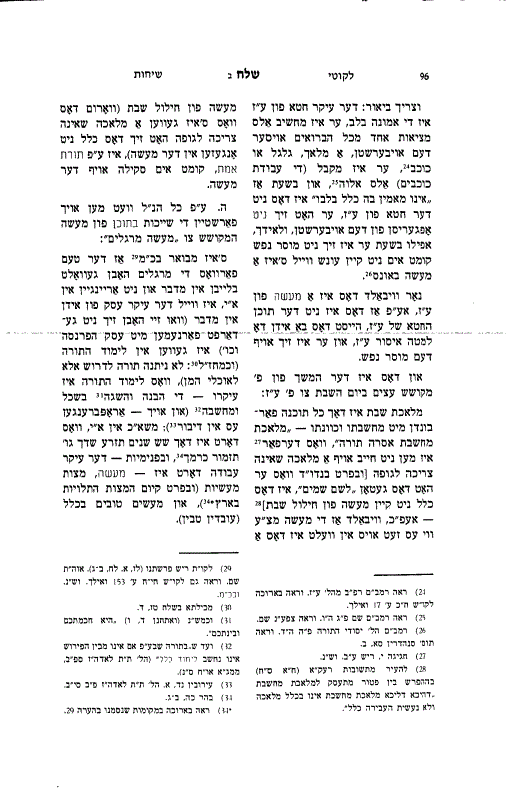
Connection to the Spies
This also explains the connection between idolatry and the story of the spies.
After the decree that the generation would remain in the wilderness, the people reasoned that practical mitzvah observance was no longer the primary focus.
Since life in the Land of Israel represents the fulfillment of Torah through engagement with the physical world, they assumed that remaining in the wilderness shifted the emphasis to spiritual contemplation and inward service.
The wood-gatherer sought to refute this mistaken idea.
His message was that even in the wilderness, and even regarding Shabbos—whose essence is associated with thought and intention—the decisive factor remains concrete action.
The same applies to idolatry. Even where belief is central, actual conduct retains critical importance.
Thus, the juxtaposition of these sections teaches a fundamental principle:
No matter how lofty one's spiritual thoughts may be, Torah places supreme importance on actual performance. The ultimate expression of one's relationship with G‑d is not merely what one thinks or feels, but what one does in practice.