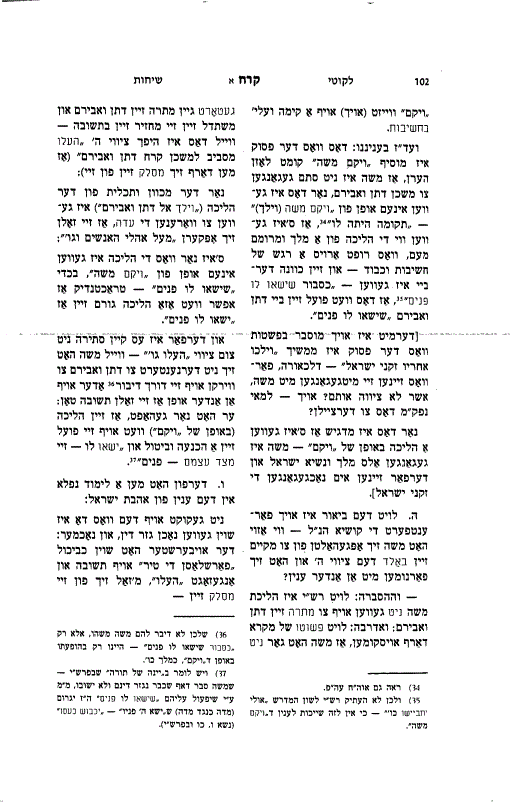
In this week's Torah portion, the Torah recounts that before the L‑rd punished Korach, Dathan, and Abiram — "And the earth opened its mouth and swallowed them and their households" — the L‑rd instructed Moses: "Speak to the congregation, saying, 'Withdraw from around the dwellings of Korach, Dathan, and Abiram.'" Moses then rose and went to Dathan and Abiram, and spoke to the congregation, saying, "Please depart from the tents of these wicked men." Rashi comments on the words "Moses rose" and explains: "He thought they would show him respect and not persist." The commentators question why Moses went to Dathan and Abiram, as his command (from G‑d) was directed not to them, but to the congregation: "Speak to the congregation, saying..."
The purpose was to influence Dathan and Abiram to repent, as the Midrash states: "Even though Moses heard from the Almighty, he did not tell them to withdraw until he went and warned them, as it is said, 'Moses rose and went to Dathan and Abiram.'" However, it is difficult to say that this is Rashi's intention, because initially, there is no question as to why Moses went to Dathan and Abiram, since the Jews were then gathered around the dwelling of Korach, Dathan, and Abiram (as is evident from the L‑rd's command, "Withdraw from around...").
Therefore, in order to convey the L‑rd's command to the congregation, Moses had to go to the dwelling of Korach, Dathan, and Abiram. Additionally, according to the simple meaning, it seems inappropriate to accept the Midrash's interpretation that "Even though Moses heard from the Almighty, he did not tell them to withdraw until he went and warned them," because once the L‑rd commanded Moses, "Speak to the congregation," how could Moses delay fulfilling the command and do something else first (even if it was out of his own good intention)?
Thus, it seems that when the Torah recounts "Moses rose and went," it is telling us that Moses was engaged in another matter, quite the opposite — that Moses immediately fulfilled the L‑rd's command, "Speak to the congregation," and "Moses rose and went" (was a going, but not a speech through which it is relevant to warn), and subsequently, "He spoke to the congregation." It is entirely unclear: from where does Rashi derive in the simple meaning of the text that Moses' going was (not immediately to convey the L‑rd's command to the congregation, but) to Dathan and Abiram, hoping they would show him respect (and repent)?
The Midrash explains that Moses thought they would show him respect and return from their dispute. The phrase "thought they would show him respect" implies that Moses hoped they would give him honor. Even if we assume that Rashi wanted to use a phrase that conveys what Moses' going was supposed to accomplish, Rashi should have quoted the Midrash's language, "perhaps they will be ashamed and repent" (or the language of the Rashbam: "perhaps they will repent"), which clearly expresses the purpose of Moses' going.
One might initially think to explain Rashi's wording based on the Talmudic statement regarding the verse "Moses rose and went to Dathan and Abiram," where Reish Lakish says, "From here we learn that one should not persist in a dispute." For this reason, Rashi uses the phrase "thought they would show him respect" (and not "perhaps they will be ashamed and repent," etc.) because the emphasis here is not on them showing respect (opposite to their previous behavior of opposing Moses and engaging in dispute, as in "Moses sent to call Dathan and Abiram, and they said, 'We will not come up'").
However, Rashi rejects this interpretation: regarding "Moses sent, etc.," Rashi explains, "From here we learn that one should not persist in a dispute, for Moses sought to make peace with them through words of peace." Since Rashi derives this teaching from the Talmud (which learns the concept of "not persisting in a dispute" from our verse "Moses rose and went"), and learns it from the previous verse "Moses sent, etc." (especially considering Rashi's precise language "or (that one persists in a dispute)"), it is evident that according to Rashi's approach in his commentary on the Torah, Moses' going to Dathan and Abiram was not due to the concept of "not persisting in a dispute."
Therefore, we must say that Moses' going to Dathan and Abiram was (even in the simple meaning) not because of the concept of "not persisting in a dispute," but, as mentioned earlier, to bring them to repentance — and the question returns to its place. The key to understanding Rashi's commentary lies in the words that Rashi quotes from the verse as the introductory phrase. As has been discussed many times, in Rashi's commentary, the words he quotes from the verse are very precise, including the words he chooses to quote from the verse itself.
In this context, Rashi quotes from the verse only the words "Moses rose" and nothing more.
However, Rashi quotes only "Moses rose" and even adds an explanation. With this, Rashi intends to clarify that the difficulty in the verse he comes to address is specifically in these words, "Moses rose," and it is these words he comes to explain. The verse stating "Moses went to Dathan and Abiram" is understood, as it narrates how Moses fulfilled G‑d's command to warn the congregation, the Jews, who were then surrounding the dwelling of Dathan and Abiram, to "separate yourselves." However, we must understand why the verse precedes with the words "Moses rose." What does the word "rose" add to the narrative of "he went to Dathan and Abiram"?
From this, Rashi is compelled to explain that in addition to Moses going to Dathan and Abiram, there was a distinct action indicated by "rose." "Rose" also implies an act of rising with importance. In our context, the verse adds "Moses rose" to convey that Moses did not merely go to the dwelling of Dathan and Abiram, but he did so in the manner of "Moses rose (and went)" — it was a rising, as it were, like the movement of a king and exalted leader, which evokes a sense of importance and honor. His intention was that perhaps they would show him respect, hoping that this would influence Dathan and Abiram to "show him favor."
This also explains simply why the verse continues with "the elders of Israel followed him." At first glance, why did they accompany Moses, as he did not command them? Also, what is the significance of narrating this? It emphasizes that it was a journey in the manner of "Moses rose" — Moses went as the king and leader of Israel, and therefore they followed him. The purpose of going to warn Dathan and Abiram and to endeavor to bring them to repentance was contrary to G‑d's command to "separate yourselves from the dwelling of Korach, Dathan, and Abiram" (as one must distance oneself from them). However, the intention and purpose of the journey ("he went to Dathan and Abiram") was to warn the congregation to turn away "from the tents of these wicked men." It was only that the journey was in the manner of "Moses rose," hoping that perhaps his going would cause them to "show him favor."
Therefore, it is not a contradiction to the command to "separate yourselves," because Moses did not approach Dathan and Abiram to influence them through speech or any other means for them to repent. He merely hoped that his journey (in the manner of "Moses rose") would cause them to submit and humble themselves and "show him favor" due to his presence.
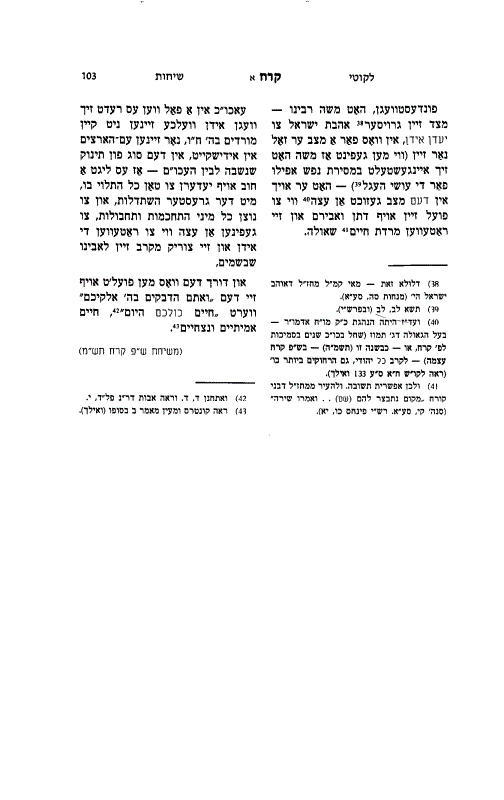
Nevertheless, Moses, due to his great love for every Jew, in whatever situation they might be (as we find that Moses was willing to sacrifice himself even for the makers of the Golden Calf), sought a way to influence Dathan and Abiram and save them from descending alive into the pit.
And this applies even more so in a situation concerning Jews who are not rebels against G‑d, G‑d forbid, but are rather ignorant in matters of Judaism, akin to a "child who was captured among the nations." In such cases, it is an obligation upon everyone to do everything within their power, with the greatest effort, and to employ all kinds of wisdom and strategies to find a way to save these Jews and bring them back closer to our Father in Heaven.
By influencing them to adhere to "you who cleave to the L‑rd your G‑d," they will attain "life, all of you, today," which means true and eternal life.