
Regarding the daughters of Tzelafchad, the Torah states:
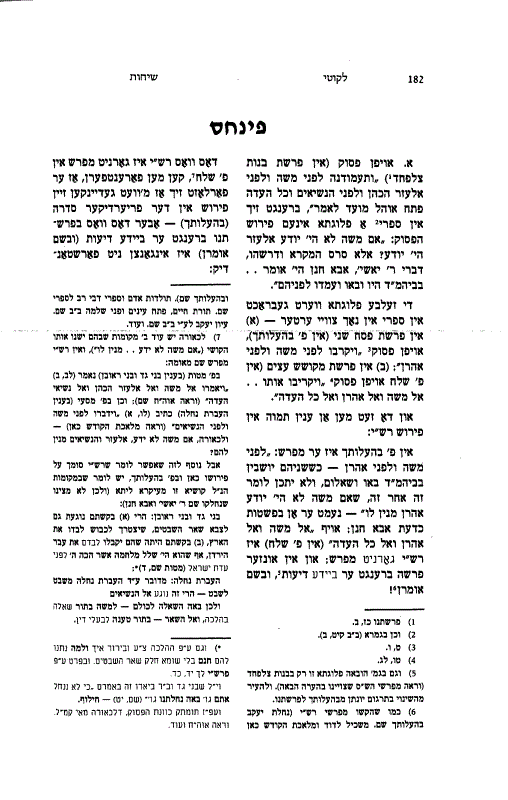
"They stood before Moshe, before Elazar the Kohen, before the leaders, and before the entire congregation..." (Numbers 27:2).
Rashi comments:
"Before Moshe—and afterward before Elazar. Is it possible that if Moshe did not know the law, Elazar would know it? Rather, rearrange the verse and interpret it accordingly. This is the opinion of Rabbi Yoshiyah.
Abba Chanan, in the name of Rabbi Elazar, says: They were sitting in the study hall, and the daughters stood before all of them."
This requires explanation.
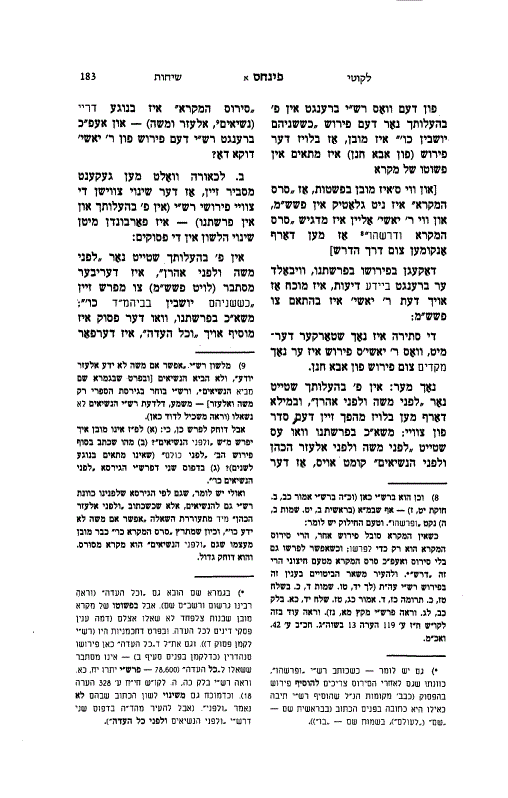
The Sifrei, Rashi's source, records this same disagreement regarding both Pesach Sheini and the wood-gatherer.
Yet in the case of Pesach Sheini, Rashi cites only one opinion:
"Since both Moshe and Aharon were sitting in the study hall, they came and asked them."
In the case of the wood-gatherer, Rashi offers no explanation at all.
Why, then, does Rashi bring both opinions here, and why is the first opinion different from the explanation he gave in Parshas Beha'alosecha?
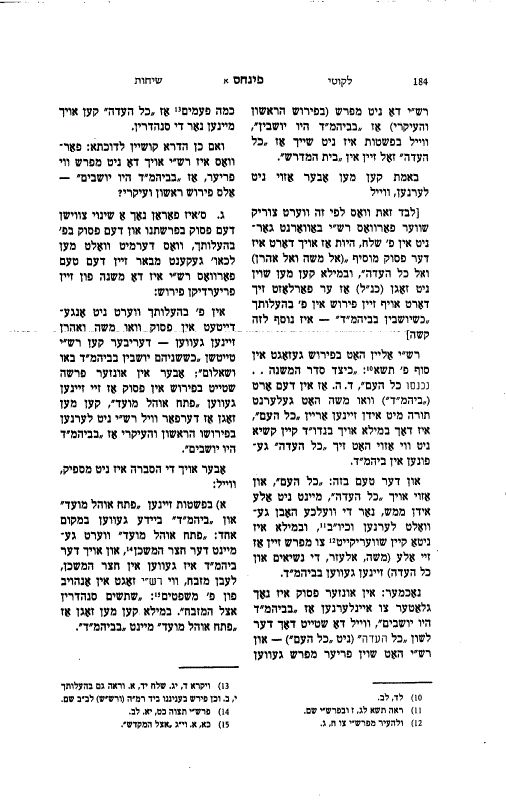
The explanation is as follows.
Had the Torah simply stated,
"They stood before Moshe and Aharon,"
one could have understood that the question was directed only to Moshe, while Aharon is mentioned merely because he happened to be present.
However, the Torah explicitly says:
"And before Aharon."
This wording indicates that the question was intentionally presented to Aharon as well.
This explains Rashi's emphasis on the study hall.
The unique nature of a study hall is that everyone present participates in analyzing the question. Unlike someone asking a personal question of a rabbi, every scholar considers the issue and contributes his understanding.
Therefore, in the case of Pesach Sheini, the Torah emphasizes "before Aharon," because the question was addressed to him as part of the collective Torah discussion.
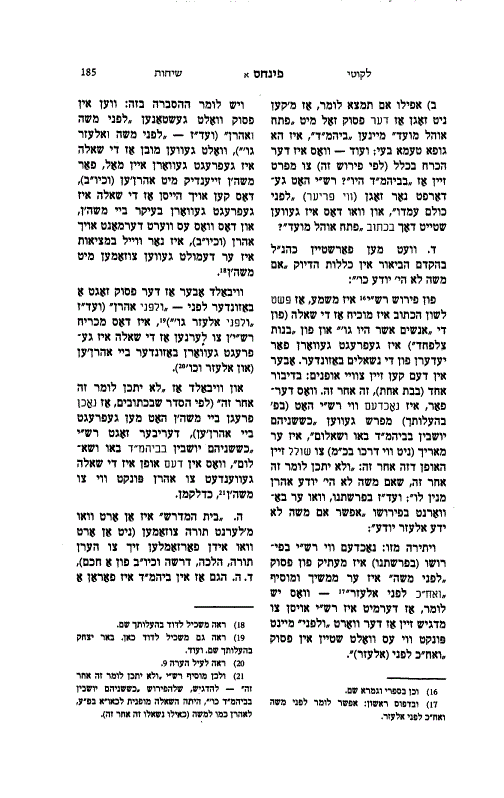
In our parashah, however, the situation is different.
Here the Torah explicitly states that Moshe, Aharon, and the entire congregation were gathered at the entrance of the Tent of Meeting.
The Tent of Meeting was not primarily a study hall. It was the place where the nation assembled to hear Hashem's word as transmitted by Moshe.
Therefore, it is difficult to explain this scene as an ordinary study-hall discussion.
For this reason, Rashi first explains that the daughters approached each person separately.
The order recorded in the verse is not chronological.
Rather, the verse has been rearranged. They first approached the leaders, then Aharon, and finally the matter came before Moshe.
Only afterward does Rashi bring the second explanation—that they were sitting in a study hall.
The case of the wood-gatherer is different still.
There, everyone already knew that he was liable for the death penalty.
The only uncertainty concerned which form of execution applied.
Therefore, he was brought equally before Moshe, Aharon, and the entire congregation, because the purpose was to place him under the authority of the public while awaiting the final ruling.
Wine of Torah
Pesach Sheini and the daughters of Tzelafchad share an important feature.
Both sections entered the Torah as a result of requests initiated by the Jewish people.
Accordingly, these episodes emphasize the greatness of the lower realm (mateh)—the initiative that begins from below.
In Parshas Beha'alosecha, where an entirely new law was revealed, the emphasis is on the study hall, representing the creative development of the Oral Torah built upon the Written Torah.
In the case of the daughters of Tzelafchad, however, the halachah itself was not newly created. Rather, it had been temporarily concealed from Moshe.
Here the greatness of the lower realm is expressed through Rashi's explanation:
"Rearrange the verse and interpret it."
As the matter appears from Above, it is not immediately understood—or, in this instance, has been forgotten.
Precisely through human effort, by rearranging and interpreting the verse, its true meaning becomes revealed.
Thus, even when the Torah originates from Above, its fullest understanding is achieved through the active participation of human beings in the study and interpretation of Torah.