מבוא
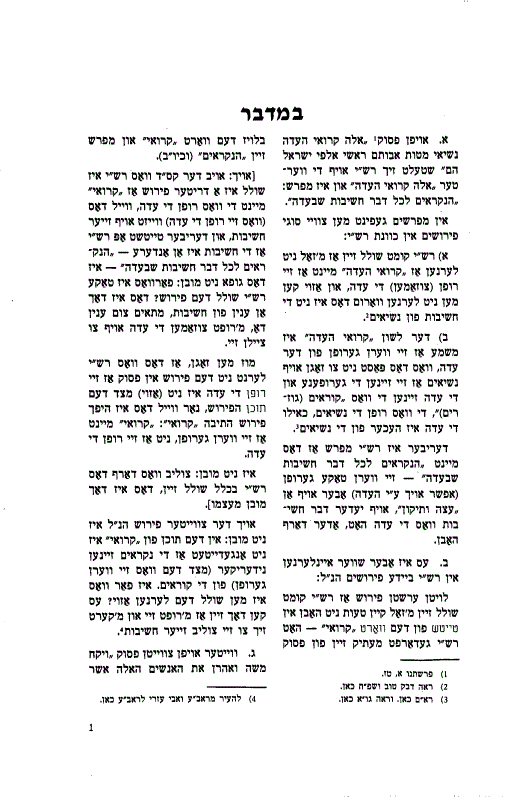
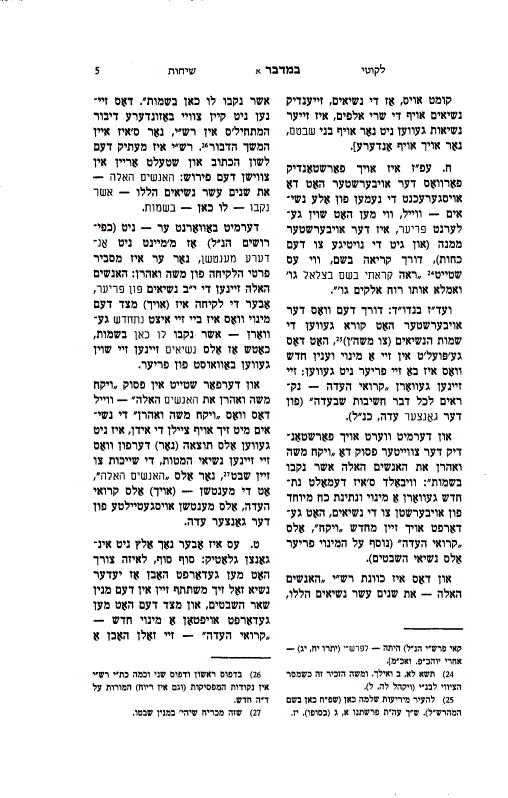
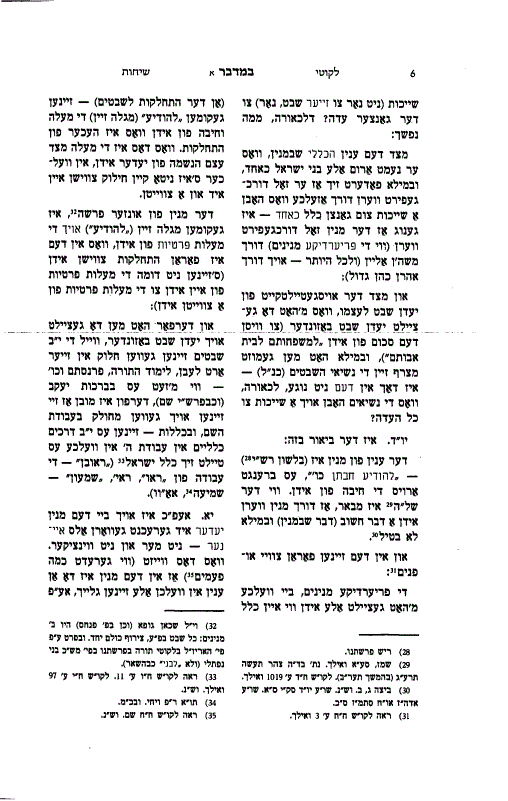
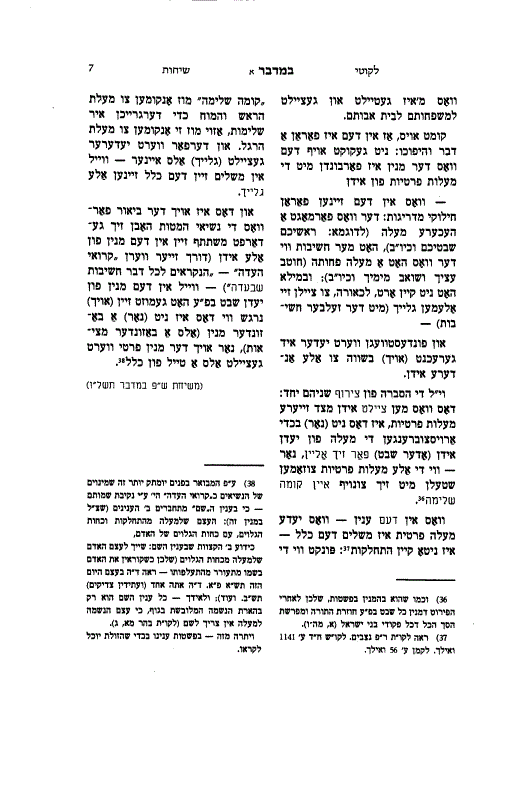
In this review, we will study a sicha from Likkutei Sichos, Chelek Gimmel, the first sicha on Parshas Bamidbar. This is a Rashi-focused sicha, where the Rebbe analyzes the beginning of the parsha—specifically, the words קְרוּאֵי הָעֵדָה—and explores Rashi’s commentary on them.
The Rebbe examines how Rashi explains these words and brings in other commentaries—the Meforshim—who interpret the verse differently. The Rebbe shows why these other explanations do not fit with the approach of peshuto shel mikra—the straightforward meaning of the text—which is always Rashi’s main focus. He clarifies Rashi’s interpretation and offers his own insights into why this is the best reading.
Throughout the beginning of the parsha, there are several Rashis that the Rebbe discusses. We will follow along as he explains each one. The discussion begins with the verse that describes how each tribe was counted by name for the census of Bnei Yisrael.
Together with Moshe and Aharon, leaders from each tribe participated in this count. The Torah lists these Nesi’im—princes or leaders—who assisted Moshe in counting their respective tribes. The verse then states that these men were those who were called by the community for all important matters.
Rashi comments that these individuals were indeed the leaders—the princes of their tribes—determined by paternal lineage: “You go by the father’s side.” They were heads of thousands among Bnei Yisrael, those who were called upon by the community whenever significant issues arose. In other words, they served as representatives for communal affairs—the Nesi’im, or tribal leaders.
The key question is: what exactly does Rashi mean when he says קְרוּאֵי הָעֵדָה? What is he trying to clarify?
The Rebbe notes that there are two opposite interpretations among the Meforshim regarding Rashi’s intent here. He identifies two main categories of commentary about what Rashi means: first, that Rashi is coming to reject an erroneous interpretation…
סעיף א׳
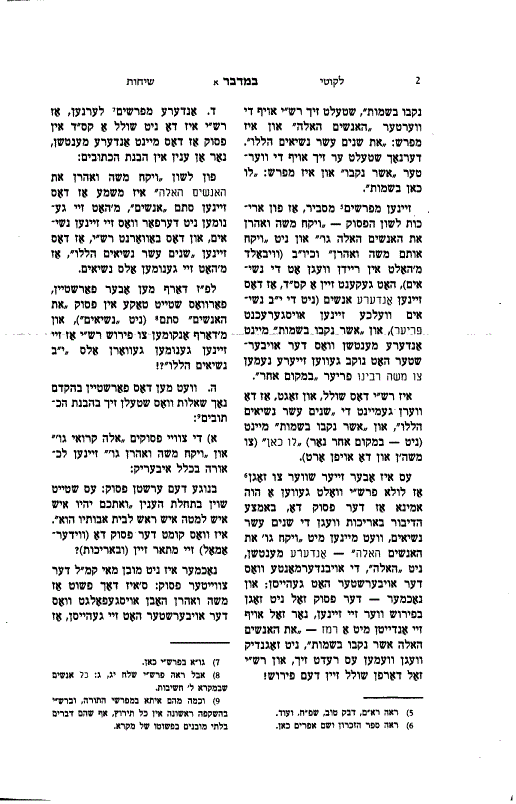
The discussion begins with the interpretation of the phrase kruyei ha'eidah. One might think that this means those who call or gather the community together—the ones who assemble the people. However, Rashi rejects this explanation and clarifies that kruyei ha'eidah refers instead to those who are being called, not those who do the calling.
Why does Rashi reject the idea that these are the ones who call the community? The role of the princes of the tribes is not to be those who summon everyone else; their importance is not defined by their ability to gather people. This is one approach to understanding Rashi’s intent.
Another interpretation focuses on the language itself, suggesting that kruyei ha'eidah means they are called by the community—that is, the community summons them. But this too seems unfitting for leaders and princes. If they are simply being called by others, it implies a lack of respect or status, as if the community holds a higher position because it can summon its leaders at will.
According to this view, when an important matter arises in the community, these leaders are called—not as a decree or command, but for advice and guidance. The calling here is not about authority over them but about seeking their counsel and correction. There’s a clear distinction between commanding someone and consulting them out of respect for their wisdom.
The Rebbe points out difficulties with both of these interpretations in Rashi. For example, if Rashi’s main goal was to reject the idea that kruyei means “those who call,” then he should have simply quoted the word kruyei from the verse. Instead, Rashi also includes eileh and eidah in his citation—why add these extra words?
Furthermore, if Rashi’s intent was only to reject one specific interpretation (that they are callers), perhaps there’s yet another possible meaning he wants to exclude: maybe kruyei ha'eidah refers not just to callers but to those with authority to assemble the community—those whose importance lies in their ability to bring everyone together.
This would actually highlight their significance: their power is demonstrated by their ability to summon others. If so, why does Rashi reject this as well? According to Rashi, their true importance is not in gathering people but in being called upon for all significant matters affecting the community—they are sought out for their wisdom and leadership.
If that’s what kruyei ha'eidah means, then we must ask: what exactly is wrong with saying that their greatness lies in being able to assemble or direct the community? Why does Rashi insist on a different explanation?
סעיף ב׳
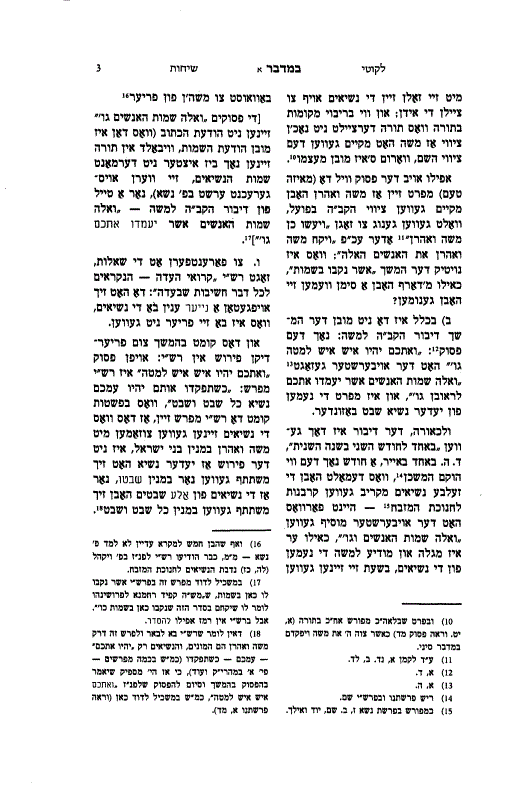
The question arises: if these are the ones who call the community together, which shows their importance, why does Rashi reject this explanation? After all, gathering the community to count them fits the context. So why doesn't Rashi accept that kruyei eidah means those who call the community?
The answer is that Rashi rejects this interpretation not because it doesn't fit the subject matter, but because it doesn't fit the meaning of the word. The word kruyei means "those who are called," not "those who call." Therefore, we can't interpret kruyei as referring to people who call others together due to their importance. It's self-evident that this is not what the word means, so there's no need for Rashi to explicitly reject that interpretation.
So why does Rashi feel compelled to address this at all? The issue is that even if kruyei means "those who are called," it still doesn't necessarily imply any special importance. Just being called upon doesn't mean they are leaders or have a unique status. Why should we assume they are important simply because they're called? Perhaps they're just being summoned for a task.
This leads to another point: maybe their being called is itself a sign of their distinction, and that's why they're mentioned. But again, just being called doesn't automatically make them significant; perhaps they're only being called for practical reasons. So why do we need to say they were called because of their importance?
The Rebbe points out that it's possible to interpret kruyei eidah as simply referring to those summoned for communal matters, without implying any special status. However, Rashi insists on interpreting it as referring specifically to leaders—those who are distinguished and appointed for leadership roles.
The discussion then turns to another phrase in the verse: anashim ha'eileh. Some might think this refers to other people whose names Hashem had previously given Moshe in another context. But this seems unlikely, since it's in the middle of discussing these very leaders. Why would it suddenly refer to different individuals?
Rashi clarifies that anashim ha'eileh refers specifically to the twelve princes just mentioned—shnei'm asar nesim halalu. When it says they were "mentioned by name," it means here and now—loykan, at this place and time—not somewhere else.
The Rebbe notes it's difficult to suggest that without Rashi's commentary, one might have thought these verses refer to other people entirely. It's clear from the context that we're talking about those already discussed—the twelve princes—and not some unrelated group.
If so, what is Rashi coming to clarify? Not merely rejecting an unlikely interpretation, but explaining a subtlety in understanding the verses themselves. The language of vayikach Moshe va'Aharon es anashim ha'eileh could be read as referring simply to ordinary people—it doesn't specify princes or leaders.
This could lead one to think Moshe took just anyone for this task, not specifically leaders. Therefore, Rashi emphasizes that these were indeed the twelve princes—their selection was due to their status as leaders.
If that's so, we must ask: why does the verse use the term "people" (anashim) instead of explicitly calling them "princes" (nesim)? Why leave it ambiguous and require Rashi's clarification?
The Rebbe will explain later that there is a specific reason for using "anashim" rather than "nesim." For now, he sets up further questions about these verses and how best to understand them according to both peshat and Rashi's approach.
סעיף ג׳
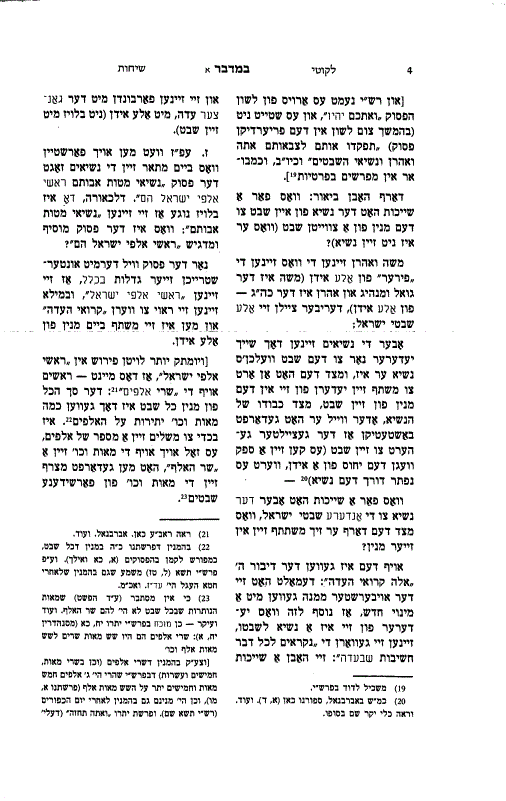
Let us analyze these verses. First, the two verses—“אלה קרואי העדה” (“these are the ones called by the community”) and “ויקח משה ואהרן”—seem, at first glance, to be superfluous. Earlier in the parsha, in verse 16, it already states: “אלה קרואי העדה נשיאי מטות אבותם ראשי אלפי ישראל הם.” Then it says, “ויקח משה את האנשים האלה שנקבו בשמות.” Why do we need these verses after all the tribes and their leaders have already been named?
Regarding the first verse—“אלה קרואי העדה נשיאי מטות אבותם ראשי אלפי ישראל הם”—the Torah had already stated at the beginning of this topic: “אתכם יהיו איש איש למטה איש ראש לבית אבותיו הוא,” meaning that each tribe would have its leader, head of his father’s house. So why does the Torah repeat at length who these people are? The verse is again describing them as “אלה קרואי העדה נשיאי מטות אבותם ראשי אלפי ישראל,” which was already established earlier.
The second verse—“ויקח משה ואהרן את האנשים האלה אשר נקבו בשמות”—is also puzzling. Why does it need to say that Moshe and Aharon took them? It is obvious that Moshe did as Hashem commanded. In most places, after Hashem gives a command, the Torah does not explicitly state that Moshe fulfilled it; it is self-understood. Even if for some reason the Torah wants to emphasize that Moshe fulfilled Hashem’s command in actuality, it would have sufficed to say simply that Moshe did as Hashem told him.
Furthermore, why does it specify “את האנשים האלה אשר נקבו בשמות”—that he took those mentioned by name? This was already stated previously. Why repeat it here?
Another difficulty concerns the flow of Hashem’s speech to Moshe. First, Hashem tells Moshe to count Bnei Yisrael from twenty years old and up. Then He says that with you will be one man from each tribe, and then enumerates who these people are by name.
The nesi’im—the leaders of each tribe—were counted individually and separately. The Torah states: “On the first day of the second month, in the second year after they left Egypt.” This took place for the first time in the second year after the Exodus, meaning on the first of Iyar.
The verse begins: “Hashem spoke to Moshe in the Wilderness of Sinai on the first day of the second month, in the second year.” This means that the counting occurred on the first of Iyar.
Now, the Mishkan had already been erected earlier, on the first of Nissan. It had therefore been standing for an entire month before this census took place. During that month, the nesi’im had already brought their korbanos for the dedication of the Mizbeach. Their offerings are later described in Parshas Naso, but chronologically they occurred beginning on the first of Nissan.
Thus, by the time this census happened, the leaders had already established their importance through the Chanukas Hamizbeach. These were the very same leaders who brought the korbanos during the dedication ceremonies.
The Rebbe then explains: since the Mishkan had already been set up and functioning, and the nesi’im had already offered their korbanos, it becomes understandable why they were now counted and recognized in this special manner through Moshe.The names of each group leader are listed individually. This all takes place on the first day of the second month in the second year after leaving Egypt—meaning on Alef Iyar. The verse begins: “וידבר ה׳ אל משה במדבר סיני באחד לחודש השני בשנה השנית.” This was after the Mishkan was erected and dedicated (between Alef and Yud Beis Nisan). The same leaders who brought korbanos for Chanukas HaMizbeach (as described later in Parshas Naso) are mentioned here first.
Why is this? It seems as if now Hashem is instructing Moshe about these leaders’ names at this moment—yet they were already known from before! They had already brought their korbanos starting from Alef Nisan. All these tribal heads were established leaders by then.
The Rebbe asks: Why does the Torah present it as if Hashem is telling Moshe something new about these leaders’ names? If it were just a list of names for informational purposes (as in Parshas Naso), that would be understandable—but here Hashem Himself is telling Moshe their names as if this is new information.
The verse states: “And with you there shall be one man from each tribe, each one the head of his father’s house.”
Rashi explains simply that the nesi’im were appointed together with Moshe over the counting of Bnei Yisrael. However, this does not mean that each nasi counted only the members of his own tribe individually. Rather, it means that the leaders of all the tribes participated together in the census of every tribe.
Rashi emphasizes this point carefully in his wording. The role of the nesi’im was not merely tribal representation, where each leader dealt exclusively with his own shevet; instead, they joined collectively with Moshe in conducting the census of all of Bnei Yisrael.When the verse says “with you shall be a leader for each tribe,” Rashi explains that this does not mean every nasi participated in counting every single tribe; rather, each nasi participated only with his own shevet. Rashi derives this from the plural language used: “אתכם יהיו”—they (plural) will be with you—which implies several nesi’im together with Moshe and Aharon.
This is further clarified by comparing to earlier verses: “תפקדו אותם לצבאותם אתה ואהרן ונשיא איש לבית אבותיו” (“You shall count them according to their legions—you and Aharon and a leader for each father’s house”). Here too we see that Moshe is the general leader; Aharon is Kohen Gadol; and then there are tribal leaders for each shevet.
Thus these nesi’im are not just local heads of their own tribes but now become connected to all of Klal Yisrael—they are counted among those who represent all of Israel. Their role expands beyond their own shevet; they become communal leaders for all Bnei Yisrael.
This explains why they are called both “נשיאי מטות” (tribal princes) and also “ראשי אלפי ישראל” (heads of thousands of Israel). At first glance one might think their only function was as tribal heads—but now they are described as heads over thousands within all Israel.
ראשי אלפי ישראל
This phrase means they were appointed over thousands—they were responsible not just for their own tribe but for large segments within Klal Yisrael as a whole.
Therefore they are called upon here as communal representatives—“קרואי העדה”—and included when counting all Bnei Yisrael together. This gives them a new status beyond being simply tribal leaders; they become part of leadership over all Israel.
This also clarifies why there is a second verse stating that Moshe took these men who were designated by name—it emphasizes their appointment to this broader communal role at this particular moment.
סעיף ד׳
Rashi does not simply state that Moshe and Aharon took the princes; rather, he specifies the taking of these particular men. What is unique about these individuals? These are the same twelve leaders mentioned earlier, but now their appointment is being renewed for a new purpose. Previously, they were known as princes of their tribes, but here they are distinguished as representatives of the entire community.
Rashi’s wording—“ויקח משה ואהרן את האנשים האלה”—emphasizes that Moshe and Aharon took these specific men, not merely as tribal leaders but as people who had been set apart from the rest of the nation. Their role was not limited to representing their own tribe; they were chosen as “קרואי העדה,” those called upon to represent the whole congregation.
This raises a question: Why was it necessary for each leader to participate in counting all the tribes? If their main function was to represent their own shevet, then for the collective count of Bnei Yisroel, Moshe and Aharon alone would suffice. The leaders’ involvement seems superfluous if their connection is only to their individual tribes.
The answer lies in understanding the deeper purpose of counting. As Rashi explains, counting expresses Hashem’s love for Bnei Yisroel. The Shaloh adds that when something is counted individually, it cannot become nullified; its significance is preserved because it is recognized as an individual entity.
There are two types of counts described in the Torah. The first count treated all Jews as one collective unit, without distinction between tribes. This highlights the essential unity and equality of every Jew—the level where differences between individuals do not exist.
However, our parsha introduces a different kind of count: each tribe is counted separately. This emphasizes not just the collective value of Bnei Yisroel but also the unique qualities and strengths found within each shevet. The blessings given by Yaakov Avinu and explained by Rashi illustrate how each tribe had its own distinct character and mission.
These differences extend to their service of Hashem—there are twelve general paths in avodah corresponding to the twelve tribes. Thus, this census highlights both individuality and unity: every shevet has its own way of serving Hashem, yet all are part of one nation.
This duality creates a paradox. On one hand, each tribe—and indeed each Jew—has unique qualities and a distinct role. On the other hand, when counted, everyone is counted equally: no one more or less than another. Even those with greater spiritual stature or leadership are counted as “one,” just like those whose roles seem more modest.
This teaches us that while we recognize and celebrate individual greatness, true completeness comes only when all parts—each with its unique contribution—join together to form a unified whole. Just as a body needs both head and foot to be complete, so too does Klal Yisroel require every member’s contribution for true wholeness.
Therefore, it was necessary for each Nasi to participate in counting all Yidden—not just his own tribe—by virtue of being “קרואי העדה,” representatives of the entire community. This ensured that even within each tribe’s separate count, there remained an awareness that every Jew is part of something larger than himself—a vital component in making up Am Yisroel as a whole.
In summary, this census teaches us both about our individual strengths and our indispensable place within Klal Yisroel. Each person’s unique qualities contribute to—and are only fully realized within—the unity of the Jewish people.
They joined together with Moshe in conducting the census. Through this, they were called “the leaders of the congregation” (keri’ei ha’eidah).
They were the ones summoned and recognized for every important matter concerning the congregation. Through them, each tribe was counted as its own distinct entity.
And this distinction was not expressed only in the fact that there was a separate census for each tribe as a whole, but also in the counting of the individual members within each tribe.
This is Besiches Shabbos Parshes Bamidbar Tovshin Lamed Vov.
Key Points of the Sicha.
1. In this sicha, the Rebbe analyzes Rashi’s commentary on the phrase "kruyei ha'eidah" at the beginning of Parshas Bamidbar. He compares Rashi’s explanation to those of other Meforshim, demonstrating why their interpretations do not align with the straightforward meaning of the text (peshuto shel mikra), which is always Rashi’s focus. The Rebbe clarifies Rashi’s intent and explains why his reading best fits the context of the Torah’s description of the census and the role of the tribal leaders (Nesi’im).
2. The Rebbe discusses two main interpretations regarding "kruyei ha'eidah." One suggests it means those who call or gather the community, but Rashi rejects this, clarifying that it refers to those who are called upon by the community. Another view holds that being called by others implies a lack of status, but Rashi distinguishes between being summoned for advice out of respect versus being commanded. The Rebbe questions why Rashi cites extra words from the verse and explores whether "kruyei ha'eidah" could refer to those with authority to assemble others. Ultimately, he concludes that their significance lies in being sought for their wisdom and leadership, not merely in their ability to summon or direct others.
3. The Rebbe explains that although gathering the community is an important function, Rashi rejects interpreting "kruyei" as "those who call," because linguistically it means "those who are called." However, simply being called does not necessarily confer importance; perhaps they are summoned only for practical reasons. Rashi insists that "kruyei ha'eidah" refers specifically to leaders appointed for communal roles. The Rebbe addresses why the Torah uses ambiguous terms like "anashim" (people) instead of explicitly calling them "nesi’im" (princes), noting that Rashi clarifies these were indeed the twelve princes chosen for their leadership status.
4. The Rebbe analyzes why certain verses seem repetitive or superfluous—such as restating who the leaders are and specifying that Moshe took those mentioned by name—when these facts were already established earlier in the parsha. He notes that Hashem’s instructions about these leaders’ names appear as if they are new information, even though these individuals were already known as tribal heads and had previously brought offerings. The Rebbe explains that each Nasi participated only with his own shevet in counting, but through this process they became connected to all of Klal Yisrael as communal representatives ("kruyei ha'eidah"), expanding their role beyond just tribal leadership.
5. The appointment of these leaders as "kruyei ha'eidah" signifies a new communal function: they are now responsible not only for their own tribes but also serve as heads over thousands within all Israel ("rashei alfei Yisrael"). This dual status is reflected in their inclusion in both tribal and national leadership roles. The Torah emphasizes Moshe taking these men by name to highlight their formal designation for this broader responsibility at this particular moment.
6. Rashi’s precise wording underscores that Moshe and Aharon selected these specific men not merely as tribal princes but as individuals set apart for representing all Israel. Their renewed appointment was necessary because counting Bnei Yisroel involved both collective unity and individual distinction among tribes. While each shevet has unique qualities and a distinct mission—reflected in separate counts—the unity of Am Yisroel is preserved through equal participation in the census. This teaches that true completeness comes when every individual contributes their unique strengths within a unified whole; thus, each Nasi participated in counting all Jews as representatives ("kruyei ha'eidah") to maintain both individuality and unity within Klal Yisroel.