מבוא
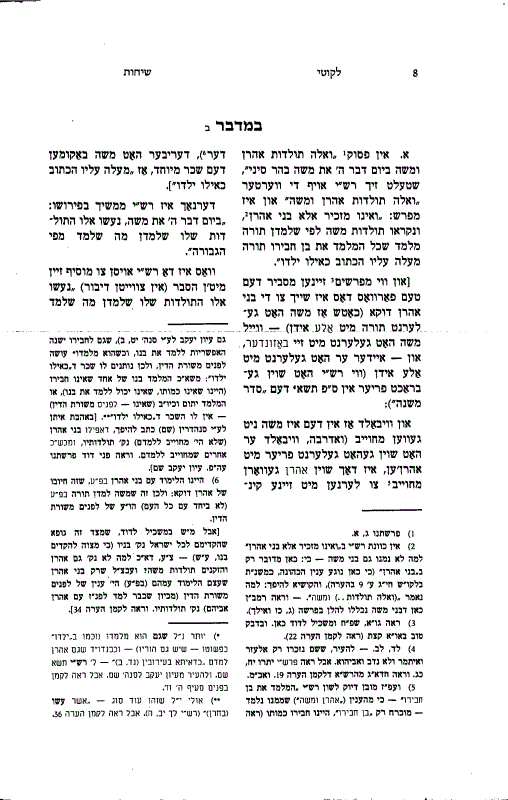
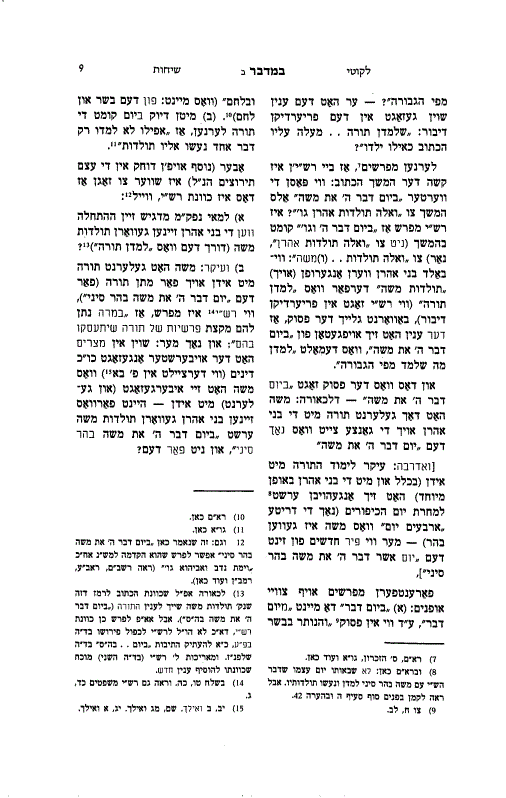
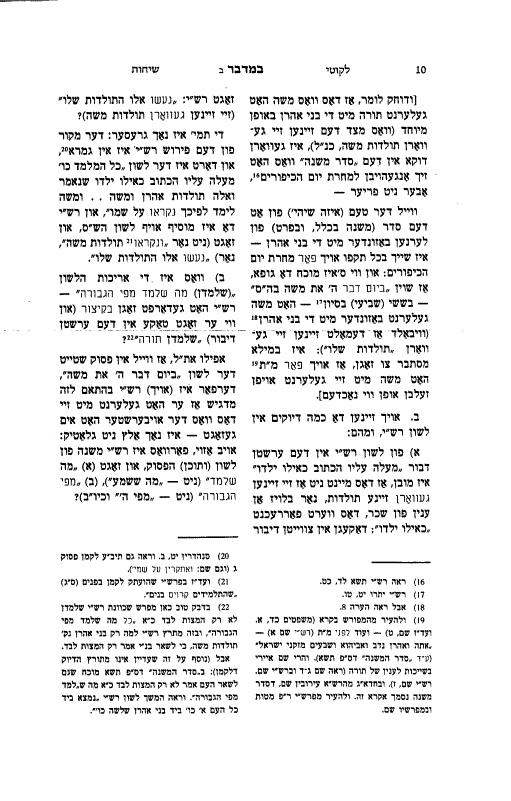
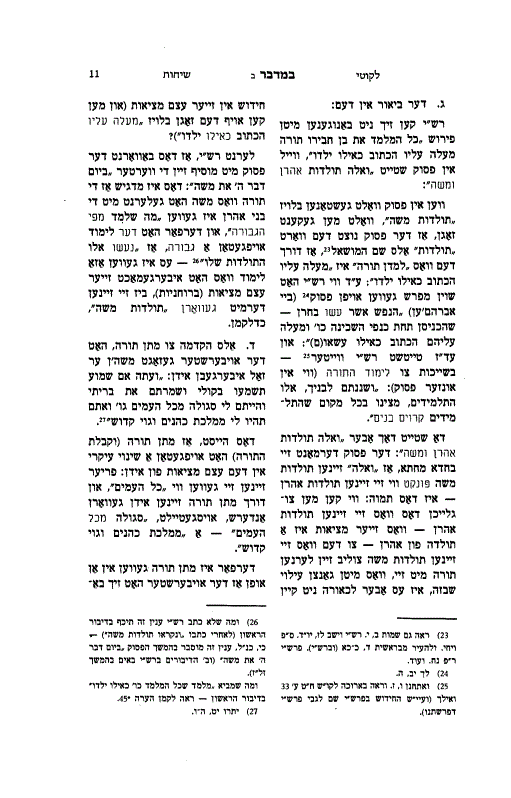
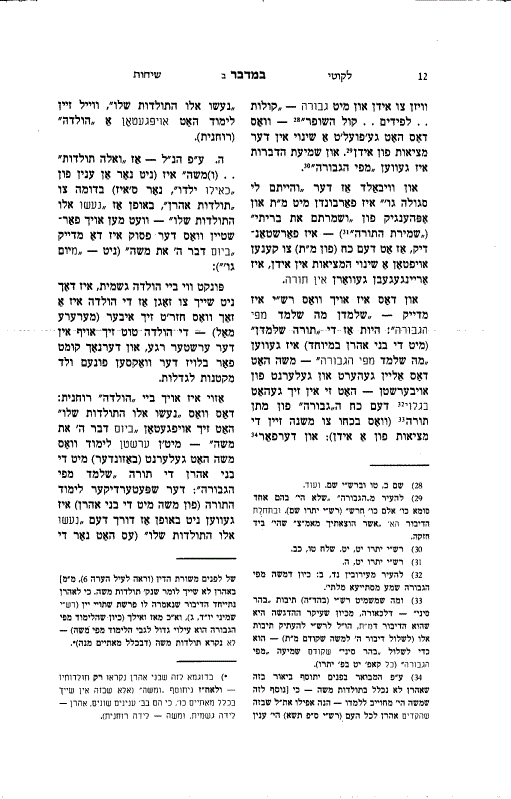
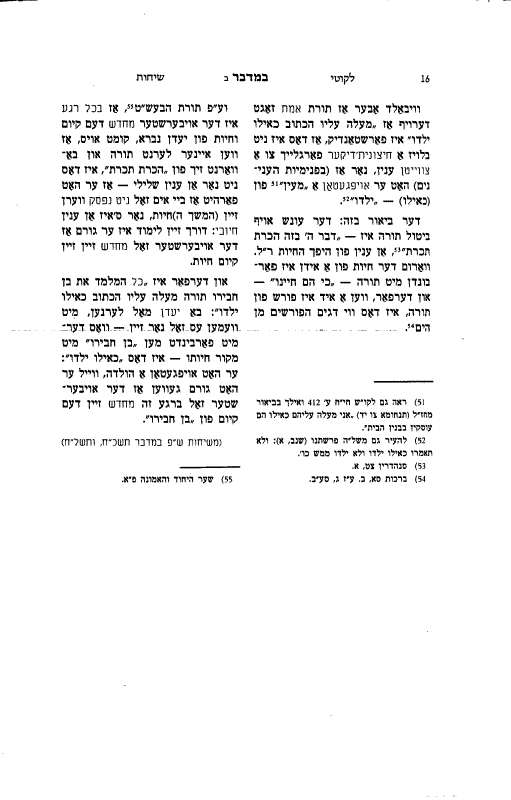
In this review, we will study a sicha from Likkutei Sichos, Chelek Chof-Gimel (volume 23), the second sicha on Parshas Bamidbar. This is a Rashi-focused sicha, where the Rebbe analyzes Rashi’s commentary on the idea that when a person teaches Torah to the child of his friend, it is considered as if he gave birth to him.
Rashi brings this concept from the verse that says Moshe “gave birth” to the sons of Aharon—referring to their descendants—even though Moshe did not physically give birth to them. Rather, since he taught them Torah, it is considered as if they are his children.
The Rebbe explores this explanation in depth and raises several questions about it. Ultimately, the Rebbe’s main point is that there is a special power granted from Matan Torah: since the Jewish people learned Torah directly from Moshe Rabbeinu, who received it “Pi HaGevurah”—directly from Hashem—this gave Moshe a unique ability. It was considered as if he actually gave birth to Aharon’s sons by teaching them Torah in this way.
This special power is not limited to Moshe’s generation; rather, every Jew in all generations possesses this potential, as will be explained further in the sicha.
Let’s begin inside and go step by step. The verse states:
וְאֵלֶּה תּוֹלְדוֹת אַהֲרֹן וּמֹשֶׁה בְּיוֹם דִּבֶּר ה׳ אֶת מֹשֶׁה בְּהַר סִינַי
“These are the generations of Aharon and Moshe on the day that Hashem spoke with Moshe at Har Sinai.”
Rashi comments on the words וְאֵלֶּה תּוֹלְדוֹת אַהֲרֹן וּמֹשֶׁה—“these are the generations of Aharon and Moshe.” As we continue reading, we see that the verse only lists Aharon’s children and does not mention any children of Moshe. Why then does the Torah say “the generations of Aharon and Moshe”?
Rashi explains: “Because he taught them Torah, it is considered as if they are his children.” In other words, even though only Aharon’s sons are listed, they are called also ‘the generations of Moshe’ because Moshe taught them Torah.
סעיף א׳
The Torah teaches us that anyone who teaches Torah to the son of his friend is considered by the verse as if he gave birth to him. This is derived from the fact that Moshe Rabbeinu taught Torah to the children of Aharon, and therefore, they are also considered his descendants. That is why the verse refers to “the offspring of Aharon and Moshe.”
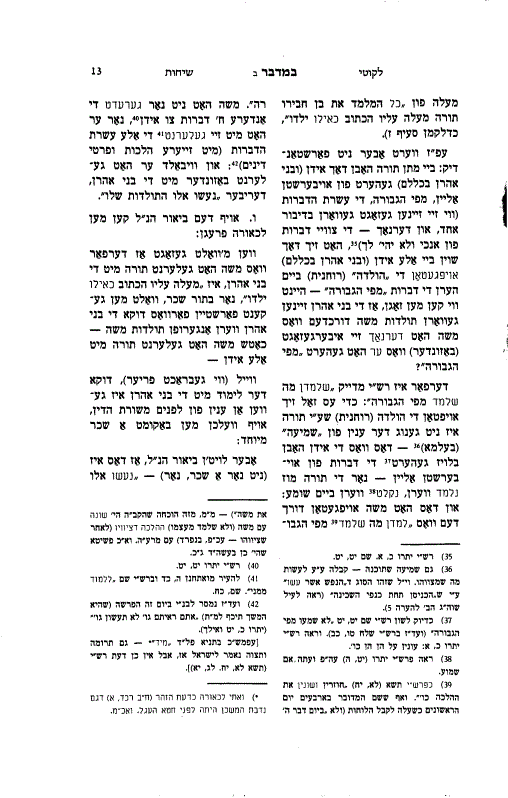
Um vi meforshim zayinem mazvir dem tam—The commentators explain why this special status is attributed specifically to the sons of Aharon. Why do we call them the children of Moshe as well? After all, Moshe taught Torah to all Jews, not just Aharon's sons.
Although Moshe Rabbeinu taught Torah to all of Bnei Yisrael, there was something unique about his teaching to Aharon's sons. While all Jews heard the Torah together from Moshe, he taught the sons of Aharon individually, before teaching it to everyone else. This special instruction set them apart.
Rashi already explained earlier at the end of Parshas Ki Sisa how Moshe would teach: first to Aharon alone, then to Aharon's sons, and only afterwards to all of Bnei Yisrael. Thus, the sons of Aharon received their lesson before everyone else.
This order was not obligatory for Moshe Rabbeinu; he was not required to teach Aharon's sons ahead of everyone else. In fact, once he had taught Aharon himself, it became Aharon's own responsibility as a father to teach his children. Nevertheless, Moshe went beyond what was required and personally taught them first.
Because Moshe took this extra step, he received a unique reward: the verse considers it as if he gave birth to them. That is why they are called “the offspring of Aharon and Moshe”—they are also considered Moshe’s spiritual children.
Rashi continues in his commentary on this point. The verse says:
ביום דבר ה׳ אל משה
On the day that Hashem spoke to Moshe—Rashi explains that this is when these students became his descendants. That is when they became “his generations,” because Moshe taught them what he had learned directly from Hashem (mi pi ha’gevurah).
The question arises: What is Rashi adding with this second explanation? He already stated in his previous comment that since Moshe taught them Torah, it is considered as if he gave birth to them. Why does Rashi elaborate further?
The commentators explain that Rashi noticed a difficulty with the flow of the verse. How do the words “on the day that Hashem spoke to Moshe” connect with “these are the offspring of Aharon”? The phrase seems out of place—what does being Aharon's children have to do with the specific day Hashem spoke?
Rashi clarifies that “on the day Hashem spoke” does not refer back merely to their being Aharon's children; rather, it connects specifically with their being called also “the offspring of Moshe.” Since they are referred to as both Aharon's and Moshe’s children—because Moshe taught them Torah—the Torah immediately tells us that this status was achieved on that very day when Hashem spoke with Moshe.
This means: when Hashem was teaching Moshe, at that moment, Moshe began teaching what he learned directly from Hashem to Bnei Aharon. That is why they are called both “the offspring of Aharon” and “the offspring of Moshe.”
But if so, why does the Torah specify only “on the day Hashem spoke”? Shouldn’t this apply for all subsequent times as well? After all, didn’t Moshe continue teaching Torah to Bnei Aharon even after that initial day?
סעיף ב׳
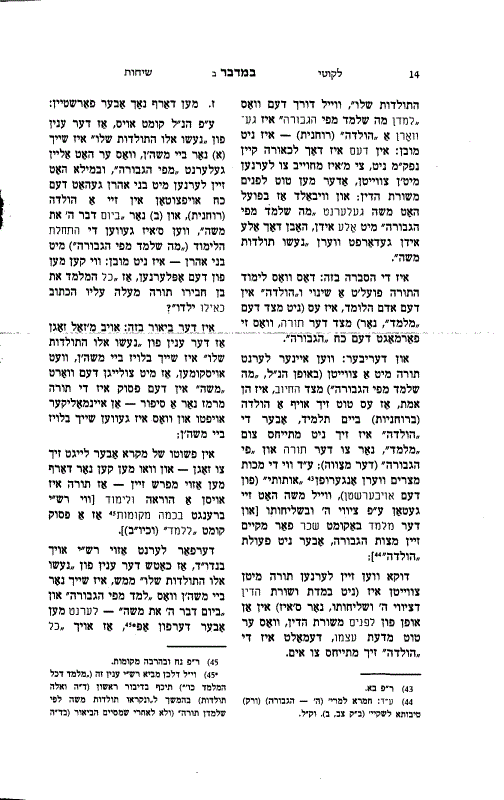
The Rebbe begins by addressing the phrase, “on the day that Hashem spoke to Moshe.” The Torah seems to limit the special status of Aaron’s sons as Moshe’s children to that specific day. Yet, Moshe continued teaching Torah to the Jewish people and especially to Aaron’s sons well beyond that day. Why, then, does the Torah specify only “on the day” that Hashem spoke to Moshe?
In fact, not only did Moshe continue teaching them, but the main period of Torah instruction—both to all Jews in general and especially to Aaron’s sons—began after Yom Kippur. This was after the third set of forty days that Moshe spent on Har Sinai. The first forty days were for receiving the Luchot; after breaking them, he prayed for another forty days; then he ascended again for a final forty days until Yom Kippur, when Hashem forgave Bnei Yisrael and said “סלחתי כדבריך.” Only after this did Moshe come down and begin teaching Torah in earnest.
This means that more than four months passed from when Hashem first spoke to Moshe at Har Sinai until this main period of teaching began. So why does the Torah use the phrase “ביום דבר ה׳ אל משה”—“on the day Hashem spoke to Moshe”—as if it all happened immediately?
The commentators offer two explanations. First, they suggest that “ביום” doesn’t literally mean “on that day,” but rather “from that day onward.” This is similar to other verses where a prefix like ב־ or מ־ means “from” rather than “in” or “on.” For example, in the verse about leftover meat from a korban—“והנותר בבשר”—the word בבשר means “from the meat,” not “in the meat.” So too here: “ביום דבר” means “from the day Hashem spoke,” not just on that particular day.
But even with this explanation, there remains a deeper question: Why does the Torah emphasize this point at all? Why is it so important to stress that Aaron’s sons became considered Moshe’s children because he taught them Torah? And why connect it specifically to this time period?
The Rebbe points out another difficulty: If we say they became his children because he taught them Torah, why mention their childhood? After all, Moshe taught Torah both before and after they were children. Perhaps one might argue that at this time there was something unique about his teaching—that now they needed him more than before—but it is difficult to say there was such a drastic change in their relationship or in his role as their teacher.
Furthermore, if we look at how things were organized before and after Yom Kippur, there seems no essential difference in how Moshe related to Aaron’s sons or taught them Torah. Even before Yom Kippur, during Matan Torah itself—whether it was on Friday or Shabbat—the same pattern existed: Moshe was already involved in instructing Bnei Yisrael and Aaron’s sons.
Therefore, it is puzzling why the verse singles out this moment as when Aaron’s sons became considered Moshe’s children through his teaching. If nothing fundamentally changed at this point compared to earlier times—such as before Matan Torah—why does the Torah highlight it?
The Rebbe suggests that perhaps there is something uniquely significant about what happened at Matan Torah itself—a point he promises to clarify later in the sicha. But for now, he raises several questions about Rashi’s language and approach here.
One question is based on Rashi’s wording: If the verse had simply stated “אלה תולדות משה”—“these are the offspring of Moshe”—we might have said it uses a borrowed term (שם המושאל), meaning not literal biological children but spiritual offspring through teaching. This would be similar to how Rashi explains other verses where spiritual influence is described as if one had created or given birth.
For example:
הנפש אשר עשו בחרן
Rashi explains there that Avraham and Sarah brought people under the wings of Shechinah, so Scripture considers it as if they made those souls themselves.
Similarly here: Through teaching Torah, it is considered as if Moshe gave birth to Aaron’s sons spiritually.
סעיף ג׳
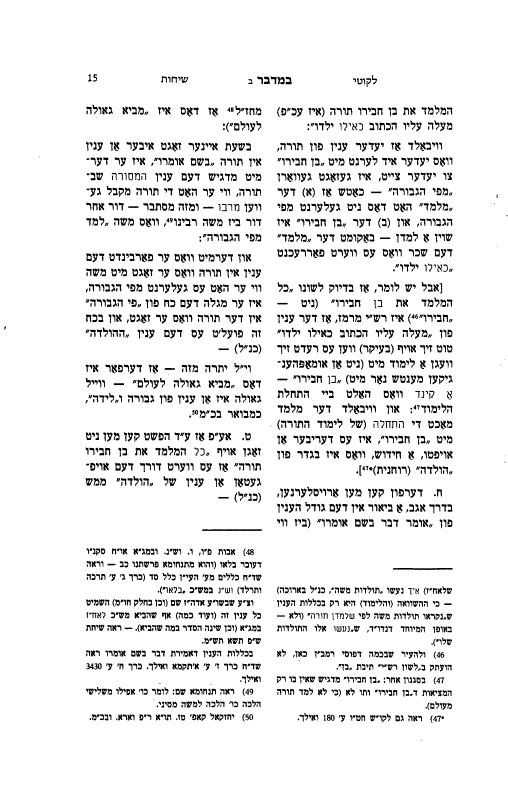
In our verse, we see the Torah discussing the concept of children, but here it is referring specifically to Torah study. The verse states, v’shinantam l’vanecha—you should teach them to your sons—and Rashi explains that “your sons” here refers to your students. We find in many places that students are called sons. So when the verse says v’shinantam l’vanecha, it is referring to students; students are considered like children.
This explanation would suffice if the verse had only said eileh toldos Moshe. However, the verse actually says v’eileh toldos Aharon u’Moshe, mentioning both Aharon and Moshe together in one phrase. The Torah equates these two: these are the children of Moshe, exactly as they are the children of Aharon. Since the Torah uses this inclusive language—toldos Aharon u’Moshe—it raises a question: how can we equate them?
Aharon’s sons are literally his biological children. How can we say that they are also Moshe’s children just because he taught them Torah? Even though teaching Torah is a tremendous merit and students are called “children,” it does not seem to be a true novelty regarding their essential existence—they do not actually become someone else’s children in reality.
The most we could say is what the Sages teach: ma’aleh alav hakasuv k’ilu yelado—the Torah considers it as if he gave birth to them. But not that they truly became his actual children in essence.
This is what Rashi comes to clarify with his commentary on our verse. Rashi adds the words: “On the day that Hashem spoke to Moshe.” This emphasizes that the Torah which Moshe taught to Aharon’s sons was unique—it was what he learned directly from Hashem, described as mipi haGevurah, from the mouth of the Mighty One.
This detail highlights that this was not an ordinary teaching; rather, learning Torah directly from Hashem endowed Moshe’s teaching with a special strength—gevurah. This power transformed those who learned from him so deeply that they became his spiritual children in a real sense.
Their spiritual existence was changed through this unique transmission of Torah. It was such an intense form of study—Torah received directly from Hashem—that it altered their very spiritual essence, making them truly Moshe’s children through Torah.
The Rebbe now explains how this works. Before Matan Torah (the giving of the Torah), Hashem tells Moshe to convey a message to Bnei Yisrael: if you listen to My voice and keep My covenant, you will be My treasured nation among all peoples—a kingdom of priests and a holy nation.
ואתם תהיו לי ממלכת כהנים וגוי קדוש.
This means that through accepting and receiving the Torah, there was a fundamental change in the very essence of Bnei Yisrael. Previously, they were like all other nations; after Matan Torah, they became different—set apart as a treasured people, a kingdom of priests and a holy nation.
This transformation required an act of divine strength—gevurah. That is why Matan Torah occurred with such might: thunder, lightning, shofar blasts—all expressions of Hashem’s power. This display brought about a real change in their existence.
The hearing of the commandments at Sinai is described as coming mipi haGevurah, from Hashem Himself—the source of strength—which effected this essential transformation in Bnei Yisrael.
וכל העם רואים את הקולות ואת הלפידים ואת קול השופר.
Since becoming Hashem’s treasured nation depends on Matan Torah and on keeping His covenant—the observance of Torah—it follows that this transformative power resides within Torah itself. When Jews learn and keep Torah, it has the ability to change their very existence.
This is why Rashi is precise in his wording: “that which he learned from mipi haGevurah.” The teaching that Moshe gave specifically to Aharon’s sons was what he had received directly from Hashem. That study openly contained within it the power and strength of Matan Torah—the capacity to transform one’s spiritual identity.
This unique aspect made them into Moshe’s true spiritual children—not just metaphorically or by virtue of teaching alone, but because his transmission carried with it an element of spiritual birth through divine strength. Thus, through learning this special level of Torah from Moshe, Aharon’s sons became his children in essence.
סעיף ד׳
Based on the above, we explained that Moshe and Aharon’s sons became, in a very real sense—not just as if, but truly—Moshe’s children through the power of the gevurah of Matan Torah. The verse says, “אלה תולדות,” and Moshe is not merely like a father to them in a figurative way, nor is he simply a successor to Aharon’s children. Rather, “אלה תולדות משה ואהרן”—these became his children in actuality.
When we understand what the verse is accomplishing with this wording, we can also appreciate why it specifically says “ביום,” on the day, and not “מיום”—not “from that day onward.” Just as with physical birth, it would not make sense to say that birth repeats itself many times; birth happens at one moment. Afterwards, the child grows and develops, but the act of being born is a single event. The same applies to spiritual birth: when they became Moshe’s children, it was accomplished “ביום דיבר ה׳ את משה”—on that day.
What was unique about that day? It was the first time Moshe taught something special to Aharon’s sons—a teaching he received directly from Hashem with unparalleled clarity and power. This was when they were given something unique.
Afterwards, even though Moshe continued to teach Aharon’s sons separately, there was nothing else that matched this special transmission. They were not given anything fundamentally new; it was only a repetition or review of what had already been taught. This is similar to any student who learns from his teacher—there is growth and development, but not another act of creation or birth.
So if this unique spiritual birth happened when Moshe taught them what he learned directly from Hashem—what about everyone else? Didn’t all of Bnei Yisrael hear Torah directly from Hashem at Matan Torah? Why are only Aharon’s sons called Moshe’s children?
Here Rashi is precise: he writes “שלימדם מה שלמד מפי הגבורה”—that he taught them what he learned from the mouth of Gevurah (Hashem). Not just that he passed on what he heard, but that he actively taught them what he himself had absorbed from Hashem.
This distinction is crucial. For spiritual birth through Torah to occur, it is not enough merely to hear—it must be studied and internalized. The fact that all Jews heard the Ten Commandments directly from Hashem did not itself create this transformation; Torah must be learned and absorbed through active study.
This is what Moshe accomplished: after teaching them what he learned from Hashem Himself—“לימדם מה שלמד מפי הגבורה”—he made them into his spiritual offspring. It wasn’t just about relaying information; it was about learning together in depth—all ten commandments and their detailed laws.
Moshe studied separately with Aharon’s sons. Because of this extra effort—this individualized teaching—they became his true spiritual children. Through this process, their very identity changed; they became a holy nation through Torah study with Moshe Rabbeinu.
This raises a question: why specifically Aharon’s sons? Didn’t Moshe teach all of Bnei Yisrael? If this transformation comes through learning Torah from Moshe, then seemingly all Jews should be considered his spiritual children—not just Aharon’s sons.
If we were to say that calling Aharon’s sons Moshe’s children is simply a reward for going beyond his obligation (since teaching them separately was above and beyond), then we could understand why only they are singled out—it would be a special payment for extra effort.
But according to our explanation—that their status as Moshe’s children comes because teaching them created a new spiritual reality—this should apply equally to all Jews whom Moshe taught Torah! In such a case, whether or not it was obligatory should make no difference; anyone who receives Torah in this way should become his spiritual child.
סעיף ה׳
The Rebbe begins by addressing a fundamental question: since Moshe Rabbeinu taught all of the Jewish people Torah, in a sense, all Jews should be considered his children. If so, why does the Torah specifically refer to the sons of Aharon as Moshe’s children? This is more than just a reward for Moshe; it points to something deeper about the nature of teaching Torah.
The explanation is that when someone teaches Torah, it creates a spiritual transformation—a kind of birth—in the student. However, this transformation is not due to the teacher’s personal qualities, but rather because of the inherent power of Torah itself. The impact comes from the Torah, not from the individual who transmits it.
Even when one teaches another Torah using their own words and fulfills their obligation to teach, while it is true that this brings about a spiritual birth in the student, that birth is not attributed to the teacher personally. Instead, it is credited to the Torah and its divine source. The teacher receives reward for fulfilling Hashem’s mitzvah, but not for creating that spiritual “birth”—that belongs to Hashem and His Torah.
This concept can be compared to Moshe’s role in performing the plagues in Egypt. Although Moshe carried out these acts, they are referred to as Hashem’s signs and wonders because Moshe acted solely on Hashem’s command. The accomplishment is attributed to Hashem, not Moshe personally.
Therefore, when someone teaches Torah out of obligation—because he must—the effect is not considered his own accomplishment. Only when a person goes beyond what is required by law and teaches another out of his own initiative does he truly become like a parent to his student; then it can be said that he “gave birth” to them spiritually.
Applying this idea to Moshe Rabbeinu: when he taught Aharon’s sons even though he was not obligated to do so, he became like their father in a spiritual sense. The credit for their growth in Torah was attributed directly to him because he went beyond his formal duty.
This leads to an apparent contradiction: if this special status only applies when someone teaches voluntarily and beyond obligation—as was unique with Moshe—how can Rashi say that anyone who teaches another’s child Torah is considered as if he gave birth to him?
Even though Moshe Rabbeinu learned directly from Hashem Himself — mi’pi hagevurah — nevertheless, when he later taught the Bnei Aharon, that learning possessed the power to be transmitted outward and passed on further.
In other words, although Moshe’s Torah came directly from the mouth of Hashem, its true completion was when it could be taught over to others, specifically to the Bnei Aharon.This means that since Moshe learned directly from Hashem—pi ha’gevurah—his teaching had unique power. When the Torah adds Moshe’s name alongside Aharon’s sons in this context, it hints at something more than just a one-time event; it signals an ongoing lesson for us all.
In peshuto shel mikra—the simple meaning of the verse—it makes sense that the Torah isn’t just telling us what happened once with Moshe and Aharon’s sons. Rather, it wants us to learn an enduring lesson: whenever someone teaches another person’s child Torah—even if not on Moshe’s level—the act is counted as if he gave birth to him.
This is why Rashi emphasizes that even though only Moshe could literally create such spiritual children through teaching directly from Hashem, we still learn from here that anyone who teaches another's child Torah receives credit as if he gave birth to him. Every aspect of Torah study contains some element of this transformative power because every word ultimately comes from Hashem.
However, Rashi uses precise language: “one who teaches his friend’s son,” rather than simply “one who teaches his friend.” This highlights that we are speaking about teaching a child—someone just beginning their journey in learning—not an independent adult scholar. The teacher who opens up this path for a young student achieves something especially significant; he initiates their connection with Torah and thus earns this unique merit.
סעיף ו׳
When you teach someone Torah, you are not simply imparting information—you are establishing them, putting them on their feet. This is akin to a spiritual birth. That is why it is described as starting someone off with a blessing; you are giving them a new beginning.
This concept also sheds light on the importance of quoting something in the name of the one who originally said it. Our sages teach that “one who says something in the name of its originator brings redemption to the world.” The Gemara illustrates this with Esther, who told King Achashverosh about the plot against him in Mordechai’s name, which ultimately led to the miracle of Purim.
When a person shares a Torah teaching and attributes it to its source, he is connecting himself—and his student—back through an unbroken chain of transmission. Each teacher received from his own teacher, generation after generation, all the way back to Moshe Rabbeinu. Moshe learned Torah directly from Hashem—Pi HaGevurah.
By linking your words of Torah to your teacher, and through him all the way back to Moshe and Hashem, you reveal and draw down the power of Pi HaGevurah into your own teaching. This connection empowers your words with a unique strength and vitality—the very energy of Divine revelation.
This is why such transmission can be described as “birth.” It is not merely an analogy; there is an essential similarity. Just as physical birth brings new life into the world, teaching Torah in this way brings about spiritual renewal and strength—a rebirth for both teacher and student.
The Talmud says that if you teach Torah to your friend’s child, it is considered as if you gave birth to him. While we cannot say this literally in every case, the Torah itself uses this language: it counts as if you have given birth. This is not just a superficial comparison; there is a deep inner connection between teaching Torah and giving life.
On the other hand, neglecting Torah study carries a severe consequence. The punishment for wasting time from Torah—bitul Torah—is described as “V’Nafsho Hikorais Tikareis”—the soul will be cut off. This reflects how essential Torah is to Jewish life; our very existence depends on our connection to Torah.
The life-force of a Jew comes from Torah—ki hem chayeynu (“for they are our life”). When one separates from Torah, it is like a fish leaving water; just as a fish cannot survive outside its natural environment, so too a Jew cannot survive spiritually without Torah.
Based on Chassidus, we understand that Hashem constantly renews creation at every moment. When you learn Torah and connect another Jew to it—ben havayre—you are helping renew his existence by keeping him attached to his source of life.
This idea encapsulates the power and responsibility inherent in teaching Torah: by transmitting it faithfully and attributing it properly, you sustain spiritual life for yourself and others. This was discussed in Sichos Shabbos Parshas Bamidbar, 5728 (1968) and 5738 (1978).
Key points
1. The Torah teaches that anyone who instructs his friend’s child in Torah is regarded by Scripture as if he himself gave birth to that child. This is derived from Moshe Rabbeinu, who taught Torah to the sons of Aharon, and thus they are also considered his descendants. Although Moshe taught all of Bnei Yisrael, there was a unique aspect to his teaching of Aharon’s sons: he instructed them individually before teaching the rest of the nation, an act that was not obligatory but done out of his own initiative. Because Moshe went beyond what was required and personally taught them first, the verse considers it as if he gave birth to them, hence they are called “the offspring of Aharon and Moshe.” Rashi further clarifies that this status was achieved specifically “on the day Hashem spoke to Moshe,” when Moshe transmitted what he learned directly from Hashem to Aharon’s sons, thereby making them his spiritual children at that moment.
2. The Rebbe addresses why the Torah specifies “on the day that Hashem spoke to Moshe,” seemingly limiting this special status to a particular time, even though Moshe continued teaching Torah afterward. Commentators suggest “on the day” can mean “from that day onward,” yet a deeper question remains: why emphasize this point at all? The Rebbe notes that there appears to be no essential difference in Moshe’s relationship with Aharon’s sons before or after Matan Torah; thus, why does the verse single out this moment as when they became his children through Torah instruction? He suggests there must be something uniquely significant about Matan Torah itself and raises questions about Rashi’s language—especially regarding whether this is merely a borrowed term or reflects an actual transformation akin to spiritual birth.
3. The verse equates Aharon’s sons being both Aharon’s biological children and Moshe’s spiritual children through Torah study. While students are often called “children” in rabbinic literature, here the Torah places both on equal footing—raising the question of how teaching alone could effect such an essential change. Rashi clarifies by emphasizing that Moshe taught them what he learned directly from Hashem—mipi haGevurah (“from the mouth of the Mighty One”). This unique transmission endowed their learning with transformative power, fundamentally altering their spiritual existence so they became truly Moshe’s children in essence. This parallels how Matan Torah itself transformed Bnei Yisrael into a treasured nation—a change effected by divine strength manifest in Torah study received directly from Hashem.
4. Thus, through the gevurah (strength) of Matan Torah, Aharon’s sons became genuinely Moshe’s children—not merely figuratively but in actuality—at a specific moment: “on the day Hashem spoke to Moshe.” Just as physical birth occurs at one time, so too did their spiritual birth happen when Moshe taught them what he had received directly from Hashem. Subsequent teachings were only repetitions or reviews; only this initial transmission constituted true spiritual creation. However, since all Jews heard Torah at Sinai, why are only Aharon’s sons called Moshe’s children? Rashi is precise: it is not enough merely to hear; true transformation requires active study and internalization. Only through individualized instruction did Aharon’s sons become his spiritual offspring—a status not automatically conferred upon all who heard at Sinai.
5. The Rebbe explains that while teaching Torah effects a kind of spiritual birth in students, this transformation stems from the inherent power of Torah itself—not from the personal qualities of the teacher. When one teaches out of obligation, any resulting spiritual renewal is attributed to Hashem and His Torah; only when one goes beyond obligation and teaches voluntarily does he become like a parent to his student. Thus, when Moshe taught Aharon’s sons without being required to do so, he became their spiritual father. Yet Rashi generalizes: anyone who teaches another's child Torah is considered as if he gave birth to him—even if not on Moshe's level—because every word of Torah ultimately derives from Hashem. Rashi specifies “one who teaches his friend’s son,” highlighting that initiating a child into learning carries special merit akin to giving life itself.
6. Teaching someone Torah is not merely imparting knowledge but establishing them spiritually—a form of rebirth. This underlies our sages’ teaching that quoting something in its originator's name brings redemption: each link in transmission connects back through generations to Moshe Rabbeinu and ultimately Hashem (Pi HaGevurah), imbuing every lesson with divine vitality. Such transmission constitutes true spiritual birth; just as physical birth brings new life, so too does faithful teaching renew both teacher and student spiritually. Conversely, neglecting Torah severs this connection—bitul Torah leads to spiritual extinction (“V’Nafsho Hikorais Tikareis”). Since our very existence depends on attachment to Torah (“ki hem chayeynu”), transmitting it faithfully sustains Jewish life across generations—a responsibility highlighted in Chassidus and discussed in Sichos Shabbos Parshas Bamidbar 5728 and 5738.