
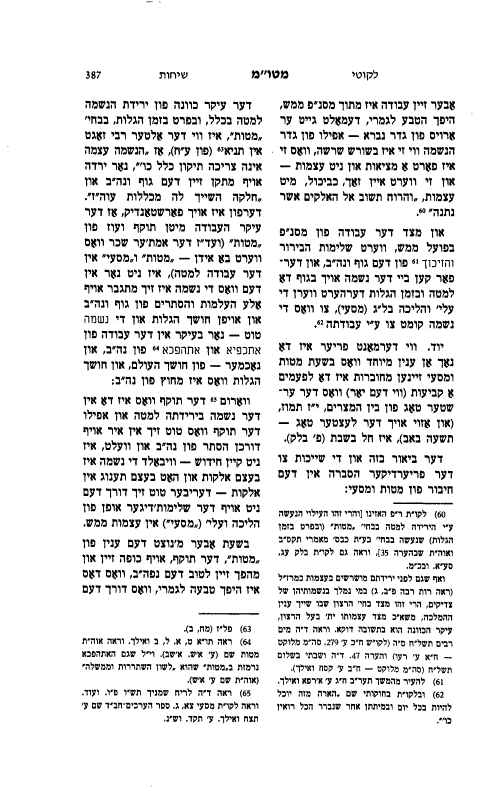

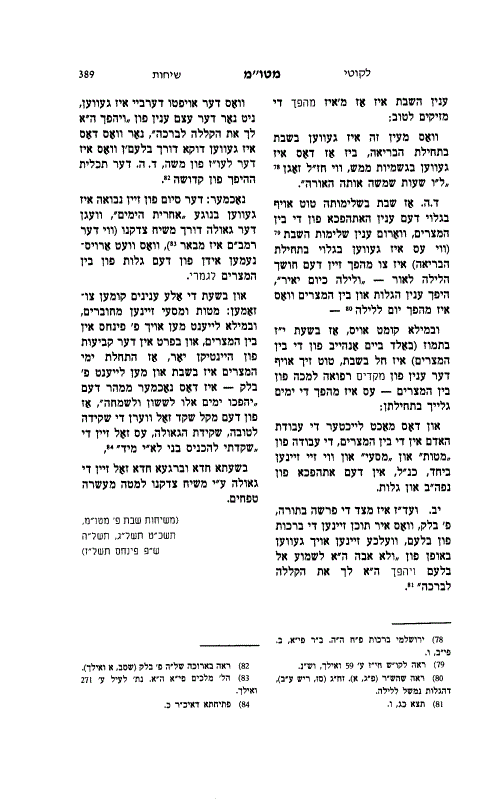
“Matos” refers to the soul in its descent below, and the purpose of this descent is “Masei” — that through it, the soul should be elevated. However, in a more detailed sense, even in “Matos” itself the ascent is hinted.
The tribes are called both “shevatim” and “matos.” The difference between them is that “shevatim” refers to branches when there is still moisture from the tree within the branch, and when it is still connected to the tree. But when the branch hardens because it has been separated from its source, it is called “matos.”
In general, “shevet” refers to the soul as it exists above, where it is in the state of a branch still connected to its source. When the soul descends below, it is called “mateh,” because its connection to Elokus is not as recognizable.
However, the purpose is “Masei.” Through the soul’s descent below, it becomes elevated even higher than it was before its descent. In other words, “Matos” indicates the descent, while “Masei” indicates the ascent.
Yet in a more detailed sense, even in “Matos” the ascent is hinted. When the soul descends below and becomes like “matos,” it needs special strength and firmness in order to carry out its service. This strength is also hinted in the word “matos.” Through this, the soul experiences an ascent, as the root of the soul is revealed within it in the level of “eisan” — firmness and strength.
In “Masei,” too, the descent below is hinted, because “Masei,” in the plural, refers also to the journey of descent into this world.