
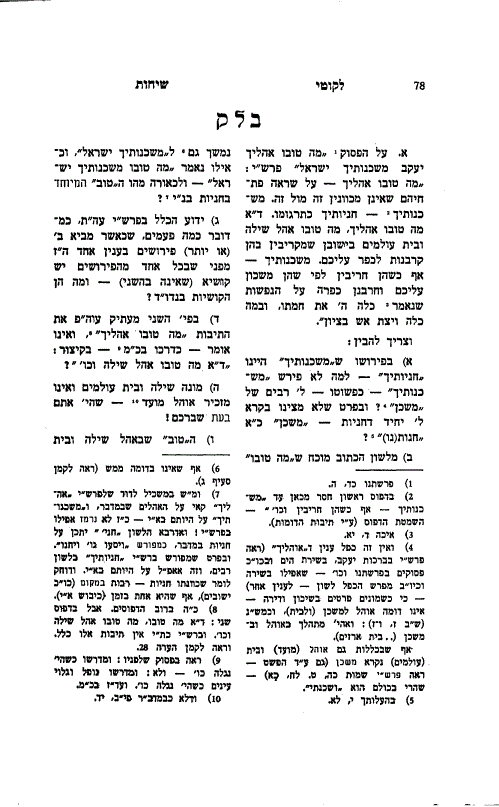
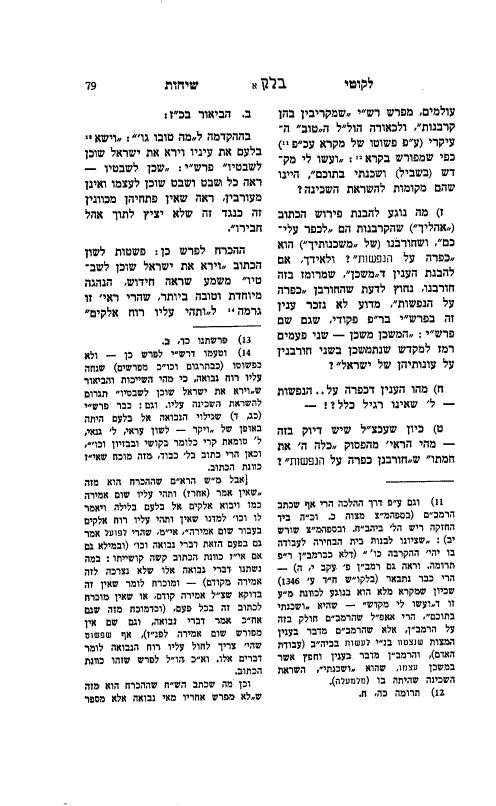
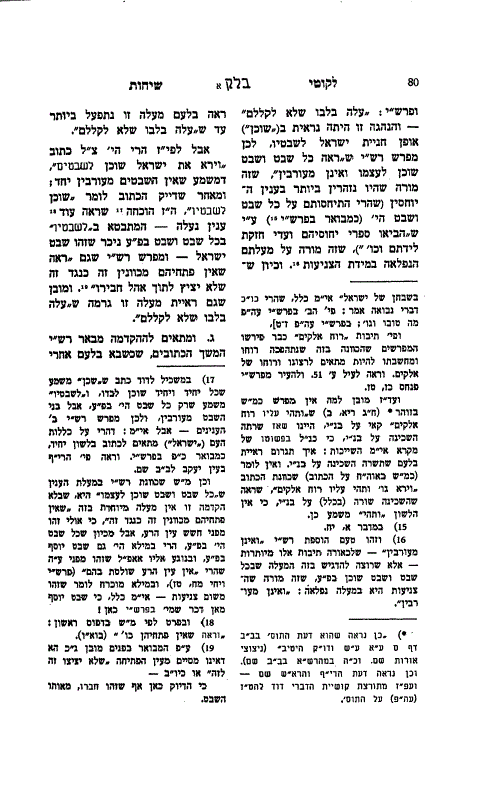
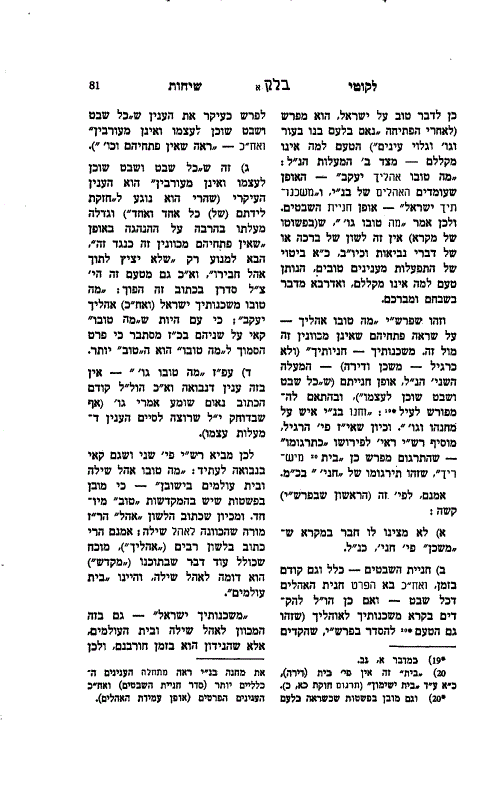
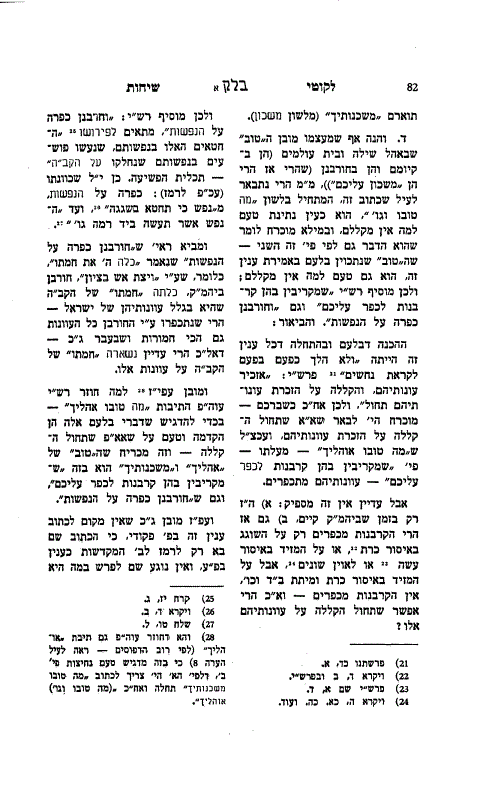
Rashi comments on the verse (Bamidbar 24:5):
“How goodly are your tents”—because he saw that their entrances were not aligned opposite one another.
“Your dwelling places”—your encampments, as translated by Targum.
Another explanation: “How goodly are your tents”—how goodly are the Tent of Shiloh and the Eternal House (the Beis HaMikdash) when they stand in their settled state, for sacrifices are offered there to atone for you.
“Your dwelling places”—even when they are destroyed, because they serve as a pledge (mashkon) on behalf of Israel, and their destruction brings atonement for souls, as it is stated: “The L‑rd has exhausted His wrath… He kindled a fire in Zion.”
This requires explanation. Why does Rashi need two interpretations? Why does he not explain the primary greatness of the Beis HaMikdash—that it is the place where G‑d says, “I shall dwell among them”? And what is the significance of Rashi’s precise wording, “atonement for souls”?
The explanation is as follows:
Before Bilam proclaimed “How goodly are your tents,” the Torah states:
“And he saw Israel dwelling according to its tribes.”
Rashi explains:
“He saw each tribe dwelling by itself and not intermixed with the others. He saw that their entrances were not aligned one opposite another.”
The necessity for this explanation comes from the wording of the verse itself, which implies that Bilam observed something distinctive and noteworthy.
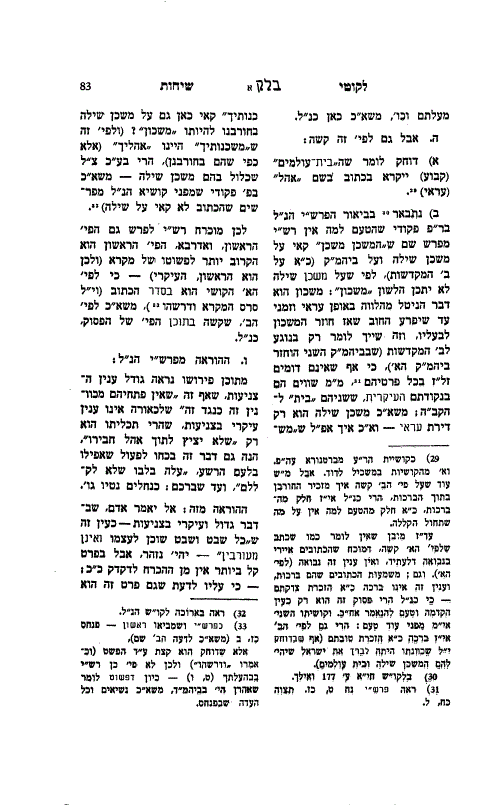
Accordingly, Rashi explains that “How goodly are your tents” refers to the entrances of the tents, while “your dwelling places”—translated as “your encampments”—refers to the orderly arrangement of the tribal camps.
However, this explanation presents a difficulty. Why does Bilam begin with the detail of the tent entrances before mentioning the more fundamental matter—the tribal arrangement itself?
Furthermore, according to this interpretation, “How goodly are your tents” is not really part of Bilam’s prophecy, but merely a description of what he observed. If so, it would seem more appropriate to place it in the introduction to his prophecy rather than within the prophecy itself.
Therefore, Rashi brings a second explanation: that the verse refers to the Sanctuary at Shiloh and the Beis HaMikdash.
Although the greatness of the Beis HaMikdash is self-evident, Rashi specifically emphasizes its role in providing atonement.
Earlier, on the verse:
“He did not go, as at other times, to seek omens,”
Rashi explains that when Bilam sought to curse the Jewish people, he searched for their sins. Therefore, now that he comes to bless them, he mentions the atonement provided through the Beis HaMikdash, demonstrating that they are not deserving of a curse.
Yet another difficulty arises. Sacrifices generally atone only for inadvertent sins, not for deliberate transgressions.
To answer this, Rashi continues with his explanation of “your dwelling places.” Even when the Sanctuary and Temple are destroyed, their destruction itself serves as atonement. Through the destruction, even deliberate sins are atoned for.
The proof is the verse:
“The L‑rd has exhausted His wrath.”
The fact that His wrath was completely exhausted demonstrates that the destruction itself brought a complete measure of atonement.
However, the second interpretation also presents difficulties. Why would the Beis HaMikdash be called “your tents”? Moreover, as explained regarding the double expression “Mishkan, Mishkan” in Parshas Pekudei, Shiloh cannot fully be described as a mashkon (pledge), because a pledge is eventually returned in its original form, whereas the Beis HaMikdash was not rebuilt in exactly the same form as Shiloh.
For this reason, Rashi places the first explanation before the second. The difficulty in the first interpretation concerns only the sequence of the verse, whereas the difficulty in the second interpretation lies in the actual meaning of the words themselves.
Practical Lesson
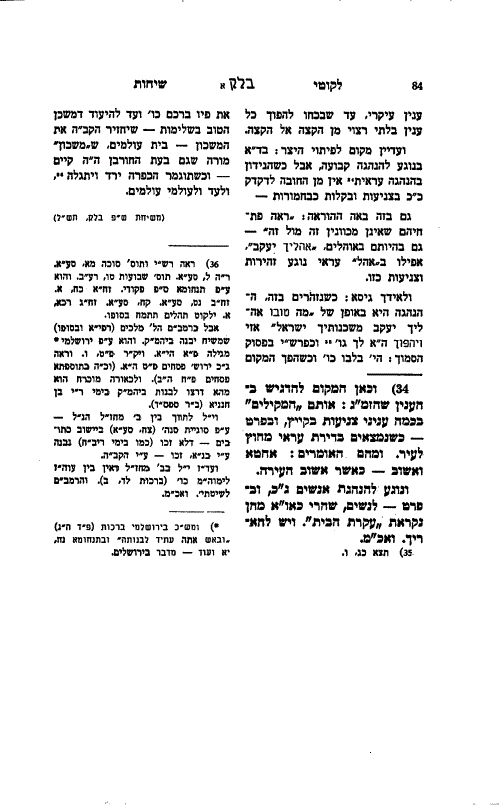
A Jew must strive not only to uphold the general principle of modesty and proper separation—“dwelling according to their tribes”—but also to be careful with the finer details, symbolized by the placement of the tent entrances.
Moreover, this responsibility applies even when one is living in a temporary setting, represented by “your tents.” Holiness and modesty are not limited to permanent institutions or established communities; they must permeate every aspect of Jewish life, even in temporary and transient circumstances.