Introduction
In this study, we will be learning the second sicha on Parshas Beha’aloscha from Likkutei Sichos, volume 13. The Rebbe here discusses the concept of humility—anovah—as it is described regarding Moshe Rabbeinu. The Torah says that Moshe was the most humble person, “anov me’od,” more than any other human being.
The central question is: what does true humility mean? As the Rebbe explains, it cannot mean that a person is unaware of their own greatness or advantages. Moshe certainly knew his own unique qualities and achievements. Yet, he was still called the most humble of all people. How does this work?
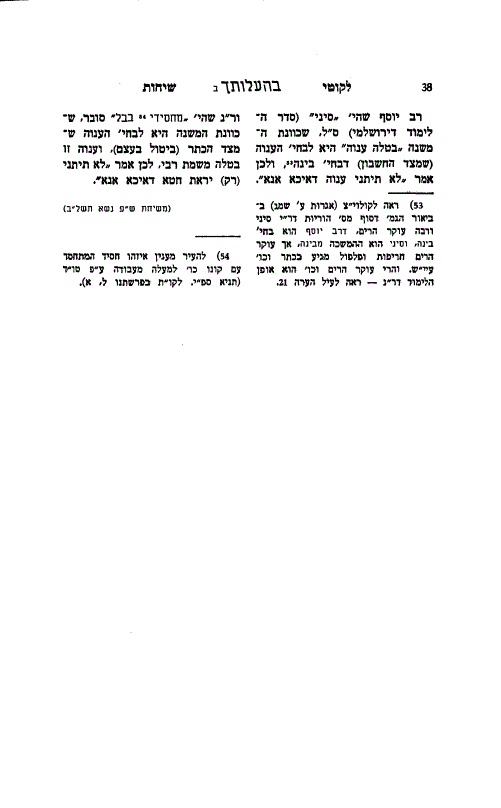
This sicha also serves as a siyum—a completion—on Meseches Sotah. There, we find a puzzling statement from Rabbi Yosef: he says that there are still humble people in his generation, and points to himself as an example. At first glance, this seems self-contradictory—how can someone declare their own humility and still be considered humble?
The Rebbe will explain that there are actually two levels of humility. One level comes from a person’s honest calculation: recognizing that their accomplishments are not necessarily so great, or thinking that if someone else had their qualities, they could have achieved even more. This is a rational, reflective kind of humility.
But there is also a deeper, inherent humility—a quality that exists independent of any calculation or comparison. The Rebbe will explore these two aspects through both Chassidus and Kabbalah, as well as through straightforward explanation.
We will also see how these ideas play out in the discussions between Rav Nachman and Rabbi Yosef in the Gemara. The sicha will analyze their statements and show how each represents a different dimension of humility.
The main verse under discussion comes from our parsha—Parshas Beha’aloscha, chapter 12, verse 3—which states that Moshe was “the most humble man on the face of the earth.” At first glance, this description seems difficult to understand; we will explore why and how the Rebbe addresses this issue.
Saif Aleph
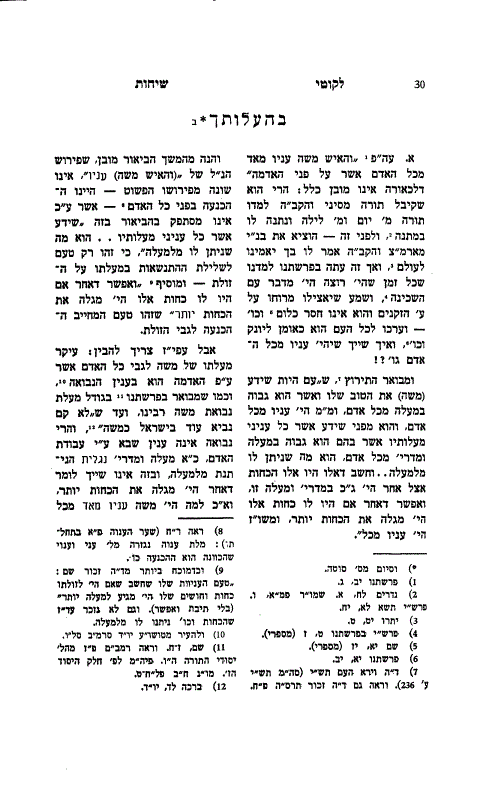
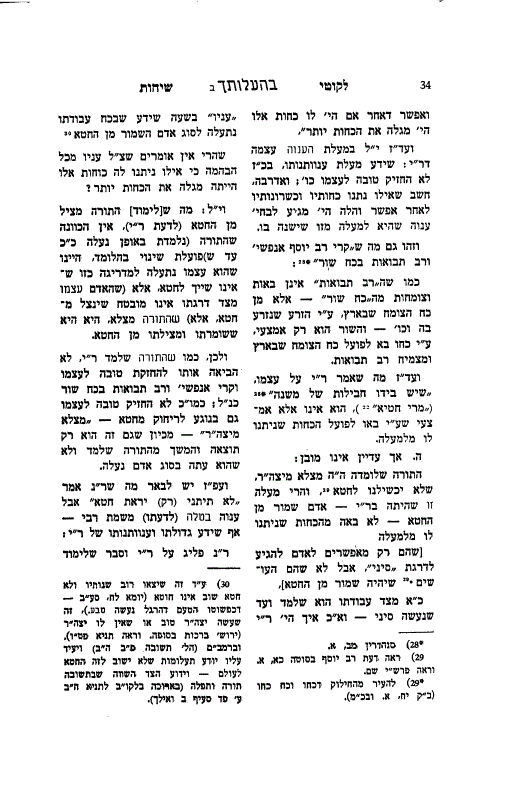
In this section, the Rebbe begins by enumerating the extraordinary qualities and privileges of Moshe Rabbeinu. Moshe was the one who received the Torah at Sinai—not merely as a recipient, but as someone to whom it was given as a gift, as the Gemara explains. This distinction elevates Moshe beyond simply being taught; he was uniquely chosen for this role.
Before receiving the Torah, Moshe had already accomplished remarkable feats. He led the Jewish people out of Egypt and merited that the people would believe in him forever. These are not just historical achievements but reflect a unique holiness and spiritual stature with which Moshe was endowed.
The Rebbe points out another privilege mentioned in our parsha: whenever Moshe wished, he could speak directly with Hashem. When he appointed the seventy elders to assist him, Hashem declared that He would take from Moshe’s spirit and bestow it upon them—yet Moshe himself would not be diminished in any way. This demonstrates that even when his spiritual powers were shared with others, his own greatness remained fully intact.
Additionally, the Torah describes Moshe as carrying the Jewish people like a nursing mother carries her infant. This metaphor highlights how essential and nurturing Moshe’s relationship was to Bnei Yisrael—his value to them is like that of a mother to her child.
Given all these unparalleled qualities, the question arises: how could Moshe be described as “more humble than any person on earth”? The Rebbe emphasizes that this entire paragraph serves to underscore just how great Moshe truly was, making his humility all the more astonishing.
The answer brought by the Rebbe comes from a maamar of the Previous Rebbe. Despite being superior in every way to all other people, Moshe remained humble because he recognized that all his greatness was granted from above—it was a gift from Hashem. He reasoned that if someone else had been given these same powers and opportunities, they too could have reached his level.
However, this only explains why he did not feel pride or superiority over others—it does not yet explain true humility before others. The maamar adds another step: Moshe considered that perhaps another person, if given these gifts, might have developed them even further than he did himself. In other words, he thought someone else could have done an even better job with what he had been given.
This perspective led Moshe not only to avoid arrogance but actually to feel less than others—to be truly humble before every person. Thus, his humility was genuine; he saw himself as smaller or less than those around him because he believed they might have accomplished more with his gifts.
The Rebbe clarifies that there are two aspects here: first, recognizing that one’s talents are not self-made but divinely bestowed removes any basis for pride; second, considering that others might have achieved more leads to actual humility and self-effacement.
From the continuation of this explanation in the Previous Rebbe’s maamar, it is clear that this understanding of humility is consistent with its simple meaning—anavah means feeling genuinely less than another person, not merely equal. The first point alone only negates arrogance; it is the second point—the possibility that others could have done better—that brings about true humility.
The Rebbe notes a subtlety: while it is understandable for someone to feel humble regarding talents or accomplishments achieved through effort (since others might have worked harder), what about gifts from Hashem such as prophecy or unique missions? Even here, Moshe applied this logic—recognizing both the source of his greatness and his own potential limitations compared to what others might have achieved in his place.
Saif Beis
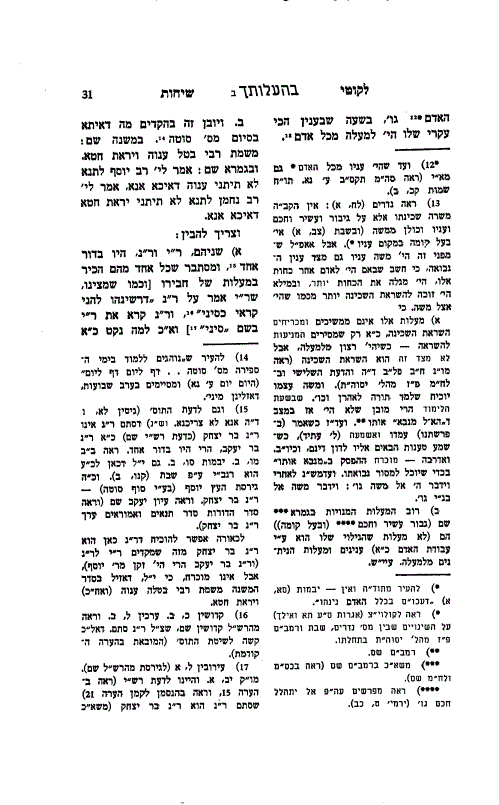
The discussion here centers on the unique quality of Moshe Rabbeinu as a leader. Unlike other traits or talents that a person can develop or in which someone else might excel, Moshe’s role as a prophet was not something he could cultivate or that another could surpass. Prophecy, in Moshe’s case, was a direct gift from Hashem—something only Moshe possessed. It wasn’t about skills or personal development; it was an exclusive status bestowed upon him by God.
This raises a fundamental question: How could Moshe Rabbeinu be humble regarding his prophecy? In other areas, perhaps he could think that someone else might have done better, but in the realm of prophecy—his defining quality—Moshe was singular. The Torah itself testifies that “no prophet arose in Israel like Moshe.” Since prophecy is not achieved through human effort but is a divine gift, it would seem there is no room for humility here. How then could Moshe remain truly humble?
The Rebbe notes that there are two kinds of humility. One is a calculated humility—a person recognizes their gifts but imagines that if someone else had those same gifts, they might have accomplished even more. The other is an essential humility, which characterized Moshe Rabbeinu. This deeper humility exists even when one’s greatness is entirely unique and divinely given.
Let’s look inside the text to clarify the question further. The main advantage of Moshe over all people was his prophecy, as explained in our parsha: “There has not arisen another prophet among Israel like Moshe.” This level of prophecy is not something attained through personal effort; it is a revealed greatness given from above. Therefore, we cannot say that someone else might have developed this potential more fully—it simply wasn’t given to anyone else.
If so, why was Moshe described as “very humble, more than any person”? In his primary area—prophecy—Moshe stood above everyone else by virtue of Hashem’s choice. How could he be humble about this?
The Rebbe discusses this issue further in the footnotes, referencing the Gemara’s discussion about different levels of humility and how certain qualities may require personal development. However, when it comes to prophecy itself, it remains fundamentally a gift from Hashem. Thus, the question persists: How could Moshe maintain humility regarding his prophetic greatness?
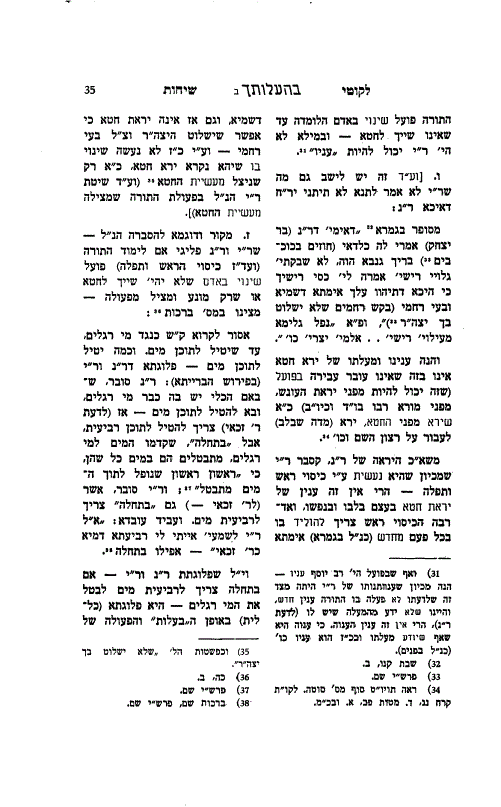
To explore this further, the Rebbe turns to the end of Tractate Sotah. There, the Mishnah laments the spiritual decline over generations and lists qualities that were lost with the passing of great leaders. Specifically, it states: “When Rebbe (Rabbi Yehuda HaNasi) died, humility and fear of sin ceased.”
The Gemara relates that when this Mishnah was taught before Rebbe Yosef and Rebbe Nachman, each responded personally to its statement. Rebbe Yosef told the teacher not to say humility had ceased—“for I am still here.” Similarly, Rebbe Nachman said not to say fear of sin had ceased—“for I am still here.”
This exchange raises several questions. First and foremost: If both statements were true—that Rebbe Yosef embodied humility and Rebbe Nachman embodied fear of sin—why did each only mention their own quality? Why didn’t Rebbe Yosef also point out Rebbe Nachman’s fear of sin and vice versa? If both virtues existed in their generation through these sages, shouldn’t each have acknowledged both?
The implication is that there are different understandings or levels within these qualities themselves—a point that will be clarified later in the sicha.
Additionally, since Rebbe Yosef and Rebbe Nachman lived in the same generation and certainly knew each other well, it stands to reason they recognized each other’s greatness in these respective areas. Thus, their selective responses require explanation.
Saif Gimmel
We see that Rebbe Nachman and Rebbe Yosef were both aware of each other's greatness. For example, the Gemara records that Rebbe Yosef said about Rebbe Nachman that he expounded verses like an expert, showing his respect for Rebbe Nachman's knowledge. Conversely, Rebbe Nachman referred to Rebbe Yosef as "Sinai," indicating his mastery of Torah. This mutual recognition raises a question: why did each only mention their own advantage when responding to the Mishnah? Why didn't they also point out the greatness of their colleague?
If someone is willing to speak about their own virtues, how much more so should they be ready to publicize the virtues of their friend. This is the first question: why did each only highlight their own quality and not also mention the other’s?
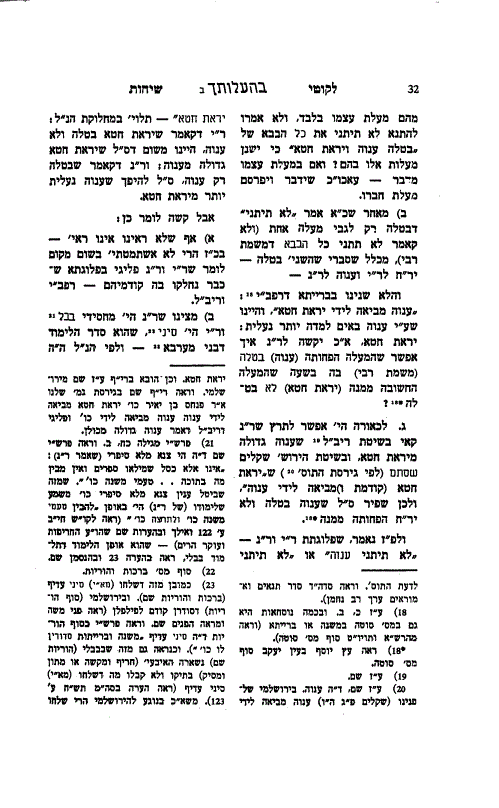
This suggests that within humility—anovah—there are different levels, and each sage understood the Mishnah’s statement about humility in a different way. They weren’t simply disagreeing about facts; they were interpreting which level of anovah or yiras chet—fear of sin—the Mishnah was referring to.
Looking closer, when Rebbe Yosef says not to teach that humility has ceased because he himself possesses it, he does not object to the statement about fear of sin being gone. The same is true in reverse for Rebbe Nachman: he objects only to the claim that there is no more fear of sin, since he himself possesses it, but agrees with the Mishnah that humility has ceased.
This leads to a deeper question: how can there be fear of sin if there is no humility? The Braisa teaches that humility leads to fear of sin—anovah mevi’ah li’yiras chet. In other words, one must first have humility in order to reach fear of sin. So how could Rebbe Nachman claim to possess fear of sin if he agrees with the Mishnah that humility has ceased?
The implication is that if one accepts the teaching from Pinchas ben Yair—that humility brings a person to higher levels such as fear of sin—then lacking humility should make it impossible for someone to attain true fear of sin. Yet Rebbe Nachman claims exactly this: even though humility has ceased, he still possesses fear of sin.
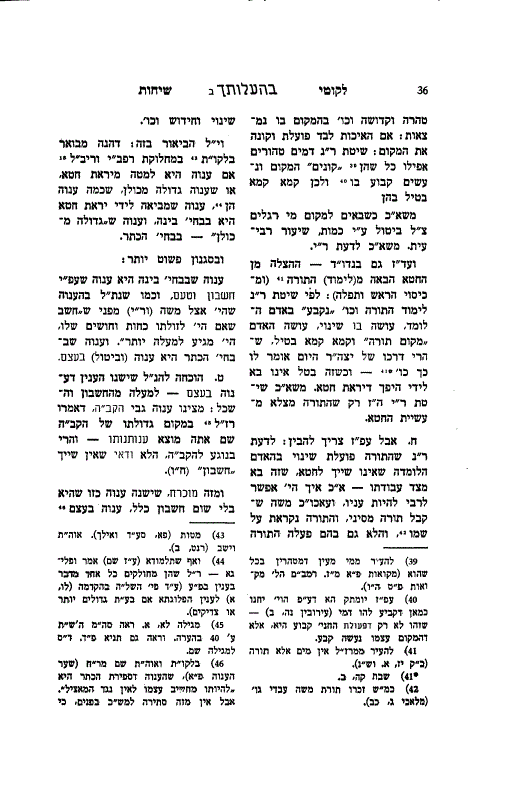
The Rebbe now introduces a side point before answering this question directly. Perhaps our entire assumption—that fear of sin requires humility—is itself subject to debate. There is a Yerushalmi which seems to suggest just the opposite: that fear of sin brings a person to humility.
If we follow this view, then it would be possible for someone like Rebbe Nachman to possess fear of sin even if humility has ceased. In this scenario, yiras chet would be considered a lower level than anovah, and thus could remain even after anovah is gone.
This would mean that the disagreement between Rebbe Yosef and Rebbe Nachman centers on which trait is greater—humility or fear of sin—and which leads to which. According to one view (like Pinchas ben Yair), humility leads up to fear of sin; according to another (the Yerushalmi), it’s reversed.
The Rebbe points out that according to Tosafos’ version in Yerushalmi Shkolim, it states plainly that “fear of sin comes before and brings about humility.” If so, then it makes sense for Rebbe Nachman to say that while humility has been nullified (since it’s higher), fear of sin remains (since it’s lower).
This would explain why each sage objected only regarding their own quality—they each held a different view about which trait was primary and which was secondary. However, as we will see later in the sicha, the Rebbe will challenge whether this explanation fully resolves all difficulties.
Saif Daled
The Rebbe explains that the previous discussion answers both of our earlier questions: why did they not count each other, and how could Rebbe Nachman say there is no humility while still maintaining there are those who fear sin? The answer hinges on the underlying dispute—namely, which quality is greater: humility or fear of sin?
The core disagreement between Rebbe Yosef and Rebbe Nachman is whether to object to including humility (anavah) or fear of sin (yirei chet) in the Mishnah. In other words, which one remains depends on which is considered the lower level. If fear of sin is lower, as Rebbe Nachman holds, then only humility is gone; if humility is lower, as Rebbe Yosef holds, then only fear of sin is gone. Their positions reflect their views on which trait is more essential or rare.
Rebbe Yosef says that fear of sin has disappeared but humility remains, because he believes that fear of sin is a higher level than humility. Conversely, Rebbe Nachman maintains that only humility has disappeared—he agrees with the Mishnah on this point—but he objects to removing fear of sin because he considers humility to be greater than fear of sin. Thus, according to him, there are still people who possess fear of sin.
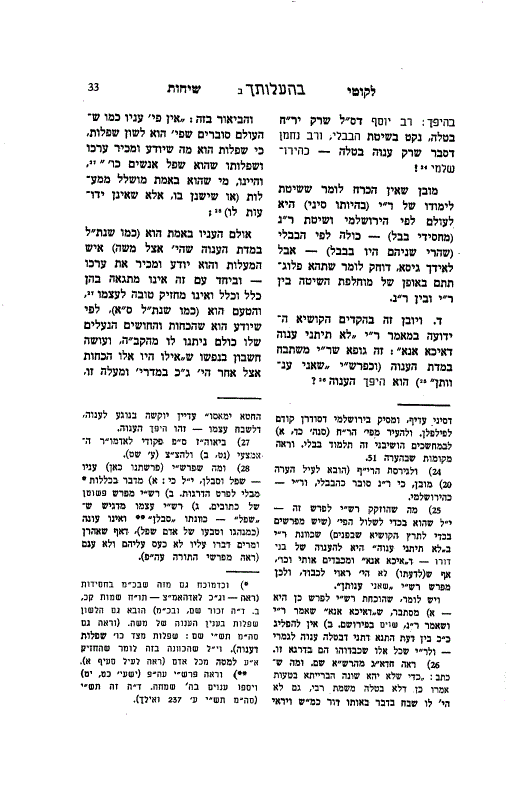
This approach would resolve the issue. However, the Rebbe points out several difficulties with this explanation. First, he notes that he has never seen anyone explicitly connect the dispute between Rebbe Yosef and Rebbe Nachman to the debate over whether humility leads to fear of sin or vice versa. While not seeing something does not prove it does not exist, it remains significant that no earlier authority made this connection.
Additionally, the Rebbe observes that such an explanation would run counter to what we know about these sages’ backgrounds and learning styles. Typically, Rebbe Nachman is associated with Babylonian scholarship (Bavel), while Rebbe Yosef is linked with Sinai—a style characterized by vast knowledge rather than dialectical reasoning—and more closely aligned with the approach in Eretz Yisrael.
If we follow this logic, it would result in a reversal: Rebbe Yosef would be adopting a Babylonian perspective (that humility is greater), while Rebbe Nachman would be siding with the Jerusalem Talmud’s view (that fear of sin is greater). This seems inconsistent with their usual associations.
Nevertheless, it’s not an absolute contradiction for a sage from Bavel to adopt a view from Yerushalmi or vice versa. Both lived in Bavel and were exposed to multiple traditions; their personal backgrounds do not strictly determine their halachic positions. Still, it feels forced to say their disagreement should play out in such a reversed manner.
The Rebbe now transitions to clarify another important concept: how can someone like Rebbe Yosef claim for himself the title “humble” (anav)? Doesn’t self-identifying as humble contradict true humility?
This question arises from a statement in which Rebbe Yosef says regarding himself: “Do not read in the Mishnah that there are no more humble people—because I am here.” At first glance, this appears self-congratulatory and at odds with genuine humility.
The answer lies in understanding what true anavah means. Contrary to popular belief, anavah does not mean thinking oneself lowly or insignificant—that would be shiflus, lowliness. A person who truly possesses shiflus sees themselves as lacking any special qualities or advantages.
Anavah, however, does not require denying one’s strengths or greatness. As we saw earlier regarding Moshe Rabbeinu—who was aware of his extraordinary qualities—true humility means recognizing one’s gifts without taking personal credit for them or feeling superior because of them.
This attitude stems from knowing that all abilities and virtues are gifts from Hashem. Since they are divinely granted rather than self-made achievements, there’s no room for arrogance or self-importance.
The truly humble person also reasons: if someone else had been given these same strengths and opportunities by Hashem, perhaps they would have accomplished even more. Therefore, even while acknowledging his own greatness—as did Moshe and as does Rebbe Yosef—the humble person does not see himself as inherently superior.
ואחר שהם היו מישהו אחר, הוא גם היה במדרגו מלזו, אז הוא גם היה במהלך הזה. ואפשר, ויש אפילו אפשרות, האחר, אם היו לקויכס אילו, אולי אם אחר אחד הייתה במהלך הזה, הוי מגלס, הקויכס ייסר, אולי הוא יפגש את הכוחים עדיין יותר.
If someone else had been given these same abilities and circumstances by Hashem, perhaps they would have revealed even greater strengths.
This explains how Rebbe Yosef could truthfully state his own level without compromising his humility—because his sense of self was never about personal credit but about fulfilling what Hashem enabled him to do.
Saif Hei
The Rebbe explains that when we speak about humility, it does not mean a person is unaware of his own qualities or accomplishments. Rather, true humility means he does not attribute these qualities to himself, nor does he take credit for them. He recognizes that others could have achieved even more had they been given the same opportunities and talents.
This is seen in the case of Rabbi Yossi, who was aware of his own musical and artistic abilities. Yet, he did not consider these as reasons to hold himself in high regard. On the contrary, he thought that if others had been given his talents and circumstances, they would have accomplished even more.
Rabbi Yossi’s humility extended to his Torah knowledge as well. Even though he possessed great expertise and mastery in Torah, he did not see this as something to boast about. He considered himself merely a conduit for the divine gifts bestowed upon him from above.
The Gemara in Sanhedrin (42a) uses an analogy: just as an ox threshes grain and produces many kernels, so too Rabbi Yossi saw himself as an instrument through which much Torah was produced. The ox is only a tool; it is the earth’s natural power that causes the grain to grow. Similarly, Rabbi Yossi viewed his own achievements as resulting from the powers Hashem gave him, not from his own greatness.
When Rabbi Yossi said he had “bundles of Mishnah,” it meant he possessed vast Torah knowledge. However, he did not attribute this to himself; rather, he saw it as a result of the abilities granted to him by Hashem. These abilities were only tools enabling him to fulfill his purpose—they were not inherently his own.
This attitude is what defines true humility: recognizing one’s gifts but understanding they are not self-generated. Even when a person works hard and achieves much, if he realizes these achievements are due to Hashem’s help and the talents granted from above, then he remains humble.
Sometimes it may seem difficult for someone who has worked hard and accomplished much to remain humble. One might think: “If I have been given such great abilities and have used them well, doesn’t that make me special?” The answer is that even then, one must recognize that everything comes from Hashem—the talents themselves are a gift.
For example, when someone learns Torah and becomes protected from sin as a result of their learning, this protection is not due to their own greatness but because of the Torah itself. The Torah has an inherent power to guard a person from sin; it is not something the individual can take credit for personally.
The Rebbe emphasizes that even when someone reaches a level where they are “guarded from sin,” this does not mean they have become inherently greater than others—it simply means they have merited the protective influence of Torah. Their avoidance of sin is a consequence of their connection with Torah rather than their own personal virtue.
This explains why Rabbi Yossi could remain humble despite his greatness—he saw all his achievements as stemming from Hashem’s gifts rather than personal accomplishment.
Rabbi Nachman disagreed with this approach. He believed that such greatness was indeed an achievement attributable to Rabbi Yossi himself and therefore felt it was impossible for Rabbi Yossi to be truly humble—how could someone with such accomplishments remain humble?
According to Rabbi Nachman’s view, there is no longer true fear of sin in our times because people recognize their own greatness and cannot maintain genuine humility alongside such recognition.
The Rebbe clarifies that even according to Rabbi Yossi’s perspective—where all achievements are attributed to Hashem—there remains room for humility because one does not see oneself as inherently great but merely as a recipient of divine gifts.
This also explains why certain statements were made about other sages but not about Rabbi Nachman or others who held different views regarding humility and greatness. The distinction lies in whether one attributes success to personal effort or recognizes it as coming entirely from above.
The discussion concludes by noting that sometimes people refrain from sinning not out of genuine fear or moral strength but due to external factors—such as fear of punishment or concern for their reputation among others. True humility involves recognizing both one’s strengths and limitations while attributing all success ultimately to Hashem.
Saif Vov
The discussion here revolves around the concept of yiras cheit—fear of sin—and how it manifests in different individuals, particularly in the context of Torah study and religious practice. The example is given of someone who covers their head, not out of a deep, internalized fear of Hashem, but simply because it is the custom or requirement. This external act does not necessarily indicate true yiras cheit; rather, it may just be a habitual behavior.
Rav Yosef is brought as an example. He would always cover his head, but this did not mean he was afraid of Hashem in the essential sense. He needed to consciously remind himself each time to cover his head, which shows that the action was not coming from an intrinsic fear or awe. Even when he did cover his head, it was not necessarily out of fear of Hashem, but perhaps for other reasons.
This leads to a distinction: someone who refrains from sin only because they are prevented by external factors or habits cannot be called a true yarei cheit. Rav Nachman therefore could not say about Rav Yosef that he was a yarei cheit, because Rav Yosef’s avoidance of sin was not due to an inner transformation or essential fear, but rather due to external circumstances or practices.
The Rebbe explains that this is similar to the concept in halacha regarding covering one’s head during prayer or Torah study. The act itself does not necessarily indicate an inner change; it might just be a protective measure against sinning, rather than a sign that the person has become fundamentally different.
This idea is further illustrated with a story from the Gemara involving Rav Yosef and Rav Nachman. As previously discussed in this sicha, Rav Nachman did not consider Rav Yosef to be a yarei cheit, even though Rav Yosef was careful in his actions. The reason is that Rav Nachman believed that unless there is an actual change in the person’s essence—that they have become someone who cannot sin—they cannot be called truly God-fearing.
The Rebbe points out that sometimes a person may excel in one area and feel that no one else could do better than them in that specific aspect. However, if their avoidance of sin comes only from external factors and not from an internal transformation, then their status as a yarei cheit is questionable according to Rav Nachman’s view.
This brings us to a broader question: does Torah study itself transform a person so deeply that they become essentially different—someone who cannot sin? Or does Torah merely serve as a protective shield against sin without fundamentally changing the individual?
The Rebbe clarifies that according to Rav Yosef, Torah study protects and saves one from sinning, but it does not necessarily change the person’s essence. Therefore, even if someone refrains from sin due to their learning or religious habits, they are still considered vulnerable and must always remain vigilant.
On the other hand, according to Rav Nachman, Torah study can indeed transform a person into someone who is intrinsically protected from sin—a true yarei cheit. In this view, when someone becomes “the place” of Torah (meaning Torah becomes part of their very being), they are fundamentally changed and no longer susceptible to certain sins.
This debate is illustrated with another halachic example: in earlier times people would have buckets for waste at home. There are laws about saying words of Torah or Shema near such buckets. If you pour clean water into such a bucket, does it purify the area so you can say Shema? According to Rav Nachman, even pouring a small amount of clean water transforms the status of the area immediately; it becomes permissible because there has been an essential change. But if waste was present first and then water added later, more effort (removal or greater purification) is required before one can recite Shema there.
Rav Yosef disagrees: regardless of whether water was present first or added later, you always need enough clean water to actually remove or neutralize the impurity before you can recite Shema nearby. The mere presence of some clean water does not suffice unless it actively changes the situation.
The Rebbe draws an analogy between these halachic opinions and our discussion about spiritual transformation through Torah study. According to Rav Nachman’s approach, when Torah becomes part of your essence (like clean water transforming the bucket), you become fundamentally changed—a true yarei cheit. According to Rav Yosef’s approach, Torah protects you from sin (like covering your head), but unless there is active effort and vigilance at every moment (like continually adding enough clean water), there isn’t an essential transformation.
This distinction explains why Rav Nachman could say about others that they were yarei cheit, but could not say so about Rav Yosef—because for him it required more than just protection; it required transformation. Conversely, for Rav Yosef himself, he would attribute his avoidance of sin only to Torah’s protective power and would never claim personal credit as being essentially changed.
The Rebbe concludes by noting that this difference has practical implications for how we view ourselves and others regarding spiritual growth and humility. For some people (like those described by Rav Nachman), Torah truly transforms them into new beings who are intrinsically protected from certain failings. For others (as per Rav Yosef), constant vigilance and humility are required because protection comes only through ongoing effort rather than inherent change.
Saif Zayin
According to Rabbi Nachman, the Torah has the power to transform a person who learns it. This means that someone who truly studies Torah becomes changed by it, and is no longer connected to sin. The transformation is credited to the person’s own effort—his avodah—in learning and internalizing Torah.
This raises a question: if greatness comes as a result of one’s own work in Torah, how can such a person be called humble? Specifically, how could Rebbi be an anov—a truly humble person—and even more so, how could Moshe Rabbeinu, who received the Torah at Sinai and for whom the Torah is named, be called humble? The Torah itself made them great; their qualities were real and earned. How does humility fit into this picture?
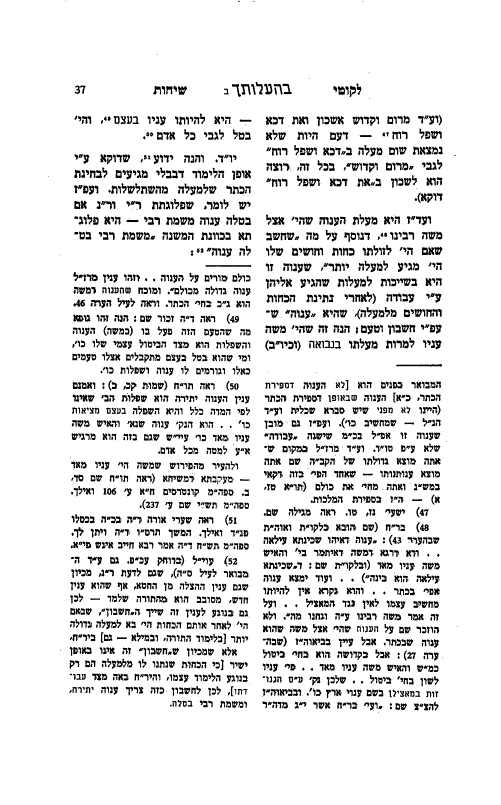
The Rebbe introduces a deeper understanding of humility, drawing on concepts from Chassidus. He explains that there are two levels of anovah—humility: one that is “beyond intellect” and one that is “below intellect.” In Kabbalistic terms, these correspond to different spheres or spiritual attributes.
The first level is humility that comes from calculation and reason. This is called the level of bina—understanding. Here, a person recognizes his own qualities but reasons that if someone else had been given his abilities and opportunities, that person might have achieved even more. This was the humility of Moshe Rabbeinu and Rabbi Yosef as explained earlier: their sense of humility was based on thoughtful consideration.
The second level is a much higher form of humility—the level of keser. This type of anovah is not based on any calculation or intellectual reasoning. It is an essential humility and self-nullification (bitul be’etzem) that simply exists within the person’s being.
This higher form of humility can be seen in Hashem Himself. The sages teach: “In the place where you find God’s greatness, there you also find His humility.” Clearly, Hashem’s humility cannot be based on any calculation or comparison—there is no one to compare Him to! Rather, it is an essential aspect of His being.
This proves that there exists such a thing as essential humility—anovah be’etzem—that does not depend on any external factors or logical reasoning. It simply is.
This idea is echoed in the verse:
מרום וקדוש אשכון ואת דכא ושפל רוח
"I dwell in exaltedness and holiness, but [also] with the contrite and lowly of spirit."
Even though there may be no apparent advantage in those who are lowly or contrite compared to those who are exalted and holy, Hashem chooses to dwell specifically with them. This choice cannot be explained by any calculation or merit on their part; it reflects Hashem’s essential desire for humility.If Hashem’s connection with those who are humble were based on some advantage they possessed, then it would not be true essential humility. But since there is no such advantage, we see that this relationship stems from pure essence—a fundamental quality beyond reason or calculation.
This concept helps us understand how true anovah, both for great tzaddikim like Moshe Rabbeinu and for Hashem Himself (so to speak), can exist even when their greatness is real and earned. Their humility comes not from denying their qualities or achievements, but from an inner state that transcends all calculations altogether.
Saif Ches
The Rebbe explains that there are two types of humility. One is a humility that comes from calculation and reason—a person recognizes that if someone else had his strengths and talents, they might achieve even more. This is a logical, acquired humility, connected to the advantages a person reaches through their own service, after being granted certain powers and gifts from above.
However, there is another level of humility that is not based on calculation. This is an essential humility—anovah be’etzem—where the person is truly humble in their very being, regardless of any achievements or comparisons. Moshe Rabbeinu exemplified this deeper level; his humility was not something one could arrive at through reasoning or self-assessment. He was simply and inherently humble, completely subjugated before every person.
The Rebbe draws a parallel to Hashem’s own humility, as discussed earlier in the sicha. Just as there is a level of humility that transcends calculation, so too with Moshe—his essence was one of bitul, absolute self-nullification.
This distinction also relates to the study of Talmud Bavli. The Rebbe notes that it is specifically through the unique style of learning in the Bavli—with its depth and dialectic—that one can reach the level of keser, which is higher than the regular order of spiritual worlds (seder hishtalshelus). The Bavli’s approach elevates a person beyond what can be achieved through straightforward learning alone.
With this background, we can better understand the disagreement between Rabbi Yosef and Rav Nachman regarding whether humility ceased after Rebbe passed away. Their debate centers on how to interpret the Mishnah’s statement: “When Rebbe died, humility ceased.” What kind of humility does this refer to?
Rabbi Yosef was known as a “Sinai”—his learning style resembled that of Yerushalmi—and he held that the Mishnah refers to calculated humility: an attitude reached through understanding and contemplation (the level of bina). He claimed that this type of humility still existed in his time—he himself possessed it—so he said not to teach that “humility ceased,” because he embodied it.
On the other hand, Rav Nachman was from the “chasidei Bavl”—the pious ones of Babylonia—and he interpreted the Mishnah as referring to essential humility: bitul be’etzem. He believed this deeper form had indeed ceased with Rebbe’s passing. According to Rav Nachman, Rabbi Yosef only had calculated humility but not this true essential bitul. Therefore, Rav Nachman said only “fear of sin” remained in their generation—not true humility.
This analysis clarifies why each sage responded as he did regarding which qualities remained after Rebbe’s passing. Rabbi Yosef saw himself as possessing calculated humility; Rav Nachman insisted that only fear of sin persisted because essential humility was no longer present.
This concludes the discussion for Shabbos Parshas Naso 5732 (1972).
Key Points
1. Moshe Rabbeinu’s unparalleled greatness—his prophecy, leadership, and spiritual stature—was fully recognized by himself, yet he remained the most humble person because he saw all his gifts as divinely bestowed and believed others could have achieved even more with them.
2. True humility (anovah) is not ignorance of one’s strengths, but the recognition that one’s talents and achievements are gifts from Hashem; this leads to a genuine sense of being less than others who might have accomplished more in the same circumstances.
3. The Gemara’s discussion about Rebbe Yosef and Rebbe Nachman highlights two levels of humility and fear of sin: a calculated humility based on reason, and an essential humility that transcends calculation—each sage embodied and emphasized a different level.
4. The debate between Rebbe Yosef and Rebbe Nachman over which quality—humility or fear of sin—remained after Rebbe’s passing reflects deeper disagreements about the nature and hierarchy of these virtues, as well as their sources in different Talmudic traditions.
5. True humility does not require denying one’s greatness; rather, it means not taking personal credit for it and always considering that others could have done better with the same divine gifts. This attitude allows someone like Rebbe Yosef to acknowledge his own humility without contradiction.
6. There is a distinction between being protected from sin due to Torah study (external protection) and being fundamentally transformed into someone who cannot sin (internal change); Rav Nachman required intrinsic transformation for true fear of sin, while Rav Yosef saw Torah as protective but not necessarily transformative.
7. The two types of humility are: one based on intellectual calculation (the level of bina)—recognizing one’s gifts but reasoning that others could surpass them—and a higher, essential humility (keser) that is innate and beyond logic or comparison, exemplified by Moshe Rabbeinu and even attributed to Hashem Himself.
8. The disagreement between Rabbi Yosef and Rav Nachman about whether humility ceased after Rebbe’s death centers on which form of humility is meant: Rabbi Yosef claimed calculated humility still existed (and possessed it), while Rav Nachman insisted only essential humility had truly ceased, leaving only fear of sin in their generation.