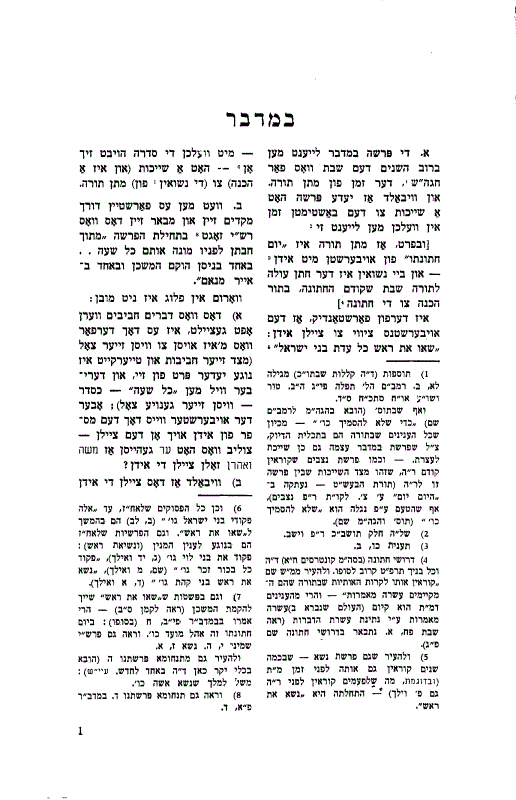
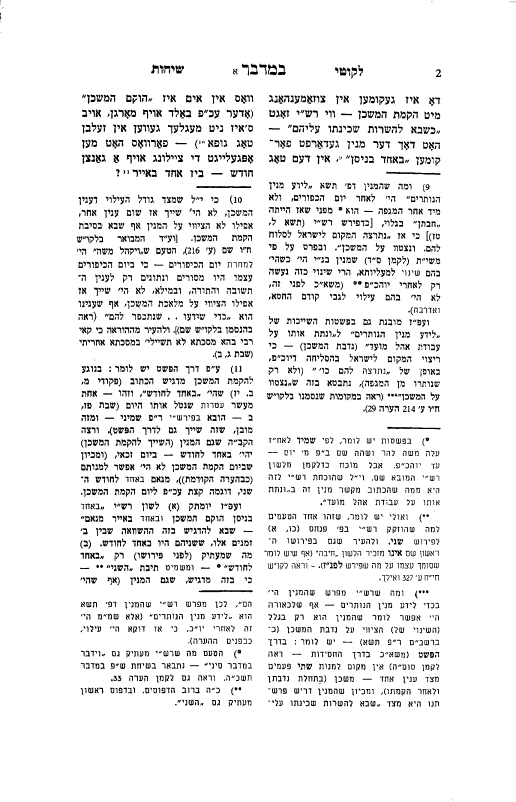
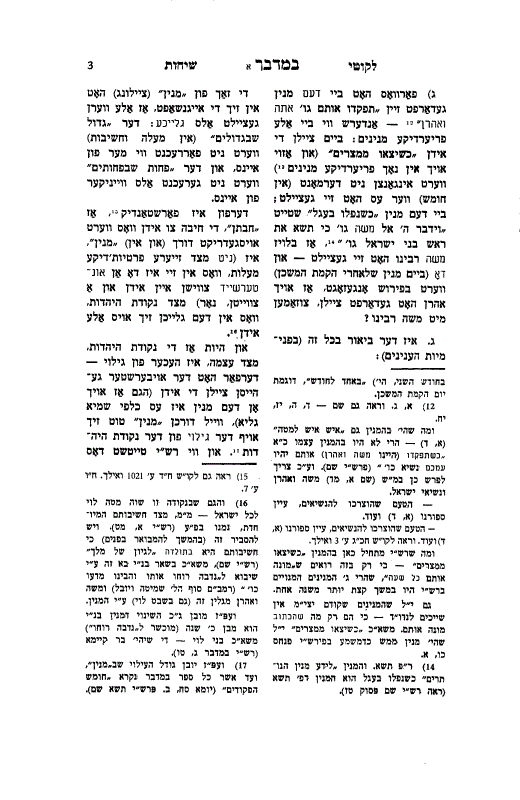
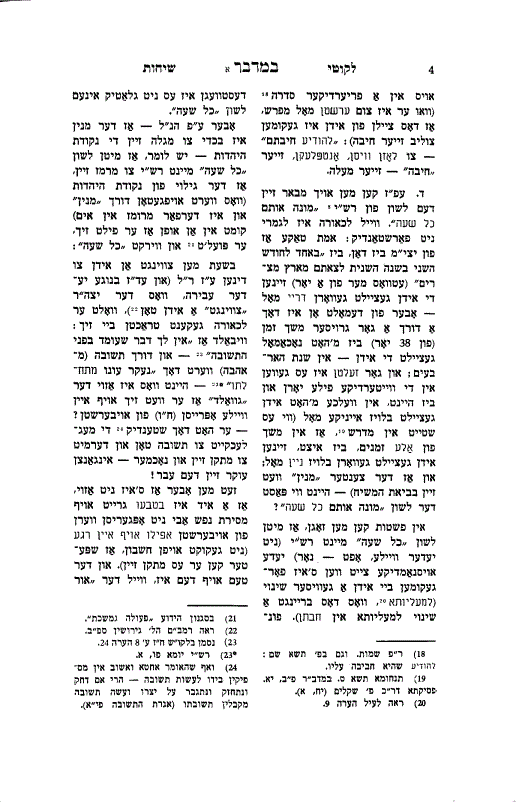
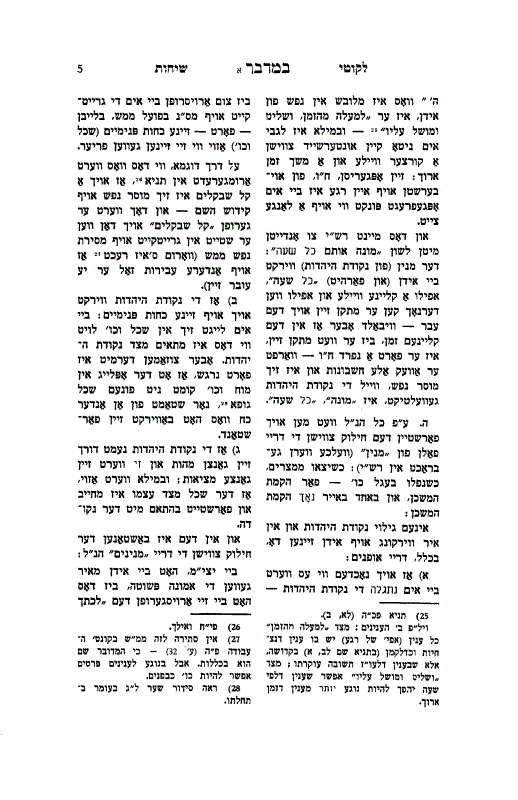
In Likkutei Sichos, this is the first sicha on Parshas Bamidbar. In this sicha, the Rebbe explains the connection between Parshas Bamidbar and Matan Torah, since Parshas Bamidbar is always read before Shavuos, the זמן מתן תורתנו. The Rebbe will also explain the deeper meaning behind the counting of the Jewish people, and why Rashi says that Hashem counts the Yidden “all the time,” even though in actuality they were only counted several times throughout their journey in the desert.
The Rebbe explains that counting is not merely a technical matter. Counting gives strength and importance. At every major stage in the journey of the Jewish people, they were counted again, and through that counting they received renewed strength as they transitioned to a higher level.
The Rebbe will also discuss the concept of מסירת נפש as explained in Tanya. A Jew is prepared to sacrifice his life rather than become separated from Hashem. Seemingly, one could ask: if later he can do Teshuvah, why is he prepared to give up everything now? The Rebbe explains that this itself reveals the essence of a Yid — that a Jew cannot tolerate even a temporary separation from the Eibishter, even for a single moment. The sicha contains many profound and foundational ideas, and the Rebbe develops them step by step.
Aleph
Parshas Bamidbar is read, in most years, on the Shabbos preceding Shavuos, the time of Matan Torah. Since every Parsha is connected to the time in which it is read, there must be a special connection between Parshas Bamidbar and Shavuos.
The Rebbe explains that this is true regarding every Yom Tov and special time of the year, but it is especially relevant regarding Shavuos. Matan Torah is described as the wedding day between HaKadosh Baruch Hu and Knesses Yisrael. Just as a chosson receives an Aliyah on the Shabbos before his wedding as a preparation for the marriage, so too Parshas Bamidbar serves as the preparation for the “wedding” of Matan Torah.
Accordingly, the opening theme of the Parsha — the counting of the Jewish people — must itself contain a connection to Matan Torah and serve as a preparation for it.
The Sedra begins with the command:
שְׂאוּ אֶת־רֹאשׁ כָּל־עֲדַת בְּנֵי יִשְׂרָאֵל\text{שְׂאוּ אֶת־רֹאשׁ כָּל־עֲדַת בְּנֵי יִשְׂרָאֵל}שְׂאוּ אֶת־רֹאשׁ כָּל־עֲדַת בְּנֵי יִשְׂרָאֵל
The Rebbe explains that this counting is not merely a census. It is part of the preparation for Matan Torah. Since the Shabbos before the wedding serves as a preparation for the marriage itself, the reading of Bamidbar — especially the counting of the Jewish people — contains a deeper message connected to the readiness and preparation of the Jewish people to receive the Torah.
Thus, the Rebbe establishes the foundation of the sicha: because Parshas Bamidbar is always read before Shavuos, the themes of the Parsha must contain a profound connection to Matan Torah and to the eternal bond between the Eibishter and the Jewish people.
Beis
The Rebbe now raises several fundamental questions regarding the entire concept of counting the Jewish people. Usually, when someone repeatedly counts something, it is because the object is precious and important to him, and he wants to make sure that everything is present and accounted for. However, in this case, the counting was commanded by Hashem Himself. Since the Eibishter certainly knows exactly how many Jews there are, why was there any need for a count at all? Furthermore, why were Moshe and Aharon specifically commanded to perform the counting?
The Rebbe introduces this discussion through Rashi’s explanation at the beginning of the Parsha. Rashi explains that because the Jewish people are beloved before Hashem, He counts them constantly. Rashi then notes that the Mishkan was erected on the first of Nissan, and the Jewish people were counted on the first of Iyar.
The Rebbe explains that there are three major difficulties in this Rashi.
The first question is on the very idea of counting. Normally, when precious things are counted repeatedly, the reason is because one wants to know their exact number. Since these things are valuable and cherished, every individual item matters, and therefore one constantly checks and counts them carefully.
But this explanation seems difficult regarding Hashem. The Eibishter does not need to count in order to know how many Jews there are. Their number is already fully known before Him without any counting whatsoever. If so, why did Hashem command Moshe and Aharon to count the Jewish people? What purpose was accomplished through the counting?
The second question concerns the timing of the count. Rashi explains that the counting was connected to the erection of the Mishkan and the resting of the Shechinah among the Jewish people. However, the Mishkan was erected on the first day of Nissan, while the counting only took place on the first of Iyar, a full month later.
If the counting was connected to the Hashra’as HaShechinah, it seemingly should have taken place immediately when the Mishkan was erected. At the very least, it should have happened the following day. Why was the counting delayed for an entire month until Rosh Chodesh Iyar?
The third question concerns the role of Aharon. In the earlier countings of the Jewish people, we do not find Aharon participating together with Moshe. When the Jewish people left Mitzrayim, the Torah does not even specify who performed the counting. Later, after the sin of the Golden Calf, the Torah addresses Moshe regarding the census. But here, after the erection of the Mishkan, the Torah explicitly states that the counting was to be performed by “you and Aharon.”
Why was this counting different from all the previous ones? Why was it specifically necessary here for Aharon to participate together with Moshe Rabbeinu?
Thus, the Rebbe presents three central questions:
Why was counting necessary altogether if Hashem already knows the exact number of the Jewish people?
Why was the counting delayed from the first of Nissan until the first of Iyar?
And why did this counting uniquely require both Moshe and Aharon together?
The Rebbe will now proceed to explain these questions according to the deeper inner dimension of the matter — על פי פנימיות הענינים.
Gimmel
The Rebbe now begins to explain the entire subject according to פנימיות הענינים — the inner spiritual meaning behind the matter. Through this deeper understanding, all of the earlier questions will become resolved: the meaning of counting, the role of Moshe and Aharon, and the significance of the months of Nissan and Iyar.
The Rebbe first explains the very concept of counting. A number does not express the qualities or importance of the thing being counted. In counting, everything is equal. Whether someone is on the highest level or the lowest level, each one is counted simply as one.
The idea of counting has a unique characteristic: everyone is counted equally. The greatest of the great, no matter how elevated he may be in importance and greatness, is still counted only as one. Likewise, the simplest and lowest person is not counted as less than one. In the world of counting, all distinctions disappear. Everyone is equal.
From this, the Rebbe explains the deeper meaning of Rashi’s statement that Hashem counts the Jewish people because of His love for them. The love expressed through counting is not because of the individual qualities or accomplishments of each Jew. If counting reflected individual greatness, then there would naturally be differences between one Jew and another, since people are not all on the same level.
Rather, counting expresses something much deeper — the נקודת היהדות, the essential point of Jewishness that exists equally within every Jew. At that level, all Jews are truly equal. Every Jew possesses the same essential connection to the Eibishter. That is what counting reveals.
Thus, the love expressed through counting is not a love based on accomplishments or spiritual greatness, but a love for the very essence of a Jew. Counting highlights the fact that every Jew, regardless of level, possesses the same essential holiness and bond with Hashem.
The Rebbe continues further. This essential נקודת היהדות is ordinarily hidden. It exists within every Jew, but it remains above revelation. Since it transcends the revealed faculties of a person, it is not always openly felt or expressed.
Therefore, Hashem commanded that the Jewish people specifically be counted. True, Hashem already knows exactly how many Jews there are even without a census. Before the Eibishter, everything is fully revealed. The purpose of the counting was not for information.
Rather, the counting itself accomplishes something profound. Through counting, the essential point of Jewishness hidden within every Jew is drawn into revelation. The counting reveals that inner essence.
The Rebbe connects this to Rashi’s earlier explanation regarding the counting of the Jewish people, where Rashi says that the counting was “להודיע חיבתן” — to make known their belovedness. The purpose of the counting is to reveal and make known the preciousness of the Jewish people.
Accordingly, the counting itself creates the revelation. It is not merely that the Jews are precious and therefore counted. Rather, through the counting, their essential preciousness becomes revealed.
This answers the Rebbe’s original question. The counting was not necessary because Hashem needed to know their number. Instead, the counting itself brought forth the revelation of the deepest essence of every Jew — the נקודת היהדות that transcends all distinctions and unites every Jew equally.
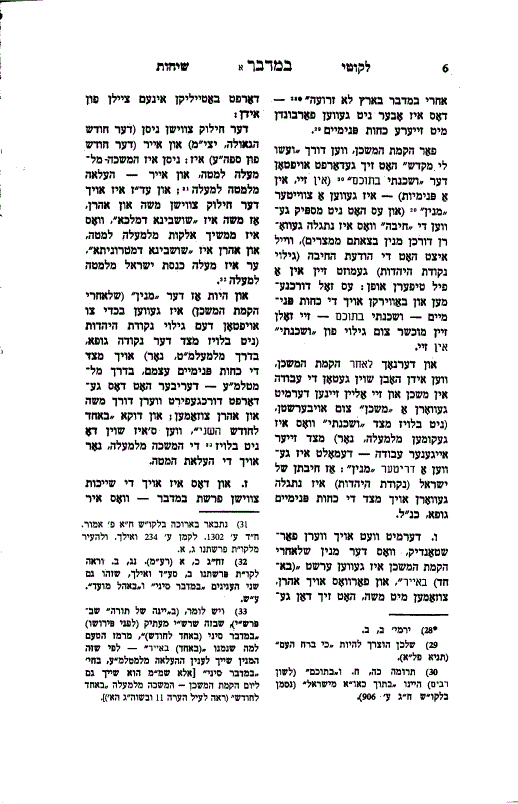
Daled
The Rebbe now continues to explain Rashi’s expression that Hashem counts the Jewish people “כל שעה” — “all the time.” At first glance, this language is difficult to understand. The Jewish people were not literally counted constantly. From the time of Yetzias Mitzrayim until this counting in Parshas Bamidbar, they had only been counted several times. Then, after this census in the second year, there was a gap of thirty-eight years until the next counting in the fortieth year before entering Eretz Yisrael. In fact, Chazal say that throughout all of history the Jewish people were only counted nine times, with the tenth counting destined to take place in the time of Moshiach. If so, how can Rashi say that Hashem counts them “all the time”?
At first, one might explain that “כל שעה” does not literally mean constantly, but rather at every significant moment — whenever there is a new stage or a special change in the spiritual standing of the Jewish people. Whenever there is a renewed expression of their belovedness before Hashem, there is another counting.
However, the Rebbe explains that this still does not fully fit the simple meaning of “כל שעה,” which implies a constant and continuous effect.
Based on the explanation in the previous section, the Rebbe says that Rashi is teaching something much deeper. The purpose of counting is to reveal the נקודת היהדות, the essential Jewish core that exists equally within every Jew. Once this inner essence is revealed through the counting, its influence remains constant. The actual counting may occur only occasionally, but the effect of the counting continues “כל שעה” — at every moment.
The counting reveals the deepest essence of a Jew, and that revelation affects the person continuously under all circumstances.
To explain this idea, the Rebbe brings the famous teaching of the Alter Rebbe in Tanya regarding מסירת נפש. The Alter Rebbe explains that even a Jew who may be on a very low spiritual level is nevertheless prepared to give up his life rather than separate himself from Hashem through עבודה זרה.
Seemingly, this is difficult to understand. Since nothing stands in the way of תשובה, why would a person sacrifice his life? Even if he would sin, he could later repent. Moreover, through תשובה מאהבה, the sin can become completely uprooted retroactively. If so, why is a Jew unwilling to tolerate even a temporary separation from Hashem? Why not sin now and correct it later through Teshuvah?
Yet in reality, we see that this is not the case. A Jew is naturally prepared to give up his very life rather than become separated from the Eibishter, even for a single moment. Even though later he could repair everything through Teshuvah, he cannot tolerate the separation itself.
The reason for this, explains the Alter Rebbe, is because the essence of the Jewish soul is above time. The divine spark within a Jew transcends the normal limitations of time altogether. From the perspective of this essential bond with Hashem, there is no difference between being separated for a brief instant or for a prolonged period. Any separation whatsoever is completely intolerable.
This, says the Rebbe, is the deeper meaning of Rashi’s words “מונה אותם כל שעה.” The counting reveals the essential נקודת היהדות within every Jew, and once revealed, that bond affects the person continuously — every moment and under all circumstances.
Even when a Jew later intends to correct and repair things through Teshuvah, the essence of his soul cannot tolerate even a temporary disconnection from Hashem. Therefore, he is prepared to sacrifice everything rather than allow such a separation to occur.
So although the Jewish people were only physically counted a limited number of times throughout history, the effect of that counting — the revelation of the essence of the Jewish soul — remains active constantly. That revelation protects and influences the Jew “כל שעה,” at every moment.
Hei
The Rebbe now explains that the revelation of the נקודת היהדות expressed through counting developed in three distinct stages. These correspond to the three major countings of the Jewish people mentioned by Rashi: the counting at the time of Yetzias Mitzrayim, the counting after the sin of the Golden Calf, and the counting after the erection of the Mishkan. Each counting represented a deeper and more internal revelation of the essential Jewish soul.
The Rebbe explains that, generally speaking, there are three levels in how the נקודת היהדות can influence a person.
The first level is where the essential Jewish core becomes revealed strongly enough to inspire a person to מסירת נפש, yet without fundamentally transforming his inner character and faculties. The person remains essentially the same as before. His intellect, emotions, and ordinary personality have not changed. The revelation of the soul’s essence influences him powerfully in a moment of ultimate test, but it does not permeate his regular day-to-day inner life.
The Rebbe brings the example discussed in Tanya concerning the קל שבקלים, a Jew who may otherwise be very distant spiritually, yet is nevertheless prepared to give up his life for Kiddush Hashem. Even while he stands ready for Mesiras Nefesh, he may still remain a “קל שבקלים” regarding other matters. This demonstrates that the essence of the soul is active and revealed, yet it has not fully transformed the person’s inner faculties and behavior.
The second level is higher. Here, the revelation of the נקודת היהדות begins to affect the person’s inner powers as well. His intellect and emotions begin to appreciate and internalize what the essence of the soul feels naturally. His שכל begins to understand and agree with the truth of the soul.
However, even at this stage, the person still senses that this understanding does not originate entirely from within his own intellect. Rather, it feels as though a deeper force is influencing and guiding his mind from above. The inner faculties are now aligned with the soul’s essence, but they still recognize that the inspiration is coming from something higher than themselves.
The third and highest level is when the נקודת היהדות completely permeates and transforms the person’s entire being. At this stage, the essence of the soul is no longer merely influencing the person from above or from within — it becomes the person’s very identity. His intellect itself naturally sees and understands reality through the perspective of the soul. There is no tension between the essence of the soul and the person’s inner faculties because the entire person has become unified with the essence.
The Rebbe now explains that these three levels correspond to the three countings of the Jewish people.
The first counting, at Yetzias Mitzrayim, represented the first level. At that time, the Jewish people experienced a tremendous revelation from Above. Their simple faith shone openly, enabling them to follow Hashem into the desert with complete trust — “לכתך אחרי במדבר בארץ לא זרועה.” However, this revelation had not yet transformed their inner faculties. Their connection came primarily from אמונה פשוטה, from a transcendent faith that had not yet become fully internalized within their intellect and emotions.
The second counting, after the sin of the Golden Calf and before the erection of the Mishkan, represented a deeper stage. The purpose of the Mishkan was “ועשו לי מקדש ושכנתי בתוכם” — that Hashem should dwell within the Jewish people in an internal way. The revelation of the soul’s essence now needed to penetrate the person’s inner faculties as well. It was no longer sufficient for the connection to remain only at the level of transcendent faith. The Jewish people now had to internalize the Divine presence within themselves.
Therefore, a second counting was necessary. This counting expressed a deeper revelation of the נקודת היהדות, one capable of affecting and permeating the inner powers of the soul so that the Jewish people could become vessels for “ושכנתי בתוכם.”
Finally came the third counting, the counting after the Mishkan had already been erected and after the Jewish people had begun serving within it. At this point, the Jewish people themselves had become a Mishkan for the Divine Presence through their own avodah. Now the revelation of the נקודת היהדות was no longer merely an influence coming from Above. Rather, it had become integrated into their very being. Through their own service, they themselves became transformed into a dwelling place for Hashem.
This represents the highest level — where the essence of the soul completely permeates the person until the entire individual naturally lives and thinks according to the truth of the נשמה. The Jew himself becomes a Mishkan for the Eibishter.
Vav
The Rebbe now explains how this answers the remaining questions: why the counting after the erection of the Mishkan specifically took place in the month of Iyar, and why this counting uniquely required both Moshe and Aharon together.
The Rebbe explains that Nissan and Iyar represent two opposite spiritual movements.
Nissan, the month of Yetzias Mitzrayim, represents a revelation that comes from Above to below — an awakening and drawing down initiated by the Eibishter. The redemption from Egypt was not something the Jewish people achieved through their own efforts. It was a Divine revelation from Above.
Iyar, however, represents the opposite movement — elevation from below to Above. Iyar is the month of Sefiras HaOmer, the avodah performed by the Jewish people themselves. During Sefirah, the עבודה is one of refinement and personal growth, where the person elevates himself step by step from below upward.
This same distinction also exists between Moshe and Aharon.
Moshe is called the “שושבינא דמלכא,” the attendant of the King. His role is to draw down Godliness from Above to below. Moshe represents revelation from Heaven downward.
Aharon, by contrast, is called the “שושבינא דמטרוניתא,” the attendant of the Queen, meaning Knesses Yisrael. His role is to elevate the Jewish people upward toward the Eibishter. Aharon represents the movement from below to Above.
With this, the Rebbe explains why this counting specifically required both Moshe and Aharon together.
The earlier countings reflected primarily revelations that came from Above. But the counting after the erection of the Mishkan represented something far deeper. At this stage, the goal was that the revelation of the נקודת היהדות should not remain merely a revelation imposed upon the Jewish people from Above. Rather, the Jewish people themselves, through their own inner faculties and avodah, should internalize and elevate themselves until they themselves became a dwelling place for Hashem.
Therefore, this counting required both dimensions together: Moshe, who draws down the revelation from Above, and Aharon, who elevates the Jewish people from below upward.
This also explains why the counting took place specifically on the first of Iyar and not in Nissan.
Nissan represents the revelation from Above alone. But the counting after the Mishkan was connected with the higher stage in which the Jewish people themselves became transformed through their own avodah. That idea belongs specifically to Iyar, the month of elevation from below to Above.
Thus, the timing of the counting and the participation of both Moshe and Aharon perfectly express the deeper purpose of this census: that the revelation of the נקודת היהדות should permeate not only from Above, but also through the עבודה and inner transformation of the Jewish people themselves.
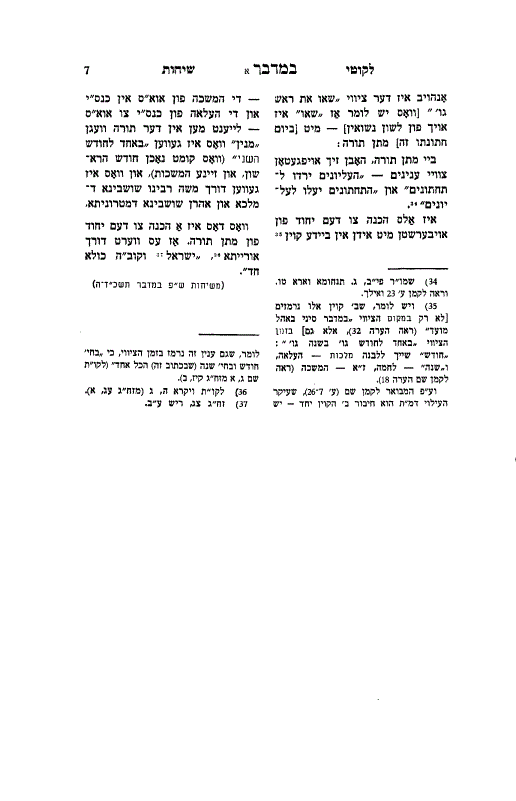
Zayin
The Rebbe now returns to the original question with which the sicha began: what is the connection between Parshas Bamidbar and Shavuos, the time of Matan Torah?
The Rebbe explains that the connection now becomes very clear. The counting described in Parshas Bamidbar — specifically the counting that took place after the erection of the Mishkan through both Moshe and Aharon, in the month of Iyar — expressed the fusion of two opposite movements: the revelation from Above downward and the elevation from below upward.
This is precisely the theme of Matan Torah itself.
The Parsha begins with the command:
שְׂאוּ אֶת־רֹאשׁ\text{שְׂאוּ אֶת־רֹאשׁ}שְׂאוּ אֶת־רֹאשׁ
The Rebbe notes that the word “שאו” can also be connected to the language of “נישואין,” marriage. Matan Torah is described by Chazal as the wedding between the Eibishter and the Jewish people — “ביום חתונתו זה מתן תורה.” Thus, already in the opening words of the Parsha there is an allusion to the union and marriage of Matan Torah.
At Matan Torah, two opposite movements were united together.
On one hand:
“עליונים ירדו לתחתונים”
“The higher realms descended to the lower realms.”
Hashem descended upon Har Sinai and brought holiness into this physical world.
On the other hand:
“ותחתונים יעלו לעליונים”
“The lower realms ascended to the higher realms.”
The Jewish people ascended upward toward Hashem, as Moshe was told to ascend the mountain.
Matan Torah therefore created the ultimate union between Above and below — between the Divine and the physical world.
The Rebbe explains that the counting in Parshas Bamidbar served as the preparation for this union. The counting on the first of Iyar represented not only the drawing down of holiness from Above, but also the elevation of the Jewish people themselves from below upward.
This is why the counting specifically took place in Iyar, the month of Sefiras HaOmer, whose avodah is the עבודה of refinement and ascent from below upward. And this is why the counting specifically required both Moshe and Aharon together — Moshe representing the drawing down from Above, and Aharon representing the elevation from below upward.
Together, Moshe and Aharon prepared the Jewish people for the union of Matan Torah: the drawing down of the Infinite Light of Hashem into Knesses Yisrael, and the elevation of Knesses Yisrael upward toward the Infinite One.
This ultimately leads to the complete unity accomplished through Torah:
“אורייתא וקודשא בריך הוא וישראל כולא חד”
“The Torah, the Holy One Blessed Be He, and the Jewish people are entirely one.”
Thus, the entire theme of Parshas Bamidbar serves as a preparation for Matan Torah — the ultimate union between Hashem and the Jewish people, where Above and below become completely united as one.
This is from the sichos of Shabbos Parshas Bamidbar, תשכ״ד and תשכ״ה.